















An omnichannel platform is an orchestration layer that preserves identity, intent, history, and workflow state as a conversation moves across channels. The difference from multichannel tools is simple: multichannel software gives each channel its own system, while omnichannel software makes those channels operate as one connected journey.
How many channels can your customers use today, and how many times must they repeat themselves when they move between them? That question exposes the gap between channel availability and journey continuity. A business can offer chat, email, voice, mobile, social messaging, and in-person service without giving employees or customers a shared view of what happened.
An omnichannel platform connects those touchpoints through shared data, rules, and workflows. It carries the customer's identity, intent, conversation history, authentication status, transaction state, and next action from one interaction to the next. The result isn't only more ways to contact a business. It's one coordinated service experience delivered through the channels that fit the situation.
Table of Contents
- The Plain-English Definition of an Omnichannel Platform
- Four Core Capabilities That Make a Platform Genuinely Omnichannel
- Identity Resolution as the Hidden Data Foundation
- Three Enterprise Scenarios Where Continuity Pays Off
- Why More Channels Can Actually Hurt the Experience
- The Technical Architecture Behind Real Omnichannel Platforms
- KPIs, Compliance, and a Vendor Checklist With Yellow.ai
The Plain-English Definition of an Omnichannel Platform
Start with a familiar journey. A customer opens a bank's mobile app and asks a mortgage question in chat. The request is too specific for automation, so the conversation moves to a human advisor by voice. The customer later receives a secure email containing the paperwork and completes the application without explaining the mortgage request again.
That's the practical meaning of an omnichannel platform. It acts as the integration and orchestration layer between channels, preserving identity, intent, history, transaction state, and business rules as the interaction moves. The customer may change channels, but the journey doesn't restart.
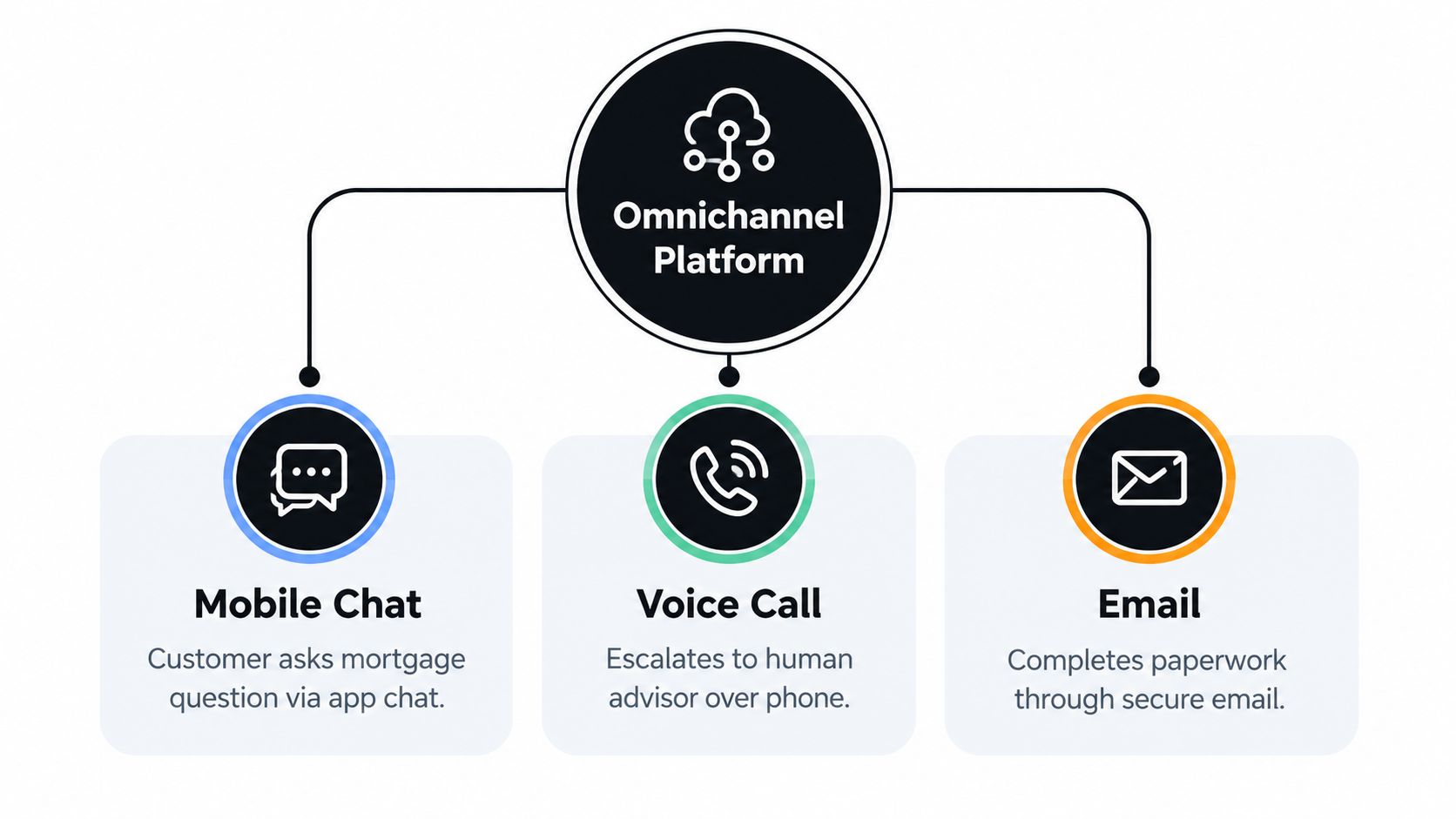
Multichannel gives you doors, omnichannel gives you continuity
A multichannel setup might provide a mobile app, a call center, email support, and a branch. Each channel works, but each may have separate records, teams, authentication steps, reporting, and service logic. The customer can choose a door, yet the organization may not know what happened behind another door.
Think of a bank. Multichannel is a bank with several separate entrances, including an ATM, an app, and a call center. Each entrance leads to a different team with limited visibility. Omnichannel is one shared lobby, where every teller can see the relevant account history and continue the same request.
The distinction isn't the number of channels. Academic research describes omnichannel operations through integrated data, processes, and journeys, with channels managed synergistically rather than as isolated touchpoints. The concept developed from online and offline commerce models into a more fully integrated ecosystem, as described in this research on omnichannel customer experience.
Operational test: Ask whether a customer can switch channels without losing identity, context, permissions, or workflow state. If the answer is no, you have connected channels, not a genuinely omnichannel journey.
A study of 516 omnichannel retail customers found that integrating pricing and product information, transaction data, and order fulfillment explained 40.8% of cognitive, 38.8% of relational, and 36.1% of affective customer-experience variance (study of omnichannel integration and customer experience). For teams comparing platform options, the useful question is therefore not “Which channels are supported?” but “What information survives the handoff?”
Readers looking for broader explanations of connected customer journeys can also compare this definition with an overview of omnichannel customer experience. For organizations evaluating distributed service or operations talent, LatHire can be a useful resource when the technology requires specialized implementation and support skills.
Four Core Capabilities That Make a Platform Genuinely Omnichannel
A vendor demo can make almost any product look omnichannel. A better evaluation starts with four capabilities that reveal whether the platform coordinates a journey or places several channels under one brand name.
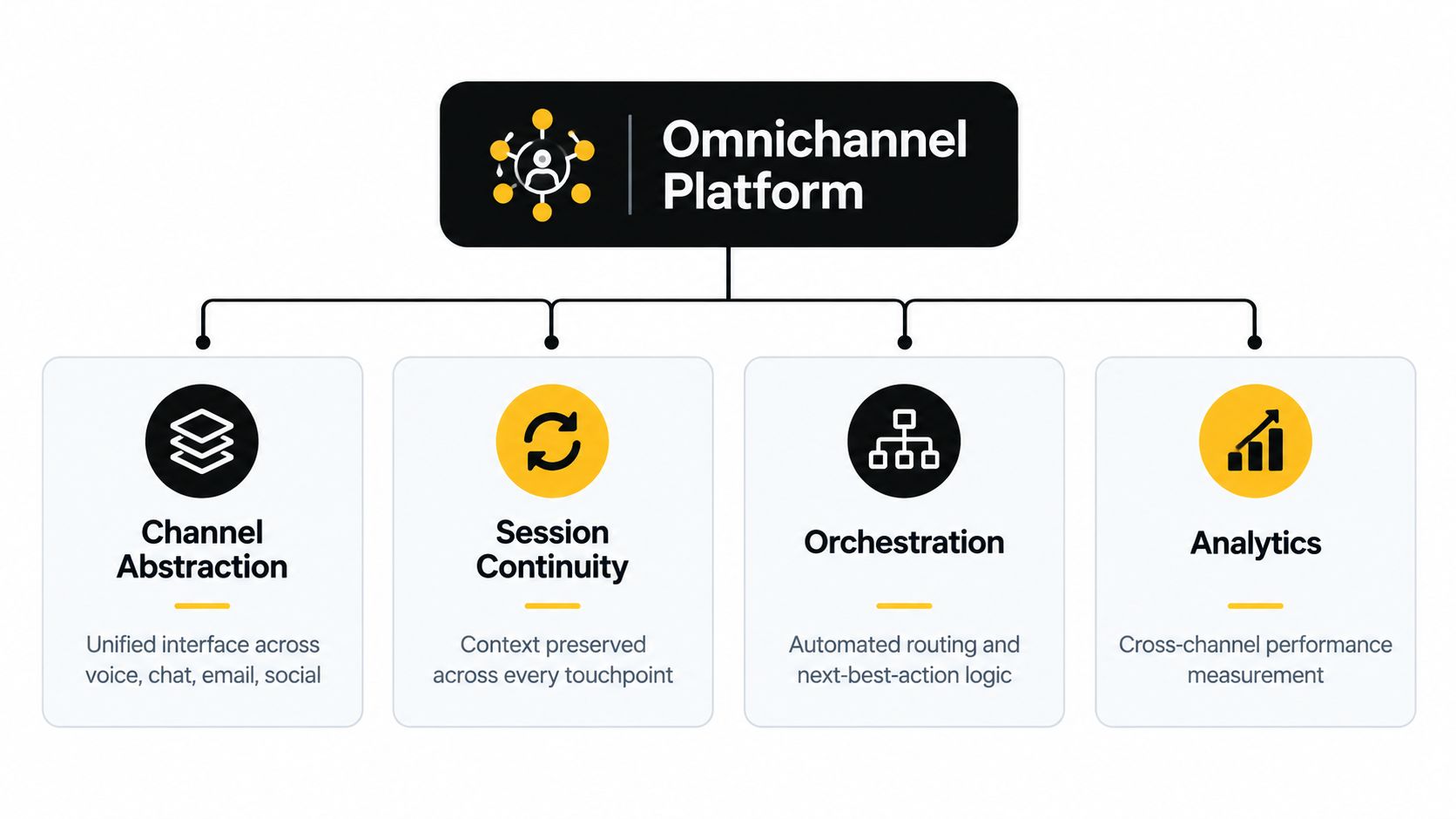
Channel abstraction
The platform should treat voice, chat, email, social messaging, mobile, web, and physical service as interaction inputs to a shared operating model. That doesn't mean every channel behaves identically. Voice may require real-time turn-taking, while email supports longer-form communication. It means the underlying case, customer profile, permissions, and business rules remain connected.
Without channel abstraction, leaders see separate queues and separate metrics. Customers see separate conversations.
Orchestration
An orchestration engine decides what should happen next. It can route a billing request to automation, escalate a sensitive dispute to a trained employee, or move a complex conversation from chat to voice when the customer needs immediate assistance.
The decision should use more than channel availability. It should consider intent, risk, authentication status, language, employee skills, service hours, and workflow state. A chatbot that transfers every difficult request to a generic queue isn't orchestrating the journey. It's passing responsibility to another silo.
Context continuity
Context includes the customer's identity, conversation history, authentication result, documents, transaction status, permissions, and next-best action. If a voice agent receives only a phone number and a blank screen, the platform hasn't transferred context.
Customers notice the difference most quickly. They don't care whether a vendor calls its product a customer data platform, contact center suite, or engagement hub. They care whether they must repeat the same account number and explanation.
Unified analytics
A connected journey needs connected measurement. Count the request once, then follow it across channels until it reaches an outcome. Otherwise, one customer's chat, email, and voice interactions may appear as separate contacts, making performance look worse or better than it is.
Adobe's 2025 retail research found that 75% of shoppers considered consistent experiences across websites, apps, email, social media, and stores important, while only 41% of brands delivered that consistency (Adobe retail digital trends research). That gap makes continuity a platform capability, not merely a design preference.
Identity Resolution as the Hidden Data Foundation
Every cross-channel experience depends on one underlying question: does the platform know that the person in the mobile app is the same person who later calls, emails, or visits a service location?
Identity resolution converts fragmented identifiers into a governed profile. Those identifiers may include a phone number, email address, device ID, account ID, loyalty record, or employee record. Without this layer, the platform can't reliably retrieve the right history or apply the right eligibility and access rules.
Matching identity without losing control
A well-built identity design uses more than one matching method. Deterministic matching relies on strong signals, such as an authenticated account or CRM key. Probabilistic matching helps when attributes are incomplete, inconsistent, or formatted differently across systems.
Neither method should operate without governance. Consent, access control, data minimization, retention rules, and audit policies must shape what the platform can match, store, display, and use for automation. A profile that connects the wrong two people creates a more serious problem than a profile that fails to connect them.
The identity layer should also distinguish between recognition and authorization. Recognizing a customer from an email address doesn't automatically permit access to sensitive account information. The platform must carry authentication status and permission context alongside the profile.
Metrics that expose identity quality
A vendor should show how identity performance is measured, not claim to provide a single customer view. Useful indicators include:
- Authenticated-profile match rate: How often the platform connects a verified interaction to the correct profile.
- False-merge rate: How often the system incorrectly combines two people.
- False-split rate: How often one person remains fragmented across multiple profiles.
- Profile freshness: Whether important attributes and permissions remain current.
- Consent coverage: Whether usable consent information exists for the relevant interactions.
- Resolution without re-identification: Whether the journey continues without asking the customer to prove their identity again.
A 2025 study of three enterprise implementations reported customer-recognition rates of 87% to 94% across digital channels, revenue increases of 7% to 18%, and marketing-efficiency improvements of 12% to 35% (study of identity engineering in retail). Those are implementation-specific findings, not universal benchmarks. They illustrate the mechanism clearly: when identity continuity improves, the platform is more likely to retrieve the correct history and rules.
Three Enterprise Scenarios Where Continuity Pays Off
The value of continuity becomes easier to judge when the journey includes a real handoff. A platform earns its place when it removes work for the customer and gives the next employee enough information to act safely.

Banking dispute
A customer reports an unfamiliar transaction in a mobile app. A virtual assistant captures the intent, opens a case, and collects the relevant transaction details. A voice specialist receives the case history and authentication status, investigates the dispute, and triggers a written explanation through secure email.
The customer doesn't need to describe the charge three times. The institution can measure whether the original intent survived the transfer, whether the handoff reached the correct specialist, and whether the case reached a final resolution.
Healthcare triage
A patient begins a symptom check on a website, continues through a messaging channel, and escalates to a nurse by voice. The nurse receives the triage summary, relevant answers, consent information, and the point at which the automated flow stopped.
Healthcare requires stricter controls than ordinary service. The platform needs role-based access, clear audit records, appropriate escalation rules, and careful separation between information gathering and clinical decision-making. Continuity should reduce repetition without encouraging unsafe automation.
A representative interaction flow can be evaluated against the following architecture signals:
Retail return
A loyalty member asks about a return in chat and later sends photos by email. When the customer visits a store, the associate can retrieve the case, verify the purchase and return policy, and complete the process through the point-of-sale workflow.
The customer's preferred channel changes, but the return remains one case. The organization can then evaluate the complete journey rather than treating chat, email, and store service as unrelated activity.
| Scenario | Capability Demonstrated | Proof Metric |
|---|---|---|
| Banking dispute | Identity, authentication, and case continuity | Resolution after voice handoff |
| Healthcare triage | Context transfer with governed escalation | Successful transfer of triage summary |
| Retail return | Shared case and transaction state | Completion without repeated data collection |
Why More Channels Can Actually Hurt the Experience
Adding a channel feels like progress because it increases customer choice. It can also increase operational failure when the organization adds another queue, knowledge base, identity store, policy set, and reporting workflow without connecting the underlying systems.
A 2025 industry analysis reported that 73% of marketers struggled to measure cross-channel performance and 56% struggled to integrate data from different sources. The same analysis found that only 21% fully used online first-party data and 11% fully used offline data for omnichannel efforts (industry analysis of marketer priorities).
The lesson isn't that organizations should offer fewer channels by default. It's that every channel needs a job, an owner, a shared policy model, and a measurable contribution to resolution.
Match channel to intent and risk
Use low-friction automation for repeatable requests, such as status checks or straightforward document guidance. Reserve human escalation and voice for cases where ambiguity, sensitivity, urgency, or emotional complexity makes automation unsuitable.
That rule also helps executives challenge channel expansion proposals. A channel should earn its place by improving access or resolution, not by appearing on a coverage spreadsheet.
Decision rule: Choose the channel according to the customer's intent and risk, then measure whether the complete request was resolved. Don't optimize a channel that creates more work in the next one.
A fragmented knowledge base can produce conflicting answers across chat and email. Inconsistent authentication can force customers through repeated verification. Poor attribution can make one successful resolution look like several failed contacts. The platform's job is to reduce those dependencies, not hide them behind a unified dashboard.
The Technical Architecture Behind Real Omnichannel Platforms
Enterprise omnichannel architecture usually combines several layers. The names vary by vendor, but the responsibilities should remain visible during an architecture review.
Event-driven state synchronization
An event backbone publishes changes such as “case created,” “identity verified,” “payment status updated,” or “handoff accepted.” Other channels and systems subscribe to those events and update their view of the journey.
Without synchronized state, the customer may complete a step in chat while the voice agent sees an old case. Ask vendors how they handle ordering, retries, duplicate events, and synchronization delay.
API connectivity to systems of record
The platform needs governed APIs into systems such as CRM, ERP, HRIS, ticketing, order management, knowledge, and contact-center tools. It shouldn't create a parallel version of every business record unless that design is deliberate and controlled.
The architecture should define which system owns each fact. For example, a CRM may own account identity, an order system may own fulfillment status, and a case system may own service workflow.
Identity and profile graph
This layer links identifiers, consent, authentication status, attributes, and relationship data. It should support deterministic and probabilistic matching while exposing confidence, provenance, and audit information to authorized systems.
Policy and orchestration engine
The orchestration layer applies routing, escalation, authentication, eligibility, language, workforce, and compliance rules. It determines whether automation should continue, which employee should receive the case, and what information can travel with the interaction.
A useful explanation of this operating layer appears in enterprise omnichannel orchestration guidance.
Analytics and observability
Observability connects technical events to customer outcomes. Teams should be able to trace a journey across channels, identify failed transfers, inspect policy decisions, and reconcile duplicate contacts.
An RFP should ask vendors to demonstrate propagation of the canonical profile, intent, authentication status, case history, and next-best action. It should also request evidence for synchronization delay, duplicate-contact rate, context-transfer success, and resolution after handoff.
KPIs, Compliance, and a Vendor Checklist With Yellow.ai
A serious evaluation begins with continuity metrics rather than channel counts. Track context-transfer success rate, synchronization delay, duplicate-contact rate, resolution after channel handoff, and first-contact resolution across the complete journey.
Security and compliance belong in the same evaluation. Regulated teams should examine HIPAA, ISO 27001 and 27701, SOC 2 Type II, PCI-DSS, consent capture, data minimization, role-based access, retention, and audit trails. The right controls depend on the use case, but a platform shouldn't treat governance as an optional configuration after deployment.
Use this checklist to compare vendors:
| Criterion | What to Evaluate | Yellow.ai Capability |
|---|---|---|
| Channel coverage and modality depth | Voice, chat, email, messaging, images, documents, and video support | Omnichannel orchestration across voice, chat, email, images, and video |
| Orchestration maturity | Shared context, routing, escalation, and next-best-action logic | Connected automation and handoffs across supported channels |
| Governance and compliance posture | Security controls, consent, auditability, and regulated-industry requirements | HIPAA, ISO 27001/27701, SOC 2 Type II, and PCI-DSS |
| Time to value | Integration options and deployment workflow | 150+ pre-built integrations, including Salesforce, Zendesk, Genesys, Freshdesk, HubSpot, and NICE |
| Total cost of ownership | Licensing, implementation, maintenance, workforce impact, and reporting effort | Evaluate against the complete operating model, including AI Agent Builder 2.0 |
For service leaders, contact-center metrics for omnichannel performance can help turn the checklist into an operating scorecard. Yellow.ai is one platform option that combines multimodal orchestration, enterprise integrations, governance features, and AI agent development in a single environment. Evaluate it against your own workflows, controls, data architecture, and continuity targets rather than selecting on channel breadth alone.
Yellow.ai can help CX and EX teams connect voice, chat, email, messaging, and other interaction modes while carrying context through the journey. Visit Yellow.ai to assess how its orchestration, integrations, compliance controls, and AI Agent Builder 2.0 fit your enterprise continuity requirements.



