














A lot of CX leaders are in the same spot right now. You've added chat, email, maybe SMS, maybe a bot, and your contact center can technically handle more than one channel. On paper, that looks modern. In the customer's hands, it often still feels broken.
The break usually happens at the handoff. A customer starts in one place, switches to another, and the company forgets everything it just learned. That's why the question behind what is omnichannel customer experience isn't “How many channels do we support?” It's “Does customer context survive movement between them?”
That sounds like a service design question. In practice, it's mostly a data and orchestration question. If identity, history, intent, and resolution status don't move with the customer, you don't have omnichannel CX. You have several channels sitting next to each other.
Table of Contents
- The Moment a Customer Has to Repeat Themselves
- Defining Omnichannel Customer Experience
- Core Components of a Connected Journey
- Omnichannel vs Multichannel in Practice
- The Business Case Integration Drives Retention
- Implementing Omnichannel Across Siloed Teams
- Measuring Omnichannel Performance the Right Way
- How Conversational AI Makes Omnichannel Work
The Moment a Customer Has to Repeat Themselves
A customer opens a mobile chat to ask about a delayed order. The bot asks for an order number, confirms the shipment is late, and suggests basic troubleshooting. The customer uploads a screenshot, then leaves to get on with their day.
Later, they send an email because the issue isn't resolved. The email team doesn't see the chat transcript, so the customer repeats the order number, explains the delay again, and attaches the same screenshot. Hours pass. No real progress.
Then they call the contact center. The agent asks for account verification, order details, and what troubleshooting has already been tried. By this point, the customer isn't just trying to solve a shipping issue. They're deciding whether this brand is worth dealing with again.
That moment matters more than most dashboards capture. Customers rarely describe the failure as “channel fragmentation.” They describe it as, “I already told you this.”
What the customer experiences
The customer feels three things at once:
- Lost time: They've already done work the company didn't preserve.
- Reduced trust: If the brand can't carry a conversation forward, they start to doubt everything else.
- Quiet churn risk: Loyalty decisions often happen before the call ends, not after a survey arrives.
The moment a customer repeats themselves, your channels stop feeling like convenience and start feeling like labor.
This is the problem omnichannel customer experience is supposed to solve. Not with nicer messaging. With continuity.
A true omnichannel design preserves identity, context, and intent across every switch. The mobile chat should feed the email thread. The email thread should be visible to the voice agent. The voice agent should know what the customer already tried and what outcome they want next.
That's why teams investing in omnichannel virtual assistants that reduce call volumes usually end up talking about context handoff, not just automation. Lower call pressure matters. But the larger win is preventing the same issue from being restarted three times.
Defining Omnichannel Customer Experience
The cleanest working definition is this: omnichannel customer experience is the orchestration of customer interactions across channels so the customer's identity, history, and intent persist from one touchpoint to the next.
That definition is stricter than most marketing copy. It doesn't mean your company offers phone, chat, email, and in-store support. It means those channels behave like surfaces of one system.
Academic work in the early 2020s pushed this idea into clearer focus. A literature review and later construct work described omnichannel customer experience as the experience customers have across integrated channels, including dimensions such as personalization, service quality, consistency across channels, information safety, delivery, returns, and loyalty programs, rather than isolated touchpoints alone, as summarized in this research reference.
Multichannel is access. Omnichannel is continuity.
A useful analogy is a relay race versus a single runner.
In a multichannel setup, several runners touch the same race, but the baton gets dropped at every exchange. The customer has to pick it up and carry it.
In an omnichannel setup, one runner carries the baton all the way through. The channel changes, but the journey doesn't restart.
Here are the three measurable dimensions I use when assessing whether a program is omnichannel:
- Identity resolution across touchpoints: Can the business recognize the same person across login, phone number, email address, device, loyalty account, or store visit?
- Continuity of conversation history: Does the next agent, bot, or associate see the prior interaction without the customer replaying it?
- Consistency of policy and personalization: Are eligibility, pricing, inventory, recommendations, and service rules coherent across channels?
The mental model that prevents confusion
Most readers get stuck because “omnichannel” sounds like a channel strategy. It isn't, at least not first.
It's a data-integration discipline expressed through customer-facing channels.
Practical rule: If switching channels causes a loss of memory, you don't have omnichannel CX, no matter how many channels you've launched.
That framing matters because teams often spend budget on the visible layer first. They add messaging apps, launch a new bot, or redesign an inbox. Meanwhile, identity remains fragmented and context still dies at the handoff.
Core Components of a Connected Journey
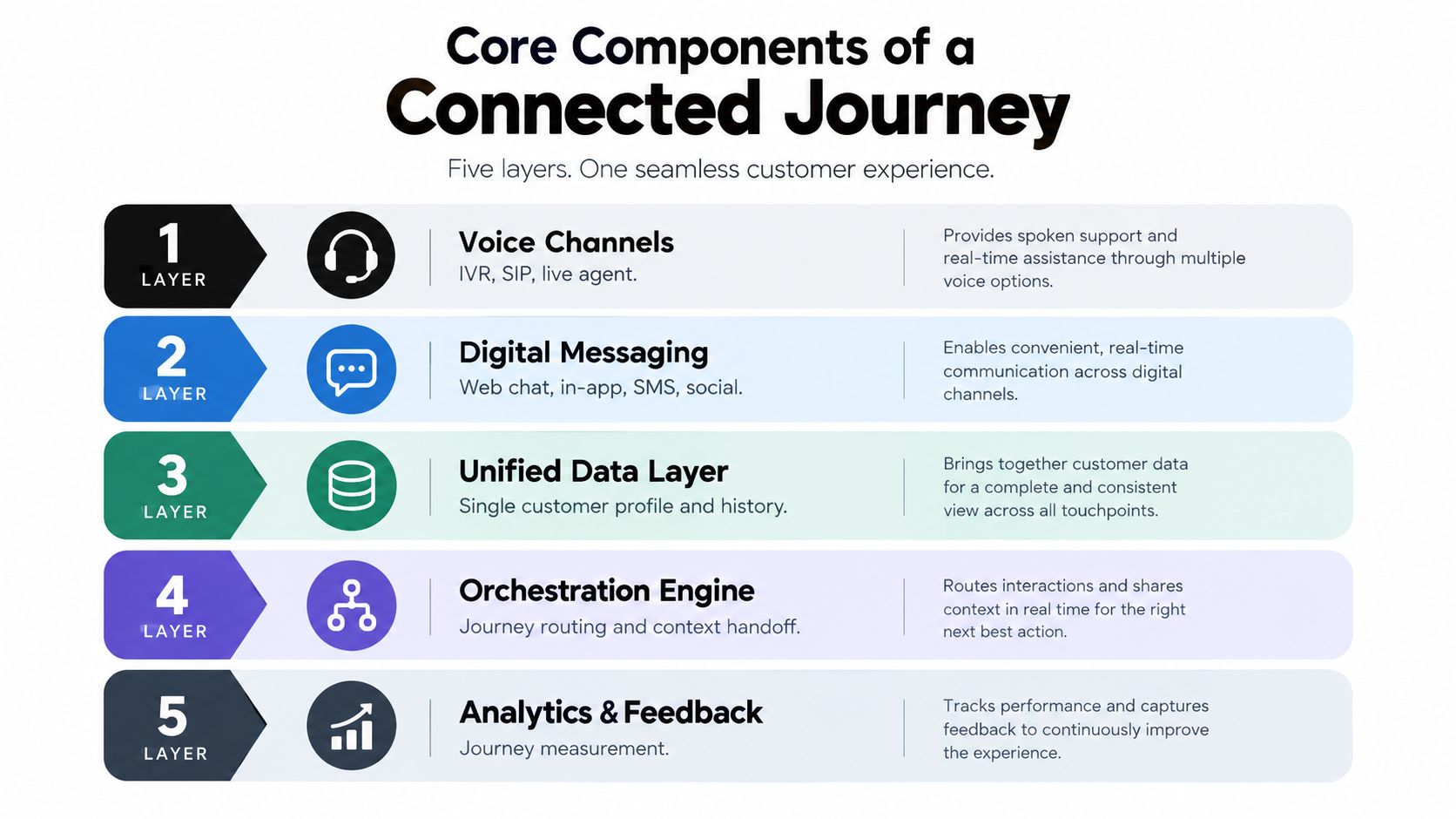
An omnichannel program works as a layered operating system, not a channel checklist. Each channel contributes something different. Its value comes from whether it writes to and reads from shared customer context.
The channel layer
Voice handles urgency and ambiguity well. IVR, SIP-based calling, and live agents are often where customers go when stakes rise or prior attempts fail. Voice also captures rich signals such as hesitation, frustration, and urgency that don't always show up in text.
Digital messaging includes web chat, in-app chat, SMS, WhatsApp, and social messaging. These channels produce structured event data. Buttons clicked, forms started, authentication attempts, and timestamps all become useful context for the next step.
Email and ticketing matter because not every issue is synchronous. Email anchors longer-running threads, attachments, approvals, and auditability. It's often the memory layer for complex cases, but only if that history is visible elsewhere.
A lot of teams use omnichannel AI automation to connect these channel types so the system can route and respond based on shared history instead of isolated queue logic.
The continuity layer underneath
Video, co-browse, and face-to-face interactions matter for higher-friction moments. A mortgage discussion, a high-value dispute, a product setup session, or an in-store return may need richer interaction than chat alone can offer.
The deeper point is that none of these channels are “omnichannel” by themselves. They become omnichannel when they connect to:
- A unified customer profile
- A shared interaction history
- An orchestration layer that controls handoffs
- A measurement layer that tracks the journey, not just the touchpoint
This short explainer shows the layered idea well:
If one channel looks advanced but can't inherit the customer's state, it adds surface area without reducing effort. That's why I'd rather see a company run fewer integrated channels than many disconnected ones.
Omnichannel vs Multichannel in Practice
A customer disputes a charge in chat, calls ten minutes later because the issue feels urgent, then walks into a store on the way home. On paper, both a multichannel company and an omnichannel company supported chat, phone, and in-person service. The customer used the same three channels in both cases.
What changes is whether context survives the handoffs.
Same journey, different operating model
In a multichannel setup, each channel behaves like its own workstation. Chat keeps one record, the contact center keeps another, and the store may only see account basics. The customer is the integration layer. They repeat the problem, re-verify identity, and restate what the last person already confirmed.
In an omnichannel setup, the systems do that integration work. The phone agent can see the chat transcript, the case status, and whether authentication already happened. The store associate can see the same case and what still needs to be resolved. The customer changes channels, but the case does not reset.
That is the practical difference. Omnichannel is less about how many doors you open and more about whether the customer's state can pass through them intact.
| Dimension | Multichannel | Omnichannel |
|---|---|---|
| Identity | Separate records by channel | One persistent customer identity |
| History | Prior interactions stay in local systems | Shared interaction history follows the customer |
| Verification | Repeated at each boundary | Reused where policy allows |
| Routing | Based on channel queues | Based on intent, status, and customer context |
| Agent view | One touchpoint at a time | One journey across touchpoints |
| Ownership | Each team closes its own task | One journey has end-to-end accountability |
| Customer effort | Customer carries context | System carries context |
What usually fools teams
Channel availability gets mistaken for omnichannel maturity all the time. A company may offer chat, email, phone, SMS, app messaging, and stores, yet still force customers to start over whenever they switch paths.
The operational test is simpler than the marketing language suggests. Can identity be resolved across systems? Can interaction history be read in the next channel? Can routing use case status, not just the inbound queue? Can one team see who owns the next step?
If the answer is no, the business has a multichannel estate with an omnichannel label.
Gartner draws a related distinction in its customer service and support guidance. Many organizations offer customers multiple contact options, but far fewer connect those options into a single service journey customers can continue across channels without losing context (Gartner customer service and support glossary).
Channels are just entry points. Omnichannel begins when identity, history, and case state move with the customer.
The Business Case Integration Drives Retention
Retention usually slips at a specific moment. A customer starts in chat, moves to email for documentation, then calls because the issue is urgent. If the agent on the phone cannot see the earlier steps, the company has created extra effort at exactly the point where trust is most fragile.
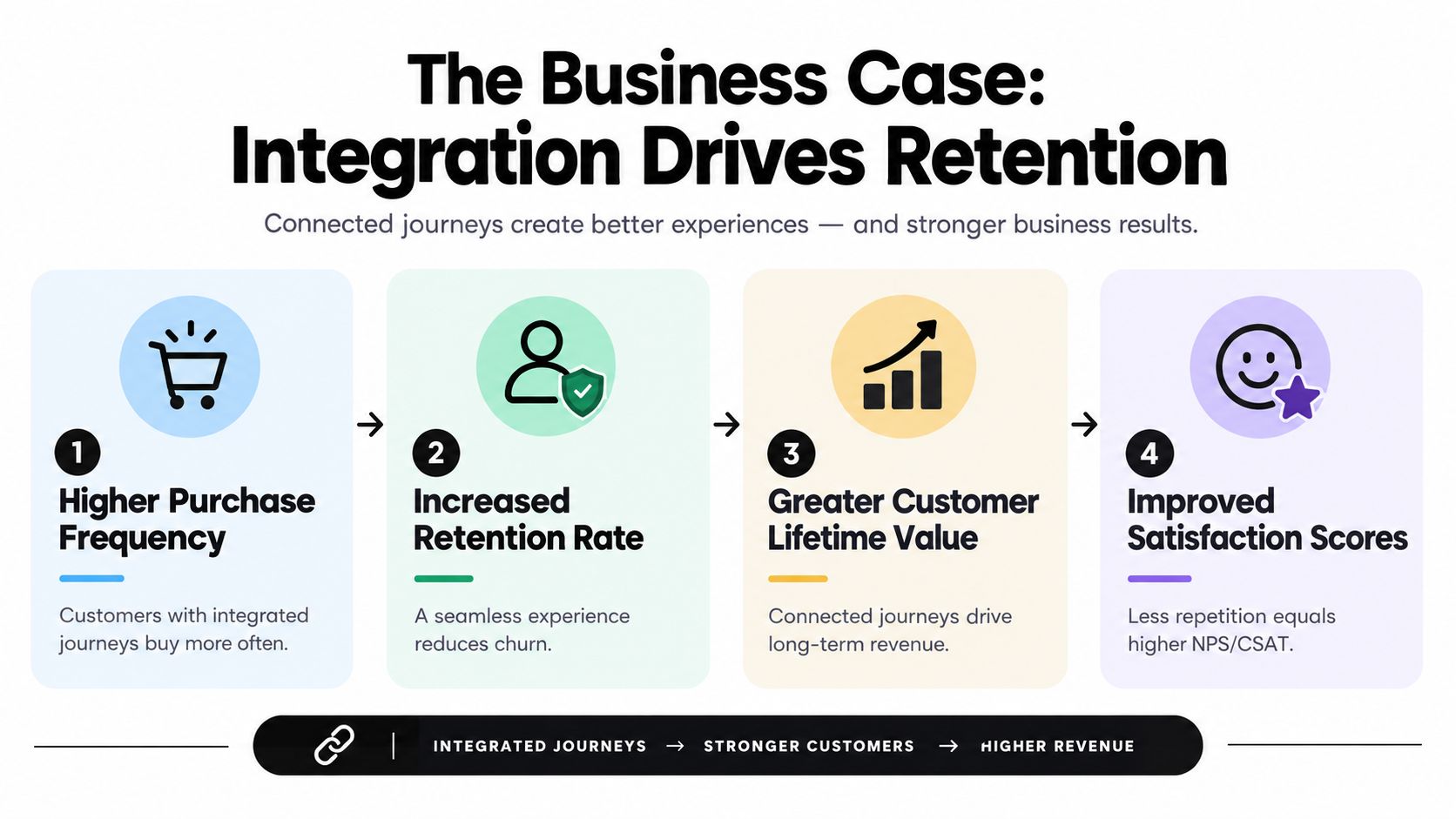
That is why the business case for omnichannel CX is really a business case for shared context. Channel choice matters to customers, but continuity matters more. The return does not come from offering one more touchpoint. It comes from carrying identity, history, and case state forward so the next interaction starts where the last one ended.
Why the gains show up
A connected journey improves economics in a few very practical ways.
- Lower service effort: Agents spend less time rebuilding the timeline, reauthenticating the customer, or asking for screenshots and order numbers that already exist elsewhere.
- Better resolution quality: Decisions improve when the next team can see prior promises, previous failures, and current case status.
- More relevant treatment: Personalization works better when it uses actual interaction history instead of a partial view from one system.
- Fewer abandonment points: Customers are less likely to drop out when a handoff feels like continuation rather than restart.
The operational pattern is similar to relay racing. Speed matters, but the handoff zone decides the result. In CX, that handoff zone is identity resolution, event sync, and case-state visibility across systems.
Peer-reviewed retail research supports that direction. A study on omnichannel retailing and retention found that integration, individualization, and interaction are the mechanisms most associated with stronger brand experience and customer retention in connected environments, as discussed in this study on omnichannel retailing and retention.
Why executives should care
The financial argument is more concrete than the marketing language around omnichannel often suggests.
If customers regularly move across touchpoints during one service journey, then every broken handoff creates repeat contacts, longer handle times, duplicated labor, and lower confidence in the brand. If the system preserves context, those costs fall. Retention improves because customers do not have to keep paying an effort tax to get help.
Industry analysts also see sustained spending in this area. A 2025 market summary from Business Research Insights estimated the global omnichannel customer service market at USD 14.2 billion in 2023, with a projection of USD 35.6 billion by 2032 at a 10.8% CAGR, according to Business Research Insights' omnichannel customer service market report.
Enterprise leaders should read that signal carefully. The investment is not about adding channels for their own sake. It is about reducing the revenue leakage that shows up when systems cannot pass customer context cleanly from one touchpoint to the next.
Implementing Omnichannel Across Siloed Teams
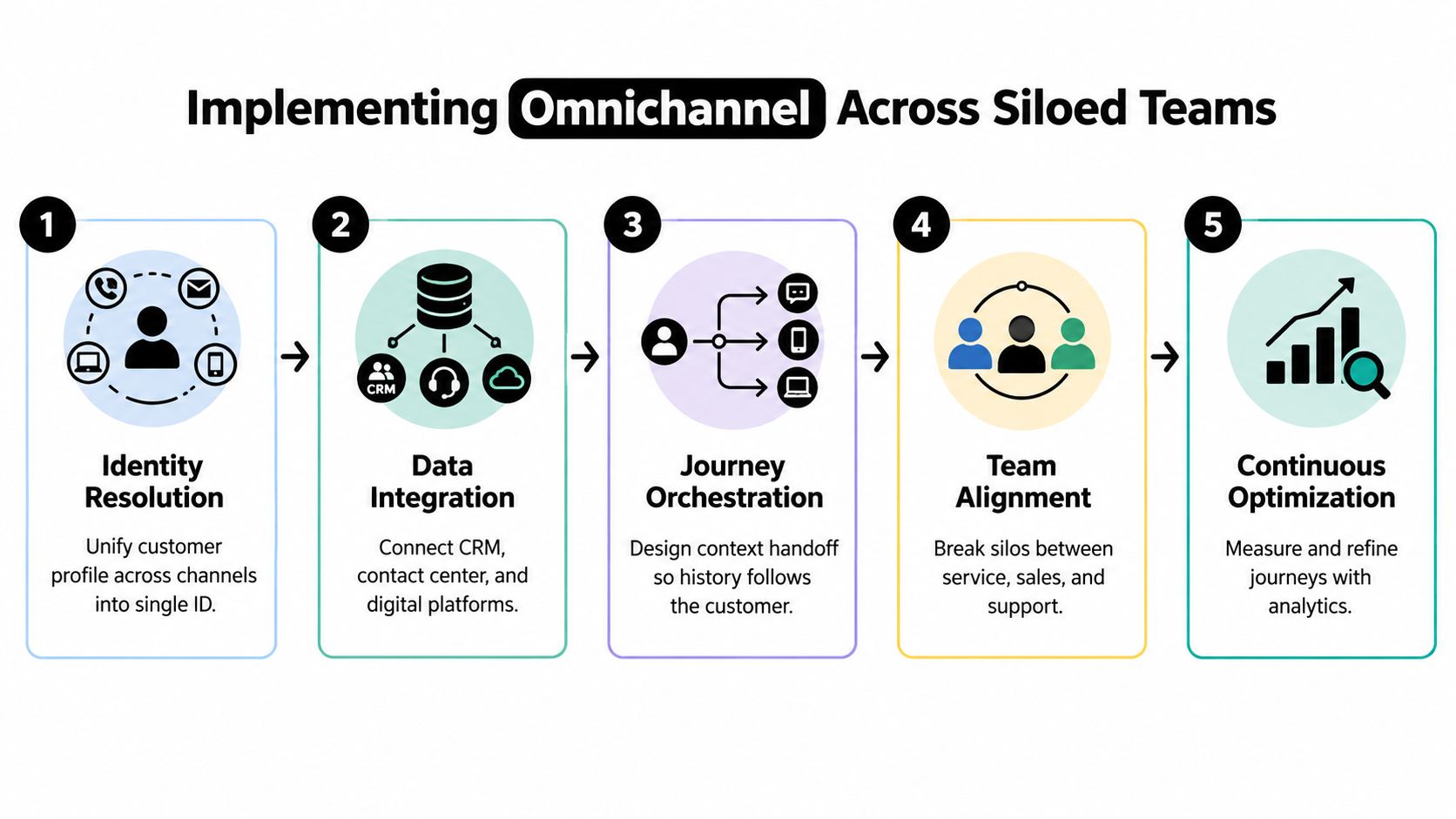
Most omnichannel programs fail long before the customer sees anything. They fail in identity, in data architecture, and in org design.
A state-of-CX report identifies the major barriers as siloed departments, competing priorities, voice-of-customer data gaps, and poor carry-over of context between channels, summarized in this state of customer experience report. That's why implementation has to start below the channel layer.
Start with identity, not interfaces
If the same customer appears as one person in CRM, another in the contact center, and a third in ecommerce, every later handoff leaks.
Solve the recognition problem first:
- Match records across systems: Login, phone, email, loyalty ID, and service history need a reconciliation model.
- Decide confidence rules: What counts as the same person, and what requires explicit confirmation?
- Preserve one durable ID: Every event from every channel should attach to that identity.
Build a real-time data layer
A nightly sync into a warehouse won't rescue a live handoff. The useful architecture is one where CRM events, commerce updates, ticket changes, bot transcripts, and agent notes share a common schema and flow quickly enough to be useful in-session.
That usually means teams need:
- Event-level integration: Not just static profile syncs
- Shared conversation history: Searchable and writable across systems
- Common status definitions: “Open,” “resolved,” “awaiting customer,” and similar states must mean the same thing everywhere
For many enterprises, that requires connecting existing systems rather than replacing them all at once. Tools such as enterprise platform integrations matter here because the orchestration layer is only as good as the systems it can read from and write back to.
A broken omnichannel program usually isn't missing channels. It's missing a trustworthy handoff between systems and teams.
Assign one owner for the journey
This is the part companies avoid because it's political.
Chat may sit with digital. Voice may sit with contact center operations. Store experience may report elsewhere. If nobody owns the entire journey, each leader optimizes their own boundary and the customer absorbs the seams.
The programs that mature tend to do three things:
- Name an end-to-end journey owner
- Review failed handoffs, not just channel KPIs
- Redesign the worst transitions on a regular cadence
Measuring Omnichannel Performance the Right Way
Most dashboards flatter disconnected systems. Channel-level CSAT can look fine while the customer's journey is falling apart between one touchpoint and the next.
That's why I don't start with satisfaction alone. A bot interaction can score well in isolation and still create failure if the later handoff drops context.
Measure the journey, not just the touchpoint
Qualtrics' 2025 benchmark is useful because it treats omnichannel CX as a measurable performance system. It evaluated 27,146 U.S. consumers across 7 channels and measured task completion, effort, satisfaction, and agent attributes such as knowledge, friendliness, and understanding, as described in the Omnichannel CX Benchmark 2025.
That structure points to a better measurement stack:
- First-contact resolution: Did the customer get the issue solved on the first overall attempt, not just the first attempt inside one channel?
- Cross-channel completion rate: When a journey requires movement, does the task still finish successfully?
- Customer effort: How hard was the journey, especially at switching points?
- Retention by journey type: Do customers who experience clean handoffs stay longer than those who don't?
Instrument handoff telemetry
If you want to fix omnichannel performance, tag the handoff itself.
Track things like:
| KPI layer | What to watch |
|---|---|
| Resolution | Resolution status by intent and channel pair |
| Effort | Survey responses after escalation or transfer |
| Continuity | Whether transcript, authentication, and case state were carried forward |
| Leakage | Abandonment or restart rates at channel boundaries |
Give every journey a unique ID. Tie events to the intent, not just the inbox or queue. Once you do that, you stop asking “How is chat doing?” and start asking “What happens when customers move from chat to voice on billing disputes?”
That's where the failure pattern usually sits.
How Conversational AI Makes Omnichannel Work
Conversational AI matters here, but not for the reason vendors usually lead with. The important role isn't that AI can answer more questions. It's that AI can become the orchestration layer that keeps memory, intent, and status intact across channels.
Traditional chatbots were narrow. They handled one channel, one session, and one short interaction. They forgot between visits. They often escalated badly because they passed a ticket number instead of a usable conversation state.
What actually changes with an orchestration layer
A stronger AI layer can unify several mechanics that used to live in separate tools:
- Intent recognition across channels: The same customer request is classified consistently whether it arrives by chat, voice, or email.
- Persistent memory: Prior interactions remain available when the customer returns or switches channels.
- Shared context graph: Account state, prior cases, preferences, and recent events inform the next response.
- Escalation with history attached: A live agent receives transcript, reason for escalation, and actions already attempted.
That's what turns automation from deflection into continuity.
One practical example is how voice and text data can converge. A call transcript can enter the same profile as a chat transcript. An email reply can inherit the same case status. A supervisor can review the entire path as one service event rather than three disconnected records.
Where many AI deployments still fall short
The field itself is still uneven. Academic review work describes omnichannel CX as fragmented and underdefined, and a 2025 benchmark found only 54% of consumers were satisfied with these experiences, while 60% said they would trust companies more if the experience were consistent across channels, as noted in this review of omnichannel customer experience research.
That gap explains why AI alone doesn't solve the problem. If identity is fragmented, AI personalizes against the wrong record. If event streams are delayed, the assistant responds with stale information. If observability is weak, teams can't see where the handoff failed.
A platform such as Yellow.ai fits this conversation because it combines omnichannel orchestration across voice, chat, email, images, and video with integrations into systems like Salesforce, Zendesk, Genesys, Freshdesk, HubSpot, and NICE. In practical terms, that means teams can use one layer to preserve context across channels instead of wiring each handoff manually.
The value of conversational AI in omnichannel CX isn't that it talks like a person. It's that it remembers like a system.
That's the answer to what is omnichannel customer experience in operational terms. It's not a promise that customers can reach you anywhere. It's the discipline of making sure they don't have to start over when they do.
If you're trying to turn disconnected channels into one continuous customer journey, Yellow.ai offers an agentic AI platform built for exactly that orchestration problem. Its support for voice, chat, email, video, and broad enterprise integrations makes it relevant for teams that need context to survive every handoff. You can explore the platform and its approach to omnichannel CX at Yellow.ai.



