














A lot of teams are living with a customer experience that looks modern on the surface and broken underneath. The company offers chat, email, voice, mobile app support, maybe even WhatsApp or social messaging. But the journey still feels stitched together. Customers repeat account details, agents re-ask diagnostic questions, and context disappears the moment someone moves from self-service to a live person.
Business leaders usually see the symptoms before they see the architecture problem. Service costs stay stubborn. Escalations feel messy. Digital adoption rises, yet loyalty doesn't improve at the same pace. Employees feel the strain too, because disconnected systems force them to hunt for answers across CRM records, ticketing tools, policy documents, and prior conversations.
That's where omnichannel orchestration becomes more than a CX buzzword. It's the operating model that turns separate channels into one coordinated journey, and in the agentic AI era, it increasingly acts as an active decisioning layer rather than a passive message switchboard.
Table of Contents
- Beyond Multichannel The Shift to True Orchestration
- The Business Case for Unified CX and EX Journeys
- Core Architecture of an Orchestration Platform
- Orchestration Patterns and Real-World Use Cases
- Your Phased Implementation Roadmap
- Measuring Success with the Right KPIs
- How to Choose an Orchestration Platform
Beyond Multichannel The Shift to True Orchestration
A customer starts in chat to ask about a delayed order. The bot identifies the order number, but it cannot see the refund exception approved over email an hour earlier. The customer switches to voice, enters the same details again, reaches an agent, and still waits while that agent checks a separate system for policy guidance. Every channel is live. The business still delivers a broken journey.

That gap explains why multichannel is no longer enough. Multichannel gives customers more ways to reach you. True orchestration coordinates those channels around one live view of customer state, business rules, and next best action.
The timing matters because agentic AI has changed what the orchestration layer is expected to do. In older service stacks, orchestration mostly meant routing work to the right queue. In modern environments, AI agents can interpret intent, gather missing context, decide whether to resolve, escalate, or defer, and trigger actions across systems while the journey is still in motion. The orchestration layer becomes an active decisioning engine, not a passive switchboard. That shift sits at the center of platforms such as Yellow.ai, where AI is used to manage transitions across channels, people, and systems with continuity instead of handoff friction.
This changes the architecture and the operating model. Orchestration now has to make decisions in real time, with enough context to protect revenue and customer trust. If a customer is one step away from abandoning a purchase, the system should preserve cart context across devices and channels. If a high-value service issue is at risk of escalation, the system should recognize that pattern early and route the case with the right priority, history, and policy controls already attached.
In practice, true orchestration maintains four kinds of continuity:
- Context continuity so identity, history, intent, and transaction state persist across channels
- Decision continuity so the workflow does not restart at every transfer
- Policy continuity so approvals, compliance rules, and service guardrails stay consistent
- Experience continuity so customers and employees do not feel the boundaries between bots, agents, and back-end applications
A simple test works well in executive reviews. If customers have to repeat the problem after switching channels, or if employees have to reconstruct the journey before they can act, the company has channel coverage, not orchestration.
That is why the shift matters now. Enterprises are not adding AI to the edge of the journey anymore. They are using it in the control layer to decide what should happen next, who should do it, and which system needs to be updated in the same motion. For teams evaluating that model, this guide to omnichannel customer experience strategy and execution is a useful reference point for what coordinated orchestration looks like in practice.
The Business Case for Unified CX and EX Journeys
A customer starts a return in chat, calls when the refund stalls, and reaches an agent who cannot see the prior steps. At the same time, that agent has to open three systems, message a supervisor for an exception, and wait on finance to confirm policy. The customer experiences delay. The business pays for duplicate work, longer handle time, and a higher chance of churn.
That is why the business case for orchestration is larger than channel modernization. The ultimate value is realized when customer journeys and employee journeys are designed as one operating model. Modern agentic AI strengthens that model by doing more than routing demand. It can evaluate intent, journey state, customer value, policy rules, and operational conditions, then recommend or trigger the next best action across teams and systems.
Revenue, loyalty, and cost move together
Unified journeys change unit economics. Customers complete tasks faster because they are not forced to restart across channels. Employees resolve issues faster because they are not reconstructing history or chasing approvals by hand. Those two gains show up in the metrics leadership already reviews: conversion, retention, service cost, and time to resolution.
The connection to revenue is straightforward. Faster resolution protects renewals and repeat purchases. Better continuity reduces abandonment during high-intent moments such as onboarding, claims, upgrades, and order changes. Lower effort also improves loyalty because customers remember whether the company made progress easy or expensive.
For teams building the case across operations, service, and IT, this guide to omnichannel customer experience strategy and execution is a useful reference point.
EX is the multiplier executives often miss
Service quality depends on what employees can see and do in the moment. If an agent has context, policy guidance, and system actions in one workflow, the interaction is faster and more consistent. If not, the customer hears hold music while the employee does integration work the platform should have handled.
That shows up across the enterprise, not only in the contact center. HR teams field repeat policy questions. IT service desks handle access requests and device issues. Operations teams manage exceptions that begin in customer channels but require internal decisions to finish.
A strong orchestration model improves EX in practical ways:
- Less manual lookup because systems pass case state and history forward
- Better handoffs because routing includes intent, priority, and recommended next steps
- Faster exception resolution because approval paths and business rules are built into the flow
- Stronger policy control because the same rules apply across bot, agent, and back-office actions
Agentic AI thus changes the design. Instead of waiting for an employee to interpret the situation from scratch, the system can assemble context, suggest the right path, and start downstream tasks before the interaction loses momentum. Platforms such as Yellow.ai are pushing orchestration in that direction, from passive routing toward active decisioning.
What usually fails
The first failure pattern is funding channels instead of outcomes. A company adds chat, voice automation, and outbound notifications, but never defines how a refund, claim, service request, or internal approval should move from start to finish. Activity goes up. Completion does not.
The second is optimizing for deflection instead of resolution. Containment looks efficient in a dashboard, but it creates cost elsewhere if a customer reaches an agent with missing context or arrives in a back-office queue without the required data. Good self-service reduces work for everyone. Bad self-service redistributes it.
The third is treating employee workflows as a separate program. That decision usually creates a polished front end and a slow operational core. Customer promises then outrun internal execution.
Teams that avoid those traps usually start with a few high-friction journeys, map the business rules behind them, and fix both sides of the flow at once. For organizations working through support modernization, this guide to digital customer support is also a helpful benchmark for what better service operations should enable.
Core Architecture of an Orchestration Platform
The simplest way to explain the architecture is to think of it as a central nervous system. Data comes in from many places. A decisioning layer interprets what's happening. Then an action layer responds through the right channel, person, or workflow. If any one of those layers is weak, the experience degrades fast.
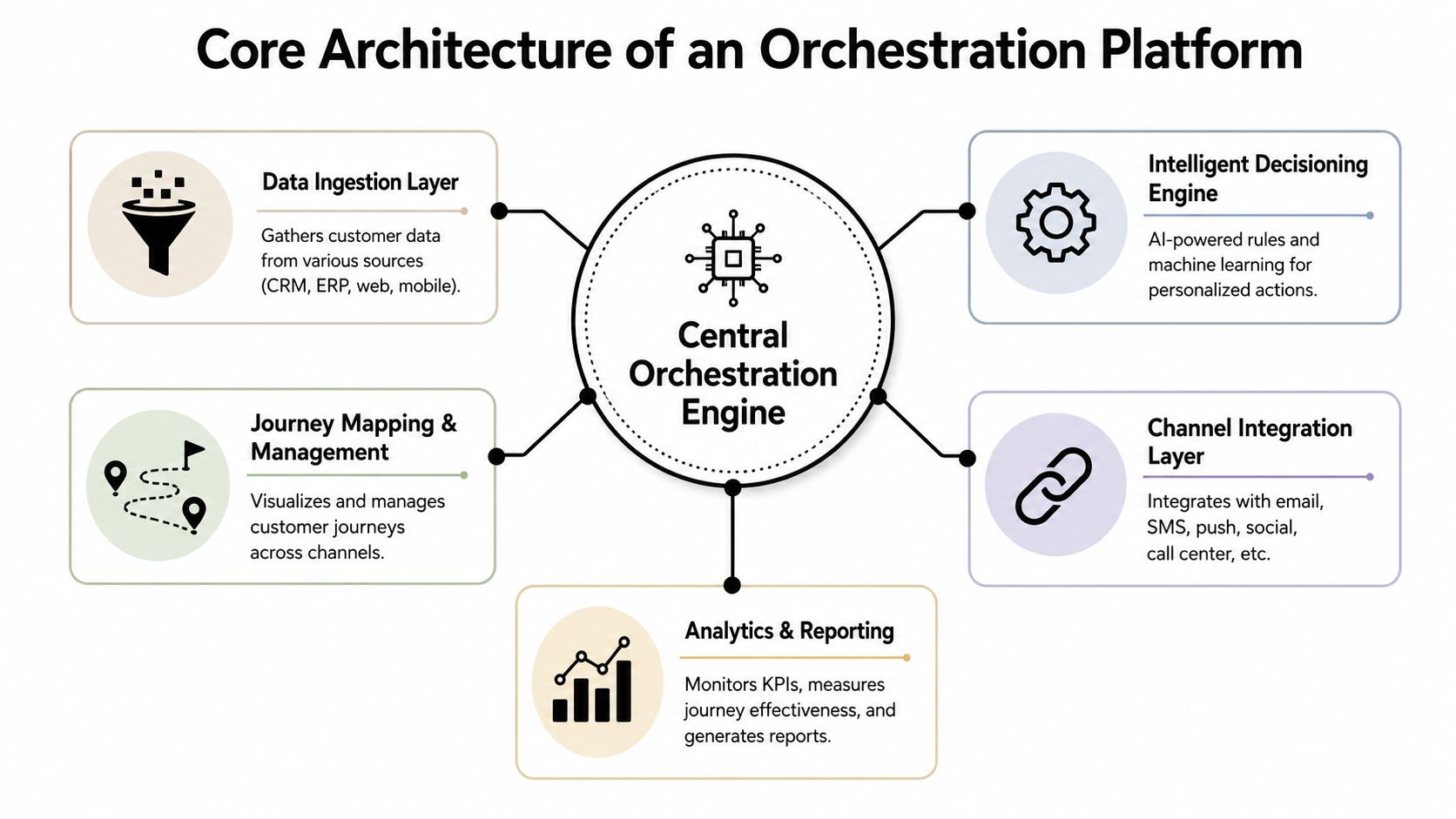
Nielsen Norman Group makes an important distinction here. A mature orchestration layer is not just a channel router. It acts as a decisioning engine that uses customer data to determine what, when, and how to deliver the next interaction, with AI increasingly used to suggest actions and optimize personalized pathways (Nielsen Norman Group on journey orchestration engines).
The data layer gives the system memory
This layer connects the systems that already hold customer and operational truth. CRM, ERP, web analytics, order management, billing, ticketing, identity, knowledge bases, and workforce tools all feed the orchestration layer.
Without this foundation, every conversation starts from partial memory. That's why teams working on digital support maturity often benefit from a practical guide to digital customer support, especially when they need to align service operations, channels, and support tooling before adding more automation.
What this layer needs in practice:
- Identity resolution so the platform knows whether the web visitor, mobile user, and caller are the same person
- State management so the current step in the journey is stored and reusable
- Event ingestion so signals like cart abandonment, payment failure, claim submission, or login trouble become triggers
- System adapters so the platform can read and write to business applications, not just observe them
The decisioning layer chooses the next best step
Modern agentic AI changes the game. Traditional workflow engines rely on static rules. If X happens, do Y. That still matters, especially for regulated processes, but it doesn't handle ambiguity well.
The decisioning layer combines business rules, customer data, journey logic, and AI-assisted recommendations. It asks practical questions in sequence. Is this customer authenticated? What is their current intent? Is there enough confidence to automate? Does policy require disclosure or approval? Should the next action be a chatbot prompt, a voice callback, an email, or a live transfer?
A strong orchestration design balances deterministic control with adaptive intelligence:
| Layer behavior | Best used for |
|---|---|
| Fixed rules | Compliance, eligibility, approvals, routing thresholds |
| AI suggestions | Next-best action, response drafting, path selection |
| Confidence-based escalation | Switching from automation to human handling |
| Journey memory | Avoiding repeated questions and duplicated steps |
Architecture test: If your AI can answer a question but can't update the journey state, trigger the next workflow, and hand off with context, it isn't orchestrating. It's just conversing.
For teams evaluating applied AI in service operations, one example of this category is omnichannel AI automation, which focuses on continuity across channels and coordinated automation flows.
The action layer delivers and learns
The final layer executes decisions across chat, voice, email, SMS, mobile push, agent desktop tools, and internal workflows. Many projects underinvest in this final layer. Sending a message is easy. Delivering the right action with proper context, timing, permissions, and fallback logic is harder.
A good action layer includes:
- Channel-aware rendering because the same intent needs a different format in voice than in email
- Human handoff controls so agents receive summary, history, and recommended next steps
- Workflow triggers that open tickets, update records, request approvals, or schedule follow-ups
- Feedback loops that capture completion, drop-off, escalation, and error signals
This layer is also where latency, handoff quality, and exception handling become visible. Customers don't care which microservice failed. They care that the conversation stalled after they said yes.
Orchestration Patterns and Real-World Use Cases
The value of omnichannel orchestration becomes obvious when you watch it operate inside a real journey. Not as a dashboard concept, but as a sequence of decisions, handoffs, and completed outcomes. The best implementations don't feel complicated to the end user. They feel organized.
Service journeys that recover before they fail
Start with a common service scenario. A utility customer receives an appointment reminder by SMS for an upcoming technician visit. The message offers two actions: confirm or reschedule. If the customer chooses reschedule, the system shifts to voice automation because date negotiation is faster in a conversational format than in a text thread.
The voice agent checks available slots, updates the field-service system, and sends a confirmation email with the new appointment window. If the customer asks a billing question mid-call, the orchestration layer recognizes the intent shift and either opens a parallel workflow or routes the customer to the right specialist with the appointment context preserved.
What works here is not the number of channels. It's the continuity of state.
What usually fails is this:
- Disconnected triggers where outbound reminders aren't linked to back-end scheduling
- Single-channel logic where rescheduling works by SMS but breaks when the customer calls
- Blind transfers where the live agent sees only the latest interaction, not the journey
Commerce journeys that preserve intent across devices
Now take a retail flow. A shopper browses on a laptop, adds items to cart, and leaves before checkout. Later, they open the brand's mobile app. The orchestration layer recognizes the same user, understands the unfinished state, and resumes the journey from where it stalled.
If the shopper asks a sizing question in chat, the AI agent can respond using product knowledge and order context. If confidence drops or the question turns into a return-policy dispute, the system passes the session to a human advisor with the cart contents, prior messages, and customer profile attached.
This pattern matters because commerce intent is fragile. Customers often switch devices, pause the process, compare alternatives, and come back through another channel. If the business treats every re-entry as a new session, it creates friction right when the buyer is deciding.
Good orchestration doesn't force channel loyalty. It protects intent while the customer changes channel, device, or pace.
Employee journeys that remove internal friction
EX use cases are where architecture discipline often shows up most clearly. Consider employee onboarding. HR sends a welcome email with the first set of tasks. The new hire uses a chatbot to ask about payroll, benefits, and required documents. The same orchestration layer triggers IT account setup, tracks provisioning steps, and opens a service ticket if equipment hasn't shipped.
A weak implementation sends notifications from multiple systems and leaves the employee to coordinate the rest. A strong one manages dependencies. If identity verification is incomplete, access requests wait. If a manager hasn't approved role-based permissions, the system escalates internally before the start date slips.
Three orchestration patterns show up repeatedly in successful EX programs:
Question-to-workflow conversion
The conversation isn't treated as an endpoint. It becomes the front door to action.Cross-functional dependency handling
HR, IT, facilities, and managers each own part of the journey, but the employee sees one coherent process.Proactive exception management
The system flags blockers before the employee has to chase someone for updates.
These are not flashy use cases. They're operational ones. And that's why they produce durable value.
Your Phased Implementation Roadmap
Most large organizations make the same early mistake. They try to orchestrate everything at once. Every channel, every business unit, every region, every customer segment. The result is predictable: long timelines, blurred ownership, and a platform that launches before the operating model is ready.
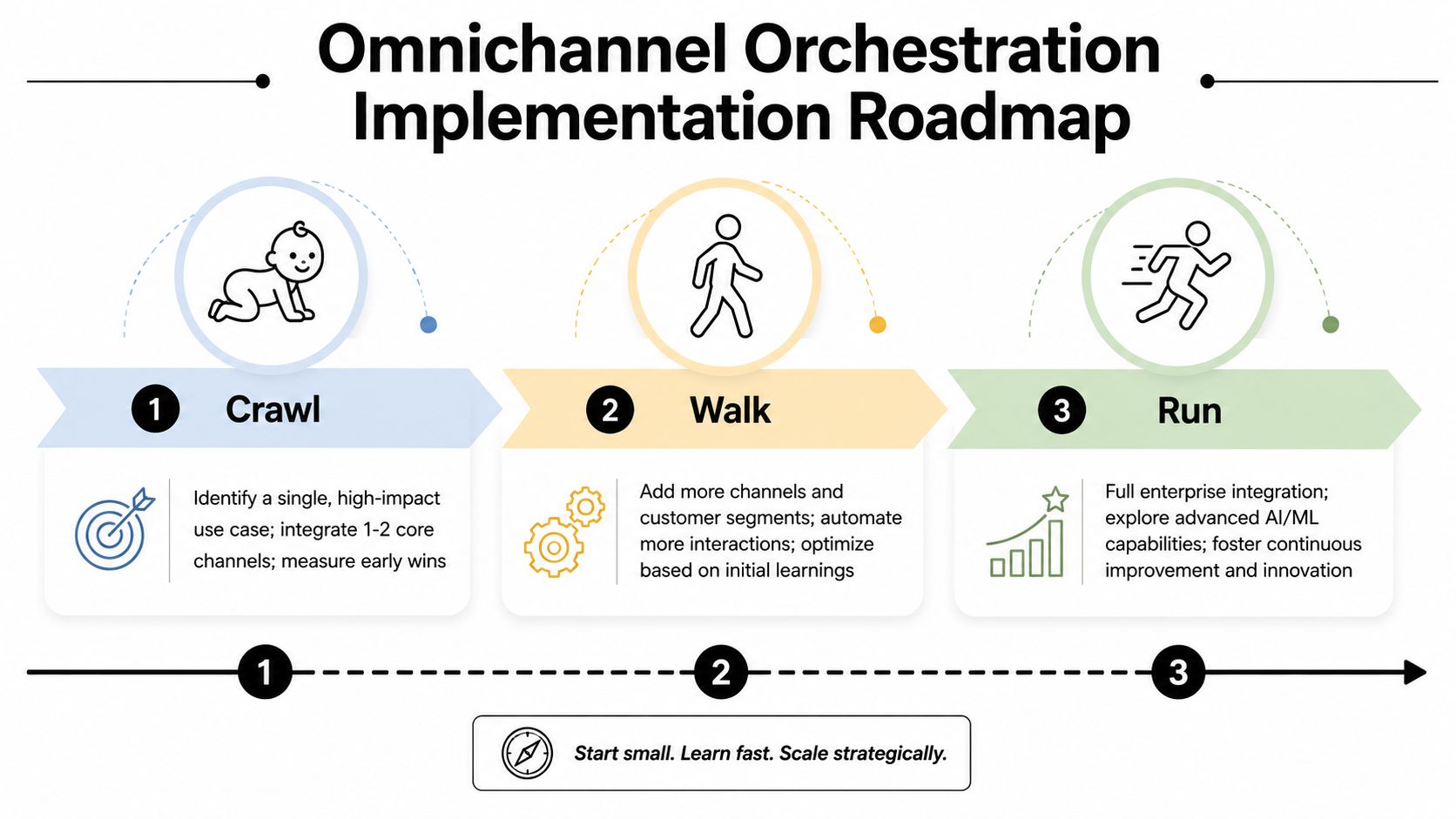
Smart Communications describes a more disciplined progression. Organizations should move from a single workflow or campaign, then expand across multiple campaigns or business units, and finally reach enterprise-wide orchestration that connects systems, channels, and teams in real time. The same guidance also recommends tracking engagement, efficiency, compliance, and business outcomes as core measurement areas (Smart Communications on orchestration maturity).
Crawl with one journey that matters
Start with a journey that is painful, frequent, and cross-functional enough to matter, but not so broad that governance collapses. Good candidates include appointment management, order status with escalation, claims intake, password reset, or employee onboarding.
The first goal isn't enterprise transformation. It's proving that context can move cleanly across systems and channels.
At this stage, keep the scope tight:
- Choose one high-friction journey with visible business pain
- Connect one or two channels where customers already switch naturally
- Integrate the minimum systems of record needed to complete the task
- Define escalation rules early so human fallback is designed, not improvised
Walk by connecting teams and systems
Once the first journey works, the next challenge is organizational, not technical. Multiple teams now need shared definitions for intent, identity, ownership, and exception handling. At this stage, many programs either mature or fragment.
A practical walk-stage program usually includes a governance group with operations, IT, CX, compliance, and analytics represented. That group should own journey priorities, handoff standards, and the shared data model.
A useful design checklist at this stage:
| Focus area | What to decide |
|---|---|
| Journey ownership | Which team owns end-to-end completion |
| Data contracts | What context is required at each handoff |
| Escalation design | When automation stops and humans step in |
| Policy controls | Which journeys need approvals, disclosures, or audit history |
Build governance around journeys, not channels. Channel owners optimize local performance. Journey owners protect customer outcomes.
Run with enterprise-wide decisioning
The run stage is where orchestration becomes an enterprise capability rather than a sequence of connected projects. Channels, systems, and teams operate through a shared decisioning framework. AI assists with path selection, next-best actions, response generation, and exception triage. Human agents remain critical, but they enter the workflow at points where judgment adds value.
This stage requires discipline in three places.
First, data quality. If identity, entitlement, or journey state is unreliable, intelligence won't save the process.
Second, policy design. Adaptive systems still need clear rules around approvals, disclosures, and logging.
Third, operating cadence. Journeys need regular review, not one-time deployment. Teams should inspect where customers abandon, where AI confidence drops, and where handoffs generate rework.
The companies that do this well don't chase the most channels. They build the most reliable continuity.
Measuring Success with the Right KPIs
A surprising number of orchestration programs still measure the wrong things. They report bot sessions, channel volumes, or containment rates, then struggle to explain whether the business improved. Good measurement starts with outcomes, then works backward into platform and workflow signals.
Customer outcomes
Customer metrics should answer one question: did the journey become easier to complete?
Useful indicators include journey completion, repeat-contact reduction, transfer quality, and satisfaction at the end of the task. If a customer starts in chat, finishes in voice, and doesn't need to come back later, that's a stronger signal than whether one channel handled the interaction alone.
Look for patterns such as:
- Lower customer effort because fewer steps are repeated
- Better handoff experience because context survives escalation
- Higher journey completion because the system guides users to resolution instead of dead ends
Operational efficiency
Efficiency measurement should focus on work removed, not just work shifted. If automation reduces one queue but increases downstream rework for agents, the operating model hasn't improved.
Track the mechanics of execution:
- Resolution quality across automated and human-assisted paths
- Agent preparation time before they can act on a transferred case
- Exception volume where journeys break and require manual intervention
- Workflow latency between trigger, decision, and action
A practical review rhythm helps here. Pull examples of failed handoffs every week. Inspect what context was missing, what rule fired incorrectly, and whether the issue came from data, policy, or channel rendering.
If your dashboard celebrates deflection while agents complain about bad transfers, trust the agents first and fix the journey logic.
Business impact
The final layer connects orchestration to the priorities executives care about. Retention, service cost, conversion support, compliance risk, and employee productivity all sit here. You won't always isolate orchestration as the only causal factor, but you can show whether the journey redesign is contributing to those outcomes.
A balanced KPI set usually spans three levels:
Customer layer
Journey completion, effort, and satisfaction.Operational layer
Rework, escalations, and time spent moving between systems.Business layer
Revenue support, loyalty, cost-to-serve directionally, and internal productivity.
That mix prevents a common reporting trap. Teams often over-index on tactical platform metrics because they are easy to collect. Leaders need measures that explain whether omnichannel orchestration improved service economics and trust.
How to Choose an Orchestration Platform
Platform selection is where strategy gets real. A polished demo can hide weak integration depth, limited governance, brittle voice support, or poor handoff controls. The right evaluation process should test how a platform behaves under operational pressure, not just how it looks in a sandbox.
What to test before you buy
Start with the essentials. Can the platform preserve context across voice, chat, email, and agent handoff? Can it read and write to the systems that hold operational truth? Can it support both customer and employee journeys without forcing separate stacks?
Then move into the harder questions.
Decisioning depth
Does the platform route interactions, or can it apply rules, AI recommendations, confidence thresholds, and escalation logic in one orchestration layer?Integration realism
It's not enough to show connectors on a slide. Ask what the integration supports: read, write, event trigger, authentication, and error handling. For teams comparing connectors and ecosystem fit, the integration library is the kind of asset worth reviewing closely.Voice and handoff quality
Many vendors are fine in chat and weak in voice. Test transitions between voice automation and live support, including summary transfer and journey-state preservation.Governance and safety
Ask how the platform handles role-based access, auditability, policy constraints, approval flows, and AI testing before release.Operational usability
Business teams should be able to modify journeys without creating a backlog for engineering every time wording, routing, or workflow changes.
Vendor Evaluation Checklist for Omnichannel Orchestration
| Capability Area | Key Questions to Ask | How Yellow.ai Delivers |
|---|---|---|
| Omnichannel continuity | Can one journey persist across chat, voice, email, and agent handoff without losing context? | Supports omnichannel orchestration across voice, chat, email, images, and video for coordinated journey management |
| AI decisioning | Does the platform support next-best-action logic, agentic workflows, and confidence-based escalation? | Provides an agentic AI platform with multi-modal agents, AI Copilot, and analytics to guide action selection and optimization |
| Voice orchestration | Is voice treated as a first-class orchestration channel or an add-on? | Includes Nexus Vox for voice AI within the broader orchestration environment |
| CX and EX coverage | Can the same platform support customer service and employee service workflows? | Supports both CX and EX use cases on a unified platform |
| Integration breadth | How quickly can the platform connect to CRM, helpdesk, contact center, and enterprise systems? | Offers 150+ pre-built integrations across systems such as Salesforce, Zendesk, Genesys, Freshdesk, HubSpot, and NICE |
| Model flexibility | Are you locked into one model provider, or can you adapt over time? | Uses a multi-LLM architecture with 15+ models, which helps teams balance fit, speed, and governance |
| Compliance posture | Does the vendor support enterprise controls needed for regulated environments? | States support for HIPAA, ISO 27001/27701, SOC 2 Type II, and PCI-DSS |
| Deployment practicality | Can teams design, test, and harden journeys without excessive custom engineering? | Includes AI Agent Builder 2.0, Conversational Knowledge Base with agentic RAG, and Automated Testing |
The strongest platforms tend to look similar at the surface level. They all promise omnichannel support, AI, analytics, and integrations. The differences show up in execution quality.
What strong platforms do differently
First, they treat orchestration as a decisioning discipline, not a channel bundle. That means journey state, policy logic, AI guidance, and handoff design are built into the core architecture.
Second, they support human fallback by design. A weak platform makes escalation feel like failure. A strong one treats automation and human support as coordinated steps in the same workflow.
Third, they support enterprise change management. Journeys evolve. Policies change. New channels appear. Good platforms let teams adapt without rebuilding the whole stack.
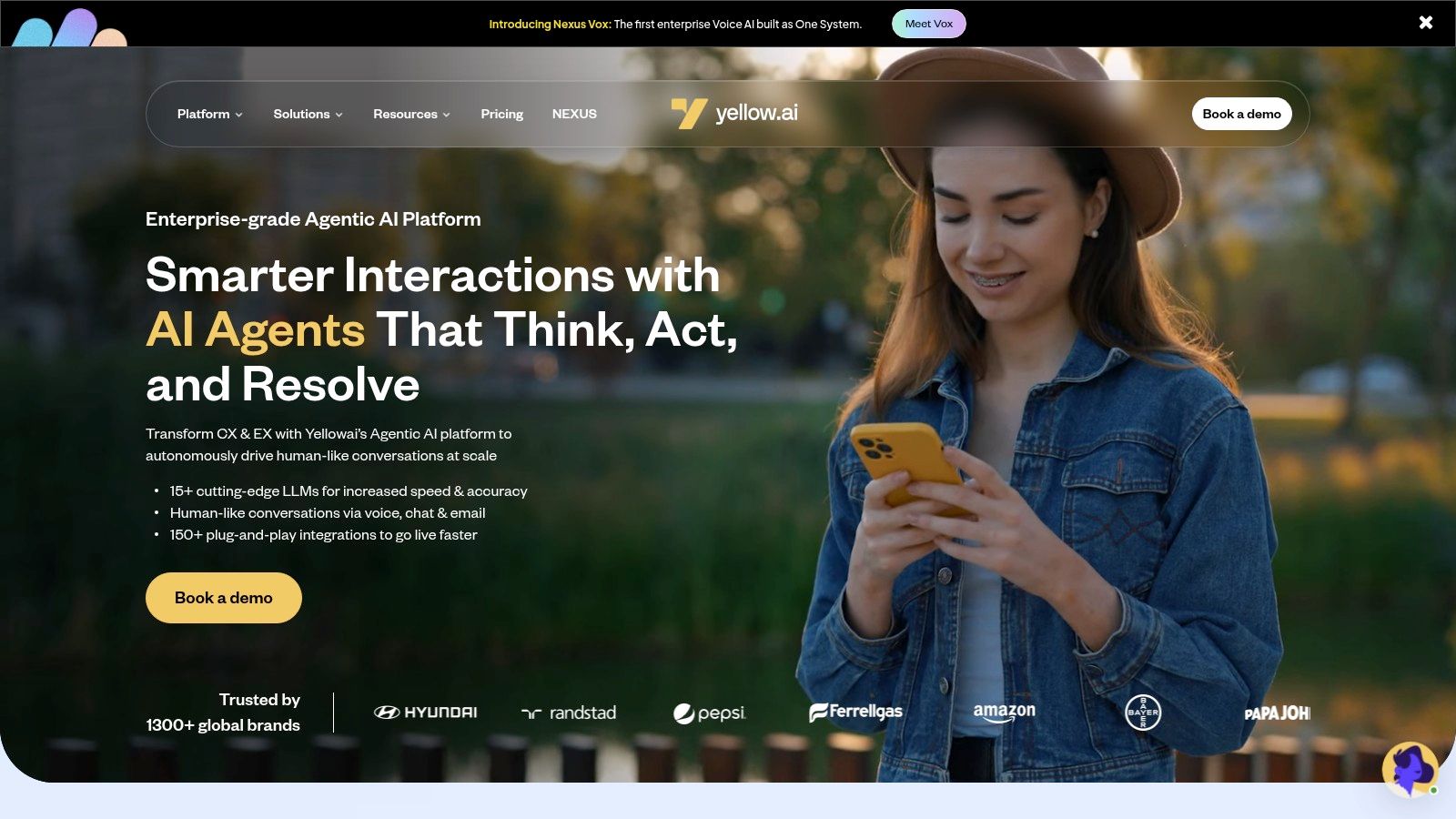
One option in this category is Yellow.ai. Based on the publisher information provided, it offers an agentic AI platform for CX and EX, supports multimodal orchestration across channels, includes Nexus Vox for voice AI, and provides pre-built integrations that can shorten implementation work when the surrounding architecture is already defined.
A short product walk-through is useful after the written checklist because you can inspect how these capabilities appear in the actual product experience.
The final selection decision should come down to fit. Not claims. Run scenario-based evaluations using your own journeys. Test a failed payment flow, an address update with identity verification, a high-emotion service escalation, and an employee onboarding request with approvals. Those exercises expose the gap between omnichannel messaging and actual omnichannel orchestration.
If you're evaluating how agentic AI can improve omnichannel orchestration across both CX and EX, explore Yellow.ai as one platform to assess against your own journey, governance, and integration requirements.



