










You've probably asked a support bot a simple question, got a polite paragraph back, and still had to do all the work yourself. The bot answered, but nothing moved. That gap between getting information and getting something done is where the confusion about What Is Agentic AI usually starts.
If you're choosing tools for customer service, employee support, or operations, you don't need a grand theory of intelligence. You need a plain test you can apply to any product claim. Does the system only reply, or can it also act, check what happened, and adjust until a task is finished?
Table of Contents
- What Agentic AI Means in Plain Terms
- How Agentic AI Differs From Chatbots and Copilots
- How an Agent Works Through a Task
- What Agentic AI Can and Cannot Reliably Do
- Where Enterprises Use Agentic AI Today
- Risks, Governance and Keeping Agents Within Limits
- Decide Where Agentic AI Fits Your Operations
What Agentic AI Means in Plain Terms
Say a traveller asks to move a flight from Tuesday to Friday. A basic chatbot explains the change fee policy, maybe links to a form, and stops. The traveller still has to find a seat, pay any difference, and confirm the new booking.
An agentic system handles that request differently. It checks the existing booking, searches for seats on Friday, rebooks within the rules it's been given, confirms the new ticket was issued, and tells the traveller what changed. If no seat is available, it doesn't pretend the job is done. It offers the closest alternative or hands the case to a person.
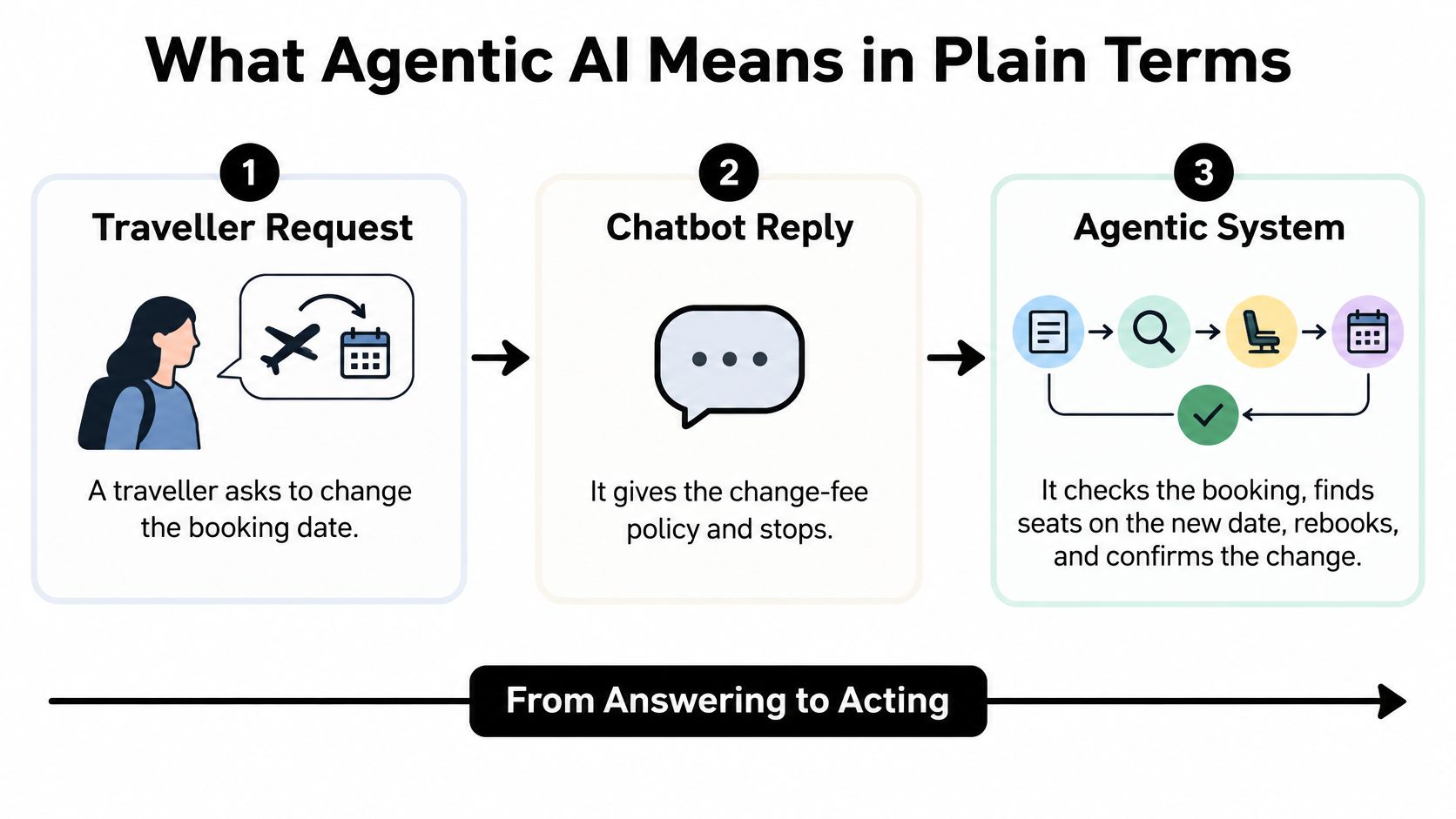
Think of a chatbot as a reference librarian who points you to the right shelf. Think of an agent as a travel agent who makes the booking and checks that it went through. Both are useful, but they're not the same job, and they shouldn't be judged by the same standard.
Three tests for any product claim
- Goal, not just a prompt: Does it start from an outcome, such as rebook this flight, rather than a single question?
- Action inside systems: Does it use tools, APIs, or software to change a record, not just describe how a person could?
- Checking before declaring success: Does it read the result of each step and change course if that result is wrong?
Speed alone doesn't prove those tests are met. The Stanford AI Index summary of RE-Bench, introduced in 2024 found leading AI systems scored approximately four times higher than human experts in short two-hour settings, but at 32 hours, human experts outscored AI systems by a 2-to-1 margin. Short, bounded work suits agents well. Long projects that need sustained planning and error recovery are harder.
That's why fluent language isn't enough. Judge an agent on task completion, tool use, escalation quality, latency, and reliability.
Agentic AI means AI systems that interpret a goal, plan a sequence of actions, use tools or software environments, evaluate each intermediate result, and keep iterating until the task is completed or fails.
How Agentic AI Differs From Chatbots and Copilots
Labels overlap in sales material, so compare systems on what they do. The table below uses the same four questions for each type, including whether a system re-plans when a step fails.
| Type | Main output | Acts in your systems | Plans multi-step work | Typical example |
|---|---|---|---|---|
| Scripted automation | Fixed workflow result | Yes, fixed steps only | No, follows the script | Password reset macro |
| Generative chatbot | Text answer | No | No | FAQ answer bot |
| AI copilot | Suggestions for a human | Rarely, a human approves each action | Limited | Draft reply in an agent desktop |
| Agentic AI | Completed outcome | Yes, through tools and APIs | Yes, re-plans after each result | Rebooks a flight after checking seats |
Scripted automation is fast and predictable, but it breaks when a case falls outside its script. A generative chatbot can explain a policy in natural language, yet it changes nothing in your billing, booking, or support system. A copilot sits between the two. It drafts, summarizes, or recommends, while a person remains the actor who approves and sends.
The operational autonomy test
An agent earns the label when it can break an open-ended objective into steps, choose tools, act, observe the outcome, adapt its plan, and continue with limited supervision. The OECD conceptual analysis of agentic systems distinguishes more agentic systems by their ability to coordinate agents, delegate tasks, operate for extended periods, and function in less predictable environments. That ability matters only where the workflow requires it.
A password reset or status lookup is often safer and cheaper as deterministic automation because the steps never change. A dispute, investigation, or cross-system fulfilment case is different, since the right next step depends on what the agent finds. For a fuller side-by-side view, see this guide to generative AI compared with agentic AI.
Don't ask only how autonomous a system is. Ask where that autonomy beats a rule, a workflow, or a person on resolution quality, latency, cost, exception rates, and escalation outcomes. In predictable work, extra planning can add cost and delay without improving the result.
Does the system decide its next step itself, based on what just happened?
How an Agent Works Through a Task
A billing dispute shows the loop clearly. The customer says they've been charged twice and wants the duplicate reversed. The agent's job isn't to write a sympathetic reply. It's to resolve the charge correctly or explain why it can't.
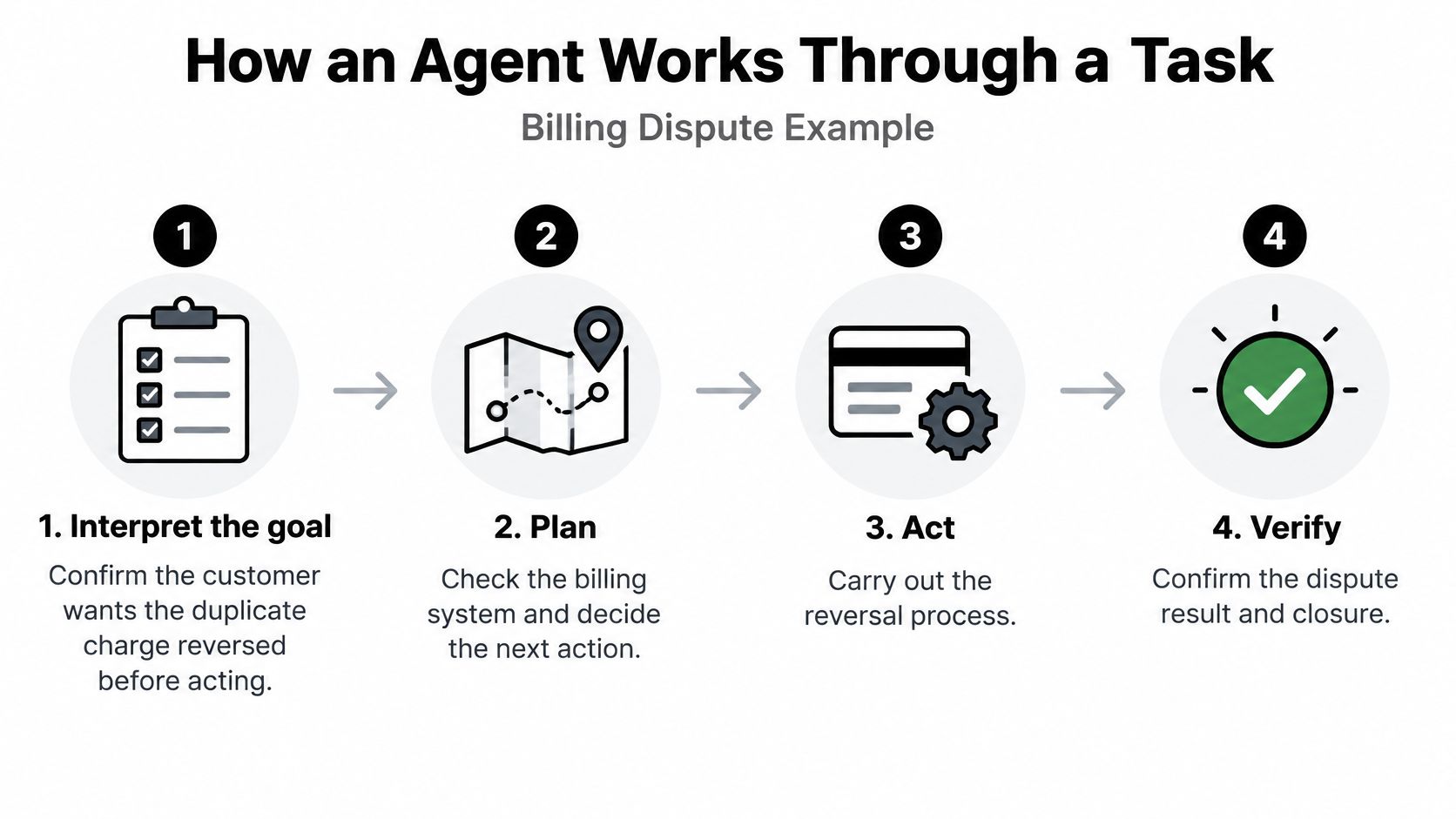
Six steps, repeated as needed
- Interpret the goal: Confirm the customer wants the duplicate charge reversed, not a general explanation of the bill. Acting on the wrong goal is the fastest way to create a second problem.
- Plan the checks: Decide to inspect the billing record first, confirm whether a duplicate exists, and then check the refund policy. Each result determines whether the next step is allowed.
- Select tools: Call the billing system for transactions and the policy knowledge base for the rule that applies. No single source holds both facts, so the agent needs both before it acts.
- Execute within limits: Issue the refund only if the amount sits within the agent's authority limit. Above that limit, it should request approval instead of guessing.
- Observe the result: Read the status returned by the billing system. If the system reports an error, retry safely or change the plan rather than reporting success.
- Decide and close: Send a confirmation with the reference number, or escalate to a human with a summary of what was checked and what remains open.
The most damaging slip is acting on stale data. Verify the current record immediately before a refund, booking change, or account update, because another agent, employee, or customer action may have changed it seconds earlier. A second common slip is treating a tool call as proof of success. Calling a system isn't the same as confirming that system accepted the change.
Tool access is what turns a plan into work. For email-led workflows, for example, you could give agent access to inbox tools so the agent can read context and complete permitted actions instead of only drafting replies. The underlying connections matter as much as the language model, which is why an AI agent architecture view of tools, memory, and control is useful when you map your own systems.
That loop repeats for every step, so an agent may take longer than a fixed script. In return, it can recover from a missing record, a failed payment action, or an unexpected policy exception. Try mapping one of your workflows onto these six steps and mark exactly where the agent must stop and ask a person.
What Agentic AI Can and Cannot Reliably Do
Enthusiastic demos often hide a simple question. How many real tasks does the agent finish without help?
The Stanford AI Index chapter reporting TheAgentCompany benchmark evaluated language-model agents on 175 consequential workplace tasks that required interaction with realistic computer systems. The strongest system completed 30.3% of tasks fully autonomously and achieved a 39.3% score when partial completion received credit.
What those numbers mean in plain terms
Fewer than one in three broad workplace tasks were finished end to end. The system still made meaningful progress on additional tasks, which explains the higher partial score. That gap is the central lesson. An agent can plan well, complete several steps, and still fail to deliver a dependable final outcome.
Don't treat that benchmark as a ceiling for every business workflow. Broad workplace tasks are deliberately varied and messy. A narrow process with clear tools, current policies, tight permissions, and a precise definition of success can perform much better because the agent has fewer choices and fewer surprises.
Don't treat the word agentic as a promise, either. It doesn't mean fully reliable, and it doesn't mean human-level general intelligence. It describes a way of working, not a guaranteed success rate.
What production use therefore requires
- Constrained permissions: Limit which records the agent can read or change.
- Verified knowledge: Retrieve policy and product facts from approved enterprise sources.
- Monitoring and testing: Track failures in production, not only before launch.
- Human handoff and fallback: Route uncertain or high-impact cases to a person with context.
Judge vendors on completion rate and failure recovery, not on how confident the replies sound. Pilot on narrow workflows first, compare completed outcomes with your human baseline, and expand only when completion stays high across a representative sample that includes awkward, incomplete, and exceptional cases.
Where Enterprises Use Agentic AI Today
Teams usually start where agents have to move between systems and make small decisions along the way. The image below reflects the planning work behind that choice, since workflow design matters more than the chat window customers see.

| Workflow | Typical agent actions | Autonomy need | Better as |
|---|---|---|---|
| Order or delivery status lookup | Read order record and reply | Low | Deterministic automation |
| Password or account unlock | Verify identity and reset credentials | Low | Scripted automation |
| Booking change or reschedule | Check availability, rebook and confirm | Medium to high | Agentic AI |
| Billing dispute with refund | Check records, apply policy, issue refund within limit | High | Agentic AI with approval threshold |
| Employee IT or HR request | Route, provision access and track fulfilment | Medium | Agentic AI with audit trail |
| Complex complaint investigation | Gather evidence across systems and draft resolution | High | Agentic AI with human handoff |
The pattern is consistent. When a workflow has one system, one rule, and one correct output, simple automation wins. When it needs several systems, judgement about exceptions, and a decision about when to escalate, planning starts to earn its cost.
Adoption is still uneven. In Adobe's global survey of 3,000 CX executives and practitioners, 16% of surveyed organizations reported embedding agentic AI organization-wide for customer support in 2026. Many teams are therefore still piloting or rolling out by department, not replacing service operations in one move.
The short video below gives a visual sense of how this kind of automation is presented in practice.
You'll see these workflows often in BFSI, healthcare, utilities, retail, and logistics, where contact volume is high and a single case may touch accounts, orders, payments, and case history. If you're scoping a first deployment, a governed enterprise AI agent pilot is a useful reference point for keeping the rollout bounded. Rank your top ten workflows by volume and number of systems touched, then start with the highest-volume one that has clear success criteria and a safe fallback.
Risks, Governance and Keeping Agents Within Limits
A wrong chatbot answer can usually be corrected in the next message. A wrong agent action is harder to undo. It can refund the wrong customer, expose private data, close a case that wasn't resolved, or change a record another team relies on.
That difference makes governance a question about actions, not just answers. Deloitte research across 3,235 business and technology leaders in 24 countries found nearly three-quarters expect to deploy agentic AI within two years, yet only 21% report a mature governance model. Adoption is moving faster than the controls many organizations need.
Controls that close the gap
- Least-privilege access: Give each agent only the systems and actions its workflow requires.
- Approval thresholds: Require a person for high-impact steps, such as refunds above a set amount.
- Continuous evaluation: Sample live cases and test new failure patterns after launch.
- Full audit trail: Record the chain of decisions and actions so any outcome can be reconstructed.
- Rollback mechanisms: Make reversible actions reversible in practice, with a tested procedure.
- Named incident ownership: Assign a person who can pause the agent and answer for the response.
Governance isn't a one-time approval checklist you sign before go-live. Policies change, tools fail, customers phrase requests in new ways, and agents encounter cases your test set missed. A sound enterprise AI governance approach treats monitoring, limits, and review as part of daily operations.
Start with lower-risk use cases, learn where the agent hesitates or fails, and widen its authority only as your controls mature. That sequence feels slower than a big launch, but it gives you evidence before the agent can affect money, access, or regulated records.
What may the agent do alone, under which conditions, and how can we prove afterwards that it stayed within those limits?
If your governance plan can't answer that question for a specific workflow, the workflow isn't ready for autonomous action yet. You can still use a chatbot for information or a copilot to help employees while you build the missing controls.
Decide Where Agentic AI Fits Your Operations
Use a three-question filter before you compare platforms. It'll stop you buying autonomy for work that doesn't need it.
The three-question filter
- Is the workflow predictable? If yes, choose deterministic automation. It's cheaper, faster, and easier to audit.
- Does it need several systems, judgement, and a multi-step plan? If yes, it's a candidate for agentic AI.
- Can you define success and the autonomy limit before launch? If not, don't launch. Clarify the outcome, approval threshold, and fallback first.
A sensible first pilot has high volume, clear success criteria, moderate risk, and a human fallback. Measure completion rate, latency, cost per resolved case, escalation quality, and exception rates against your current process. Include cases where data is missing or the customer changes their mind, because clean test cases flatter every system.
Platforms implement this model in different ways, so evaluate them against the same filter. Our Enterprise-Grade Agentic AI Platform uses 15+ LLMs to drive autonomous experiences for customers and employees, and our AI agents can automate end-to-end workflows such as making a purchase or rescheduling a booking in real time. Yellow.ai Agent Assist also automatically transfers a conversation to a human agent when negative user sentiment is detected, which gives you one concrete fallback to test rather than a vague promise of handoff.
Take a short checklist into your next planning meeting. Name the workflow, its owner, the systems involved, the action limit, the success measure, and the person who receives escalations. If any item is blank, fill it before you expand the agent's authority.
Ready to move from answers to completed outcomes on one well-chosen workflow? Yellow.ai helps enterprise teams build, test, and govern agents for customer and employee experiences, with clear limits and human fallback built into the work. Visit Yellow.ai to explore the platform and plan a pilot you can measure from the first case.