









Most companies don't have an AI problem. They have an operating model problem.
Board attention is already there. In 2025, 62% of corporate boards held regular AI discussions, yet only 27% had formally integrated AI governance into committee charters, according to Knostic's AI governance statistics roundup. That gap reveals the core challenge. Enterprises are talking about AI at the top, while teams below are still stitching together pilots, vendor tools, internal copilots, and early-stage agents without a consistent control system.
That mismatch is why enterprise AI governance has become urgent. Not because leaders suddenly want more policy documents, but because modern AI systems don't stay confined to a sandbox. They route across models, call tools, retrieve enterprise data, trigger workflows, and increasingly act on behalf of employees and customers. If governance exists only as an ethics statement or procurement checklist, it won't survive contact with production.
The practical question isn't whether governance slows innovation. It's whether your company can scale agentic AI without losing visibility, ownership, and runtime control.
Table of Contents
- Beyond Risk Management Why AI Governance Is Now a Growth Engine
- What Is Enterprise AI Governance Really
- The Pillars of a Modern AI Governance Framework
- Mapping Key Roles and Responsibilities in AI Governance
- An Enterprise Playbook for Implementing AI Governance
- Sector-Specific Governance Considerations
- Measuring Success with AI Governance Metrics and Reporting
- Frequently Asked Questions on Enterprise AI Governance
Beyond Risk Management Why AI Governance Is Now a Growth Engine
Many teams still treat governance as the final gate before launch. That's outdated. In production AI environments, governance is what lets teams launch repeatedly without renegotiating risk from scratch every time.
Without it, every new use case becomes a custom argument. Legal asks different questions than security. Data teams classify the same workflow one way, business owners classify it another, and engineering ships around the process because nobody wants to wait. The result isn't speed. It's local optimization followed by central cleanup.
Enterprise AI governance changes that by creating a repeatable path from idea to production. It gives teams approved patterns for data access, model selection, human review, incident handling, and runtime monitoring. That structure reduces friction for low-risk use cases and concentrates scrutiny where it matters.
Governance done well doesn't slow the business. It stops every launch from becoming a one-off negotiation.
This is why governance has moved beyond pure risk management. It now affects throughput. It affects whether an organization can move from demos to durable systems, especially when AI starts taking actions inside customer support, employee service, operations, and compliance workflows.
The biggest shift I've seen in enterprise programs is simple. Leaders no longer ask, "Do we need AI governance?" They ask, "What kind of governance lets us scale safely without killing adoption?" That's the right question, because modern governance isn't the brake. It's the steering system.
What Is Enterprise AI Governance Really
Enterprise AI governance is best understood as an operating system for trust. It defines who can deploy AI, what those systems are allowed to access, how decisions get approved, and how the organization proves that the system stayed within its boundaries.

Governance is an operating system for trust
A mature model isn't just a policy set. Mature AI governance operates as a full-lifecycle control system, applying policy and review gates across data, modeling, deployment, and post-production changes, as described by NICE's enterprise AI governance guidance. That matters because production risk rarely starts at a single point. It accumulates across the lifecycle.
Think about a customer-facing AI agent. The original use case may be approved. Then a team adds retrieval from a new knowledge source. Later they connect a ticketing tool. Then they swap the underlying model or expand the geography. If governance only happened at initial approval, the system has already drifted away from what was originally reviewed.
A useful governance model answers five operational questions:
- Use case authority: Is this AI workflow approved for this business purpose?
- Data authority: What data can it retrieve, transform, or expose?
- Action authority: What tools can it call, and under what conditions?
- Change authority: Who reviews prompt, model, retrieval, and workflow changes?
- Evidence authority: What logs, approvals, and decision records prove compliance?
What weak governance looks like in practice
Weak governance usually has recognizable symptoms. The company has an AI policy, but no inventory. It has a review board, but no runtime controls. It has risk principles, but no owner for model changes once the system is live.
A stronger approach treats each model or AI workflow as a controlled enterprise asset. That means named ownership, defined review gates, clear escalation paths, and post-deployment monitoring. It also means governance has to sit close to product and operations, not just in legal or security.
A simple comparison makes the distinction clear:
| Governance style | What it looks like | Where it breaks |
|---|---|---|
| Document-first | Static policy docs, annual review, manual sign-offs | Doesn't keep up with prompt, model, or tool changes |
| Lifecycle-first | Intake, approval, deployment controls, monitoring, change management | Requires cross-functional coordination and technical enforcement |
| Runtime-first | Real-time policy decisions, logging, access control, escalation | Harder to implement if architecture is fragmented |
The mistake is assuming governance starts after the build. In reality, it starts when a team decides an AI system should be trusted with enterprise data, customer interactions, or operational actions.
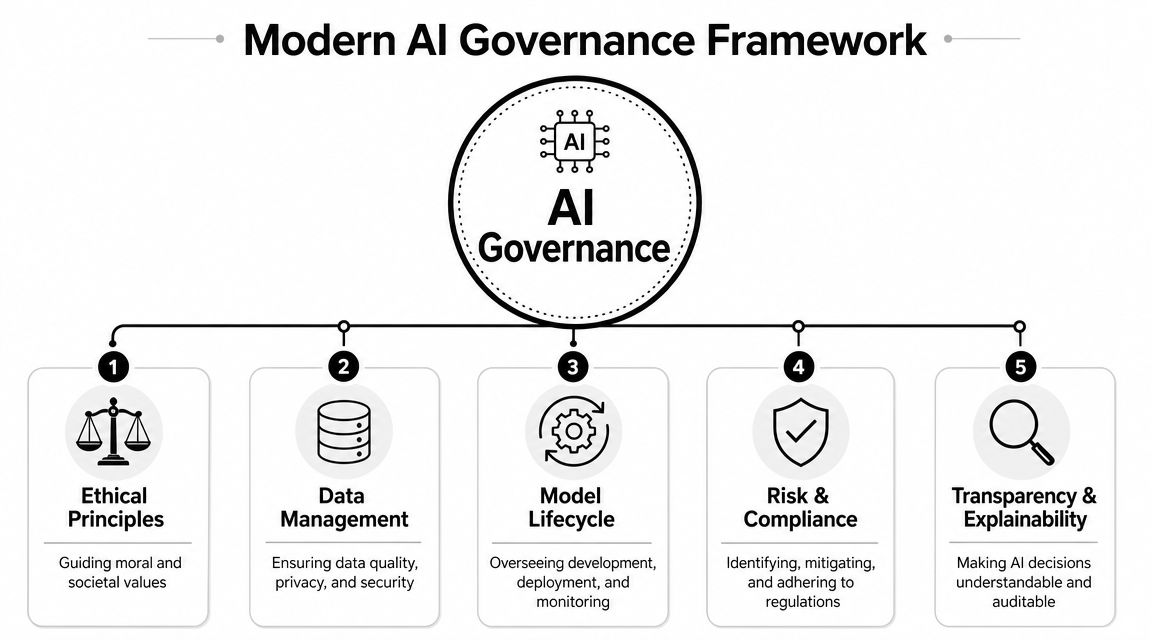
The Pillars of a Modern AI Governance Framework
A governance framework needs more than principles. It needs structure that holds up under live traffic, distributed teams, and fast iteration.
Five pillars that hold up production AI
I break modern enterprise AI governance into five working pillars.
- Principles
These are essential considerations. Human oversight, approved use, privacy boundaries, fairness expectations, action limits, and accountability. Principles should be short enough that executives can endorse them and product teams can apply them.
Policies
Policies translate principles into rules. Which models are approved. Which data classes can enter prompts. Which use cases require human review. Which vendors are restricted. Where output logging is mandatory.
Processes
The absence of usable workflows is a common reason why many frameworks fail. Teams need usable workflows for intake, risk classification, approval, exception handling, incident response, and post-launch change review. If the process is vague, people bypass it.
Platforms
Controls have to be enforceable in the system. That means identity, access policy, routing controls, logging, approval records, and monitoring integrated into the architecture. If your platform layer can't enforce policy, governance becomes a memo.
Proof
Enterprises need evidence. Not just that a policy exists, but that it was applied. That includes logs, decision history, use case records, approval chains, and incident documentation.
For organizations thinking about customer-facing and employee-facing agents, it also helps to study adjacent disciplines like modern trust and safety, where runtime controls, abuse handling, and escalation paths are treated as product requirements rather than side policies.
A practical platform stack often includes identity controls, data labels, approval workflows, observability, and secure deployment infrastructure. Teams evaluating production environments should look closely at capabilities such as enterprise-grade security for AI deployments, especially when AI is handling customer data or executing workflows across business systems.
What changes when AI becomes agentic
Traditional governance focused on model quality, explainability, and static approval. Agentic systems change the problem. The risk isn't only what the model says. It's what the system can do.
Governing agentic AI requires moving beyond traditional controls. Enterprises now need prompt-injection defenses, data-exfiltration safeguards, and granular logging for forensic auditability, as outlined in EW Solutions' enterprise AI governance framework. That's the shift from model governance to action governance.
The design implications are concrete:
- Prompt boundaries matter because hostile or malformed input can alter downstream behavior.
- Tool boundaries matter because an agent with broad permissions can take the wrong action correctly.
- Routing boundaries matter because multi-LLM systems may hand off work across models with different strengths and risks.
- Logging depth matters because forensic review becomes impossible if you only capture final outputs.
Practical rule: If an AI system can retrieve, decide, and act, govern each stage separately. Don't approve the workflow as one black box.
A modern framework should assume three realities. Teams will use more than one model. Some AI will emerge outside formal programs. And the hardest failures won't happen in demos. They'll happen at runtime, under mixed permissions, with real data and real consequences.
Mapping Key Roles and Responsibilities in AI Governance
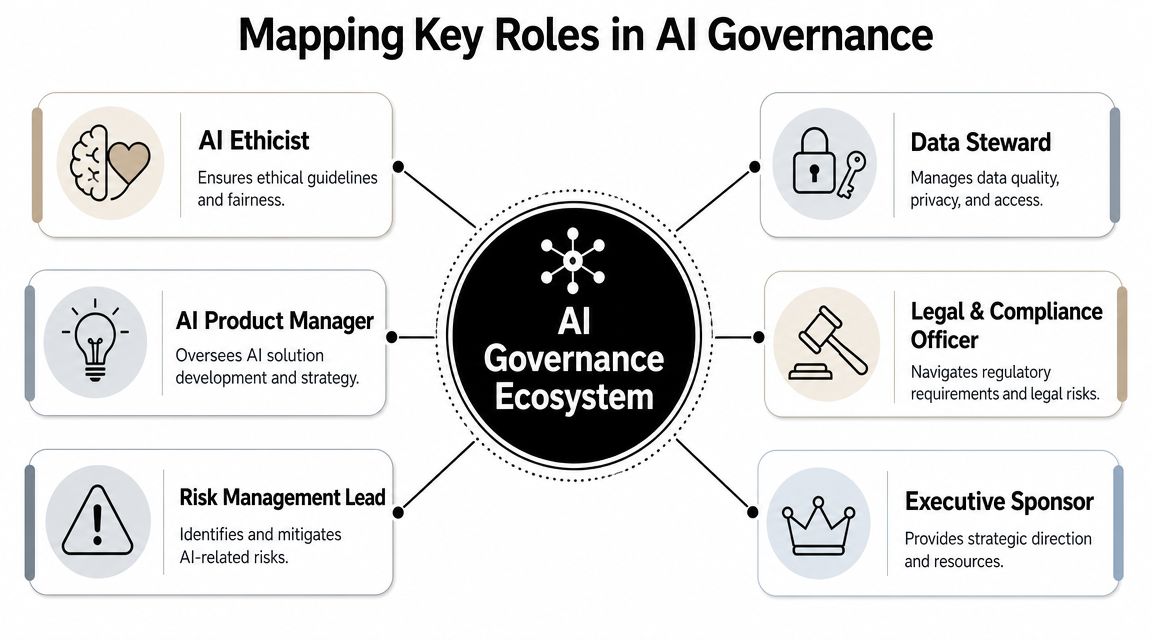
Good governance fails fast when everyone is consulted and no one is accountable. The structure has to be specific enough that a real person can say yes, say no, or stop a rollout.
The core decision-makers
Most enterprise programs need a small set of roles with clear decision rights.
| Role | What they own | What they should never own alone |
|---|---|---|
| Executive sponsor | Funding, escalation authority, strategic alignment | Technical approval details |
| AI steering committee | Policy approval, high-risk use case review, exception decisions | Day-to-day workflow triage |
| AI product manager | Business case, user journey, success criteria, release coordination | Final compliance interpretation |
| Data steward | Data quality, access rules, labeling, retention alignment | Business risk acceptance |
| Model risk owner | Model approval, change review, testing sign-off, monitoring triggers | Vendor contracting |
| Legal and compliance lead | Regulatory interpretation, documentation standards, control evidence | Architecture design |
| Security lead | Access control, threat paths, runtime enforcement, incident response | Use case prioritization |
The steering committee shouldn't become a weekly bottleneck. Its purpose is to decide on edge cases, high-impact use cases, and policy exceptions. Low-risk requests should move through predefined workflows without dragging executives into every approval.
The AI product manager role is especially important in customer and employee experience programs. This person sits between business ambition and control reality. They decide whether a proposed automation should stay assistive, move to autonomous execution, or require human confirmation at critical points.
A day in the life of a model risk owner
This role is often misunderstood. In practice, the model risk owner isn't just checking a benchmark score or reading a one-page launch brief.
For a new customer support agent release, this person typically checks:
- Scope drift: Has the agent moved beyond the approved use case?
- Data path changes: Is it retrieving from a new source or exposing a broader class of records?
- Prompt and workflow changes: Did the team alter escalation logic, system prompts, or tool access?
- Fallback behavior: What happens if retrieval fails, confidence drops, or a downstream system times out?
- Monitoring readiness: Are logs, alerts, and rollback procedures live before launch?
The strongest governance teams don't ask only, "Did this model perform?" They ask, "What changed, who approved it, and what happens when it fails in production?"
An ethics board can add value, but only if its remit is focused. It should review high-impact edge cases, not become a symbolic layer with no practical effect. In most enterprises, the better pattern is a working governance forum that includes product, security, data, legal, and operations. That creates decisions people can execute, not just principles people can admire.
An Enterprise Playbook for Implementing AI Governance
Enterprise AI governance succeeds or fails in operations. Policies matter, but agentic AI creates risk through live prompts, tool calls, retrieval paths, and unsanctioned experimentation across teams. The practical playbook is to find what is already running, set controls by risk, enforce them in production, and tighten the loop as systems change.
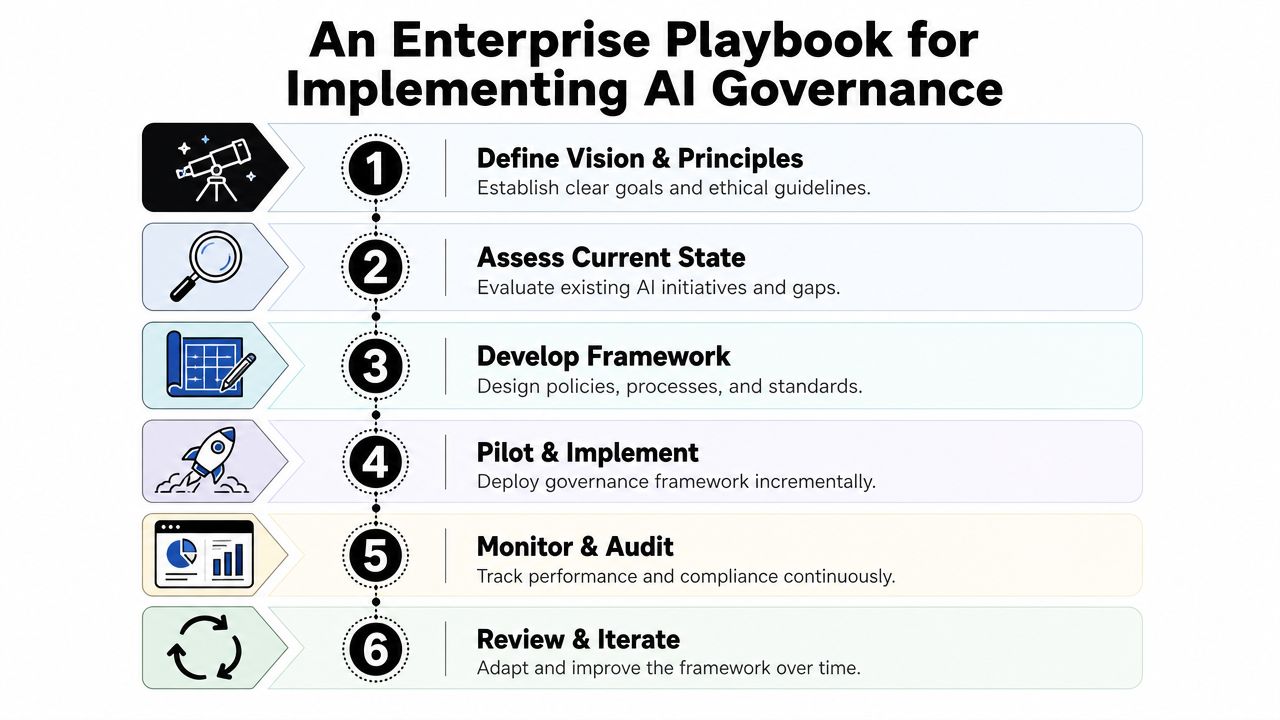
Phase one discover what already exists
Start with an inventory that reflects how AI enters the enterprise in real life. It rarely arrives through one central program. It shows up through approved vendors, AI features embedded in existing software, internal copilots, and quiet experiments inside business units.
Shadow AI is the first operational problem to solve. Dell's guidance on avoiding shadow AI with effective enterprise governance makes the point clearly. Governance breaks down when leadership approves a policy but cannot see where AI is being used, what data it touches, or who is accountable for failures.
Use four inventory buckets:
- Approved enterprise tools with contracts and central visibility
- Embedded AI inside CRM, contact center, HR, and productivity platforms
- Custom workflows and copilots built by internal teams or partners
- Unsanctioned usage in public tools, browser assistants, or department-led pilots
Partner choice belongs in this phase too. Teams often move fast with external builders, then discover later that no one defined logging, approval paths, or change control. Enterprise buyers that outsource part of the stack often compare top Web3 and AI development partners to assess differences in architecture, integration discipline, and operational accountability.
Keep the inventory lightweight enough that teams will complete it. For each system, capture the owner, business purpose, model or vendor, connected systems, data classes touched, current controls, and escalation path.
Leadership teams also need a planning model that assumes model behavior, vendor capabilities, and cost structures will keep changing. A useful reference is building an AI strategy that survives rapid evolution of LLMs, especially for enterprises standardizing governance while the underlying model stack is still shifting.
Phase two design controls people can use
Discovery creates visibility. Control design determines whether the program will hold up under real delivery pressure.
The common mistake is building one approval path for everything. That slows low-risk use cases and still misses the controls that matter for high-autonomy systems. A document summarizer, a customer support copilot, and an agent that can update records should not pass through the same gate with the same evidence requirements.
A workable control model usually includes:
- Short intake forms with business, technical, and data-use fields
- Risk-tiered approval paths instead of one committee for every request
- Reusable control templates for common patterns such as internal search, service automation, and agent assist
- Exception handling for limited pilots, sandboxes, or time-bound approvals
For low-risk use, approved tools, data restrictions, logging, and line-manager accountability are often enough. For higher-risk workflows, require review of data access, action scope, fallback behavior, prompt changes, and release management. For agentic systems, add explicit controls for tool permissions, transaction limits, and human approval at decision points that can affect customers, employees, or regulated records.
Failure patterns are predictable. Annual policy refreshes without intake workflows do little. Punitive messaging around shadow AI drives usage further underground. Review boards with vague criteria create delays, and teams route around them.
A short explainer can help teams align on the implementation pattern:
Phase three enforce at runtime not just in review meetings
Governance becomes credible when it shapes what the system can do in production.
Static review cannot control an autonomous workflow after launch. Agentic systems make decisions across prompts, retrieval layers, external tools, and downstream applications. If runtime policy is missing, a well-documented approval process still leaves the enterprise exposed.
Knostic's guidance on AI data governance points to the controls that matter most. In practice, enterprises need policy enforcement points and decision logs around prompts, retrieval, outputs, and actions so the system can allow, deny, redact, or escalate based on identity, data sensitivity, and risk.
The strongest runtime controls usually include:
Identity-aware access
Tie permissions to role, business unit, geography, device posture, and data classification.
Prompt and retrieval controls
Filter or block unsafe requests before the model or retrieval layer processes them.
Tool authorization
Separate permission to answer from permission to act. An agent may generate a response while remaining blocked from changing an account, issuing a refund, or submitting a case.
Decision logging
Record why a request was allowed, denied, escalated, or modified so teams can investigate incidents and prove control execution.
This is the shift many enterprises underestimate. Governance for modern AI is not only about model approval. It is about controlling behavior at the moment an agent tries to read, decide, or act.
Phase four monitor and adapt continuously
Production changes the risk profile. Prompts evolve, retrieval sources expand, teams connect new tools, and business owners push for more autonomy once early results look good.
That is why governance needs an operating rhythm, not a one-time review. Monitor logs, review alerts, track incidents, and require approval for meaningful changes to prompts, knowledge sources, tool integrations, and model routing. If an agent starts exposing sensitive summaries, mishandling edge cases, or using a connected system outside policy, teams need a clear path to pause it, investigate root cause, fix the issue, and relaunch under tighter controls.
Strong governance teams expect gaps to appear in production. They build fast feedback loops to catch them before they become audit findings, customer harm, or internal loss of trust.
Sector-Specific Governance Considerations
A governance framework shouldn't be copied across sectors without adaptation. The same control can be reasonable in one environment and inadequate in another.
Healthcare and life sciences
Consider a voice or chat agent supporting appointment scheduling, benefits questions, or patient education. The core issue isn't only whether the bot answers correctly. It's whether the workflow keeps protected health information within approved boundaries, routes edge cases to staff appropriately, and avoids generating clinical overreach.
In healthcare settings, teams usually need tighter data minimization, stronger access segmentation, and explicit escalation rules for anything that drifts from administrative support into clinical guidance. Runtime logging also matters more because post-incident review needs more than a transcript. It needs context about retrieval, permissions, and action attempts.
Financial services
In banking, insurance, and lending, governance pressure shows up in explainability, decision traceability, and model risk ownership. A customer support copilot may look low risk until it starts drafting resolution language tied to disputes, complaints, or account actions. A fraud operations assistant may seem internal until it changes analyst behavior enough to affect customer outcomes.
Enterprises already have large AI portfolios, but governance maturity is slowing deployment. ModelOp's benchmark found that 56% of companies take 6 to 18 months to move a generative AI project to production, as reported in its AI governance benchmark report. In finance, that delay often reflects a real issue. Teams don't trust the control environment enough to move faster.
A practical solution is to separate assistive and autonomous capabilities clearly. Let copilots recommend. Require explicit approval for actions with customer, transaction, or reporting impact. That reduces governance friction without pretending all AI use cases deserve the same treatment.
Customer experience and employee experience
In CX and EX, the governance challenge is breadth. Agents work across chat, voice, email, internal knowledge, CRM, HR systems, and analytics layers. They touch personal data, entitlement logic, and workflow actions in the same conversation.
That means governance should define channel-specific policies, identity-aware data access, and fallback behavior for uncertain or high-impact interactions. It should also distinguish between an AI assistant that drafts and an AI agent that acts. Enterprises often collapse those categories and then discover too late that they approved content generation while unintentionally enabling workflow execution.
BPO and shared service environments
BPOs and shared service operators face a different risk profile. Multi-tenant environments create strict requirements around tenant isolation, customer-specific policy enforcement, and auditability across accounts. One client may permit automation for refunds or scheduling, while another requires human review for the same action.
A governance model for this environment has to support policy variation by tenant, line of business, geography, and channel. Generic central policies won't be enough. Operators need granular runtime control and clear evidence trails when clients ask how a decision or action occurred.
Measuring Success with AI Governance Metrics and Reporting
The easiest way to make governance look bureaucratic is to measure only compliance tasks. Mature programs track whether governance improves visibility, operational control, and production readiness.
Track visibility before you celebrate control
If shadow AI is a core risk, your first success metric isn't perfection. It's visibility.
Governance teams need to know whether they are discovering previously untracked AI usage, assigning owners, and bringing workflows into an approved operating model. That aligns with Dell's recommendation for real-time inventory, usage monitoring, and documented approvals, covered earlier in the implementation playbook.
Good reporting usually spans three categories:
- Coverage metrics such as AI inventory completeness, named ownership, and documented approval status
- Control metrics such as policy exceptions, blocked actions, escalations, and unresolved incidents
- Operational metrics such as deployment lead time, change review cycle time, and rollback readiness
The point isn't to produce a crowded dashboard. It's to show whether governance is improving the organization's ability to run AI safely at scale.
What a governance dashboard should show
A steering committee dashboard should help leaders answer a small set of practical questions.
| Question | Useful signal |
|---|---|
| What AI is live today? | Current inventory by business unit, use case, and owner |
| Where are we exposed? | Open incidents, unresolved exceptions, high-impact systems awaiting review |
| Are controls working? | Runtime policy denials, escalation volumes, audit log coverage |
| Are we getting faster? | Intake-to-approval trend, release readiness, post-launch issue rate |
| Where is behavior changing? | New tool connections, retrieval-source changes, prompt or routing updates |
For customer and employee experience teams, these governance metrics should sit next to outcome metrics rather than in a separate reporting silo. A useful reference point is measuring AI agent performance in an AI-first world, especially when leadership wants to connect control maturity with service quality, containment, and escalation behavior.
Governance works best when the reporting tells a business story. Not just "we reviewed more systems," but "we now know what is running, who owns it, what it can access, and where our controls are holding."
Frequently Asked Questions on Enterprise AI Governance
How is AI governance different from data governance
Data governance controls how data is classified, accessed, retained, and protected. AI governance builds on that foundation but goes further. It governs model behavior, prompt handling, retrieval, tool use, approvals, monitoring, and action boundaries. Strong data governance is necessary, but it won't tell you whether an agent should be allowed to trigger a refund or route a case autonomously.
What is the first step for a company with no AI governance
Start with an AI inventory. Find approved tools, embedded AI in existing platforms, internal copilots, external pilots, and shadow AI usage. Assign a business owner for each one. Until you know what exists, every other governance discussion stays abstract.
Can a pre-built AI platform handle governance for us
A platform can handle parts of governance very well, especially access control, logging, policy enforcement, monitoring, and workflow guardrails. It can't replace executive accountability, risk decisions, or use case ownership. The strongest model is shared responsibility. The platform enforces controls. The enterprise decides what should be allowed, monitored, and escalated.
Who should own enterprise AI governance
No single function can own it alone. Security, legal, compliance, data, product, and business operations all have to participate. In practice, one executive sponsor usually drives the program, a cross-functional steering group approves policy and exceptions, and named owners stay accountable for each production system.
How often should governance policies change
Less often than the controls. Principles and core policies should stay relatively stable. Runtime rules, approved patterns, vendor settings, escalation paths, and monitoring thresholds should evolve as teams learn from production. If your policies change every week, nobody can follow them. If your controls never change, they won't match the production system.
Yellow.ai helps enterprises deploy governed AI agents for customer and employee experience with capabilities such as multi-LLM orchestration, analytics, and enterprise controls that support secure production operations. If you're building or tightening your enterprise AI governance model, Yellow.ai is one option to evaluate alongside your broader architecture, policy, and operating requirements.