













Most leaders still treat generative AI and agentic AI as a budgeting choice. That's the wrong frame. The more useful distinction is operational: generative AI produces outputs for people to use, while agentic AI executes outcomes with minimal human intervention, and industry analysis increasingly describes that shift as a move from reactive prompting to autonomous action.
That difference matters in enterprise environments because most high-value work isn't a single prompt. It's a chain of decisions, tool calls, approvals, exceptions, and follow-ups across systems. A model that writes a response is useful. A system that can reason across context, invoke the right tools, complete the task, and improve from feedback changes how CX, EX, and operations run.
The surprise is that this isn't really a rivalry. In practice, agentic systems often depend on generative AI as their cognitive layer. The generative model interprets intent, summarizes context, drafts communications, and helps reason through the next best action. The agentic layer then carries that reasoning into execution.
Table of Contents
- Beyond the Hype The True Relationship Between AI Types
- Defining the Two Core AI Paradigms
- Technical Distinctions That Drive Business Outcomes
- Transforming CX and EX with Agentic Automation
- Evaluating Strategic Benefits and Enterprise Risks
- Your Enterprise Implementation Framework
- Frequently Asked Questions
Beyond the Hype The True Relationship Between AI Types
Most commentary on generative AI vs agentic AI treats them as if one must replace the other. That framing creates bad architecture decisions. Teams split budgets, build separate pipelines, and end up with strong content generation on one side and brittle workflow automation on the other.
A better way to think about it is this: generative AI is the mind for language-heavy reasoning, while agentic AI is the operating model for getting work done. According to analysis summarized by NICE, drawing on Red Hat, agentic AI uses generative AI to converse, create content, and communicate with tools, which makes gen AI the cognitive layer inside the broader agentic framework. You can see that relationship in practice in discussions around the autonomic enterprise and universal agentic interfaces.
Practical rule: If your AI only drafts, suggests, or summarizes, you've implemented assistance. If it can also plan, decide within guardrails, and complete a workflow, you're moving into agency.
This is why the “versus” debate misses the point. Enterprises don't need fewer generative capabilities. They need those capabilities embedded inside systems that can pursue goals across channels, applications, and process steps.
Why the distinction matters in enterprise strategy
A copilot can help an agent write a better response. That's useful, especially in support, HR, and IT service scenarios. But most service operations don't win on draft quality alone. They win when the issue gets resolved with fewer handoffs and less manual coordination.
That's where agentic design changes the conversation. Instead of asking, “Can the model write this well?” leaders start asking more valuable questions:
- Can the system access the right tools
- Can it maintain context across the task
- Can it recover from failure
- Can it escalate safely when confidence is low
Those are platform questions, not just model questions. And they define the next stage of enterprise AI maturity.
Defining the Two Core AI Paradigms
Clarity starts with function, not hype.
Generative AI is a reactive technology. It waits for a prompt, interprets the request, and returns a single output such as text, code, or an image. Agentic AI is a proactive system. It plans and executes a series of steps toward a goal without needing ongoing prompting, as described in this breakdown of reactive generative AI versus proactive agentic AI.
Think of generative AI as a highly capable specialist you call for a deliverable. Think of agentic AI as an operations lead that can coordinate the work, use specialists when needed, and keep moving until the objective is complete.
What generative AI actually does well
Generative systems are strong when the task is bounded and content-centric. They help teams draft emails, summarize conversations, propose knowledge answers, create test scenarios, or produce first-pass documentation.
A simple HR example makes this concrete. If a team needs help writing a role summary, a generative tool is a good fit. Something like this job description generator guide shows the kind of structured content support generative systems are well suited for.
What they don't do by themselves is own the rest of the workflow. They won't gather missing approvals, update downstream systems, chase exceptions, or monitor completion unless another orchestration layer handles those actions.
What agentic AI is built to accomplish
Agentic AI starts with a goal, not just a prompt. It can break that goal into sub-tasks, choose an action path, call external tools, and continue until the process reaches completion or a guardrail triggers human review.
That distinction is useful in enterprise buying conversations because it separates two very different investments:
- Content assistance for productivity
- Task execution for automation and orchestration
For a concise enterprise-oriented primer on that distinction, Yellow.ai's Agentic AI 101 guide is a helpful reference.
Generative AI helps an employee produce the next artifact. Agentic AI helps the business finish the job.
In practice, organizations need both. The mistake is assuming that better generation alone will produce autonomous operations. It won't. You need execution logic, tool access, memory, control, and governance around the model.
Technical Distinctions That Drive Business Outcomes
The architectural gap between these systems explains the business gap.
Early in the evaluation process, I tell teams to stop asking whether an LLM is “smart enough” and start asking whether the system can act safely and consistently. That shift surfaces the core difference between generative AI and agentic AI.
| Capability | Generative AI | Agentic AI |
|---|---|---|
| Primary mode | Prompt-response | Goal-driven execution |
| Output | Content for a human to use | Completed actions and workflow progress |
| Human role | Frequent prompting and review | Goal-setting, guardrails, exception handling |
| Tool use | Limited unless explicitly orchestrated | Uses connected tools as part of task execution |
| Process scope | Usually single-turn or narrow tasks | Multi-step and persistent across a workflow |
| Adaptation | Requires a new prompt for the next step | Adjusts within the task based on context and feedback |
Generative AI vs Agentic AI Core Differences
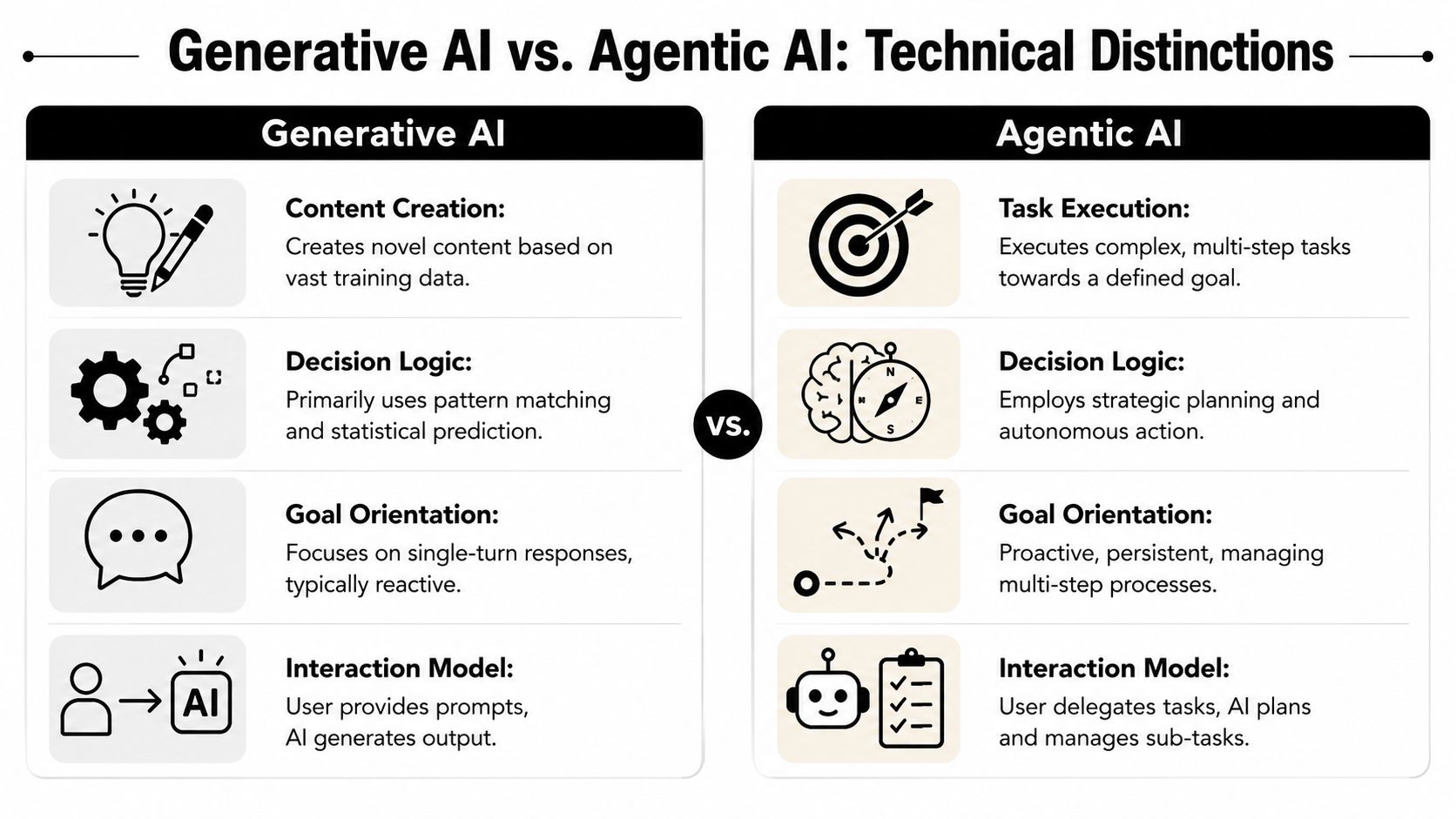
The table above is simple on purpose. Most enterprise failures happen because teams over-focus on the model and under-design the control system around it.
A generative model can answer brilliantly and still fail operationally. It may produce the right reply, but if no system checks order status, updates the CRM, triggers a refund workflow, and logs the action, the customer still has an unresolved issue.
The autonomy loop that changes architecture
Salesforce describes agentic AI as operating through a four-step cycle of perceive, reason, act, and learn in its overview of technical differences between agentic AI and generative AI. That's the key architectural shift.
Generative AI usually stops at generation. Agentic AI keeps going.
- Perceive means the system gathers signals from conversations, enterprise data, APIs, and workflow state.
- Reason means it interprets the goal, constraints, and possible next actions.
- Act means it calls tools, updates systems, or triggers workflows.
- Learn means it uses outcomes and feedback to improve future execution.
This loop is why agentic platforms behave less like chat interfaces and more like orchestration systems with intelligence embedded inside them.
Strong enterprise AI needs two layers working together: a reasoning layer that understands context and an execution layer that can do something about it.
Why this changes enterprise design decisions
Once autonomy enters the picture, architecture changes fast.
You need persistent state, not just session memory. You need tool permissions, auditability, retry logic, escalation paths, and testing for branching behavior. Retrieval also changes role. In a generative setup, retrieval often exists to improve answer quality. In an agentic setup, retrieval supports decision quality inside a larger task flow.
This is also where many organizations discover that one-model strategies are too limiting. Real deployments often need flexibility across model types, channels, and enterprise systems. The technical question stops being “Which model writes best?” and becomes “Which platform can reason, orchestrate, and execute reliably under enterprise constraints?”
Transforming CX and EX with Agentic Automation
The easiest way to understand generative AI vs agentic AI is to compare what the user experiences.

In customer experience, generative AI improves communication. In employee experience, it improves drafting and search. Those are meaningful gains. But the enterprise step change happens when the system owns the process, not just the wording.
Customer experience moves from replies to resolution
Take a shipping-delay scenario.
A generative chatbot can apologize, explain a delay, and suggest next steps. If it has retrieval support, it may also pull a policy excerpt or summarize an order note. That's useful, but the customer still depends on a human or a separate automation layer to solve the problem.
An agentic system handles the same issue differently. It can detect the exception, check the order system, determine the approved remediation path, notify the customer, update the ticket, and trigger the next workflow step. The conversation becomes one part of the service resolution, not the whole service experience.
That's why agentic AI is better suited to process automation and orchestration, while generative AI remains stronger for brainstorming and communication-heavy tasks.
Employee experience shifts from assistance to execution
The same pattern shows up in EX.
A generative assistant can help HR draft an onboarding policy, summarize benefits information, or write responses to common employee questions. But an employee's actual onboarding journey spans identity creation, device provisioning, orientation scheduling, policy acknowledgment, and issue handling across multiple enterprise systems.
An agentic workflow can coordinate those tasks end to end. It can initiate requests, track dependencies, follow up when a step stalls, and keep the employee informed in natural language.
This short explainer is useful if you want to see how that shift is being discussed visually in the market:
Where teams get the most value
The strongest use cases usually have four traits:
- Clear objective: The process has a defined outcome such as resolving a ticket, completing a claim step, or onboarding an employee.
- Connected systems: The AI can access the tools it needs, whether that's CRM, ITSM, HRIS, billing, or logistics platforms.
- Repeatable decisions: The workflow contains policies, thresholds, and known next actions.
- Structured escalation: A human can step in when confidence is low, data is missing, or the action carries material risk.
That's the practical shift from assistance to automation. The AI stops being a better interface for information and becomes a coordinated execution layer for work.
Evaluating Strategic Benefits and Enterprise Risks
The upside of agentic AI is real, but so is the implementation risk.
Benchmark findings cited earlier indicate that agentic systems perform better in complex, multi-step workflows than generative systems, which often break down when sequential decision-making or tool use is required. That matters directly in CX and EX because most high-friction service journeys involve exactly those conditions. The challenge is that higher capability also introduces a wider operational blast radius if the system is poorly governed.

Where the upside is real
Agentic systems can reduce manual handoffs, shorten cycle time, and improve consistency across service operations. In practice, that can affect metrics leaders already track closely, such as resolution speed, containment, employee effort, and process completion quality.
The reason is straightforward. An autonomous system can persist across the workflow. It doesn't stop after creating an answer. It can keep checking state, triggering actions, and managing dependencies.
That's especially useful in environments with fragmented systems. Contact centers, HR service desks, and IT support functions rarely suffer from a lack of text generation. They suffer from too many handoffs between channels, teams, and tools.
The fastest way to disappoint the business is to deploy a polished assistant on top of a broken workflow and call it transformation.
Where deployments fail
The biggest risk isn't that agents are autonomous. It's that organizations give them autonomy without enough structure.
Common failure points include:
- Weak guardrails: The system can take action, but no one has defined approval boundaries, fallback paths, or policy constraints.
- Poor tool hygiene: APIs exist, but permissions are messy, outputs are inconsistent, or key systems lack reliable access.
- Thin testing: Teams test prompts, not workflows. They validate answers, but not retries, edge cases, or escalation logic.
- No clear accountability: Operations, IT, security, and business owners all assume someone else owns the agent once it's live.
Governance matters more than demos. Agentic systems need observability, logs, role-based access, human override, and disciplined rollout. If those controls aren't in place, a simpler generative implementation may be the better short-term choice.
Your Enterprise Implementation Framework
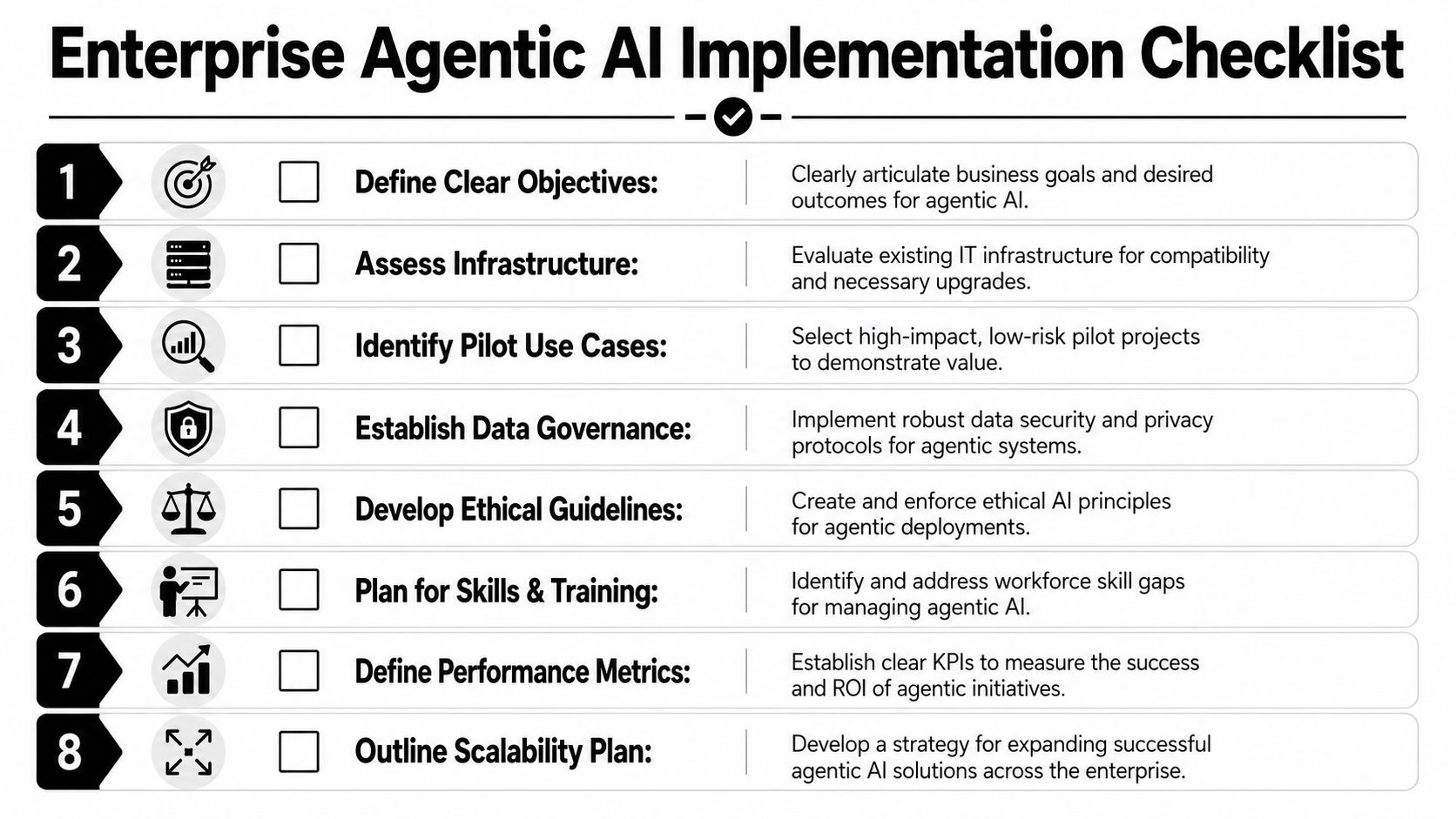
Most organizations shouldn't jump from chatbot pilots to broad autonomy. The better path is staged adoption with hard operational criteria.
Start with process readiness not model excitement
Before selecting vendors or debating model stacks, pressure-test the process itself.
Pick one workflow with real business pain
Good pilots are repetitive, rules-aware, and cross at least one system boundary. Think claims status, onboarding coordination, password reset plus access provisioning, or order exception handling.Audit your execution dependencies
List the systems the agent must read from or write to. If APIs are missing or poorly documented, autonomy will stall. For teams designing knowledge-rich workflows, resources on building an AI agent knowledge system can help frame how memory, context, and retrieval should support execution.Define outcome metrics, not just response quality
Measure task completion, exception rate, escalation rate, and business impact. If you only score tone, accuracy, or answer relevance, you'll miss whether the system is reducing work.Design human takeover deliberately
Don't treat escalation as failure. Treat it as part of the control design.
Choose platforms built for action
Vendor evaluation should focus on agency, not just generation.
Look for these capabilities:
- Multi-LLM flexibility: You don't want your architecture locked to one model or one provider.
- Agent building and orchestration tools: Teams need a practical way to define flows, tools, policies, and handoffs. Platforms such as Yellow.ai's AI Agent Builder are designed around building and deploying AI agents rather than only exposing a chat interface.
- Testing for autonomous behavior: Workflow simulation, branch validation, and failure testing matter more than prompt tweaking alone.
- Enterprise integrations: Tool access determines whether the agent can execute.
- Governance controls: Access boundaries, audit trails, and safe fallback behavior are essential.
A simple readiness checklist helps keep teams honest:
- Data readiness: Is the underlying knowledge current, governed, and accessible?
- System readiness: Can the agent take action through reliable integrations?
- Process readiness: Are the policy paths and exceptions documented?
- Org readiness: Does one team clearly own performance after launch?
The practical goal isn't “more AI.” It's dependable task completion inside enterprise guardrails.
Frequently Asked Questions
Should enterprises start with generative AI or agentic AI
Start with the workflow, not the label. If the need is drafting, summarization, search, or knowledge assistance, generative AI is enough. If the problem requires multi-step execution across systems, agentic design is the better fit.
How should leaders measure ROI
Measure outcomes the business already cares about. Focus on task completion, reduced handoffs, faster resolution, lower manual effort, and cleaner escalation. For generative tools, quality of output matters. For agentic systems, completion quality matters more.
Does agentic AI replace generative AI
No. In most enterprise architectures, agentic systems use generative AI as the reasoning and communication layer. The relationship is additive, not adversarial.
What's the biggest mistake in vendor evaluation
Buying on demo fluency. A polished assistant can look impressive and still fail in production if it lacks tool access, governance, testing, and process control.
If your team is moving from prompt-based copilots to workflow-level automation, Yellow.ai is worth evaluating as part of that shortlist. The platform is built for enterprise CX and EX use cases where AI needs to reason across context, operate across channels, and execute actions through connected systems rather than only generate responses.



