









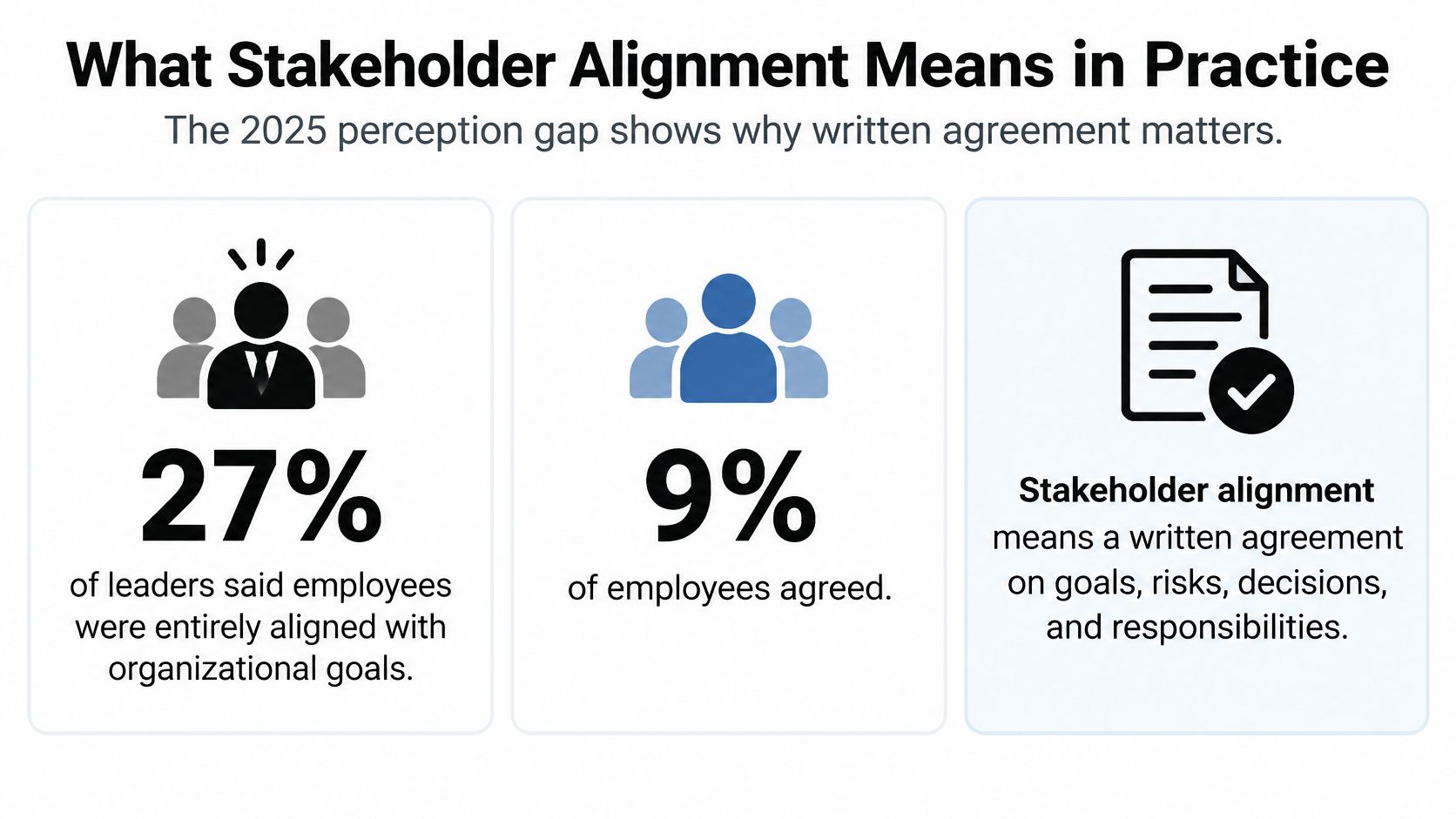
In 2025, 27% of leaders said their employees were entirely aligned with organizational goals, while 9% of employees agreed, according to Axios HQ's internal communications research as reported by Mixing Board. That gap should change what happens in your next steering meeting: stop asking whether everyone supports the program and start asking what each group has agreed to own.
Table of Contents
- What Stakeholder Alignment Means in Practice
- How to Run the Five-Step Alignment Method
- Decision Rules When Stakeholders Stay Split
- Messages That Land with CIO CX HR and Ops
- Measuring Alignment and Spotting False Alignment After Launch
- Lock the Charter Before You Scale
What Stakeholder Alignment Means in Practice
Stakeholder alignment is a written agreement on objectives, decision rights, risk tolerance, and success measures among the groups that can influence or experience a program's outcomes. It doesn't require everyone to prefer the same solution. It requires people to understand how decisions will be made, including decisions they wouldn't choose themselves.
Freeman's stakeholder test is useful here: include “any group or individual who can affect or is affected by the achievement of the organization's objectives,” as described in the stakeholder theory overview. For enterprise AI and customer-experience work, that means customers, service agents, CX, operations, HR, IT, security, legal, finance, vendors, and the executive sponsor.
The perception gap makes the case for checking agreement below the leadership layer.
Approval isn't operating agreement
An approved business case tells you that someone authorized spending. A quiet steering room tells you very little. The operations manager may still lack capacity for exceptions, while HR may not know whether agent scorecards will change.
Real alignment leaves evidence:
- Behavior ownership: A named person answers for what the AI agent does, including failures after a model or knowledge update.
- Outcome ownership: A business leader answers for customer resolution, rather than treating successful execution as successful service.
- Recorded trade-offs: The team documents what it sacrificed, such as broader coverage, to preserve a necessary control.
- Protected challenge: Frontline employees can question an automated decision without being treated as obstacles to adoption.
Say a billing agent can explain a charge but can't authorize an adjustment. CX may accept that boundary; finance may require it. Operations still needs to accept the resulting handoffs and assign capacity to handle them.
Map consequences, not just influence
Don't let the organization chart determine who gets heard. A supervisor whom agents call when the workflow breaks may have more practical influence than a senior leader on the distribution list.
For a useful cross-sector perspective, Unitism®’s Stakeholder mapping for land-value reform offers a resource for thinking about affected interests beyond the immediate project team. The transferable discipline is to identify who bears consequences, not merely who approves funding.
Your working kit should contain a one-page success charter, a decision-rights matrix, role-specific messages, and a proposed 90-day cadence. Before booking another workshop, list the affected groups and the decisions each needs to influence.
How to Run the Five-Step Alignment Method
Run this as a sequence of working decisions, not a workshop series. The program lead maintains the artifacts; accountable leaders supply decisions and evidence.
Build agreement in a usable order
Inventory the stakeholders. Record influence, impact, decision rights, and informal authority in a shared register. Include the supervisor people call, the administrator who understands integration failures, and representatives of affected users. Ask each person who is missing.
Interview for constraints, not endorsements. Ask what outcome each group wants, what it cannot accept, and what would make it withdraw support. Write disagreements plainly. If CX wants broader automation and operations lacks escalation capacity, don't summarize both positions as support for improved service.
Co-create the success charter. Keep the core agreement on one page: business value, customer or employee outcomes, operational KPIs, risk tolerances, and adoption expectations. Put unresolved choices beside named owners. Attach supporting detail rather than turning the charter into a requirements archive.
Convert commitments into authority and work. Build the decision-rights matrix below, then create backlog items with acceptance evidence. A requirement to preserve human handoff becomes routing logic, context transfer, queue ownership, and a testable acceptance condition. It isn't complete because someone added a transfer button.
Review leading indicators weekly and outcomes monthly. Watch participation, sentiment themes, unresolved objections, decision latency, and action closure. Compare those signals with adoption, resolution, escalations, cost-to-serve, and benefits realization. Investigate when enthusiastic participation produces little operational use.
PMI found that 84% of projects defined success criteria upfront, and those projects achieved a Net Promoter Score for Project Success of 41, versus 20 when criteria weren't defined upfront, according to its project success report. Defining success won't remove disagreement, but it gives the team something concrete to resolve.
Decision rights for an enterprise AI or CX program
Treat this matrix as a starting allocation. Replace role labels with people's names before approval.
| Decision | Accountable owner | Consulted | Proceed only when |
|---|---|---|---|
| Automation scope and channels | CX leader | Ops, frontline supervisors, finance | In-scope intents and excluded work are listed on the charter |
| Model, data, and integrations | CIO or platform owner | Security, data protection, legal | Data-use limits and the integration list are signed |
| Workforce impact and skills | HR | Ops, frontline reps, works council where required | Role changes, training, and measurement rules are written |
| Risk, compliance, and pause rights | Security or compliance lead | Legal, CIO, CX | Escalation thresholds and a named pause owner exist |
| Success definition and funding | Executive sponsor | CX, Ops, finance, HR | Baseline, targets, and pilot exit criteria are agreed |
Read each row as a boundary. CX can choose eligible service intents, but can't authorize an unapproved data use. The CIO owns technical choices, but can't redefine employee performance measurement without approval. The sponsor resolves funding and success-definition conflicts without absorbing every operational decision.
Use an AI adoption roadmap to connect these decisions to delivery dependencies. Executive approval is not alignment if operating teams still hold unresolved constraints.
I would refuse channel, model, or vendor selection until the charter and decision-rights matrix are signed. Otherwise, a compelling demo becomes the scope before anyone has accepted its consequences.
Decision Rules When Stakeholders Stay Split
More stakeholder meetings won't create alignment when people share the goal but disagree about acceptable risk. Customer support, HR, IT, security, legal, operations, and finance can all want better service while disagreeing over who absorbs errors, who owns recovery, and what qualifies as success.
A productive meeting ends with an authorized decision, not a more agreeable slide.

Consultation isn't approval
Governance work on heterogeneous stakeholder preferences identifies allocated decision rights, clearly defined corporate objectives, and structured deliberation as practical levers, described in this strategic-management paper. Translate those levers into ordinary operating language: what are we optimizing, who decides, and how does conflicting evidence get heard?
A consulted group must have a genuine opportunity to challenge a proposal. It shouldn't acquire an indefinite veto by not replying. Require an objection to identify the violated constraint, supporting evidence, and requested remedy; an evidenced breach triggers the applicable approval or pause authority.
Approval authority carries a different obligation. The accountable owner must decide, state the rationale, and accept responsibility for consequences within that decision boundary.
Make the pause executable
For an agentic deployment, write the trigger as an observable condition. A prohibited disclosure or unauthorized transaction should trigger an immediate stop to the affected capability; a deteriorating exception pattern can trigger a hold on expansion while the current service continues under tighter supervision.
Name the person who can invoke that pause and the person who can execute it technically. Specify what stops, how work reaches humans, what evidence must be preserved, and who authorizes restart. A pause right without access to disable the workflow is only a request.
This video provides an additional discussion resource for the working group.
Use a short escalation path:
- Working team: Log the competing options, customer impact, evidence, and unresolved constraint.
- Accountable owner: Decide within the assigned row and document the accepted trade-off.
- Steering forum: Resolve cross-row conflicts, especially when customer outcomes, workforce obligations, and technical controls collide.
Set an explicit response deadline in the charter so escalation doesn't become a waiting room. Update the business case when the accepted constraint materially changes cost, coverage, or expected value.
Document the trade-off, don't manufacture a unanimous slide.
Messages That Land with CIO CX HR and Ops
A generic change memo asks different leaders to find their own relevance. That's avoidable work, and it encourages each function to interpret the proposal differently. Use short briefings that address the decision each audience needs to make.
Give each leader a concrete ask
| Audience | What worries them | Message that addresses it | Ask |
|---|---|---|---|
| CIO | Vendor lock-in, shadow models, security debt | Use a governed control plane with explicit data rights, access boundaries, and change records | Name the system owner and integration boundary before demonstrations set scope |
| CX | Containment that leaves customers carrying the hardest work | Judge resolution quality and customer effort, not avoided human contacts | Co-own the intent list and human handoff standard |
| HR | Trust, job design, and invisible employee scorecards | Explain how automation changes work and measurement, including how employees challenge decisions | Publish measurement rules and a protected dissent path |
| Operations | Exception volume and workflows that only handle the happy path | Design around recovery, queue capacity, and actual exceptions | Commit subject-matter experts to design reviews and accept an exception service standard |
For the CIO, bring an architecture boundary and an exit question: what happens to knowledge, logs, and integrations if the model or platform changes? A feature demonstration doesn't answer that question. An export and replacement plan does.
For CX, bring a failed journey, not just a successful transcript. Show where the customer repeats information, loses context, or must restart authentication. That makes the handoff standard a service-design decision rather than a routing setting.
HR needs the proposed measurement policy before training invitations go out. Operations needs exception samples before staffing assumptions become budget commitments. Neither group can give meaningful approval from a headline benefits slide.
Send a decision note, not meeting minutes
Keep the sponsor's decision note consistent across audiences. Use fixed lines for the decision, accountable person, accepted constraint, and next evidence review. The charter supplies the actual person's name and calendar date before the note is sent.
A reusable example for a customer-service pilot is:
Decision: Containment isn't the success measure; resolution quality and customer effort are.
Owner: The named CX leader recorded in the charter.
Constraint accepted: Complex billing contacts transfer to a human before an adjustment is attempted.
Next evidence review: The booked pilot review date, reading resolution quality and customer effort.
Send that same decision, owner, and review commitment to every audience. Change only the constraint line to highlight the relevant obligation: the CIO sees the approved-data boundary, HR sees the employee measurement protection, and operations sees the exception-capacity commitment.
Don't disguise a different decision as customized messaging. If the underlying commitment changes between audiences, the sponsor has created conflicting instructions.
Before the first build sprint, put each leader's accepted ask into the charter. Acknowledging an email isn't acceptance; assigning a person, deliverable, and review condition is.
Measuring Alignment and Spotting False Alignment After Launch
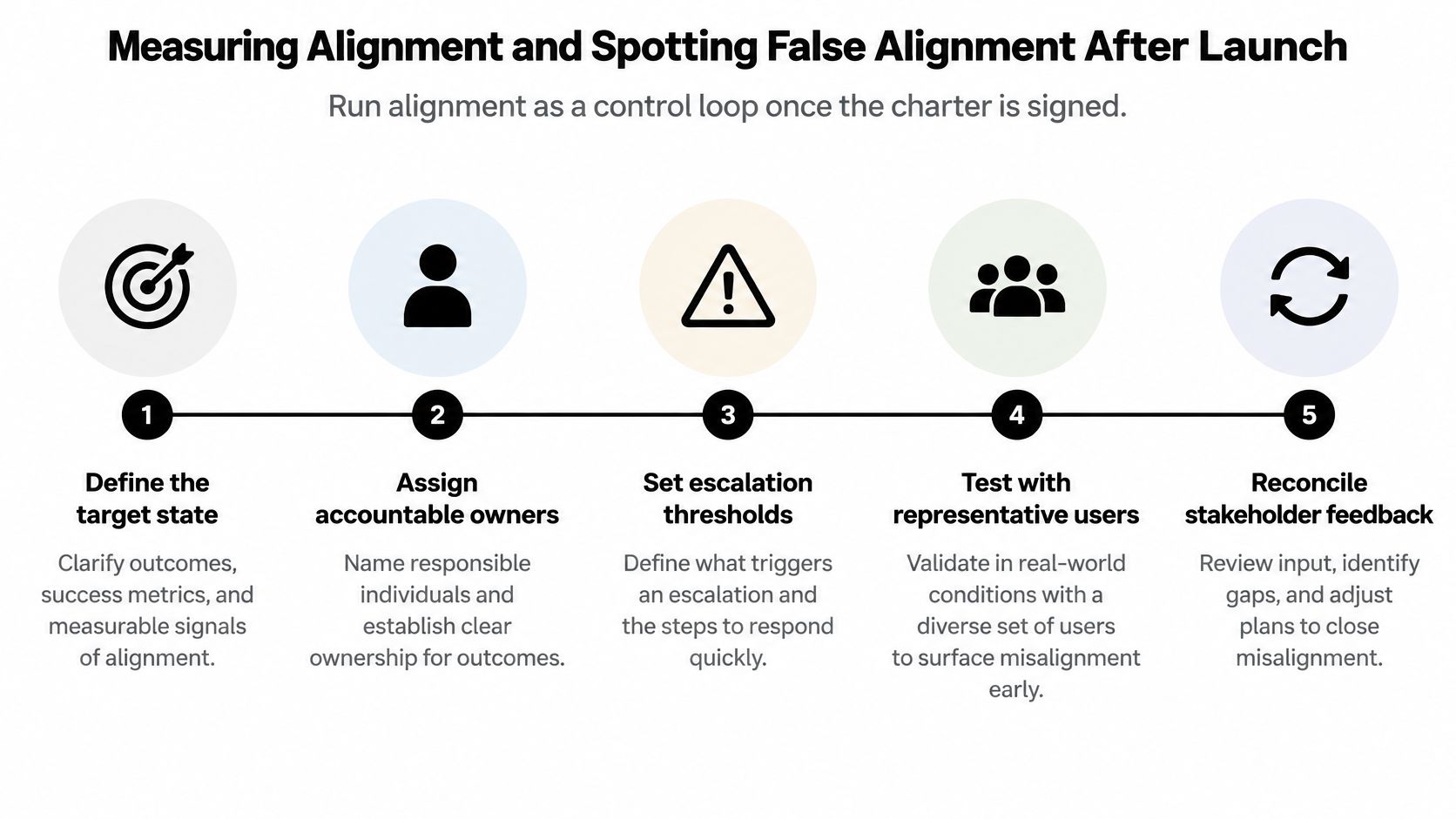
Once the charter is signed, run stakeholder alignment as an operating control loop. Define the target state, assign accountable owners, set escalation thresholds, test with representative users, and reconcile stakeholder feedback with delivery evidence.
Use a steering forum for scope and risk decisions, workflow design reviews for subject-matter detail, and frontline usability tests before production expansion. Don't make the steering committee adjudicate every interface defect, or let workflow designers accept risks outside their authority.
Measure outcomes, behavior, and execution
- Organizational outcomes: Resolution rate, escalation volume, cost-to-serve, benefits realization, and customer effort. Examine whether improved automation results correspond to better service.
- Individual behavior: Employee proficiency, override use, handoff quality, and policy compliance. Check whether employees can perform the new workflow under realistic conditions.
- Change execution: Participation, unresolved objections, decision latency, and closed actions. Count closure only when the affected person can verify the promised remedy.
Prosci reports that 76% of respondents who measured compliance and overall performance met or exceeded project objectives, compared with 24% among those who didn't, in its stakeholder engagement guidance. Measurement needs an owner who can act on the result, not merely someone who updates a dashboard.
The operating sequence should remain visible after launch.
Use the calendar to organize work, not authorize expansion
The following is a proposed 90-day stakeholder alignment cadence, not a promise that every program should launch on that schedule. Advance when the exit evidence is accepted; move the date when it isn't.
| Phase | Owner | Exit criterion |
|---|---|---|
| Days 1–30: Define and authorize | Program lead and executive sponsor | Charter signed, decision owners named, baseline established, and material objections assigned |
| Days 31–60: Validate the workflow | CX leader and platform owner | Representative tests pass, handoffs work, and controls are evidenced |
| Days 61–90: Pilot and decide | Operations leader and risk owner | Pilot outcomes meet agreed criteria, exceptions have capacity, and restart procedures are tested |
| Month 4 onward: Reinforcement | Change owner | Monthly outcome review and a closed-action log |
Keep a gate record with the evidence, reviewer, decision, and unresolved conditions. A launch date on a project plan isn't evidence that the workflow is ready.
Look for trust at the point of work
PwC reports that 66% of surveyed respondents said their company experienced trust concerns around AI, data privacy, or transparency to at least a moderate extent during the prior year, in its discussion of AI alignment. Don't assume training attendance tells you whether employees trust the system or understand their exposure.
Run these monthly checks:
- Read override and escalation patterns by team. A low override rate might indicate reliable automation, or employees who believe intervention will hurt their score.
- Compare training completion with live workflow use. Ask employees to demonstrate the exception path, not just recall the training.
- Sample comments about automated measurement. Check whether people can explain how their work is assessed and challenge an incorrect assessment.
- Review complaints tied to automated answers. Separate factual errors, policy errors, inaccessible journeys, and failed recovery.
- Compare outcomes across relevant demographic or language groups. Use appropriate privacy controls and investigate differences rather than averaging them away.
Log every frontline challenge and assign an accountable responder. Close it with a workflow change, a demonstrated explanation, or an explicitly accepted risk. Preserve a protected escalation route when the employee disputes that response.
Practical rule: A closed ticket isn't a resolved concern unless the response addresses the evidence.
False alignment often appears as full meeting attendance, absent informal influencers, incompatible success definitions, and a reinforcement plan that ends at go-live. Look for employees using unofficial workarounds, supervisors privately reversing automated decisions, and unresolved actions repeatedly carried into the next meeting. Those are operating problems, not communication problems.
Lock the Charter Before You Scale
Make the expansion decision a go or no-go, not an expression of confidence. A successful demonstration doesn't authorize more channels, broader access, or more consequential actions.
Apply the release test
Authorize expansion only when the following evidence is available:
- Signed charter: The sponsor and affected owners have accepted the operating objective and its constraints.
- Usable authority: Scope, data, workforce, and pause decisions have named accountable people.
- Accepted role asks: CIO, CX, HR, and operations leaders have committed the resources and deliverables required from them.
- Pilot exit evidence: Results satisfy the agreed conditions, and frontline employees have a working dissent route.
If something is missing, finish the artifact or test before widening deployment. Don't compensate for an unresolved ownership question with a smaller rollout and hope that nobody needs to make the decision.
Technology selection should follow those boundaries. A platform such as Yellow.ai is an option for deploying conversational agents against accepted intents, risk limits, and handoff rules; an existing contact-center stack may suit a narrower workflow. Evaluate either against the same charter.
Leave with an authorized decision
Use an enterprise AI governance checklist to prepare a short briefing with the accountable leaders. Put open trade-offs on the agenda, not a tour of completed project tasks.
Ask the owner of each unresolved condition to accept it, remedy it, or recommend a hold. If nobody can say who pauses the program, the answer for this phase is no-go. Record the release decision, remaining restrictions, and next review date before leaving the room.
We scale what we can own, measure, and pause.
Yellow.ai offers conversational AI agents for customer and employee service, with tools to design, test, deploy, and monitor workflows. Bring your accepted intents, ownership boundaries, and pilot criteria to Yellow.ai to discuss a deployment scoped around decisions your team is ready to own.