










Your board has seen the demo. Your customer service team has a backlog of requests it wants automated. IT has a promising prototype, legal has unanswered questions, and finance wants to know when any of this will change operating costs. Everyone agrees AI matters. Nobody agrees on what earns the next release.
A credible AI adoption roadmap resolves that disagreement before implementation starts. Treat it as a gated investment portfolio, not a calendar of pilots. For customer experience (CX) and employee experience (EX), the right strategy is fewer experiments, stronger evidence, and explicit permission to stop.
Table of Contents
- Why Most Enterprise AI Pilots Never Reach Production
- The Five-Stage Gated Roadmap from Pilot to Scale
- Weaving Governance into Every Stage with NIST Govern Map Measure Manage
- Build Versus Buy and the Multi-LLM Decision
- Data Readiness, RAG, and the Integration Choices That Decide Scale
- Change Management, Automated Testing, and the Runbook That Keeps AI Honest
- Your 90-Day First Quarter and Frequently Asked Questions
Why Most Enterprise AI Pilots Never Reach Production
The first mistake is rewarding demonstrations. The second is postponing measurement until after the team has built something. Together, these habits let sponsors mistake a convincing interaction for an operational improvement.
Consider a hypothetical service assistant that answers a policy question correctly. That demonstration doesn't establish whether it can authenticate the customer, retrieve the applicable policy, complete an authorized action, or transfer the request with its context intact. It proves an answer was possible, not that the enterprise should delegate the workflow.
Production-grade agentic AI needs a stricter definition. It must perform an authorized task within documented boundaries, produce evidence of what happened, and return control safely when it can't continue. A human reviewing every interaction may be appropriate during evaluation, but that arrangement doesn't prove autonomous service economics.
Deployment isn't the same as enterprise maturity
IBM's 2023 Global AI Adoption Index, based on 2,342 IT decision-makers and influencers across 20 countries, found that 42% of enterprises were actively deploying AI and 40% were exploring it; for generative AI, 38% were implementing and 42% were exploring. These are historical adoption measures, not a current production-readiness benchmark.
The useful distinction is between starting an initiative and institutionalizing it. A team can deploy an application without establishing durable ownership, comparable economics, or a reliable operating process.
For a complementary discussion of stalled integration work, use insights from Arch on AI failures to structure a review of your own unresolved dependencies. Ask which decisions remain open, who can resolve them, and whether the pilot depends on manual work nobody has costed.
Remove the habits that protect weak pilots
Watch for these behaviors in portfolio reviews:
- Demo-led funding: Sponsors authorize expansion because the interface impressed them, without comparing outcomes against existing service.
- Measurement after implementation: Teams choose success criteria once they know which metrics look favorable.
- Ownerless operations: Engineering completes the prototype, but nobody accepts responsibility for service quality, maintenance, or incidents.
Practical rule: If nobody can name the business outcome, the economic owner, and the stopping condition, don't authorize the pilot.
My recommendation is blunt: stop treating pilot volume as evidence of progress. Fund the workflows your organization can measure, govern, and operate. Leave the rest in discovery until their sponsors can make a defensible case.
The Five-Stage Gated Roadmap from Pilot to Scale
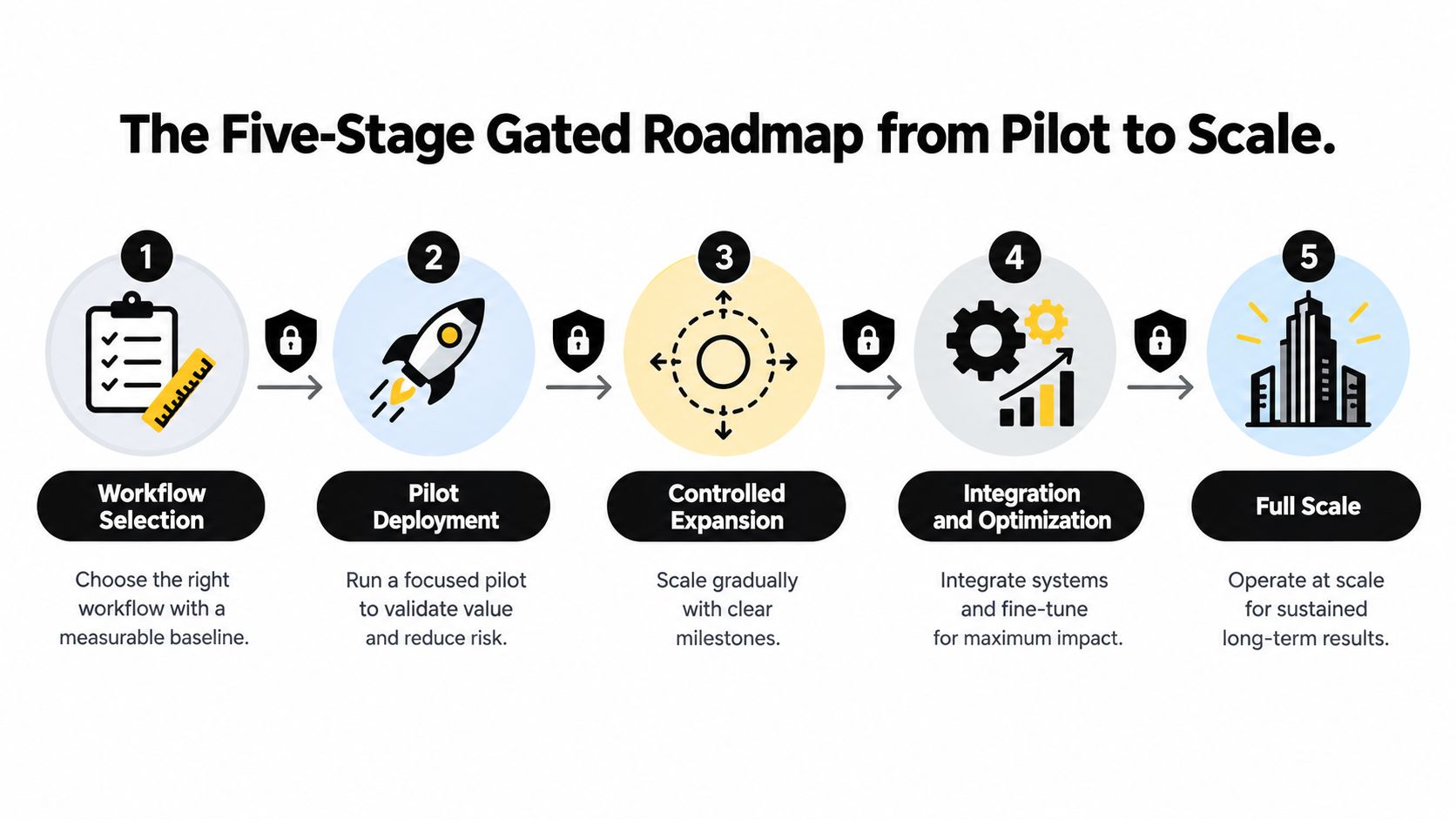
A stage gate is a decision backed by evidence, not another steering committee presentation. Every gate needs a named decision-maker, an exit artifact, and a credible no-go outcome.
The economics justify that discipline. Infosys research on the AI ROI gap reports that 72% of respondents said fewer than one-quarter of their pilots both scaled enterprise-wide and delivered intended ROI; 67% struggled to measure AI ROI, and 46% lacked a centralized KPI framework.
Use the following progression for a hypothetical assistant handling routine inbound service inquiries. Treat the visual as an overview of deployment maturity, not permission to defer mapping until after launch.
Establish the case and map the work
Workflow selection starts with a bounded request, such as checking an order's status. The service owner documents current resolution outcomes, handling effort, repeat contacts, and cost. Finance validates the benefit assumptions. The exit artifact is an investment brief with a baseline and an agreed scale-or-stop rule; no credible baseline means no pilot.
For an implementation-oriented companion, consider Wonderment Apps' guidance to maximize AI ROI in your company. Use that discussion to challenge your assumptions, not replace your own financial model.
End-to-end mapping comes next. The solution architect traces identity checks, knowledge sources, order-system access, tool permissions, and human handoffs. Distinguish what the model recommends from what application logic authorizes. The exit artifact is a reviewed workflow and dependency map; unresolved access rights or an unowned handoff should block progression.
Require evidence before expansion
The controlled pilot tests the complete request journey against predefined quality, safety, latency, adoption, and financial thresholds. The product owner controls scope and records the comparison method before reviewing results. The exit artifact is a pilot evaluation, including failures and supervisory effort, not a collection of favorable transcripts.
Hardening turns a promising implementation into a supportable service. Engineering and security owners assemble representative evaluation cases, adversarial tests, access controls, monitoring, and a demonstrated rollback procedure. The exit artifact is a release-readiness package. A critical unresolved failure should prevent release regardless of average performance.
At scale, the operations owner accepts the service, the change lead confirms workforce readiness, and finance approves ongoing outcome reporting. Expansion should proceed only when representative results remain stable and the receiving team has capacity to manage the additional workload.
| Gate outcome | Required action |
|---|---|
| Evidence supports expansion | Approve the next bounded deployment |
| A correctable dependency remains | Assign remediation and reassess |
| Economics or safety remain unacceptable | Stop or redesign the use case |
Don't make stopping synonymous with failure. A rejected investment can be a good portfolio decision. The expensive mistake is continuing because the team has already spent money.
Weaving Governance into Every Stage with NIST Govern Map Measure Manage
Governance should determine what an AI system may do, who can change that permission, and what evidence reviewers need. A signed policy alone answers none of those operational questions.
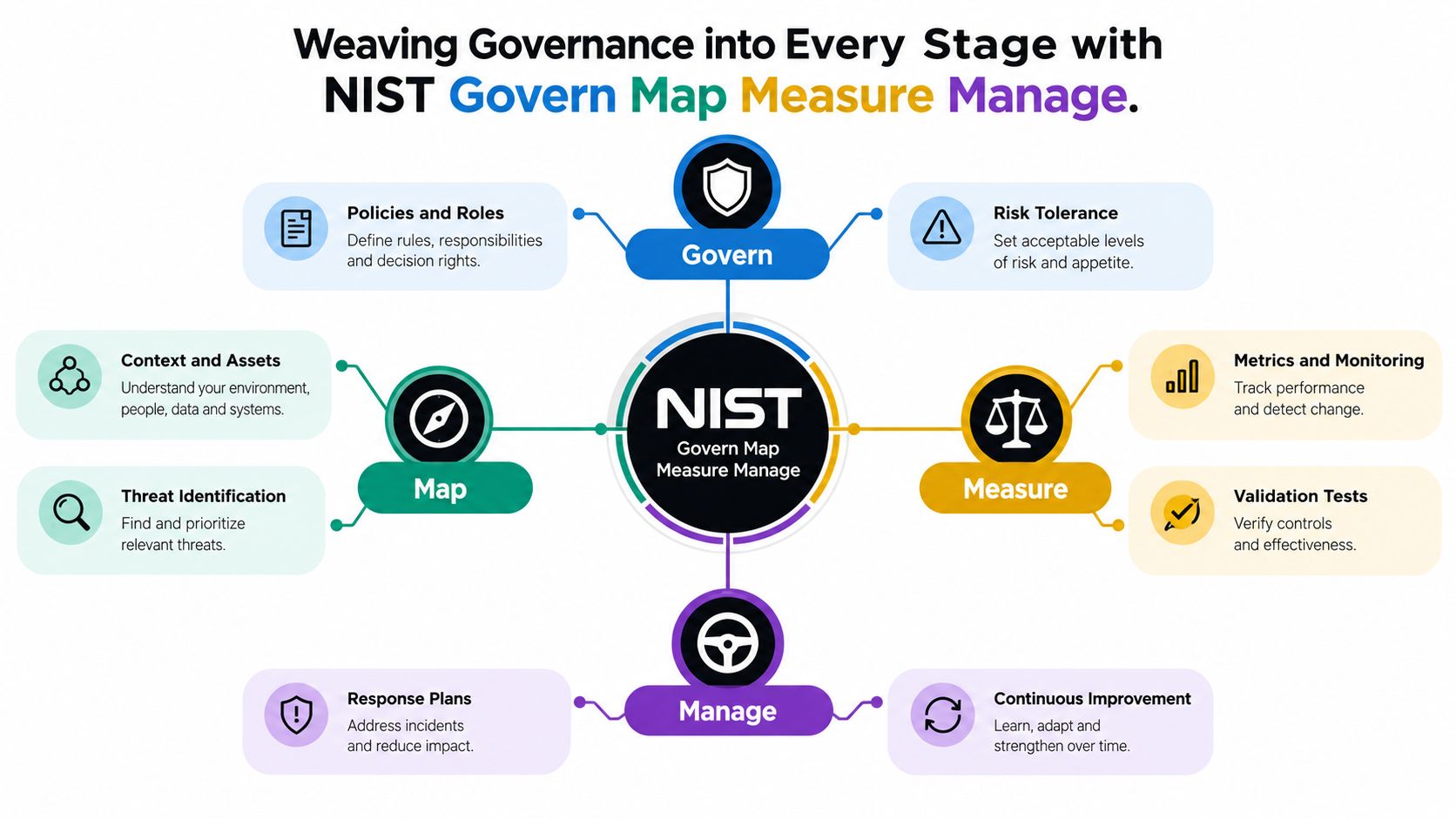
The NIST AI Risk Management Framework development record documents the release of AI RMF 1.0 on January 26, 2023, organized around Govern, Map, Measure, and Manage. The framework is voluntary and intended for use across sectors and use cases. Treat it as a lifecycle discipline, not a certification or a substitute for applicable legal requirements.
Assign decision rights before granting autonomy
Govern means putting accountable people around the system. The executive sponsor owns the investment decision, the product owner owns workflow performance, and designated security, privacy, and compliance representatives approve controls within their remit. Record who can authorize new actions and who can suspend them.
Map means documenting context and consequences. An assistant answering a published leave-policy question shouldn't receive the same authority as an assistant changing an employee's leave record. Examine the affected user, the data involved, the reversibility of the action, and the consequences of a mistake.
Task-level autonomy boundaries belong here. Define whether the agent may retrieve information, draft a recommendation, request approval, or execute a transaction. Don't infer permission to act from permission to read.
Make oversight usable during operations
Measure turns risk concerns into testable questions. Evaluate whether the system respects access boundaries, follows approval requirements, and behaves appropriately when records conflict. Include operational performance alongside privacy, security, and fairness considerations.
Manage assigns responses to the findings. Specify mitigation owners, escalation routes, human override rights, and evidence-retention requirements. Revisit those decisions when the workflow, data, model, or population changes.
A practical enterprise AI governance approach should connect these responsibilities to deployment decisions rather than create a parallel paperwork process.
Before each gate, require a compact evidence pack:
- Authority register: Allowed actions, prohibited actions, approval thresholds, and accountable owners.
- Context record: Relevant users, systems, sensitive information, and foreseeable harms.
- Evaluation record: Test coverage, unresolved limitations, and accepted residual risks.
- Response record: Incident ownership, override procedures, and retained audit evidence.
Don't ask whether the model has been approved. Ask whether this action, using this data, for this user, has been authorized.
Centralize the standards and the highest-risk decisions. Let teams reuse approved controls for lower-risk work. That gives reviewers a clear basis for intervention without requiring the AI council to debate every routine configuration change.
Build Versus Buy and the Multi-LLM Decision
Don't start with vendor demonstrations. Start with the cost of a successfully completed request.
Ask finance and the workflow owner to model expected eligible volume, model and infrastructure consumption, integration work, maintenance, human review, and the value of improved resolution or reduced handling effort. Keep capacity released separate from cash savings. Employees having more time doesn't automatically reduce expenditure.
The denominator matters. A low cost per generated answer can conceal repeat contacts, unsuccessful tool calls, and additional employee supervision. Compare alternatives on the same completed business outcome.
Choose the operating model before the model provider
A Fortune report covering an MIT-related analysis reported that approximately 95% of enterprise generative-AI pilots produced no measurable P&L impact, while about 5% achieved rapid revenue acceleration; partnerships or specialized external solutions reportedly succeeded about 67% of the time, versus roughly one-third as often for internal builds. Treat these as directional findings whose scope and methodology matter, not universal odds for your program.
My recommendation is to buy repeatable capabilities and build differentiated workflow logic. Building a proprietary orchestration layer can be justified, but only if the enterprise intends to maintain it as a product. Access to capable developers isn't the same as funded operational capacity.
A single agentic platform can consolidate workflow design, testing, and operations. A best-of-breed stack gives the enterprise more component-level control but requires an owner for cross-component reliability. A hybrid can retain a common agent layer while allowing different models behind it.
Vendor Posture Decision Matrix for Enterprise AI Programs
| Enterprise condition | Single agentic platform | Best-of-breed stack | Hybrid with multi-LLM |
|---|---|---|---|
| Limited platform-engineering capacity | Prefer an integrated operating surface | Avoid unsupported assembly work | Consider if routing is managed |
| Complex compliance requirements | Validate controls and contractual evidence | Choose when custom enforcement is necessary | Verify every model route |
| Mature integration and engineering teams | Assess whether standardization helps | Consider for differentiated workflows | Consider for shared orchestration |
| Broad use-case portfolio | Check functional coverage | Budget for component sprawl | Require consistent evaluations |
| Unclear data ownership | Resolve ownership before buying | Don't build around the gap | Model choice won't resolve it |
Multi-LLM isn't an outcome by itself. Require an operational reason for each route, such as task suitability, approved deployment location, resilience, or economics. Every route should satisfy the same workflow-level acceptance criteria.
Ask vendors to demonstrate exportability, model-version controls, failure behavior, and consumption reporting using your evaluation cases. A fallback model isn't useful if it violates data policy or changes task behavior without detection.
Choose the posture your team can operate, not the architecture that looks most flexible on a slide. Flexibility without ownership becomes another maintenance obligation.
Data Readiness, RAG, and the Integration Choices That Decide Scale
Before changing the model, inspect the information and permissions it receives. For a service assistant, a plausible answer built from an obsolete policy is still a wrong answer. A correct answer based on another employee's restricted record is a security failure.
The NIST AI RMF publication provides a lifecycle basis for documenting system context, evaluating risks, and monitoring outcomes. Apply that discipline to the complete data path, not just the model's output.
Separate enterprise knowledge from transaction state
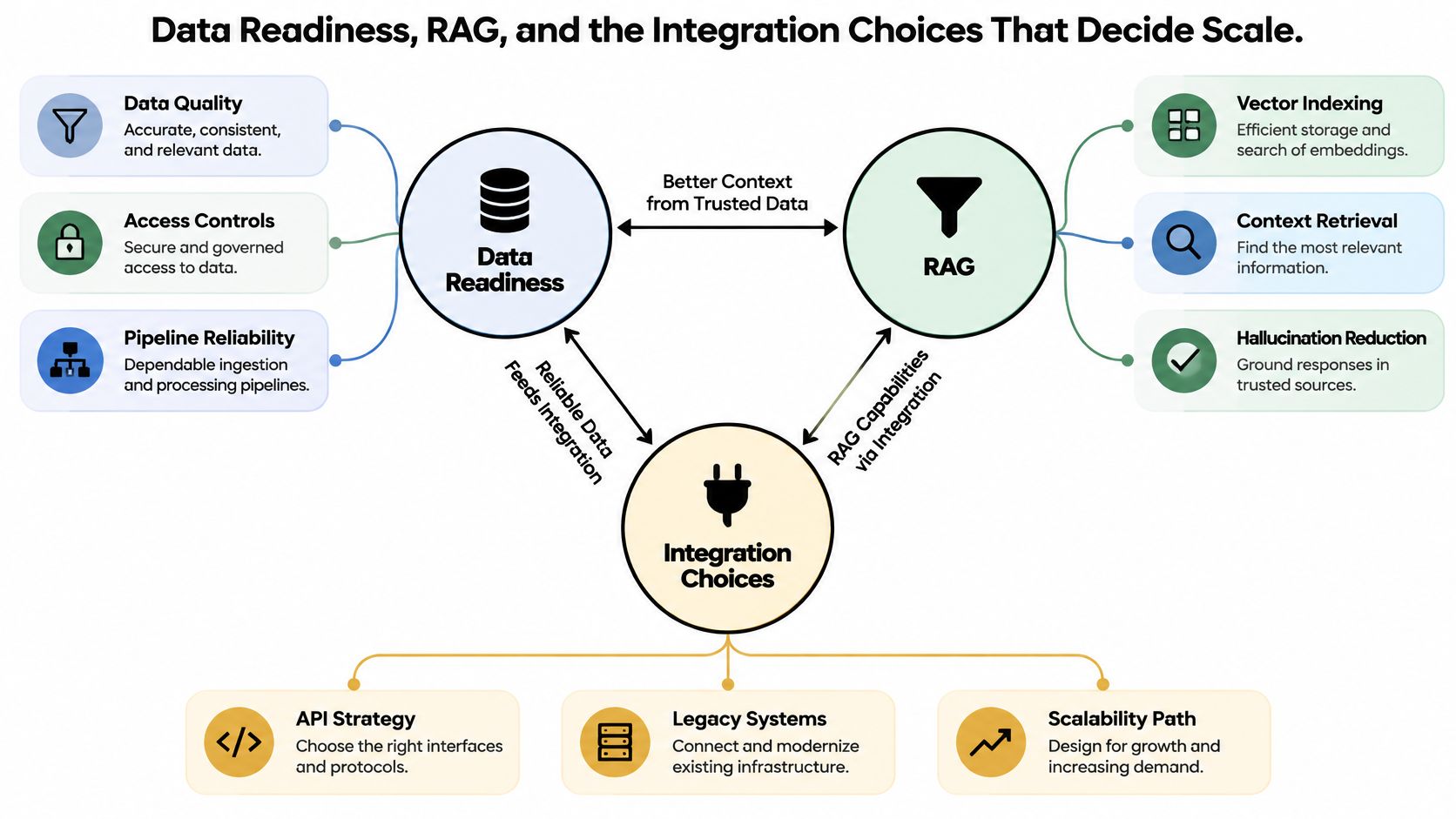
Treat the Conversational Knowledge Base as a governed service, not a document dump. Assign authoritative sources and content owners. Set freshness expectations according to the consequences of stale information, and define how corrected or retired content leaves the retrieval path.
Use retrieval-augmented generation to supply relevant enterprise context to the answer-generation process. In an agentic design, specify when the assistant should retrieve information, ask a clarifying question, or stop because available evidence is insufficient. Retrieval does not guarantee correctness; test whether the selected evidence supports the response.
Keep policy knowledge separate from live transaction state. Published guidance may explain how refunds work, while the transaction system determines whether a particular order is eligible. Don't let retrieved prose substitute for a current system check.
As a preparation resource, digna's guidance to prepare data for reliable AI can support discussions between data owners and implementation teams. Convert those discussions into explicit acceptance requirements.
Challenge the integration design
A pre-built connector can simplify initial connectivity. It doesn't establish the meaning of a field, reconcile conflicting customer identifiers, or decide which system owns a record. Require architects to explain those decisions in business language.
For actions that change records, define duplicate-request handling, retry behavior, timeouts, partial-failure recovery, and confirmation to the user. The assistant must distinguish a successful transaction from a successful API connection.
Use this readiness checklist before authorizing live traffic:
- Source authority: Each policy and transactional field has an accountable owner.
- Permission preservation: Retrieval and tool execution enforce the user's access rights.
- Freshness handling: Teams can identify stale, conflicting, and withdrawn material.
- Evaluation coverage: Test cases include missing evidence and integration failures.
- Dependency visibility: Owners can trace upstream changes to affected workflows.
Plan voice, chat, email, images, and video around shared identity, permissions, and business state. Evaluate their interfaces separately where needed, but don't create disconnected business logic for each channel.
Architecture test: Ask what happens when the source system changes its schema or becomes unavailable. Require an executable answer, not an assurance.
Change Management, Automated Testing, and the Runbook That Keeps AI Honest
A launch plan isn't an operating model. Define how employees will supervise, correct, and challenge the service before you ask them to rely on it.
Testing reviews should bring service specialists and engineers together around actual outcomes.

Capgemini's 2025 generative AI research reported that 93% of surveyed large organizations were exploring or enabling generative AI, yet 71% couldn't fully trust autonomous agents for enterprise use; 46% had governance policies, with adherence remaining low. My recommendation is to treat trust as an operational requirement supported by evidence, not a communications campaign.
Redesign the work people actually perform
Name who handles escalations, corrects knowledge, reviews exceptions, and decides whether a behavior warrants suspension. Adjust workload expectations so employees have time for those duties. Otherwise, you're assigning supervision without funding it.
Training should include failed retrievals, incorrect actions, ambiguous requests, and contested answers. Employees need to know how to intervene, not merely how to use the interface.
Build an automated test suite from representative requests and confirmed failures. Include paraphrases, permission violations, prompt-injection attempts, unavailable tools, and interrupted conversations. Use an AI Copilot to preview behavior and inspect execution traces, but retain independent acceptance checks rather than letting generated tests define correctness.
A practical approach to testing AI agents should connect each test to an expected behavior and a responsible reviewer.
The following video provides an additional viewing resource for the team's implementation discussion.
Maintain a release scorecard and a response runbook
Use a scorecard that makes trade-offs visible:
| Measure | Review question |
|---|---|
| Task success and grounded-answer rate | Did the assistant complete the request using supported information? |
| Escalation appropriateness | Did it transfer control when required? |
| Unsafe-response rate | Did it breach a prohibited behavior? |
| p95 latency | Was slower-tail performance acceptable for the channel? |
| Cost per resolved interaction | Did complete service economics meet expectations? |
| Customer or employee satisfaction | Did users accept the experience? |
The runbook should name the incident owner, suspension trigger, human fallback, evidence to preserve, and conditions for reinstatement. Trigger fallback when confidence, policy, or data-quality requirements aren't met. Review confirmed failures with operations and engineering, then add regression coverage before reopening affected behavior.
Your 90-Day First Quarter and Frequently Asked Questions
Use this 90-day plan as a proposed planning cadence, not a promised implementation duration. Appoint the executive sponsor, accountable product owner, and cross-functional AI council before implementation begins.
- Weeks one to two: Select the workflow and validate its baseline.
- Weeks three to six: Resolve data, integration, and governance requirements.
- Weeks seven to ten: Run the bounded pilot against agreed acceptance criteria.
- Weeks eleven to twelve: Complete initial hardening and make the go/no-go decision.
- Quarter close: Record remaining actions and the next investment decision.
Frequently asked questions
How long should a realistic pilot take?
Use the proposed window for a bounded workflow. Extend discovery when access, policy, or integration questions remain unresolved.
Who belongs on the AI council?
Include business operations, product, IT, security, privacy, compliance, finance, and workforce representatives with actual decision rights.
What if a pilot fails its gate?
Classify the failure as remediable, economically unattractive, or unacceptable risk. Assign corrective work, redesign, or stop.
Does the roadmap apply across channels and back-office workflows?
Yes. Keep investment discipline consistent while adapting evaluations to each interface and action.
The signals that matter
Look for clearer ownership, reproducible outcome evidence, and fewer unresolved release blockers. More demonstrations aren't a substitute.
Yellow.ai offers an enterprise agentic AI platform for CX and EX, with agent-building, knowledge-grounding, testing, and analytics capabilities. Visit Yellow.ai with a bounded workflow, a validated baseline, and your gate criteria, then ask the team to demonstrate how those requirements would be implemented and evaluated.