














Most business case advice starts in the wrong place. It tells you to polish the executive summary, sharpen the ROI slide, and make the funding request compelling. That approach treats approval as the finish line. In enterprise environments, approval is only the point at which the test begins.
A credible business case is a decision instrument and a value-realization system. It should show why the organization must act, compare credible alternatives, expose uncertainty, assign ownership for every material benefit, and define how leaders will know whether the investment is working after launch. The UK government's Five Case Model guidance formalizes this discipline through strategic, economic, commercial, financial, and management dimensions. That structure remains relevant because boards don't approve ideas. They approve accountable decisions.
Table of Contents
- Why Most Business Cases Die on the CFO's Desk
- The Strategic and Economic Spine of a Strong Case
- Building a Cost Model That Survives Scrutiny
- Modeling ROI and NPV Without Overconfidence
- When the Real Value Is Risk Reduction Not Revenue
- Stakeholder Mapping, KPIs, and the Communication Plan
- Approval Checklist and Common Objections Answered
Why Most Business Cases Die on the CFO's Desk
A business case usually fails before finance challenges the spreadsheet. It fails when the document arrives as a polished funding memo instead of a clear answer to a defined decision.
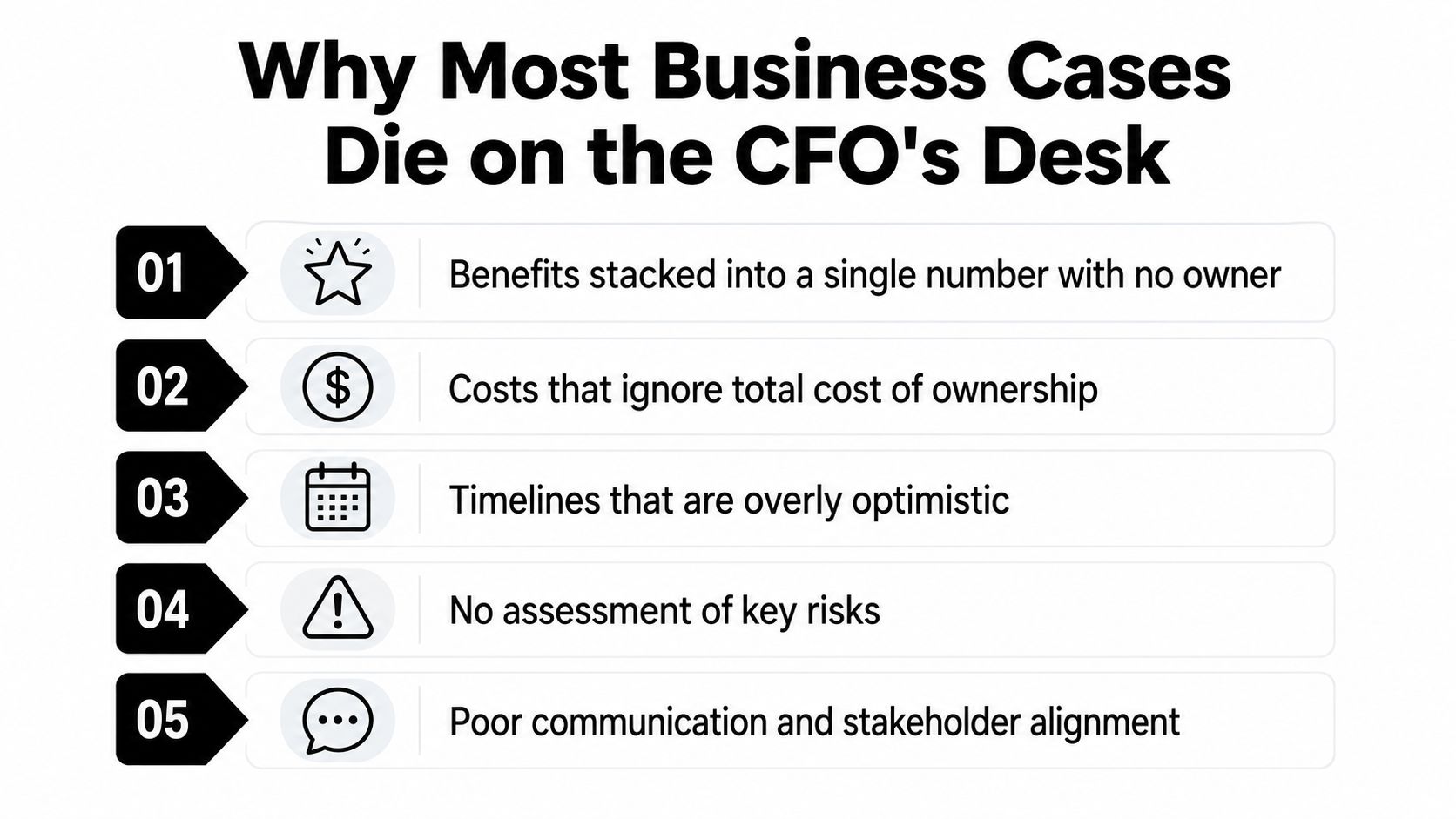
CFOs, CIOs, security teams, and operating executives look for the same weaknesses. Benefits appear as one optimistic total with no accountable owner. Costs exclude integration, data work, training, support, or the productivity disruption caused by implementation. The timeline assumes full value immediately after go-live. Downside scenarios are absent. After approval, nobody has a formal process for checking whether the assumptions still hold.
The fix isn't another template. It's a change in posture.
Write for the decision, not the project
Start with the decision the board or investment committee must make. State the amount and type of commitment requested, the alternatives considered, the consequences of waiting, and the conditions under which the organization should pause or stop.
A strong case also makes rejection visible. If the team considered process redesign, internal development, a competing platform, and no change, explain why each option was rejected. Finance gains confidence when the recommendation survives comparison rather than standing alone.
Practical rule: Every benefit line needs an owner, a baseline, a measurement source, and a review date.
The benefits-realization discipline described in PMI's benefits realization framework treats benefits as outcomes that must be identified, executed against, measured, and sustained. That means the business case should include a register that survives the approval meeting. Each quarter, owners should re-forecast benefit delivery, document adoption or delivery barriers, and recommend corrective action.
Make uncertainty explicit
A three-year payback claim means little if the model hides its ramp, dependencies, and assumptions. Show what must happen for the benefit to materialize, who controls those conditions, and what happens if adoption, integration, or operating capacity lags.
The document should make three things easy to find:
- The decision: What approval is required, from whom, and by when?
- The exposure: Which assumptions could damage value, cost, timing, or compliance?
- The control system: How will leaders track performance and change course?
That reframing changes the review. Finance can test the economics, IT can examine feasibility, security can assess exposure, and the executive sponsor can see exactly what accountability continues after funding.
The Strategic and Economic Spine of a Strong Case
A durable case has two connected layers. The strategic layer explains why the organization should act. The economic layer proves whether the preferred response creates enough value relative to its cost and risk.
The Five Case Model remains a useful reference because it tests whether a proposal is strategically needed, economically worthwhile, commercially viable, financially affordable, and deliverable across management arrangements. Infrastructure Australia's Assessment Framework similarly expects a case to establish the strategic rationale, assess relevant costs and benefits, examine deliverability, and explain how the preferred option will be delivered.
Build the strategic layer around four questions
Why now? Identify the trigger. It might be a service constraint, an aging platform, a regulatory requirement, a board priority, or a capability gap that now limits growth.
Why this initiative? Define the capability the investment creates. Avoid describing software features. Explain the operating change, such as faster resolution, more consistent employee support, stronger controls, or better access to enterprise knowledge.
Why us? Show why the organization can execute. Name the data, process ownership, skills, leadership sponsorship, and operational capacity already available. If those conditions don't exist, include their creation in the plan and cost model.
Why this option? Compare the preferred route with credible alternatives, including doing nothing. A conversational AI proposal, for example, should make clear whether the evaluation covers integration depth, governance, knowledge quality, analytics, deployment channels, and operating ownership. A practical guide to evaluating conversational AI solutions can help teams structure that comparison.
The economic layer then translates those answers into measurable value. Include direct savings, revenue effects where supportable, cost avoidance, capacity release, risk reduction, and total cost of ownership. Do not bury uncertainty in a footnote. Tag each benefit with a driver, owner, measurement source, timing assumption, and confidence assessment.
| Layer | Key Questions | Required Evidence |
|---|---|---|
| Strategic layer | Why act now? Why this capability? Why this organization? Why this option? | Board priorities, current-state evidence, options analysis, consequence of inaction |
| Economic layer | What value does the option create? What does it cost? What could change the result? | Baselines, benefit drivers, TCO, scenario analysis, risk assumptions |
| Connection between layers | Does every strategic claim translate into an economic outcome? | Traceability from strategic objective to KPI, owner, and review date |
The spine holds when a board-level objective connects directly to an economic line, and every economic line answers a strategic question the board cares about.
Building a Cost Model That Survives Scrutiny
Cost credibility determines whether finance treats the case as serious. A single implementation estimate rarely reflects the investment an enterprise must make to operate a new capability safely and consistently.
Build total cost of ownership from the operating model backward. Identify what the organization must buy, build, integrate, govern, train, support, and eventually retire. Infrastructure Australia's framework emphasizes capturing relevant costs and benefits, not merely the visible purchase price. That principle matters just as much for an AI platform as it does for a major infrastructure option.
Itemize the full cost stack
Separate one-time costs from recurring costs, then map each item to the fiscal period in which it occurs. Your model should consider:
- Build and configuration: Solution design, workflow configuration, testing, documentation, and project management.
- Integration and data: APIs, data engineering, knowledge preparation, identity access, monitoring, and environment management.
- Security and compliance: Reviews, controls, audit preparation, privacy work, and required assurance activities.
- Adoption and change: Training, communications, process redesign, support for managers, and temporary productivity loss during cutover.
- Run costs: Licenses, usage fees, cloud infrastructure, support, model operations, analytics, and continuous improvement.
- Retirement: Data migration, contract exit, legacy decommissioning, archiving, and process changes tied to the replaced system.
- Contingency: A transparent reserve tied to known uncertainty, not an unexplained padding percentage.
Vendor escalators, minimum commitments, security requirements, and support tiers often create more financial drag than the initial license discussion suggests. Tag every assumption with its source, owner, date, and whether it's confirmed, estimated, or dependent on negotiation.
| Cost Category | Typical Treatment | Risk of Underestimation |
|---|---|---|
| Licenses and usage | Modeled from quoted commercial terms | Escalation, volume changes, minimum commitments |
| Integration and data | Often treated as a project detail | Internal labor, data quality work, testing, and rework |
| Security and compliance | Added late in the approval process | Delays, specialist effort, control remediation |
| Training and adoption | Limited to formal training sessions | Manager time, communications, workflow redesign, productivity dip |
| Support and optimization | Excluded from the business case | Ongoing administration, analytics, tuning, and incident response |
| Legacy retirement | Assumed to happen automatically | Migration, contract closure, archiving, and decommissioning |
Give finance a downside it can inspect
Split capital and operating treatment according to your accounting policy, then show the cash profile rather than only a total. Include sensitivity rows for cost overruns at 10%, 20%, and 30%, as required by the planning brief. These are scenario inputs, not forecasts. Their purpose is to reveal how much resilience the recommendation has.
If the initiative includes a financing or acquisition component, teams may also need to understand how acquisition funding differs from ordinary operating investment. A resource on find SBA acquisition financing can provide context for that separate financing question, but it shouldn't substitute for an enterprise TCO model.
A one-year cost number is a warning sign. Enterprise value depends on what the organization must fund after launch, not just what it pays to begin.
Modeling ROI and NPV Without Overconfidence
Finance doesn't distrust ROI. It distrusts ROI presented as certainty.
Start by separating hard benefits from soft benefits. Hard benefits have a credible path to cash, capacity, or avoided spend, such as reduced contractor use, deflectable support cost, or license consolidation. Soft benefits, such as improved experience or brand equity, may matter greatly, but they need a different measurement approach and shouldn't be forced into false precision.
Build the model in accountable layers
For each benefit, document:
- The baseline: What happens today, measured through a named source system.
- The driver: What operational change creates the benefit?
- The owner: Which executive or functional leader can influence delivery?
- The timing: When does the benefit start, and how does it ramp?
- The test: What evidence confirms that the outcome is real?
Don't model full run-rate value from the day of launch. Use a phased ramp based on implementation readiness, user adoption, workflow coverage, and operating capacity. The brief recommends a ramp assumption across months six to eighteen, with benefit realization modeled at 30%, 60%, and 90% of run-rate rather than treated as immediate. Those are modeling assumptions, not universal benchmarks, so explain why they fit your program.
Then calculate ROI, payback, NPV, and IRR together. Apply the company's approved WACC and document the terminal assumption. A reviewer should be able to change a driver and see the effect across the model without rebuilding the deck.
The Yellow.ai ROI calculator can support early scenario framing for conversational automation, but the final case still needs company-specific baselines, costs, adoption assumptions, and benefit ownership.
| Scenario | Benefits vs Base | Costs vs Base | NPV ($M) | IRR (%) | Payback (months) |
|---|---|---|---|---|---|
| Base | Management assumption | Management assumption | Insert calculated value | Insert calculated value | Insert calculated value |
| Downside | -25% | +15% | Insert calculated value | Insert calculated value | Insert calculated value |
| Stretch | Management assumption above base | Management assumption below base | Insert calculated value | Insert calculated value | Insert calculated value |
The downside row must be calculated from your own model. Don't populate it with invented values. The point is to show whether the recommendation remains defensible when benefits arrive slowly and costs rise.
Turn the model into a control register
Create a benefit-tracking register beside the financial model. Link each modeled dollar to a source system, responsible owner, baseline date, target date, and quarterly checkpoint. When performance changes, re-forecast rather than preserving the original approval number.
Expert guidance on business case pitfalls specifically highlights weak attribution, late baselining, double counting, overconfident forecasts, and unrealistic benefit ramps. Those failures are governance problems disguised as spreadsheet problems.
When the Real Value Is Risk Reduction Not Revenue
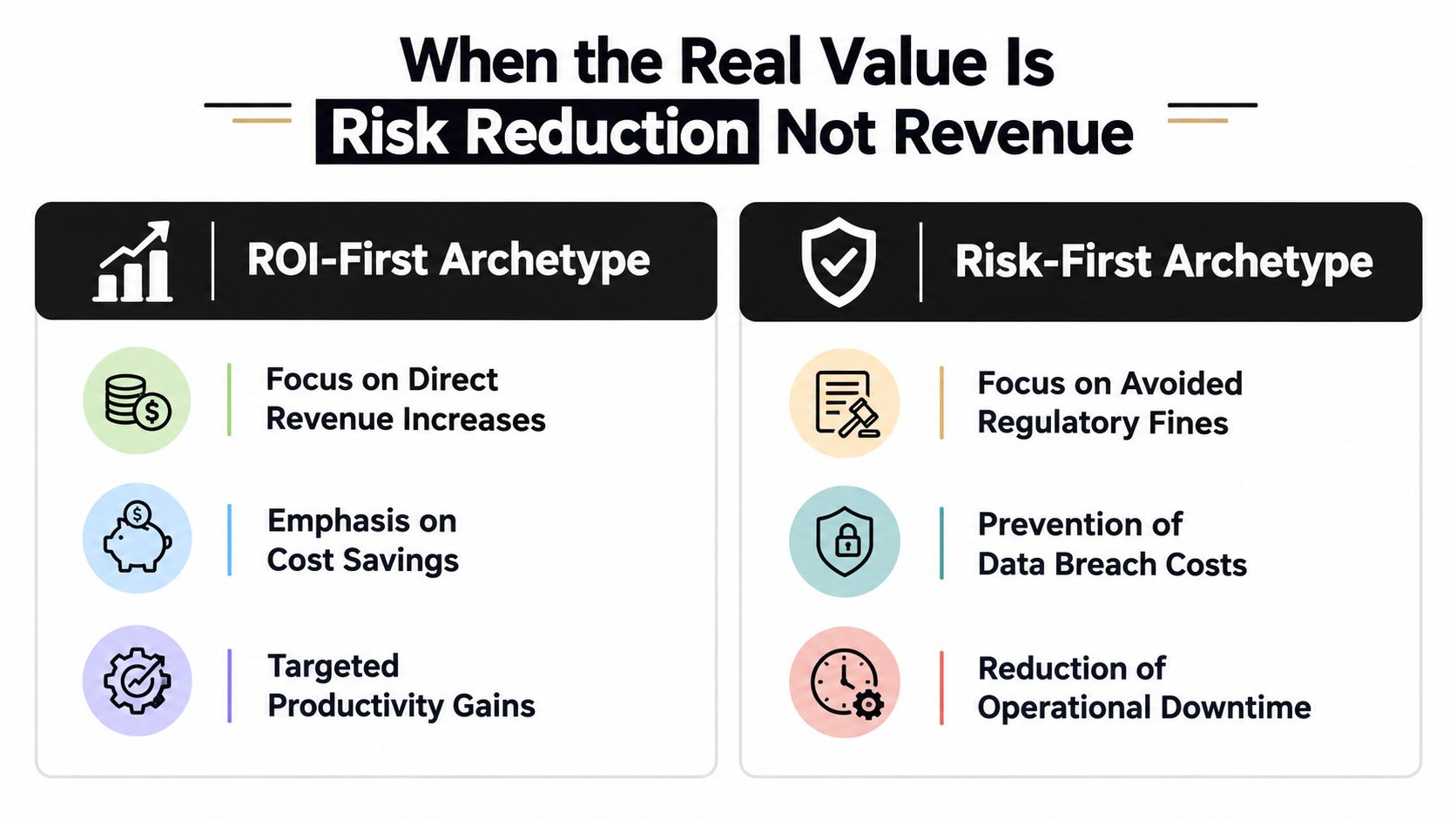
An ROI-first case asks, “How much cash will this initiative create or release?” A risk-first case asks, “What costly exposure does this initiative control, and what happens if we leave it unmanaged?”
Both are legitimate. They require different evidence.
Choose the archetype deliberately
| ROI-first case | Risk-first case |
|---|---|
| Direct revenue, cost savings, or productivity gains lead | Avoided losses, control failures, downtime, or compliance exposure lead |
| Baseline operating performance drives the model | Event probability, impact, control strength, and remediation cost drive the model |
| Growth and efficiency sponsors usually lead | Risk, legal, compliance, security, or resilience sponsors often lead |
| Upside is visible in operating KPIs | Value is often visible through incidents that don't occur |
Compliance initiatives such as SOX, GDPR, DORA, and HIPAA controls may not produce revenue upside. Requiring that upside before approval creates a distorted case. Instead, quantify the avoided-cost scenarios: regulatory response, breach remediation, audit remediation, service interruption, emergency staffing, contractual penalties, or reputational recovery.
Use expected-value logic where the evidence supports it. Estimate the probability of an event, multiply it by the financial impact, and show how the proposed control changes the exposure. Anchor assumptions to internal incident history, audit findings, contractual obligations, or credible external benchmarks. If you can't support a probability, present a range and explain the uncertainty.
“Reduces exposure” isn't a benefit. “Avoids the modeled cost of a defined control failure under specified assumptions” is a benefit.
For a growth-driven AI platform, lead with measurable service or employee outcomes when they're credible. Add risk reduction as a sensitivity layer and a deal-closing argument. For a mandatory compliance or resilience initiative, lead with the obligation, exposure, control gap, and consequence of delay. Keep the financial model honest by separating expected avoided loss from guaranteed savings.
The key is specificity. Name the event, the affected process, the financial consequence, the control, and the evidence that will demonstrate improved readiness.
Stakeholder Mapping, KPIs, and the Communication Plan
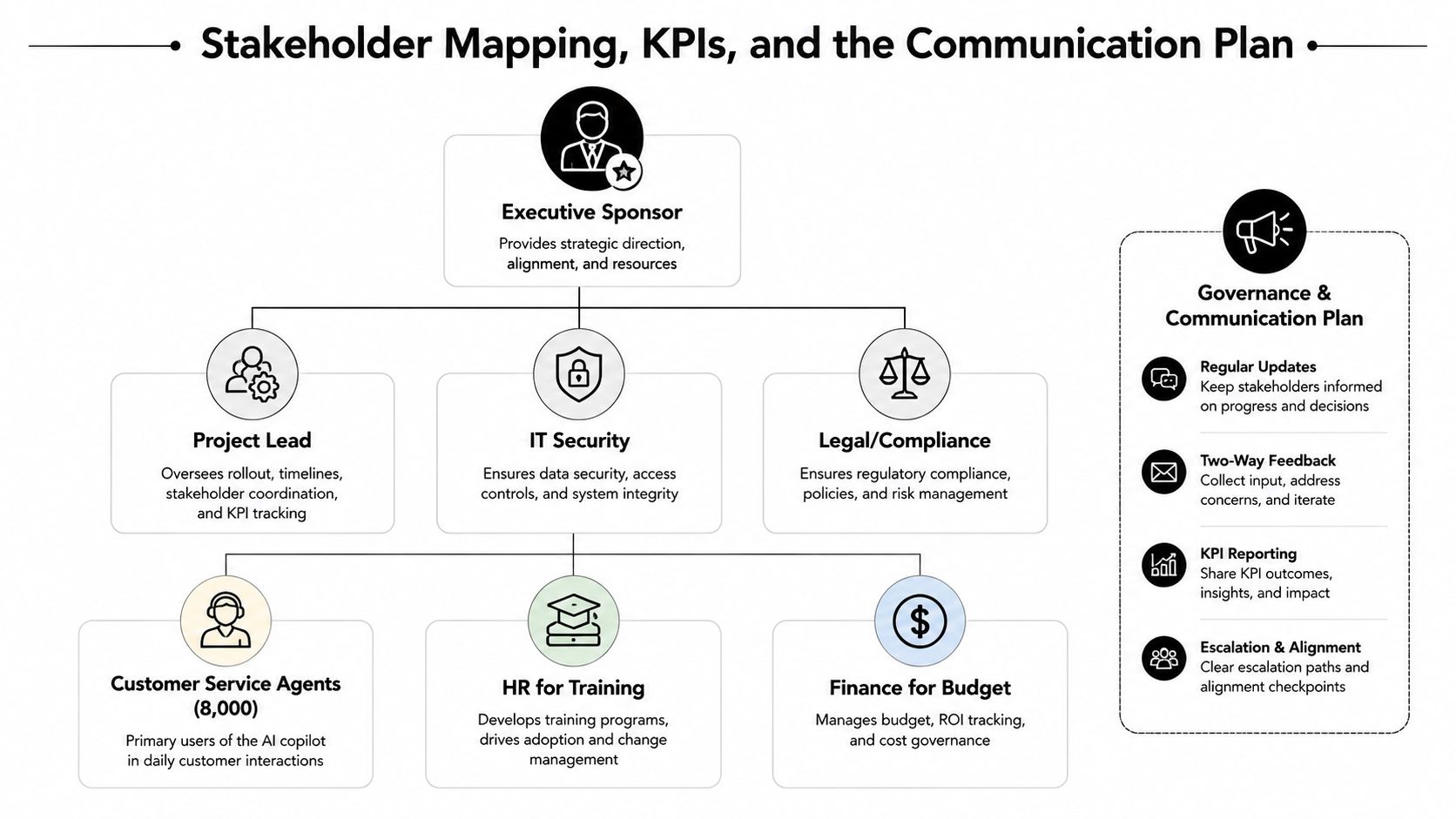
Consider a representative enterprise deployment of a customer service copilot for 8,000 agents. The scale creates a predictable governance problem. The executive sponsor wants strategic progress, finance wants accountable value, platform engineering wants architectural fit, frontline leaders want usable workflows, and security and legal teams want control evidence.
Assign one decision to each stakeholder
The CIO or COO may control sponsorship and escalation. The CFO or business unit head controls the economic commitment. Platform engineering evaluates architecture, integration, reliability, and operational ownership. Frontline service leaders decide whether the workflow fits daily work. The CISO, legal, and compliance teams assess data handling, controls, policy, and evidence.
Don't give every stakeholder the same deck. Give each person the artifact needed for their decision:
- Executive sponsor: Outcome map, major dependencies, decision gates, and escalation path.
- Economic buyer: TCO, benefit register, scenario model, and owner commitments.
- Technical evaluator: Architecture, integrations, data flows, testing evidence, and support model.
- Frontline champions: Workflow demonstrations, training plan, adoption feedback, and exception handling.
- Risk reviewers: Control matrix, data classification, audit trail, incident process, and approval conditions.
Cascade KPIs from outcome to behavior
Board-level measures might include cost to serve, customer satisfaction, and handle time. Operational measures should explain why those outcomes move, such as containment, response quality, knowledge retrieval accuracy, escalation rates, adoption, and workflow completion.
Avoid declaring success from a single dashboard number. A copilot can raise usage while failing to improve resolution quality, or reduce handle time while increasing escalations. Pair outcome KPIs with guardrails and review them together.
The communication plan should create a predictable operating rhythm:
- During build: Weekly delivery stand-ups with owners and dependency decisions.
- During steering: Biweekly reviews focused on scope, risk, adoption, and benefit evidence.
- For executives: Monthly updates that show decisions required, current forecast, and variance.
- After launch: A value-realization review at 90 days, with explicit recommendations to scale, correct, pause, or stop.
A RACI matrix closes the accountability gap. Name who is responsible for delivery, accountable for the outcome, consulted on controls, and informed about changes. The sponsor owns the decision. Benefit owners own the result. The project lead shouldn't become the permanent owner of savings that only operations can realize.
Approval Checklist and Common Objections Answered
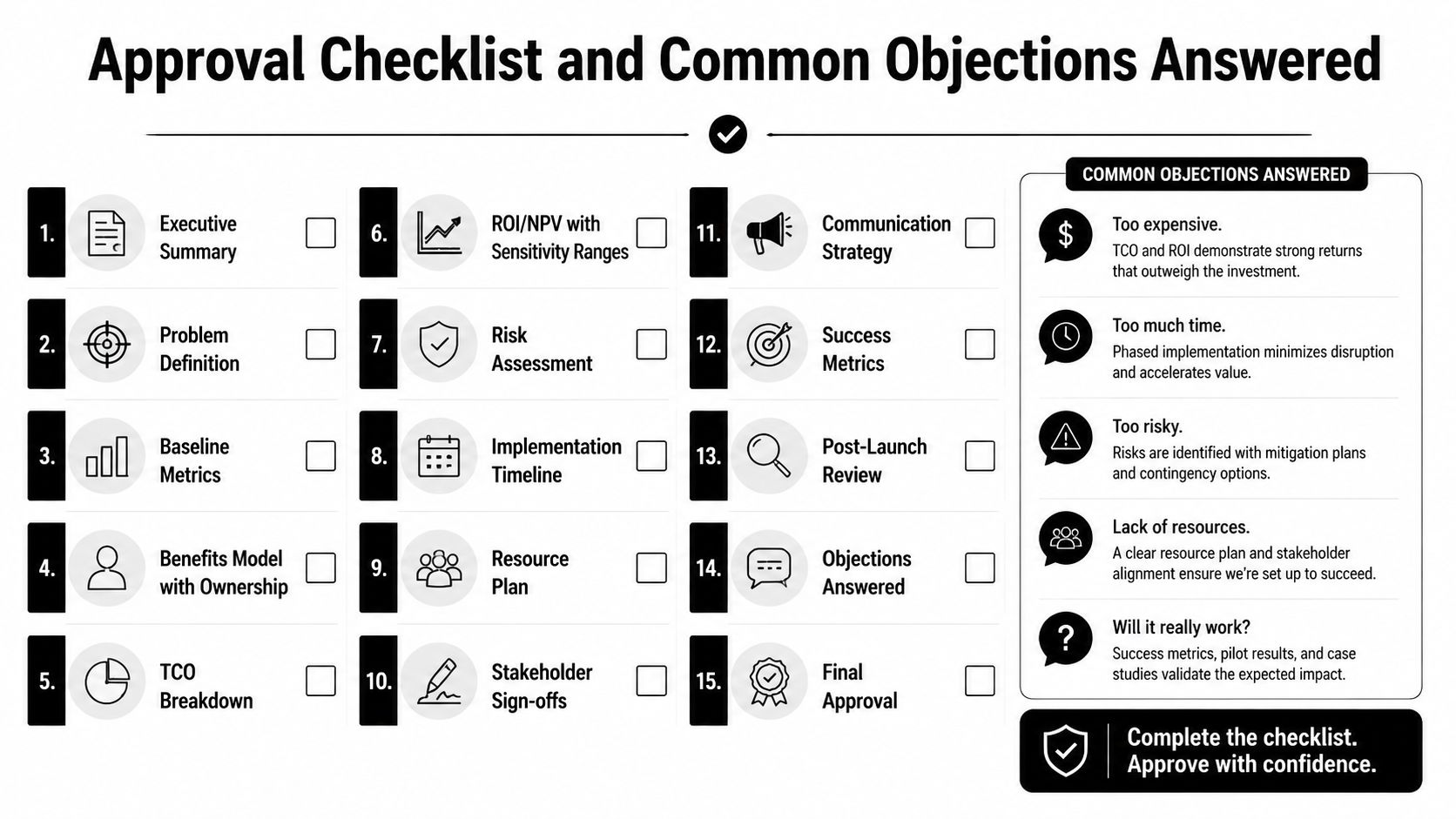
Before submission, treat the case like an investment committee pack and an operating contract. The following 15-point checklist catches the gaps that usually trigger a second review:
- Executive summary: Decision, recommendation, investment, value, and conditions are clear.
- Problem definition: The current-state problem has a defined owner and consequence.
- Baseline metrics: Measurement sources, dates, and limitations are documented.
- Benefits model with ownership: Every material benefit has a driver, owner, and target.
- TCO breakdown: Build, integration, security, adoption, operations, and retirement costs appear.
- ROI and NPV with sensitivity ranges: Base, downside, and stretch views are calculated.
- Risk assessment: Risks include probability assumptions, impact, controls, and owners.
- Implementation timeline: Dependencies, gates, and realistic ramp conditions are visible.
- Resource plan: Internal capacity, specialist skills, and operating ownership are funded.
- Stakeholder sign-offs: Finance, technology, security, legal, operations, and sponsor positions are recorded.
- Communication strategy: Cadence, audiences, artifacts, and escalation paths are defined.
- Success metrics: Outcome KPIs and operational guardrails are paired.
- Post-launch review: Dates, decision rights, and course-correction triggers are specified.
- Objections answered: The case responds to likely financial, technical, adoption, and risk concerns.
- Final approval: Authority, conditions, release gates, and next action are explicit.
Answer the objections before they become vetoes
“The benefits are too soft.” Reframe the case around measurable operational outcomes. Separate hard benefits from experience improvements, define a baseline, and assign an owner. Add a measurement plan instead of inflating soft value.
“We've never hit projected value.” Acknowledge the history. Use a phased investment gate, controlled rollout, re-forecasting, and explicit kill criteria. A build-versus-buy blueprint for enterprise customer service AI can help structure the option and ownership discussion.
“Vendor lock-in is unacceptable.” Show portability, integration boundaries, data ownership, exit requirements, and commercial protections. Treat lock-in as a modeled risk, not a procurement footnote.
“Implementation risk is too high.” Break delivery into gates with evidence required at each gate. Fund discovery and validation before committing to the full rollout.
“Who owns the savings?” Name the operating executive, baseline the current cost, and put the benefit in that leader's scorecard. A project team can't own savings it doesn't control.
“What if usage is low?” Define adoption thresholds, workflow redesign actions, training responsibilities, and a decision trigger for changing scope or stopping investment.
“Can we defer this?” Show the cost of waiting, including exposure, lost capacity, contract timing, or dependency risk. If delay is rational, say so. Credibility improves when the case doesn't pretend every investment is urgent.
Boardroom FAQ
What decision are we approving? A defined investment, option, scope, owner, and release condition.
What happens if we do nothing? The current-state cost, risk, constraint, or missed opportunity continues under stated assumptions.
How will we know it worked? Named owners will report baseline-to-target outcomes through the agreed review cadence.
What happens if the forecast is wrong? The case includes sensitivity ranges, gates, and course-correction or stop criteria.
Who carries accountability after launch? The operating owner, not just the project team, owns benefit realization.
A business case wins approval when it makes the investment understandable, the downside visible, and the post-approval accountability unavoidable. Use the checklist to turn your next proposal into a living value system, then validate every assumption with the people who will carry the result.
Yellow.ai provides enterprise agentic AI for customer and employee experiences, with multi-modal agents, integrations, analytics, automated testing, and enterprise compliance controls that can be evaluated within a structured business case. Visit Yellow.ai to assess how its platform could fit your target workflows, governance requirements, cost model, and value-realization plan.



