













The most popular advice about speech recognition accuracy is to compare vendors by their headline Word Error Rate and choose the lowest number. That can be a useful starting point, but it isn't a buying decision. A score earned on clear English speech won't tell you whether a system can transcribe an accented caller, distinguish an account number from a similar-sounding phrase, or keep an authentication flow on track.
For enterprise voice, accuracy is conditional: on the language, the channel, the speaker, and what the business needs the transcript to do. A more useful evaluation connects the metric to its drivers, tests the actual scenarios customers and employees encounter, and measures the outcomes that matter, such as authentication success, containment, and first-contact resolution.
Table of Contents
- Why One Number Never Tells the Whole Story
- The Two Metrics Every Buyer Must Understand
- What Actually Moves Accuracy in Production
- Why Clean Benchmarks Fail in Real Contact Centers
- Measuring Accuracy the Way Operators Actually Need
- An Enterprise Playbook for Higher Accuracy
- Compliance, Governance, and the Accuracy Outcomes That Matter
Why One Number Never Tells the Whole Story
Speech recognition benchmarks became more useful when researchers could compare systems on shared recordings and a common scoring method. By the 1990s, evaluations increasingly used Switchboard, a corpus of conversational telephone speech. That made comparisons more consistent, but it didn't make the resulting score universal. In NIST's 2000 conversational-speech evaluations, the best reported Word Error Rate (WER) was approximately 19.3% for Switchboard and 31.4% for CallHome, a different telephone-speech task. The same evaluation reported a 57.1% character error rate for Mandarin, showing how sharply results could vary by language and task (historical WER benchmarks).
A benchmark result describes a system's performance under specific conditions. It doesn't tell you how the system handles your callers' accents, a compressed phone channel, interruptions, or product names absent from its training data. Even two systems with similar WER can produce different operational results: one may miss a critical account identifier, while the other makes harmless punctuation or filler-word errors.
Language makes the single-score problem harder. Research evaluating Malayalam, English, and Arabic found that Character Error Rate (CER) aligned more closely with human judgments than WER, including for English. WER depends on how a language forms words and how its writing system marks word boundaries, so one score can mean different things across languages. A 2025 study also reported a 10.8% WER for Tamil, compared with 16.2% for baseline systems, while showing that improvement doesn't make performance uniform across languages (multilingual ASR evaluation).
Evaluate the task, not the leaderboard
A buyer should ask four questions: What metric was used? Which language and channel were tested? Which speakers and intents were represented? What happens when the transcript is wrong? Those answers matter more than a vendor's single headline number.
For teams evaluating dictation or recorded notes, this bench work voice note transcription guide offers a practical example of why the quality of the source audio and the intended use of the transcript matter. In contact centers, the same principle applies: judge a transcript by whether it supports the next action, not only by how closely its words match a reference.
The Two Metrics Every Buyer Must Understand
Word Error Rate counts how many word-level edits a speech recognizer makes against a human-verified reference transcript. The edits are substitutions, where one word is replaced by another; deletions, where a spoken word is missing; and insertions, where an unspoken word appears. WER divides the combined edit count by the number of words in the reference. A lower percentage means fewer word-level differences, but it doesn't automatically mean the transcript is more useful.
Consider a short reference transcript: “Please send the order to my home today.” Suppose the system returns: “Please send order to my office today.” It has deleted “the” and substituted “office” for “home.” If the reference has eight words, that is two edits divided by eight, or a WER of 25%. The arithmetic is straightforward. The operational importance isn't: a missed article may not matter, while a substituted address could send a delivery to the wrong place.
Character Error Rate applies the same basic idea to characters rather than words. It counts character substitutions, deletions, and insertions, then divides by the number of characters in the reference. CER can be a fairer comparison when a language's word boundaries make word-level scoring unstable or hard to interpret. It also complements WER when small spelling changes or inflectional forms affect how a word is segmented.
Ask what the metric misses
Neither metric tells the whole story. A transcript can receive a penalty for a difference that doesn't change the meaning, or an error on one short but critical entity can disappear among many correctly recognized words. For multilingual procurement, ask vendors to report WER and CER by language, then review the actual error types and have fluent speakers assess whether the transcript remains understandable.
The worked example above illustrates WER mechanics, not a vendor result. In a pilot, calculate scores against carefully checked reference transcripts, confirm how text normalization is handled, and inspect errors that could alter an intent, identity, or instruction. If the vendor can't explain its scoring method, its accuracy claim isn't ready to guide a purchase.
What Actually Moves Accuracy in Production
The largest practical gains often come from fixing the audio and the evaluation setup before changing models. A recognizer can't recover words that a distant microphone captures poorly, or reliably infer a rare account name without useful context. Improving accuracy is an engineering problem across the full voice path, from the microphone to the next action the system takes.
Start with the channel. Headset placement, phone compression, echo, and background speakers affect what reaches the recognizer. A far-field kiosk needs different audio handling from a close-talk headset, and noise suppression that helps one setting can distort another. Test with the actual device and channel rather than assuming a clean recording represents production.
Prioritize the levers you can control
Domain fit comes next. Teams should compile frequently used product names, locations, acronyms, and service terms, then check whether the recognizer handles them in natural sentences. A vocabulary list can help, but it won't compensate for a model that poorly handles the language, dialect, or speaking style in the call.
| Driver | Affects most | Practical lever |
|---|---|---|
| Microphone and channel | Word recovery, speaker separation | Test the target headset, phone line, or far-field device |
| Background noise and echo | Short or quiet utterances | Improve placement and tune noise handling on representative audio |
| Domain vocabulary | Names, products, numbers | Provide relevant terms and evaluate entity transcription |
| Accent, age, and speaking style | Recognition consistency | Stratify test audio by speaker type and review errors with fluent evaluators |
| Language identification and code-switching | Language-specific words and boundaries | Test language changes within real utterances |
| Recognition model and decoding | Overall transcript behavior and latency | Compare candidates on the same held-out recordings and operating settings |
Speaker variability and language switching need dedicated tests, not a footnote in the benchmark report. A model can perform well on one accent and struggle with another, or follow a caller until they switch languages mid-sentence. Recognition mode and silence handling also shape the interaction: if the system cuts off a pause too early, it may miss the rest of the caller's thought.
Spend effort where errors change the outcome
Don't begin by tuning every decoding parameter or buying the largest model available. First identify which error categories disrupt the workflow. If callers repeat account numbers, test entity recognition and audio capture; if calls fail after an intent is recognized incorrectly, examine the transcript and intent handoff together. Voice-system design and orchestration also matter, so engineering teams can compare their pipeline assumptions with voice system engineering practices.
Why Clean Benchmarks Fail in Real Contact Centers
A clean benchmark can make a recognizer look ready for a queue it cannot reliably serve. Consider a retail caller requesting a return while a child talks in the background. The caller has a regional accent, the microphone is distant, and the recognizer mistakes a product name. A human agent may recover from context; an automated workflow could create the wrong case or request the same details again.
The operational failure is the wrong action.

For a BFSI caller switching between English and Hindi during identity confirmation, the stakes change. A recognizer that handles monolingual English well may lose part of a name at the language transition. Correct information from the caller can then become a failed authentication attempt. Queue-wide accuracy can hide that failure if easier calls dominate the average.
Errors follow the call into the workflow
Overlapping speech can merge words or assign a phrase to the wrong speaker when two agents interrupt each other on a recorded line. A utility caller asking about net metering presents a different risk: substituting a familiar phrase for the domain term can produce a fluent summary of the wrong issue. Fluency makes that error harder to spot during a quick review.
A 2025 evaluation of diverse conversational audio identifies overlapping speakers, accents, background noise, and code-switching as ASR challenges, and reports that Whisper medium, even with speaker diarization, had approximately 35% WER on child speech and 30% WER on code-switched speech (evaluation of conversational audio). Both results come from the same evaluation. They illustrate sensitivity to conversational conditions, rather than universal performance estimates for a contact-center deployment.
Switchboard results have a similar boundary: the benchmark covers U.S. English telephone conversation, while an enterprise queue may combine languages, microphone types, and specialized vocabulary. Buyers need to know where performance holds across language, channel, and intent. An authentication queue and a return-status queue can tolerate different errors, even when their aggregate transcription scores look similar.
That distinction changes the buying decision. A harmless wording substitution may leave containment untouched; a misrecognized identity detail may force escalation, and a wrong issue summary may undermine first-contact resolution. Accepting some transcript imperfections can be reasonable, provided the workflow detects errors that change decisions.
Operator question: When the transcript is wrong, which customer journey breaks, and how will the team detect it?
For quality teams, contact-center QA practices help connect transcript review with call handling and agent performance. Reviewers should distinguish recoverable wording differences from errors that cause repeat authentication, incorrect cases, or avoidable escalation. That keeps accuracy discussions tied to customer outcomes rather than a reassuring average.
The explainer below illustrates the gap between controlled results and live-call conditions:
Measuring Accuracy the Way Operators Actually Need
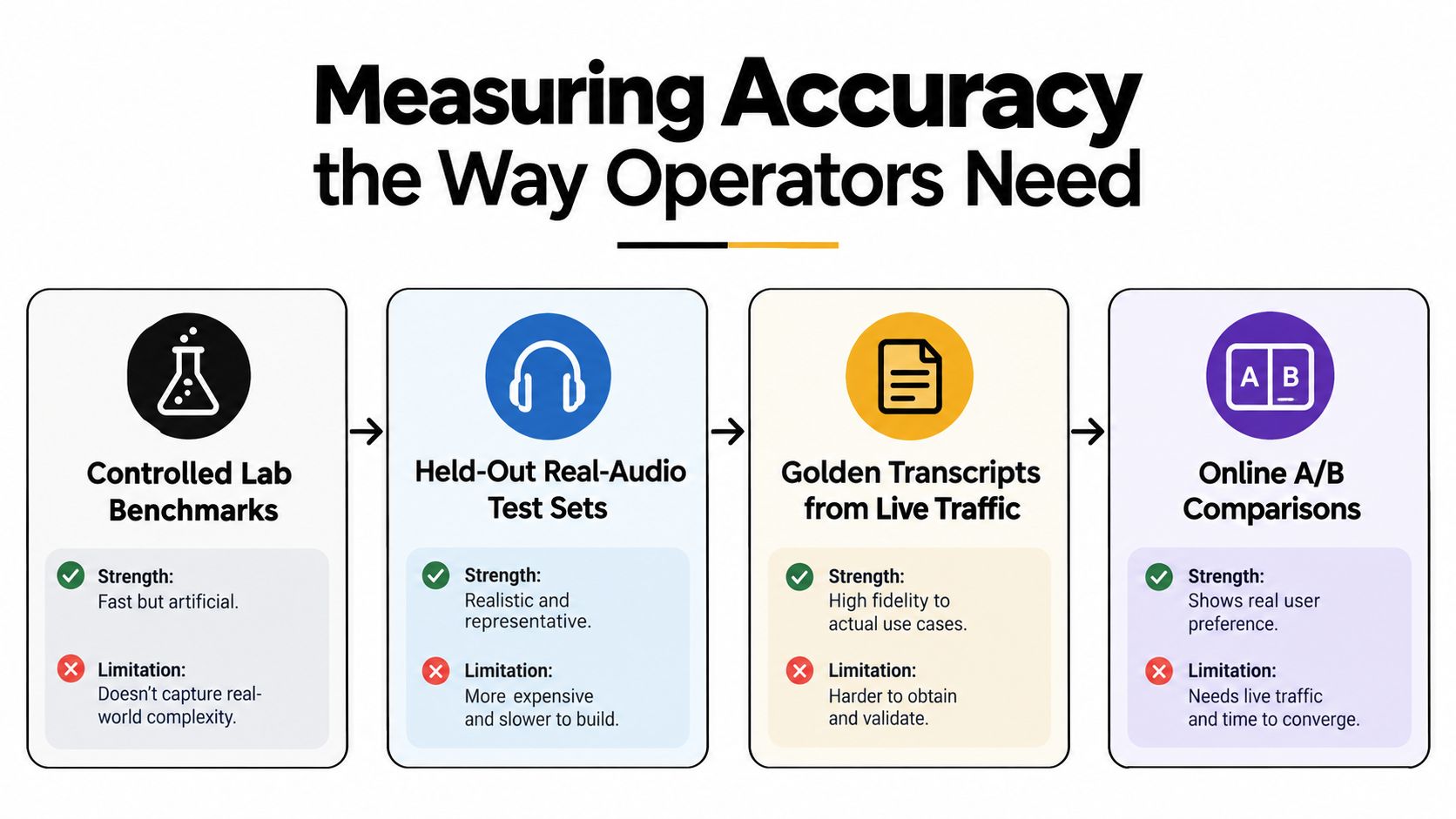
An enterprise accuracy program needs more than one evaluation method. Each method answers a different question: can systems be compared under controlled conditions, do they work on our audio, have recent changes caused regressions, and does the live experience improve business outcomes?
| Evaluation method | What it's good for | What it can miss |
|---|---|---|
| Controlled lab benchmark | Comparing models on a shared task | Your callers, channels, and domain terms |
| Held-out real-audio test set | Estimating performance on representative traffic | New patterns not present in the sample |
| Golden transcripts from live traffic | Catching regressions against reviewed examples | Changes in call mix or behavior over time |
| Online A/B comparison | Measuring live workflow and customer outcomes | Isolating the cause of a change without careful design |
Combine offline evidence with live outcomes
A controlled benchmark is useful when the team needs a repeatable comparison, but it's not a substitute for a held-out set of actual calls. Build that set from the channels and languages the system will serve, and have qualified reviewers prepare and check the reference transcripts. Keep a separate golden set of reviewed examples for regression testing, especially for critical intents and entities.
Refresh the samples when the call mix, product vocabulary, channel, or workflow changes. Don't let a fixed test set become the only definition of success; it can miss new caller behavior. Review results by language, intent, speaker segment, and channel, so an overall average can't hide a weak experience in one group.
Online A/B testing provides a different kind of evidence. It can show whether a new configuration changes authentication completion, transfers, containment, or customer feedback. But those results need context: a shift in the types of calls reaching each version can make one variant appear better or worse for reasons unrelated to recognition. Track operational measures alongside transcription errors, and review the conversations behind unexpected changes.
Teams can use customer interaction analytics to connect conversation evidence with the operational measures used to assess service. The practical rule is to use benchmarks to narrow candidates, representative audio to validate them, golden transcripts to guard against regressions, and live comparisons to test whether the change improves the journey. No one method carries all four jobs.
An Enterprise Playbook for Higher Accuracy
Treat accuracy as an operating loop, not a one-time model selection. The loop begins with the customer or employee task, identifies the speech errors that can disrupt it, and feeds evidence from real interactions back into model, audio, and workflow changes.
Build the test and data loop first
Start by defining what a successful interaction requires. Authentication may depend on correctly capturing a spoken identifier; employee self-service may depend on distinguishing a request from a follow-up; a contact-center summary may need the right product and resolution. For each task, define which transcript errors matter and how the team will observe them.
Then assemble representative audio across the languages, channels, speakers, and intents that matter. Add reviewed examples of recurring names, acronyms, and specialist terms. Where the data is sensitive, work with security and privacy teams on collection, access, retention, and redaction before using it for evaluation or model improvement.
Match architecture to the workload
Compare recognition options on the same representative set, then consider latency, integration effort, operating controls, and the ability to switch models when a workload changes. A multi-model setup can make sense when one recognizer performs better for a particular language or channel, but it also adds routing and monitoring complexity. Teams need clear fallback behavior when language identification is uncertain or an endpoint returns incomplete speech.
Audio handling deserves its own test plan. Evaluate voice activity detection and silence settings against natural pauses, interruptions, and short replies. Noise performance should be checked on the devices people use; a strategy for a close headset may not fit a room microphone. Balance latency against the time needed to capture a complete utterance, because fast responses don't help if the system regularly cuts off callers.
Make every fix measurable
Instrument recognition errors, language and intent confusion, silence events, and downstream outcomes. When a change ships, compare its behavior against the golden set and monitor live interactions for regressions. An agent-building environment with automated testing can shorten the path from spotting a failure to checking a fix, but the test cases still need to reflect real users and business intents.
Yellow.ai is one platform option for teams connecting voice transcription with conversational agents: it offers configurable speech-to-text capabilities, multi-model orchestration, automated testing, and analytics across customer and employee interactions. Evaluate those capabilities against the same per-language, per-channel, and per-intent requirements used for any other vendor. The important result is not a flexible architecture on paper, but a workflow that captures the caller accurately enough to complete the task.
Compliance, Governance, and the Accuracy Outcomes That Matter
A transcript can be operationally wrong and still look polished. It can also expose sensitive information if the system fails to recognize a name, account detail, or payment-related phrase before downstream tools process it. That makes speech recognition accuracy a governance concern as well as a model-quality question.
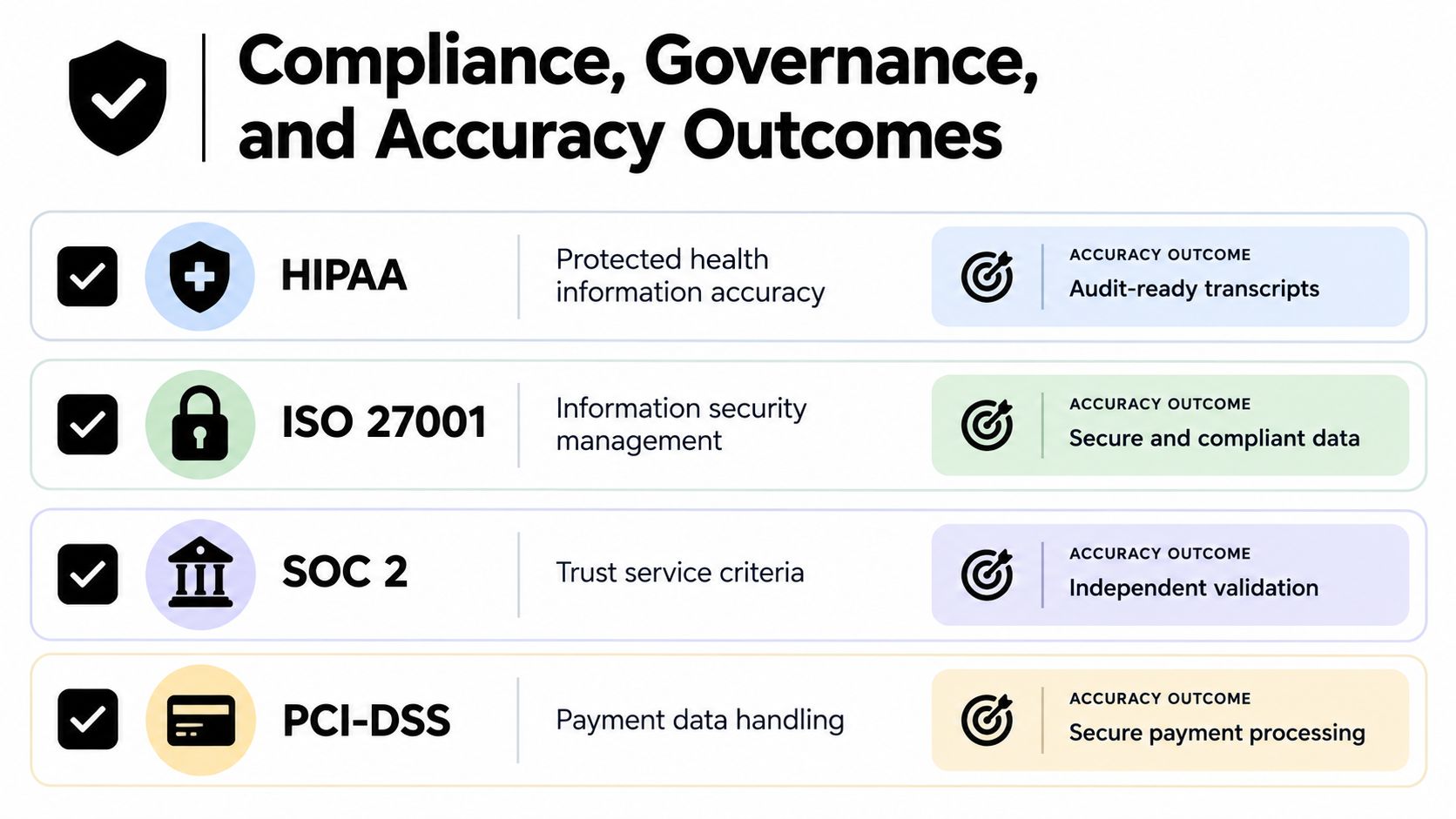
Compliance frameworks such as HIPAA, ISO 27001, SOC 2, and PCI-DSS address different obligations and controls. A certification or compliance program doesn't prove that a speech recognizer transcribes a given language accurately, nor does a good WER prove that data is handled appropriately. Teams should assess security, access controls, retention, and auditability separately from language and channel performance.
Connect evidence to business risk
Redaction and personally identifiable information detection depend partly on what the recognizer captured. If a spoken name or account identifier is transcribed incorrectly, a downstream control may not find the sensitive detail. Governance reviews should therefore examine both the handling of speech data and the system's ability to recognize the kinds of information the workflow must protect.
Executives should also ask how speech errors affect first-contact resolution, authentication success, average handle time, and customer satisfaction. A model with a favorable overall score may still create repeat calls if it misrecognizes a particular account identifier or language segment. Measure those outcomes by relevant customer and employee journeys, and investigate cases where recognition quality and service performance move in different directions.
Take this checklist to the vendor review
- Request segmented evidence: Ask for results by language, channel, intent, and relevant speaker conditions, not just an overall score.
- Inspect critical errors: Review missed or substituted names, identifiers, intent-bearing words, and sensitive details.
- Confirm evaluation controls: Check how reference transcripts are prepared, how test data is protected, and how model or configuration changes are monitored.
- Tie quality to outcomes: Ask how transcription errors affect authentication, containment, escalation, and resolution in your workflows.
- Test your own audio: Require a pilot using representative recordings and clear criteria for success before committing to production.
Use that checklist to make the next vendor conversation concrete. Ask each provider to show how its system performs on your languages and channels, how it handles errors that matter to your workflows, and how you'll know when performance changes.
Yellow.ai offers voice AI and agent orchestration capabilities that teams can evaluate against their speech-recognition accuracy, language coverage, testing, and governance requirements. Bring representative call scenarios and business outcomes to a Yellow.ai discussion to assess whether its platform fits your enterprise workflow.



