









Most contact centers still treat QA like a sidecar process. That's backward. The strongest evidence for why comes from the industry shift itself: modern QA platforms can now evaluate 100% of customer interactions across voice, chat, and screen activity, replacing random manual review with full-coverage analysis of sentiment, silence, keyword usage, and script adherence, as described in CMSWire's buyer's guide to call center quality assurance software.
That changes the job of QA completely. It isn't just a human review function anymore. In an AI-powered operation, QA becomes the control system for the whole CX stack. It tests human agents, catches process failures, surfaces policy drift, and exposes where autonomous voice bots and chat agents break down in customer interactions. If your QA model still assumes a supervisor sampling a few calls and filling out a scorecard, you're running a legacy system against a modern risk surface.
Table of Contents
- Redefining Quality Beyond the Scorecard
- From Manual Sampling to 100% Automated Evaluation
- The Art and Science of Calibration and Coaching
- Integrating QA with Your Enterprise AI Platform
- Establishing QA Governance and Continuous Improvement
- FAQ on Advanced QA Contact Center Programs
Redefining Quality Beyond the Scorecard
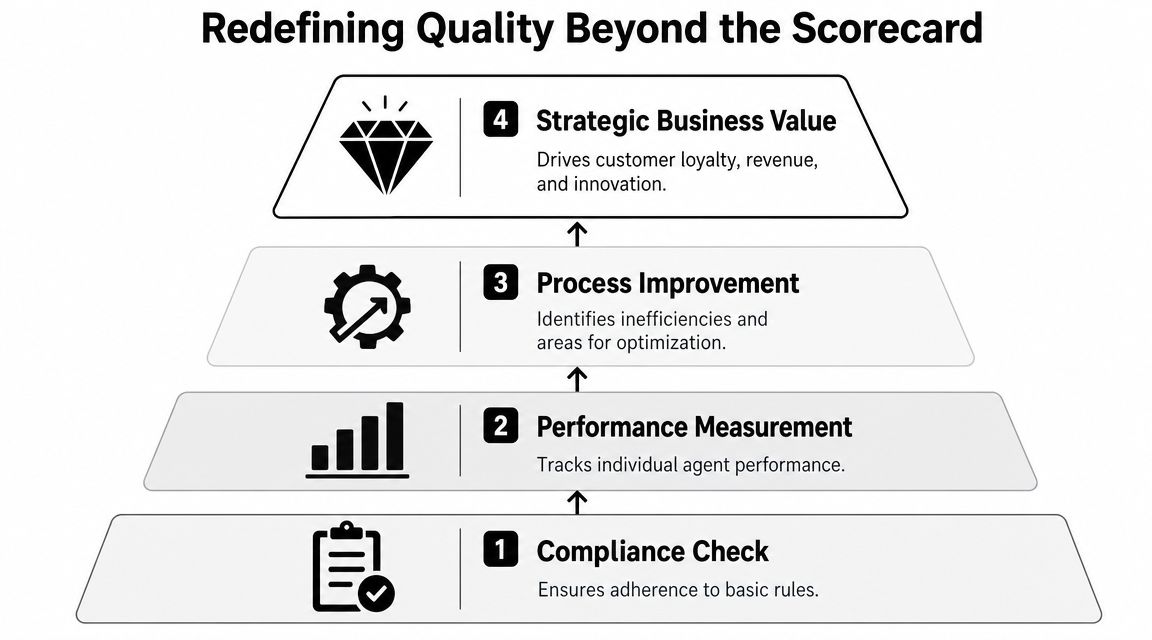
Most QA programs still overvalue compliance theater. They check whether an agent said the approved phrase, followed the script, and kept handle time under pressure. That isn't useless. It's just incomplete.
A modern QA contact center program has to answer a harder question: did the interaction create the right business outcome without creating unnecessary friction? RingCentral identifies core QA metrics such as first call resolution, average handle time, average speed to answer, customer satisfaction, net promoter score, and customer effort score in its overview of call center QA. That's the right starting point because it forces leaders to stop pretending quality is only about script adherence.
Stop rewarding activity over outcomes
Legacy scorecards reward what is easy to inspect. They penalize pauses, deviations, and escalations without asking whether the customer issue was resolved well. That model trains agents to sound compliant rather than be effective.
The same lesson has played out in software. Teams that care only about checklist completion usually miss whether the system itself is resilient, usable, and safe in production. If you want a parallel, ThirstySprout on software quality is useful because it shows how mature QA evolves from defect detection into a broader discipline of reliability and performance governance.
Practical rule: If your scorecard can't explain movement in customer outcomes, it isn't a quality system. It's an audit form.
You should still track process discipline. But process metrics belong under a broader hierarchy. Compliance is the floor. Performance is the middle. Business value is the target.
Build a business-facing quality model
The cleanest way to redesign QA is to map each quality dimension to an executive outcome. Keep it simple enough to govern and specific enough to coach.
| Quality dimension | What it should answer | Business implication |
|---|---|---|
| Compliance | Did the interaction meet required standards? | Reduces risk exposure |
| Resolution quality | Did the customer leave with a correct outcome? | Protects retention and reduces repeat demand |
| Effort and experience | Was the interaction easy and confidence-building? | Supports CSAT, NPS, and loyalty |
| Efficiency | Was the issue handled with appropriate resource use? | Controls operating cost without damaging CX |
That model changes the conversation in the boardroom. Instead of asking whether QA scores are up, leaders ask whether the center is reducing repeat demand, protecting trust, and optimizing operational performance.
Designing Your Dynamic QA Scorecard
A scorecard should be an operating instrument, not a museum piece. Too many enterprises build one giant template, freeze it for years, and wonder why agents don't trust it. Static scorecards age badly because channels, products, policies, and automation layers keep changing.
Balto outlines a strong workflow for high-performing QA programs: define measurable standards, score interactions with a calibrated rubric, and audit both agent behavior and customer outcomes in its call center QA best practices guide. That's the architecture to follow. Not because it's elegant, but because it prevents chaos.
Start with standards, not forms
Starting by drafting categories and weights is a common approach. That's too early. First define what "good" means for each interaction type.
For a billing dispute call, quality might mean correct verification, accurate explanation, and clear next steps. For a sales chat, quality might mean need discovery, recommendation quality, and proper objection handling. For an AI voice bot, quality might mean recognition accuracy, containment appropriateness, and escalation timing.
Only after that should you build the rubric.
A dynamic scorecard should adapt to:
- Channel differences: Voice, email, and chat don't require identical standards.
- Journey type: Complaint handling, onboarding, collections, technical support, and renewals need different evaluation logic.
- Risk level: Regulated interactions deserve stricter pass-fail criteria than low-risk service moments.
- Automation involvement: Conversations handled partly by bots need quality checks for handoff quality, knowledge accuracy, and fallback behavior.
What a dynamic scorecard should include
The most durable scorecards usually include a mix of hard requirements, diagnostic criteria, and business-linked outcomes.
Non-negotiables first
Put critical compliance and policy checks at the top. These are mandatory and should be scored clearly.Resolution before polish
If the issue wasn't solved properly, a friendly tone shouldn't rescue the score.Customer understanding checks
Don't just ask whether the agent explained something. Ask whether the explanation was likely understandable and actionable.Handoff logic
In AI-enabled environments, score whether the interaction stayed with the right resource. Poor transfers ruin both cost and experience.Channel-specific criteria
Email needs clarity and completeness. Chat needs efficiency without robotic phrasing. Voice needs pacing, listening, and silence management.
Good scorecards don't chase total objectivity. They reduce ambiguity enough that humans can apply judgment consistently.
Common scorecard design failures
The biggest design mistakes are predictable:
- Overloaded categories: When everything matters, nothing matters.
- Subjective labels without definitions: "Empathy" means very different things to different reviewers.
- No calibration path: A rubric without shared interpretation creates evaluator drift.
- Efficiency obsession: AHT matters, but not at the expense of FCR or customer confidence.
- One-template governance: Enterprise complexity can't be managed with a single universal form.
If your current scorecard is bloated, cut it. Remove items that don't drive coaching or governance action. A useful scorecard should help leaders decide what to fix, who to coach, what to automate, and where to escalate.
From Manual Sampling to 100% Automated Evaluation
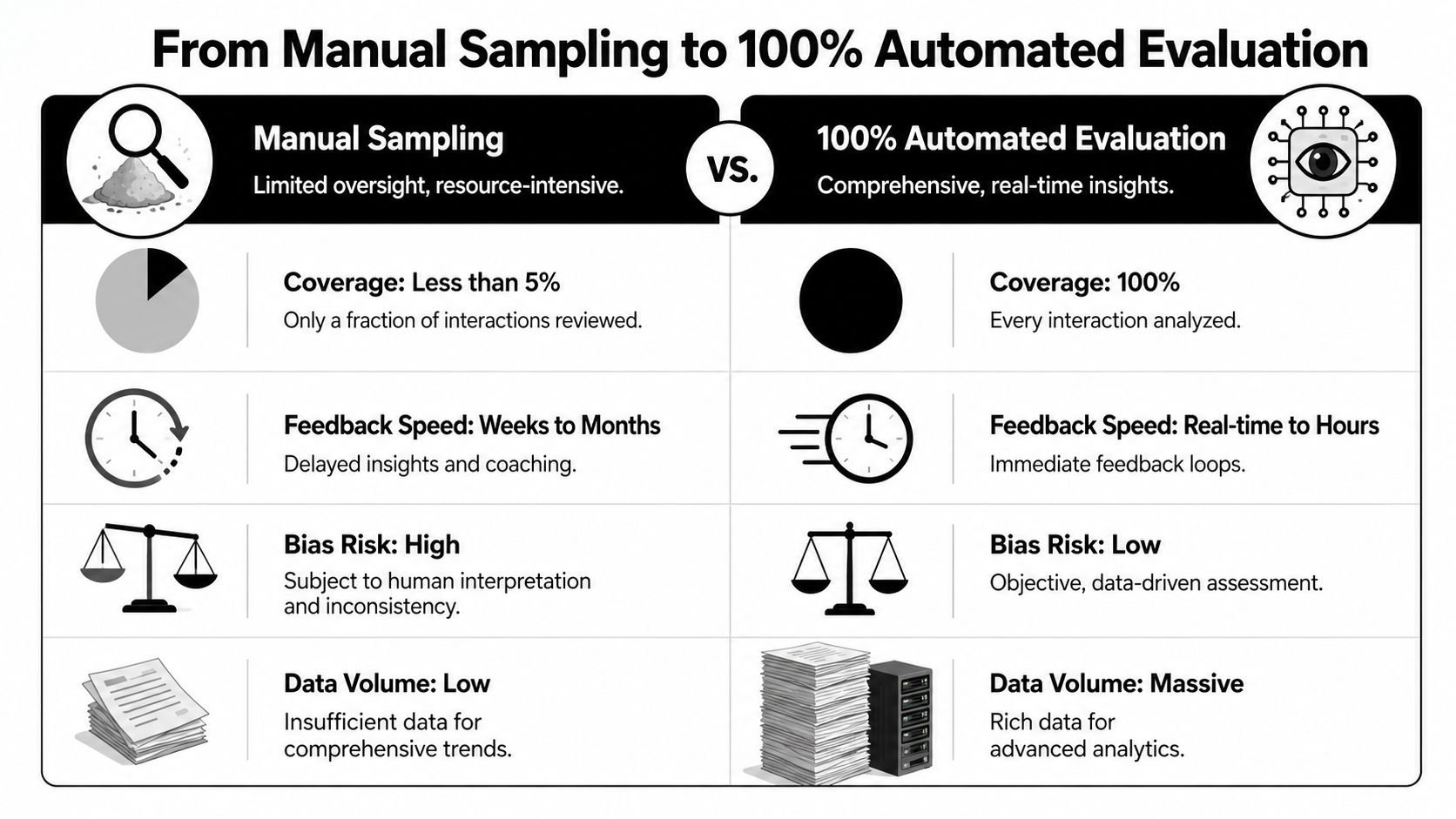
Manual sampling is a legacy control system. It was built for lower volume, fewer channels, and slower consequences. It fails in AI-powered contact centers because the biggest quality risks now spread across every interaction, every bot flow, and every escalation path.
Manual QA misses the system, not just the call
Sampling a small slice of interactions gives leadership a partial view of performance. A partial view is not governance. It does not reliably catch compliance failures, broken bot routing, inconsistent policy application, or recurring moments where automation creates friction and agents inherit the damage.
That is the shift. QA no longer exists to grade a handful of human conversations after the fact. It now has to test and govern the full CX stack, including human agents, copilots, chatbots, voice bots, knowledge prompts, and transfer logic between them.
The same foundation applies across adjacent workflows. If your team is evaluating how spoken interactions become usable operational data, this AI video transcription guide shows how automated transcription converts raw conversation into searchable input for analysis. QA depends on the same move from inaccessible audio to machine-readable signals.
What 100% evaluation changes at the enterprise level
Full-coverage evaluation changes QA from an audit function into an operating system for CX improvement.
Leaders gain five advantages:
- Earlier risk detection: Failures stop hiding inside unreviewed interactions.
- Stronger pattern recognition: You can see where policy confusion, poor transfers, repeated silence, or bot fallback issues are concentrated.
- Better coaching inputs: Supervisors work from recurring behavior patterns, not isolated examples.
- Cross-channel governance: Voice, chat, messaging, and bot conversations can be reviewed under one quality framework.
- AI oversight: Autonomous agents can be measured against containment quality, escalation quality, and customer outcome, not just deflection rates.
This is the competitive line most enterprises still miss. If AI handles part of the customer journey, QA has to verify whether the system made the right decision, gave the right answer, and handed off at the right time. That requires conversation intelligence tied to bot performance, workflow performance, and customer outcome. Yellow.ai Analyze and the future of bot automation and insights is a useful example of how teams connect bot analytics with broader operational visibility.
A quick briefing can help teams visualize the shift before they redesign operating processes:
Automate the coverage. Keep humans on judgment.
AI should score at scale, surface anomalies, and prioritize review queues. Humans should own ambiguity, exceptions, and decisions with legal, financial, or brand impact.
That division of labor matters because bad automation scales bad judgment fast. A weak rubric, poor taxonomy, or outdated policy mapping will produce neat dashboards and bad decisions. Enterprises need QA models that route ambiguous or high-risk interactions to human review, monitor model drift, and update evaluation logic as products, policies, and bot behaviors change.
Automated QA should expand control across the entire CX ecosystem. Human reviewers should govern the edge cases that determine trust.
The right target is clear. Stop treating QA as a manual scorecard process for agents alone. Build it as a continuous evaluation layer for every customer interaction your business, your agents, and your AI systems produce.
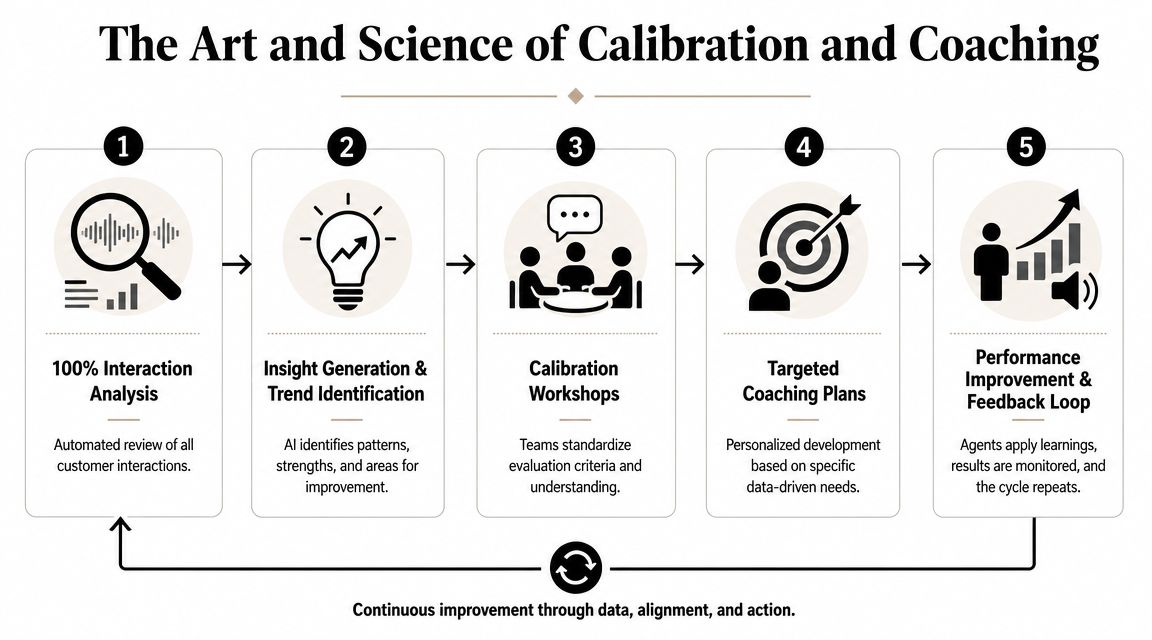
The Art and Science of Calibration and Coaching
When enterprises expand QA coverage, they often assume the hard part is over. It isn't. More data only helps if people trust the scoring and know how to act on it.
That is where many programs fail. They automate evaluation, then keep the coaching model vague, delayed, or punitive. Agents quickly learn to treat QA as surveillance instead of support, and supervisors drown in dashboards they can't translate into behavior change.
Calibration is how you earn trust
Calibration isn't an administrative chore. It's the mechanism that makes quality data usable. Without it, two supervisors can review the same interaction and reach different conclusions, which poisons both coaching and trend analysis.
The discipline is simple:
- Review the same interactions across evaluators.
- Compare not just final scores, but reasons for scoring.
- Rewrite ambiguous criteria.
- Separate binary requirements from judgment-based quality dimensions.
- Revisit scoring logic when products, policies, or automation flows change.
This matters even more in AI-augmented environments because the system is making judgments at scale. Human reviewers need to validate whether the machine is classifying interactions in a way that still matches operational reality.
Coaching should be specific, visible, and fair
The most actionable proof point in the current QA environment is from Observe.AI: one published case study reported a 22.3% CSAT improvement when agents were given access to their own performance data and QA scores in its write-up on QA that transforms teams. The message is clear. Transparency improves coaching effectiveness when teams use it constructively.
That doesn't mean dumping raw scores on agents. It means giving them enough visibility to understand what happened, why it mattered, and what to change next.
A sound coaching workflow usually includes:
| Coaching input | What the supervisor should do |
|---|---|
| Repeated failure pattern | Focus on one behavior change, not a pile of issues |
| Isolated exception | Review context before assigning blame |
| Strong performance trend | Reinforce and replicate it across peers |
| Bot-assisted failure | Determine whether the issue was human execution, AI suggestion quality, or knowledge design |
Leader's test: If an agent leaves a coaching session unsure what to do differently on the next interaction, the session failed.
How to coach in an AI-first environment
Coaching now has to cover more than human soft skills. Supervisors need to help agents work with AI copilots, recover from bot handoffs, and recognize when automation is steering them wrong.
That requires a broader performance lens. The metrics for AI-assisted service need to distinguish between agent execution, system recommendation quality, and customer outcome. This guide to measuring AI agent performance in an AI-first world is useful because it reframes evaluation around how humans and AI jointly deliver service.
Use AI-flagged examples in coaching. But don't coach from score deltas alone. Coach from conversation evidence, root causes, and repeatable alternatives.
A healthy QA culture sounds like this:
- "Here's the pattern."
- "Here's the risk it creates."
- "This is what good looks like."
- "Let's monitor whether the change sticks."
That is how QA becomes developmental instead of disciplinary.
Integrating QA with Your Enterprise AI Platform
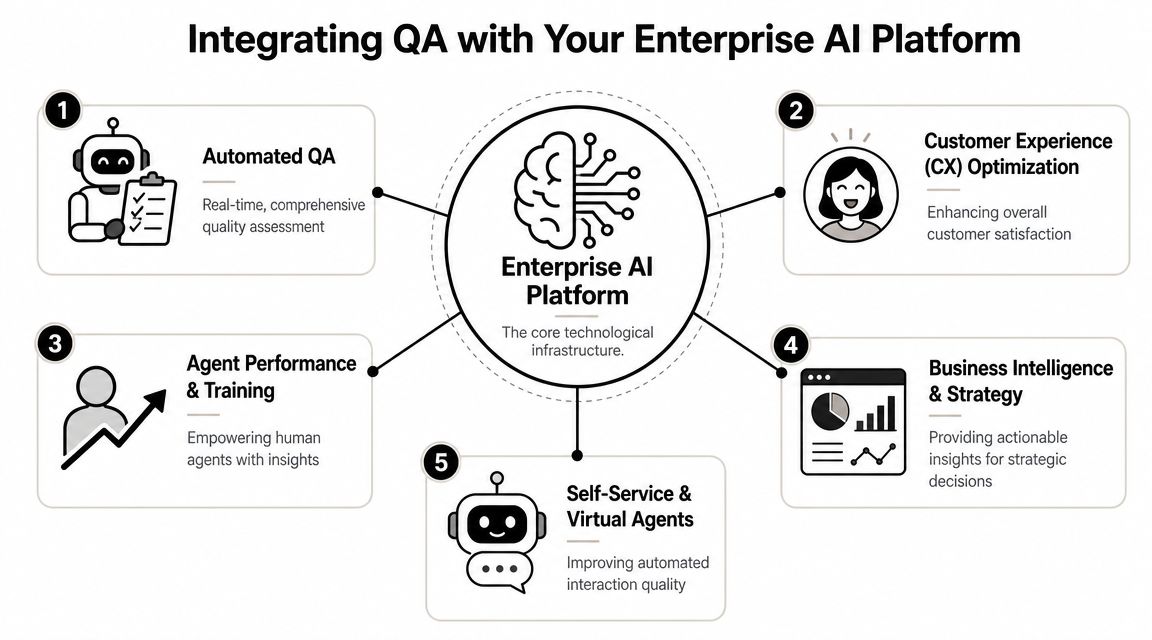
Most enterprises still isolate QA inside the contact center. That made sense when quality reviews focused on human calls. It doesn't work once AI agents, voice bots, copilots, retrieval systems, and orchestration engines are all participating in customer interactions.
QA now belongs inside the enterprise AI stack.
QA should govern humans and machines
If a bot mishandles intent detection, retrieves the wrong knowledge, or hands off too late, that's a quality failure. If a human agent follows a flawed AI recommendation, that's also a quality failure. Treating those as separate governance tracks is a mistake.
A mature QA contact center model should evaluate:
- Human execution: Clarity, correctness, judgment, and resolution quality.
- Bot behavior: Recognition, response appropriateness, containment logic, and escalation timing.
- Knowledge performance: Whether the underlying content supports accurate answers.
- Workflow design: Whether routing, handoffs, and fallback paths protect the customer journey.
This is why the old view of QA as call scoring is obsolete. In an AI-powered environment, QA acts as a hardening layer. It tests whether the whole service system behaves safely and effectively under live conditions.
Turn QA signals into AI improvement loops
The highest-value QA signals are the ones that can be reused. If repeated interaction reviews show the same policy confusion, that should update training content, knowledge retrieval logic, and bot prompts. If customers repeatedly abandon a voice automation path at a specific step, that should trigger flow redesign, not another memo to agents.
An enterprise insights layer is essential here. A platform such as Yellow.ai's Insights Engine can centralize interaction analysis across channels so operators can inspect patterns in human conversations and automated journeys from one place. That's the right model because QA data shouldn't die in a spreadsheet. It should feed service design.
This is also the one place where product architecture matters. Enterprises need platforms that connect analytics, orchestration, testing, and agent workflows. Otherwise QA findings stay diagnostic and never become corrective.
What enterprise governance has to include
Verequest's most useful strategic point is that AI-driven QA requires governance for model drift, review queues, and escalation rules. That's the missing layer in many deployments. Teams adopt automation, but they don't define who reviews edge cases, who approves rubric changes, or when an AI issue becomes a policy issue.
A workable governance model should cover:
- Confidence thresholds for when automated scoring is trusted.
- Escalation paths for ambiguous or high-risk interactions.
- Review queues for bot failures, policy exceptions, and unresolved intents.
- Drift checks to confirm models still align with current products and standards.
- Change approval for scorecards, prompts, and knowledge sources.
QA is the only enterprise function that can simultaneously see what customers asked, what the AI answered, what the human corrected, and where the process broke.
Treat it accordingly.
Establishing QA Governance and Continuous Improvement
Most enterprises don't have a QA problem. They have an operating model problem. They install technology, create dashboards, and still fail to improve because nobody owns the decisions that QA data should trigger.
Governance fixes that. Not governance as bureaucracy. Governance as decision rights, escalation logic, and disciplined follow-through.
Assign ownership by decision type
Don't organize QA ownership around job titles alone. Organize it around what decisions need to be made.
| Decision type | Primary owner | Supporting roles |
|---|---|---|
| Scorecard changes | QA leadership | Operations, compliance, training |
| Coaching actions | Frontline supervisors | QA analysts |
| Bot failure review | AI operations or automation team | QA, CX ops, knowledge managers |
| Policy exception handling | Compliance or risk leaders | Operations, QA |
| Trend-driven process fixes | CX operations leaders | Product, training, digital teams |
That structure matters because AI-enabled service creates cross-functional failure modes. A bad answer might come from a policy problem, a knowledge problem, a bot design problem, or a supervisor habit. If ownership is vague, the issue gets admired and not fixed.
Build reporting for action, not theater
Most QA reporting is too broad for agents and too shallow for executives. You need different views for different actors.
For supervisors, report patterns they can coach this week. For operations leaders, report friction categories, transfer failures, recurring policy confusion, and emerging risk pockets. For executives, show whether service quality is improving, where customer effort is rising, and which failure modes are systemic.
Use a dashboard stack like this:
- Agent view: Personal trends, flagged examples, coaching commitments.
- Manager view: Team patterns, calibration variance, coaching completion.
- Operations view: Journey failures, escalation clusters, channel comparison.
- Executive view: Customer outcome movement, compliance exposure, automation quality signals.
Don't overload dashboards with vanity metrics. A metric without an owner and an action path is reporting clutter.
Create a real continuous improvement loop
Continuous improvement isn't a monthly meeting. It's a closed loop between detection, interpretation, intervention, and verification.
Use this rhythm:
- Detect patterns from QA across human and automated interactions.
- Classify the root cause.
- Assign the fix to the right function.
- Update scripts, knowledge, training, prompts, or routing.
- Recheck whether the change improved the interaction pattern.
The final step is the one frequently skipped. They launch fixes and assume impact. Real governance checks whether the signal moved.
A durable QA contact center program should also document:
- what changed,
- why it changed,
- who approved it,
- what risk it addressed,
- and how success will be reviewed.
That operating discipline is what turns QA from a monitoring expense into a control system for enterprise CX.
FAQ on Advanced QA Contact Center Programs
How do you handle agent resistance to 100% interaction monitoring
Tell the truth early. If leaders position expanded QA as surveillance, agents will resist it. Position it as a fairness and coaching system instead. Full-coverage review reduces cherry-picked evaluations and gives agents more context on their own performance.
Make scores visible, explain how they're used, and separate developmental coaching from disciplinary action wherever possible. Agents accept monitoring faster when they see specific examples, consistent standards, and a path to improve.
What's the most practical first step for a large enterprise moving beyond manual QA
Don't start with an enterprise-wide rollout. Start with one high-value queue where quality risk, repeat demand, or automation complexity is already obvious. Build a narrow scorecard, validate calibration, test automated tagging, and define escalation rules.
Then expand in layers:
- one journey,
- then one business unit,
- then channel expansion,
- then bot and human governance together.
That sequence keeps change manageable and exposes scorecard flaws before they spread.
How do you prove ROI to leadership
Don't reduce ROI to labor savings. Measure whether QA improves the operation's ability to control risk, coach effectively, and improve customer outcomes.
Track:
- movement in customer outcome metrics already used by your business,
- reduction in recurring failure patterns,
- improvement in coaching precision,
- better visibility into bot and handoff failures,
- faster correction of policy or knowledge issues.
If leadership can see that QA identifies root causes faster and helps teams correct them with confidence, the business case becomes self-evident.
If you're rethinking QA as part of a broader AI-powered CX operating model, Yellow.ai is one option to evaluate. Its platform supports omnichannel automation, analytics, bot testing, and AI-assisted service workflows, which makes it relevant for enterprises that want QA to govern both human agents and autonomous conversations rather than treat them as separate systems.