










The surprising part about customer interaction analytics isn't that it helps teams listen better. It's that it changes what a CX organization is for. Once companies stop reviewing a small sample of calls and start analyzing conversations across phone, email, chat, social media, and web interactions, customer data stops being a QA artifact and becomes an operating system for service, coaching, compliance, and decision-making. That shift is already reflected in how the category is defined, with direct ties to operational measures such as First Contact Resolution (FCR) and Average Handle Time (AHT) in modern contact center programs, as outlined in Omind's overview of customer interaction data analytics.
Most enterprises still behave as if interaction analysis is a retrospective reporting exercise. It isn't. At scale, the point is to convert unstructured conversation data into signals a business can act on while the experience is still unfolding. That's the difference between explaining customer problems after the fact and designing systems that reduce them.
Table of Contents
- Beyond Call Monitoring The New Mandate for CX Leaders
- Unlocking the Voice of the Customer at Scale
- Architecting Your Single Source of Customer Truth
- Key Metrics That Drive Enterprise Performance
- How Leading Industries Deploy Interaction Analytics
- A Practical Roadmap for Implementation and Governance
- The Future is Autonomous From Interaction Analytics to Decision Intelligence
Beyond Call Monitoring The New Mandate for CX Leaders
Manual call monitoring was built for a smaller world. Fewer channels, lower contact volumes, slower feedback loops. In that environment, reviewing a thin slice of interactions felt acceptable because leaders mainly wanted a rough sense of agent quality.
That logic breaks once service happens everywhere. Customers move between voice, web chat, messaging, email, social, and self-service. The old sample-based model can't tell you where friction starts, how it spreads across channels, or which operational issues are inflating repeat contacts. Modern customer interaction analytics exists because contact volumes exploded and because unstructured conversations now carry some of the most important signals in the enterprise, as described in this contact center analytics explainer from Yellow.ai.
The old QA model misses the business problem
A sampled review process does one thing reasonably well. It checks whether a limited number of interactions match a scorecard.
It does not reliably surface:
- Systemic failure patterns that show up across thousands of interactions
- Journey-level friction where one broken policy creates contacts in multiple channels
- Emerging sentiment shifts that supervisors need to catch before queues fill up
- Operational causes behind FCR and AHT movement
That's why leaders who still frame analytics as “better QA” usually underinvest. They buy reporting when they really need decision support.
Practical rule: If your analytics program can't influence staffing, routing, coaching, policy design, and self-service improvement, you don't have a CX intelligence function. You have a reporting layer.
The mandate has changed
A modern program analyzes customer conversations as business evidence. That means capturing interaction data across channels, structuring it, and using it to improve outcomes that executives already care about. For teams evaluating the broader advantages of contact center data, the key value isn't visibility alone. It's the ability to connect customer language to operating decisions.
CX leaders in large enterprises now need three capabilities at once:
- Coverage across channels so insight isn't distorted by one queue or one system
- Operational linkage so findings map to process owners, not just contact center managers
- Actionability so teams can intervene before a pattern becomes a KPI problem
Customer interaction analytics is no longer a side tool for supervisors. It's part of how the business understands itself.
Unlocking the Voice of the Customer at Scale
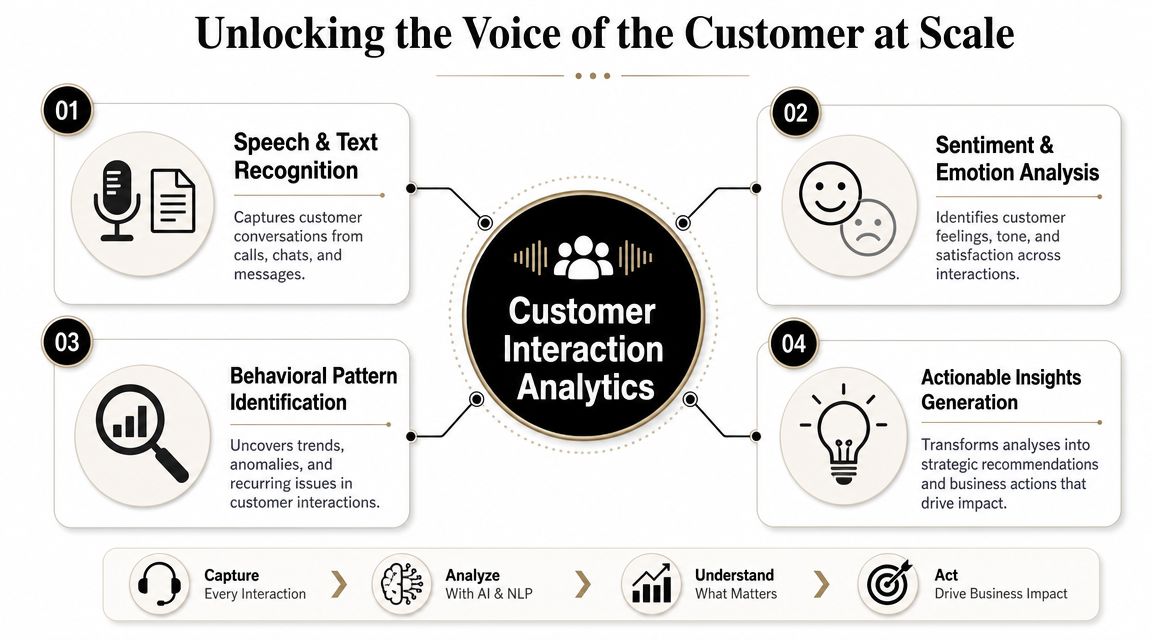
The easiest way to understand customer interaction analytics is to think of it as digital forensics for customer experience. Every interaction leaves traces. Words, pauses, escalation phrases, repeat questions, compliance language, transfer patterns, tone shifts, abandoned intents. On their own, these fragments are messy. Together, they show how customers experience the company.
The discipline becomes technically strong when organizations stop sampling a few interactions and instead capture the full interaction universe across voice, chat, email, social, and surveys. By capturing and transcribing 100% of customer interactions, teams can identify root causes of dissatisfaction, coaching gaps, and churn risk at scale, rather than relying on manual QA samples that miss systemic issues, as explained in TP Infinity's interaction analytics overview.
From raw conversations to usable signals
The process is systematic. There's no magic in it, but there is a lot of operational discipline.
First, the platform ingests interactions from every relevant source. That usually includes telephony recordings, chat transcripts, email threads, messaging logs, survey comments, and social interactions. If the data never enters the same analytical workflow, the business never gets a coherent picture.
Then the system converts unstructured content into analyzable data. Voice becomes text through transcription. Text is normalized so models can detect recurring patterns. From there, machine learning and NLP can classify topics, infer sentiment, detect intent, isolate recurring complaints, and flag moments that deserve review.
A good mental model looks like this:
| Stage | What happens | Why it matters |
|---|---|---|
| Capture | Conversations from multiple channels are collected | Prevents blind spots |
| Convert | Audio and text are structured into machine-readable data | Makes large-scale analysis possible |
| Interpret | Models identify topics, sentiment, intent, and patterns | Turns language into business signals |
| Act | Teams use dashboards, alerts, and workflows to respond | Converts insight into improvement |
For teams investing in a broader voice of the customer strategy, interaction analytics becomes the highest-frequency signal stream in the stack because it reflects what customers are saying when they need something now.
Why full coverage changes the outcome
Sampling tells you whether a few interactions looked good. Full coverage shows you how the operation behaves.
That difference matters in ways practitioners feel immediately. When every interaction is available for analysis, supervisors can coach based on patterns rather than anecdotes. Process owners can identify recurring policy confusion instead of arguing over isolated examples. Digital teams can see which intents leak out of self-service and become assisted contacts.
Full coverage doesn't just improve visibility. It changes the unit of analysis from agent compliance to business behavior.
It also forces better questions. Instead of asking, “Did this call go well?” teams start asking, “Why are customers contacting us about this issue across channels, and what should we change upstream?” That's where customer interaction analytics becomes a strategic capability rather than a reporting feature.
Architecting Your Single Source of Customer Truth
Most interaction analytics projects fail for predictable reasons. The models aren't usually the problem. The architecture is. Teams buy a tool, connect one channel, generate some dashboards, and then wonder why the insights never reshape operations.
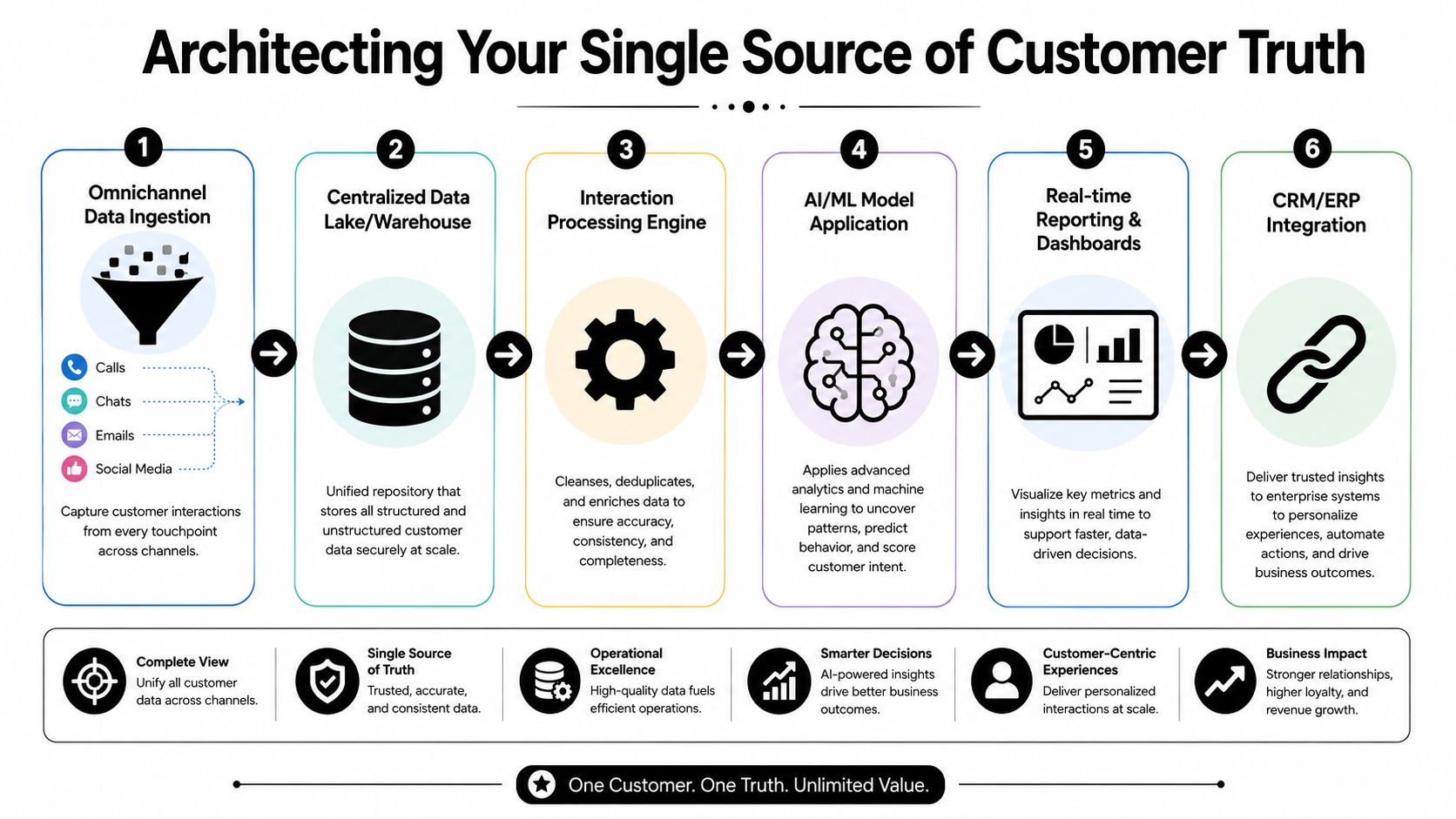
A usable analytics program needs a data architecture that reflects how customer journeys work. That means interaction data has to move from fragmented systems into a unified environment where it can be processed, enriched, analyzed, and routed back into operational platforms.
A useful visual for the stack looks like this:
What the architecture actually needs
At minimum, the enterprise stack needs six layers working together.
- Omnichannel ingestion: Pull data from contact center platforms such as Genesys or NICE, digital channels, CRM systems such as Salesforce, ticketing tools, and survey systems.
- Central storage: Use a data lake or warehouse as the durable record of customer interaction data and its metadata.
- Processing and enrichment: Clean transcripts, tag speaker turns, align customer IDs, add journey context, and normalize fields.
- Analytical models: Run classification, summarization, topic clustering, intent mapping, and anomaly detection.
- Operational surfaces: Push outputs into dashboards, QA workflows, routing logic, agent assist tools, and case management systems.
- Governance layer: Control permissions, retention, auditability, and model review.
Many teams often underestimate the complexity. Voice data without CRM context is interesting but incomplete. CRM data without the actual conversation tells you what happened in the system, not what the customer experienced. The architecture has to combine both.
For leaders comparing methods and tooling, Formbricks offers useful customer experience analytics insights on how feedback and behavior data can be connected. The same principle applies here, except interaction analytics adds direct conversational evidence to the picture.
Where AI creates leverage
The category changed when platforms moved beyond dashboards and keyword spotting. Contemporary systems now include topic modeling, intent recognition, automated summarization, and generative-AI-assisted analysis, allowing leaders to ask natural-language questions of customer data instead of relying only on preset reports, as described in Uniphore's glossary on customer interaction analytics.
That sounds abstract until you translate it into operations.
Topic modeling helps teams find the “unknown unknowns.” Instead of predefining every issue, the system can surface clusters of conversation themes the business wasn't actively tracking. Automated summarization reduces the reading burden for supervisors and analysts. Intent recognition helps separate “billing confusion” from “payment failure,” which matters because those are different owners and different fixes.
A short comparison makes the shift clearer:
| Legacy setup | Modern setup |
|---|---|
| Preset reports | Natural-language querying and exploratory analysis |
| Keyword counting | Topic and intent detection |
| Manual review notes | Automated summaries |
| Historical scorecards | Continuous insight layer |
One option in this space is Yellow.ai's Insights Engine, which provides analytics, dashboards, and conversational insight capabilities that can feed broader automation workflows. In practice, the platform matters less than the architecture discipline behind it. If the stack can't unify channels, preserve context, and operationalize outputs, the analytics won't travel far inside the enterprise.
Key Metrics That Drive Enterprise Performance
Most contact centers still organize metrics as if they belong in separate worlds. Operations watches handle time. QA watches compliance. CX watches satisfaction. Workforce teams watch staffing. Revenue teams look somewhere else entirely.
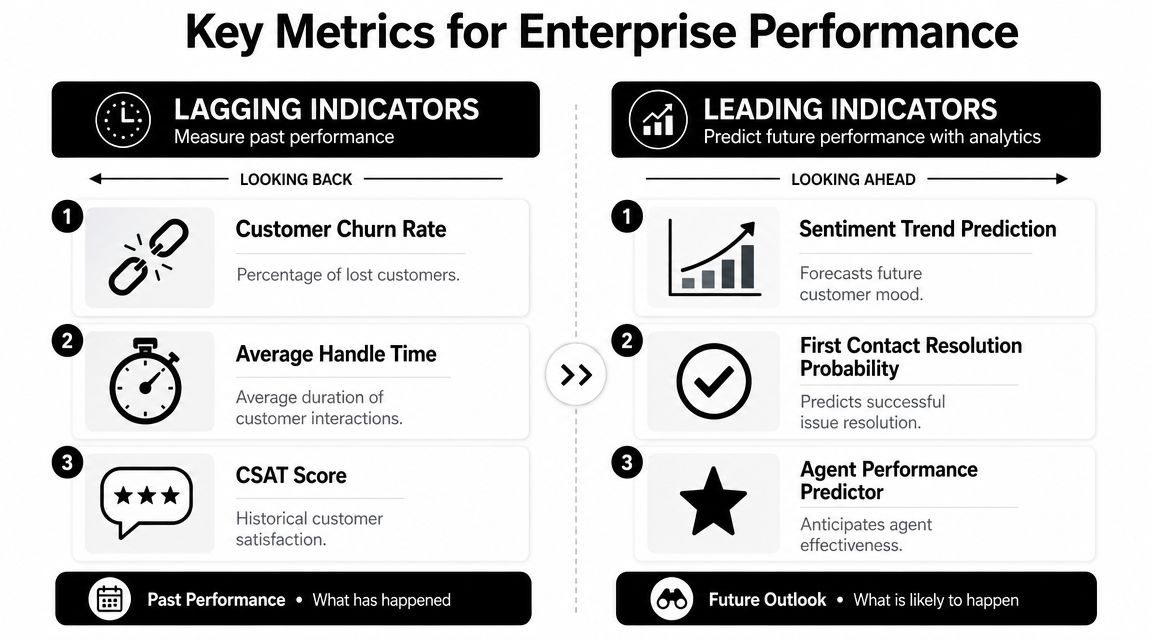
Customer interaction analytics is valuable because it connects those worlds. The strongest programs don't stop at lagging metrics such as FCR or AHT. They examine the conversational patterns, process breakdowns, and in-the-moment signals that shape those outcomes before the final KPI report lands.
Stop treating metrics as isolated dashboards
AHT is a good example. In many organizations, leaders react to rising handle time with generic pressure on agents to work faster. That often makes service worse because the underlying causes sit elsewhere. Broken authentication flows, missing order information, confusing policy language, or repeat contacts from failed self-service all inflate interaction time before the agent has a chance to “perform” better.
The same applies to FCR. It's not just an outcome metric. It's also the downstream effect of intent clarity, agent guidance, knowledge quality, routing logic, and customer emotion. If those upstream conditions are weak, FCR falls and the metric becomes a score without a diagnosis.
What to measure in a modern program
A stronger dashboard uses categories that reveal cause and effect.
- Operational efficiency: hold patterns, transfer reasons, silence moments, repeat-contact triggers, and queue-level issue concentration
- Agent performance: adherence to required language, evidence of effective discovery, empathy markers, interruption patterns, and coaching opportunities
- Customer experience: sentiment shifts, frustration cues, escalation language, unresolved intent, and effort signals
- Business outcomes: churn-risk indicators, complaint themes, service failure clusters, missed revenue opportunities, and policy friction
Recent tools increasingly move beyond retrospective reporting. Buyers are asking what actions analytics can automate in the moment, and newer systems use real-time interaction data to interpret needs, predict behaviors, and trigger interventions such as routing, alerts, or offer suppression, according to Sprinklr's discussion of customer interaction analytics.
A useful metric is one that points to an owner and a next action. If a dashboard creates discussion but not intervention, it's decorative.
A practical metric framework looks like this:
| Metric family | Lagging view | Leading view |
|---|---|---|
| Resolution | Final FCR result | Signals that resolution is at risk during the interaction |
| Efficiency | Final AHT | Friction sources extending work before closure |
| Quality | QA score after review | Real-time prompts for missed steps or weak discovery |
| Experience | Survey outcome later | Sentiment and escalation indicators during service |
The dashboard should tell a story executives can follow. Which intents are creating repeat work. Which channels are producing avoidable effort. Which agent behaviors correlate with clean resolutions. Which policy or product issue is driving contact demand this week. That's when customer interaction analytics starts to influence enterprise performance instead of merely describing it.
How Leading Industries Deploy Interaction Analytics
The best use cases aren't generic. They're shaped by industry risk, customer expectations, and operational structure. Customer interaction analytics becomes useful when it helps a team spot the exact failure patterns that manual review misses and broad dashboards blur.

BFSI and healthcare
In banking, financial services, and insurance, compliance is the obvious use case, but it's not the only one. Firms use analytics to detect where required disclosures are inconsistently delivered, where customers express confusion during product servicing, and where fraud-related language should trigger deeper review. A key advantage is scale. Instead of waiting for audits or supervisor spot checks, risk and operations teams can inspect recurring language patterns across the full stream of interactions.
A common BFSI problem looks like this: agents follow process on straightforward service calls, but exceptions create variation. Fee disputes, account holds, disputes, and identity verification edge cases generate long conversations with inconsistent explanations. Analytics helps teams cluster those interactions, identify phrases that correlate with escalation, and redesign scripts, knowledge guidance, or routing paths.
Healthcare teams use the technology differently. Their pressure points usually sit at the intersection of patient experience, scheduling friction, and privacy requirements. Interaction analytics can reveal where patients struggle to understand next steps, where referral workflows break down, and where handoffs between contact center staff and clinical teams create confusion.
A practical healthcare application is intent leakage. Patients often start with a simple appointment or billing question, then reveal a more complex need halfway through the conversation. If the organization only tracks the original disposition code, it misses the true reason for contact. Interaction analytics captures the nuance that standard case coding often flattens.
In regulated industries, the strongest programs don't choose between compliance and experience. They use the same interaction evidence to improve both.
Retail and logistics
In retail, interaction analytics often exposes a gap between what ecommerce teams think the journey looks like and what customers report after purchase. Contact reasons such as delayed refunds, order modifications, damaged goods, and delivery confusion rarely stay contained to one queue. They spill into chat, email, messaging, and social.
That matters because retail leaders often overfocus on conversion and underinvest in post-purchase friction. When analytics clusters repeat complaints and maps them to journey stages, the organization can see which issues are driving avoidable service demand. In practice, that may lead to clearer order-status messaging, better return instructions, or more accurate agent guidance during inventory exceptions.
In logistics, the classic symptom is repetitive “where is my order” contact. But the useful insight isn't that customers ask for updates. Everyone knows that. The useful insight is why some delivery journeys generate far more contacts than others. It may be missing proactive communication, unclear exception codes, failed handoffs with carriers, or internal terminology customers don't understand.
A logistics team can use interaction analytics to compare dispatch conversations, customer support contacts, and digital messages around delay events. That often reveals where a process is producing uncertainty, not just where a queue is busy.
Across industries, the pattern repeats. The technology creates value when teams use customer language as operational evidence and then assign the resulting issues to the people who can actually change the process.
A Practical Roadmap for Implementation and Governance
Buying the platform is the easy part. Building trust in the outputs is harder. That's why enterprise deployments should be staged, tightly scoped, and governed from the beginning.
Many vendor materials emphasize sentiment and intent detection but say very little about reliability. That's a problem because leaders eventually want to use these outputs for agent coaching, compliance review, and executive reporting. A better question is whether the analytics are accurate enough to trust for those decisions. Verizon's guidance highlights this validation gap and points out that inferred layers such as satisfaction estimation are still inference, not ground truth, which is exactly why measurement rigor matters before the outputs influence high-stakes workflows, as discussed in Verizon's guide to customer interaction analytics.
Phase one through phase four
A practical roadmap looks like this.
- Discovery and scoping
Start with business problems, not features. Pick a narrow set of use cases tied to real operational pain, such as repeat billing contacts, escalation detection, complaint clustering, or compliance phrase monitoring.
Map the relevant data sources early. Voice, chat, email, CRM, QA records, knowledge systems, and case metadata all matter. If legal, privacy, and security teams aren't in the room during scoping, the project will slow down later.
- Vendor evaluation
Teams often compare dashboards and demos. That's not enough. The deeper questions are about model behavior, integration fit, and operational maintainability.
Use criteria such as:
- Validation approach: How will your team test summarization quality, classification consistency, and alert usefulness?
- Workflow fit: Can outputs flow into QA, CRM, workforce, and routing environments without manual workarounds?
- Analyst usability: Can supervisors and operations leaders ask useful questions without depending on data science support?
- Auditability: Can the organization inspect why a flag, summary, or classification was produced?
- Phased rollout
Don't launch enterprise-wide on day one. Start with one channel or one high-value use case and build confidence in the outputs. A focused rollout makes it easier to compare machine-generated insight with expert review and tune taxonomies, prompts, and thresholds.
That discipline matters because customer interaction analytics often fails from organizational overreach, not technical impossibility. Teams promise transformation, skip calibration, and then lose credibility when frontline managers find obvious errors.
Field note: If supervisors can't explain why the system flagged an interaction, they won't operationalize it. Interpretability drives adoption.
- Scaling and optimization
Once one use case is working, expand deliberately. Add more channels. Connect more operational systems. Introduce role-based dashboards for supervisors, compliance leads, CX analysts, and executives. Build recurring review forums so insights result in process change, not just observation.
Governance that holds up under scrutiny
Governance can't be bolted on after deployment. It has to shape the program from the start.
An effective governance model should define:
| Governance area | What to decide early |
|---|---|
| Data access | Who can see transcripts, summaries, and sensitive fields |
| Retention | How long different interaction records are stored |
| Use boundaries | Which outputs can inform coaching, compliance, or executive reporting |
| Human review | When a person must confirm a finding before action |
| Model review | How taxonomies, prompts, and thresholds are updated |
This is especially important in regulated environments. If the system flags a compliance risk, someone must own the review workflow. If the model estimates sentiment or satisfaction, leaders need a policy for how those inferences can and cannot be used. If summaries are generated automatically, teams need spot-check routines that compare them against the original interaction.
The practical test is simple. Could your organization defend the output if an employee challenged a score, a regulator questioned a flag, or an executive asked how a board-level metric was derived? If the answer is no, the program isn't ready for full operational authority.
The Future is Autonomous From Interaction Analytics to Decision Intelligence
Customer interaction analytics started as a way to hear more of what customers were saying. It's becoming the layer that helps enterprises decide what to do next.
That shift matters because most service organizations are still built for hindsight. They review outcomes after the fact, coach after the fact, redesign workflows after the fact, and discover emerging issues after the backlog arrives. Once analytics moves into real-time detection, summarization, and recommendation, the function of CX changes. Teams can route differently, assist agents differently, suppress the wrong offer at the wrong moment, escalate earlier, and fix the journey while signals are still fresh.
The next stage is decision intelligence. Not a dashboard that waits for an analyst, but a system that combines customer language, operational context, and business rules to recommend or trigger the right action with appropriate oversight. That doesn't remove people from the loop. It changes where they spend time. Less hunting through interactions. More validating patterns, refining rules, and improving systems.
Three implications stand out:
- CX becomes a control tower: Interaction data informs product, policy, risk, digital, and service teams at the same time.
- Automation gets better context: Bots and agent-assist tools perform better when they learn from actual conversational patterns.
- Governance becomes strategic: The more organizations rely on AI-generated insight, the more they need confidence in validation, permissions, and review.
The companies that benefit most won't be the ones with the prettiest dashboards. They'll be the ones that treat customer interaction analytics as a production system for operational learning. That's how a contact center stops being measured only as a cost of service and starts functioning as one of the clearest sources of enterprise intelligence.
Yellow.ai helps enterprises put that model into practice with agentic AI for voice and chat, omnichannel orchestration, analytics, and governance features that support both customer and employee experiences. If you're building a modern customer interaction analytics program and want to connect insight with automation, explore Yellow.ai.