













Voice system engineering is now a systems discipline, not a component integration exercise. The teams that ship reliable enterprise voice experiences treat speech, reasoning, orchestration, channel context, observability, and policy enforcement as one runtime with shared constraints.
That shift matters because enterprise voice has changed shape. Earlier generations focused on getting recognition quality high enough to be usable. Current systems succeed or fail on whether they can coordinate low-latency turn taking, preserve context across channels, call business systems safely, and let an agentic workflow decide what to do next. A useful overview of that transition appears in this guide to enterprise voice AI systems.
In practice, the hardest problems show up between components. Audio has to be streamed, interpreted, grounded in business context, routed through the right tools, and returned fast enough to feel natural. Every handoff adds latency and failure modes. Every integration decision affects security scope, auditability, and how much control the enterprise keeps over its data and customer experience.
This article treats voice as a unified architecture problem. That is the standard enterprises now need if they want voice systems that scale beyond demos and hold up in production.
Table of Contents
- The New Foundations of Voice System Engineering
- Decoding the Core Voice AI Components
- Choosing Your Enterprise Voice Architecture
- Integrating Voice Across Your Tech Stack
- Solving the End-to-End Latency Challenge
- Navigating Voice AI Security and Compliance
- Your Roadmap to Enterprise Voice Deployment
The New Foundations of Voice System Engineering
Traditional IVR design treated voice as a routing surface. The caller spoke or pressed keys, the system matched that input to a branch, and the branch led to another branch. It worked for narrow flows, but it broke the moment the user spoke naturally, changed goals midstream, or needed the system to do actual work across business systems.
Modern voice system engineering is different. The job now is to build a system that can listen, interpret, reason, act, and respond while preserving conversational continuity. That's the difference between a scripted play and an improv actor. One can only deliver prewritten lines. The other has to understand what just happened, adapt in real time, and still move the interaction toward an outcome.
From scripted flows to agentic behavior
A simple voice bot maps utterances to intents and plays back approved responses. A true voice agent maintains state, handles interruptions, uses tools, retrieves data, and decides what action should happen next. That shift changes the engineering discipline.
Teams have to design for:
- Stateful interactions: The system needs memory within the session, and often across sessions.
- Actionability: The agent must do more than answer. It should update records, trigger workflows, and hand off with context.
- Recovery paths: Misrecognitions, ambiguity, and partial failures aren't edge cases. They're normal operating conditions.
- Channel continuity: Voice can't sit apart from chat, email, or case systems if the enterprise wants one customer journey.
A lot of organizations still evaluate voice using chatbot criteria. That's a mistake. Chat can tolerate a little delay and a little repair. Voice can't. Speech is temporal. Once the user pauses, they expect the system to behave like a participant in the conversation, not a back-office queue.
Practical rule: If your design depends on the customer speaking in a narrow pattern, you haven't built an enterprise voice system. You've built a fragile demo.
How the components work together
The most useful way to think about voice system engineering is as a control plane for conversation. The AI model matters, but it sits inside a larger runtime that decides how fast to respond, which data to access, when to confirm, when to escalate, and how to preserve context.
That's why unified design matters more than bolting together point tools. Separate vendors for telephony, ASR, orchestration, TTS, analytics, and workflow can work, but the integration burden lands on your team. In practice, enterprises often need a common interaction fabric that can coordinate voice with the rest of the customer stack. A good overview of that evolution appears in this explanation of modern Voice AI systems.
The strongest implementations treat latency, intelligence, and omnichannel context as first-order architecture decisions. Not cleanup work for later. When those pillars are built in from the start, voice stops feeling like a side channel and starts acting like an enterprise interface.
Decoding the Core Voice AI Components
Enterprise voice systems fail in the seams between components, not in the component names themselves. A vendor demo can make ASR, orchestration, or TTS look strong in isolation. Production systems are judged on whether those parts behave like one real-time, context-aware runtime under interruption, ambiguity, and policy constraints.
From scripted flows to agentic behavior
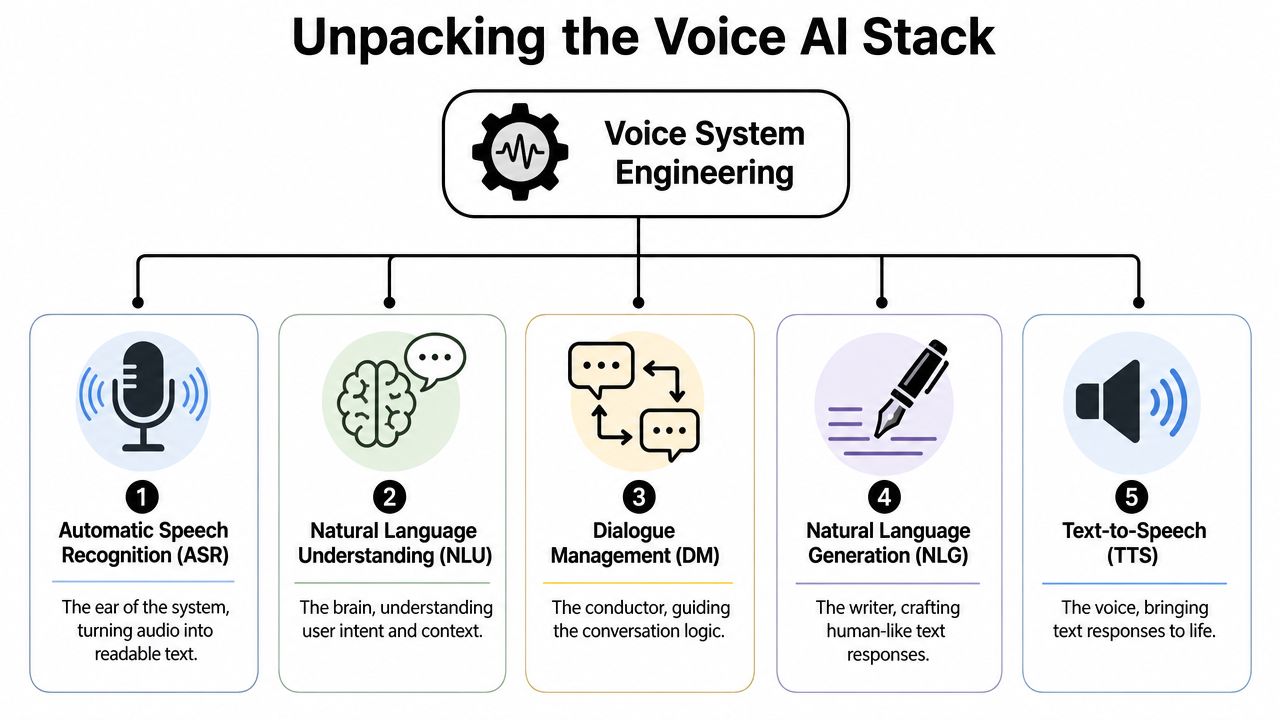
Automatic Speech Recognition (ASR) converts audio into text. In practice, its job is broader than transcription accuracy. ASR quality shapes barge-in handling, partial transcript stability, speaker separation, confidence scoring, and how quickly the rest of the system can act. For teams evaluating the operational side of speech recognition, ASR's applications and benefits gives useful business context.
Natural Language Understanding (NLU) determines what the user means. In older voice stacks, that usually meant intent classification and slot filling. In current enterprise systems, NLU often works alongside retrieval, memory, and policy checks so the agent can handle indirect requests, missing details, and follow-up turns without collapsing into fallback logic.
Dialogue Management (DM) controls the interaction. It decides whether to answer, ask a clarifying question, call a tool, verify identity, hand off to a human, or stop an action that violates policy. This layer carries much of the enterprise burden because it has to combine user intent, session state, business rules, tool results, and channel-specific behavior in one decision loop.
That is the shift from component integration to agentic voice design. The stack still has named layers, but the architecture goal is no longer to pass text from one box to the next. The goal is to run a coordinated conversational system where intelligence, latency, and context stay aligned across every turn.
How the components work together
Natural Language Generation (NLG) produces the response text. In enterprise settings, that means more than sounding natural. The response has to be concise enough for speech, consistent with brand and policy, and structured so the user can act on it without asking the agent to repeat itself.
Text-to-Speech (TTS) renders that response as audio. Voice quality matters, but timing matters just as much. Pronunciation control, streaming behavior, multilingual support, interruption handling, and prosody under stress all affect whether the caller experiences the system as competent or synthetic.
A practical model looks like this:
- Hear: ASR captures and streams the user's words.
- Interpret: NLU resolves meaning, entities, and conversational context.
- Decide: Dialogue management selects the next action and applies policy.
- Compose: NLG creates a response that is useful, brief, and appropriate for voice.
- Deliver: TTS speaks the response with timing and pronunciation that fit the moment.
This sequence is simple on paper. It gets hard in production because each layer changes the operating conditions of the next one. Unstable partial transcripts force the dialogue layer to wait longer or recover more often. Weak semantic understanding pushes too much logic into prompts and fallback trees. Slow or awkward speech synthesis makes a capable agent feel indecisive.
The strongest enterprise implementations treat those handoffs as first-class engineering work. That is why full-stack platforms have gained traction. A unified runtime can coordinate speech, orchestration, policy, analytics, and channel state more effectively than a loose chain of APIs. Teams evaluating that model can look at Yellow.ai's full-stack Voice AI automation platform as an example of how vendors are packaging those layers together for enterprise deployment.
One architecture principle holds across vendors and models. Component quality matters, but interaction quality depends on the system's ability to preserve context, enforce policy, and respond within conversational time.
The best voice systems improve the handoffs, not just the parts.
That distinction also explains why older, script-heavy voice systems felt brittle. The limitation was rarely one component alone. It was the lack of a unified control model that could adapt in real time as users interrupted, corrected themselves, switched topics, or moved between channels.
For architects, the takeaway is straightforward. ASR, NLU, dialogue management, NLG, and TTS are still useful building blocks. Enterprise voice system engineering starts when those blocks are designed and operated as one agentic system.
Choosing Your Enterprise Voice Architecture
Architecture decisions in voice aren't academic. They show up later as deployment speed, debugging pain, resilience gaps, and vendor dependency. Most enterprise teams end up choosing among three broad patterns: monolithic, microservices-based, and hybrid.
Where monoliths still work
A monolithic architecture can be sensible when one team owns the stack, the use cases are limited, and speed matters more than long-term flexibility. It reduces integration overhead because core services are packaged together. For a contained employee helpdesk or a narrow support workflow, that can be enough.
The downside appears later. A monolith makes it harder to swap ASR providers, isolate failures, optimize one component without retesting everything, or run different models for different lines of business.
Why hybrid usually wins
Pure microservices provide freedom. Teams can choose separate vendors and runtimes for telephony, transcription, orchestration, retrieval, policy, analytics, and TTS. That's appealing for highly specialized environments, especially when different regions, business units, or compliance constraints require different controls.
But freedom has a cost. You now own the seams. You own retries, tracing, media orchestration, consistency in session state, and every provider contract when one interface changes.
For most enterprises, the practical answer is a hybrid architecture. Use a unified platform for common capabilities, then expose extension points where your organization needs custom logic, proprietary models, or regulated controls.
| Pattern | Best For | Pros | Cons |
|---|---|---|---|
| Monolithic | Narrow deployments with one team and limited customization | Faster initial setup, fewer integration points, simpler operations early on | Harder to customize deeply, harder to swap vendors, larger blast radius on failure |
| Microservices | Large engineering organizations with strong platform maturity | Fine-grained control, component independence, easier targeted optimization | High integration complexity, more observability work, slower delivery without strong discipline |
| Hybrid | Most enterprises scaling across business units and channels | Balanced flexibility, faster rollout, shared controls with selective customization | Requires careful governance to avoid turning into an accidental monolith or accidental sprawl |
A few decision criteria matter more than feature checklists:
- Change frequency: If you expect frequent updates to models, channels, and workflows, modularity matters.
- Internal platform strength: If your organization doesn't already run distributed systems well, a full microservices approach will hurt you.
- Compliance boundaries: Regulated environments often need clear data paths and policy isolation.
- Procurement strategy: If avoiding lock-in is a board-level concern, architecture has to support component portability.
One useful middle path is to standardize the voice runtime while keeping business logic and tool execution outside the platform boundary. That preserves speed without burying your process logic inside vendor-specific flow builders. Teams evaluating full-stack options often look at platforms that package telephony, voice AI runtime, and orchestration together, such as VoiceHUB for enterprise voice automation, then decide where custom services should still live.
Architecture heuristic: Own the business logic that differentiates you. Buy the plumbing that doesn't.
The wrong architecture usually doesn't fail on day one. It fails six months later, when one region needs a different compliance path, one business unit wants a different voice provider, and your ops team still can't trace a broken conversation across five services.
Integrating Voice Across Your Tech Stack
A voice agent without systems access is just a talking FAQ. Real enterprise value appears when the agent can pull context from existing tools and write the result back cleanly.
Context has to survive channel changes
Customers don't care how your channels are organized internally. They'll start in chat, continue in email, call support, and expect the agent to know what happened before. That means voice system engineering has to include shared identity, session context, transcript continuity, and workflow continuity across channels.
A common example is order support. A customer may first ask in chat where an order is, then call later because the shipment is delayed. The voice layer should already know the order reference, recent ticket history, and whether an escalation was opened. If it asks the customer to restate everything, the architecture failed even if the speech model performed well.
Integration patterns that hold up in production
The strongest pattern is to keep voice orchestration close to a service layer that abstracts enterprise systems. Instead of letting the agent call Salesforce, Zendesk, Genesys, HubSpot, or NICE in ad hoc ways, create stable internal actions such as lookupCustomer, getOpenCases, checkOrderStatus, or createEscalation. That gives you a controlled contract between conversation logic and systems of record.
In practice, effective integration design usually includes:
- Read paths first: Let the agent retrieve customer, order, policy, and ticket context before you expose write actions.
- Scoped write permissions: Start with narrow actions such as case creation, note logging, or status updates rather than broad record editing.
- Idempotent actions: Repeat calls happen in voice. The same request may be retried if audio drops, the user interrupts, or a downstream timeout occurs.
- Transcript-aware logging: Store enough conversation detail to support audit, handoff, and quality review without exposing sensitive data broadly.
A practical production flow often looks like this:
- The caller is identified through the telephony session or an account lookup.
- The voice agent pulls CRM and ticket context before asking broad questions.
- The orchestration layer chooses whether it can resolve the issue directly or needs a human handoff.
- If it hands off, it passes the summary, customer intent, and action history so the live agent starts in context.
That's much better than using the language model as the integration layer. Models are good at reasoning over context. They are not your transaction boundary.
A voice agent should never be the only place where business state exists. The source of truth still belongs in your systems of record.
Integration also has to account for failure modes. CRM access may be slow. A ticket system may reject malformed payloads. A contact center platform may support transfer metadata differently by region. Good voice systems plan for these cases with explicit fallbacks, queue messaging, and deterministic escalation paths.
Omnichannel context isn't a feature you tack on after launch. It's the backbone that makes voice useful in a real enterprise.
Solving the End-to-End Latency Challenge
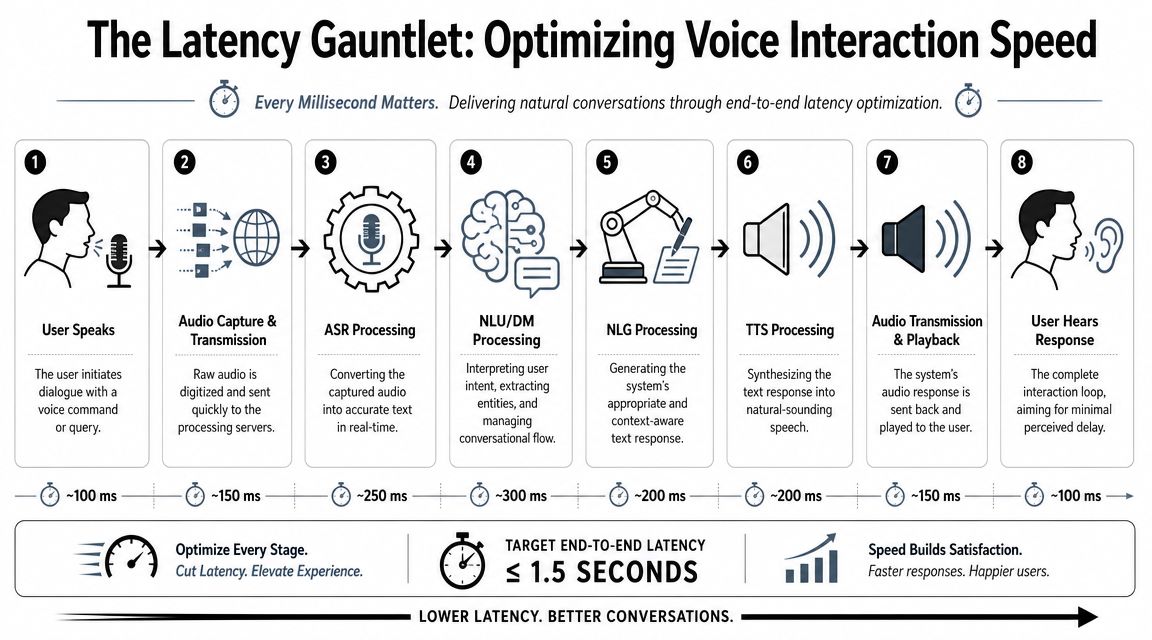
Latency is often discussed as if it belongs to one model. It doesn't. In real voice systems, latency is a path problem. The user speaks, audio is captured, transmitted, transcribed, interpreted, routed through business logic, enriched by backend systems, turned into a response, synthesized into speech, transmitted again, and then played back.
That full path is where natural conversation is won or lost.
Latency lives across the whole path
A major blind spot in enterprise voice is over-focusing on ASR or model inference while ignoring transport and infrastructure. End-to-end network conditions shape the interaction heavily. For example, GEO satellite internet can have latency more than 20 times higher than fiber, and even LEO systems don't deliver uniform performance because coverage and capacity vary by latitude and constellation design, as discussed in this analysis of connectivity and voice latency.
That matters more than many teams expect. A contact center may run clean tests from a metro office on reliable fiber, then struggle in rural deployments, field-service scenarios, or internationally distributed operations where the audio path, gateway placement, and backend systems introduce uneven delay.
Here's the latency chain that architects should measure:
- Audio capture and ingress: Microphone quality, browser or device audio handling, telephony ingress, and regional media routing.
- Speech processing: Streaming ASR behavior, partial transcript stability, and confidence handling.
- Reasoning and policy: Intent interpretation, state retrieval, dialogue policy, and guardrails.
- Tool execution: CRM reads, order lookup, knowledge retrieval, identity checks, and transactional APIs.
- Response generation and playback: Response composition, TTS generation, outbound media transmission, and playback timing.
If one layer is slow, users don't care which layer it was. They only hear silence.
A short technical brief can help teams understand interruption behavior and conversational pacing in this context. The engineering issues described in handling interruptions in voicebots are useful because interruption support and latency are tightly coupled in real systems.
What actually reduces perceived delay
The first fix is architectural, not algorithmic. Put media processing, inference, and key integrations as close as possible to the user path. Regional gateway placement matters. So does keeping long-haul round trips out of the critical loop.
The second fix is workflow design. Don't make the user wait for information you could have fetched earlier. If identity, account status, or recent case history is almost always needed, preload it as the session starts.
The third fix is response strategy. Some requests need a complete answer immediately. Others need a short, purposeful acknowledgment while a backend system works. The distinction matters. Filler audio without substance feels evasive. A concise, relevant progress update feels deliberate.
A practical latency program usually includes:
- Distributed tracing: Track every stage of a call path, not just model timings.
- Streaming everywhere possible: Stream transcripts, model output, and audio playback instead of waiting for complete batches.
- Concurrent execution: Run retrieval, validation, and policy checks in parallel when dependencies allow it.
- Caching with care: Cache stable prompts, common phrases, and non-sensitive reference data that improves responsiveness.
- Fallback logic: Degrade gracefully when a backend system is slow, unreachable, or inconsistent.
Operational insight: The caller experiences one delay budget. Your architecture may have ten contributors to it, but the customer hears only one silence.
The biggest mistake I see is treating latency as a KPI owned by the model team. In enterprise voice system engineering, latency belongs to networking, telephony, application architecture, integration design, and conversation design at the same time. That's why some systems with impressive models still feel robotic, while simpler systems feel responsive and capable.
Navigating Voice AI Security and Compliance
Security in voice systems has a different shape than security in chat. You're not only protecting text. You're protecting live audio, transcripts, metadata, identities, and actions performed on backend systems.
Audio security is different from chat security
Start with the media path. Audio in transit needs strong transport protection, and recordings or transcripts at rest need access controls that reflect operational reality. Far too many teams secure the application layer but leave broad internal access to recordings, transcripts, or debug logs.
The next problem is sensitive content leakage. Voice interactions often contain payment details, health information, account identifiers, addresses, and spoken secrets like one-time codes. If those show up in raw transcripts, analytics exports, QA workflows, or prompt logs, the exposure multiplies quickly.
Strong designs usually include:
- Selective redaction: Remove or mask sensitive data from transcripts and recordings where feasible.
- Role-based access: Let QA, operations, developers, and compliance teams see only what their jobs require.
- Data minimization: Store what the business and regulators require, not every artifact by default.
- Auditability: Record who accessed what, what actions the system took, and which policies were applied.
Compliance starts in the architecture
HIPAA, PCI-DSS, GDPR, and SOC 2 don't become relevant at procurement time. They shape system boundaries from the start. In healthcare, for example, teams need clear handling for protected health information in both transcripts and downstream workflows. In payments, spoken card data can create storage and processing obligations that many voice implementations underestimate.
Emergency and life-safety voice systems also show why resilience and monitoring matter. A design guide for voice evacuation systems emphasizes redundant speaker-circuit topology and recommends interleaving circuits so a single failed line doesn't silence part of a zone, as described in this voice evacuation design reference. The same engineering mindset applies in enterprise AI. Don't let one failure path take down the whole communication surface.
For organizations operating in healthcare, it's also worth reviewing practical guidance on affordable HIPAA pentesting, especially when voice workflows touch patient data, scheduling, benefits, or triage. The point isn't the vendor. It's the discipline of testing voice-connected systems the way an attacker or auditor would.
Security reviews should test the conversation path itself, not just the surrounding app. The audio path, transcript flow, handoff path, and tool permissions all create risk.
There's another compliance issue teams miss. Voice systems can trigger real-world actions quickly. Resetting credentials, changing account details, opening claims, or accessing records through a spoken interface demands explicit authorization controls. That means policy checks before action execution, not just after the fact in logs.
A trustworthy voice system feels smooth to the user because the controls were designed into the runtime. Not layered on as manual exceptions later.
Your Roadmap to Enterprise Voice Deployment
Most enterprise voice programs don't fail because the idea was wrong. They fail because the rollout tried to do too much at once, across too many workflows, with too little operational discipline.
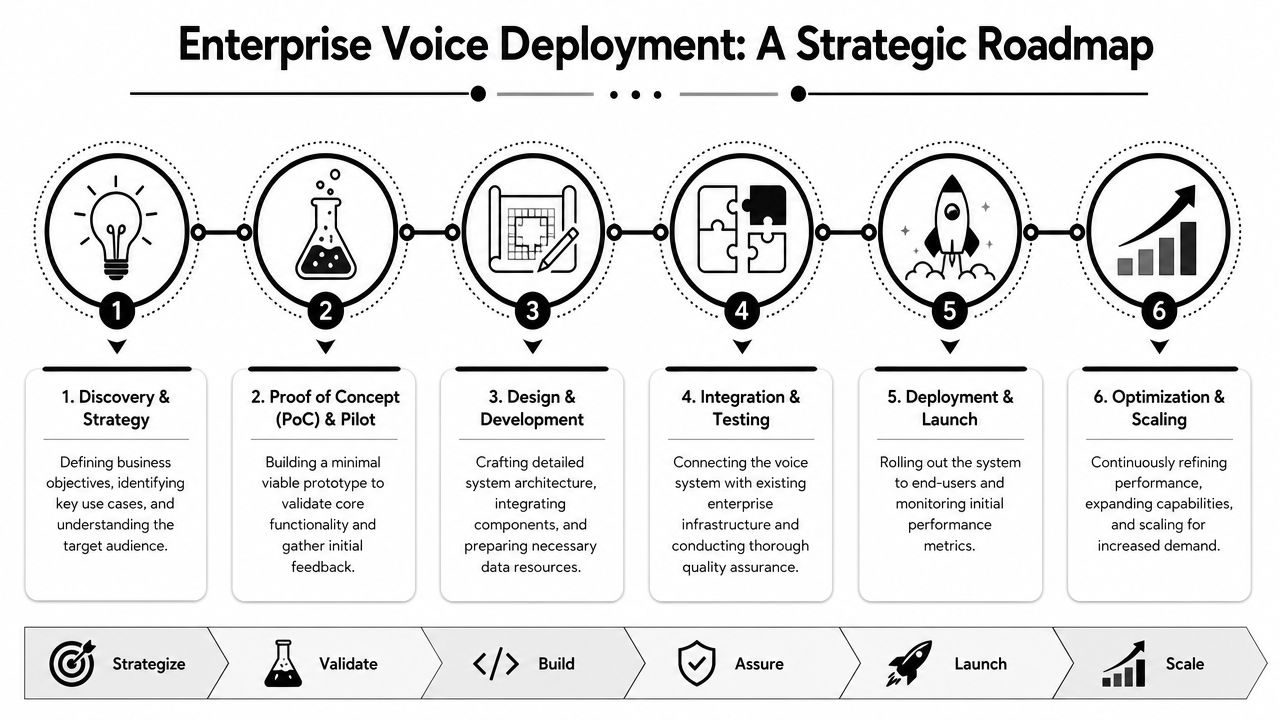
Phase the program instead of betting on a big launch
Start with one use case where voice offers a clear advantage. Good candidates usually share three traits: high volume, repeatable process steps, and meaningful system access requirements. Think appointment management, order tracking, employee IT support, benefits questions, account servicing, or after-hours triage.
Then move through a phased operating model:
Discovery and strategy
Define the business outcome first. Not “deploy voice AI,” but “resolve common order-status calls without forcing agent transfer” or “automate employee password reset and ticket creation.” Identify where voice is the right interface and where it isn't.Pilot and proof of concept
Keep scope narrow. One line of business. One geography. One set of integrations. Test whether the system can handle actual caller behavior, not just prepared scripts.Design and development
Build around the production constraints you already know. Authentication, data access, handoff logic, transcript handling, and observability should exist before scale, not after it.Integration and hardening
Many teams rush during this phase. Don't. Validate error handling, escalation paths, noisy audio conditions, interruptions, backend slowness, and policy edge cases.Deployment and controlled launch
Roll out gradually. Watch real interactions. Tune prompts, response policies, and routing rules based on real caller interactions.Optimization and scaling
Expand to adjacent workflows only after the first one is operationally stable.
Measure operations, not just model quality
Voice programs need metrics, but teams often choose the wrong ones. A transcript that looks good in a test set doesn't prove the business flow works. Enterprises should track outcome metrics tied to service delivery.
That usually includes:
- Containment rate: How often the system resolves the interaction without human transfer.
- First contact resolution: Whether the issue was solved in the first interaction.
- Customer satisfaction: Gathered through channel-appropriate feedback and operational review.
- Operational cost impact: Examined through staffing, handle time, and service efficiency.
- Escalation quality: Whether handoffs include enough context for a human to continue effectively.
One more engineering note matters for physical and distributed voice infrastructure. Voice evacuation design references often use 25 V or 70.7 V distributed audio with built-in alert tones because higher-voltage constant-voltage architectures reduce current for a given power level and help with long cable runs and large building zoning, as explained in this voice evacuation reference guide. The enterprise AI analogy is straightforward. Scalable voice systems need architecture that anticipates distribution, distance, and failure, not just functionality in a lab.
Launch isn't the finish line. It's the point where your observability finally starts telling the truth.
The best deployment roadmaps also define ownership clearly. Product owns the use case. Platform owns runtime standards. Security owns control validation. Operations owns service outcomes. If everyone owns voice, no one owns it.
Yellow.ai provides an enterprise platform for building agentic conversations across voice and other channels, so teams evaluating voice system engineering options can use it as one path for combining orchestration, integrations, testing, and governance in a single environment.



