









Tuesday morning in a contact center. Three customers enter the same queue: one disputes a charge, another wants to return a product, and a third can't get a device working. A generic script gives them the same opening questions. A next-best-action system looks at what each person needs and recommends a different move: route the billing dispute to an appropriate agent, offer an eligible return path, or connect the technical issue to a specialist.
That distinction matters. Next best action (NBA) isn't just an AI that answers questions. It's an operating approach for choosing what should happen next, based on the customer's situation, the organization's policies, and the outcomes the business wants to achieve. To work in an enterprise, the system must do more than make a recommendation. Teams need to know who owns it and whether it helps the customer beyond the current interaction.
Table of Contents
- What a Next Best Action Actually Does
- How AI Decides the Next Step
- Business Benefits Leaders Actually Care About
- Inside the NBA Reference Architecture
- Comparing Rules, Machine Learning, and Reinforcement Learning
- Where NBA Wins in the Real World
- Measuring Whether NBA Is Actually Working
- Governance, Accountability, and the Road to Launch
What a Next Best Action Actually Does
The simplest way to understand next best action is to think of it as a decision made at a particular moment. The system considers the situation, identifies actions that are allowed, and selects the one that best fits the context. That action might be to answer directly, route a customer, schedule a follow-up, offer a suitable product, or do nothing for now.
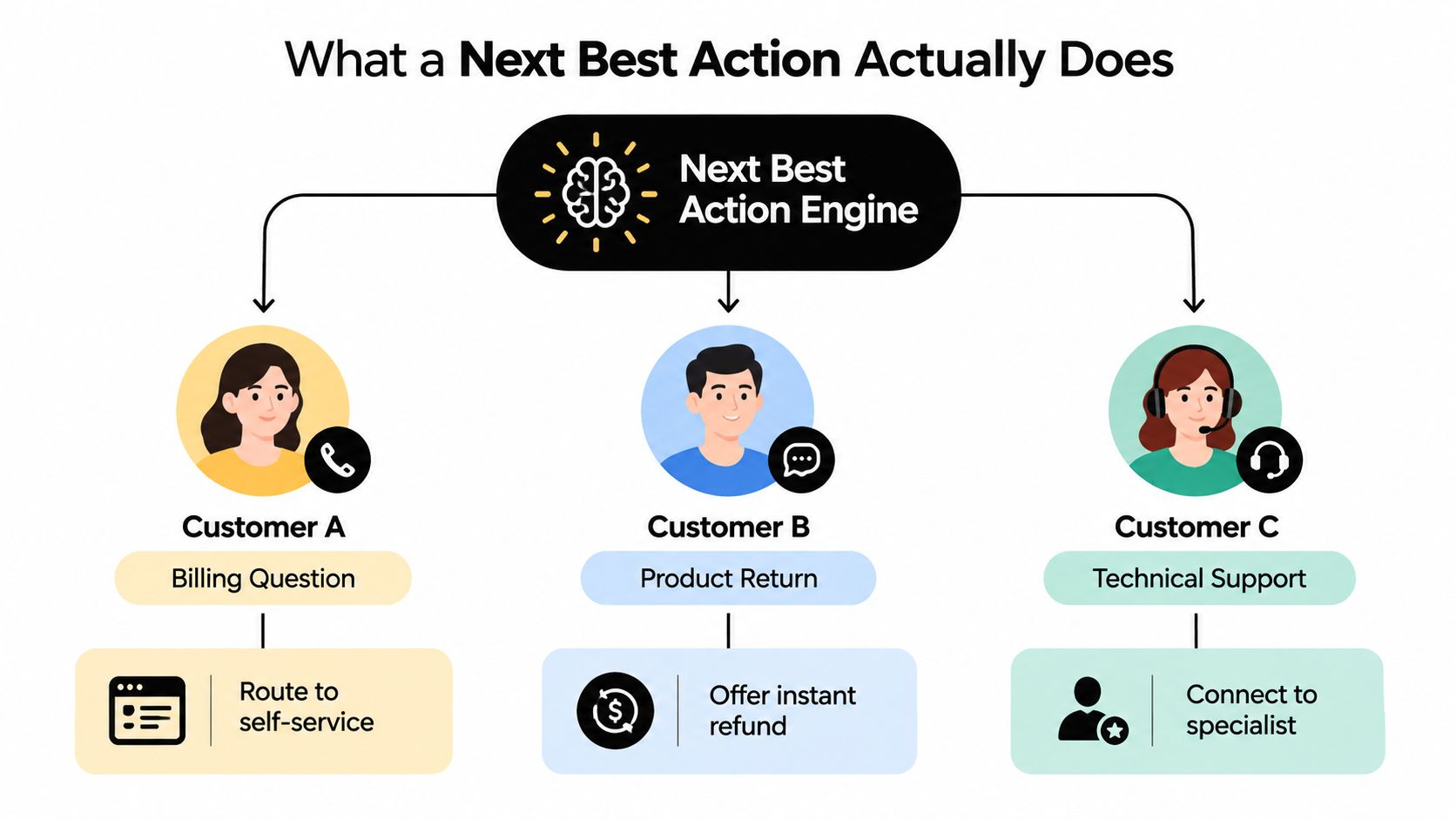
A product recommendation engine typically ranks items a person might want. An NBA system can make a broader operational choice: which action to take, through which channel, and whether to take an action at all. A customer looking at a product may be ready for an offer. Someone who just had a difficult service conversation may need help, not another promotion.
The idea grew beyond “next product to buy” thinking because enterprises face decisions that aren't sales recommendations. A service team must decide whether to resolve a request through self-service or send it to a person. An employee-support team may need to direct a sensitive request to the right specialist. In each case, the system's job is to help move the situation toward a useful outcome.
That's why NBA is neither a generic machine-learning model nor a fixed script. A model can estimate what might happen, and a script can enforce a predefined path. NBA combines decision logic, business constraints, and the available actions to make a contextual recommendation. The implementation might use rules, machine learning, or both, but the operating question stays the same: what's the most appropriate next step for this person now?
Practical distinction: A recommendation has value only when the organization can act on it in the customer's current context.
This way of thinking about customer qualification also has parallels in other businesses. For example, teams that want to win more cleaning jobs can use structured qualification to decide which prospect deserves a follow-up and what that follow-up should be. NBA applies the same basic discipline to a wider range of service, sales, and employee decisions.
How AI Decides the Next Step
A useful way to understand decisioning methods is to compare them to people working from different kinds of guidance. Some follow a rulebook, some recognize patterns, some learn by trying actions and observing outcomes, and some combine several perspectives.
Rules provide the guardrails
A rule-based system is like a rulebook. If a request falls into a category that must be reviewed by a person, the system can route it accordingly. Rules are direct and easy to inspect, which makes them useful for eligibility checks, policy enforcement, and other decisions where teams need a clear reason for the outcome.
Their limitation is rigidity. A rule can handle situations its designers anticipated, but it won't automatically discover a better path when customer behavior changes.
Supervised machine learning spots patterns
Supervised machine learning is a pattern-spotter. It learns from examples in historical data, such as which customers responded to a particular outreach or which signals tend to precede a particular service need. The system can then score possible actions for a new situation.
This approach depends on having useful historical examples. When an organization introduces a new action or encounters a customer situation it hasn't seen much before, the model has less evidence to guide its recommendation. Teams also need to check that the data and resulting recommendations don't reproduce unfair patterns.
Reinforcement learning learns from outcomes
Reinforcement learning is closer to an experimenter. The system selects an action, observes what happens, and uses that feedback to improve future choices. This can help when the best choice depends on how earlier decisions shape later interactions.
The hard part is defining a meaningful reward. If a system is rewarded only for closing a conversation, it may favor a quick action even when the customer returns with the same problem. Learning from outcomes doesn't guarantee the system is learning the right outcome.
Ensembles combine methods
An ensemble is a council rather than a single adviser. Rules can screen out actions that aren't permitted, machine learning can rank eligible options, and a learning layer can help adapt choices based on observed results. Combining approaches can address different needs, but it also means teams must be able to explain which component influenced a recommendation.
A sensible design starts with the decision's risk and data context, not a preference for the newest technique. The more important the decision, the more carefully the organization should specify which methods can recommend, which rules can block, and who can review an outcome.
Business Benefits Leaders Actually Care About
NBA can support business goals, but leaders should be precise about the mechanism. A system doesn't reduce costs or improve loyalty because it makes recommendations. The value comes from selecting an appropriate action, delivering it through a workable process, and measuring whether the result holds up beyond the immediate interaction.
For customer experience, the first potential benefit is a more suitable route to resolution. If a routine request can be answered through self-service, an agent can focus on situations that need human judgment. If the customer's issue is complex or sensitive, the system can help avoid an unhelpful automated loop by routing the conversation to the right team.
For employee experience, a well-designed NBA workflow can reduce the need for agents to search across separate tools and decide from scratch which step to take. The prompt should explain what action is recommended and give the employee enough context to assess it. If the system presents an unexplained instruction, it may shift work from searching for information to questioning the recommendation.
Revenue opportunities require similar restraint. NBA can help surface a relevant retention intervention or product offer when it fits the customer's circumstances. It can also recommend no offer when a sales message would be inappropriate. That's a better basis for a business case than counting recommendations or clicks alone.

Make the business case measurable
Before launch, agree on what the team will inspect. A director might review whether routine requests reach suitable self-service, whether agents can act on prompts without extra searching, and whether offers lead to healthy customer outcomes rather than unwanted pressure. These are measurement questions, not promised results.
Consistent policy enforcement and easier handling of new services can also matter. But neither should be treated as an automatic benefit. The team needs to establish that the decision rules are current, the right people can update them, and frontline staff understand when to accept or override the recommendation.
For the quarterly review: Show not only how often the system recommended an action, but what happened after customers and employees acted on it.
When evaluating systems for a different kind of service business, the same practical lens helps. A guide to features tutoring businesses actually need is useful for seeing how software capabilities should map to the work a team performs. For NBA, the equivalent test is whether each feature supports a real decision, an appropriate handoff, or a meaningful outcome.
Inside the NBA Reference Architecture
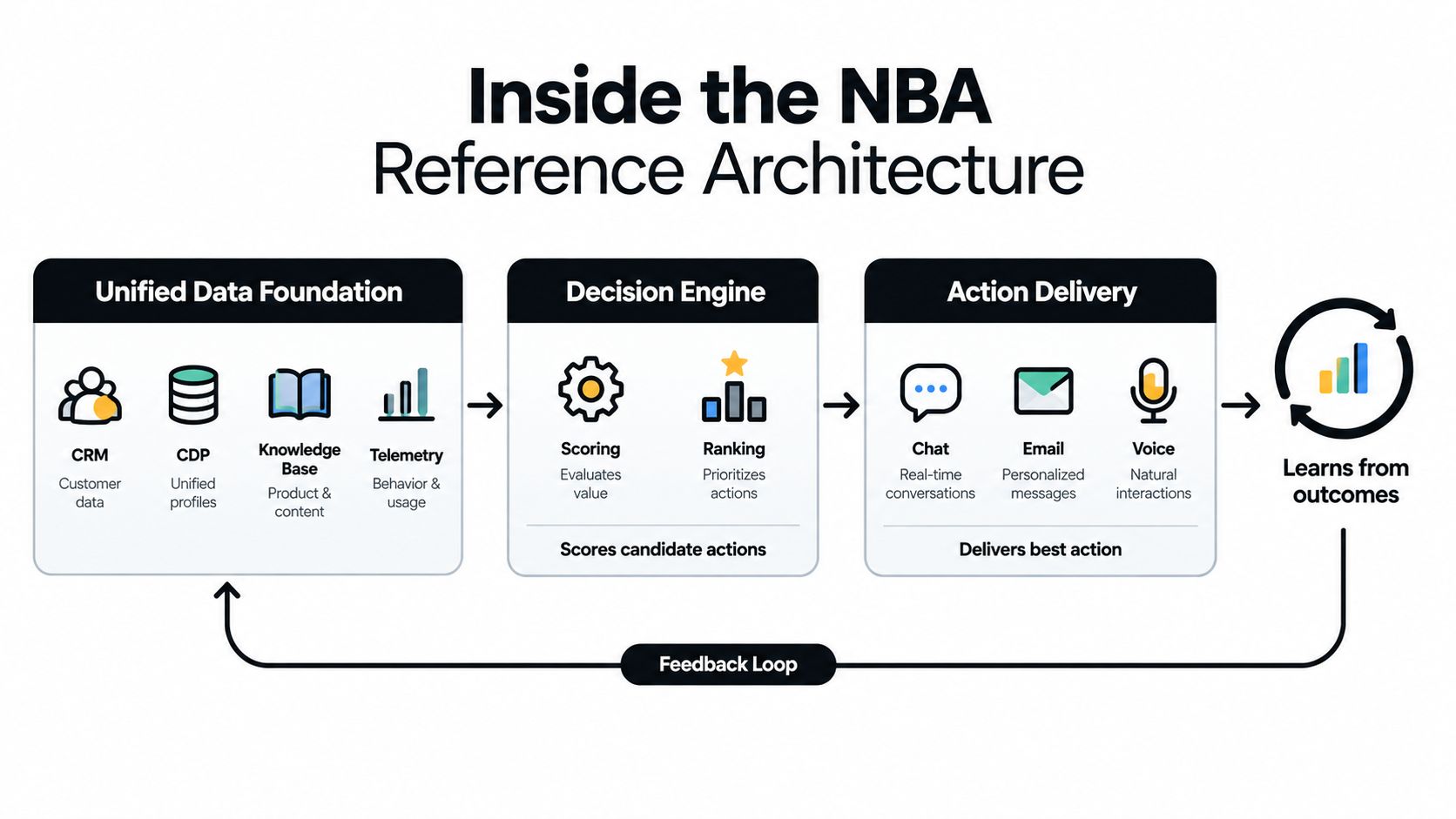
An NBA system has to connect information, decision logic, and the tools employees and customers already use. Teams can think about the architecture as a set of working layers, each with a distinct job.
Start with a usable data foundation
The data layer gathers information that helps describe the current situation. That may include CRM records, customer profiles, knowledge articles, and interaction events. A contact-center recommendation can be weak if it sees the latest message but misses the existing case history, or if it relies on a record that hasn't been updated.
Unification doesn't mean collecting every available field. It means making relevant context accessible and reliable enough for the decision at hand. Teams should be clear about which sources are authoritative and what the system should do when information is missing or conflicts.
Rank actions, then decide how to deliver them
The decision engine evaluates possible actions and ranks the ones that satisfy business policies. For a service request, its options might include a knowledge-based answer, a workflow, or an escalation. The engine should preserve the reason behind its choice, not just emit an action label.
An orchestration layer can then determine where and when the action belongs. It may account for the current channel, whether the customer is already speaking with an agent, and whether another team needs to take over. The activation layer sends the action into the relevant customer or employee workflow, such as voice, chat, email, or an agent queue.
Keep the existing workflow connected
In practice, the architecture must fit around systems such as Salesforce or Zendesk for customer records and service workflows, Genesys for contact-center operations, or ServiceNow and Workday for internal processes. Integration is not merely a technical connection. The receiving system needs to accept the recommendation in a form employees can understand and act on.
Governance needs to be built into these connections. Capture what triggered a recommendation, which model or agent participated, its confidence, what action was allowed, who reviewed or overrode it, and what happened afterward. Those details help teams investigate a poor outcome and improve a decision without guessing which part of the system failed.
Comparing Rules, Machine Learning, and Reinforcement Learning
Choose a decisioning approach by looking at the decision's risk, the data available, and the kind of change the organization expects. The table below is a practical guide, not a guarantee that a method will perform well in every implementation.
Choosing the Right Decisioning Approach for an NBA Stack
| Approach | Data Needs | Latency | Transparency | Best For |
|---|---|---|---|---|
| Rules | Explicit policies and conditions | Typically straightforward to execute | High, because the conditions can be inspected | Eligibility checks, policy limits, and tightly controlled decisions |
| Supervised machine learning | Historical examples with useful outcomes | Depends on the model and serving setup | Varies by model and supporting explanations | Ranking likely actions when relevant historical data is available |
| Reinforcement learning | Action and outcome feedback, plus a carefully defined reward | Depends on how learning and serving are implemented | Can be harder to explain than direct rules | Adapting action selection as outcomes accumulate |
| Ensemble stack | Data and policy inputs suited to each component | Depends on how components are coordinated | Requires tracing how each component contributed | Journeys where no single approach covers all decisions |
Rules are a strong starting point when the organization needs a decision that staff can inspect and challenge. Supervised learning can help when the team has relevant past examples and needs to compare options across varied customer contexts. Reinforcement learning is a candidate when outcomes can feed back into the decision process and the organization has a defensible way to define success.
Why hybrid systems are common
An enterprise doesn't have to choose one technique for every decision. Rules can constrain what's allowed, a predictive model can prioritize options, and an adaptive method can refine selection as the system observes outcomes. The design should keep these roles distinct so the team can tell whether a result came from a policy constraint, a model score, or a learned preference.
Start with one decision that has a clear owner and a manageable set of permitted actions. Confirm the data is suitable, identify how a person can intervene, and establish how the team will evaluate the outcome. That approach avoids committing the whole customer journey to a complex stack before the organization understands what it needs.
Where NBA Wins in the Real World
The same decisioning approach can produce very different actions depending on who needs help and what the organization knows. Its usefulness comes from matching a choice to the situation, not from applying the same automation everywhere.
Contact center
A billing dispute arrives alongside a password-reset request. An NBA workflow can flag the dispute for a suitable agent while offering the password-reset customer a self-service route. The team should evaluate whether those actions lead to durable resolution and appropriate handling, not assume that routing itself counts as success.
The system also needs to leave room for judgment. If the customer's account history or current message suggests the issue is more complicated than the initial category, the agent should be able to revise the path rather than follow an unsuitable prompt.
Self-service
A customer returns to a support page after trying an answer that didn't solve the problem. The system might offer a guided form or a live conversation rather than presenting the same answer again. The decision can draw on intent, recent interaction history, and the channel the customer is using, while the team checks whether the selected route resolves the issue.
A coordinated experience across touchpoints requires the organization to understand how people move between them. Customer journey orchestration offers a useful frame for thinking about how actions in one channel should relate to what happens in another, rather than creating separate, disconnected journeys.
Employee experience
A new hire may need help completing an onboarding task, locating a relevant document, or getting a sensitive question to the right person. An NBA workflow can distinguish between a straightforward information request and one that needs a people leader or specialist. The system should make the next step clear to the employee without exposing information to people who shouldn't see it.
Across these situations, the decision engine may be similar, but the permitted actions, risks, and success measures are not. A customer-service queue and an employee-support portal shouldn't use identical policies because both can recommend a next step.
Measuring Whether NBA Is Actually Working
A system can make a channel look more efficient while making the overall relationship worse. Containment, handle time, click-through, and ticket closure can help teams understand local performance, but none proves that a customer's problem is resolved or that employees can manage the resulting workload.
A 2025 CX survey cited in industry coverage of human-in-the-loop practices found an average satisfaction score of 60% for AI-only interactions, compared with 88% for human-led interactions. The finding challenges a simple assumption: the fastest automated action isn't automatically the best action.
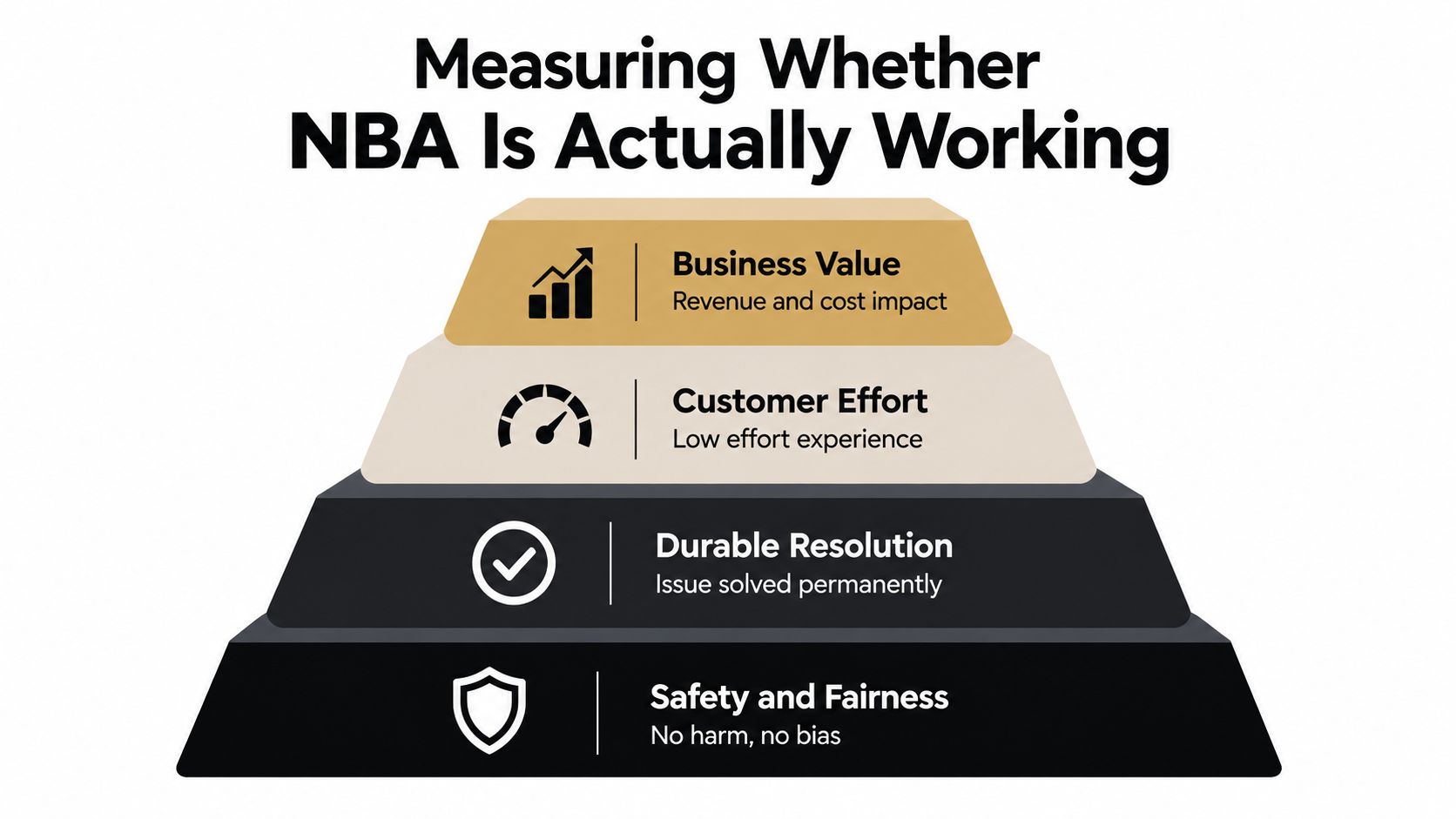
Use an outcome hierarchy
Evaluate recommendations from the customer and employee impact upward to business value:
- Safety and fairness: Check that recommendations don't create harm or treat people inequitably.
- Durable resolution: Find out whether the issue stays resolved, rather than merely disappearing from the current queue.
- Customer effort and satisfaction: Assess whether people can complete the task without unnecessary work or frustration.
- Business value: Review cost and conversion only within the limits set by the outcomes above.
A dashboard should connect these tiers. It can show what action the system chose, whether a person changed it, whether the issue returned, and how the customer or employee experienced the process. For a broader view of customer interactions across channels, customer interaction analytics can help teams consider which interactions belong in the measurement picture.
Test for what happens later
A next-day view can miss delayed effects. Teams should compare an NBA recommendation with a suitable alternative and define in advance what follow-up outcomes matter, such as recontact, escalation, complaints, retention, and employee burden. They should also examine results across relevant customer situations, channels, languages, and levels of vulnerability.
The central question is whether the recommendation improves the whole relationship, not merely the metric easiest to collect. A quick ticket closure that leads to another contact may be a poor outcome, even if the channel dashboard looks positive.
Governance, Accountability, and the Road to Launch
The difficult question isn't only whether an NBA engine can make a recommendation. It's who owns that recommendation after the system makes it. A customer-service survey described in the agentic AI customer-service index found that 81% of teams still operate AI through disconnected tools. In that survey, approximately one-third said the human agent owns the outcome, while nearly 20% said ownership is unclear.
That uncertainty matters when several systems contribute to a decision or an automated action causes harm. Who approves an automated refund or a hardship intervention? What should happen when two agents recommend conflicting actions? Which responsibilities belong to the AI platform, the business owner, the frontline employee, or a vendor? “Keep a human in the loop” doesn't answer those questions unless the organization defines the human's authority and responsibility.
Make every recommendation auditable
Record the information needed to reconstruct a decision: the triggering data, model or agent involved, confidence level, permitted action, reviewer, override, and customer outcome. For decisions that need approval, specify who can approve them and what happens if that person isn't available. For automated actions, define the conditions that should trigger a pause or escalation.
Before a pilot: Name the owner of each decision, the person who can stop it, and the team that reviews a poor outcome.
A practical launch begins with decision rights, not model selection. Then the team can confirm its data foundation, choose a contained pilot, define the permitted actions, and run a controlled rollout with ongoing review. Enterprise teams evaluating AI governance for enterprise use should make sure that governance covers how recommendations are approved, monitored, challenged, and reviewed after incidents.
Pressure-test the operating model
Before approving an NBA proposal, ask who owns each decision and whether that ownership remains clear across connected systems. Check how the system handles conflicting recommendations, missing context, a customer who asks for a person, and an employee who rejects the suggested action. Confirm that the organization can inspect what happened and change the policy when the evidence calls for it.
A next-best-action program is ready to scale only when its decision rights, intervention paths, and outcome measures are as clear as its model design.
Yellow.ai provides an enterprise AI platform for customer and employee conversations, with agents that can use knowledge, trigger workflows, or escalate issues across channels. If you're defining an NBA operating model, visit Yellow.ai to explore how its conversational tools and analytics could fit your service workflows.