














A customer opens your website on a laptop, compares two products, leaves, calls support the next day, and then gets an email pushing the item they already ruled out. Later, your mobile app sends a discount that contradicts what the contact center agent promised. Nothing is technically broken. But the customer experiences the brand as forgetful, slow, and oddly self-centered.
That's the condition many enterprises are in right now. They've invested in CRM, analytics, automation, support software, and AI pilots. Yet the customer still has to stitch the journey together alone. Teams optimize channels. Customers live through outcomes.
Customer journey orchestration fixes that only when it's treated as an operating model, not a campaign feature. It's the layer that decides what should happen next across web, app, email, voice, chat, and human service, based on live context rather than channel silos or preset schedules.
Table of Contents
- The Disconnected Experience and the Promise of Orchestration
- What Is Customer Journey Orchestration Really
- The Core Components of an Orchestration Engine
- Unlocking Strategic Value and Business Benefits
- Powering Orchestration with Data and Agentic AI
- A Practical Roadmap for CJO Implementation
- Choosing the Right Orchestration Platform
The Disconnected Experience and the Promise of Orchestration
Most CX failures don't come from one bad interaction. They come from inconsistency between interactions.
A customer starts in self-service, moves to chat when they get stuck, then ends up on the phone repeating account details and problem context. Marketing still sends nurture emails as if nothing happened. Billing has one view. Service has another. Commerce has a third. Each team feels productive inside its own tool. The customer feels the handoff friction immediately.
That's why customer journey orchestration matters. It gives the enterprise a way to respond as one system instead of a collection of departments. In practice, that means the website, messaging layer, support operation, and sales motion stop acting like separate businesses.
The customer never sees your org chart. They only see whether the next interaction makes sense.
The strategic urgency is clear. The global customer journey orchestration market is projected to reach approximately USD 86.8 billion by 2034, growing at a 24.0% CAGR, which reflects a broader move toward real-time, data-led engagement strategies, according to Dimension Market Research's customer journey orchestration market outlook.
Why disconnected channels keep failing
A lot of companies still treat orchestration as a marketing add-on. That's too narrow. Some of the most important signals sit outside marketing altogether:
- Voice interactions: What customers say to agents often reveals urgency, confusion, and purchase intent faster than clickstream data.
- Service events: A complaint, failed delivery, or unresolved ticket should change downstream messaging immediately.
- Operational context: Appointment windows, payment status, inventory constraints, and account eligibility all affect what should happen next.
That's also why telephony and CRM integration matter more than many teams expect. If you're evaluating how voice fits into a connected experience stack, this guide to integrated business phone systems is useful because it shows how call data and customer records can work together instead of creating another blind spot.
Customer journey orchestration is the practical answer to brand amnesia. It acts like a central nervous system for CX. Signals come in from every touchpoint, decisions get made in context, and the next action reflects what the customer just did, said, or needed.
What Is Customer Journey Orchestration Really
Journey mapping and customer journey orchestration are related. They aren't the same discipline.
Journey mapping is a planning tool. It helps teams visualize how customers move through awareness, purchase, onboarding, support, renewal, and advocacy. That's useful work, but it's static. It shows an intended path, common pain points, and moments that matter. It doesn't decide what to do live.
Customer journey orchestration is the execution layer. It manages millions of individual variations in real time and adjusts the experience as customer behavior changes.
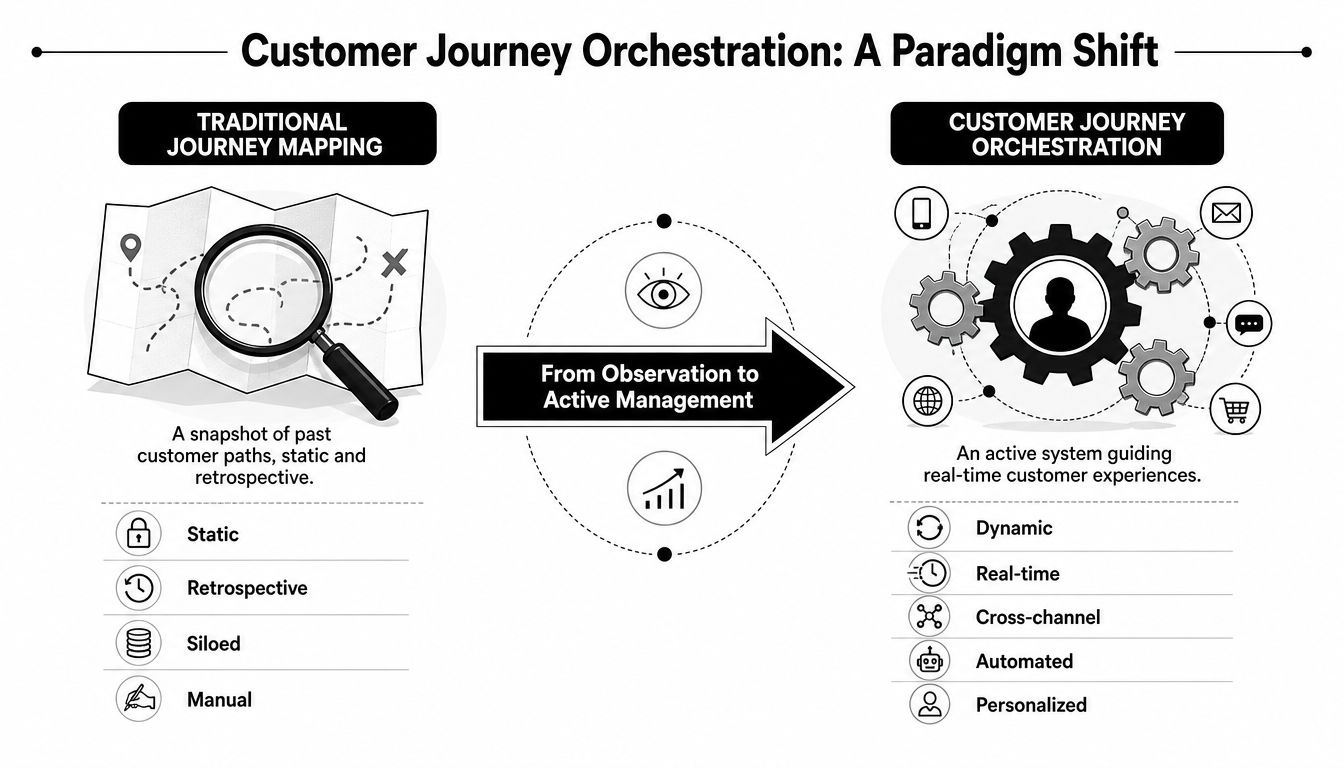
Paper map versus live GPS
The cleanest analogy is this:
| Approach | What it does | Where it breaks |
|---|---|---|
| Journey mapping | Documents the route customers are expected to take | Can't react when customers deviate |
| Customer journey orchestration | Continuously recalculates the next best move using live signals | Depends on strong data and decisioning foundations |
A paper map can show the roads. It can't tell you there's traffic ahead, that the customer just changed destination, or that a better route opened up in the last thirty seconds. A real-time GPS can.
That's the leap enterprises need to make. Stop asking only, “What journey did we design?” Start asking, “What should happen for this customer right now?”
Orchestration is not the same as automation
This distinction matters because many teams think they already have orchestration when they really have automation.
Automation runs predetermined sequences. If a customer enters a nurture flow, the system sends message one, then message two, then message three. It's orderly. It's efficient. It's also brittle when reality changes.
Orchestration sits above those sequences and decides whether the customer should enter, exit, pause, switch, or skip them altogether.
Consider the difference:
- Automation says: send a reminder two days after sign-up.
- Orchestration says: the customer already contacted support, completed setup in the mobile app, and opened a billing question. Don't send the reminder. Route them to a different onboarding path.
Practical rule: If your system can only execute prebuilt flows, you have automation. If it can choose among flows based on live context, you're moving into orchestration.
What real orchestration looks like in practice
A mature setup usually does three things well:
- It listens continuously: browsing behavior, service history, messaging engagement, transaction status, and conversational signals update the customer context.
- It decides in context: the system weighs business rules, customer intent, compliance constraints, and channel suitability before acting.
- It coordinates across teams: sales, service, marketing, and operations stop stepping on each other with conflicting outreach.
That's why customer journey orchestration has become bigger than campaign management. It's now part of how enterprises run service, retention, conversion, and even employee-facing workflows. Once you see it clearly, it stops looking like a marketing tactic and starts looking like an operational backbone.
The Core Components of an Orchestration Engine
A real orchestration engine has architecture behind it. Without that architecture, teams end up with disconnected triggers, duplicate outreach, and stale customer context. The cleanest way to understand the stack is through three layers: data, decisioning, and action.
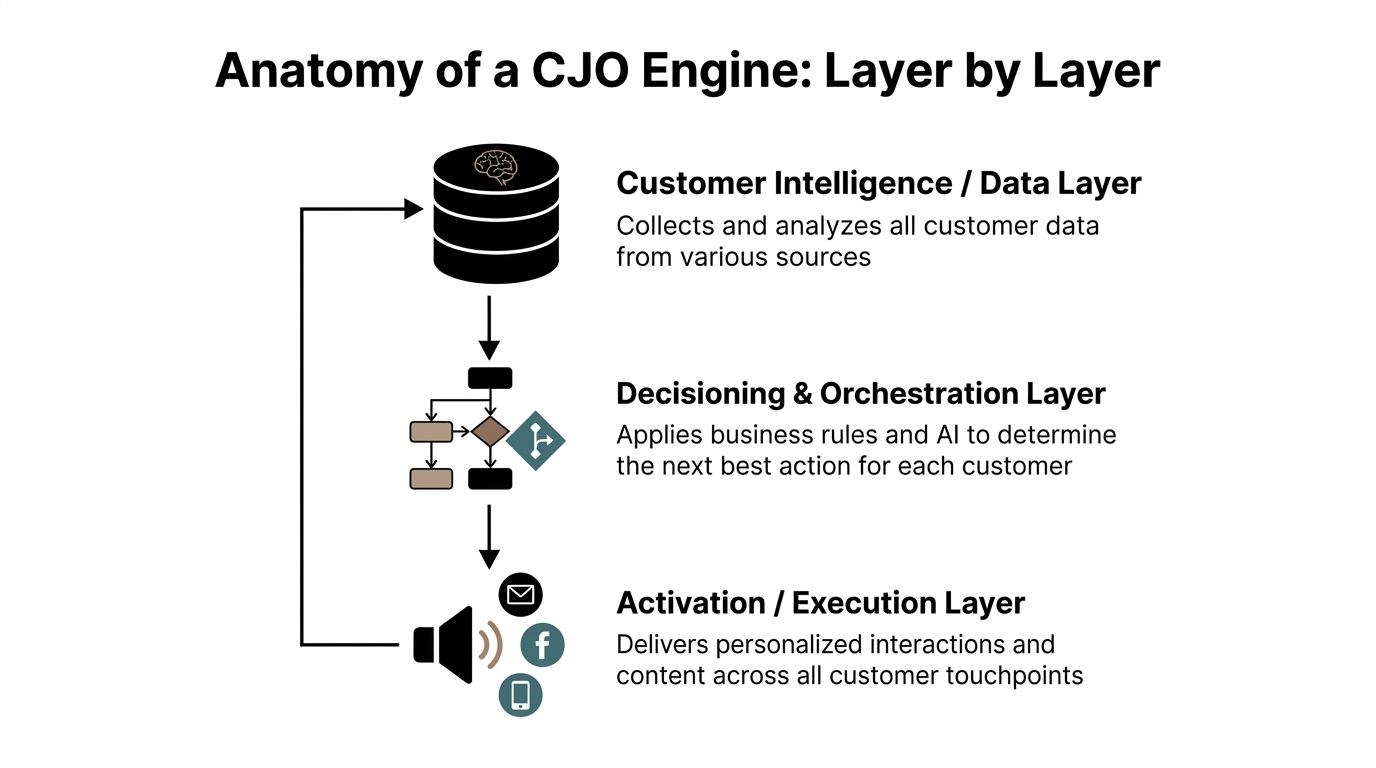
Forrester's definition is useful here. Customer journey orchestration requires a unified customer profile built from data collection, journey visualization, design, and orchestration, often with a CDP that unifies physical and digital touchpoints into a closed-loop learning system, as described in CSGI's overview of customer journey orchestration.
The data layer
At this stage, most programs either become scalable or slowly falter.
The data layer brings together behavioral events, transactional records, customer attributes, service history, and channel activity into a usable customer profile. Not a weekly export. Not three different IDs stitched together by hand. A working profile that can support live decisions.
Typical inputs include:
- Behavioral signals: web visits, product views, search behavior, app actions, and abandonment events
- Operational records: order state, claims status, renewals, appointments, and delivery milestones
- Service context: ticket outcomes, call summaries, sentiment tags, and escalation history
A CDP often plays a major role here, but the tool matters less than the discipline. Identity resolution, event hygiene, consent handling, and schema consistency decide whether the profile is trustworthy.
The decisioning layer
This is the brain of customer journey orchestration. It decides the next best action based on what the customer is doing, what the business wants to achieve, and what constraints apply.
In weak implementations, this layer is just a rules engine. Rules still matter. They help suppress bad experiences, enforce eligibility, and prevent channel overuse. But rules alone don't scale well when journeys become complex.
Better systems combine:
- Business logic for compliance, priorities, and exclusions
- Predictive or AI models for intent, churn risk, and likely channel response
- Journey logic that weighs lifecycle stage, unresolved issues, and prior outcomes
That's where integration depth starts to matter. If you're evaluating orchestration in a broader enterprise stack, platform integrations for CX systems show the sort of connectors you need across CRM, contact center, commerce, and helpdesk platforms. Without those connections, the decision engine will always operate with partial context.
The hardest part of decisioning isn't choosing a message. It's knowing when not to send one.
The action layer
The action layer turns a decision into an experience. That can mean an email, push notification, chatbot prompt, agent assist recommendation, voice outreach, in-app message, or workflow handoff to a human team.
The best action layers do more than broadcast. They coordinate timing, suppress conflicts, personalize content, and capture outcomes so the system can learn from what happened.
A simple comparison makes the distinction clear:
| Layer | Core question | Failure mode when missing |
|---|---|---|
| Data | What do we know right now? | Fragmented customer understanding |
| Decisioning | What should happen next? | Static logic and channel collisions |
| Action | How do we execute consistently? | Delayed, duplicate, or irrelevant interactions |
When these three layers work together, customer journey orchestration becomes a closed loop. Data informs decisions. Decisions trigger action. Outcomes feed back into the data layer. That feedback cycle is what turns a workflow engine into a learning system.
Unlocking Strategic Value and Business Benefits
Leaders usually approve orchestration for one reason and keep funding it for another. They approve it because disconnected experiences are visibly broken. They keep funding it because the economics improve.
The strongest hard-number case comes from Boston Consulting Group data cited by Dynamic Yield. Organizations that implement journey orchestration successfully report revenue gains of 10% to 20% and cost reductions of 15% to 25%, as outlined in Dynamic Yield's review of modern customer journey orchestration capabilities.
Here's a visual summary of the business case many teams use internally:
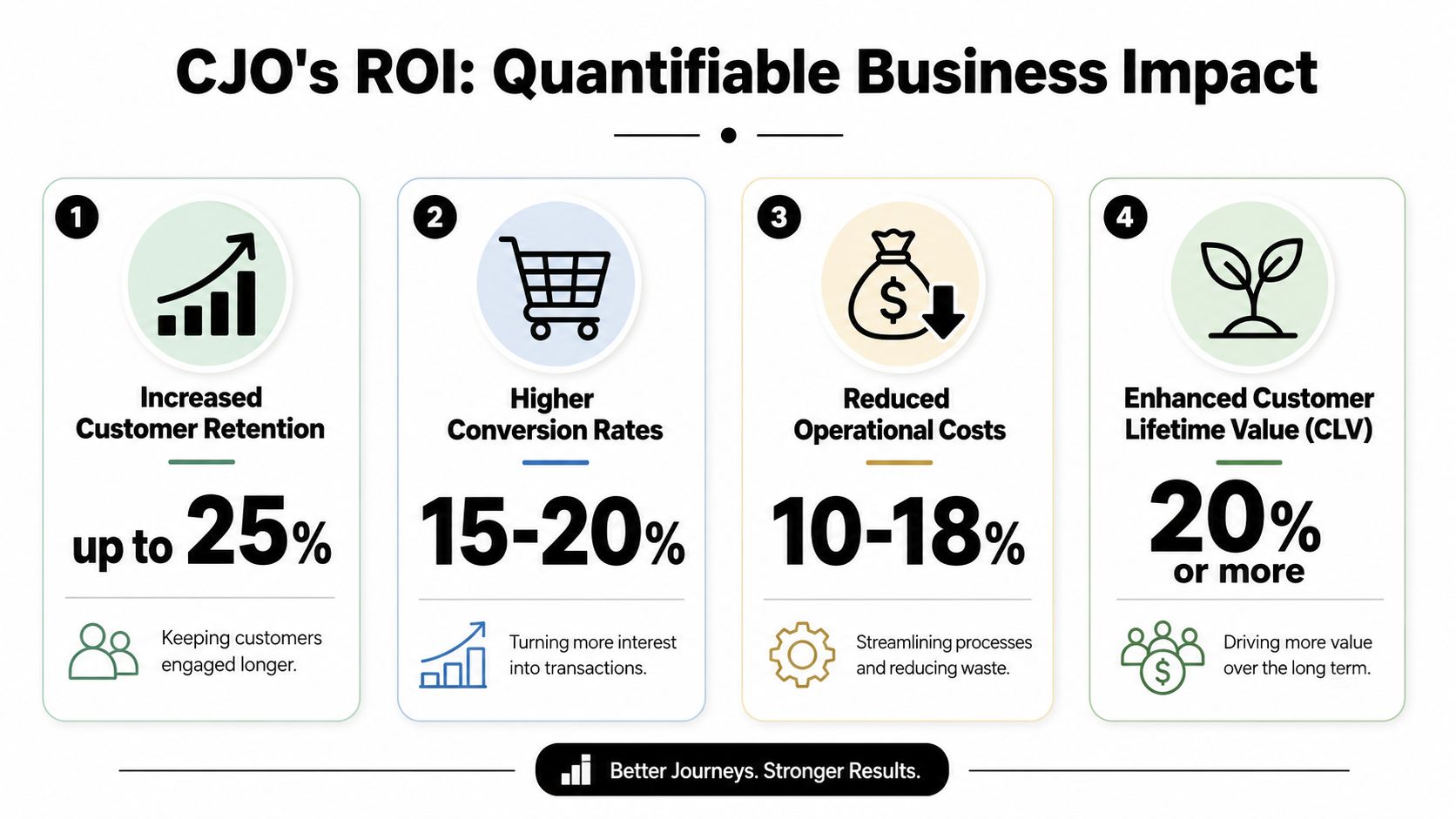
Where the financial case gets real
Those gains don't appear because orchestration is fashionable. They appear because it replaces broad, mistimed outreach with interactions tied to actual need and intent.
That changes the economics in several ways:
- Less wasted contact volume: teams stop sending messages that conflict with recent service events or completed actions
- Higher conversion efficiency: follow-up happens when intent is active, not after the moment has passed
- Lower service cost: routine routing, nudges, and reminders can be automated before they become expensive human-handled issues
A quick explainer can help socialize this internally:
Why the gains compound across functions
Orchestration creates value outside the marketing budget line. That's where many business cases become understated.
For service teams, it reduces repeated context collection and prevents avoidable escalations. For sales teams, it improves timing and prioritization. For operations teams, it turns status changes into proactive outreach instead of inbound volume.
Better customer journey orchestration often looks like fewer messages, not more. The win is relevance.
A few benefits are harder to quantify cleanly but are obvious in enterprise operations:
- Consistency across channels: customers don't get one answer in chat and a conflicting answer on the phone.
- Faster recovery from friction: complaints, delays, and failed tasks can trigger corrective journeys before dissatisfaction spreads.
- Stronger retention logic: onboarding, renewal, and win-back motions become part of one system rather than separate campaigns.
The strategic shift is important. Customer journey orchestration isn't just a way to improve communications. It's a way to improve how the enterprise allocates attention. That's why the best programs sit at the intersection of CX, service operations, data, and AI. They don't belong to one channel owner.
Powering Orchestration with Data and Agentic AI
At enterprise scale, customer journey orchestration can't run on manual logic alone. There are too many signals, too many channels, and too many changing states. AI isn't decoration here. It's the mechanism that makes real-time decisioning possible.
According to Acoustic's guide to customer journey orchestration, these systems operate on a real-time decisioning loop that ingests behavioral signals and triggers immediate, channel-specific actions, translating analysis into personalized routing and messaging within milliseconds of the event.
From signals to decisions
Think about the signal flow in a normal customer moment.
A user views a pricing page twice, opens the help center, starts a chatbot session, abandons the conversation, and then returns through the mobile app. A rules-only system struggles because each event sits in a different context window. An AI-driven orchestration layer can combine those actions into a live interpretation of intent.
That's the practical loop:
- Signal capture picks up behaviors from digital, conversational, and operational touchpoints.
- Intent interpretation evaluates what those signals suggest right now.
- Next action selection weighs whether to prompt, suppress, route, escalate, or wait.
- Outcome learning observes whether the intervention helped and adjusts future decisions.
First-party data is most critical. It's closer to the moment, more relevant to the actual customer state, and less dependent on broad assumptions. Teams that skip this foundation often end up with AI that sounds smart in demos but makes weak real-world decisions.
Where agentic AI changes the model
Most orchestration systems decide what should happen next. Agentic AI starts to execute what should happen next.
That's a meaningful change. Instead of only sending a message or selecting a channel, an agentic system can handle multi-step work such as verifying intent, collecting missing information, updating a case, handing off with context, and following up after resolution.
Examples look like this:
- In service: an AI agent recognizes that a delivery issue is likely to trigger a support contact, proactively opens the conversation, authenticates the customer, surfaces order context, and routes only exceptions to a human agent.
- In commerce: the system detects hesitation, answers product questions, applies eligibility rules, and helps complete the purchase without bouncing the customer across tools.
- In employee experience: an internal agent handles onboarding tasks, policy lookup, access requests, and workflow updates through one conversation.
That's why the distinction between orchestration and conversation is fading. Modern platforms are converging those capabilities. If you're assessing that shift, this explanation of agentic AI and how it differs from AI agents is a useful reference point because it frames the move from reactive bot logic to more autonomous execution.
The operational payoff is straightforward. When orchestration and agentic execution work together, the enterprise doesn't just choose the next best action. It completes more of the action on the customer's behalf.
A Practical Roadmap for CJO Implementation
Most customer journey orchestration programs stall for a simple reason. Teams try to orchestrate everything before they can reliably orchestrate one thing.
The better approach is phased. Build the foundation, choose a narrow but meaningful journey, prove operational value, then expand. That keeps the work tied to outcomes rather than turning into a long architecture project with no visible payoff.
Phase one unify the customer signal
Start with data unification, but stay practical. You do not need every system integrated before launch. You do need a reliable profile for the journey you want to improve.
Focus on the inputs that directly affect decision quality:
- Identity basics: can you connect the same person across web, app, CRM, support, and communication channels?
- Event freshness: do key actions show up fast enough to support timely decisions?
- Operational truth: can the orchestration layer see state changes that should suppress, trigger, or reroute communication?
This is also where governance begins. Define data owners, consent rules, field definitions, and escalation logic early. If you leave those questions unresolved, scale will expose the mess.
Start with fewer signals that you trust. Bad orchestration with more data is still bad orchestration.
Phase two choose journeys that matter
Don't begin with a broad ambition like “personalize the full lifecycle.” Choose one journey where timing, context, and coordination clearly affect business outcomes.
Good first candidates usually share three traits:
| Journey type | Why it works as a starting point | Common trap |
|---|---|---|
| Onboarding | Clear milestones and obvious failure points | Treating it as email-only |
| Cart or application recovery | Strong intent signal and direct commercial value | Ignoring service or eligibility context |
| Post-case follow-up | Easy to connect service outcomes to next actions | Sending generic satisfaction messaging |
Map the journey in plain operational terms. Where does the customer get stuck? Which teams own the moment? What signal tells you the moment has changed? What action would help?
Phase three automate one journey end to end
Many teams often overbuild. Don't.
Pick a single journey and implement the minimum orchestration logic needed to improve it. That usually means:
- a clear entry signal
- a small set of next-best-action decisions
- channel rules
- suppression logic
- outcome tracking
For example, an onboarding journey might branch based on whether setup was completed, whether a support ticket was opened, and whether the customer prefers chat or email. That is already more valuable than a static seven-step nurture sequence.
Use a compact review loop during this phase:
- Check decision quality: did the system choose the right action?
- Check timing: did it act while the moment still mattered?
- Check conflict handling: did another team or channel undermine the experience?
- Check handoff quality: if a human stepped in, did they receive the right context?
Phase four scale governance and optimization
Once one journey is working, the temptation is to clone the logic everywhere. Resist that. Scale requires governance more than speed.
Create shared standards for journey design, action prioritization, and measurement. Otherwise, each team will build its own orchestration logic and reintroduce channel conflict through a more advanced toolset.
The programs that scale well usually add three disciplines:
- Journey portfolio management: decide which journeys deserve orchestration and which can remain simpler automations.
- Testing and learning: compare timing, content, channel choice, and escalation paths. Learn from failures, not just wins.
- Operational ownership: assign who owns data quality, who owns decision policies, and who approves customer-facing changes.
Customer journey orchestration becomes durable when it's embedded into service design, not treated as a side project. That's the point where it starts behaving like enterprise infrastructure instead of a pilot.
Choosing the Right Orchestration Platform
Plenty of vendors claim orchestration. Fewer can support it across channels, teams, and operational systems without forcing brittle workarounds.
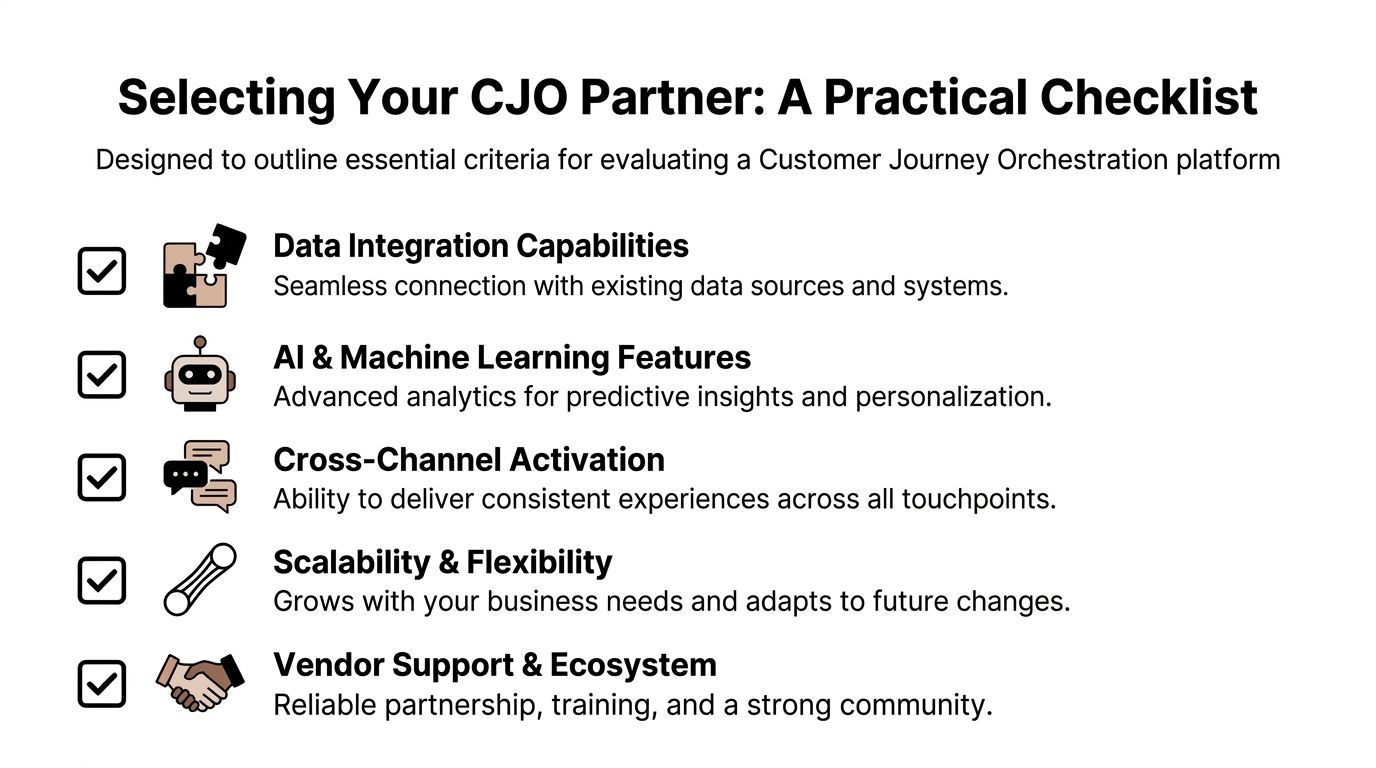
The evaluation mistake I see most often is buying for campaign design instead of buying for decision quality. Nice canvases matter. They aren't the hard part. The hard part is whether the platform can ingest the right data, make the right decision, and execute across the channels and systems that shape the experience.
What to pressure test in every demo
Ask vendors to show the system under realistic conditions, not ideal ones.
Use this checklist:
- Cross-channel depth: Can it coordinate voice, chat, email, app, and human-assisted workflows, or does it mostly specialize in outbound marketing?
- Integration realism: Can it connect cleanly with CRM, helpdesk, contact center, commerce, and identity systems you already run?
- Decision transparency: Can teams understand why the platform chose a next best action, and can they apply business constraints without engineering bottlenecks?
- Operational handoffs: When automation reaches a limit, does the human agent receive full context or just a transcript fragment?
- Governance support: Can different teams share a decision framework without constantly colliding?
If a platform can personalize a message but can't suppress the wrong one, it isn't ready for enterprise orchestration.
How modern agentic platforms fit the requirement
Reflecting a market shift, enterprises increasingly need orchestration platforms that don't stop at channel messaging. They need platforms that can run autonomous conversations, trigger workflows, surface enterprise knowledge, and support low-latency interactions across service and support environments.
One example is Yellow.ai's buyer's guide for evaluating conversational AI solutions, which is relevant because the selection criteria for enterprise conversational AI now overlap heavily with customer journey orchestration requirements. Multi-channel execution, knowledge access, analytics, integration breadth, governance, and handoff design all matter on both sides.
A platform like Yellow.ai fits this newer category because it combines omnichannel conversation capabilities with multi-LLM architecture, a conversational knowledge base, and pre-built integrations across systems such as Salesforce, Zendesk, Genesys, Freshdesk, HubSpot, and NICE. That makes it suitable for teams that want orchestration to extend into voice and service automation, not remain limited to marketing journeys.
The right choice depends on your operating model. If your main challenge is outbound lifecycle messaging, you may prioritize campaign control and segmentation depth. If your challenge is broader CX coordination across support, commerce, and contact center workflows, the bar is higher. You need a platform that can act as an orchestration layer for both decisions and execution.
If customer journey orchestration is becoming part of your AI and CX stack, Yellow.ai is worth evaluating as a platform for enterprises that need omnichannel orchestration, autonomous conversations, knowledge-driven automation, and integration with existing service and CRM systems.



