









A customer asks whether a refund applies after changing plans. The support agent finds a policy paragraph that sounds relevant, but the customer's account history and an earlier ticket may change the answer. A quick search produces a response. It doesn't necessarily produce a complete one.
That's the challenge multi-agent RAG is designed to address. Rather than asking one AI process to find information, reason over it, and check its own answer in one pass, it divides the work into roles with evidence and decisions that teams can inspect. For CX leaders, the point isn't just to add agents. It's to make complex answers more traceable, identify where failures happen, and decide when a simpler system is enough.
Table of Contents
- Why Single-Pass Retrieval Falls Short
- How Multi Agent RAG Divides the Work
- Architecture Patterns Behind Multi Agent RAG
- Enterprise Use Cases Across CX, EX, and Contact Centers
- Weighing Benefits, Limits, and Cost
- Governing and Evaluating Multi Agent RAG in Production
- Choosing a Platform and Taking the Next Step
Why Single-Pass Retrieval Falls Short
A support agent searches the refund policy and finds a paragraph about plan changes. It says refunds depend on the customer's terms, but it doesn't confirm which terms apply to the person asking. That detail may be in a CRM record. A past ticket could clarify how an earlier exception was handled.
A single-pass search retrieves text that resembles the question. That's useful when the answer lives in one clear passage. It's less reliable when the agent must connect several facts from different systems, especially if the question is ambiguous or one source is out of date.
The gap between a relevant passage and a complete answer
Enterprise information is rarely organized around a customer's question. Policies may be maintained by compliance, account records by sales operations, and tickets by the support team. Each source has its own owner and update process. A search can return a passage that matches the wording while missing the relationship that makes it applicable.
This is a multi-hop question: the answer depends on following more than one connection. In the refund example, the system needs to find the policy, identify the customer's plan and change date, and check whether a prior support decision affects the current request. If it skips a step, the answer may sound confident while resting on incomplete evidence.
The same pattern appears in employee services. A question about leave might depend on location, employment terms, and the latest policy update. If employees or customers routinely need to correct answers, or agents keep checking several systems manually, those are signs that a one-pass retrieval path may be missing important context.
When one search is still enough
Not every question needs a team of agents. “Where can I find the return form?” may be answered by a single current article. Adding more stages to that request could slow the experience without improving the answer.
The useful distinction is between finding a relevant passage and assembling a supported answer across sources. Teams that want a refresher on how retrieval-augmented generation connects search with response generation can review this overview of retrieval-augmented generation. When answers depend on scattered records, changing context, or several connected facts, the problem is no longer just search quality. It's how the system plans and checks its work.
How Multi Agent RAG Divides the Work
Think of a complex customer question as a request handled by a small service team. One person clarifies what's being asked, another gathers records, a specialist checks the policy, and a lead prepares the response. Multi-agent RAG applies a similar division of responsibility to AI.
RAG, short for retrieval-augmented generation, combines a language model that writes responses with a retrieval process that supplies relevant information. In the original design, the model draws on external memory rather than relying only on information encoded during training. The foundational RAG paper was published at NeurIPS in 2020. It described a generator paired with a dense index built from Wikipedia, and reported strong results across open-domain question-answering benchmarks. Its historical-leader evaluation also illustrated a practical lesson: matching the retrieval index to the question's reference period mattered to accuracy. These findings are documented in the original RAG paper.
Give each job a name
A multi-agent design separates tasks that a single process might otherwise attempt all at once:
- Planner: Rephrases an unclear request and identifies what evidence the answer needs.
- Retriever: Searches the approved sources for relevant documents or records.
- Extractor: Pulls out the specific details the planner asked for, rather than returning whole documents without context.
- Verifier: Checks whether proposed claims are supported by retrieved evidence and flags gaps.
- Synthesizer: Writes the response from the evidence that passed review.
A team doesn't have to create a separate agent for every role. The important design choice is to make responsibilities and handoffs explicit. That gives the organization points where it can inspect whether the plan was sound, the sources were appropriate, and the final wording stayed within the evidence.
Coordination, not just more models
This setup differs from a single model that searches, reasons, and verifies within one response. The roles create checkpoints, but they also create coordination work. A planner can overlook a key question; a retriever can return a stale article; a verifier can miss a contradiction. Separating tasks makes those failures easier to locate only if the system retains a useful trace of what each role did.
A 2025 MA-RAG study found that planning and extraction both mattered in its evaluations, which included open-domain and multi-hop question-answering tasks. Its results suggest that dividing work can help with complex questions, but they don't guarantee the same benefit for every enterprise workflow or knowledge base. The study's findings and comparison results are available in the MA-RAG research paper.
Architecture Patterns Behind Multi Agent RAG
A customer question can pass through several systems before the answer is ready. A clear architecture shows where each decision happens and gives teams control points to ask practical questions: which agent failed, what did each resolution cost, and would a simpler pipeline have worked? Multi-agent RAG is not automatically more accurate. Its value depends on how well teams define and govern those control points.
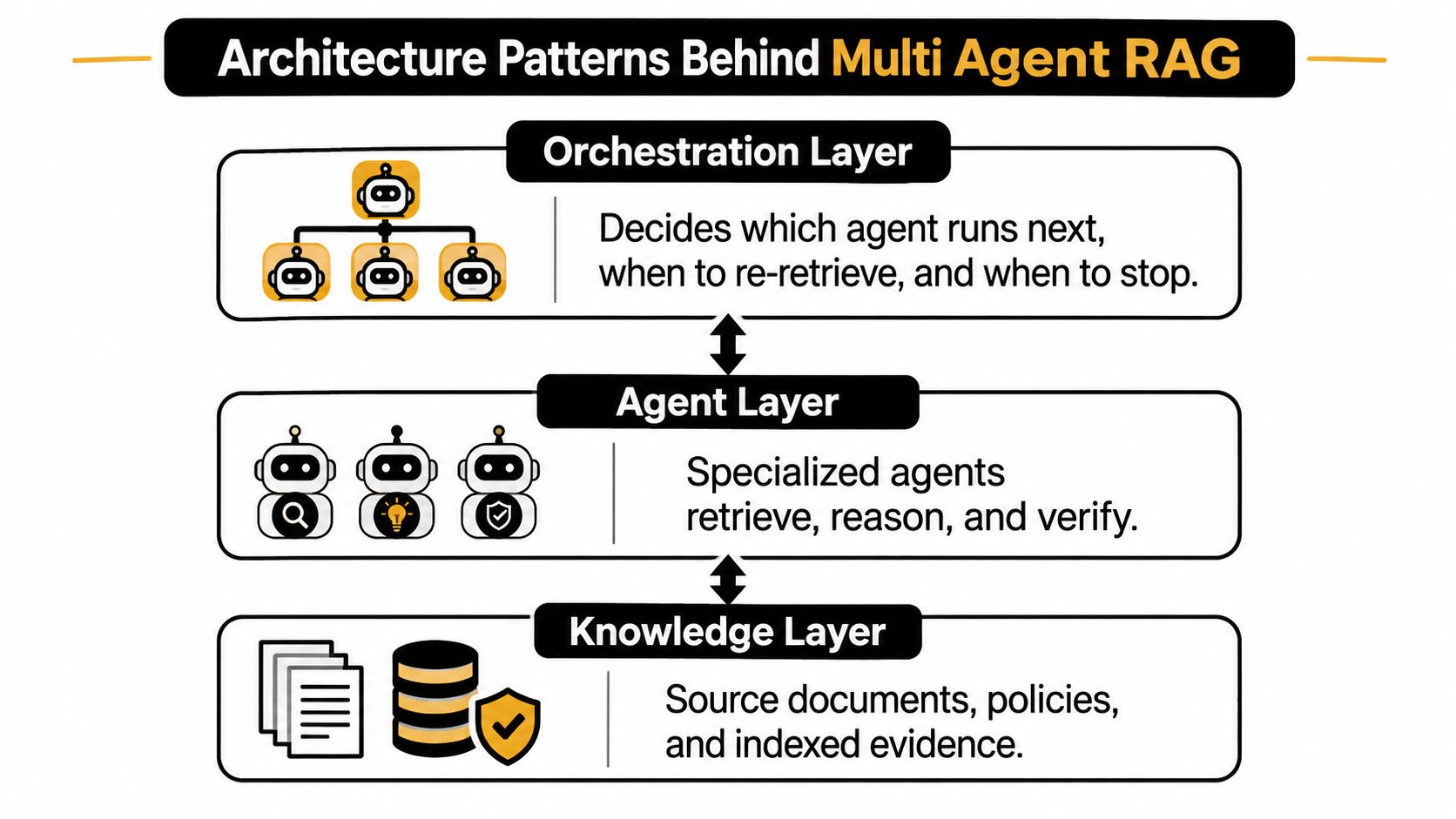
The design has three layers. Each sets different rules for how information moves, what agents can access, and when the system should stop.
Orchestration decides what happens next
The orchestration layer is the traffic controller. It sends a request to the right agent, routes subquestions to retrieval, and can request another search when evidence is missing. It also decides when to stop searching or hand the request to a person.
Set rules for common failures. What happens when sources disagree, a search finds nothing useful, or the process takes too long? Clear rules help teams identify whether a problem came from the workflow, an agent, or the decision to continue. They also make the cost of repeated searches and handoffs easier to track.
Specialization sets boundaries for each agent
The agent layer defines each role's permitted actions and required outputs. A retriever might use only approved policy and CRM sources. A verifier might need to connect key claims to a passage or record. A planner can be asked to identify missing facts rather than guess.
Require references for intermediate claims so a reviewer can follow the reasoning. These handoffs are part of multi-agent orchestration. They are not a matter of asking several models to work together. Teams should also log each agent's inputs, outputs, and time spent, so they can locate failures and assess what a resolution costs.
The knowledge layer determines what can be found
The knowledge layer contains source documents, policies, records, and search indexes. It may also include query reformulation, retrieval refinement, and answer validation. The central design choice is whether an answer needs indexed knowledge, live records, or both.
Indexed documents help agents find approved guidance. Live records can reflect changing operational details. If a policy changes but its indexed copy does not, agents may still return outdated information. Teams should specify which sources each agent can access and how current those sources need to be. For example, a current company data for SaaS workflows source may complement document retrieval when an answer depends on changing records. Keep live facts distinct from indexed guidance, so the system does not present an old document as a current account fact. This distinction also gives operators a clear place to investigate when an answer is stale.
Enterprise Use Cases Across CX, EX, and Contact Centers
A billing dispute makes the value of source-aware work easy to see. The customer says a charge appeared after a plan change. A contact-center system may need to retrieve the account history, locate the applicable policy, and review recent ticket notes. The verifier can then check whether the proposed explanation follows from those sources before the response reaches the customer.
That doesn't mean every billing question needs multiple agents. A straightforward request about where to view an invoice may be handled by a simpler retrieval flow. The more important question is whether the answer depends on connecting records that are held in different places or interpreting an exception.

Employee services need the same evidence discipline
An employee asks whether a leave rule applies to their situation. The answer may depend on the employee's location, applicable employment terms, and a recent policy update. A useful system needs to find the relevant sources, establish which ones apply, and avoid presenting a general rule as a personal determination when required details are missing.
Service teams face a similar challenge when they need to combine product guidance, support history, and planning documents. Routing each subquestion to a source-specific agent can help keep evidence organized. A final consistency check can look for contradictions before the system offers a recommendation.
An empty answer can be the right outcome
Some requests can't be answered from the available knowledge. The system might find a policy but not the account detail needed to apply it. Or it may find several similar records without enough evidence to identify the right one.
In these cases, the system should abstain, meaning it says it can't answer reliably, asks for the missing information, or hands the request to a person. Research into deep-search evaluation describes enterprise questions that require tracing evidence across interconnected documents and distinguishes answerable from unanswerable requests. That distinction matters for support and employee-service systems, where filling gaps with a plausible-sounding answer can create operational or compliance risk. See the deep-search benchmark description.
When the sources don't support a complete answer, a clear handoff is better than an unsupported summary.
Weighing Benefits, Limits, and Cost
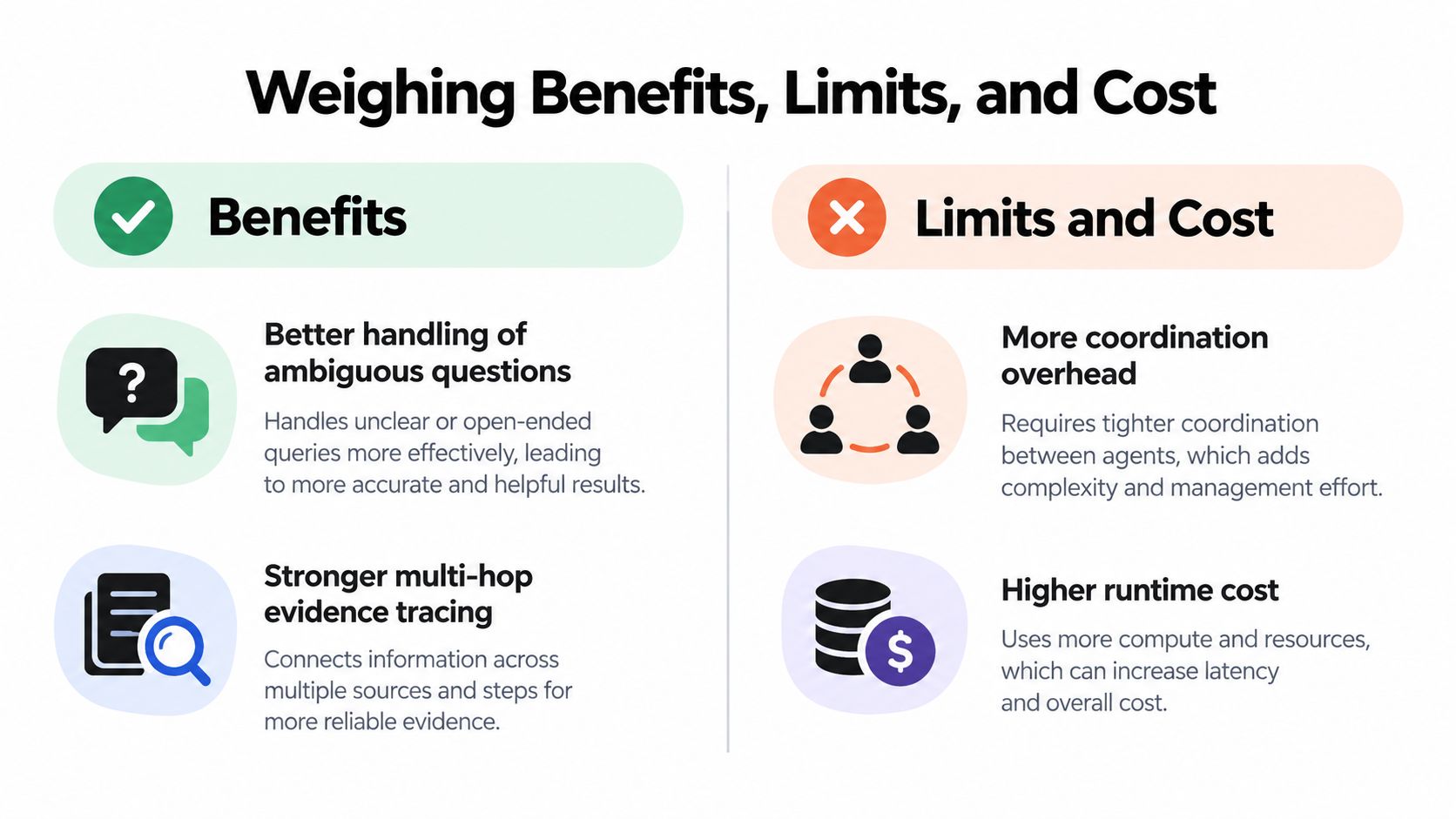
A routine question about a return policy may need only one search. A disputed charge may require evidence from several sources and a careful check before answering. Multi-agent RAG lets teams route these requests through different workflows, creating control points for deciding how much review each resolution needs.
Compare successful resolutions, not impressive architecture
Compare the total cost of a successfully resolved interaction, not one agent against several. Include planning, additional searches, verification, retries, monitoring, and human escalation. Then weigh those costs against the outcome the business values, such as resolving a request without another contact.
The added checks can improve oversight, but they also take time and model calls. A complex policy exception may warrant a careful workflow. Sending a routine question through the same sequence can add delay without enough benefit. In voice and contact-center interactions, a long pause can frustrate customers even when the final answer is accurate.
Research on multi-agent approaches identifies repeated calls for planning, retrieval, verification, and reflection as sources of added latency and inference cost. It also notes that complex designs may deliver only modest gains in some settings. Results depend on the task, design, and evaluation conditions, so treat the research on multi-agent cost and performance tradeoffs as a reason to test your own workflow, not as a guarantee of return.
Route selectively
Use a simpler retrieval pipeline when the question is routine, the source is clear, and speed matters more than another verification step. Route higher-risk requests, or those requiring evidence from multiple sources, through a multi-agent workflow. Examples include disputed charges, policy exceptions, and unclear employee cases.
Set a cost-per-resolution target for each request type. Then ask practical questions: Which workflow resolved it? Did the extra review prevent a poor answer or avoid a repeat contact? What did that resolution cost, including any human handoff? If a simpler pipeline meets the service need, extra agents may not be worth the added expense. The right design depends on the request, not the number of agents it can involve.
Governing and Evaluating Multi Agent RAG in Production
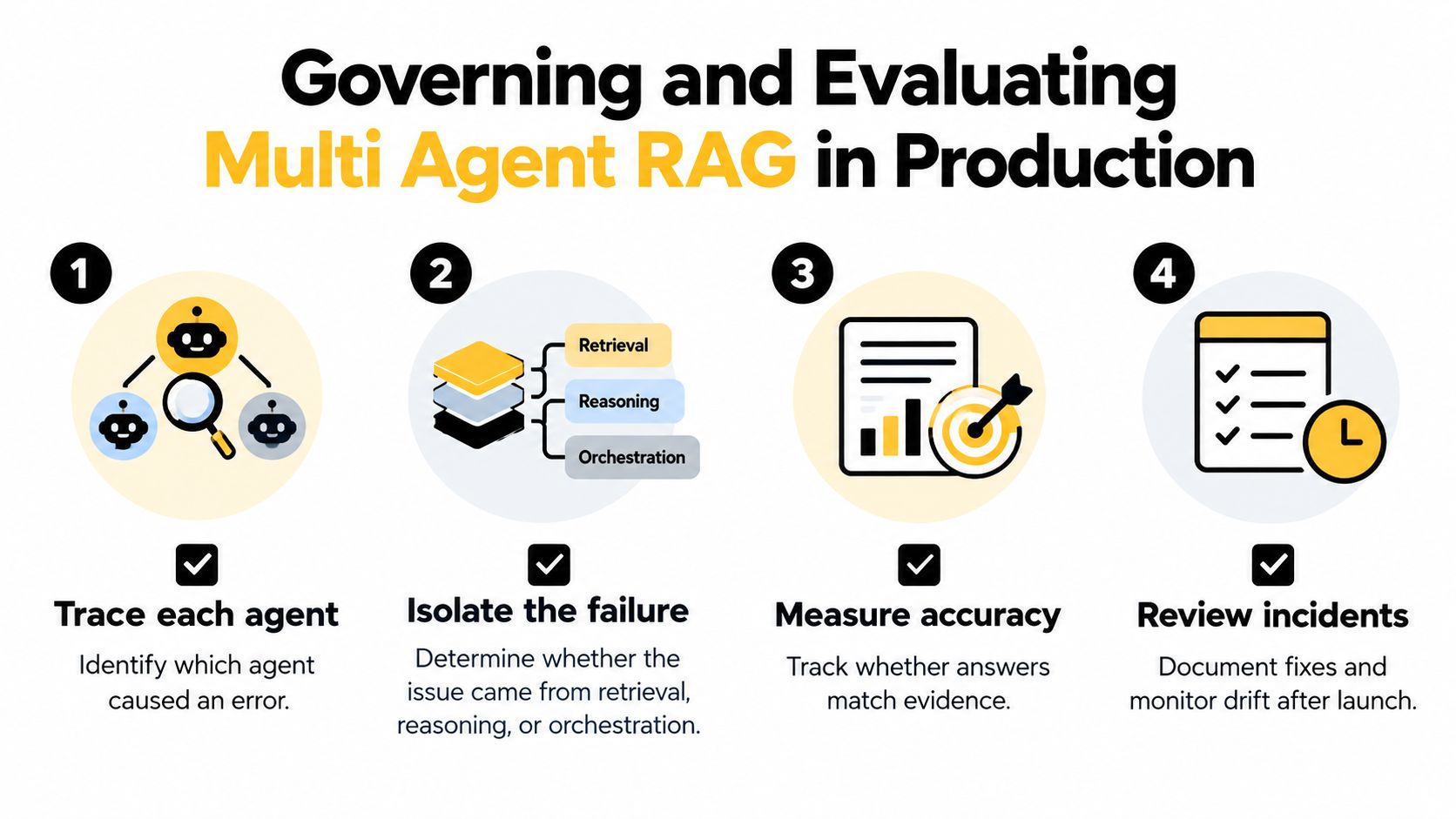
A higher answer score doesn't tell a CX leader which agent made a mistake, why the system failed, or what the interaction cost to resolve. More agents can improve task performance while making the workflow harder to govern. Without records of the handoffs, teams may know that an answer was wrong but not whether the cause was a weak plan, poor retrieval, stale knowledge, or unsupported generation.
Keep a trace of the work
A trace is a record of the steps that led to the answer. For each interaction, preserve the original request, the plan, the sources retrieved, the evidence passed between agents, and the final response. That record lets a reviewer find the failure point instead of treating the entire system as a black box.
A practical scorecard should pair technical checks with business outcomes:
- Retrieval recall: Did the search find the relevant material?
- Evidence attribution: Can reviewers connect claims to their supporting sources?
- Handoff accuracy: Did each agent pass the needed information to the next?
- Abstention quality: Did the system decline to answer when evidence was insufficient?
- Policy compliance: Did the response follow the organization's rules?
- Latency and recovery: Did the system respond in time, and could it recover from a failed search?
- Business results: Did the workflow support outcomes such as first-contact resolution or reduced escalation?
No one metric can describe the whole system. For instance, a correct answer that takes too long may be unsuitable for a live voice interaction. A fast answer that can't be traced to approved evidence may be unacceptable for a regulated decision.
Test failures before customers find them
Build adversarial tests that vary how a person asks a question, introduce conflicting records, and include requests the knowledge base can't answer. Multi-turn tests matter too: a customer may add relevant details after the initial search, and the system should update its plan rather than cling to its first interpretation.
Set clear escalation thresholds. If a critical source is missing, records conflict, or the verifier can't support a claim, the system should ask a clarifying question or route the case to a person. The testing process should track the reason for each handoff so teams can distinguish a sensible safeguard from a recurring retrieval problem.
Evaluation remains difficult because protocols and domain benchmarks vary, making direct comparisons between multi-agent systems unreliable. This is one reason to connect trace-level measures to actual business outcomes, rather than relying on benchmark accuracy alone. The challenge is discussed in research on evaluating multi-agent systems. Teams can also use a structured conversational AI testing approach to examine how a system behaves before launch and as it changes.
Choosing a Platform and Taking the Next Step
There are three practical routes to a multi-agent workflow. Build the orchestration in-house when your team needs close control over routing and already has the engineering capacity to maintain it. Assemble open components when you want flexibility and can manage the integration, testing, and monitoring work yourself. Adopt an enterprise platform when you'd rather evaluate a more integrated set of agent-building, retrieval, testing, and analytics capabilities.
None of these choices removes the need for governance. The question is which route fits your existing systems and your team's ability to operate the result.
Check the operating requirements
Before choosing a route, evaluate how it fits the environment where people will use it:
- Integration: Can it connect to the contact-center and CRM systems that hold the needed records?
- Channels and languages: Does it support the ways customers or employees ask for help?
- Testing: Can teams preview and debug workflows before they reach users?
- Compliance: Does the vendor provide the certifications and controls your organization requires?
- Model transparency: Can your team understand which models handle each part of the workflow?
- Analytics: Can you inspect outcomes, errors, handoffs, and changes in performance over time?
Yellow.ai is one platform option to assess. Its Conversational Knowledge Base uses agentic RAG, and its AI Agent Builder supports designing and testing multimodal agents. The platform also offers a multi-LLM architecture and integrations with systems such as Salesforce, Zendesk, Genesys, Freshdesk, HubSpot, and NICE. Treat those as evaluation criteria to verify against your requirements, not as a substitute for testing your own use cases.
Start with one workflow
Choose a request that is valuable enough to justify careful evidence handling, but bounded enough to test. A billing dispute or an employee policy question could work if you can identify the sources, define what counts as a supported answer, and decide when a person must take over.
Before the pilot, agree on how you'll measure retrieval quality, evidence attribution, response time, handoffs, and cost per successful resolution. Test routine, ambiguous, and unanswerable requests, then review the traces with the teams who own the relevant policies and customer or employee experience. Expand only when the system meets its operational thresholds and your team can explain how it behaves when evidence is incomplete.
Yellow.ai offers agentic RAG, agent-building and testing capabilities, and integrations that can be evaluated for enterprise CX and EX workflows. To explore how those capabilities could support a governed multi-agent RAG pilot, visit Yellow.ai.