














A common perception is that multi agent orchestration fails because the models aren't good enough. In practice, the bigger problem is usually architectural. Analysis from Atlan says 60% of multi-agent failures stem from inconsistent business glossaries rather than model errors in enterprise systems that lack a governed shared context layer (Atlan on multi-agent system orchestration). That flips the usual implementation order on its head.
The second surprise is that orchestration itself can become the bottleneck. A single supervisor agent is a practical starting point, but for systems with 50+ agents, a multi-orchestrator pattern can handle 3x more concurrent requests than centralized models when domain-specific orchestrators coordinate through agreed protocols (YouTube discussion on orchestration patterns). If you're building for enterprise scale, routing logic alone won't save you.
Production-grade multi agent orchestration is less about making one agent smarter and more about building a governed system where many specialized agents can reason, act, and exchange state without drifting away from business truth. That means context infrastructure, protocol discipline, observability, and architecture choices that fit the size of the problem.
Table of Contents
- Beyond Single Agents The New Imperative for AI
- What Is Multi-Agent Orchestration
- Comparing Orchestration Patterns
- The Cast of Agents and Their Roles
- Key Orchestration Concerns for Enterprise Scale
- Implementation Roadmap and Integration Patterns
- Measuring Success KPIs and Production Checklist
Beyond Single Agents The New Imperative for AI
Single agents are useful. They answer questions, summarize documents, draft replies, and automate narrow tasks. But enterprise workflows rarely stay narrow for long. A customer service escalation can touch identity verification, order history, entitlement rules, refund policy, risk checks, and channel-specific response logic in one interaction.
That's where single-agent designs start to break. One agent can improvise across many domains, but it won't do each one equally well. It also becomes hard to control. The same prompt stack ends up mixing retrieval, reasoning, execution, policy checks, and user interaction. When something goes wrong, teams can't tell whether the failure came from missing context, bad routing, poor tool selection, or a policy violation.
Research on orchestrated agent systems shows why the industry is moving on. Multi-agent orchestration has evolved from early single-agent systems to orchestrated collectives where coordination ensures consistency, scale, and reliability, and real deployments are already delivering measurable value in areas such as BFSI claims processing, fraud detection, healthcare diagnostics, and software engineering (arXiv paper on multi-agent orchestration).
Where single-agent pilots usually stall
A pilot often looks strong in demos because the path is curated. Production introduces messier conditions:
- Mixed intents: A user asks for billing help, policy clarification, and status updates in the same turn.
- System boundaries: The agent has to read one system, write to another, and ask permission before taking action.
- Policy tension: Fast resolution conflicts with approval controls, audit requirements, or privacy limits.
- Context fragmentation: Customer truth lives across CRM, contact center, data warehouse, ticketing, and knowledge systems.
A single agent can mask complexity. Orchestration exposes it and gives you handles to manage it.
Why coordinated agents change the ceiling
A better enterprise design assigns roles. One agent retrieves governed knowledge. Another interprets policy. Another executes tasks through tools. Another monitors quality or checks for conflicts before the system commits an action. The orchestration layer then manages planning, execution order, and quality control so the system behaves like a governed workflow rather than an improvising chatbot.
That shift matters because complex work isn't just about generating the right answer. It's about making the right decision, on the right data, with the right authority, and leaving behind a trace an operator can inspect later.
What Is Multi-Agent Orchestration
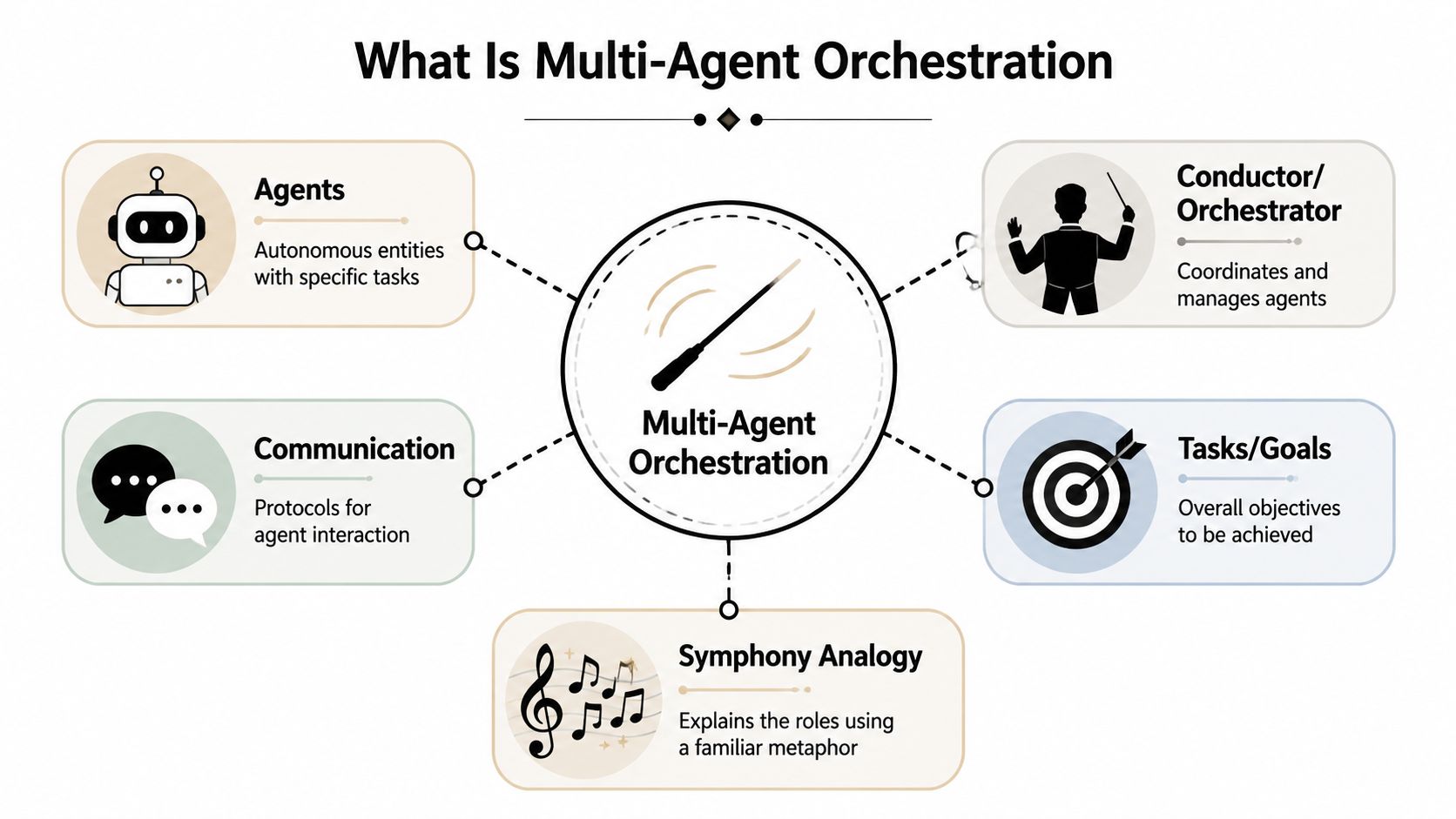
Multi-agent orchestration is the control plane for enterprise AI. It coordinates multiple agents, tools, and decision steps so the system can execute real business work without losing context, authority boundaries, or traceability.
The key distinction is that orchestration is not just routing. Routing picks the next agent. Orchestration manages how work is decomposed, how context is shared, how decisions are governed, and how outcomes are committed back into business systems.
From solo copilots to coordinated systems
A single agent can answer questions and complete narrow tasks. Enterprise operations demand more. One request may require retrieval from governed knowledge, policy interpretation, transaction execution, exception handling, and a human approval step before anything is written back.
That is why strong enterprise workflow automation separates responsibilities across specialist agents and control services. The system can preserve state across steps, enforce approval logic, and keep an audit trail that operations and compliance teams can inspect later.
For teams aligning terminology, this overview of agentic AI and how it differs from AI agents helps clarify the difference between autonomy inside one agent and coordination across a larger system.
The design goal is consistency under load, not a clever demo.
What the orchestrator does
In production, the orchestrator sits between user intent and business execution. It decides which agent should act, what context that agent is allowed to see, what tools it can call, and what must happen before an action is accepted as final.
A sound orchestration layer usually handles work like this:
- Interpret the request: Classify whether the request is simple, compound, ambiguous, regulated, or high risk.
- Break work into units: Split the goal into tasks that fit specialist agents, tools, or approval flows.
- Route with governed context: Pass only the facts, constraints, and permissions required for that step.
- Reconcile outputs: Compare results, detect conflicts, score confidence, and decide whether to retry, escalate, or continue.
- Commit the outcome: Update systems of record, trigger approvals, notify operators, or hand off to a human.
Two components are often missed here.
First, multi-agent systems need a governed shared context layer. Without it, each agent develops its own partial view of the customer, policy, or task state. That is how teams get semantic drift, duplicated work, and contradictory actions. Shared context does not mean unrestricted memory. It means a controlled layer for state, facts, definitions, and permissions so every agent works from the same operational truth.
Second, one central supervisor does not scale indefinitely. It becomes a latency bottleneck, a governance chokepoint, and an ownership problem across teams. Production systems often need multi-orchestrator patterns, where one orchestrator handles customer interaction, another manages domain workflows such as claims or onboarding, and a separate control layer enforces cross-cutting policy and observability. That structure scales better across business units and reduces the blast radius of failures.
A visual walkthrough helps make that concrete:
Practical rule: If planning, shared memory, action authority, and audit ownership are not explicitly assigned, you do not have orchestration. You have several agents taking turns.
Comparing Orchestration Patterns
Architecture choice sets the ceiling for everything that follows. It determines how requests flow, where policy is enforced, how failures are contained, and whether the system can grow beyond an initial pilot without a rewrite. In enterprise deployments, three patterns matter most: centralized supervisor, brokered or decentralized collaboration, and multi-orchestrator architecture.
The mistake I see often is treating these as routing options. They are operating models. Each one creates a different answer to four production questions: who owns workflow state, where shared context lives, how action authority is controlled, and which team is on the hook when something breaks.
Centralized supervisor pattern
The centralized supervisor is the most practical starting point for a structured workflow. AWS outlines a design where a central Supervisor Agent routes requests to specialized agents such as order tracking or technical support, using full decomposition for complex requests and direct dispatch for simpler ones. AWS also notes that custom orchestration development can take multiple quarters, while managed approaches can shorten time to production in customer support use cases (AWS multi-agent orchestration on AWS).
This pattern fits teams that need one place to inspect decisions, enforce approval rules, and trace execution end to end.
It works well when:
- The domain is bounded: Support, onboarding, claims intake, internal service desk.
- The workflow is inspectable: Teams need a clear trace of how decisions were made.
- Governance is centralized: One control point simplifies approval logic and escalation.
The trade-off is straightforward. The same component that simplifies control also becomes the queue for every decision. As request volume rises, the supervisor can turn into a latency bottleneck, and every new domain integration increases coupling inside one orchestration layer.
Brokered and decentralized collaboration
Brokered and decentralized designs spread coordination across agents or domain services. Agents interact through shared state, contracts, or an event broker that mediates requests and responses. This model gives domain teams more independence, but it also raises the bar on engineering discipline.
The upside is real:
- Local autonomy: A domain team can change its agent without rewriting the entire orchestration layer.
- Fault isolation: A failure in one workflow does not automatically stall unrelated work.
- Parallel work: Independent tasks can run at the same time instead of waiting for a central planner to issue every instruction.
The downside is usually underestimated. If teams do not share controlled schemas, explicit state transitions, and conflict-resolution rules, decentralized systems drift. Two agents may use different customer identifiers, interpret policy differently, or act on stale task state. That is why decentralized collaboration only works in production when it sits on top of a governed shared context layer, not a loose collection of prompts and message payloads.
Multi-orchestrator architecture
At enterprise scale, the pattern that holds up best is often multi-orchestrator. Instead of forcing one supervisor to manage every request, each major domain gets its own orchestrator and operating boundary. Customer interaction might sit in one orchestration layer. Billing disputes might sit in another. Identity verification, workforce operations, and knowledge retrieval can each have separate orchestration logic with a control layer above them for policy, observability, and audit.
That structure solves a scaling problem that a single supervisor cannot solve cleanly. Domain orchestrators can execute in parallel, evolve on separate release cycles, and fail without taking down the entire system. Teams also get clearer ownership. The billing team owns billing workflows. The identity team owns identity workflows. Platform engineering owns shared context, policy enforcement, telemetry, and protocol standards.
The cost is complexity. Multi-orchestrator systems require stronger interface contracts, versioned event models, and disciplined governance over shared context. Without that, teams recreate fragmentation at a larger scale.
| Pattern | Best For | Pros | Cons |
|---|---|---|---|
| Centralized supervisor | Early production systems, structured support flows, tightly governed service operations | Clear control point, easier debugging, faster initial deployment | Bottlenecks at scale, single point of failure, high coupling |
| Brokered or decentralized | Domain-driven platforms, independent teams, event-heavy workflows | More resilience, more local autonomy, better parallelism | Harder to govern, harder to debug, requires stronger contracts |
| Multi-orchestrator | Large enterprises with many agent domains and integration-heavy operations | Scales better across business domains, supports parallel execution, reduces pressure on one central controller | More architectural complexity, needs protocol discipline, stronger platform governance |
The practical selection rule is simple. Use a centralized supervisor to get a bounded workflow into production. Use brokered collaboration when domain teams are mature enough to maintain strict contracts. Use multi-orchestrator architecture when business units, compliance boundaries, and concurrency demands make a single supervisor too expensive to own and too risky to scale.
Centralize policy where consistency is required. Distribute orchestration where domain speed and scale matter.
The Cast of Agents and Their Roles
Strong orchestration starts with clean role boundaries. Teams get into trouble when they create five agents that all do roughly the same thing and differ only in prompt wording. That isn't a multi-agent system. It's prompt sprawl.
Core agent archetypes
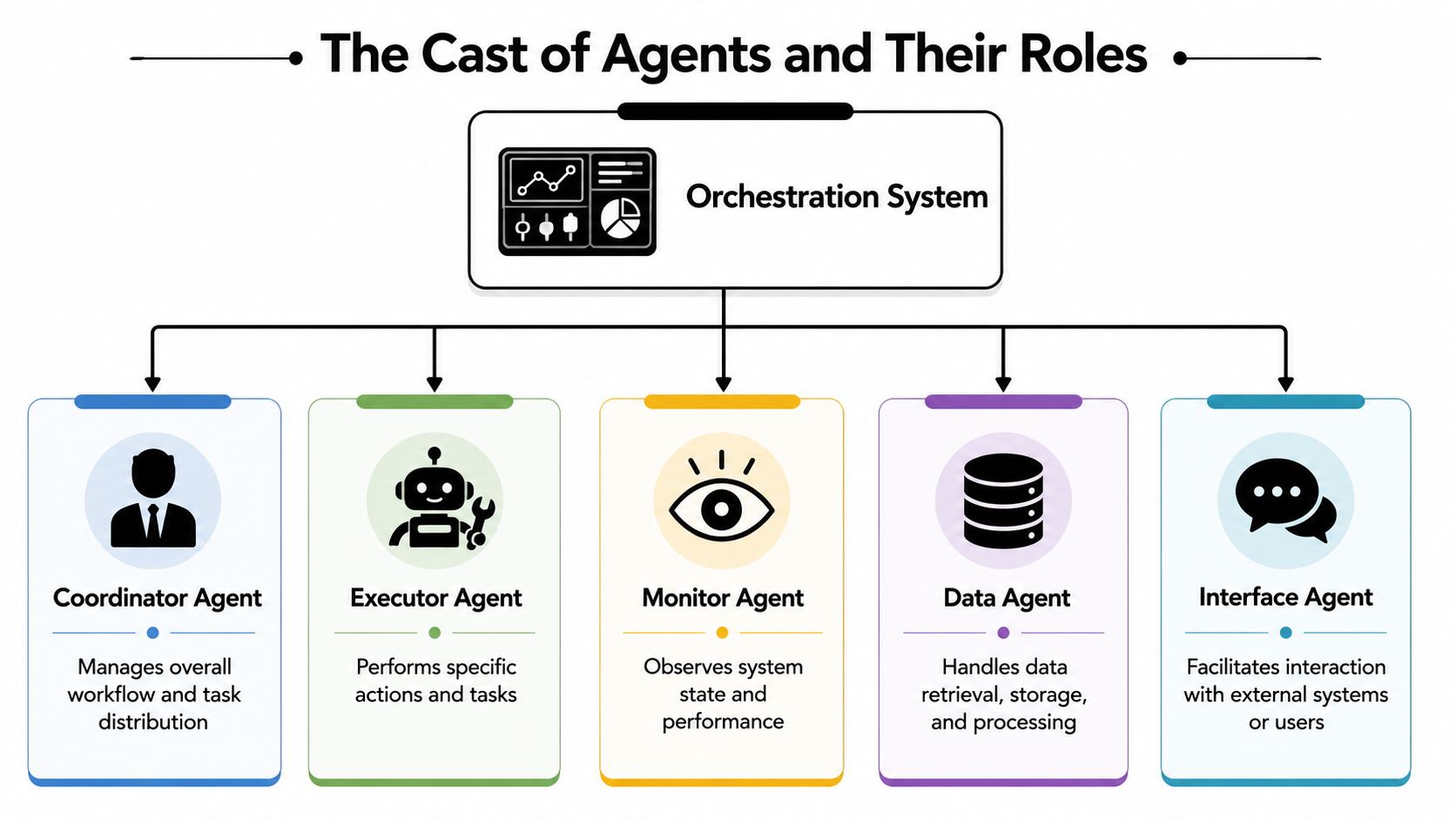
Most enterprise systems end up using a recurring cast.
Coordinator agent
This agent manages workflow state and task distribution. It doesn't need to know everything. It needs to know where to send work, what prerequisites exist, and what quality gates must be satisfied before the system moves forward.
Retrieval agent
This agent fetches and synthesizes enterprise knowledge. In practice, it often sits on top of RAG pipelines, indexed knowledge bases, policy repositories, and customer-specific records. Its job isn't to answer every question. Its job is to return grounded context the rest of the system can trust.
Executor agent
This agent performs actions. It creates tickets, updates CRM fields, submits refunds, schedules appointments, or triggers downstream workflows. It should operate with explicit permissions and narrow scopes because action authority is where risk accumulates.
Monitor or evaluator agent
This agent checks outputs for policy adherence, contradictions, missing evidence, or unsafe actions. In regulated environments, this role becomes critical because the system needs inspection before execution, not after a failure.
Interface agent
This agent handles the user-facing conversation across chat, voice, email, or internal employee portals. It maintains tone, collects clarifications, and turns backend work into coherent human interaction.
How strong teams divide responsibilities
The most reliable systems separate conversation from decisioning and separate decisioning from execution. That creates cleaner failure domains. If the conversational layer misphrases a response, you don't want it to also have the authority to issue a refund or update a claims record.
A practical division of labor often looks like this:
- Interface owns dialogue: It manages turn-taking, confirmations, and user experience.
- Coordinator owns planning: It determines sequence, dependencies, and escalation.
- Retrieval owns grounding: It provides source-backed enterprise facts and business definitions.
- Executor owns tools: It interacts with transactional systems under scoped permissions.
- Monitor owns assurance: It evaluates whether the system should proceed, retry, or hand off.
This also maps well to multimodal environments. A voice agent may own the live conversation, while separate retrieval and execution agents do the heavier backend work. That pattern keeps user interaction responsive while preserving system control.
The cleanest way to scale agents is to narrow their authority, not broaden their personality.
Key Orchestration Concerns for Enterprise Scale
Production failures in multi-agent systems usually come from architecture, not model quality. A pilot can look impressive while hiding the problems that break at enterprise volume: drifting state, inconsistent business meaning, weak control planes, and a supervisor pattern that collapses under load.

The components that determine whether orchestration scales
Four platform components show up in every production-grade design:
- Task routing engine: Assigns work, sequences tasks, and enforces dependency rules.
- Memory and state layers: Persist facts, intermediate outputs, approvals, and workflow status across turns and channels.
- Conflict resolution and guardrails: Block contradictory actions, unsafe tool use, and policy violations before execution.
- Observability: Captures traces, decisions, tool calls, and failure points so operators can debug and govern the system.
Those components matter, but they are still not enough.
The two concerns that get missed most often are the ones that separate a clever orchestration demo from an enterprise platform. First, agents need a governed shared context layer so they interpret the business the same way. Second, large deployments need multi-orchestrator patterns because one central supervisor becomes a bottleneck for throughput, fault isolation, and team ownership.
Governed shared context is the control point for semantic consistency
Routing decides where work goes. Context decides what the work means.
Teams often build orchestration logic on top of disconnected prompts, ad hoc retrieval, and local agent memory. That works until the same business term is interpreted differently across domains. "Active customer" might mean an account with current billing, an account with recent usage, or an account with an open service relationship. If three agents use three definitions, the workflow can remain technically correct while the business outcome is wrong.
A governed shared context layer should provide:
- Certified business definitions with clear ownership.
- Source lineage so every important fact can be traced back to a system of record.
- Policy inheritance so data handling, retention, and access constraints follow the context automatically.
- Cross-domain context objects that agents can reuse instead of rebuilding business meaning inside prompts.
This is not a data catalog feature bolted onto orchestration later. It is part of the runtime contract. Without it, each agent develops a local version of the truth, and coordination quality drops as the agent count rises.
A single orchestrator does not scale indefinitely
Many first deployments use one coordinator agent or one orchestration service at the center. That is a sensible place to start. It is also where scaling problems begin.
A single orchestrator accumulates too many responsibilities: task planning, state transitions, retry policy, exception handling, SLA tracking, and escalation. As more workflows and business units join the platform, that central layer becomes a latency hotspot and an operational choke point. Small failures spread too widely. Every change needs regression testing against unrelated processes. Ownership also gets muddy because one team now governs every workflow.
Enterprise systems usually need a multi-orchestrator design instead:
- Domain orchestrators manage workflows inside bounded business areas such as service, claims, HR, or finance.
- A global policy layer enforces shared rules for identity, audit, risk, and compliance.
- A handoff protocol passes state and authority between orchestrators without losing traceability.
- Local recovery paths let one workflow fail or degrade without stalling the entire platform.
This pattern trades some architectural simplicity for scale, isolation, and clearer governance. In practice, that trade is worth it once agent traffic crosses teams, systems, and regulatory boundaries.
Operational controls decide whether the system is governable
Once context and orchestration topology are in place, operations become the next pressure point.
- Latency management: Every extra agent adds model calls, tool invocations, and context transfer. Parallelize independent work, cap recursive planning loops, and define time budgets by workflow.
- Cost control: Shared context should reduce repeated retrieval and bloated prompts. Cache stable facts, summarize long histories, and pass only the state each agent needs.
- Fallback design: Define explicit paths for timeout, ambiguity, missing permissions, stale context, and human approval. Hidden fallback logic is one of the fastest ways to lose operator trust.
- Security boundaries: Agent permissions should map to enterprise roles, not prompt instructions. Teams reviewing deployment options should examine enterprise-grade security controls for agent operations such as audit logs, access governance, and compliance enforcement.
External content pipelines deserve the same scrutiny. If retrieval agents depend on scraped or third-party data, review how to compare web scraping API vendors before that data enters shared context or decision flows. Bad input quality becomes bad orchestration quickly.
The core lesson is straightforward. Enterprise orchestration is not just agent routing. It is governed context plus distributed control, backed by the same reliability and oversight standards used for any other business-critical platform.
Implementation Roadmap and Integration Patterns
Production multi-agent systems fail for a predictable reason. Teams assemble agents before they define how context is shared, who can act, and where orchestration authority should sit. The implementation roadmap should reverse that order.
A phased rollout that reduces rework
A workable rollout is usually shorter than expected when scope stays narrow and integration choices are made early. The point is not speed for its own sake. The point is to prevent teams from rebuilding prompts, state handling, and approval logic after the first pilot hits real traffic.
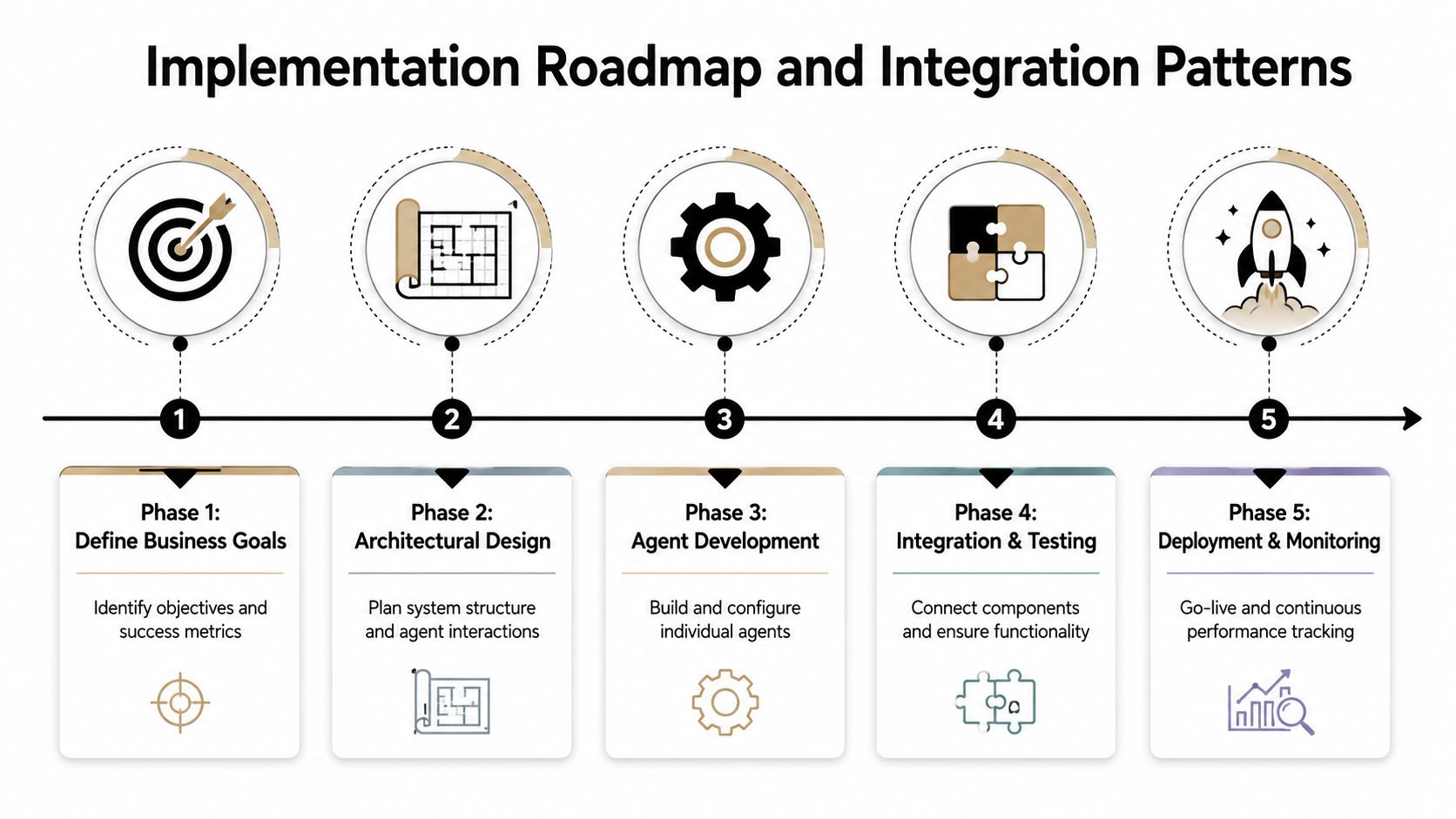
Use a sequence like this:
Phase 1
Pick one workflow with clear boundaries and measurable business value. Service request triage, refund review, employee onboarding support, and claims intake are good starting points. Avoid a first release that spans multiple business units, policy owners, and systems of record.
Phase 2
Define the control model before building the agent set. A supervisor pattern works for bounded domains with modest concurrency. A multi-orchestrator design fits better once separate domains need their own execution logic, SLAs, or compliance controls. This is usually the point where a single central coordinator becomes an operational bottleneck.
Phase 3
Build the shared context layer early. This is the part teams skip, and then pay for later in conflicting answers, duplicate retrieval, and brittle handoffs. Define business terms, source-of-truth systems, state ownership, and update rules before adding more specialized agents.
Phase 4
Add agents in order of risk. Start with retrieval, summarization, and interface agents. Add coordination agents next. Introduce action agents last, with narrow permissions and explicit approval paths for high-impact steps such as account changes, refunds, or policy exceptions.
Phase 5
Test failure modes as part of the design, not as a final QA step. Run ambiguous requests, stale records, contradictory data, unavailable tools, policy conflicts, and forced human escalation through the full orchestration flow. This process uncovers weak assumptions in context governance and orchestrator handoff logic.
Start with one workflow that matters. Expand by reusing context, policy, and orchestration components across workflows.
Integration patterns that work in real enterprises
Business value usually comes from how well the system fits existing operations. The orchestrated stack has to read customer and employee state, write back outcomes, trigger downstream work, and preserve context across channels and departments.
The common patterns are consistent across enterprises:
- CRM read and write: Pull account, opportunity, or case context from systems such as Salesforce or HubSpot, then write back summaries, dispositions, and next steps.
- Ticketing integration: Create, classify, enrich, route, or close requests in Zendesk, Freshdesk, or internal service desks.
- Contact center coordination: Pass conversation history, intent, and action state into platforms such as Genesys or NICE when a human agent takes over.
- Knowledge grounding: Query policy repositories, internal documentation, SOP libraries, and product knowledge through retrieval agents tied to governed context.
- Workflow triggers: Start approvals, notifications, fulfillment steps, or exception reviews when the orchestration layer reaches a defined state.
Integration breadth shapes the architecture. Teams evaluating platform choices should inspect available enterprise integrations for agentic workflows closely, because connector coverage affects how much custom state mapping, tool wrapping, and orchestration glue the team must maintain.
Yellow.ai, for example, offers pre-built integrations with systems such as Salesforce, Zendesk, and Genesys. That does not remove the need for architecture work. It reduces the amount of custom plumbing required so teams can spend more effort on context governance, policy enforcement, and domain-specific orchestration.
Measuring Success KPIs and Production Checklist
A multi-agent system becomes a business asset when operators can prove it resolves work safely, efficiently, and at scale. Pure model metrics won't get you there. Track operational and business outcomes together.
KPIs that reflect business value
The best KPI set is mixed. Some measures show workflow effectiveness. Others show system health.
Use a working scorecard like this:
- Task completion rate: Did the workflow reach the intended business outcome without manual repair?
- First contact resolution: Did the system solve the request in the initial interaction or require transfer and rework?
- Cost per resolution: What does a completed outcome cost once model usage, infrastructure, and human fallback are included?
- Orchestration latency: How long did the system take across routing, retrieval, tool execution, and response delivery?
- Fallback rate: How often did the system escalate because confidence, policy, or tool state blocked completion?
- Policy exception rate: How often did evaluator or guardrail layers stop a proposed action?
Production checklist before go-live
Before launch, teams should be able to answer yes to the following:
- Shared context is governed: Business terms, ownership, and source-of-truth systems are defined.
- Agent authority is scoped: Each agent has explicit permissions and clear execution boundaries.
- Observability is live: Operators can inspect traces, handoffs, tool calls, and state transitions.
- Fallback paths exist: Timeouts, tool failures, ambiguity, and compliance exceptions route cleanly.
- Human handoff works: People receive the workflow state, not just the latest user message.
- Security review is complete: Access controls, audit needs, and compliance obligations are satisfied.
- Operational ownership is assigned: Platform, data, security, and business teams know who manages which part of the system after launch.
The teams that succeed treat orchestration as operating infrastructure. They don't measure whether the model sounded smart. They measure whether the system completed work correctly, predictably, and under governance.
If you're turning single-agent pilots into a governed, scalable production system, Yellow.ai is one platform to evaluate. It supports agentic workflow design, multimodal deployment across voice and chat, and enterprise integration patterns that matter when orchestration moves out of the lab and into customer or employee operations.



