














The popular advice is simple: connect a language model to a vector database, retrieve a few chunks, and you've solved enterprise knowledge access. That advice confuses building a RAG pipeline with proving that it can be trusted. A fluent answer can still misuse a policy, combine unrelated passages, miss a critical exception, or hide the fact that the index returned weak evidence.
Retrieval augmented generation is best understood as an engineering discipline for grounding model behavior, not a plug-and-play feature. The architecture matters, but production success depends on a harder question: can your team demonstrate that answers are relevant, complete, faithful to approved sources, current enough for the workflow, and safe across languages and access boundaries?
Table of Contents
- Why Most RAG Deployments Fail the Faithfulness Test
- The Core Architecture Behind Retrieval Augmented Generation
- How RAG Transforms Large Language Model Behavior
- Enterprise Implementation Patterns and Integration Strategies
- Measuring What Matters in Production RAG
- Scaling RAG Across Languages and Compliance Boundaries
- Your RAG Adoption Checklist for Production Success
Why Most RAG Deployments Fail the Faithfulness Test
RAG became a distinct modern architecture with the 2020 paper “Retrieval-Augmented Generation for Knowledge-Intensive NLP Tasks”. That milestone unified a neural retriever with a sequence-to-sequence generator and demonstrated strong results on knowledge-intensive open-domain question answering. It also created an expectation that retrieval would naturally make generation reliable.
In production, retrieval only gives the model an opportunity to use evidence. It doesn't guarantee that the evidence is relevant, complete, current, or correctly interpreted. A support assistant can retrieve a valid refund policy and still answer the customer's question incorrectly if the policy applies to a different product, region, or account type.
Retrieval quality and generation quality are different problems
Teams often evaluate the final answer while ignoring the path that produced it. That makes diagnosis difficult. If an answer is wrong, you need to know whether the retriever selected the wrong passage, selected a useful passage but omitted a necessary one, or gave the model adequate context that the model then misread.
A 2024 survey on RAG evaluation emphasizes this separation. Retrieval needs assessment for relevance, while generation needs assessment for accuracy and faithfulness. Weak retrieval can inject irrelevant context, and weak generation can hallucinate even when the retrieved context is sound.
Practical rule: Never treat a good final-answer score as proof that your retriever and generator are both working well.
The faithfulness gap becomes especially dangerous because errors often sound professional. A model might state a correct eligibility rule, then add an unsupported deadline. Customers rarely distinguish a sourced sentence from an invented addition when both appear in the same confident response.
Why fluent answers hide operational risk
The common evaluation shortcut is to ask whether an answer “looks right.” That test rewards tone, structure, and apparent completeness. It doesn't reliably detect unsupported claims, source conflicts, or answers that omit the condition that changes the outcome.
RAG evaluation remains fragmented across tasks, systems, and metrics, as described in the 2025 survey on RAG evaluation challenges. The same source highlights a serious limitation in automated hallucination detection. In one study, RAG increased the false negative rate of widely used hallucination detectors from 23.8% to 52.0% on average, and detector-optimized RAG worsened evasion by 53.3%. Those figures don't mean RAG is ineffective. They mean detector output can't stand in for a faithfulness program.
A reliable deployment therefore needs source-level inspection, adversarial test cases, expert review for consequential workflows, and monitoring after release. The pipeline is only the beginning.
The Core Architecture Behind Retrieval Augmented Generation
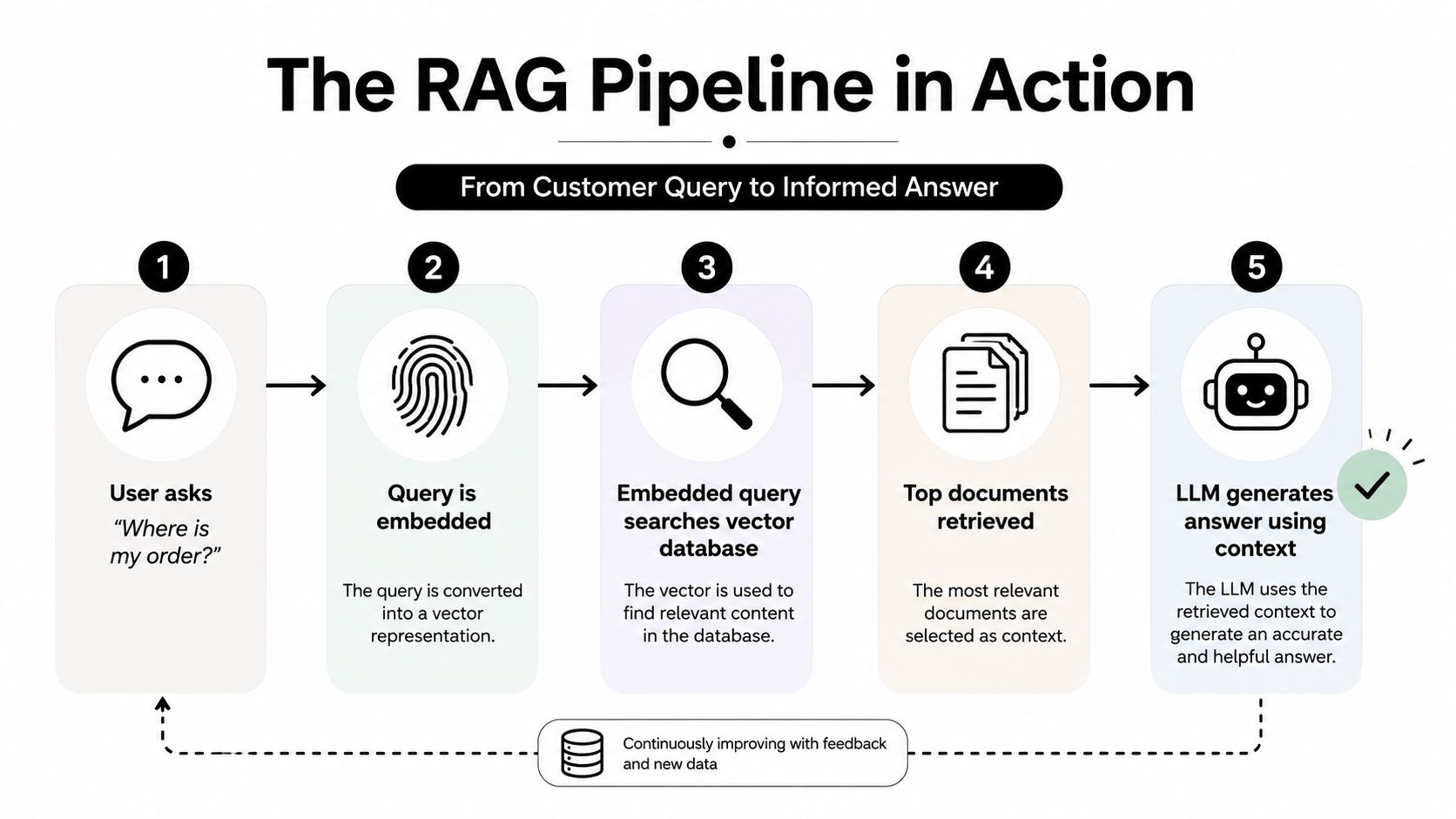
Consider a customer asking, “Where is my order?” A conventional language model may produce a helpful-sounding delivery response, but it doesn't know the customer's order record. A RAG system must connect the conversational request to the right operational data and then generate only an answer supported by the retrieved context.
From raw knowledge to searchable context
Before a customer asks anything, the system ingests relevant content. That may include delivery policies, carrier guidance, product documentation, and structured order information. Documents are cleaned, divided into chunks, converted into embeddings, and stored with metadata such as source, timestamp, document identity, permissions, and region.
Chunking is a quality decision, not a preprocessing detail. A chunk that is too small may separate an exception from the rule it modifies. A chunk that is too large may bury the answer among unrelated content. For customer support, preserve headings, policy conditions, product names, and document relationships rather than splitting text purely by character count.
Embedding models translate text into vectors that represent semantic relationships. Earlier retrieval advances helped make this practical. FAISS and other retrieval milestones describe how FAISS supported billion-vector similarity search on GPUs in 2017, DrQA established a retrieve-then-read question-answering template in 2017, and Sentence-BERT reduced nearest-neighbor sentence matching from about 65 hours to about 5 seconds for 10,000 sentences in 2019. These developments turned semantic retrieval into an engineering primitive.
What happens when the customer asks
-
The system interprets the request. “Where is my order?” is conversationally incomplete. The orchestration layer may need the order identifier, authenticated customer context, or a clarification question.
-
The query becomes a vector. The embedding model converts the request into a representation that can be compared with indexed content.
-
The retriever searches relevant stores. Dense vector search can find semantically similar material. Keyword search remains valuable for exact order identifiers, error codes, model names, and carrier references. Many enterprise systems use both.
-
The system filters and ranks candidates. Metadata filters can restrict results by customer, geography, product, language, access role, or freshness. A reranker can then improve ordering by comparing the query with candidate passages more directly.
-
The orchestration layer builds the prompt. It combines the user request, retrieved context, conversation state, and instructions such as: answer from the supplied evidence, identify uncertainty, and avoid exposing restricted information.
-
The language model generates the response. The model should explain the order status using the retrieved record and applicable policy. If the system has no reliable status, it should ask for missing information or route the interaction rather than inventing a delivery update.
A conversational knowledge base, such as Yellow.ai's Conversational Knowledge Base, fits into this broader pattern by helping agents access enterprise content during dialogue. The implementation still needs careful authorization, indexing, retrieval, prompting, and evaluation.
The video below provides a visual explanation of the workflow.
The important architectural point is that the retriever and generator form one system. A stronger language model can't compensate for consistently irrelevant retrieval, and a strong retriever can't guarantee that the generator will follow evidence. Quality belongs to the entire chain.
How RAG Transforms Large Language Model Behavior
A language model without retrieval behaves like a knowledgeable consultant who can't open the company's current files. It can explain concepts, draft language, and infer likely answers from patterns, but it has no dependable mechanism for consulting the latest internal policy or a customer's live record.
RAG changes the model's working conditions. Instead of answering from model memory alone, the generator receives query-specific evidence at inference time. That evidence can constrain the answer, support citations, expose uncertainty, and connect the response to information that wasn't available during model training.
Customer experience becomes source-aware
A customer support agent may need to answer questions about eligibility, cancellation, troubleshooting, or delivery. A generic model can produce a plausible policy explanation. A grounded system can retrieve the applicable policy, account context, and product documentation, then format the response around those sources.
The improvement isn't just “fewer hallucinations.” The response can become more specific because the model has access to details relevant to the individual interaction. It can also distinguish between:
- Known facts, supported by the retrieved record.
- Applicable rules, supported by the relevant policy.
- Missing information, which requires clarification or a system lookup.
- Unsafe assumptions, which should trigger escalation.
That distinction matters in contact centers. A polished but unsupported answer creates recontacts and remediation work. A concise answer that states what the system knows and what it can't verify is operationally safer.
Employee service requires controlled interpretation
HR assistants face a different problem. An employee may ask about benefits, leave, relocation, or access to an internal process. The assistant needs to retrieve the right policy version and account for region, employment type, and eligibility conditions.
RAG doesn't turn policy language into an automatic decision engine. It gives the model access to relevant text, but the orchestration layer must still enforce identity, permissions, and workflow rules. If an answer affects a sensitive employee decision, the system should expose the source and provide a path to human review.
Compliance needs provenance, not just confidence
Compliance teams usually care about why the system produced an answer. A response should be traceable to the documents retrieved, the version of the prompt used, the model selected, and any tools called during the interaction.
RAG supports this audit trail more naturally than a model that answers from opaque internal weights, but only if provenance is recorded deliberately. Store the retrieved passages, metadata, access decision, response, and evaluation outcome. Without that record, a citation displayed to the user may look reassuring while giving operators little ability to reconstruct the failure.
A medical benchmark included in the RAG evaluation survey used 7,663 questions and found that a RAG toolkit improved accuracy by up to 18% over chain-of-thought prompting across six LLMs. The result supports a practical conclusion: retrieval can materially improve performance when the corpus, retriever, and model are tuned together. It doesn't support the stronger claim that adding retrieval automatically makes every enterprise answer faithful.
Enterprise Implementation Patterns and Integration Strategies
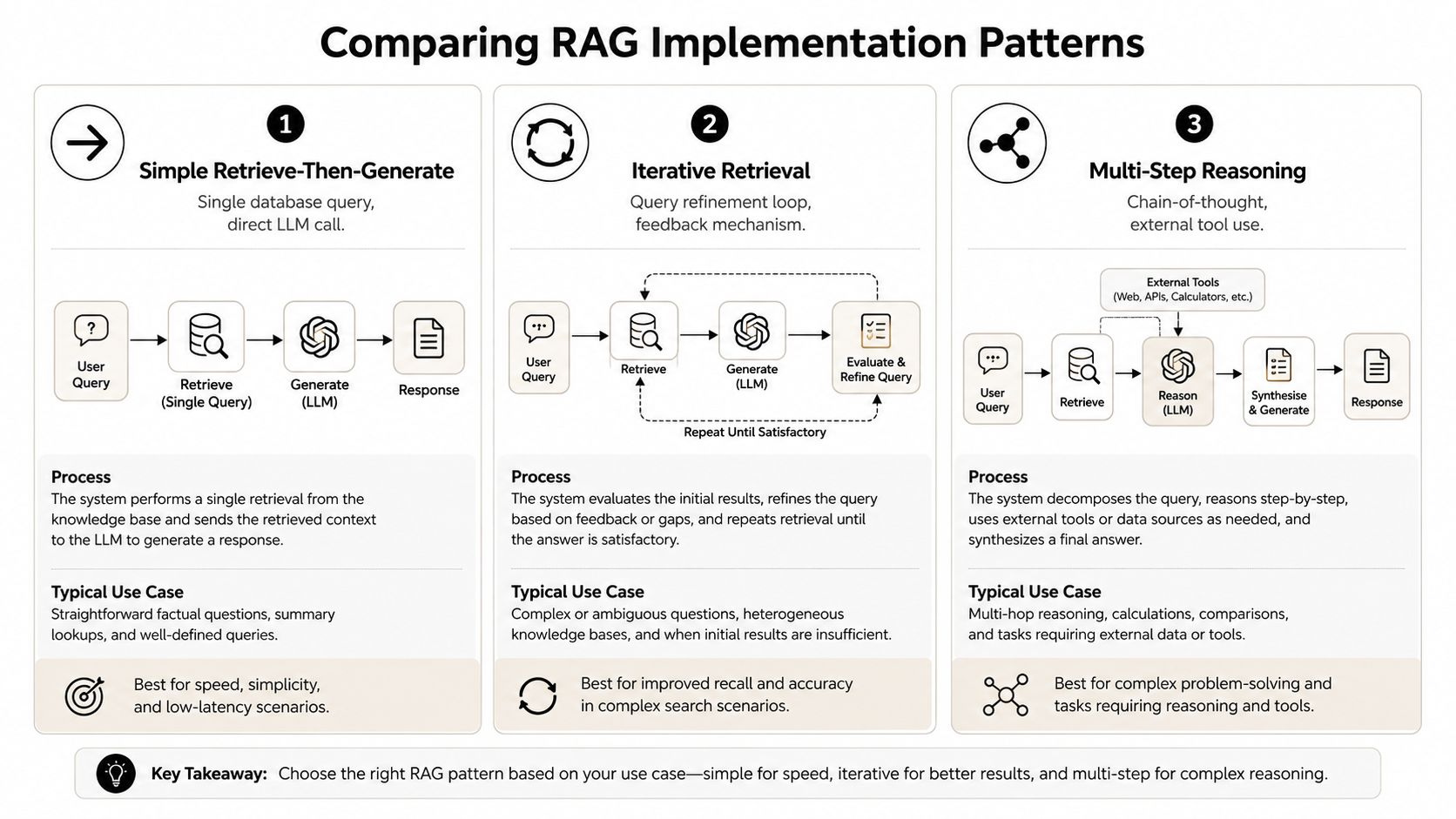
The RAG pattern should follow the question, error risk, data freshness, and action required after the answer. A high-volume FAQ assistant needs less orchestration than an employee-service workflow that combines policy interpretation with a transaction. The pipeline is easy to assemble. Proving that each pattern stays faithful under ambiguity, stale content, and permission constraints is the production challenge.
Simple retrieve then generate
This pattern makes one retrieval call, passes the selected context to the language model, and returns an answer. It suits direct questions over a coherent knowledge base, such as product setup instructions or standard service policies.
Its strengths are low orchestration complexity, predictable latency, and easier debugging. Its weakness is brittleness. An ambiguous query or a missed passage can leave the generator without the evidence needed to answer faithfully.
Set conservative fallback behavior. If relevance is weak, ask for clarification, state the limitation, or route the request to a human. Low-quality context supplied merely to avoid “I don't have enough information” can produce a more serious unsupported answer.
Iterative retrieval and query refinement
An iterative design rewrites the query, retrieves again, or uses feedback from an intermediate result. It fits follow-up questions, ambiguous support requests, and workflows where the first search must gain additional constraints.
“Can I change my plan?” may require the system to identify the customer's current plan, region, contract status, and requested change. Query refinement can turn that underspecified request into narrower searches, but every intermediate answer should remain traceable to retrieved evidence.
The trade-off is operational cost and latency. Each retrieval or model call adds a failure point. Every loop needs a stopping condition, traceable intermediate state, and a defined reason for continuing.
Multi-step and agentic retrieval
Multi-step reasoning can combine policy documents, structured records, calculators, ticketing systems, and business actions. An agent might retrieve a policy, check eligibility through an integration, and present the next permitted action.
This pattern fits complex employee-service and support operations, but it needs tighter controls than a document chatbot. Define tool permissions, action confirmation, data minimization, and audit logging before deployment. Also test whether the agent cites the policy it used and avoids presenting a tool result as permission to act.
Dense retrieval handles paraphrase and meaning. Hybrid retrieval is safer when exact terms matter, including product identifiers, error codes, legal references, or plan names. A reranking layer can improve precision when the model's context budget is limited.
RAG also requires a data update strategy. New or changed policies should trigger controlled ingestion and reindexing. Real-time customer data should usually come from an authoritative operational system rather than a periodically refreshed document index.
For integration planning, Yellow.ai's integrations show the broader enterprise requirement: RAG must connect with the systems holding customer, employee, ticket, and workflow context. The architecture still needs explicit ownership for source authority, retrieval permissions, action approval, and failure handling. A working connector does not prove that the resulting answer is faithful. That requires production traces and targeted review.
Measuring What Matters in Production RAG
A RAG demo can look excellent while the deployed system remains unproven. A single answer score, thumbs-up rate, or language-model judge score cannot establish faithfulness. Production evaluation must show whether the system retrieved the right evidence, used it correctly, and handled uncertainty without inventing claims.
RAGBench addresses this gap with 100,000 examples across five industry-specific domains and TRACe, a framework built around actionable metrics. Its domain coverage matters because an evaluation score that looks healthy overall can conceal failures in specialized workflows, where one missing condition or exception changes the permitted answer.
Build a failure-oriented scorecard
Track the pipeline in separate dimensions:
- Retrieval relevance: Did the returned passages address the user's question?
- Context completeness: Did retrieval include the conditions, exceptions, and facts required for a correct response?
- Generation faithfulness: Does every material claim follow from the supplied evidence?
- Answer completeness: Did the response cover every part of the request without unsupported detail?
- Operational behavior: Did latency, fallback, escalation, access control, and citation behavior meet the workflow requirement?
Build the test set from real questions, authoritative documents, difficult edge cases, multilingual requests, outdated-content scenarios, and adversarial prompts. Label the evidence needed to support each answer, not just the preferred wording. That separation lets engineers identify whether a failure began in retrieval or generation.
Production review should also examine claim-level traces. Store the retrieved passages, prompt context, generated claims, citations, and final disposition so reviewers can reproduce failures instead of judging the final answer in isolation.
Don't trust detectors without human review
Automated hallucination detectors can scale testing, but their reliability remains uneven. The 2025 analysis of hallucination evaluation reports that RAG raised false negatives for widely used detectors from 23.8% to 52.0% on average. A detector can therefore approve an answer containing a subtle unsupported claim.
Use expert review for high-risk cases and sample routine traffic for calibration. Reviewers should mark the exact sentence that failed, the source passage that should have supported it, and whether the system should have abstained. This creates labels that can improve prompts, retrieval settings, and escalation rules.
Faithfulness is a claim-level property. A response can contain useful evidence and still fail because one consequential sentence exceeds that evidence.
Monitor drift after launch. Track retrieval relevance, source freshness, abstention behavior, escalation patterns, user corrections, and policy-version coverage. Compare pipeline versions through controlled tests, and avoid optimizing only for shorter answers or higher satisfaction. Users can reward confident wording even when the underlying claim is unsupported.
Scaling RAG Across Languages and Compliance Boundaries
Global deployment exposes failures that a single-language prototype can hide. The pipeline must retrieve authoritative content, reason over evidence across languages, answer in the requested language, and enforce the user's authorization. Translation handles only one part of that chain.
A 2025 cross-lingual RAG paper identifies two underreported challenges. With monolingual retrieval, models may produce an answer in the wrong language. With multilingual retrieval, the harder task is reasoning over information gathered across languages, rather than merely generating a non-English response. Treat these as separate evaluation dimensions.
Treat language as a retrieval and reasoning concern
Index content with language metadata, then test queries as customers and employees phrase them. A user may ask in one language while the authoritative policy exists in another. Cross-language retrieval must preserve legal qualifiers, product terminology, and regional exceptions.
Evaluate response language separately from factual grounding. A fluent translation can still distort the source. For contact centers, include mixed-language conversations, code-switching, local product terms, and follow-up questions that refer to an earlier translated answer. Compare the claims against the original evidence, not only against the translated output.
Enforce boundaries before generation
Security belongs in retrieval, not only in the final prompt. Apply identity and authorization filters before documents enter model context. Log the query, retrieved records, access decision, model response, and downstream action so an operator can investigate suspected exposure.
Regulated environments also require controlled data handling, retention policies, encryption, tenant isolation, and human escalation. Yellow.ai's enterprise-grade security information illustrates the type of compliance and governance material to examine when assessing an enterprise AI platform. The practical question is whether listed controls match your data flows and operating procedures, not whether certifications appear on a vendor page.
Scale retrieval without hiding degradation
Latency can come from query processing, retrieval, reranking, model inference, tool calls, and external system responses. Keep the default path simple for routine questions, reserve deeper retrieval for queries that need it, and cache only information that can safely be reused.
Enterprise teams are showing greater interest in hybrid retrieval, while many qualified respondents still have no production RAG system. That market signal does not prove operational readiness. Building a multilingual pipeline is relatively straightforward; proving that it remains faithful, authorized, and observable across regions is the harder enterprise task. Prioritize governance and measurement before adding architectural complexity, and test each language and access boundary under realistic traffic.
Your RAG Adoption Checklist for Production Success
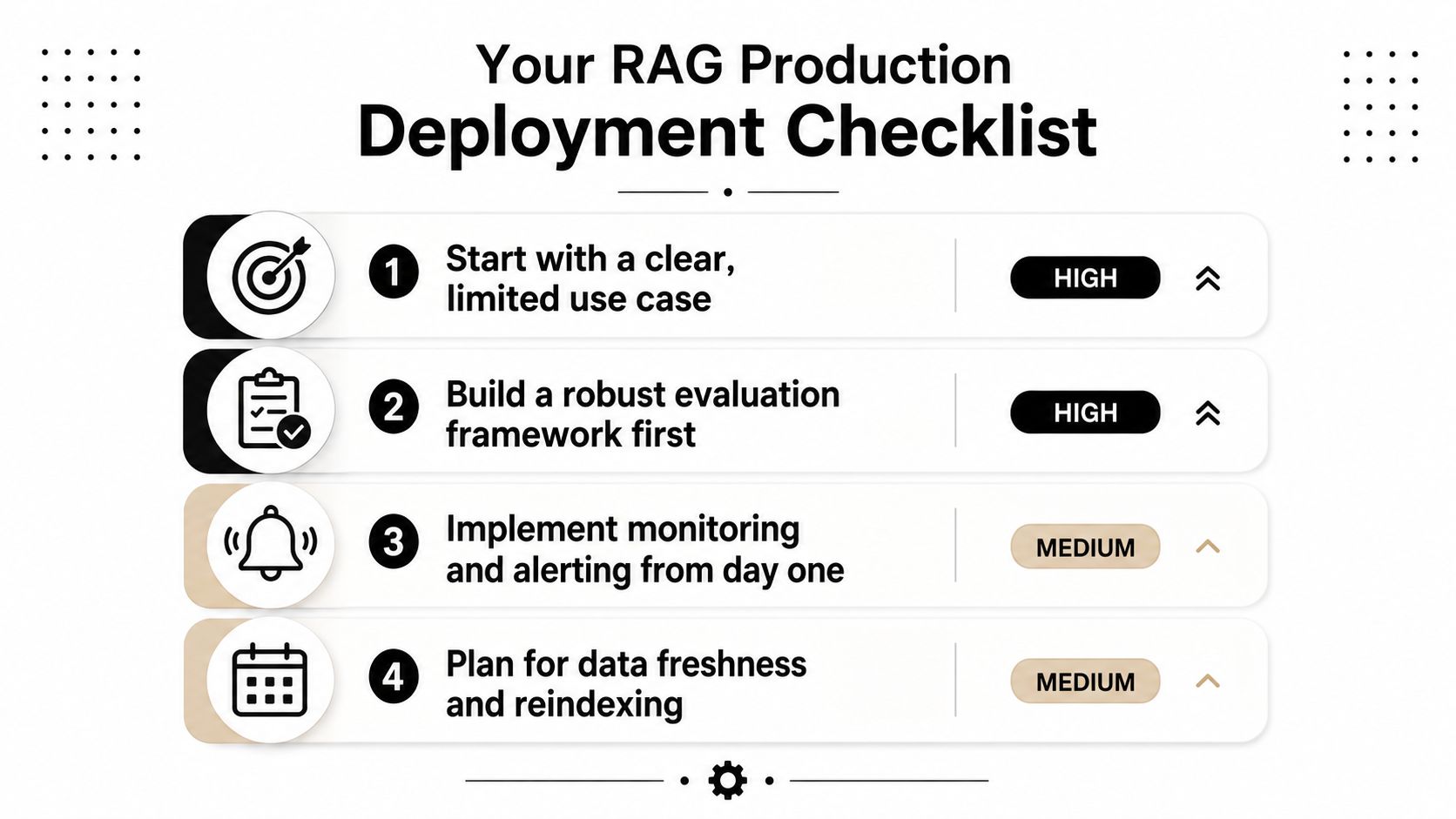
Start with a narrow workflow where source authority and business outcomes are clear. A focused support policy assistant is easier to evaluate than a general enterprise chatbot that searches everything.
Use this sequence:
-
Define the evidence boundary. List approved sources, ownership, update expectations, permissions, and the conditions under which the assistant must abstain.
-
Create evaluation data before tuning. Pair representative questions with required evidence and acceptable answers. Include ambiguous, multilingual, stale-content, and adversarial cases.
-
Choose the simplest pattern that fits. Use direct retrieval for straightforward questions. Add query refinement, tools, or multi-step reasoning only when the workflow genuinely needs them.
-
Tune ingestion deliberately. Test chunk boundaries, metadata, embedding models, dense retrieval, keyword search, filtering, and reranking against the evaluation set.
-
Instrument every decision. Record retrieved passages, ranking, prompt version, model, tool calls, response, fallback, escalation, and reviewer feedback.
-
Plan freshness from the start. Define how source changes trigger reindexing and how operators detect stale or conflicting content.
-
Measure business outcomes alongside technical quality. Track resolution, escalation, recontact, handle time, employee task completion, and compliance exceptions, while keeping faithfulness and retrieval metrics visible.
RAG earns production trust through repeatable evidence, not impressive demonstrations. Build the test harness before expanding the corpus, and make abstention a designed behavior rather than an embarrassing failure.
Yellow.ai provides enterprise conversational AI capabilities that combine agentic retrieval, conversational knowledge access, multi-LLM orchestration, and integrations across CX and EX workflows. If your team is moving from a RAG prototype to a measurable, governed deployment, visit Yellow.ai to explore how the platform can support that transition.



