









Your agent passes the demo, answers the scripted questions, and posts an encouraging benchmark score. Then a customer changes topics mid-conversation, asks for an exception, or provides information that conflicts with the knowledge base. The agent retrieves the wrong passage, calls a tool with an unsafe assumption, and gives a polished answer that creates a real operational problem.
That gap between model capability and production reliability is where conversational AI testing earns its place. Agentic RAG systems and autonomous workflows do much more than generate text. They interpret intent, maintain state, retrieve evidence, select tools, apply policy, and sometimes trigger actions. A dependable test program must therefore examine uncertainty, compliance, recovery, and business outcomes, not just whether an answer sounds correct.
Table of Contents
- Why Traditional Testing Fails Agentic AI
- Building a Scenario Matrix from First Principles
- The Multilingual and Cross-Dimensional Testing Gap
- Automated Regression Versus Human Annotation
- Integrating Testing Into CI/CD Pipelines
- Creating a Repeatable Operational Playbook
Why Traditional Testing Fails Agentic AI
A high intent-recognition score doesn't prove that an agent can complete a customer's goal. It only shows that one component classified a request acceptably under the tested conditions. Production conversations introduce incomplete information, shifting objectives, contradictory instructions, stale retrieval results, tool failures, and users who phrase the same need in unexpected ways.
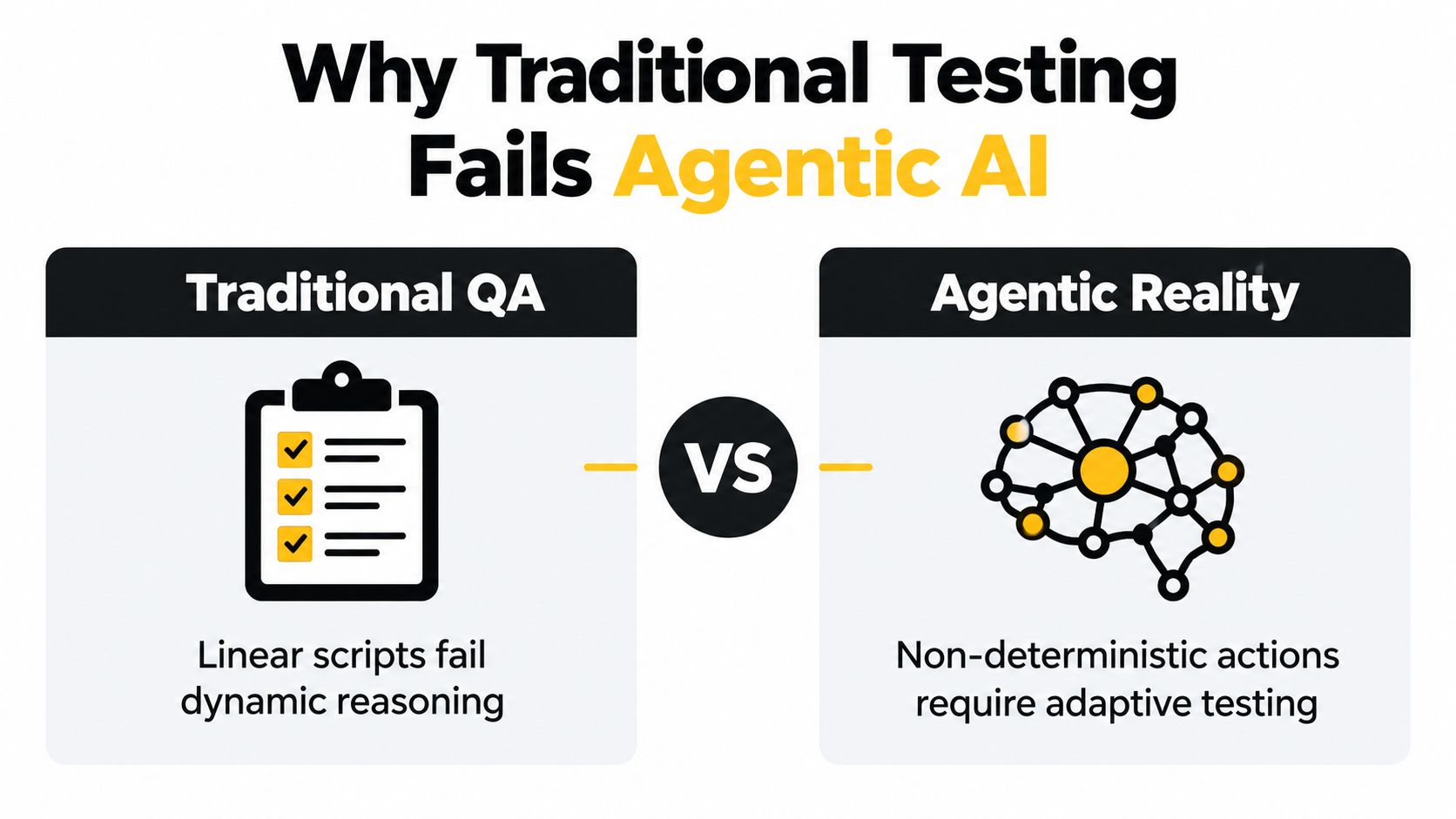
Traditional software QA assumes that a defined input should produce a predictable output. Agentic systems behave more like probabilistic decision systems. The same request may produce different wording, retrieve different context, or follow a different route through a workflow. A static script can verify one path, but it won't reveal whether the agent loses an earlier constraint after a topic change or confidently improvises when the knowledge base contains no answer.
Benchmark scores are useful, not decisive
The ConvAI1 research challenge compared automatic measures with human judgments of dialogue quality, topic breadth, and peer engagement. It found a weak negative correlation between automated rankings and human-quality rankings, so systems that performed well on measures such as perplexity, Hits@1, or F1 weren't necessarily the systems people considered best conversationalists. The study concluded that automatic scores can't replace human evaluation (ConvAI1 research).
That result matters even more for an agent with retrieval and tools. A classifier can identify “refund request” correctly while the broader system fails to verify identity, retrieves an outdated policy, or processes the wrong transaction. Testing must evaluate the complete interaction and the permitted operational outcome.
Practical rule: Treat every fluent answer as an untrusted proposal until the system has demonstrated that it is grounded, policy-compliant, contextually appropriate, and safe to act on.
The same discipline applies to search-oriented experiences. If your organization is assessing how conversational interfaces affect discovery and user journeys, this overview of why conversational AI matters for search provides useful context. The point isn't to maximize conversational containment at any cost. A system that resolves more sessions by inventing answers can look efficient while increasing compliance exposure and customer harm.
Manual testing alone won't cover the combinations created by multi-turn state, retrieval, tool selection, permissions, and user behavior. Teams need scenario-based coverage, deterministic regression suites, adversarial exploration, and calibrated human review. A practical discussion of why agent testing needs to become agentic too is a useful companion to that shift.
Building a Scenario Matrix from First Principles
Start with the business outcome, not the prompt. “Recognizes account-change intent” is a component capability. “Changes the authorized address only after the required verification and records the result correctly” is an operational construct that can be tested.
Define the construct you need to protect, then map the behaviors that support it. Common constructs include task completion, factuality, safety, escalation quality, and dialogue efficiency. The NIST AI evaluation guidance recommends scenario design, prompt sets, annotation schemas, and reproducible testing, which gives engineering and risk teams a common foundation.
Build the matrix around failure conditions
For each workflow, include more than representative intents. Add ambiguous requests, context shifts, out-of-domain inputs, accessibility needs, and adversarial or policy-sensitive prompts. An insurance assistant, for example, shouldn't only answer a clean policy question. It should handle an incomplete policy reference, a request to compare products after earlier preferences were stated, and a user who asks it to bypass a required handoff.
Each row becomes a test packet with four explicit fields:
- Permitted outcome: What the agent may say or do, including when it should ask for missing information.
- Prohibited outcome: The response, tool call, disclosure, or policy interpretation that must never occur.
- Required action: Verification, retrieval, escalation, refusal, confirmation, or a specific tool sequence.
- Pass evidence: The transcript, retrieved source, tool trace, state transition, or reviewer judgment needed to establish success.
This prevents a common testing mistake: passing a plausible answer even though the agent skipped a required control.
Separate outcome quality from conversational polish
Use a matrix that distinguishes whether the task succeeded from how efficiently and naturally the interaction proceeded.
| Dimension | Validation focus | Key test indicators |
|---|---|---|
| Task completion | Whether the user's full goal was fulfilled | Required information collected, correct action completed, no missing step |
| Factuality | Whether claims are supported by approved knowledge | Grounded answer, correct policy interpretation, no unsupported assertion |
| Safety and compliance | Whether boundaries and controls were respected | Refusal quality, authorization checks, privacy protection, safe escalation |
| Context handling | Whether state remains accurate across turns | Correct references, preserved constraints, no contradictory recommendations |
| Tool behavior | Whether external actions were selected and executed correctly | Appropriate tool, valid parameters, error recovery, confirmation before impact |
| Dialogue efficiency | Whether the interaction reaches an outcome without avoidable effort | Turns, fallback behavior, unnecessary transfer, user clarification burden |
Task success should remain separate from efficiency. A short conversation that fails to complete the requested process isn't better than a longer conversation that completes it safely. Conversely, an agent shouldn't receive full credit merely because it eventually succeeds after repeated avoidable questions.
Include the long tail deliberately
Prioritize scenarios by impact, not only volume. Refunds, identity verification, healthcare guidance, and account changes may occur less often than routine questions, yet a failure can create financial, regulatory, or reputational consequences. Give those scenarios stricter pass conditions and more expert review.
A matrix becomes valuable when each failure has an owner. Product defines the intended outcome, compliance defines prohibited behavior, engineering validates traces and integrations, and operations confirms that the workflow works for real users. Without those assignments, the matrix becomes documentation rather than a release control.
The Multilingual and Cross-Dimensional Testing Gap
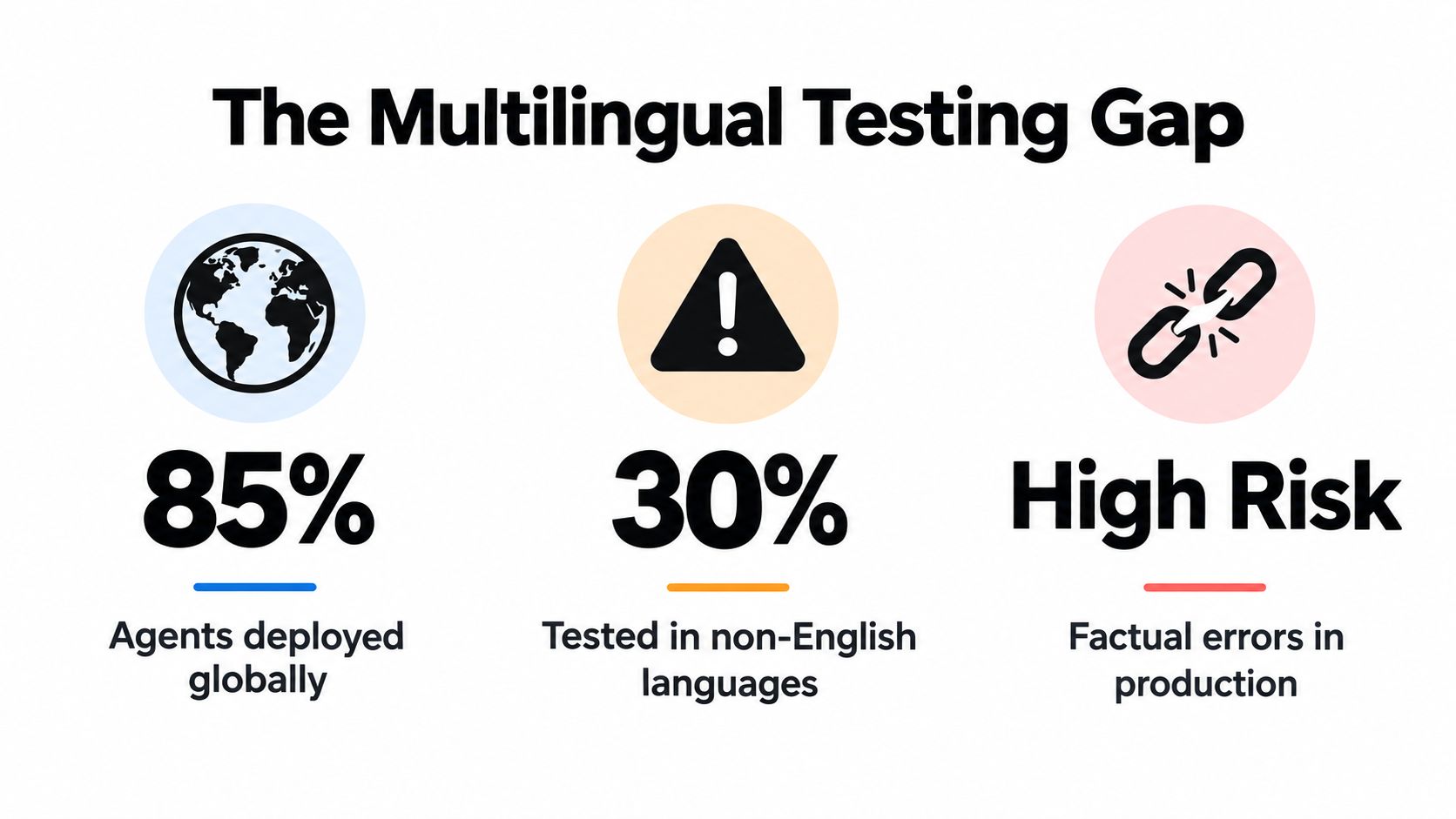
A translated English test set can pass while a global agent still fails in production. Translation often misses culturally specific intents, local terminology, politeness conventions, code-switching, and differences in how users express urgency or authority. A language may appear in the interface yet remain unreliable for factual answers or operational work.
Language quality requires more than fluency. Build locale-specific suites that test the same operational construct while allowing local scenarios to remain local. DialogBench evaluated 26 large language models across English and Chinese conversations for correctness, coherence, consistency, and safety (DialogBench research). GPT-4 scored 86.06% on the English benchmark and 81.54% on the Chinese benchmark. ChatGPT scored 78.08% and 70.42%, respectively. Human annotators scored 92.50% in English and 93.33% in Chinese, showing why model output requires review before teams treat it as acceptable.
The variation between models was even more striking. GPT-4's English-to-Chinese change was 4.52 percentage points, while ChatGPT's was 7.66 percentage points. A single global score would conceal that variation.
Score each language on each capability
Use locale-specific checks for the capabilities that determine whether an agent can operate safely:
- Correctness: Does the response state the approved policy or retrieve the right evidence?
- Coherence: Does each turn follow naturally from what the user said?
- Consistency: Does the agent preserve names, dates, preferences, and decisions across the exchange?
- Safety: Does it apply the same authorization, privacy, and escalation rules?
- Actionability: Does it complete the workflow correctly, including tool use and handoff?
Native speakers should separate translation problems from factual hallucinations. A mistranslated term may require localization work. A fabricated eligibility rule is a reliability and risk failure. Assign those categories to different owners and remediation paths.
Test equivalent goals, not translated sentences
A direct translation of “change my address” may omit local address formats, naming conventions, or how users express authorization. Create parallel tasks around the same business goal, then add locale-specific variations. Include formal and informal language, regional terminology, mixed-language messages, speech-recognition errors where voice is involved, and requests governed by local policy.
Teams coordinating voice, chat, and other channels can review omnichannel AI automation for relevant implementation context. The testing requirement remains independent of platform choice. Each channel and locale needs evidence that the same control works when the input format changes.
Language coverage also intersects with retrieval. A translated answer can sound fluent while the retriever selects a document from the wrong locale or applies terminology that changes the policy meaning. Log the query, retrieved passages, locale, tool route, and final answer. Reviewers then have a traceable path to the failure instead of a single quality label.
Automated Regression Versus Human Annotation
Automation and human review answer different questions. An automated suite is excellent at checking whether a known behavior regressed after a prompt, model, workflow, or knowledge-base change. Human annotation is better suited to judging whether a response is relevant, coherent, natural, appropriately cautious, and useful in context.
A systematic review of 122 task-oriented dialogue studies found substantial variation in constructs and measurement methods, making results difficult to compare or reproduce. It highlights construct validity, external validity, adequate sample size, and triangulation as recurring requirements (systematic review). That is a warning against treating BLEU, generic answer ratings, or one aggregate success percentage as production proof.
Assign each question to the right evaluator
Use deterministic automated checks for properties with clear expected states:
- Tool contracts: Required tool, parameter schema, authorization state, and error path.
- Grounding rules: Whether a response cites or reflects approved retrieved evidence.
- Forbidden behavior: Sensitive disclosure, unsupported action, or missing mandatory escalation.
- Workflow state: Whether the agent reached the required node and recorded the correct result.
- Regression cases: Whether a frozen scenario still produces an approved outcome.
Use blinded human annotation when judgment depends on context. Reviewers can assess whether the answer resolves the user's concern, whether the refusal is helpful rather than evasive, whether a clarification question is necessary, and whether the agent's tone creates misleading confidence.
LLM-as-judge can help triage large volumes, but don't allow the evaluator to grade its own outputs without human calibration. Compare evaluator decisions with expert labels, inspect disagreements, and revise the rubric when reviewers can't apply it consistently. This is similar to how teams validate a guide to video authenticity, where the evaluation method must be tested rather than accepted on presentation alone.
Make annotation auditable
Write a rubric with observable criteria. “Good answer” is too vague. “States only supported eligibility conditions, asks for the missing verification detail, and doesn't imply that an action has already occurred” can be applied and challenged.
Track inter-annotator agreement to identify ambiguous labels. Stratify results by intent, language, channel, customer segment, and failure severity rather than reporting only an overall average. A small number of severe failures should remain visible even when routine conversations dominate the sample.
The practical balance is a layered pipeline. Run fast automated checks on every change, use simulations to discover new paths, and send high-risk or evaluator-disagreement cases to calibrated reviewers. Tools such as automated testing for AI agents can support repeatable replay and scenario execution, but the release decision still depends on the quality of the constructs and evidence behind each test.
Integrating Testing Into CI/CD Pipelines
Conversational AI testing belongs inside the delivery system, not in a manual checklist completed before launch. A prompt edit can alter retrieval behavior. A knowledge-base update can change grounding. A model substitution can affect multilingual safety. Each change deserves a reproducible test run with enough trace data to explain a failure.

Create a balanced release gate
A single success rate hides the shape of failure. Use a scorecard that separates exact task success, critical-error rate, grounded-answer rate, unsafe-response rate, unnecessary-transfer rate, latency percentiles, and user-effort indicators. The gate should also define which failures are absolute blockers, even if other measures improve.
Keep a frozen baseline of scenarios, prompts, knowledge snapshots, model configuration, and expected labels. Compare each candidate release against that baseline. When behavior changes, engineers should know whether the cause was the application code, prompt, retriever, document version, tool response, or model.
Release discipline: Never accept an average improvement without checking whether a critical scenario regressed.
Run both typical traffic patterns and long-tail workflows. A low-volume identity or account-change scenario can carry more risk than many routine informational exchanges. Use stratified confidence intervals where appropriate, and investigate meaningful regressions instead of dismissing them as noise.
The deployment pipeline can use tiers:
- Commit checks: Validate schemas, prompt rendering, tool permissions, and a small set of critical scenarios.
- Pull-request evaluation: Replay multi-turn scenarios, inspect grounding, and run safety and compliance cases.
- Pre-release suite: Add multilingual, adversarial, failure-recovery, and end-to-end tool workflows.
- Post-release monitoring: Sample production traces, compare behavior with the baseline, and convert confirmed failures into regression cases.
Version the system around its real dependencies
Store prompt versions, model identifiers, retrieval configuration, document snapshots, tool schemas, policy rules, and evaluator rubrics together. Otherwise, a failed test may be impossible to reproduce because the agent has already changed underneath the test harness.
Capture full traces, including retrieved context, tool calls, intermediate routing decisions, final answers, errors, handoffs, and user corrections. Mask sensitive data before review, but don't remove the evidence needed to establish whether the agent acted on the wrong record or exposed information it shouldn't have.
The following video can complement written runbooks when engineering and operations teams are aligning on continuous agent validation:
Production monitoring should watch for drift in user language, retrieval coverage, escalation patterns, and failure severity. A model can remain stable while the surrounding knowledge base or user population changes. Continuous evaluation catches that operational drift before it becomes a customer-facing pattern.
Creating a Repeatable Operational Playbook
A mature testing program is a living control system. It changes when the agent changes, when policies change, when new tools are connected, and when users reveal failure modes that the design team didn't anticipate.
Start with ownership. Product teams define the user goal, domain experts define factual and policy requirements, security teams define abuse and privacy boundaries, engineering validates execution traces, and operations reviews handoffs and recovery. One person should own the release decision, but no single team should define every acceptance criterion.
Turn incidents into durable coverage
Production transcripts are a source of test discovery, not just a support archive. Sample sessions across successful, abandoned, escalated, corrected, and complained-about interactions. Remove sensitive information, classify the failure, and add the smallest reproducible scenario to the suite.
A useful incident loop looks like this:
- Detect: Identify an unsupported claim, wrong retrieval result, unsafe tool call, failed escalation, or repeated clarification pattern.
- Classify: Record the affected construct, locale, channel, workflow, and severity.
- Reproduce: Freeze the relevant prompt, documents, configuration, and tool responses.
- Remediate: Change the prompt, retriever, policy, workflow, model, or human handoff.
- Regress: Add the scenario to the permanent suite and verify neighboring scenarios haven't degraded.
This process prevents teams from fixing one transcript while leaving the underlying class of failure untested.
Measure risk, not just containment
Containment can be useful, but it isn't a sufficient objective. A system that keeps users away from human agents by confidently guessing may look efficient while increasing financial loss, compliance exposure, or harm to vulnerable users. Score outcomes by severity, and give unsafe actions more weight than awkward wording.
Review the playbook on a fixed operating cadence and after every material system change. Retire obsolete scenarios only when the underlying workflow no longer exists. Keep human reviewers calibrated, refresh locale-specific coverage, and audit whether the release gate still reflects current business risk.
The strongest teams don't ask whether an agent is “accurate” in the abstract. They ask whether it completed the right task, used the right evidence, respected the right boundary, recovered correctly when uncertain, and left a trace that an operator can audit. That is the standard that turns conversational AI testing from a launch exercise into an engineering capability.
Yellow.ai provides an AI Agent Builder, a testing Playground, automated scenario generation and replay, mock APIs, and analytics for validating multi-turn conversational flows across enterprise workflows. Visit Yellow.ai to assess how those capabilities could fit your release gates, human review process, and ongoing risk-monitoring program.