










You're calling to move an appointment between meetings. You explain what you need, hear a brief pause, and get a spoken answer that sounds surprisingly natural. But did the system check the calendar, or did it just produce a convincing sentence?
How does voice AI work? It combines speech recognition, language understanding, decision-making, business-system access, and speech generation. The difficult part isn't just making the voice sound human. It's coordinating those capabilities while keeping actions accurate, callers in control, and decisions traceable.
Table of Contents
- What Happens in One Spoken Turn
- How Speech Recognition Turns Sound Into Text
- How Synthetic Voices Sound Human and How Cloning Works
- Why Latency Decides Whether a Conversation Feels Natural
- Stitched Pipelines Versus Single-System Voice Models
- Why Accents, Dialects and Languages Change Results
- Checklist Before Deploying Voice AI in Your Operation
What Happens in One Spoken Turn
Say you call a service desk and say, “I need to move my Friday appointment to later in the week.”
The agent starts by turning your audio into words. It identifies rescheduling as your intent and Friday as an important detail. But your request contains ambiguity: do you mean later than Friday, or a later time during the week you're discussing?
A reliable agent doesn't choose an interpretation without telling you. It asks a clarifying question, retrieves your booking after the necessary identity checks, and queries available appointments. If Thursday or Monday comes back from the calendar, it must establish which dates you mean rather than treating both as valid interpretations of later.
The flow below separates the main jobs, even though a deployed system can overlap them.
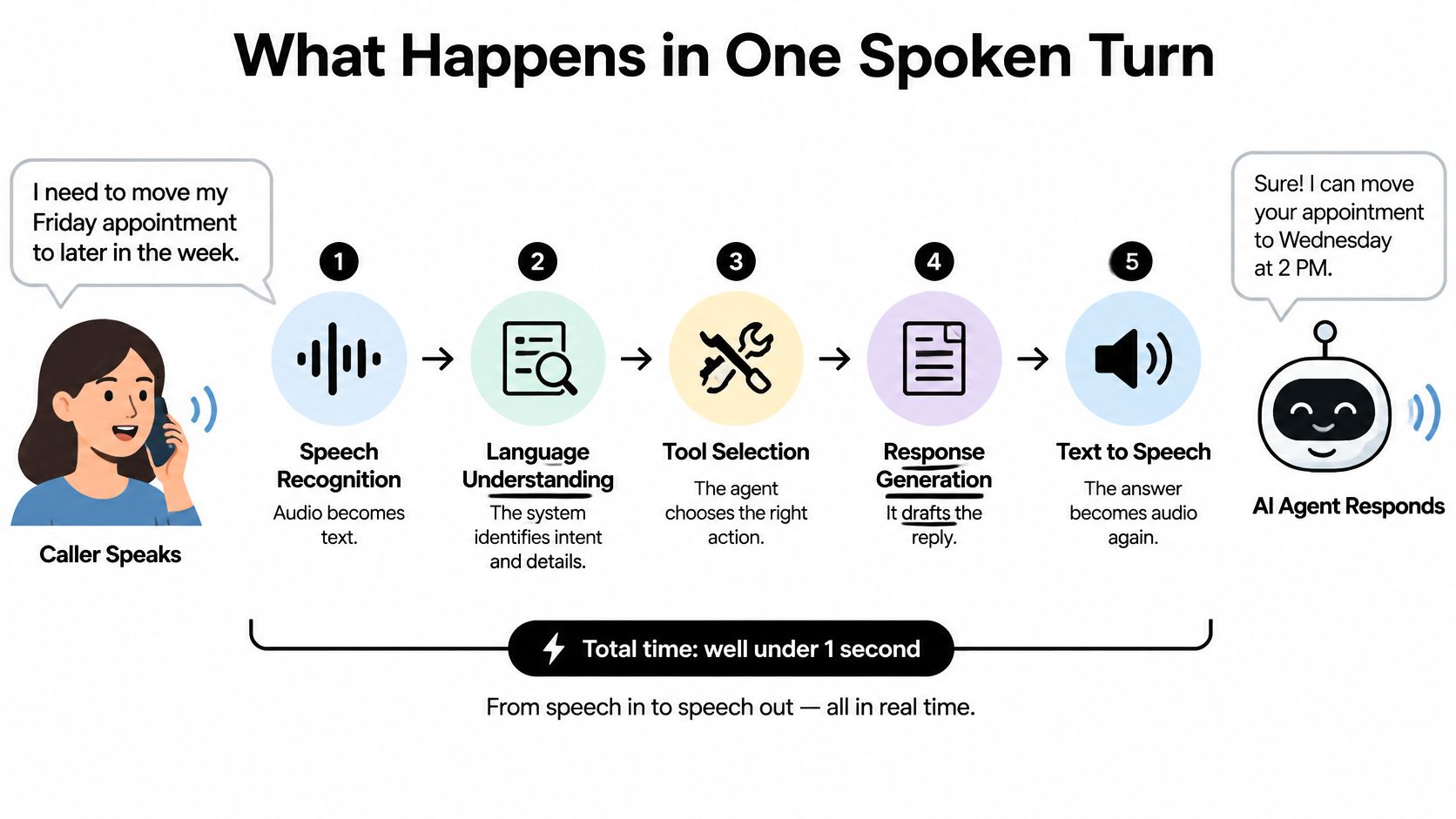
The five stages of one voice AI turn
The speech-recognition history guide describes the underlying progression from recognizing audio to understanding language, choosing a response, and synthesizing speech.
| Stage | What It Does | Example From This Call | Common Failure |
|---|---|---|---|
| Speech recognition (ASR) | Turns audio into the most likely word sequence | Recognizes move my Friday appointment | Mishears names, numbers, and dates |
| Language understanding | Identifies intent, entities, and sentiment | Intent: reschedule; entity: Friday | Misreads an indirect request |
| Dialogue and business logic | Chooses the next action and calls tools | Checks the booking and retrieves Thursday or Monday options for clarification | Calls the wrong tool or invents a policy |
| Response generation | Drafts a reply using confirmed information | Asks which date the caller means | Presents an assumption as a confirmed fact |
| Text-to-speech (TTS) | Synthesizes the reply as audio | Speaks the available appointment options | Flat delivery or slow first sound |
| Orchestration | Streams data between stages and handles interruptions | Stops playback when the caller interrupts | Delays accumulate or outdated work continues |
Orchestration isn't another model. It coordinates the five processing stages, which is why the table has an additional row.
Understanding isn't access
A language model can interpret the transcript and draft the reply, but it can't see your booking system on its own. The application must give it an authorized tool, such as a calendar lookup, and return the actual result.
Think of the model as a receptionist who can read your request but still needs access to the appointment book. Fluent speech doesn't prove that access happened.
Practical rule: Trace a bad call from the transcript onward. Find the first incorrect output before blaming the language model.
How Speech Recognition Turns Sound Into Text
Speech recognition resembles listening through a muffled phone connection. You hear incomplete acoustic clues and use context to distinguish likely words. An automatic speech recognition system, or ASR, performs a computational version of that task.
The recognizer processes short portions of audio and estimates the most likely word sequence using statistical or neural models. It does not match each sound directly to a dictionary entry. Neighboring sounds and sentence context help distinguish phrases that sound alike.
A caller discussing an appointment might say Friday, but a noisy line could make that sound like five thirty. Both interpretations can fit a scheduling conversation. The recognizer has to choose, and its choice influences what the rest of the agent does.
What word error rate measures
Word error rate, or WER, counts substituted, deleted, and inserted words relative to a reference transcript. The ACM paper on speech recognition explains the metric and describes leading systems as generally reporting 5%–20% WER; a 5% WER corresponds to roughly 5 errors per 100 reference words.
That metric treats errors as transcription events, not business consequences. Replacing a filler word and replacing the day of an appointment can each contribute to WER, even though the operational consequences differ.
| Transcript issue | Possible operational consequence | Appropriate response |
|---|---|---|
| Missing a conversational filler | Meaning remains intact | Continue if the request is clear |
| Mishearing a surname | Wrong customer record | Verify against authorized account details |
| Confusing a date | Incorrect appointment | Repeat the full date before committing |
| Changing a digit | Failed or misdirected transaction | Confirm through an appropriate secure flow |
Test the words that matter
Noise, overlapping speakers, microphone quality, accents, and specialist vocabulary all affect recognition. A clean demonstration won't tell you how an agent handles a warehouse worker calling beside machinery or an employee naming an unfamiliar benefits plan.
Use a speech recognition accuracy evaluation to separate overall transcription quality from critical-detail accuracy. Test on recordings representative of your operation, with the necessary permissions and data protections.
Score names, dates, identifiers, and business terminology separately. Give reviewers both the transcript and the resulting action, because an apparently minor recognition mistake may explain a failed call.
How Synthetic Voices Sound Human and How Cloning Works
The calendar has returned an available appointment, and the agent has drafted a confirmation. Turning that text into speech is like turning a musical score into a performance.
The acoustic model prepares the score: an acoustic representation containing information about how the words should sound. A vocoder turns that representation into the waveform the caller hears.
The streaming speech-synthesis paper describes this acoustic-generation and waveform-generation architecture, including how incremental synthesis allows playback before the whole utterance is complete.
Why pronunciation isn't enough
Prosody means the rhythm, stress, pitch, and pacing of speech. It helps distinguish a question from a confirmation and a reassuring reply from an impatient one.
The same appointment sentence can sound tentative or definitive depending on its delivery. Text punctuation provides clues, but it doesn't fully specify the performance. A speech system must infer or receive instructions about the intended delivery.
That's why testing should go beyond whether the voice sounds pleasant:
- Listen to complete replies. A convincing greeting doesn't prove that a long explanation has sensible pacing.
- Check names and numbers. Dates, abbreviations, account references, and unfamiliar names expose pronunciation problems.
- Test emphasis. The important distinction between available and unavailable shouldn't disappear in flat delivery.
- Try an interruption. Confirm that playback stops promptly rather than finishing an obsolete answer.
Streaming and cloning solve different problems
Conventional sentence-level synthesis waits for a complete utterance. Streaming TTS generates audio incrementally once it has enough linguistic context, so the caller can hear the beginning while later audio is still being produced.
For operations teams, time to first audio is more useful than total synthesis duration. Generating a long reply quickly doesn't help if the caller waits in silence before hearing anything.
Voice cloning changes speaker identity rather than the underlying purpose of synthesis. A speaker embedding or reference recording conditions generation so that new words resemble a particular speaker's voice.
A useful voice cloning technology overview should distinguish identity reproduction from conversational competence. Cloning a voice doesn't make the agent better at checking bookings or following policy.
Obtain the speaker's explicit permission and document the authorized uses. A recognizable voice is an identity asset, not merely a design choice.
Why Latency Decides Whether a Conversation Feels Natural
A production pipeline reduced median end-to-end latency from 3,277 ms to 1,909 ms, a 41.8% improvement across 30 sessions, by running intent detection and TTS concurrently, according to the voice-pipeline orchestration paper.
The gain came from removing waits between steps. A caller experiences latency the way a diner experiences a slow kitchen pass: each station can be quick and the meal still arrives late if every plate waits for the previous one to clear.
In a strictly sequential system, the recognizer finishes, the language model starts, the application retrieves information, and the synthesizer waits for its input. Network transport adds more waiting between services. Optimizing only the language model leaves those other delays untouched.
Latency and timing reference points
| Measurement | Reference Value | Setting | What It Means |
|---|---|---|---|
| Median end-to-end latency, sequential versus concurrent | 3,277 ms versus 1,909 ms | Production voice pipeline, 30 sessions | Overlapping intent detection and TTS reduced waiting |
| Streaming TTS, time to first audio | Lower startup is better; playback begins while later audio is generated | Streaming synthesis | Callers judge the pause before speech, not total generation time |
| Streaming TTS, time to first byte | A small startup value can still sit inside a slow full turn | Controlled synthesis tests | Synthesis start excludes understanding the caller or waiting on a business system |
| Streaming ASR chunk size | Shorter chunks respond sooner; longer chunks finalize with more context | Streaming recognition | Recognition context and transcript finalization must be balanced |
These measurements describe different boundaries and test conditions. They aren't interchangeable service guarantees, and an average can hide uneven waits: one caller hears a quick answer while another stalls during a slow account lookup.
For a practical explanation of what latency means, start with the caller's experience: the interval between finishing a request and hearing a useful response. Then instrument the internal boundaries that contribute to it, including recognition finalization, model start, tool calls, playback startup, and network transport.
Overlap safe work, not irreversible actions
A partial transcript can indicate that a caller wants to reschedule before the sentence is finished. The system can begin retrieving relevant booking information while continuing to listen.
That early work has limits. Partial hypotheses can change, so prefetching a record is different from committing a transaction. The safe rule is simple: prepare reversible work early, and keep irreversible actions behind confirmation.
Endpointing carries the same trade-off in miniature. Larger audio chunks give recognition models more context but delay finalization, while shorter chunks improve responsiveness and create additional accuracy and processing trade-offs.
Endpointing decides when the caller has finished, using silence and language context. Set it too aggressively and the agent cuts off someone pausing to remember a date; set it too cautiously and the caller hears dead air.
Barge-in detection handles the opposite direction: the caller begins speaking during playback. Tune both behaviors on representative calls, and verify that canceled speech doesn't leave an outdated action running.
Measure the caller's wait, then inspect every boundary that contributed to it. A fast model can still sit inside a slow conversation.
Stitched Pipelines Versus Single-System Voice Models
There are different ways to assemble these capabilities. A stitched pipeline connects separate recognition, language-model, and synthesis services. A single-system voice model processes incoming and outgoing audio within an integrated architecture.
The distinction is about engineering control, not whether one design is intelligent and the other isn't. Both still need business integrations, permissions, and operational monitoring.
This comparison shows the architectural choice.
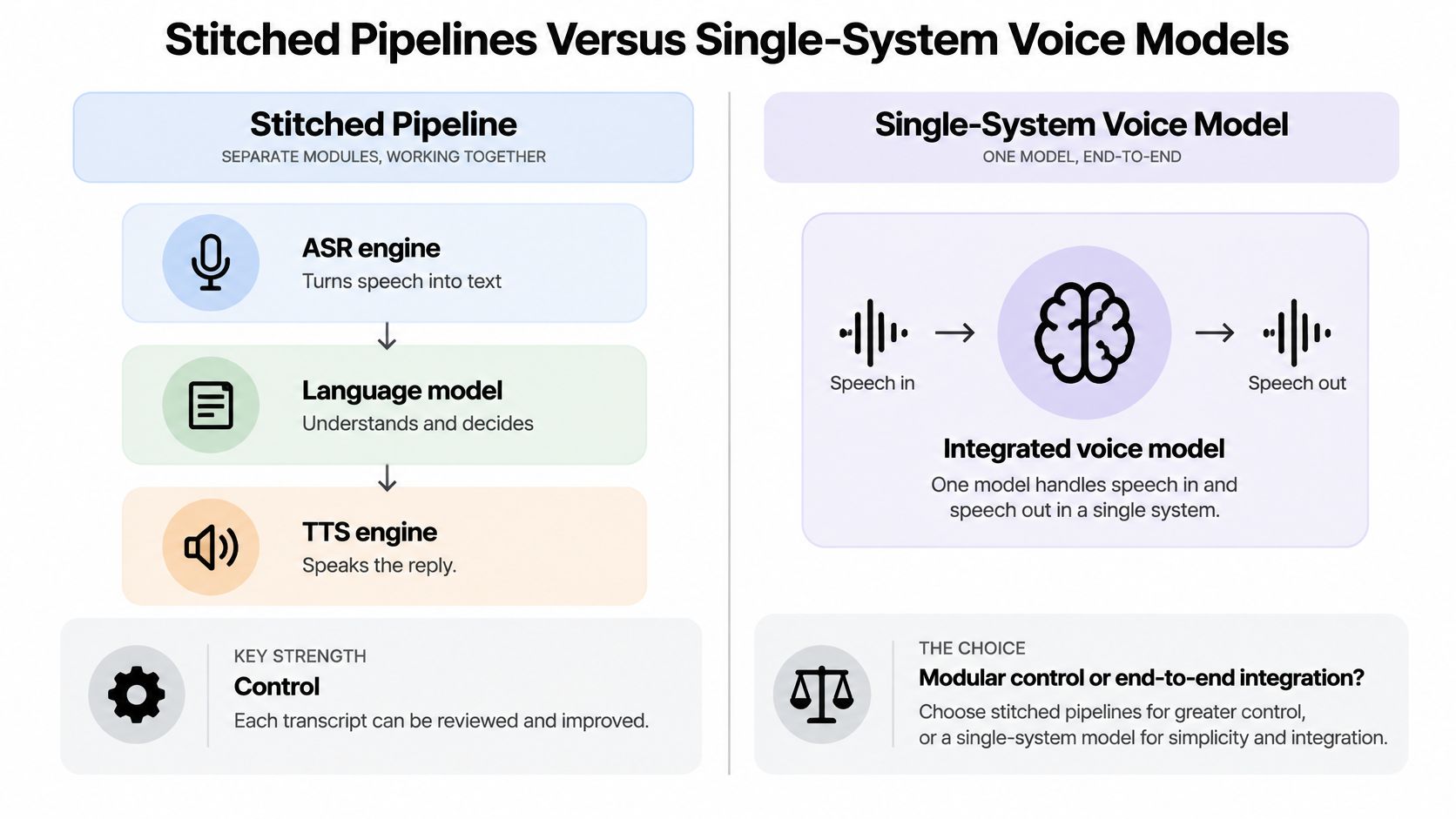
Stitched pipeline versus single-system voice model
| Criterion | Stitched Pipeline | Single-System Model |
|---|---|---|
| How it is built | Separate ASR, language-model, and TTS services | One integrated model maps incoming audio to outgoing audio |
| Debugging | Inspect transcripts and intermediate outputs | Internal causes can be harder to isolate |
| Latency | Service handoffs add coordination overhead | Fewer handoffs can reduce overhead |
| Changing a part | Replace a component, then test it and its downstream effects | A model change generally requires broad regression testing |
| Tone and interruptions | Text alone omits acoustic cues unless they're passed separately | Can retain prosody and turn-taking information |
| Policy checks | Explicit checkpoints can sit between interpretation and action | Requires deliberate action interfaces and external enforcement |
| Best fit | Workflows prioritizing inspectable transaction control | Conversation-led experiences prioritizing vocal continuity |
Choose what you need to prove
A stitched design makes intermediate artifacts easier to inspect. If the agent offers the wrong appointment, an engineer can compare the transcript, extracted date, tool request, returned availability, and spoken answer.
Its weakness is the handoff between services. Engineers must preserve context, cancel obsolete requests, and keep the components synchronized. Text-only interfaces also omit hesitation and emphasis unless the application carries those signals separately.
A unified model can use richer audio context, but integrated doesn't mean automatically auditable. You still need records of authorized actions and a clear account of what the model received.
For another workflow-oriented explanation, SnapDial's guide to how voice AI agents work connects spoken interaction with the business tasks an agent performs.
The accompanying video offers another way to visualize the design choice.
A regulated bank may favor explicit stages so deterministic authorization checks sit before transactions. A consumer conversation app may place greater weight on expressive speech and continuity.
Neither choice eliminates external safeguards. The deciding question is how much you must inspect and prove at each step, including what happens when the model gets something wrong.
Why Accents, Dialects and Languages Change Results
A contact center reports a recognition score its vendor calls excellent. Yet callers from one region repeat their account number three times before the agent responds, and some hang up and dial again later. Both things are true at once, and that is the trap in average accuracy.
Recognition quality depends partly on how closely a caller's speech resembles the language varieties represented during training. Vocabulary, pronunciation, grammar, and code-switching all change the task. A caller who moves between two languages inside a single request crosses exactly the boundary where models trained on single-language audio tend to stumble. Research in the Journal of Sociolinguistics documents uneven recognition across language varieties, so the same system can serve one caller group well and another poorly.
An aggregate score works like a class average: it can look healthy while a few students fail every quiz. The largest caller group dominates the math, so the number celebrated in a quarterly review may describe the callers who needed the least help. The segment-level gap is where callers repeat themselves, where automation fails, and where trust erodes first.
Measure outcomes by caller segment
Build a test matrix around the people your operation serves:
- Language and dialect. Include regional varieties rather than treating a language label as a complete test category.
- Accent group. Use representative speakers without assuming nationality predicts pronunciation.
- Channel conditions. Test noisy lines, speakerphones, and weak microphones, because a caller on a bus gives the recognizer a harder signal than a caller at a desk.
- Code-switching. Test callers who naturally move between languages within a request.
- Speech accessibility. Include callers with speech impairments and provide alternatives when voice interaction becomes difficult.
For each segment, track WER, containment, and repeat-contact rate. Containment means the interaction stays within automation, and it is only useful when the caller's issue is resolved. Repeat contacts expose the subtler failure: the system appeared to finish but never solved the problem.
Language availability is a coverage claim. Equal resolution quality requires evidence from the people using the service.
Set confidence thresholds around critical details such as account numbers and dates, review failed transcripts by segment rather than in aggregate, and keep a human easy to reach. A caller who fails recognition twice should reach a person, not a third attempt built to protect a metric.
Checklist Before Deploying Voice AI in Your Operation
Live failures extend beyond misheard words. An agent can call the wrong tool, invent a policy, lose transaction state during an interruption, accept weak authentication, or proceed without appropriate consent.
The Meticulous Research voice AI outlook summarizes these deployment barriers and notes that Consumer Reports' 2025 assessment found most of six tested voice-cloning products lacked meaningful safeguards against fraud or misuse; it also identifies the EU AI Act's Article 50 framework for machine-readable synthetic-audio marking and professional deployers' deepfake disclosures.
Treat regulatory applicability as a legal review question, not a feature checkbox. Your team must determine which duties apply to the specific call flow and jurisdiction.
The deployment checklist starts with the failures callers would experience.
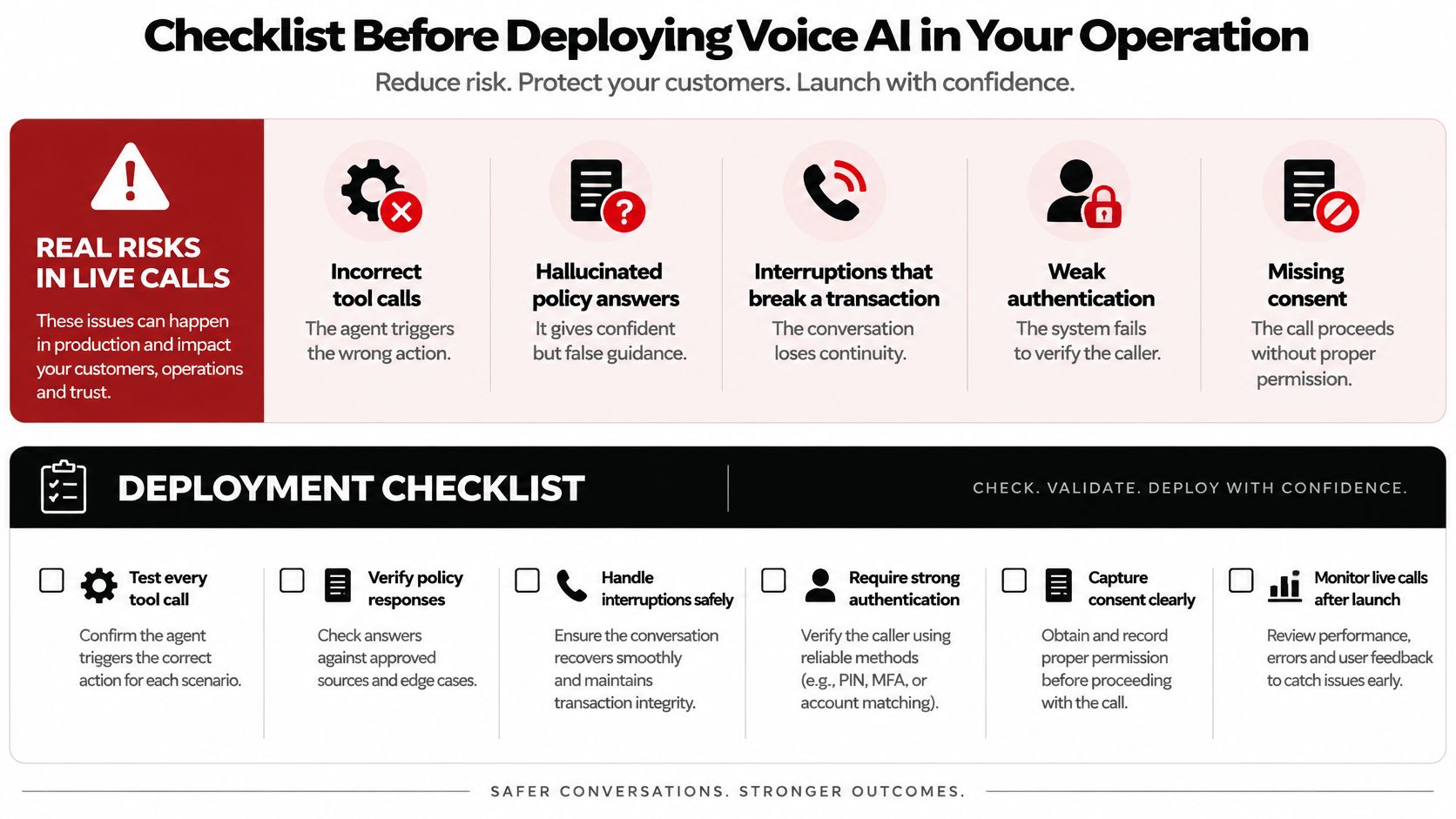
Verify the operational controls
- Set a latency budget for each stage. Alert on time to first audio and investigate slow calls, not just typical ones.
- Test barge-in under realistic conditions. Confirm that interruptions cancel obsolete playback without corrupting the conversation or transaction state.
- Put deterministic checks before transactions. Validate identity, eligibility, required confirmation, and allowed values outside the model's generated reply.
- Authorize every tool. Restrict access by task and user, validate arguments, and prevent duplicate submissions when requests are retried.
- Keep auditable records. Record what was heard, which model acted, what information it used, the tool results, and whether required consent was captured. Apply access controls and retention limits.
- Add provenance or watermarking where appropriate. Verify that the chosen mechanism survives the intended audio-processing and delivery path.
- Define a contextual human handoff. Pass the issue, verified details, attempted actions, and unresolved questions so the caller doesn't have to start again.
- Test continuously by scenario and risk. Include unavailable systems, contradictory requests, policy exceptions, and interrupted transactions.
Start with a bounded pilot
Yellow.ai's Nexus VOX is one option for agents that answer, act, and resolve calls. Our AI agents can automate routine queries and transfer complex queries to live agents with context.
Our Voice and Text Services aren't intended to be relied upon as a compliance tool and are provided without warranties of fitness for a customer's compliance purposes. Compliance review remains with your team.
Pick a low-risk appointment flow, run these checks before launch, and review pilot transcripts weekly. Approve expansion only when the agent's actions, failure handling, and caller outcomes meet your acceptance criteria.
Yellow.ai offers voice agents that connect spoken conversations with real-time business actions and contextual human handoffs. Visit Yellow.ai to explore a bounded pilot, bringing a representative call flow, its required integrations, and your safety and resolution criteria.