













The surprise isn't that voice cloning technology sounds more human now. It's that it has crossed the line from specialist capability to enterprise infrastructure. One market estimate put the global AI voice cloning market at USD 1.92 billion in 2023 and projects USD 9.75 billion by 2030, a 26.1% CAGR over that period, according to Grand View Research's AI voice cloning market report.
That matters less as a market headline and more as a strategic signal. Large enterprises don't standardize around a capability unless it can be deployed repeatedly across channels, brands, geographies, and operating models. Voice cloning technology is moving into that category because it solves a real operational problem: how to deliver scalable, branded, natural voice interactions without rebuilding every audio workflow from scratch.
Table of Contents
- The Shift from Novelty to Enterprise Necessity
- How Modern Voice Cloning Actually Works
- Driving Value Across CX and EX Use Cases
- Navigating Enterprise Security and Compliance
- Evaluating and Selecting a Voice Cloning Vendor
- Your Enterprise Implementation Roadmap
- The Future of Agentic Voice Interfaces
The Shift from Novelty to Enterprise Necessity
The old mental model treats voice cloning as a demo feature. The current operating reality is different. Enterprises now use it as a reusable voice layer for customer service, employee support, outbound notifications, accessibility, and multilingual interactions.
What changed is not only model quality. It's the business shape of the technology. Voice can now be designed, governed, and deployed like any other enterprise asset. That puts it in the same strategic category as orchestration, knowledge systems, analytics, and conversational design.
Why boards and CIOs should care
A cloned voice isn't valuable because it sounds impressive. It's valuable because it gives teams a way to standardize how the company sounds wherever speech is part of the workflow. That includes contact centers, self-service flows, internal support desks, onboarding journeys, and automated updates.
For CIOs, that shifts the question from “Should we experiment?” to “Where should this sit in the stack, and who governs it?”
For Heads of CX, the decision is even more immediate. If chat became the standard interface for digital support, cloned voice is becoming the standard for audio interactions that need to feel branded, consistent, and available at scale.
Practical rule: Treat voice cloning technology as part of your channel architecture, not as a campaign asset owned by a single team.
The enterprise pattern is familiar
This pattern shows up every time AI matures. A capability first appears as a novelty, then teams discover that true value comes from operational reuse. Product leaders have already seen this happen across planning, experimentation, and workflow design in adjacent disciplines like artificial intelligence in product management, where the winning organizations don't just adopt AI tools. They redesign decision systems around them.
Voice is on the same path.
A mature enterprise deployment doesn't ask one narrow question such as whether the voice sounds close enough to a speaker. It asks broader ones:
- Can this voice be reused safely across channels and regions?
- Can legal and security teams approve it without creating exceptions every quarter?
- Can operations teams update prompts, policies, and routing without retraining everything?
- Can the business measure impact in service quality, containment, employee adoption, and brand consistency?
What stops companies from moving
Most hesitation is rational. Leaders worry about consent, spoofing risk, uneven audio quality, latency, and integration complexity. Those concerns are valid. But they are no longer reasons to ignore the category. They are reasons to evaluate it with discipline.
The companies that move well in 2026 won't be the ones with the flashiest demo. They'll be the ones that treat voice cloning technology as an enterprise program with clear ownership, narrow first use cases, and strong controls from day one.
How Modern Voice Cloning Actually Works
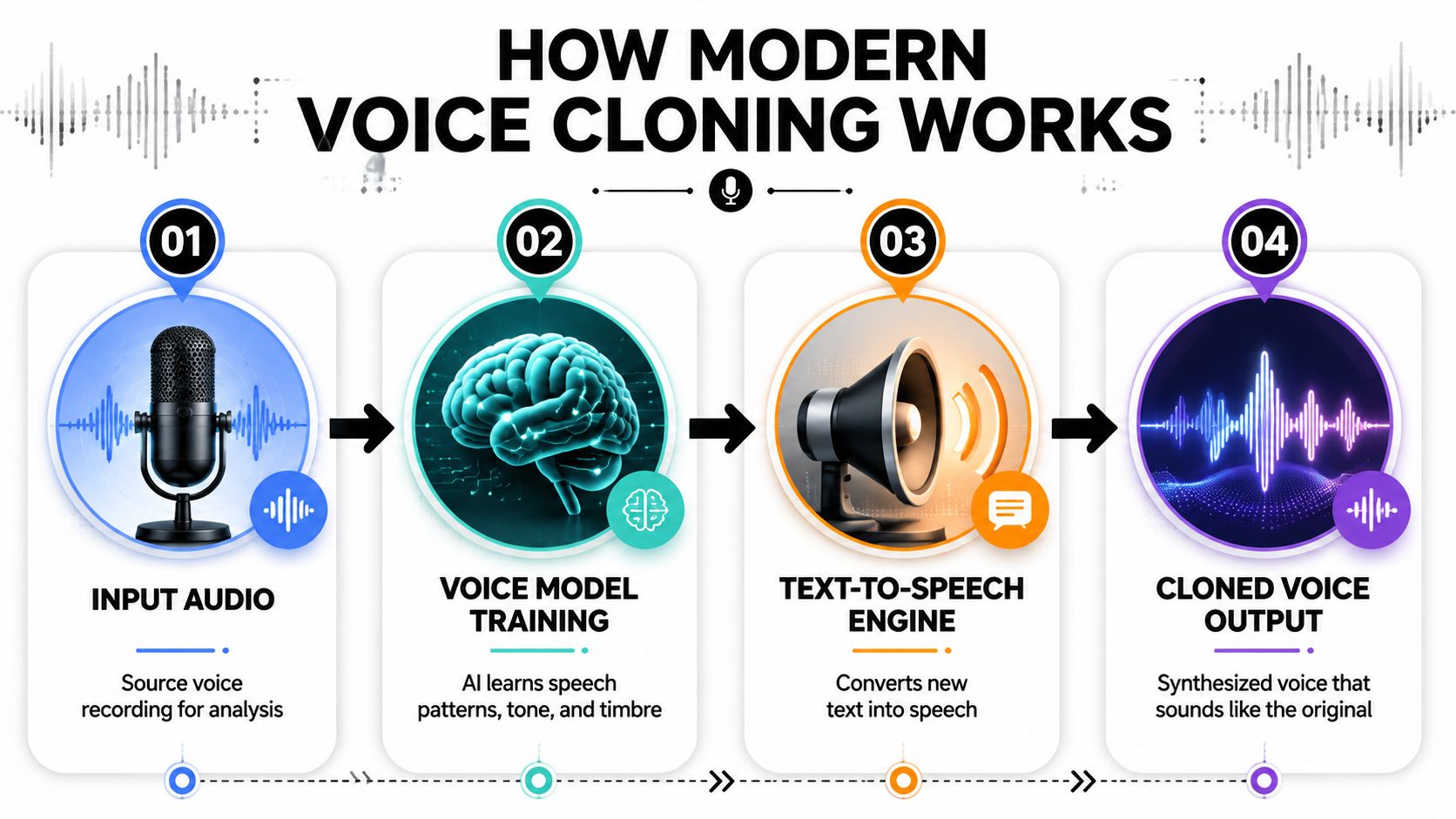
At a high level, modern voice cloning technology separates what is being said from who it sounds like is saying it. That separation is the breakthrough that made deployment practical for enterprises.
The simplest way to think about it is this: the system creates a vocal blueprint for a speaker, then uses that blueprint when generating new speech from text. The text provides the content. The voice model provides identity, tone, and style.
The core components in plain language
Most enterprise systems combine three layers.
First, a text-to-speech engine converts written text into a phonetic and prosodic plan. In plain terms, it decides how the words should be spoken.
Second, a speaker representation captures vocal identity. This is often described as a speaker embedding. It encodes features like timbre, cadence, and vocal character without requiring a full rebuild of the model for each new speaker.
Third, a vocoder or waveform generator turns that representation into audible speech. This is the stage that produces the final sound file or real-time stream.
If you're evaluating vendors, this matters because quality problems can come from different places. A robotic result may be caused by weak prosody planning, poor speaker capture, or audio synthesis artifacts. Teams often blame “the model” in general when the issue sits in one layer.
Why short audio samples can work
The barrier dropped sharply once systems could clone from much less audio. The FTC noted that modern AI voice cloning became accessible because of improvements in text-to-speech engines, and that many systems are commercially available or open sourced. The same FTC discussion also describes zero-shot cloning from seconds of reference audio and few-shot cloning with roughly 5 to 30 minutes of audio, as covered in the FTC analysis of AI-enabled voice cloning.
That changes enterprise deployment in two ways. It lowers onboarding friction for approved voices, and it raises governance pressure because short public audio clips may be enough for misuse if controls are weak.
The strategic issue is no longer whether a model can imitate a voice. It's whether your organization can control who is allowed to create, store, and deploy one.
Zero-shot versus fine-tuned deployment
These modes are not interchangeable.
- Zero-shot cloning: Best for fast prototyping, limited pilots, or situations where teams need a usable voice quickly from a small reference sample.
- Few-shot cloning: Better when a business needs stronger consistency across broader utterance sets, accents, or speaking conditions.
- Fine-tuned voice models: Useful when fidelity matters enough to justify a more controlled recording and training workflow.
The trade-off is straightforward. Faster setup usually means more edge cases in pronunciation, emotion, or style consistency. More audio and tighter curation usually improve quality, but they also increase production effort and approval complexity.
What leaders should ask technical teams
A useful executive conversation isn't about neural architectures. It's about operating characteristics.
Ask these questions instead:
- How much audio is needed for acceptable versus high-fidelity output?
- What happens with unseen phrases, uncommon names, or product terminology?
- How does the system handle latency in live conversations?
- Can the same voice operate across languages without sounding unstable or off-brand?
- What controls exist around who can generate, export, or publish synthetic audio?
Those questions move the discussion from lab performance to deployment readiness.
Driving Value Across CX and EX Use Cases
The strongest business cases for voice cloning technology don't come from novelty use cases. They come from moments where enterprises already depend on voice but struggle with consistency, speed, or scale.
In customer experience, the gap is usually between what the brand wants to sound like and what customers hear across IVRs, virtual agents, callbacks, and service workflows. In employee experience, the gap is between static systems and support interactions that feel usable enough for people to adopt.

Customer experience where voice becomes a brand asset
Consider a typical enterprise contact flow. The IVR sounds generic. The self-service bot sounds different from the mobile app. Outbound reminders use another voice entirely. The customer hears fragmentation, even when the process design is solid.
A cloned brand voice fixes that at the system level. It gives teams one approved sonic identity that can be reused across service points.
Common CX patterns include:
- Branded self-service: Use one approved voice across inbound service flows so the customer doesn't move from polished marketing to generic support audio.
- Personalized notifications: Deliver reminders, order updates, appointment changes, and account alerts in a voice designed for clarity and trust.
- Training simulations: Create more realistic customer scenarios for agent coaching, QA drills, and escalation practice.
Teams exploring broader voice automation often start with journey design rather than cloning itself. That's why resources on enterprise voice automation are useful during planning. They help leaders map where synthetic voice adds value and where a standard TTS voice is enough.
Employee experience where consistency matters more than novelty
EX teams often underuse voice because producing and updating audio content has been slow, fragmented, or expensive. Voice cloning changes that economics.
A cloned executive or approved corporate voice can support internal communications, but the bigger opportunity usually sits elsewhere:
- IT helpdesk assistants that handle common support requests in a steady, easy-to-understand voice
- HR onboarding guides that talk employees through policy questions, enrollment steps, and orientation workflows
- Operations support agents that provide hands-free assistance in environments where employees can't stop to read a screen
Operational insight: In EX deployments, the most successful voices aren't always the most human-like. They're the ones employees can understand quickly, trust, and hear repeatedly without fatigue.
What works and what doesn't
What works is narrowing the voice role to a clear operational job. A service voice should sound appropriate for support. A training voice should optimize for clarity. A high-emotion brand campaign voice may not fit either context.
What doesn't work is trying to clone voices because the technology allows it. Enterprises create avoidable friction when they clone senior leaders for routine workflows that would be better served by a neutral, approved synthetic voice. Voice choice is a design decision, not a prestige decision.
Navigating Enterprise Security and Compliance
Voice cloning creates a sharp split between opportunity and risk. The same capability that lets an enterprise deliver a consistent branded experience can also be misused for impersonation, social engineering, or unauthorized content generation. That means governance can't be bolted on after deployment.
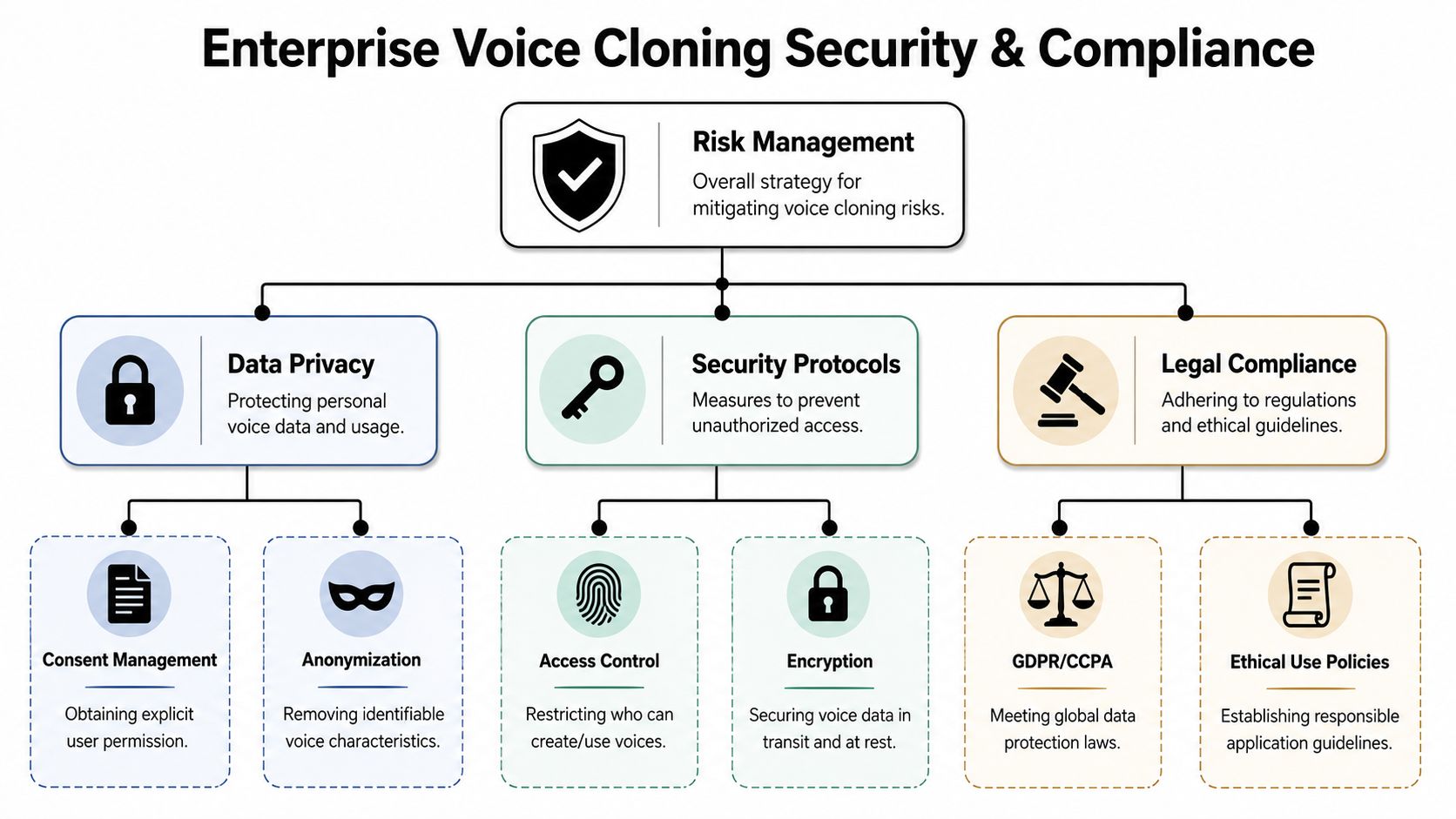
The operating model needs three pillars: consent, technical controls, and verifiable compliance.
Start with explicit consent and clear usage boundaries
A voice is personal data in practical terms, even when organizations frame it as a media asset. Enterprises need explicit permission to collect, model, store, and deploy it. They also need to define what the voice may and may not be used for.
That policy should answer concrete questions:
- Who approved the voice creation
- Which channels can use it
- Whether it can be used for external communications
- How long the voice model is retained
- What happens if the speaker leaves the organization or revokes permission
The FTC has warned that voice cloning has become easy to access because many systems are commercially available or open sourced, and because convincing replicas may be created from very small amounts of audio, as discussed in the earlier technical section. That ease of access is exactly why internal authorization must be more formal than a casual recording approval.
Build security around misuse scenarios, not generic AI policy
A generic AI policy won't cover the actual threat model. Security teams should design controls around misuse paths specific to synthetic voice.
That includes:
- Access restrictions: Limit who can create, edit, export, or deploy voice models.
- Environment separation: Keep development, testing, and production voice assets distinct.
- Approval workflows: Require named approval before a cloned voice goes live on any channel.
- Auditability: Log who generated audio, when they generated it, and where it was published.
- Encryption and storage controls: Protect voice data at rest and in transit as a sensitive asset.
For teams building a broader governance framework, visual resources on managing AI risks and compliance can help align legal, security, and operations stakeholders around the same control language.
A platform's security stance also matters. During procurement, teams should review the provider's approach to enterprise-grade security for conversational AI deployments and check whether those controls map to internal policy, not just vendor marketing.
Here's a useful primer for non-technical stakeholders before design reviews:
Compliance needs to be testable
In regulated sectors, “we take security seriously” is meaningless. Compliance has to be demonstrated through controls, documentation, and operating discipline.
A practical review should cover whether the platform and the deployment model support expectations tied to standards and frameworks such as:
| Area | What enterprise teams should verify | Why it matters |
|---|---|---|
| Privacy governance | Data handling terms, retention logic, deletion workflows | Voice assets may require tighter lifecycle management than standard audio |
| Security assurance | Independent audits, control evidence, incident processes | Synthetic voice creates impersonation and misuse risks |
| Regulated operations | Whether deployment patterns fit healthcare, finance, or other controlled environments | Voice interactions often touch sensitive workflows |
Governance fails when legal signs off on the contract, but no one defines who can press “generate.”
Evaluating and Selecting a Voice Cloning Vendor
Vendor selection usually goes wrong in one of two ways. Some teams buy on demo quality alone. Others over-index on procurement checklists and never test whether the voice performs under real conversational conditions.
A better evaluation combines audio quality, runtime behavior, integration fit, and governance maturity.
The criteria that matter in practice
Naturalness is necessary, but it isn't enough. The right voice in a staged demo can still fail in production if it struggles with response timing, pronunciation variability, or channel integration.
Use this checklist during evaluations.
| Criterion | What to Look For | Why It Matters |
|---|---|---|
| Voice quality | Natural pacing, stable pronunciation, low artifacting, consistent tone across utterances | Customers notice instability faster than teams expect |
| Speaker similarity | Whether the generated voice remains recognizably aligned to the approved source voice | Brand and trust depend on consistency |
| Latency | Real-time responsiveness in live conversations, not just batch generation | Even good audio feels broken if responses arrive too slowly |
| Multilingual support | How the voice performs across target languages and accents | Global deployments need one governance model, not many fragmented ones |
| Customization controls | Ability to manage style, pacing, and pronunciation rules | Enterprise deployments need repeatability |
| Integration readiness | APIs, connectors, event handling, compatibility with CRM and contact center systems | A strong model is useless if orchestration is painful |
| Security posture | Access control, audit logging, data protection, admin roles | Voice assets require strict operational control |
| Governance features | Consent workflows, publishing approvals, asset lifecycle management | These determine whether security can scale |
| Scalability | Reliability under production traffic and multiple business units | Pilots don't reveal all operational limits |
| Commercial flexibility | Contract terms, deployment options, support model | Voice often expands faster than the original use case |
Questions worth asking in the pilot
A pilot should stress the system, not flatter it.
Ask vendors to demonstrate how their platform handles:
- Hard names and domain terms like product SKUs, medical vocabulary, or financial entities
- Channel switching between inbound, outbound, and embedded workflows
- Fallback behavior when the model is uncertain
- Administrative controls for approvals, role-based access, and voice retirement
- Architecture flexibility if your enterprise wants to avoid lock-in across AI components
Some platforms position voice cloning inside a wider agent stack. For example, Yellow.ai offers voice AI, orchestration, and a multi-LLM architecture within one enterprise platform. That may fit organizations trying to reduce integration sprawl. Others may prefer a more specialized provider and stitch components together themselves.
For procurement teams that need a broader decision framework, a structured buyer's guide to evaluating conversational AI solutions is useful because voice usually sits inside a larger automation decision, not as a standalone purchase.
Don't ask which vendor has the most impressive sample. Ask which vendor your operations team can still manage cleanly a year after rollout.
Common selection mistakes
The most common mistake is ignoring operational ownership. If no one owns voice policy, pronunciation governance, and publishing controls, the vendor choice won't save the program.
The next mistake is testing only with polished scripts. Enterprises should test messy, real inputs. Support conversations are full of interruptions, brand names, acronyms, and uneven context. If a platform only sounds good in ideal conditions, it isn't enterprise-ready.
Your Enterprise Implementation Roadmap
A strong implementation starts before a single audio sample is recorded. Voice cloning technology touches brand, legal, security, operations, CX design, and platform architecture. If one of those functions joins late, the project slows down or gets redesigned midstream.
The cleanest rollouts move in phases, with a narrow initial use case and a clear owner.
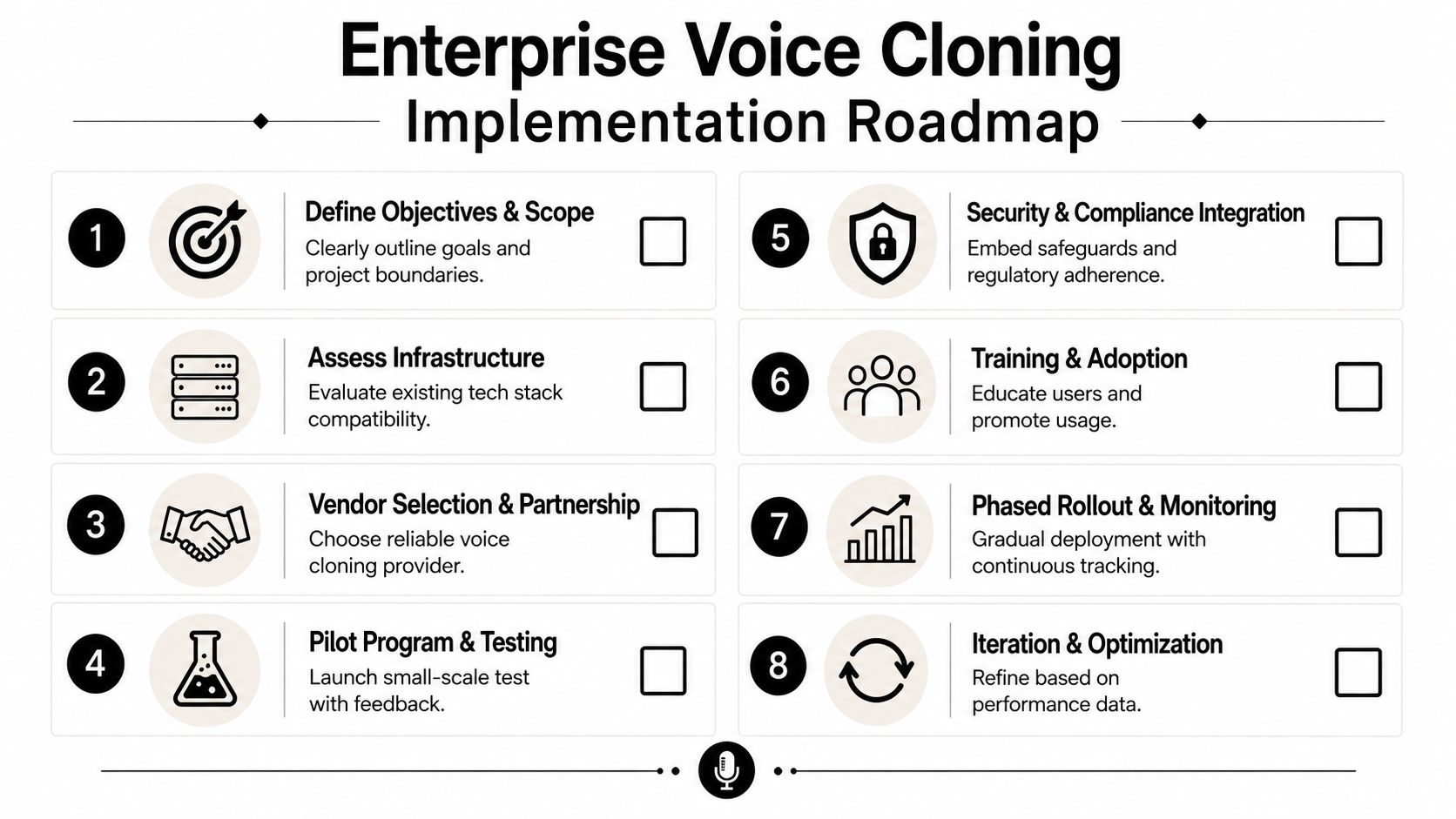
Phase one aligns business value and governance
Start with one question: where does synthetic voice remove friction that the business already pays for?
Good first use cases tend to share three traits. They have repeatable dialogue patterns, clear governance boundaries, and obvious process ownership. A branded self-service flow, internal helpdesk assistant, or outbound notification workflow usually fits better than a broad omnichannel transformation on day one.
Before technical work begins, lock down:
- Use case scope
- Voice ownership
- Consent and approval path
- Success criteria
- Channels included in the pilot
Phase two gets the audio right
Poor source audio creates avoidable problems later. High-quality voice cloning depends heavily on clean, consistent recordings. Best-practice guidance recommends 20 minutes of audio recorded at 48 kHz/24-bit in a quiet environment, with a noise floor below -60 dB, according to Inworld's voice cloning best practices.
That guidance matters operationally because audio cleanup is not a minor detail. If the training data includes room noise, mic inconsistency, clipping, or uneven loudness, the model captures those flaws along with the voice.
A practical collection checklist:
- Use a controlled environment: Keep room noise low and recording conditions consistent.
- Record varied phrasing: Include names, domain terms, and sentence types the deployment will need.
- Avoid mixed microphones: Switching hardware often creates inconsistent source characteristics.
- Document rights clearly: Every recording set should carry explicit approval and usage metadata.
Clean audio reduces downstream argument. Teams spend less time debating whether the model is weak when the source material is solid.
Phase three pilots with production realism
Don't make the pilot too safe. If the use case will eventually serve customers or employees in real time, test with realistic prompts, interruptions, and edge cases.
The pilot should answer:
- Does the voice hold up over repeated use?
- Do users trust it in context?
- Where does pronunciation break down?
- How do latency and routing affect perceived quality?
- Can supervisors and admins manage it without engineering support?
This is also where integration complexity shows up. Contact center platforms, CRM workflows, authentication steps, knowledge retrieval, and analytics all affect the experience more than the cloned voice alone.
Phase four scales through operations, not enthusiasm
Once the pilot works, expansion should follow operating readiness, not internal excitement.
Scale only when the team has:
| Readiness area | What good looks like |
|---|---|
| Governance | Approved voice policy, retention rules, named owners |
| Operations | Publishing workflow, rollback path, support playbooks |
| Measurement | Agreed KPIs for quality, adoption, and business outcomes |
| Integration | Stable handoffs to existing enterprise systems |
The organizations that succeed don't treat rollout as a launch event. They treat it as a managed service. Pronunciations get tuned. Prompts evolve. Security roles tighten. Use cases expand when the control model proves durable.
The Future of Agentic Voice Interfaces
Voice cloning technology is not the destination. It is the interface layer for something bigger: software that can converse, decide, and act across enterprise systems with far less friction than today's app-by-app workflow model.
That matters because most enterprise processes are still interaction-heavy. Customers explain problems. Employees ask for help. Agents verify, route, update, and follow up. A high-quality synthetic voice becomes powerful when it is attached to an agent that can also retrieve knowledge, trigger workflows, complete tasks, and hand off intelligently.
Why voice becomes the control surface
In many environments, voice is the fastest interface available. It's natural in service, useful in field operations, and easier than navigation-heavy screens for many routine interactions. When paired with agentic systems, voice stops being a presentation layer and becomes a control surface for enterprise action.
The strategic implication for leaders is straightforward. If your organization wants autonomous systems that employees and customers will readily use, the interaction model can't feel mechanical, fragmented, or hard to trust. Voice quality is part of that trust equation.
What mature enterprises will build next
The next wave won't be “talking chatbots” with better audio. It will be governed, task-capable voice agents embedded in real operating environments.
Expect the strongest enterprise deployments to focus on:
- Approved voice identities tied to business roles
- Task execution across contact center, CRM, HR, and back-office systems
- Multilingual consistency without rebuilding experiences market by market
- Governed autonomy where voice interactions are observable, auditable, and adaptable
The organizations that get ahead won't treat voice cloning as a content trick. They'll use it to make digital labor more usable.
If you're planning enterprise voice AI, the next step isn't another demo. It's choosing a platform that can connect cloned voice, orchestration, security, analytics, and deployment controls in one operating model. Yellow.ai is built for that kind of rollout across CX and EX environments.




