










Only about 5% of contact centers achieve world-class first contact resolution, according to the benchmark commentary summarized by Firstsource. That makes a strong FCR score worth investigating, not just celebrating. Did the customer's problem disappear, or did the ticket disappear from the queue?
For CX and operations leaders, the distinction matters more than the headline percentage. A useful measurement system separates customer-confirmed resolution, completed work, repeat contacts, and unresolved abandonment. It never treats bot containment or an agent's closure decision as proof that the customer is finished.
Table of Contents
- What Counts as First Contact Resolution
- Measure the Four FCR Numbers Instead of One
- FCR Benchmarks by Reason for Contact
- Why the First Interaction Changes Satisfaction and Cost
- Root Causes That Keep Resolution Incomplete
- Contact Paths That Raise or Fake FCR
- Raise True Resolution on Purpose
What Counts as First Contact Resolution
First contact resolution, also called first-call resolution, is the share of issues fully solved in the initial interaction with no repeat contact, transfer, escalation, callback, or follow-up.
The basic calculation is straightforward:
FCR = Contacts resolved on first contact ÷ Total contacts in the period × 100
The numerator is where teams disagree. A completed transaction belongs there; a promise to complete it later doesn't. Keep the reporting population consistent, and don't remove difficult contacts to make the percentage look better.
Apply the same outcome rules
Tag contacts against an explicit outcome table before comparing agents, channels, or automation. A closed status is an administrative event, not independent evidence of resolution.
Which outcomes count as first contact resolution
| Outcome | Counts as FCR | Why |
|---|---|---|
| Issue solved in the first interaction, no later contact | Yes | Customer need completed with no rework |
| Email or async case resolved within one business hour | Yes, under the declared convention | Emerging service-desk convention for non-live channels |
| Transfer to another agent or queue | No | The first interaction did not finish the job |
| Callback or scheduled follow-up | No | Resolution was deferred |
| Escalation to another team or specialist | No | First handler could not complete the workflow |
| Repeat contact on the same intent inside the window | No | The original contact failed |
| Reopened case | No | Closure did not hold |
| Bot answers then customer still needs a human | No | Containment is not resolution |
| Customer abandons or goes silent | No | No completed outcome is established |
| Customer switches channel and the need survives | No | Resolution must hold across the switch |
| Issue needs a second department to finish | No | Helpful initial service didn't complete the need |
The MetricNet service-desk measurement guide describes the emerging email convention of resolution within one business hour and reports worldwide average net FCR of approximately 74%. Treat the timing convention as a documented measurement choice, not permission to count an unanswered email as resolved.
Validate closure after the interaction
Combine immediate signals with later outcome checks. Capture conversation closure, transaction completion, and transfer status, then match subsequent contacts using customer identity, intent, or case ID.
Choose an observation window that fits the workflow and publish it before comparisons begin. A delivery inquiry and a billing adjustment may need different validation periods, but teams handling the same intent need the same rule.
Also distinguish an initial contact from its later follow-ups. Preserve that relationship in the CRM so a reopened ticket can invalidate the original success rather than appearing as unrelated new work.
Measure the Four FCR Numbers Instead of One
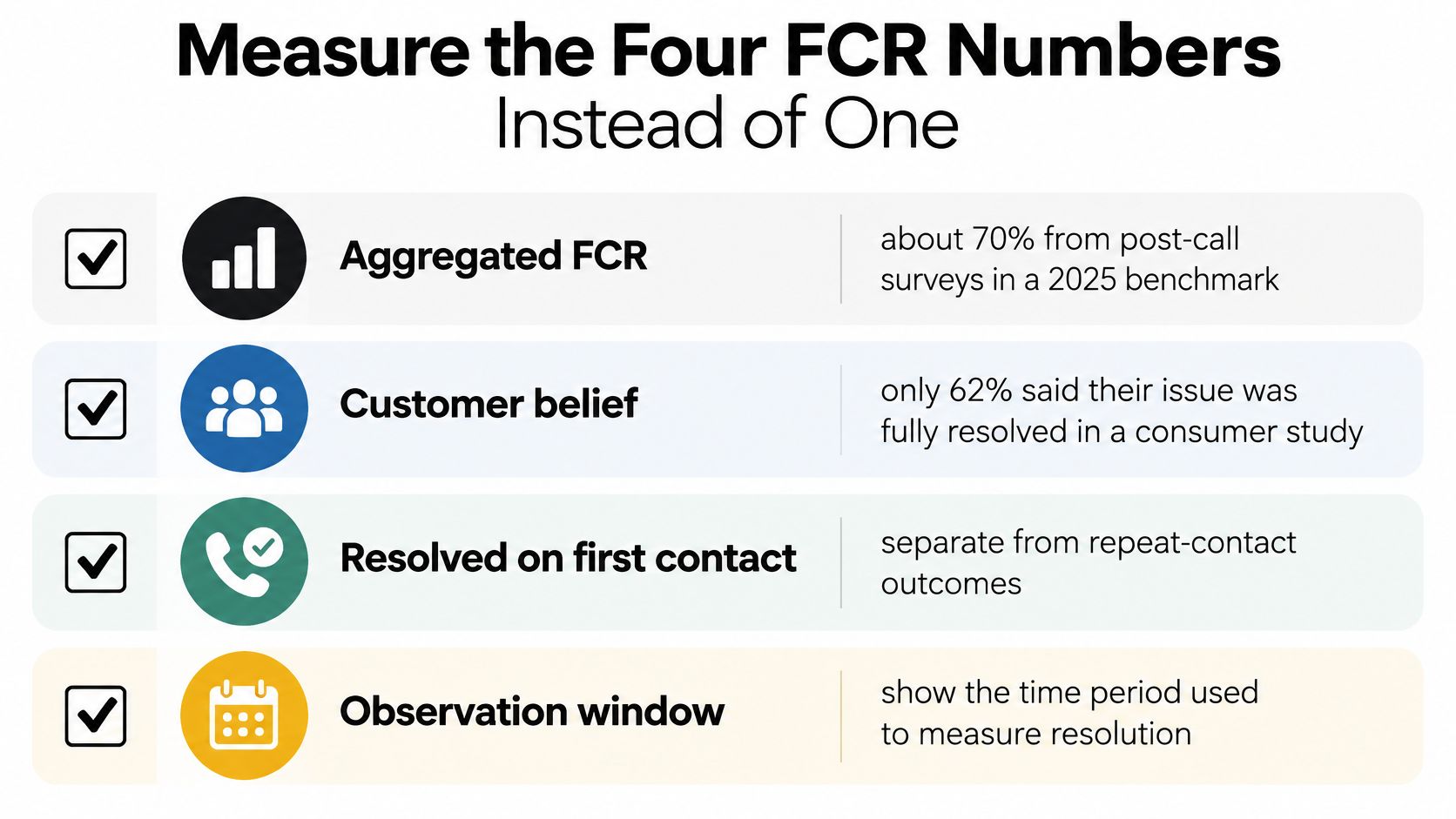
A 2025 benchmark cited 70% aggregated FCR from post-call surveys, while a separate consumer study found that only 62% of customers believed their issue was resolved the first time, according to Customer Care Staff's benchmark analysis. Those results aren't necessarily contradictory. Different populations, questions, and measurement rules can produce different answers.
The dashboard problem begins when leaders combine those answers into a supposedly universal score. Customer perception, transaction completion, and the absence of another ticket describe different things. None should automatically substitute for the others.
Publish separate measures with visible denominators
The four FCR numbers to publish
| Number | What it measures | Source |
|---|---|---|
| 1. Perceived resolution | Customer says the need was solved | Post-contact survey |
| 2. Operational resolution | Completed transaction with no transfer | System events |
| 3. Repeat contact | Same customer, intent or case ID inside the window | Cross-channel case match |
| 4. Unresolved abandonment | Customer leaves without a finished outcome | Abandon and silence events kept in the denominator |
Calculate perceived resolution from affirmative resolution responses divided by valid responses. Display response coverage alongside it. Customers who answer a survey aren't automatically representative of everyone who contacted support.
For operational resolution, divide qualifying completed contacts by the full contact population under the published definition. Label recently completed contacts provisional until their observation windows mature. Otherwise, a channel with faster reporting can look better because its failures haven't arrived yet.
Calculate repeat contact using initial contacts that generated a matched return, divided by initial contacts whose windows have matured. Keep repeat volume available separately: a case that generates several returns creates more workload than one that generates a single return.
For unresolved abandonment, report contacts that ended without a verified outcome against the full population. Distinguish confirmed abandonment from outcome unknown where instrumentation can't establish what happened. Neither category deserves automatic resolution credit.
Governance rule: No team changes the FCR definition without publishing before-and-after results for every reported measure.
Make disagreement useful
Slice each measure by intent, channel, customer segment, and escalation path. Add customer effort to the broader contact-center metrics view so leaders can see whether apparent efficiency requires customers to do more work.
The differences between measures tell you where to investigate. Strong operational completion with weak customer confirmation suggests a mismatch between the recorded transaction and the actual need. Low repeat contact alongside high unresolved abandonment may mean customers gave up, not that service improved.
Don't average these signals into a composite. Their value comes from exposing disagreement. Assign an owner to investigate gaps, and retain the underlying contact records so quality reviewers can reconstruct the customer's journey.
FCR Benchmarks by Reason for Contact
SQM Group's post-contact survey benchmarking, covering more than 500 North American contact centers, reports a 2024 all-industry FCR average of 69%, a 43% to 88% range, and an 80%-or-higher world-class band. Its contact-reason averages below show why a corporate average is an incomplete operating target.
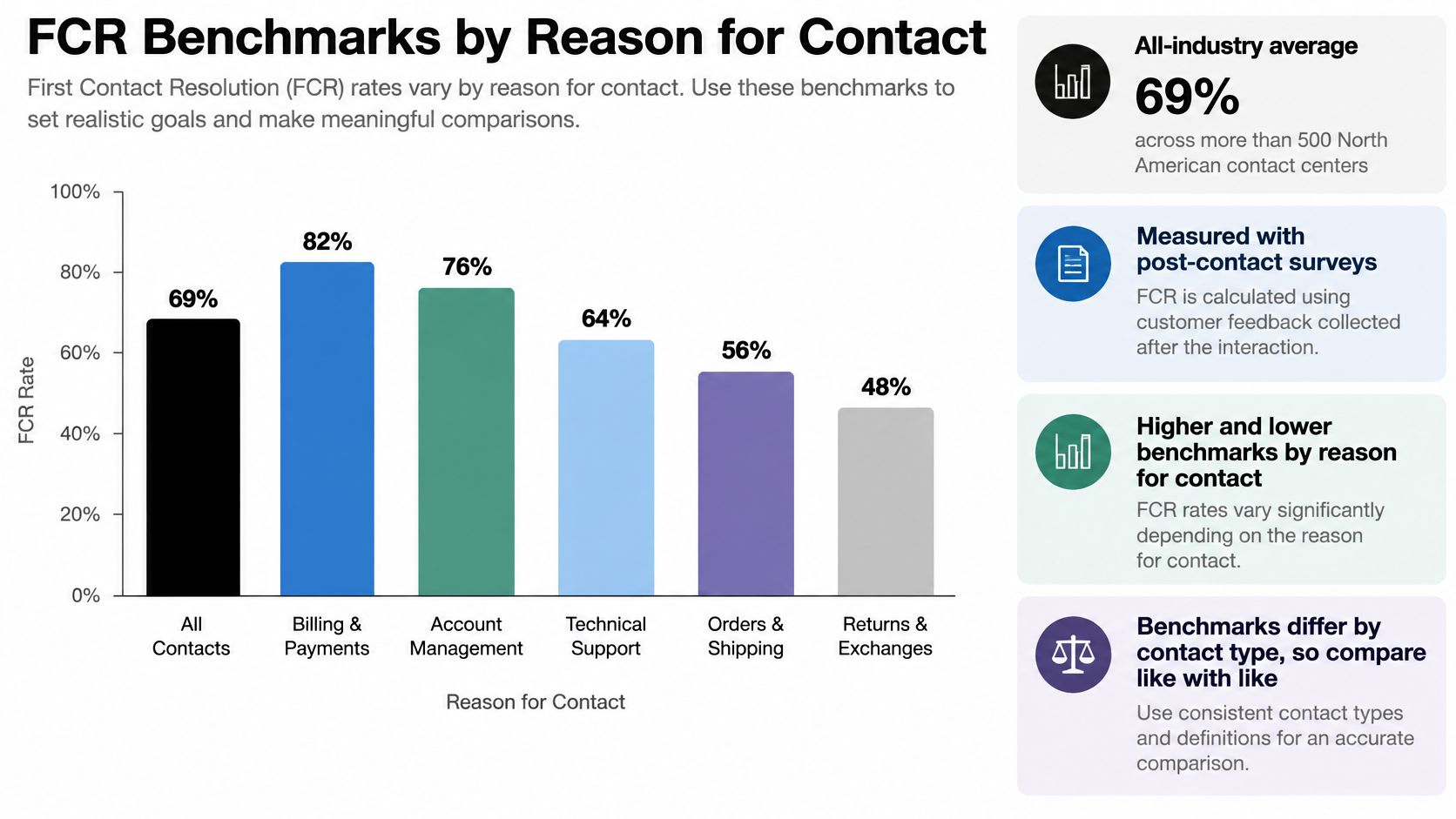
2024 first contact resolution benchmarks
| Contact reason | Average FCR | How to read it |
|---|---|---|
| All industries | 69% | Headline average, not a universal target |
| Range across centers | 43% to 88% | Substantially different service operations |
| World class | 80% or higher | An upper performance band, not an intent-level mandate |
| General inquiries | 73% | Highest of these routine intents |
| Account maintenance | 72% | Close to the inquiry rate |
| Orders | 71% | Check whether the transaction can finish during contact |
| Billing | 69% | Matches the all-industry average |
| Claims | 61% | Examine evidence and approval requirements |
| Technical support | 60% | Examine diagnosis and validation steps |
| Complaints | 48% | Substantially below general inquiries |
Compare the work, not just the percentage
The difference between inquiries and complaints is operationally important. A customer asking about opening hours needs an authoritative answer. A customer disputing a denied claim may need evidence reviewed and a decision made by someone with appropriate authority.
Those aren't equivalent opportunities for first contact resolution. Applying the same target to both encourages teams to dispute classifications rather than improve service.
A billing queue performing around its peer benchmark needs a different conversation from a routine-inquiry queue performing well below comparable work. Ask whether the issue mix, survey method, and exclusions match before interpreting a gap as poor execution.
Use benchmarks to select investigations
I would start with an intent-level comparison, then use these checks:
- Match the category. Map your intents to the closest contact reason, retaining sub-intents where complexity differs.
- Match the measurement. Don't compare a survey-confirmed benchmark directly with an agent-declared closure score.
- Inspect the shortfall. Read failed conversations for missing authority, incomplete information, and unnecessary handoffs.
- Account for workload. Prioritize a recurring failure in a busy queue over an isolated gap in a low-volume specialty.
Treat a wide performance spread as a reason to inspect operating conditions, not proof that agents should work harder. Benchmarks don't establish which system, policy, or staffing choice caused a particular result.
The practical target is improvement against comparable work under a stable definition. A universal stretch target can remain an aspiration, but it shouldn't determine whether a complaint specialist or a routine-service team is judged effective.
Why the First Interaction Changes Satisfaction and Cost
FCR is a mechanism for better service, not a trophy for shorter calls. A 2011 peer-reviewed study using survey data from 168 call-center managers found that FCR positively mediated the relationship between knowledge management, technology-based CRM, and caller satisfaction, as reported in the Journal of Database Marketing & Customer Strategy Management.
That finding supports a practical investment principle: accessible information and useful CRM capabilities should help people finish customer work. Installing either doesn't establish that customers received a complete answer.
Follow the cost of the unfinished issue
Say an agent explains why a duplicate charge occurred but can't reverse it. The call ends quickly, yet the customer must contact billing later. The operation has paid for an explanation and still owes the correction.
The second contact adds handling work, another queue entry, and another opportunity for misunderstanding. If the customer moves from self-service to a staffed channel, the resource requirements also change. Calculate that cost from your own channel and staffing records rather than borrowing a universal savings ratio.
Average handle time, containment, and FCR answer different management questions. Handle time describes interaction duration. Containment describes whether the customer stayed within a channel or automated path. Resolution describes whether the need was completed.
First contact resolution is finishing the errand in one trip, not merely answering the door.
A longer initial conversation can be the better operating choice when it prevents avoidable returns. Conversely, spending longer without authority to act doesn't create value. The decision depends on what additional handling time accomplishes.
Assign ownership beyond the agent
Use a shared accountability model:
- CX leaders own the customer outcome. Validate that the completed action matches what the customer needed, using a consistent approach to measuring customer satisfaction.
- Operations leaders own workflow and permissions. Remove preventable approval bottlenecks and give the first handler a workable completion path.
- Workforce and quality leaders own demonstrated skill gaps. Coach diagnosis, decision-making, and communication where the employee had the information and authority to succeed.
- Technology owners own execution reliability. Confirm that integrations return usable results and that failed actions aren't recorded as successful transactions.
Judge investments using resolution and satisfaction together, supported by total handling effort across the issue. Contacts per hour alone can reward an efficient-looking sequence of unfinished conversations.
Root Causes That Keep Resolution Incomplete
Low FCR is often a systems problem presented as an agent score. Before prescribing training, determine whether the handler lacked knowledge, authority, context, or a permissible completion path.
A correct explanation followed by a transfer isn't the same failure as an incorrect diagnosis. Both miss strict FCR, but coaching only helps the latter if the workflow itself is sound.
Why the first contact fails
| Cause | What the customer experiences | Signal in the data |
|---|---|---|
| Knowledge gap | Incomplete or conflicting answer | Repeat contacts on the same intent |
| Insufficient permissions | Correct explanation, no completed action | Transfer immediately after the answer |
| Channel amnesia | Customer retells the story | Same case ID appears on a second channel |
| Wrong routing | Complex issue in a general queue | Complaints and claims perform poorly relative to inquiries |
| Premature closure | Ticket closed while the need remains | Reopens inside the observation window |
| Identity friction | Time spent proving who they are | Long verification, then unresolved exit |
| Policy gate | Action cannot be finished in one contact | Intent requires a legally or operationally multi-step process |
Find the point where progress stopped
Use customer interaction analytics to locate candidate conversations, then review the underlying transcript and system events. A topic label alone won't reveal whether an agent offered the wrong answer or whether a transaction failed after the right answer.
For a knowledge gap, inspect the actual article available during contact. Was the refund policy missing, outdated, or contradicted by the billing screen? A training assignment won't correct conflicting instructions.
For permissions failures, identify the action the handler attempted and the permission that blocked it. Avoid the vague diagnosis that the agent needed more authority. Name the missing capability: posting an adjustment, unlocking an account, or updating a delivery address.
Channel history needs similar scrutiny. A shared transcript is useful, but it isn't sufficient if the next handler can't see the pending action, verification status, or promised outcome.
Separate constraints from avoidable failures
A policy gate requires careful treatment. If an action legitimately requires review or delayed fulfillment, retain it in the enterprise outcome report while identifying it as structurally multi-step. Don't punish an employee for following the required process, and don't relabel incomplete work as resolved.
Diagnostic discipline: Assign each failed contact a primary cause based on evidence, not the last team that touched it.
A contact may contain several problems. Record contributing causes, but identify the constraint that prevented completion. Then rank causes by affected workload and avoidable rework.
That produces a funding decision grounded in unfinished work. Buying another interface before identifying the constraint can leave the same approval rule, missing knowledge, or broken transaction underneath it.
Contact Paths That Raise or Fake FCR
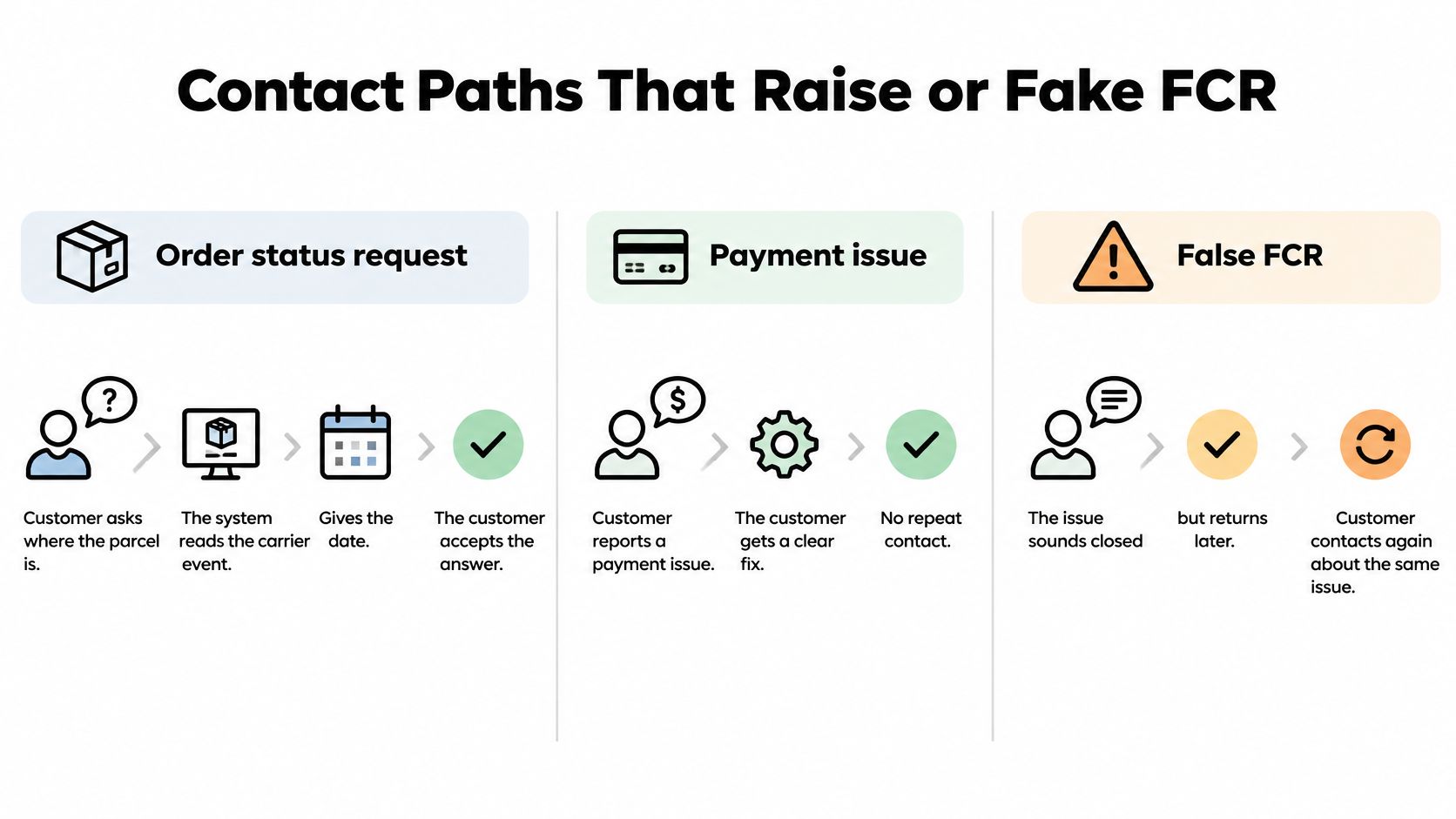
An order-status request can finish cleanly. Say the customer asks where a parcel is, the system retrieves the current carrier event, and the customer receives the delivery information they needed. If the outcome holds through the declared window, the contact qualifies.
A billing dispute can sound equally successful while remaining unfinished. The agent correctly explains the charge but can't post the adjustment. The customer calls again because the balance hasn't changed, so the explanation doesn't qualify as resolution.
A complaint presents a different decision. Empathy may calm the conversation, but the customer still needs an authorized response. An immediate specialist handoff can be the right service choice without qualifying as strict FCR.
Know when automation should stop
In a 2025 survey of 1,000 U.S. adults, 55% said they had escalated an AI-handled issue to a human, while 45% said AI failed to understand their problem, according to the Liveops customer-service report. Those findings make a containment-only objective difficult to defend.
An automated interaction can end because the customer obtained an answer, abandoned the attempt, or decided to call instead. The ending event alone doesn't distinguish those paths.
Give the automated agent explicit stopping conditions:
- Low confidence. The system can't reliably establish the intent or retrieve an authoritative answer.
- Repeated correction. The customer keeps restating the problem because the agent's interpretation is wrong.
- High-risk action. The workflow requires review under the organization's risk policy.
- Missing authority. The agent understands the request but lacks permission to complete it.
Don't make the customer exhaust a troubleshooting loop before offering help. Equally, don't transfer a straightforward request merely because the customer used unfamiliar wording. Test stopping rules against actual intent and transaction outcomes.
Make handoff quality visible
Pass the next handler the customer's identity and verification status where permitted, the identified intent, actions already attempted, relevant system responses, and the unfinished step. The specialist should continue the work, not restart intake.
Report AI-resolved FCR separately from containment. For risk-sensitive intents, define a failure-adjusted view that removes apparent successes later invalidated by a reopen, corrective action, or quality finding. Label its rules clearly rather than presenting it as a standardized benchmark.
In healthcare, financial services, utilities, and employee support, a confident answer isn't enough when the action is consequential. Evaluate whether the agent executed the permitted workflow correctly.
A well-timed escalation can lower the automation score and improve the customer outcome. Managers need room to choose that trade-off without disguising the handoff as first-contact success.
Raise True Resolution on Purpose
Improving first contact resolution requires a coordinated program across process, people, and technology. Start with a workflow that matters, identify why it remains unfinished, and change the conditions that prevented completion.
Don't begin with a mandate to close more tickets. That directs attention toward the status field rather than the customer's outstanding task.

Establish process accountability
Publish the metric definitions, observation windows, exclusions, and accountable owners. Rank intents by contact volume multiplied by failure rate to identify where a workflow change could remove the most unfinished work.
For each selected intent, write the completion condition in operational language. For an address change, that might mean the authoritative customer record is updated and the customer receives confirmation. Displaying instructions for changing the address isn't the same result.
Review reopened cases regularly and remove incentives that reward closure without outcome validation. Give supervisors a way to recognize a correct escalation even when it doesn't improve FCR.
Teach decisions and grant bounded authority
Coach employees on how to recognize the problem, choose the permitted action, and verify the result. Scripts can support phrasing, but they can't replace decision rules.
For specialized coverage, a dedicated customer support agent from Virtustant is a staffing resource to consider alongside internal capability development. Whoever handles the work needs access to the same policies, case context, and escalation ownership.
Give complaint and claims specialists authority within documented boundaries. Audit the use of that authority rather than requiring another approval for every routine decision.
Require technology to complete work
Put authoritative knowledge in the response path, preserve customer context across channels, and connect identity verification to the transaction workflow. Require execution confirmation, not merely a generated statement that the action succeeded.
For a focused pilot, Yellow.ai's generative AI-powered agent assist inbox includes auto-response, ticket summarization, and coaching insights across chat, email, and voice. Our email support delivers a 20% improvement in FCR. Treat that business result as context for evaluation, not a substitute for validating your own intent mix and measurement rules.
Choose a high-volume intent with a clear completion event. Run the pilot long enough for its observation windows to mature, compare equivalent contact cohorts, and inspect the failed conversations as closely as the successful ones.
Expand only when customer confirmation, completed work, repeat-contact outcomes, and abandonment together support the decision. If the closure score improves while unfinished work persists, fix the workflow before increasing traffic.
Yellow.ai offers AI-assisted service across channels, and Nexus VOX deploys voice AI agents that answer, act, and resolve calls. Visit Yellow.ai to discuss a single-intent pilot with explicit completion criteria, context-preserving handoffs, and an evaluation that separates genuine resolution from containment.