














Most advice on how to measure customer satisfaction is too narrow. It treats feedback as a survey problem, when in practice it's an operating model problem.
A post-ticket CSAT score can tell you whether a customer liked one interaction. It usually can't tell you whether the account is healthy, whether friction is building across channels, or whether an AI-driven journey effectively solved the problem. Enterprise teams that still rely on isolated CSAT or annual NPS programs often end up with a familiar contradiction: decent scores, rising churn, and no clear view of why.
A modern measurement system has to do more. It has to combine direct feedback with behavioral signals, conversation data, and operational context. It has to distinguish a billing complaint from a broken onboarding flow, and a one-time frustration from a structural loyalty risk. Most of all, it has to trigger action fast enough to matter.
Table of Contents
- Beyond the Score Why Traditional CSAT Is No Longer Enough
- Choosing Your Core Satisfaction Metrics CSAT NPS and CES
- Designing an Omnichannel Data Collection Strategy
- From Raw Data to Actionable Dashboards
- Closing the Feedback Loop to Drive Operational Change
- Scaling Measurement with Automation and Agentic AI
Beyond the Score Why Traditional CSAT Is No Longer Enough
Customer satisfaction still matters financially. The American Customer Satisfaction Index shows that companies with top-tier satisfaction scores outperform peers by an average of 8.2% in stock market returns over a 10-year period according to the ACSI summary on customer satisfaction. The problem isn't whether satisfaction matters. The problem is how many companies measure it poorly.
Traditional CSAT programs usually fail in three ways. They over-focus on the last interaction, they flatten every response into one average, and they ignore what customers do after they say they're satisfied. That creates a reporting layer that feels clean to executives but rarely helps operators find root causes.
A customer can rate a support chat highly because the agent was helpful, then still leave because onboarding was confusing, pricing felt misaligned, or the product never fit the use case. That's why a single score should be treated as a signal, not a conclusion.
High CSAT after a transaction doesn't automatically mean the relationship is healthy.
At enterprise scale, satisfaction is cumulative. It forms across product usage, service recovery, channel switching, billing clarity, speed of resolution, and whether the business remembers context from one touchpoint to the next.
What a modern program measures instead
A stronger framework combines three layers:
- Direct feedback: Transactional surveys, relationship surveys, and targeted follow-up questions.
- Behavioral evidence: Repeat purchase patterns, retention signals, escalation history, and service recontact trends.
- Conversational intelligence: Sentiment shifts, unresolved intent patterns, and recurring friction across voice, chat, and email.
That shift changes the role of CX teams. Instead of publishing monthly scorecards, they build an early-warning system for revenue risk, service failure, and broken journeys. That's the standard large enterprises need now, especially when human and AI-led interactions sit inside the same customer journey.
Choosing Your Core Satisfaction Metrics CSAT NPS and CES
Enterprises get into trouble when they treat CSAT, NPS, and CES as competing metrics. They are not competing. They answer different management questions, and the value comes from assigning each one to the right decision, owner, and point in the journey.
That distinction matters more in AI-assisted environments, where part of the experience may be handled by automation, part by a human agent, and part by the product itself. A modern measurement system needs metrics that can separate interaction quality, relationship health, and process friction instead of blending them into one average.
Where CSAT works best
CSAT is best for bounded interactions with a clear start and end. Support cases, delivery updates, onboarding checkpoints, payment recovery, and field service visits all fit that pattern. The metric tells teams whether that specific touchpoint met the customer's expectation.
In practice, CSAT is most useful when a team can act on it quickly. If a region, queue, partner, or bot flow starts underperforming, CSAT helps operators isolate the issue before it spreads across the journey. That makes it a strong service operations metric and a weak standalone indicator of account health.
It also needs context. A high score after a support interaction can sit alongside rising repeat contacts or churn risk.
Where NPS adds value
NPS belongs at the relationship level. It is better suited to periodic reviews of brand sentiment, account confidence, and renewal risk than to immediate post-transaction feedback. Senior leaders often keep NPS because it gives them a consistent way to compare segments, geographies, and customer cohorts over time.
Used well, NPS helps answer questions like these: Are enterprise customers losing confidence faster than mid-market accounts? Did a pricing change affect advocacy? Are customers with repeated automation handoffs less likely to recommend the brand?
Used poorly, it becomes a vanity number. Sending NPS too often, or too close to a single service event, turns a relationship metric into noisy operational feedback.
Where CES earns its place
CES, or Customer Effort Score, is often the most diagnostic of the three. It measures how hard customers had to work to complete a task, get help, or fix a problem. That makes it especially useful in journeys with multiple systems, policy steps, or channel switches.
I rely on CES when the business suspects process failure, not courtesy failure. Customers may forgive a less polished interaction if they still get the answer fast. They are far less forgiving when they have to repeat information, restart in a new channel, or work through unclear next steps.
That is why CES tends to surface issues that survey teams miss and operations teams feel every day.
CSAT vs. NPS vs. CES Which Metric to Use When
| Metric | Core Question | Measures… | Best Used For… |
|---|---|---|---|
| CSAT | How satisfied were you with this interaction? | Immediate reaction to a specific touchpoint | Support tickets, live chat, delivery, onboarding steps, service recovery |
| NPS | How likely are you to recommend us? | Relationship strength and loyalty intent | Quarterly or periodic relationship reviews, account health tracking |
| CES | How easy was it to complete this task or resolve this issue? | Friction and process effort | Self-service flows, support resolution, cross-channel journeys, operational redesign |
A few operating rules keep these metrics useful at scale:
- Use CSAT where ownership is clear. If one team, workflow, or automation flow owns the moment, CSAT can support real accountability.
- Use NPS on a planned cadence. Quarterly, biannual, or lifecycle-based measurement usually works better than event-triggered blasts.
- Use CES in journeys with handoffs and dependency chains. If effort is high, process redesign usually matters more than agent coaching.
- Pair every score with reason data. Open text, intent tags, and contact drivers explain the score and make it usable.
- Connect survey data to passive signals. Repeat contacts, containment failures, escalations, and sentiment shifts often show the problem before scores drop.
For teams refining question design and follow-up prompts, classic methods for user research still help. The difference at enterprise scale is that surveys are only one input. Programs that combine direct feedback with conversational signals from platforms such as Yellow.ai, and broader orchestration patterns described in this guide to omnichannel customer experience strategy, are better positioned to predict dissatisfaction instead of reporting it after the fact.
The practical rule is simple. Choose the metric based on the business decision, then connect it to operational data so teams can fix the cause, not just watch the score.
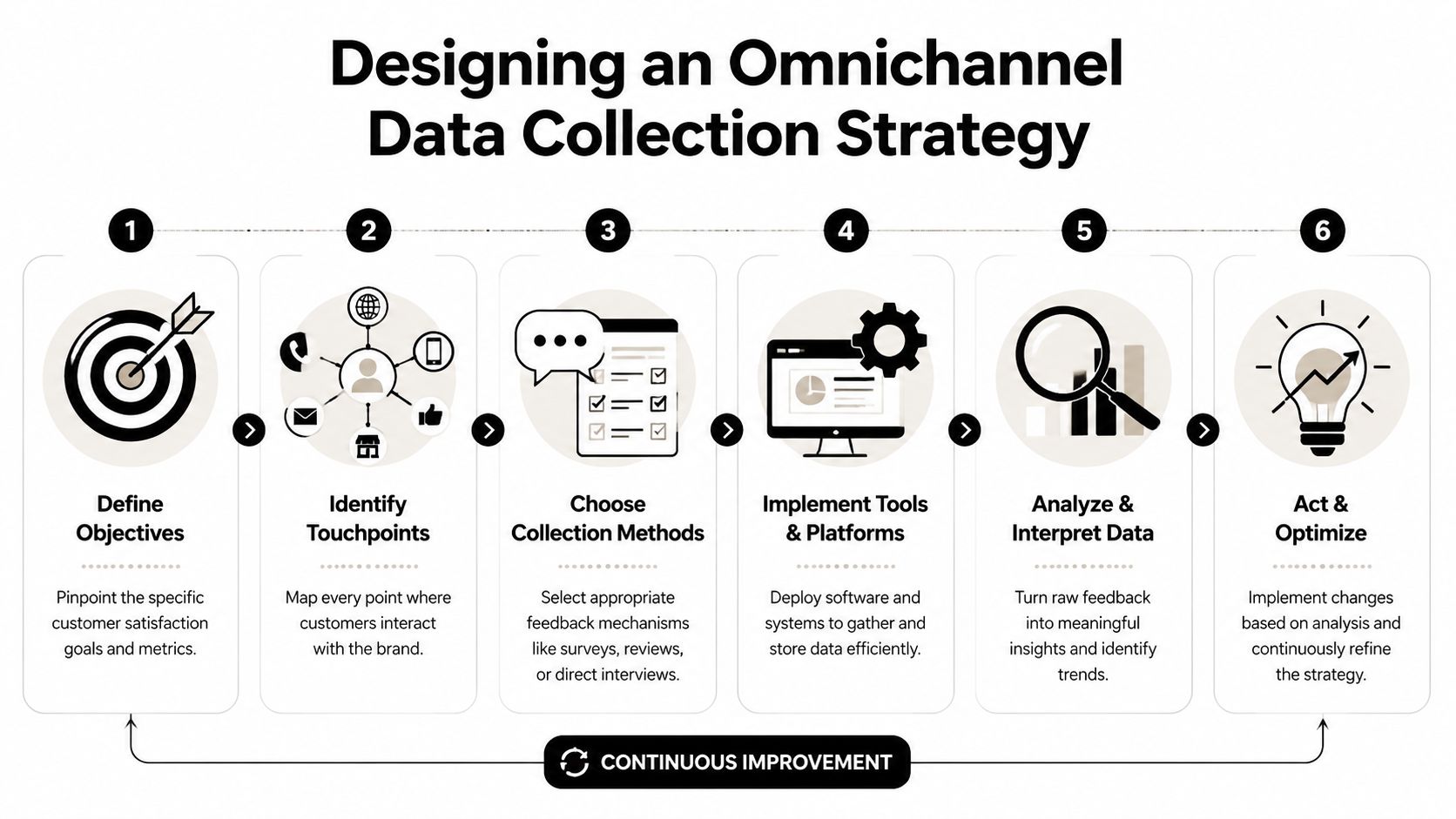
Designing an Omnichannel Data Collection Strategy
If you want accurate measurement, start with collection design. Weak sampling, bad timing, and channel bias will distort results long before anyone opens a dashboard.
Start with journey events, not survey channels
A common initial question is, 'Should we send this by email, SMS, or in-app?' That's too late in the process. First identify the event that matters. Support resolution, failed payment recovery, claims closure, chatbot handoff, and onboarding completion all create different satisfaction contexts.
For transactional moments, in-context surveys triggered immediately by user actions produce significantly more accurate responses, and best practice is to set recontact windows of at least 30–60 days to reduce bias, as outlined in Formbricks' guidance on measuring customer satisfaction. That's the baseline for human-assisted interactions where the experience is fresh and clearly bounded.
A disciplined collection strategy usually includes:
- Event mapping: Identify the moments that matter commercially or operationally.
- Sampling logic: Decide who gets surveyed, when, and how often.
- Question design: Keep the rating question stable and add a targeted diagnostic follow-up.
- Suppression rules: Exclude customers in active escalations, duplicates, or recent respondents.
- Segment tagging: Attach plan tier, region, channel, issue type, and lifecycle stage at collection time.
- Consent and governance: Align the program with internal data and compliance requirements.
Teams that need stronger qualitative inputs alongside surveys should also borrow from established methods for user research. Interviews, diary studies, and usability sessions can explain why a journey underperforms when survey comments alone stay vague.
For enterprise programs spanning service, sales, and digital channels, an omnichannel customer experience guide is useful because it frames feedback collection around the full journey instead of isolated departments.
Add passive signals to the measurement layer
Surveys only capture declared feedback. Customers also reveal satisfaction indirectly.
Useful passive signals include chat transcripts, call summaries, email tone, repeat contacts on the same issue, escalation patterns, self-service abandonment, and whether a customer had to switch channels to finish a task. These signals matter because many customers never answer surveys, and some of your highest-risk accounts stay silent until renewal.
A practical omnichannel model blends both forms of evidence:
- Direct voice of customer: CSAT, NPS, CES, and open-text responses.
- Operational friction signals: Transfers, wait experience, unresolved cases, and reopen patterns.
- Conversation-derived insight: Sentiment, emotion, topic clustering, and unresolved intents from service conversations.
That's how to measure customer satisfaction without over-relying on survey volume alone. A mature enterprise doesn't ask every customer for feedback after every interaction. It instruments the journey so the business can infer satisfaction trends even when the customer says nothing.
From Raw Data to Actionable Dashboards
Most CX dashboards fail because they answer the easiest question instead of the most important one. They show the average score. Executives see green. The business keeps losing customers.

Averages hide the accounts you should worry about
Here lies a common failing of many satisfaction programs. According to CustomerSure's guide on measuring customer satisfaction, 60% of customers who report a “very satisfied” experience still switch brands within a year, and high-value detractors drive 85% of revenue loss. That tells you two things immediately.
First, transactional happiness doesn't equal loyalty. Second, an enterprise dashboard that treats every response as equal will miss the customers that matter most.
A useful dashboard segments by business relevance, not just survey type. At minimum, that means slicing results by:
- Customer value: Enterprise accounts, strategic accounts, and lower-value segments should never be blended.
- Journey stage: Onboarding, active service, renewal, and post-escalation periods behave differently.
- Issue complexity: Password reset isn't comparable to claims denial, outage recovery, or integration support.
- Channel path: Customers who switched from bot to agent to email are telling you something about effort and containment.
What an executive dashboard should show
A strong dashboard tells a story across three levels.
At the top, show relationship health. That includes NPS trends, key segment movement, and whether high-value accounts are becoming more fragile or more stable.
At the second level, show operational drivers. Break out satisfaction by queue, contact reason, product area, geography, and service journey. This approach enables teams to find the actual defect, not just the symptom.
At the third level, show intervention signals. Which low-score events triggered outreach? Which themes are rising? Which customers have both poor sentiment and risky behavior?
A modern analytics layer should also connect conversation and survey data. Tools that unify interaction data and feedback can help teams move from score reporting to root-cause analysis. For example, AI analytics for customer conversations can be used to examine patterns across chat and support workflows rather than reading isolated comments one by one.
Don't ask whether the score moved. Ask which customers moved, on which journeys, and whether their behavior changed afterward.
If your dashboard can't answer that, it's a reporting surface, not a management tool.
Closing the Feedback Loop to Drive Operational Change
Measurement without action is expensive theater. Enterprises spend time collecting feedback, cleaning data, presenting trends, and then fail at the one step customers notice. Fixing the problem.
Build workflows around risk, not reporting
The right response to a low score isn't a monthly review meeting. It's intervention.
When undesirable results or low scores occur, industry best practice is proactive client contact to diagnose the issue, and that can be operationalized through automated triggers that immediately flag low metrics to prevent churn, as described in Luis Donoso's discussion of reliable satisfaction measurement practice.
That principle should shape your workflow design. A low score from a low-value, low-risk transaction may only require trend monitoring. A low score from a strategic account after a failed escalation should trigger immediate outreach with full context attached.
Good closed-loop design routes feedback differently based on customer value, issue severity, and recovery opportunity. In practice, that means:
- High-value detractor alerts: Route directly to account management or retention teams with survey comments and interaction history.
- Service failure recovery: Send ticket-level alerts to frontline managers when a support experience breaks down.
- Process defects: Cluster recurring comments into operational themes for product, billing, or digital teams.
- Praise signals: Route positive comments to team leads for coaching and quality reinforcement.
Operational rules that make closed-loop programs work
Closed-loop systems fail when ownership is fuzzy. Someone has to act, by when, with what authority, and against which playbook.
A durable model usually includes:
| Workflow element | What good looks like |
|---|---|
| Ownership | One team owns triage, another owns resolution, and executive escalation paths are predefined |
| Context | Follow-up teams receive score, verbatim feedback, recent cases, and account tier together |
| Response standards | Internal SLAs define how quickly each feedback type is reviewed and acted on |
| Recovery action | Teams have approved remedies, not just instructions to “call the customer” |
| Learning loop | Root causes feed back into training, product changes, policy updates, and automation redesign |
The feedback loop closes only when the business changes something that reduces repeat failure.
The strongest programs also measure the quality of the follow-up itself. If customers repeatedly say they weren't heard, or if the same complaint returns after outreach, the loop did not close. It was merely acknowledged.
Scaling Measurement with Automation and Agentic AI
Enterprise teams do not have a measurement problem. They have a coverage problem.
Survey programs capture a thin slice of the customer experience, usually after the fact and often from the easiest interactions to measure. That approach breaks down once service is spread across voice, chat, email, self-service flows, and AI-led conversations. A modern satisfaction system has to read what customers do, not just what a small sample says in a form.
Why AI changes the measurement model
Agentic AI changes measurement because it can process far more interaction data than a manual QA or survey-led program. It also shortens the gap between signal detection and intervention. Teams can flag frustration, repeat effort, abandonment risk, or unresolved intent while the journey is still active, instead of waiting for a weekly report.
That shift matters at enterprise scale. Customers switch channels mid-journey. They ask multiple questions in one session. They move between automation and live support without caring which team owns the handoff. If measurement only listens for explicit survey feedback, large parts of the experience stay invisible.
An AI-powered measurement layer usually includes:
- Conversation analysis: Identify friction patterns, escalation triggers, effort signals, and negative sentiment in transcripts.
- Intent and outcome mapping: Distinguish true resolution from short interactions that ended quickly but failed later.
- Real-time intervention logic: Trigger supervisor review, outreach, or recovery workflows when risk conditions are met.
- Cross-channel memory: Connect the bot session, agent conversation, and follow-up contact so the satisfaction model reflects the full journey.
The trade-off is governance. Broader coverage gives teams more signal, but also more noise if taxonomies, escalation logic, and outcome definitions are weak. I have seen enterprises buy advanced analytics and still miss avoidable churn because every business unit defined "resolved" differently.
Platforms built for orchestrating AI and service workflows can support this model. The agentic AI platform from Yellow.ai is one example. It supports enterprise conversation orchestration across channels and can sit alongside survey tools, CRM data, and operational systems in a continuous CX measurement stack.
Measuring satisfaction in AI-only journeys
AI-only journeys need a different measurement design. Immediate post-chat surveys often overstate success because customers are rating speed and convenience before they know whether the outcome held.
Zendesk's discussion of measuring customer satisfaction points to a practical issue in automated interactions. Survey timing can distort results when customers need time to verify whether the answer solved the problem. In practice, that means autonomous journeys should often be measured twice: once for interaction quality, then later for outcome validity.
A better design for AI-led resolution includes:
- Separate journey types: Keep human-assisted, bot-assisted, and fully autonomous interactions in different measurement cohorts.
- Delay outcome checks where needed: For billing changes, claims, cancellations, or technical fixes, ask after the customer can confirm the result held up.
- Use passive validation signals: Track recontact, reopen rate, downstream escalation, refund requests, and channel switching.
- Audit containment with care: High containment can signal efficiency, or it can signal that customers gave up.
A short product walkthrough helps clarify what this looks like in practice at the platform layer.
The enterprise end state is not a larger survey program. It is a continuous measurement system that combines declared feedback, passive behavioral signals, and AI-based interpretation to predict satisfaction risk before it shows up in churn, repeat contact, or declining retention.
If you're rethinking how your enterprise captures, interprets, and acts on customer satisfaction signals across human and AI interactions, Yellow.ai is worth evaluating as part of that stack. It can support omnichannel conversation workflows, analytics, and automation so CX teams can move beyond isolated survey programs and build a more responsive measurement system.



