









The most popular advice about enterprise requirements is to write them down early, get sign-off, and move straight to vendor selection. That advice is why so many programs stall in month seven. A document approved in a kickoff meeting isn't a baseline. It's a wish list with a date stamp, and nobody has agreed on what would prove any of it true.
Requirement sets fail in three predictable ways. They list features instead of measurable outcomes. They treat security, privacy and data readiness as a hardening phase that comes after the build. And they never define the evidence that would let a reviewer say pass or fail. Each failure is cheap to correct in week one and expensive to correct after go-live, when the fix usually means re-architecting an integration or renegotiating a contract.
The alternative is to treat enterprise requirements as a governed, testable baseline: a coverage check across every category that matters, acceptance gates backed by artifacts rather than assurances, and explicit requirements for data readiness and human handoff that most guides leave out entirely.
Table of Contents
- What Enterprise Requirements Actually Are
- The Requirement Categories Every Enterprise Must Cover
- How to Identify and Write Requirements Step by Step
- How to Prioritize Requirements Under Real Constraints
- What Enterprise Requirements Look Like in Practice
- Turning Requirements into Decisions and Acceptance Evidence
- Five Misconceptions That Sink Requirement Sets
- Your Next Step to a Signed Requirement Baseline
What Enterprise Requirements Actually Are
A feature says the agent can answer billing questions. A requirement says it answers 90% of the top 20 billing intents correctly on a fixed evaluation set, never exposes account data before authentication, and hands off to a person within two turns when confidence drops below an agreed threshold. One of those statements can be tested. The other can only be argued about in a steering committee.
Enterprise requirements are the explicit, testable, traceable statements of what an organization must achieve, under what constraints, and with what evidence of success. They cover functional outcomes, such as routing a request, retrieving approved knowledge or escalating a case, and nonfunctional thresholds such as availability, latency, accuracy, accessibility, interoperability, privacy and audit logging. Everything outside those two buckets is a preference, and preferences don't belong in a sign-off pack.
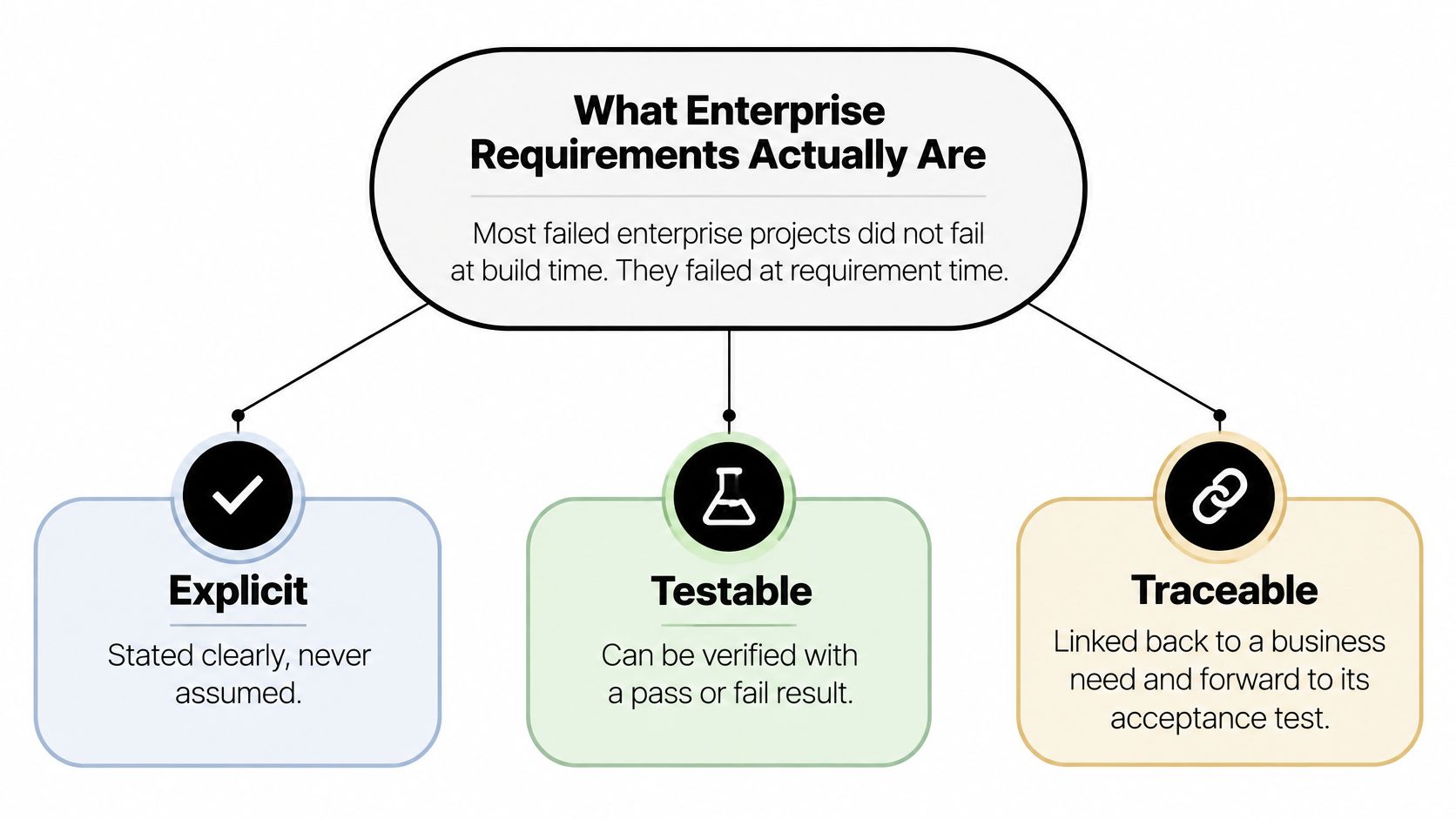
Three layers, one identifier scheme. Business requirements state why the work exists and which outcome moves. Solution requirements state what the system does and how well it must do it. Transition requirements cover training, migration, support and rollback, and they're the layer teams skip when a launch slips. In non-AI programs these usually live in a business requirements document for outcomes and constraints, plus a software requirements specification for system behavior. Both should share requirement IDs so every line in one traces to a line in the other and forward to a named test.
Requirements are the building code and the inspection schedule, not the wish list of rooms. The wish list tells you what the building is for. The code tells you whether anyone is allowed to occupy it.
Practical rule: if a requirement can't be marked pass or fail by someone who didn't write it, it's a design note.
Four groups have to agree before a requirement is real: business, security and privacy, operations, and engineering. Agreement from three of them produces a document that gets reopened the week before launch. The same discipline shows up in adjacent functions, which is why payment teams working through technology strategies for payment executives face identical traceability demands when they scope settlement, fraud and reconciliation work.
The Requirement Categories Every Enterprise Must Cover
Requirements engineering is where reliability is won or lost, because unclear or incomplete requirements become defects that are expensive to find later. A NASA technical review of software-failure research reports that an earlier examination of more than 16,000 bug reports from major U.S. government-funded software projects classified 8% of the problems as stemming from requirements. That percentage moves with the classification method, but the direction doesn't. Ambiguity, inconsistency and misinterpretation produce systems that technically match the spec and miss the objective.
The table below is the coverage check I use. Read each row, decide the answer for your program, and write the criterion in a form a tester can execute.
| Category | Decision it forces | Example testable criterion | Accountable owner |
|---|---|---|---|
| Business outcome | Which workflow and which measurable result | Cost per successfully completed task and first-contact resolution tracked monthly on top-20 intents | Business owner |
| Functional behavior | What the system must do and what it must refuse | Agent retrieves only documents tagged approved and current for the requesting region | Product owner |
| Data readiness | Whether source content is fit to automate a workflow | Top-20 intents covered by current, owned knowledge sources, with permission-test pass rate reported before launch | Knowledge owner per domain |
| Performance and availability | Acceptable latency and uptime per channel | Latency and uptime targets set per channel and verified under peak-load testing | Engineering |
| Security and access | Who can see and do what, and how it is proven | Every high-impact action requires role-based approval and is written to an immutable audit log | CISO |
| Privacy and data governance | What data may be collected, stored and deleted | No personal data retained past the stated retention window; deletion verified in test | Privacy officer |
| Accuracy and evaluation | What counts as correct, measured how | Top-20 intents meet the agreed accuracy threshold on a fixed evaluation set, re-run every release | Data science |
| Explainability and accountability | How decisions are explained and traced | Any escalation shows the reason code and the policy version applied | Operations |
| Human handoff and escalation | When and how a person takes over | Handoff offered within 2 turns when confidence falls below threshold, with full context | Contact center lead |
| Accessibility and language | Which users and languages must be served | Launch languages and accessibility checks pass before release, including assistive-technology scenarios | UX lead |
| Interoperability | Which systems must connect and how failures behave | CRM outage degrades gracefully with a fallback message and no data loss | Integration lead |
| Rollback and lifecycle | How the capability is retired or reversed | Any agent version can be reverted to the prior approved version within 1 hour | Release manager |
Two rows carry most of the risk in 2026. Data readiness asks whether the source content is fit to automate a workflow at all: source freshness, coverage of top intents, permission-test pass rate, and a named owner for every knowledge domain. Human handoff quality asks what happens at the boundary, covering confidence thresholds, time-to-human, transfer appropriateness and whether context survives the transfer. Both connect directly to data residency requirements when content and conversation logs cross regional boundaries.
Run the table as a red, amber, green check against your current requirement set. No sign-off while a launch-blocking category sits red.
How to Identify and Write Requirements Step by Step
The procedure below takes a working group from vague business need to a signed baseline. It runs over two to three weeks for a single workflow, and the artifacts it produces are the point.
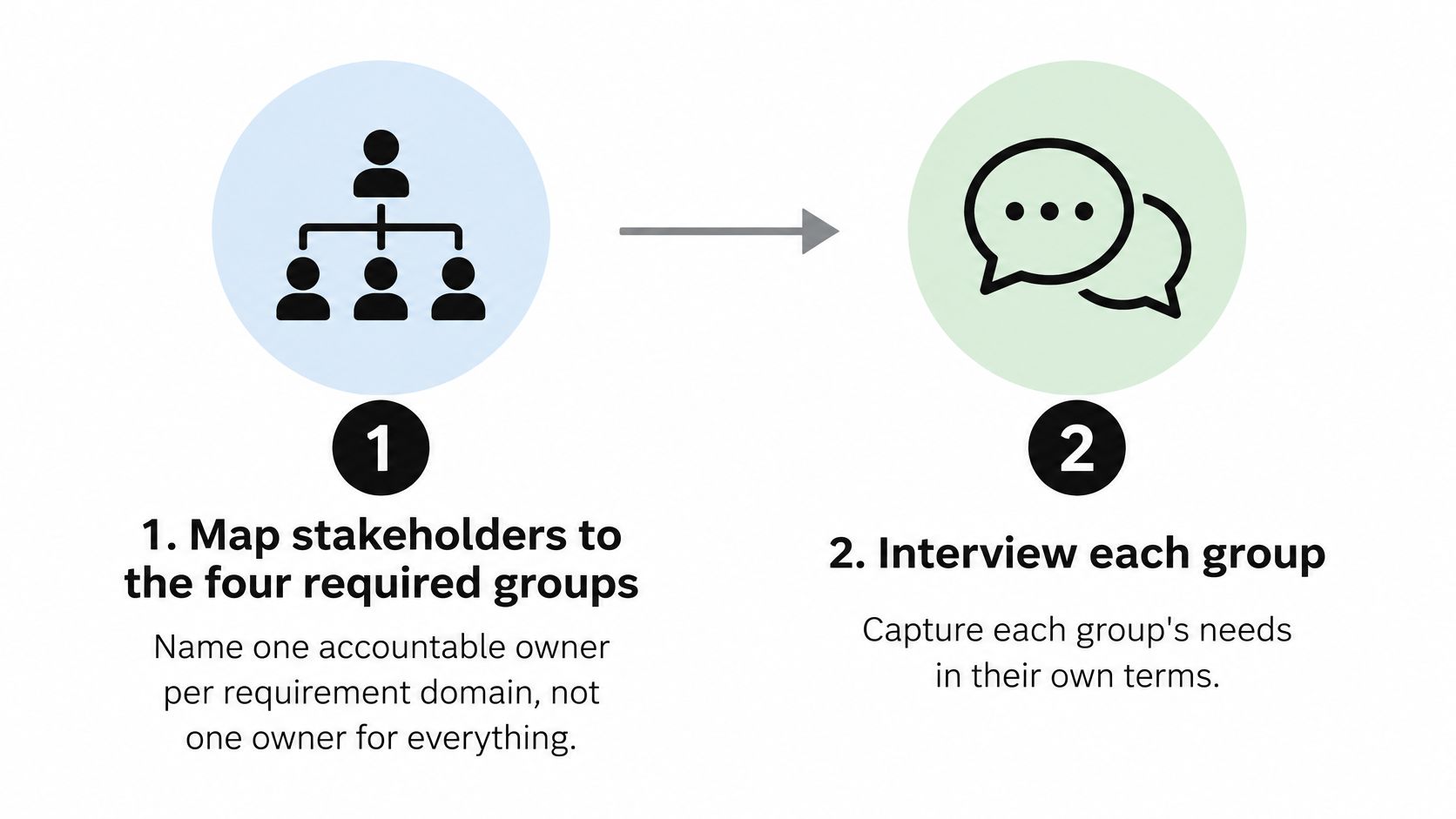
- Map stakeholders to the four groups and name one owner per domain. Business, security and privacy, operations, engineering. One owner per requirement domain, never one owner for everything, because a single owner becomes a bottleneck within a week.
- Interview each group with outcome questions. What must be true for you to approve this? What would make you reject it? What evidence would you accept? Write the answers down verbatim; they become your acceptance criteria later.
- Collect source material before drafting. Current process documentation, top contact or ticket categories, policy documents, incident logs, access matrices, and any regulated obligations. Produces a source register that data readiness requirements will reference.
- Convert every wish into a metric, a threshold and a test. Who does what, under what condition, measured how, accepted by whom. Produces a numbered requirement, not a paragraph.
- Classify each statement against the category table and flag gaps. Produces a coverage view with red, amber and green marks per category.
- Run a negative-testing workshop. What must the system never do, and what evidence proves it didn't? Unauthorized retrieval through direct questions, prompt injection, conversation history and connected systems all belong here.
- Validate against data readiness. Freshness, coverage, permission tests, named knowledge owners. This step kills more launch dates than any technical review.
- Circulate a redline draft with a review deadline. Escalate unresolved conflicts to a named decision-maker with authority to settle them. Produces a disposition log, which is the only artifact that survives an audit.
- Baseline the signed set and version it. Any later change goes through change control with a recorded rationale.
Good stakeholder alignment is what makes step eight land on time rather than drifting into a fourth review cycle.
The two failure points are predictable. Workshops that produce adjectives instead of thresholds ("the agent should be helpful and empathetic") and requirements that nobody has agreed to test. Both feel like progress in the room and both cost a sprint later.
If a workshop ends without a number, a condition and a named owner, it didn't produce a requirement. It produced meeting notes.
How to Prioritize Requirements Under Real Constraints
Prioritization is a trade-off decision, not a ranking exercise. The criteria that matter are regulatory or contractual obligation, revenue or cost exposure, user impact and volume, risk of irreversible harm, effort and dependency, and reversibility. Score the flexible ones. Gate the rest.
| Tier | Deciding criteria | Example requirements | Decision rule |
|---|---|---|---|
| Mandatory before launch | Legal, regulatory, contractual or safety obligation | Data retention limits, access controls, audit logging, entitlement checks | Pass or fail gate; never scored against other work |
| Must-have for launch | Blocks the core outcome or any irreversible harm risk | Accuracy threshold on top intents, human handoff within 2 turns, rollback within 1 hour | Ship-blocking; escalates to the accountable executive |
| Should-have next release | High user impact, reversible, dependent work can start later | Multilingual coverage beyond launch languages, supervisor override console, richer analytics | Scheduled with a named owner and target quarter |
| Deferred | Low exposure, reversible, no obligation | Convenience intents outside top categories, cosmetic reporting changes | Written risk acceptance, revisit trigger, and a review date |
Regulatory and safety requirements never enter a scoring contest. They're pass or fail, and the exposure is real: GDPR has applied since 25 May 2018, and for the most serious violations regulators may impose penalties of up to €20 million or 4% of worldwide annual turnover, whichever is higher, according to the U.S. International Trade Commission's analysis of GDPR enforcement. Retention and access requirements sit in the gate tier for that reason alone.
Automation rate is a bad primary target. Containment numbers can hide repeat contacts, agent rework and compliance exposure. CMSWire's reporting on AI handoff in contact centers puts consumer trust in AI resolution at 55% when a clear path to a human exists, which makes escalation design a product requirement rather than a fallback. The same reporting cites Adobe's 2026 research finding that executive misunderstanding of AI is the leading source of misalignment at 61% of respondents. Weight successful task completion and escalation quality alongside cost.
Sequencing rule: data readiness work usually precedes model and feature work, because a more capable model can't fix poor knowledge hygiene or fragmented permissions.
Every deferral needs three things written down: an owner, a trigger for revisiting, and the risk accepted in plain language. A deferral without those is a decision nobody made.
What Enterprise Requirements Look Like in Practice
Three composites, drawn from patterns common in regulated and high-volume settings. Treat them as illustrations, not as named client cases.
A BFSI contact center automating balance and card-blocking queries. The requirement set separated read-only intents from money-moving actions, mandated authentication before any account detail surfaced, capped policy guidance to approved scripts, and required supervisor approval for overrides. The requirement the team nearly missed was a negative test: could an unauthenticated user reach account detail by asking indirectly, or by referring to a prior conversation? It could, through conversation history. The fix was cheap. The discovery after a penetration test would not have been.

A healthcare provider's employee service desk. Protected data handling drove the spec: logging every record access, defined escalation to a clinician or HR partner, and retention limits per record type. Here the data-readiness gate did the work. A coverage review found outdated policy documents still tagged as current, which would have produced confident, wrong answers about leave entitlements. The gate cost a week and prevented a compliance incident.
A utilities field-support agent. Requirements centered on outage data freshness, tolerance for stale information, and graceful degradation when the scheduling system is down. The handoff requirement decided the outcome: field engineers needed the ticket context to travel with the transfer, so the agent passed a structured summary rather than a raw transcript. Without it, every escalation restarted the conversation and repeat contacts climbed.
The pattern holds across all three. The decisive requirements were about boundaries and evidence, not features. What must the system refuse, what must it prove, and who signs when it does neither.
Turning Requirements into Decisions and Acceptance Evidence
A mature requirement set answers three questions with evidence rather than opinion.
Build versus buy. Requirements that hinge on data residency, custom entitlement logic or deep core-system integration usually push toward a platform with configuration and integration depth. Requirements that hinge on commodity capability favor buying. Score each mandatory requirement against both paths and let the dependency count decide, not the demo.
Vendor evaluation. Convert each mandatory requirement into a question with a required evidence artifact: a certification scope document, a data-flow diagram, a retention configuration screenshot, a test result, a reference call. A demo answer is unverified until a document confirms it. Ask for the artifact in writing and set a delivery date, because vendors who can produce it do so quickly.
Release readiness. Define the evidence pack before go-live. It should cover representative conversations, adversarial and out-of-scope prompts, multilingual and accessibility checks, tool and API failure behavior, and human handoff. A worked SLA example is a useful template for turning those expectations into measurable commitments with remedies attached.
The NIST AI Risk Management Framework gives structure to all three decisions. It organizes implementation into four functions, GOVERN, MAP, MEASURE and MANAGE, and defines trustworthy AI across reliability, safety, security and resilience, accountability and transparency, explainability, privacy enhancement, and fairness. Validation must provide objective evidence that requirements for the intended use have been fulfilled, which means testing representative conversations, adversarial prompts, out-of-scope requests, multilingual and accessibility scenarios, tool and API failures, and handoff behavior. A system can hit high average accuracy and still fail acceptance if it exposes restricted data or can't explain an escalation.
If a requirement has no acceptance evidence and no owner, it isn't a requirement. It's an aspiration with a deadline.
Maintain a traceability matrix that links each requirement ID to its owner, test case, evidence artifact and release decision. An auditor should be able to follow any requirement from business need to proof without asking anyone a question.
Five Misconceptions That Sink Requirement Sets
"Requirements are a kickoff document." They're a living baseline under change control. Ambiguity and inconsistency produce behavior that matches the spec and misses the objective, which is why the version history matters as much as the content.
"A better model fixes a weak deployment." Incomplete or unready data blocks outcomes regardless of model quality. A 2025 survey of IT leaders reported by Mayfield found 32% cited incomplete or unready data as an obstacle, ahead of budget justification at 26%. Swapping models doesn't clean up stale procedures or fragmented permissions.
"Security and privacy are a later hardening phase." IBM's 2025 breach research reported that 63% of breached organizations lacked an AI-governance policy or were still developing one, and among organizations reporting AI-related breaches, 97% lacked proper access controls. Negative tests have to prove protected records can't be reached through direct questions, indirect prompt injection, conversation history or connected business systems.
"High containment equals success." Containment can hide repeat contacts, rework and compliance exposure. Use workflow outcome metrics, first-contact resolution, transfer appropriateness, time-to-human and cost per successfully completed task, rather than a single resolution percentage.
"Certifications make a vendor enterprise-ready." Certifications answer part of the question. Documented data flows, retention behavior, access reviews and incident-response exercises answer the rest, and those are the artifacts a security reviewer will read in detail.
Every one of these misconceptions treats a requirement as intent rather than as a claim that needs evidence. That's the common thread, and it's why requirement reviews that only ask "does this describe what we want" miss the failures that matter.
Your Next Step to a Signed Requirement Baseline
A signed baseline starts with a short, owned action list that turns intent into checks. Run the category coverage check from the twelve-row table and mark every category red, amber or green. Name one accountable owner per red category, one person who can align stakeholders, accept the trade-off and sign off. A committee slows that work down.
Draft ten requirements in metric-threshold-evidence form for the highest-exposure workflow. Ten is enough to show whether the format works for your teams without turning the exercise into a writing project. Book the negative-testing workshop with security, privacy and operations in the room. No substitutes. Set a baseline review date and name the decision-maker who resolves conflicts when two groups disagree.
Then treat platform selection as one shortlist entry, evaluated against the same evidence pack rather than a scripted demo. If your requirement set calls for broad integration coverage, flexibility across models and testing tooling inside one lifecycle, Yellow.ai is a reasonable candidate to test. Our Enterprise plan includes SOC2, GDPR and ISO compliance, the platform uses 15+ LLMs, and pricing is obtained by contacting Yellow.ai. Ask for the documented certifications, data-flow diagrams, retention settings and test results, then score them against the requirements you've already signed.
You're done when every launch-blocking requirement has an owner, a threshold and attached evidence. Not before.
Yellow.ai gives enterprise teams a practical platform to test against that baseline: an enterprise-grade agentic AI platform with SOC2, GDPR and ISO compliance on the Enterprise plan, 150+ pre-built enterprise integrations including Salesforce, Zendesk, Genesys and NICE, and automated testing inside a single interface before deployment. Bring your requirement set and we'll help you map each mandatory gate to the evidence our platform can document, then check those artifacts against your acceptance criteria. Visit Yellow.ai to see how the platform supports your acceptance criteria.