













Most SLA advice is stuck in an older era. NICE still uses the classic contact center benchmark of answering 80% of incoming calls within 30 seconds, and even the math is straightforward: handled within target time divided by total contacts, multiplied by 100, with a sample result of 85% when 850 out of 1,000 calls meet the target (NICE service level agreement glossary). That's useful, but it's no longer enough.
In 2026, the best example of SLA design goes beyond uptime and queue speed. Agentic AI platforms are taking first contact, routing, resolution, escalation, and even breach monitoring into their own hands. The agreement has to reflect that reality. A modern SLA should define not just whether a system stayed online, but whether it resolved the right issue, avoided hallucinations, preserved compliance, and handed off cleanly when a human needed to step in.
That's where many teams still get tripped up. They buy advanced automation, then govern it with templates written for email servers and help desks. The result is predictable. The contract says the platform is “available,” while customers still experience lag, wrong answers, broken handoffs, or compliance risk.
The seven examples below are built for AI-driven enterprise operations, especially teams using agentic platforms such as Yellow.ai. They're practical, opinionated, and meant to be adapted, not copied blindly.
Table of Contents
- 1. Customer Support SLA
- 2. Availability and Uptime SLA
- 3. AI Agent Resolution Quality SLA
- 4. Omnichannel Service Delivery SLA
- 5. Employee Experience EX Service SLA
- 6. Regulated Industry SLA
- 7. Escalation and Handoff SLA
- 7-Point SLA Comparison Guide
- From Agreement to Action Implementing Your Modern SLA
1. Customer Support SLA
Customer support SLAs fail when they measure speed at the surface and ignore what resolved the issue. In an AI-driven support operation, that gap gets wider fast. A bot can reply in seconds, classify the case, and still hand a confused customer into a human queue with missing context, bad routing, or no clear owner.

The older support model focused on response time and resolution time. Those still belong in the agreement. The modern version has to account for agentic AI decisions too. That means defining what counts as a valid first response, what the AI is allowed to resolve on its own, and when a human team must take over without restarting the clock or forcing the customer to repeat the problem.
Response rules that operations teams can actually run
A usable customer support SLA separates acknowledgment, meaningful response, and final resolution. Those are different operational moments, and each one needs its own timer, owner, and pause conditions. If they are blended together, teams can hit the target while customers still wait hours for action.
Ownership matters more once AI sits in the workflow. If you use customer service automation workflows, the SLA should state when the AI owns triage, when the case transfers to a human queue, and what must travel with that handoff. In practice, that usually means intent, summary, prior actions, confidence level, customer history, and any linked CRM or ticket data.
One rule saves a lot of reporting theater. Count first response only when the customer receives a useful next step, a confirmed action, or a working transfer to the right team.
What to put in the template
A stronger customer support SLA usually includes:
- Priority definitions: Tie severity to business impact. “Critical” should mean revenue risk, customer lockout, safety concern, or another concrete condition.
- Stage-based timers: Set separate targets for acknowledgment, first meaningful response, resolution, and reopened cases.
- Clock ownership: Define whether the SLA clock sits with the AI, the human support team, or shifts by workflow stage.
- Pause rules: Allow pauses only for specific customer-dependent delays, with clear audit trails.
- Escalation conditions: Require human review for low-confidence classifications, repeated fallback loops, sensitive requests, or policy exceptions.
- Breach handling: Spell out who reviews misses, how remediation is documented, and whether service credits apply.
The trade-off is straightforward. Tighter targets improve responsiveness, but they also expose weak routing, poor knowledge design, and understaffed queues. That is useful pressure if leadership is serious about service quality. A support SLA should not exist to make reports look tidy. It should force better operational decisions across both AI and human service delivery.
2. Availability and Uptime SLA
A 99.9% uptime promise is easy to write and easy to misread. In an AI-first enterprise, it can hide the exact failures customers notice first. The channel connects, but the agent stalls on retrieval. Voice answers, but turn latency makes the conversation unusable. The status page stays green while the experience is clearly down.

That is why availability language needs tighter boundaries for agentic systems. The service is no longer just infrastructure. It includes orchestration, model access, knowledge retrieval, business system integrations, and the delivery layer across chat, voice, and messaging channels. If any of those fail in production, the enterprise has a service availability problem, even if the underlying compute layer never dropped.
The operational mistake I see often is measuring uptime at the wrong point. Infrastructure teams want API reachability because it is clean to monitor. Business teams care whether the customer completed the task. Procurement wants one percentage. Operations needs several, each tied to a real failure mode.
Availability has to reflect the user journey
Traditional SLAs treat uptime as reachability. Modern AI SLAs should also define performance conditions that preserve usability, especially for voice and real-time service. A voice bot that responds with long pauses is technically online and commercially broken.
That distinction matters more with agentic platforms because multiple subsystems shape one customer interaction. A failed CRM lookup, a delayed retrieval step, or a dropped channel session can all produce the same outcome from the user's perspective. They could not get help.
Teams designing these clauses usually get better results when they review interaction-level telemetry before locking contract language. Yellow.ai's AI agent optimization analytics for fallback and performance patterns can help identify where availability failures show up: session drops, integration timeouts, repeated retries, or slow handoffs across channels.
What strong uptime language includes
Write the clause so legal, procurement, SRE, and service operations can all enforce the same standard:
- Service boundary: Define which layers count toward availability. Include channels, orchestration, model calls, retrieval, authentication, routing, and named integrations.
- Measurement point: Specify whether uptime is measured at the API, channel session, transaction completion, or user experience level. For AI services, more than one measurement point is often justified.
- Performance thresholds: Add maximum latency, timeout, or failed-session thresholds where poor performance creates functional downtime.
- Exclusions: Keep exclusions narrow. Scheduled maintenance, customer environment issues, and upstream third-party failures should be explicit, time-bound, and auditable.
- Degraded service rules: State when the service is considered degraded versus unavailable, and what remedies apply to each condition.
- Incident response obligations: Require update frequency, named incident owners, workaround expectations, and post-incident review timelines.
One drafting choice makes a major difference. Separate platform availability from behavior changes introduced by model, prompt, workflow, or knowledge updates. The platform may stay online while answer quality, latency, or routing logic shifts sharply after a release. If that sits inside vague uptime language, root cause reviews turn into contract arguments instead of operational fixes.
A useful availability SLA does not stop at “was the system up?” It answers the question that matters to leaders. Could customers and employees complete the task reliably, at acceptable speed, across the channels the business chose to support?
3. AI Agent Resolution Quality SLA
If your AI agent resolves tickets fast but gets the answer wrong, the SLA failed.
That is the core shift in an AI-driven enterprise. Traditional SLAs were built to measure availability and response speed. Agentic platforms add a second layer of accountability: whether the system made the right decision, stayed within policy, and knew when to hand the work to a human. Generic templates rarely handle that well.
A usable AI Agent Resolution Quality SLA makes quality contractible without pretending the model is perfect. The Maven AGI example gets that structure right by defining measurable targets for hallucination control and human escalation rates in an AI SLA example with hallucination and escalation metrics. You may set different thresholds, but the principle should stay the same. Resolution quality needs its own terms, its own review process, and its own remediation path.
The metrics that belong in an AI quality SLA
Start with business outcomes, not model vanity metrics. Resolution rate, containment rate, policy adherence, answer accuracy, repeat contact rate, and post-resolution satisfaction are more useful than abstract model scores because they reflect what customers and operations teams live with.
Agentic AI changes the measurement model further. The question is no longer just whether the bot answered. It is whether the agent completed the task correctly, chose the right workflow, used approved knowledge, and escalated at the right moment. A weak answer can be obvious. A wrong autonomous action is harder to spot and often more expensive.
Yellow.ai users often pressure-test these patterns before they commit them to contract language. The platform's AI agent optimization analytics help teams spot fallback spikes, escalation clusters, and knowledge blind spots early, which is far better than discovering them after the SLA is already in force.
A practical template shape
The strongest quality SLAs draw a boundary around where the AI is trusted to act autonomously. That boundary matters. Without it, teams either overpromise broad automation or write such vague language that every failure turns into an argument over interpretation.
I structure this section around approved intents, tested knowledge domains, and explicit escalation rules outside those areas. That gives the business room to expand automation safely while keeping the contract tied to observed performance.
Use language like this:
- In-scope intents: The AI may autonomously resolve only approved request types and workflows.
- Quality review method: Responses are sampled and scored against policy compliance, factual accuracy, and outcome completion.
- Escalation requirement: Low-confidence, ambiguous, or high-risk interactions must transfer to a human with full context attached.
- Remediation cycle: Repeated failure patterns trigger prompt changes, workflow updates, knowledge fixes, or retraining review.
- Change governance: Material changes to prompts, knowledge sources, or orchestration logic require revalidation against SLA targets.
One trade-off is worth stating clearly. If you set quality thresholds too high across every intent, the AI will escalate more often and your automation gains will flatten. If you set them too low, you may improve containment while increasing policy errors, rework, and customer frustration. Good SLA design forces that trade-off into the open so operations, legal, and support leaders can choose deliberately.
I would not write outcome percentages into a contract unless the provider can show how they were measured in an environment close to yours. Treat case studies as directional evidence. Contract only the metrics you can audit, sample consistently, and improve through a defined operating process.
4. Omnichannel Service Delivery SLA
Customers don't think in channels. They think in problems. Your SLA should do the same.
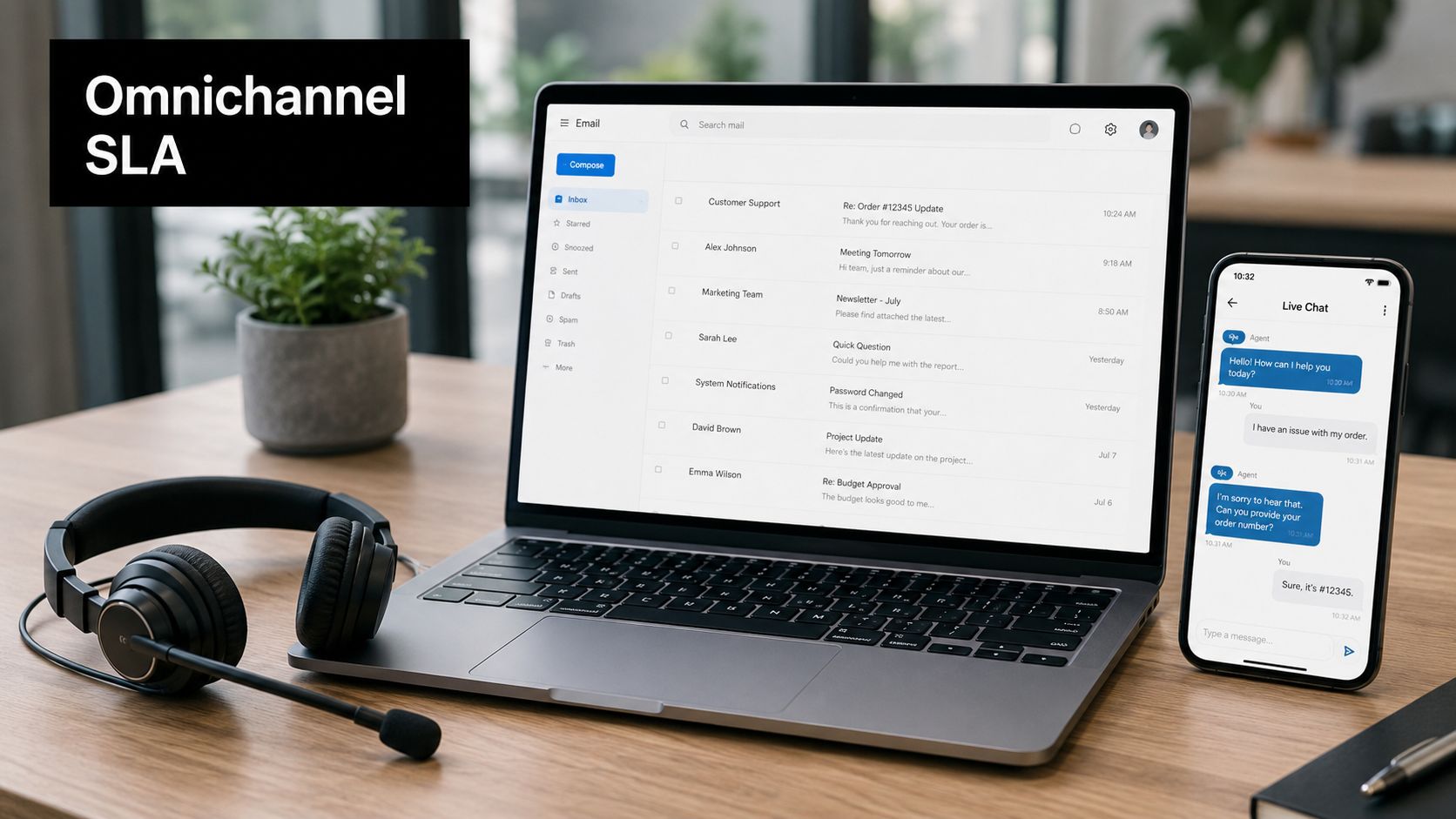
A strong omnichannel example of SLA design guarantees continuity across voice, chat, email, SMS, and other surfaces without pretending every channel works the same way. Voice needs tighter responsiveness. Email can tolerate longer cycles. What shouldn't vary is identity, context, policy application, and ownership of the issue.
Consistency matters more than symmetry
A common mistake is forcing identical targets across every channel. That sounds fair, but it usually creates bad operations. Voice queues and asynchronous email workflows behave differently, and customers judge them differently too.
What does need consistency is orchestration. If someone starts in chat, escalates to voice, and receives follow-up by email, the case history should persist. The SLA should require preserved context, linked records, and one accountable workflow across channels.
A customer will forgive a channel shift. They won't forgive repeating the same problem three times.
That's where agentic orchestration changes the model. The agreement can specify that the AI not only responds, but also selects channel transitions, triggers follow-up tasks, and routes to the right queue based on severity or customer status. That's a very different operating model from a simple chatbot bolted onto a help desk.
Clauses that prevent cross-channel chaos
Keep the template practical:
- Channel-specific response rules: Define different service targets by channel without breaking the overall case SLA.
- Shared customer profile: Require synchronization with systems such as Salesforce, Zendesk, or HubSpot when those systems are part of the workflow.
- Context persistence: Handoffs between channels must preserve conversation history and prior actions.
- Brand and policy consistency: Answers should reflect the same approved knowledge and compliance rules everywhere.
A utilities provider, for example, may take outage reports by voice, send status updates by SMS, and close the loop by email. A retail brand may begin with web chat, confirm by voice, and resolve with an order update message. The SLA should describe the service journey, not just the entry point.
Here's a useful product walkthrough related to omnichannel orchestration:
5. Employee Experience EX Service SLA
Internal SLAs are usually underwritten by optimism. HR, IT, and operations teams assume employees will tolerate fuzzy expectations that no customer would accept. They won't. Employees remember broken onboarding, slow leave approvals, and benefit questions that bounce between systems.
An EX-focused example of SLA language should treat internal support as a real service operation. That means clear intake channels, identity-aware workflows, escalation rules for sensitive topics, and separate standards for informational requests versus approvals that depend on managers or compliance review.
Internal support deserves the same rigor
The best EX SLAs start by splitting request types. Policy lookups, onboarding steps, benefits guidance, and shift-change questions can often be automated cleanly. Compensation disputes, disciplinary issues, and protected health or payroll matters need tighter controls and human oversight.
That split is where agentic AI helps. The system can handle high-volume routine requests, gather required information, and route exceptions without making HR staff read every inbound message manually. But the SLA has to codify that boundary so no one assumes “automation” means “everything.”
What to include for HR and IT workflows
I'd structure an EX SLA around employee trust as much as speed. Internal users need to know when the system is giving general guidance versus taking official action that affects pay, leave, or access rights.
Useful clauses include:
- Authentication requirements: Employees should be verified before the system reveals or changes sensitive information.
- Sensitive topic rules: Certain categories require human review regardless of AI confidence.
- System-of-record priority: The HRIS or ITSM platform remains authoritative when there's a conflict.
- Employee feedback loop: Satisfaction and repeated friction points should feed retraining and workflow redesign.
A manufacturing firm may automate onboarding checklists and policy questions. A healthcare employer may automate scheduling inquiries while restricting anything involving licensure, credentials, or protected employee data. A financial services team may automate expense intake but require manual approval chains. The SLA should mirror those realities.
6. Regulated Industry SLA
In regulated environments, vague SLA language creates legal exposure fast. “Secure” isn't enough. “Compliant” isn't enough. You need obligations that map to data handling, access control, auditability, and escalation.
The verified research for this topic explicitly notes that HIPAA and GDPR contexts require SLAs to include real-time data processing thresholds for voice interactions, not just binary availability. That's a useful correction for teams that still buy AI services using software-era uptime language while ignoring what happens inside the interaction.
Compliance language can't be an afterthought
A regulated industry SLA should specify where data flows, who can access it, what gets logged, and how incidents are reported. For healthcare, banking, insurance, and utilities, those terms belong in the operating document, not hidden in a security appendix nobody reads during an incident.
If payment flows or card-adjacent processes are involved, make sure procurement and security teams read the same operational terms. Yellow.ai has relevant material on PCI-DSS v4.0.1 compliance requirements, and it's worth aligning SLA language with those practical controls rather than leaving compliance to broad vendor assurances. In healthcare settings, teams should also think about ensuring healthcare data regulatory compliance at the workflow level, not just the storage layer.
A safer regulated industry template
The strongest regulated SLAs usually include:
- Data handling scope: Which interaction types may include sensitive data, and how they're processed.
- Access controls: Role-based access, approval flows, and audit visibility for sensitive actions.
- Logging and retention: What is recorded, where it's stored, and who can retrieve it during review.
- Incident procedure: Notification obligations, investigation steps, and remediation ownership.
Don't let legal teams sign an SLA that promises availability while saying almost nothing about data movement, consent, or auditability.
The industries differ, but the pattern is the same. A hospital needs protected patient interactions handled correctly. A bank needs secure authentication and fraud-aware escalation. An insurer needs consent-aware service and traceable decision support. The SLA should express those duties in operational language that the delivery team can execute.
7. Escalation and Handoff SLA
Automation succeeds or fails at the moment it stops being automated. That's why handoff deserves its own example of SLA structure.
Many teams bury escalation inside a broader support document. I think that's a mistake. If the AI can't resolve the issue, the customer experience now depends on how fast a human joins, how much context survives, and whether the next person starts from zero.
Bad handoffs destroy good automation
The escalation clause should define triggers, response ownership, and context transfer. Without those terms, the AI may technically “escalate” while the customer sits in a new queue with no usable history attached.
This is also where agentic systems change the playbook. The AI doesn't just notify a human. It can summarize the issue, attach prior actions, classify urgency, and route to the right specialist. Your SLA should require that behavior when the platform supports it.
The handoff terms that matter
Write this section with operational precision:
- Escalation triggers: Low confidence, repeated failure, high-risk intent, sentiment deterioration, or explicit customer request.
- Context package: Conversation summary, customer identity, prior verification, actions already attempted, and linked records.
- Queue ownership: Name the team that inherits the SLA clock after handoff.
- Warm transfer standard: Require the AI to introduce the handoff and explain the next step when the channel supports it.
The verified research on agentic enforcement is especially relevant here. It states that a 2025 McKinsey study found 54% of Fortune 500 companies now deploy AI agents to enforce SLAs, reducing breach resolution time by 72% compared with traditional methods. That matters because escalation is no longer just a support workflow. It's also a compliance and enforcement workflow, with AI watching the timers, triggering remediation, and documenting breaches in real time.
7-Point SLA Comparison Guide
| SLA Type | Implementation Complexity 🔄 | Resource Requirements ⚡ | Expected Outcomes 📊 ⭐ | Ideal Use Cases 💡 | Key Advantages ⭐ |
|---|---|---|---|---|---|
| Customer Support SLA – First Response Time & Resolution | Moderate, priority tiers, multichannel tracking, escalation rules | Moderate–High, staffing, CRM/ticket integrations, monitoring | Faster acknowledgements, higher FCR & CSAT; ⭐⭐⭐⭐ | SaaS support, retail, telecom with high ticket volumes | Sets clear expectations; measurable performance; omnichannel orchestration |
| Availability & Uptime SLA – System Reliability Guarantee | High, multi-region redundancy, failover, maintenance coordination | Very High, infrastructure, 24/7 monitoring, incident response teams | Minimized downtime, business continuity, service credits; ⭐⭐⭐⭐⭐ | BFSI, healthcare, payments, mission-critical platforms | Reliability, customer trust, reduced revenue loss from outages |
| AI Agent Resolution Quality SLA – Accuracy & Customer Satisfaction | High, continuous model training, testing pipelines, intent validation | High, labeled data, MLOps, multi-LLM orchestration, analytics | Higher autonomous resolution, fewer escalations, consistent accuracy; ⭐⭐⭐⭐ | E‑commerce FAQs, symptom triage, billing/ fraud triage | Reduces ops cost, improves consistency, identifies retraining needs |
| Omnichannel Service Delivery SLA – Consistent Experience Across Channels | Very High, unify channels, context carryover, identity resolution | High, integrations, unified profiles, orchestration platform | Consistent cross‑channel experience, fewer repeat interactions; ⭐⭐⭐⭐ | Retail, telecom, healthcare with multi‑channel journeys | Channel flexibility, seamless handoffs, consolidated reporting |
| Employee Experience (EX) Service SLA – HR & Internal Support | Moderate, HRIS integration, secure auth, business‑hour policies | Moderate, HR connectors, privacy controls, knowledge base | Reduced HR workload, faster employee resolutions, better eSAT; ⭐⭐⭐ | Large enterprises with heavy internal support (tech, manufacturing) | Lowers cost per interaction, speeds onboarding, enforces policy consistency |
| Regulated Industry SLA – Healthcare, BFSI, and Compliance Guarantees | Very High, compliance controls, audit trails, data residency constraints | Very High, compliance teams, secure infrastructure, audits | Regulatory compliance, audit readiness, reduced legal risk; ⭐⭐⭐⭐⭐ | Healthcare, banking, insurance, government | Legal protection, customer trust, certified security posture |
| Escalation & Handoff SLA – Seamless Human-AI Collaboration | Moderate, define triggers, context passing, routing & warm‑handoff rules | Moderate, contact center integration, specialist staffing, callbacks | Faster specialist resolution, fewer repeats, improved satisfaction; ⭐⭐⭐⭐ | Any AI contact center with complex cases (e‑commerce, banking) | Smooth human‑AI collaboration, reduced handle time, preserved context |
From Agreement to Action Implementing Your Modern SLA
The strongest SLA isn't the one with the most clauses. It's the one your teams can run every day without arguing over definitions.
That's the practical shift leaders need to make now. Stop treating the SLA as procurement paperwork and start treating it as an operating system for service quality. If your agreement doesn't describe how AI resolves, escalates, logs, and recovers, it's already behind the way enterprise service works.
Start with one service line. Customer support is usually the cleanest entry point because the failure modes are easy to see. Response speed, routing quality, knowledge accuracy, and escalation performance all show up quickly in production. If employee support is your bigger pain point, pilot there instead. HR and IT workflows often reveal governance gaps faster than customer-facing teams expect.
Use baseline performance first, then negotiate. Don't begin with wishful targets. Measure what your current tools, teams, and workflows can reliably deliver. Then raise the bar where automation substantially changes capacity or consistency. That's also the right moment to define which obligations belong to the platform, which belong to your internal team, and which depend on external systems such as CRM, telephony, identity, or ticketing.
This is also where many companies should rethink reviews. Annual SLA review cycles are too slow for agentic systems. Prompts change. knowledge bases change. escalation patterns change. Compliance expectations change. The agreement needs a standing review cadence tied to operational data, not just contract renewal dates.
A modern example of SLA governance also needs remediation that's more than credits. Service credits matter, but they don't fix a broken workflow. Real remediation includes root-cause review, workflow redesign, escalation rule changes, knowledge corrections, and test coverage for previously failed scenarios. For many enterprises, that's where the biggest gains come from.
Leaders negotiating provider contracts can also learn from adjacent service disciplines such as negotiating PEO service agreements, where enforcement language, accountability boundaries, and review structure often matter more than headline promises. The same principle applies here. Precision beats aspiration.
If you're evaluating platforms, look for one that can support the SLA you want to enforce. That means analytics, orchestration, testing, integration depth, and compliance features need to exist in the product, not just in sales language. Yellow.ai is one relevant option for teams building AI-led CX and EX operations because the platform supports agentic workflows, omnichannel orchestration, analytics, and enterprise integrations that map well to the kinds of SLAs described above.
Pick one area, draft the pilot agreement, run it, and revise it with real evidence. That's how an SLA stops being a contract artifact and becomes a management tool.
If you're building AI-driven SLAs for customer support, employee service, or regulated workflows, explore Yellow.ai to see how agentic AI, orchestration, analytics, and enterprise integrations can support the service commitments you want to enforce.



