














Your team may already be living this problem. A new AI service is ready for launch in Europe, the UAE, and Asia. Product says the bot is trained, security says the cloud provider has regional hosting, and operations wants one global disaster recovery plan to keep response times low. Then legal asks a simple question: where will the conversation logs, voice recordings, employee requests, and backup snapshots live during normal operations, failover, and support access?
That's where many enterprise programs stall. Not because they ignored compliance, but because they treated data residency as a procurement checkbox instead of an operating model. In CX and EX systems, data moves continuously across channels, analytics pipelines, model workflows, observability tools, and recovery environments. If one of those paths crosses a border the law doesn't allow, the architecture may be efficient and still be non-compliant.
Data residency requirements sit at the intersection of law, cloud design, platform operations, and customer trust. For enterprises running conversational AI, contact center automation, employee support agents, or regulated workflow automation, the challenge isn't picking a region once. It's proving that data stays where it's supposed to stay, all the time.
Table of Contents
- What Are Data Residency Requirements
- Key Data Residency Regulations by Jurisdiction
- The Business Impact and Risks of Non-Compliance
- Legal Mechanisms for Cross-Border Data Transfers
- Technical Solutions and Architecture Patterns
- Your Enterprise Data Residency Compliance Roadmap
- Continuous Monitoring and Future-Proofing Your Strategy
What Are Data Residency Requirements
Data residency requirements are rules that determine where certain data must be stored, and in many cases processed, so an organization stays within the legal boundaries of a specific jurisdiction. The issue sounds narrow until you apply it to a live enterprise platform. A customer support conversation may begin in one country, trigger an AI workflow in another, write logs to a third region, and replicate backups somewhere else entirely.
For enterprise leaders, it helps to separate three related ideas that are often used as if they mean the same thing. They don't.
Three terms leaders often mix up
Data residency is about location. It answers: where is the data stored, and sometimes where is it processed?
Data sovereignty is about legal authority. It answers: which country's laws govern the data and who can compel access to it?
Data localization is the strictest form. It means the law requires data to stay inside a country's borders, often with limited or heavily controlled transfer options.
A simple way to frame it is to think about physical records. Residency is the building where the files are kept. Sovereignty is the legal system that controls those files. Localization is the rule that says the files can't leave the country at all.
Practical rule: If your architecture team can name the cloud region but can't explain the legal path for transfers, access, backups, and support operations, you don't yet have a data residency strategy.
Why this becomes a board-level issue
Data residency requirements aren't just a matter for infrastructure teams. They affect market entry, procurement, incident response, customer contracting, and service design. A CX platform that stores transcripts centrally may be acceptable in one market and prohibited in another. An EX workflow for HR or IT support may cross into regulated employee data without anyone realizing it.
The mistake that causes the most trouble is assuming primary storage is the whole story. In reality, regulators, auditors, and customers increasingly care about the entire data lifecycle. That includes collection, processing, caching, analytics, backup, failover, and deletion. If even one of those layers breaks the rule, the organization may still be out of compliance.
Key Data Residency Regulations by Jurisdiction
A platform can be compliant at noon and exposed by 12:05 p.m. if traffic fails over to the wrong region, a support engineer accesses production data from abroad, or a downstream AI service trains on records outside the approved boundary. That is why jurisdictional analysis has to map to operating behavior, not just primary hosting.
The legal rules vary by market, but the practical question is consistent. What data must stay local, what data can move under conditions, and what breaks compliance during routine operations such as backup, disaster recovery, model tuning, analytics, and vendor support?
A quick regional view
The United States generally regulates by sector, state, and contract rather than through a single federal localization rule. The European Union permits transfers, but only through a lawful mechanism and with protections that satisfy GDPR. China and Russia impose stricter localization requirements for covered data. Saudi Arabia also applies tighter controls in several regulated contexts. The UAE takes a sector-specific approach, including local hosting expectations for certain financial records, as outlined in Signzy's regional overview of data residency laws.
For enterprise leaders, those differences change architecture choices. A market governed by transfer controls may allow a centralized platform with tight legal and technical safeguards. A market with localization rules often requires local storage, local operations, and tested restrictions on replication and administrative access.
| Jurisdiction | Governing Regulation(s) | Core Mandate | Applies To |
|---|---|---|---|
| European Union | GDPR | Cross-border transfers require a lawful transfer mechanism and adequate protection in the receiving environment | Personal data of individuals in scope of GDPR |
| United States | Sector-specific frameworks and state laws | No single federal localization rule. Requirements depend on sector, state, contract, and regulator expectations | Varies by industry and data category |
| China | Cybersecurity Law, Data Security Law, PIPL | Localization and security assessment requirements apply to covered personal information and important data, especially in regulated or high-volume scenarios | Personal information and important data in scope under Chinese law |
| Russia | Federal Law No. 242-FZ and related personal data rules | Covered personal data must be initially collected and stored in databases located in Russia | Personal data covered by Russian law |
| Saudi Arabia | PDPL and sector requirements | Cross-border transfers are restricted and local handling expectations can apply depending on the data and sector | Personal and regulated data under local law |
| UAE | Central Bank and sector frameworks | Certain regulated entities, particularly in financial services, face local storage obligations for customer and transaction records | Banking, financial services, payment data, and related records |
| India | DPDPA 2023 and implementing rules | Transfer rules depend on the government's approach to restricted jurisdictions and future implementation details | Personal data in scope under final rules |
What leaders need to understand by market
European Union
The EU model is about transfer governance, accountability, and risk controls across the full data lifecycle. Hosting in an EU region helps, but it does not close the issue if call recordings, chat transcripts, employee tickets, telemetry, or AI prompts are later accessed or processed elsewhere.
In practice, continuous compliance becomes operational. A CX provider may keep production data in Dublin but still send logs to a U.S. observability tool, allow after-hours support from another region, or restore backups into a non-EU recovery environment during an outage. Each of those actions can create a separate transfer question. Teams building GDPR programs often use a working control list such as the UTMStack GDPR checklist to test vendors, subprocessors, access paths, and recovery workflows against actual obligations.
United States
The U.S. gives architects more flexibility, but that flexibility is uneven. Healthcare, financial services, public sector work, and large enterprise procurement often impose residency terms through contracts, supervisory expectations, or state-specific privacy obligations.
In practice, many CX and EX platforms still end up with location constraints because buyers require them. A contact center deployment serving a federal contractor, a hospital, and a multinational bank may face three different data handling rules even if none comes from a single federal localization statute.
China
China requires more than regional preference. The combination of the Cybersecurity Law, the Data Security Law, and PIPL can trigger domestic storage, security assessment, and tightly controlled transfer requirements for covered personal information and important data, as explained by DLA Piper's overview of data protection laws of the world for China.
For AI-enabled CX systems, this affects more than the database. Speech analytics, centralized model improvement, cross-border admin access, and offshore disaster recovery can all create friction with the local operating model. Standard global patterns usually need redesign.
Russia
Russia's rules are often summarized too loosely. The practical issue is initial collection and storage of covered personal data in databases located in Russia. That has direct consequences for web forms, employee portals, customer onboarding flows, and any SaaS workflow that writes first to a global environment before syncing locally.
Architects should test where the first write occurs, where replicas sit, and whether support tools create parallel copies outside the country.
Saudi Arabia and UAE
These markets reward precision. Saudi Arabia's transfer restrictions and local regulatory expectations can be stricter in practice than a generic regional deployment plan assumes. In the UAE, the answer depends heavily on sector and regulator. Financial services is the clearest example, where local record storage requirements can affect core CX systems, payment support workflows, and fraud operations.
A “Middle East region” answer is often too broad for regulated use cases.
India
India is still a policy watchpoint. The law is in place, but implementation details will determine how restrictive outbound transfers become. That uncertainty matters for procurement and platform design because it affects contract clauses, recovery patterns, and whether teams should build for local containment from the start.
The operational lesson across all of these jurisdictions is straightforward. Data residency is not a one-time hosting decision. It is a continuous control problem that has to survive failover, vendor changes, feature releases, AI workflow updates, and emergency response.
The Business Impact and Risks of Non-Compliance
A common failure pattern looks routine at first. A CX platform is launched with in-region production storage, then a disaster recovery test routes traffic to another geography, support pulls live transcripts for troubleshooting, and an AI evaluation workflow copies samples into a central environment. The platform still appears healthy. The compliance posture does not.
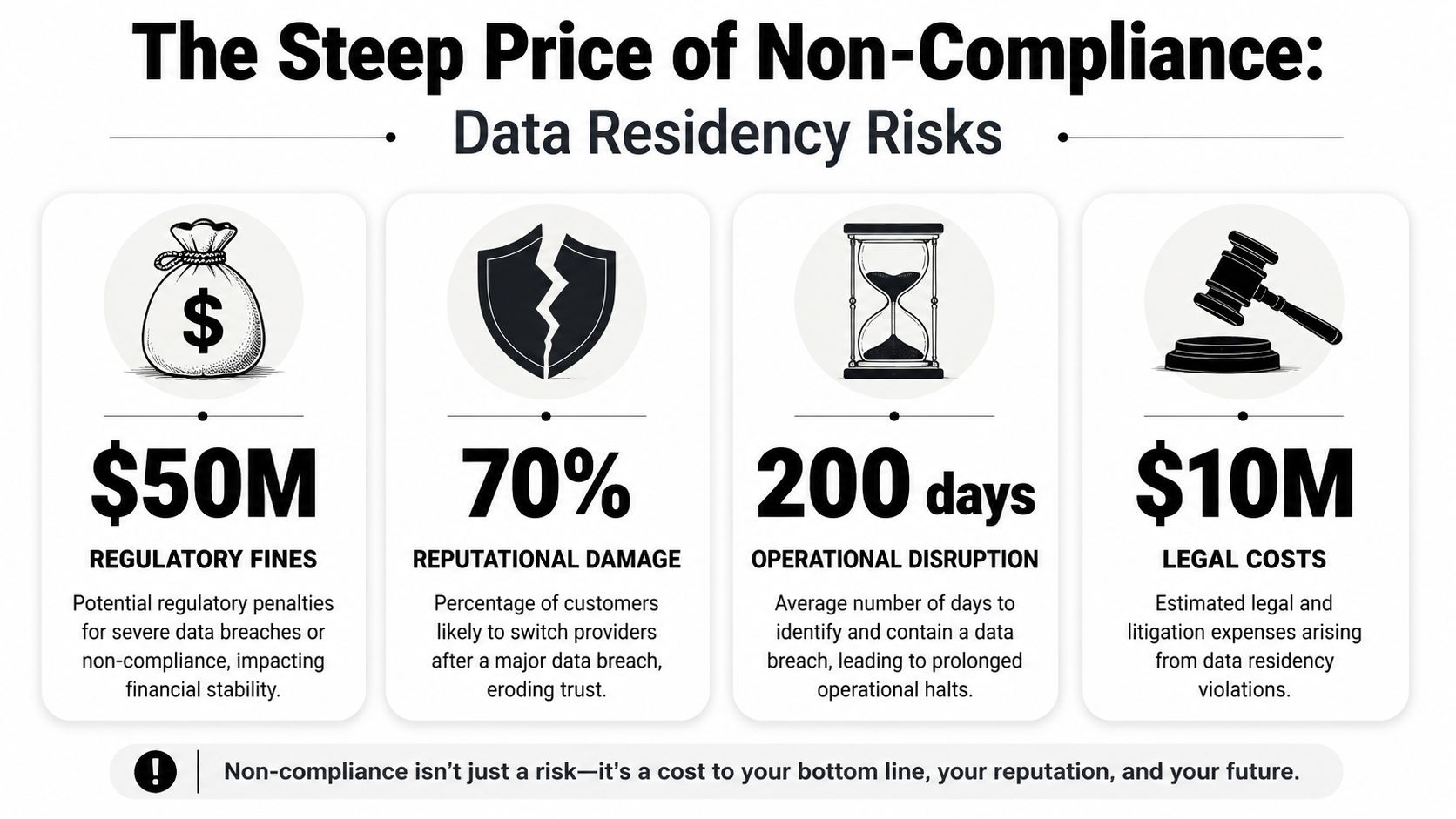
Data residency failures rarely stay inside the compliance function. They affect revenue, operations, customer trust, and in some cases whether the business can keep serving a market. Regulators can impose material penalties for unlawful storage or transfer practices, and sector regulators may go further by restricting operations, forcing remediation, or challenging the use of affected systems. For enterprise leaders, the risk is not limited to a fine. It is loss of control during a live service event.
Why the legal risk becomes an operating risk
Residency breaches usually surface during moments of change. Failover. Incident response. Vendor troubleshooting. A new analytics connector. An AI feature release that introduces a new prompt store or model logging path. Those are operational events, but they trigger legal exposure because they change where data is processed, copied, or accessed.
That matters more in AI-enabled service environments than in static systems. Contact centers, employee support platforms, agent assist tools, and knowledge systems generate a steady flow of transcripts, recordings, session metadata, summaries, sentiment outputs, prompts, quality reviews, and audit logs. If even one of those data paths leaves the permitted geography without the right legal and technical controls, the organization may have to suspend processing, ring-fence data sets, or disable parts of the service while teams investigate.
For customers and employees, that disruption is visible. Wait times increase. Automation quality drops. Supervisors lose reporting. Regional teams fall back to manual processes. Trust erodes faster when the affected system is customer-facing or tied to HR workflows.
Where CX and EX platforms are exposed
The highest-risk gaps are usually built into normal platform operations:
- Conversation storage: Chat, email, and voice records often contain personal, financial, health, or employee data that triggers local handling rules.
- Observability pipelines: Centralized logs, traces, and screen recordings can move regulated data outside the approved region without product teams noticing.
- Model operations: Evaluation, tuning, red-teaming, and debugging workflows often rely on production samples. Those samples are frequently copied to separate environments.
- Support access: Remote access by vendor or contractor teams can create cross-border processing even if the primary database stays local.
- Backups and disaster recovery: Secondary replicas and restore procedures are one of the first places residency controls fail under pressure.
- Exports and integrations: BI tools, CRM connectors, data lakes, and archive jobs often bypass the controls applied to the core application.
The most expensive pattern is late discovery.
An enterprise signs contracts that promise local processing, then learns during an audit, customer diligence review, or outage that recovery replicas, logging tools, or AI operations sit elsewhere. At that point, remediation becomes a business interruption issue. Teams have to redesign architecture, renegotiate customer commitments, update documentation such as a published privacy policy for AI and customer experience workflows, and prove that the new control set works during failover, not just in steady-state production.
Reputational damage follows quickly because residency claims are testable. If the company says data stays in-country or in-region, procurement, auditors, and regulators will ask for evidence. Architecture diagrams are not enough. They will want logs, access records, backup locations, subprocessors, and proof that emergency operating procedures do not override the stated policy.
In practice, non-compliance is rarely a single bad decision. It is a control gap that persists across releases, regions, vendors, and recovery events. That is why mature teams treat data residency as continuous compliance for a living platform, not a one-time infrastructure choice.
Legal Mechanisms for Cross-Border Data Transfers
Global operations still need lawful ways to move data. The key is to use the right legal mechanism for the right transfer pattern, then make sure the architecture matches the legal paperwork.
The practical decision path
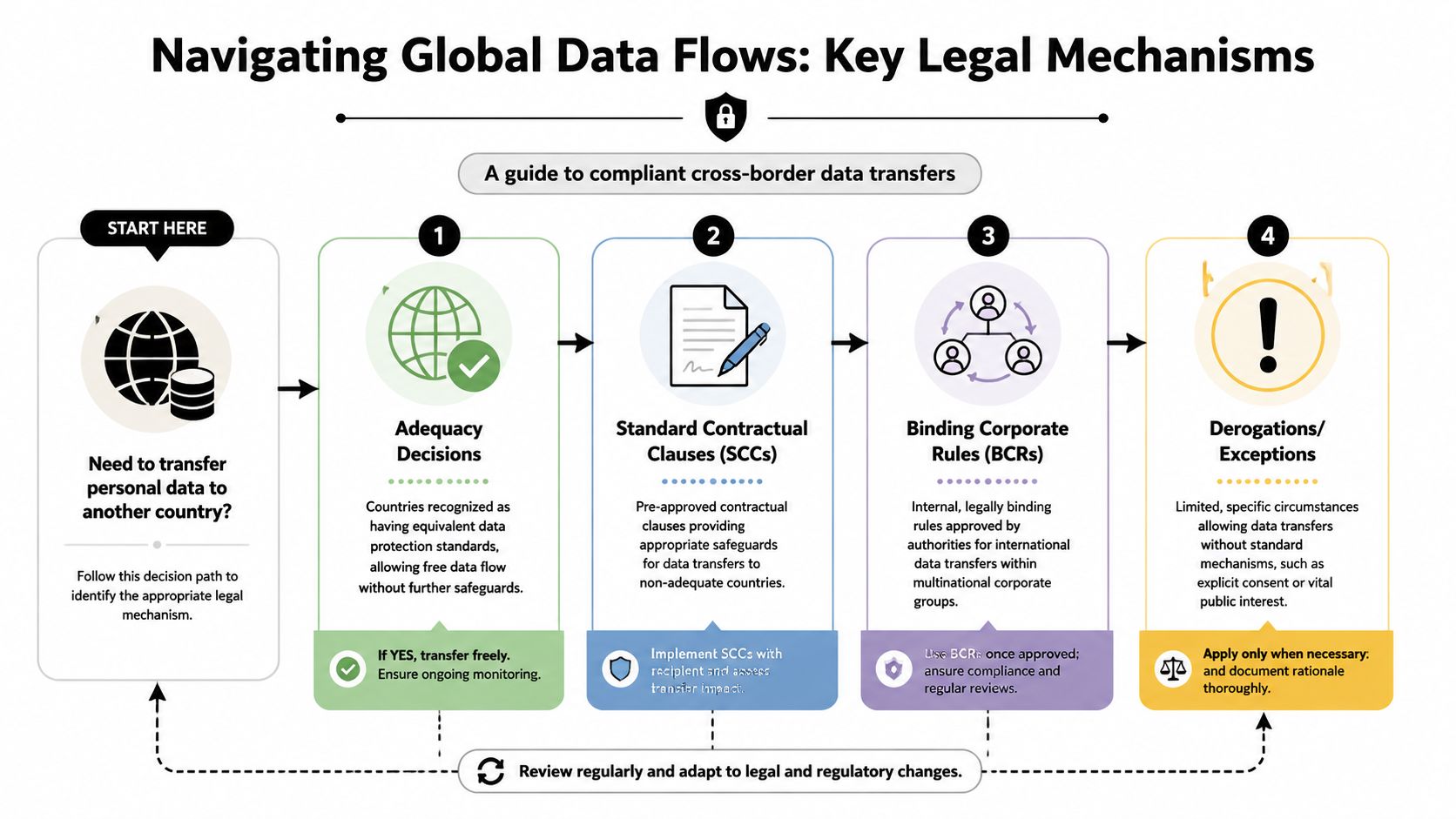
Adequacy decisions are the simplest route where they exist. If a destination country is recognized as providing an adequate level of protection under the relevant legal framework, transfers can move with fewer additional safeguards. For enterprise teams, this is the closest thing to a fast lane.
Standard Contractual Clauses, or SCCs, are the workhorse for many transfers to countries that don't benefit from adequacy. They create contractual obligations between parties, but they aren't magic language that fixes weak operational controls. If the architecture still permits uncontrolled replication, broad support access, or opaque sub-processing, SCCs won't rescue a poor design.
Binding Corporate Rules, or BCRs, are the more mature path for multinational groups moving data within the same corporate family. They're demanding to establish, but they can create a more durable intra-group framework than stitching together transfer clauses for every internal flow.
Derogations and exceptions exist for specific situations, but they should be treated as narrow tools, not a foundation for large-scale platform design.
What legal teams should verify in contracts
The transfer mechanism should map to real processing paths. That means contracts and technical diagrams must line up on at least five points:
- Storage location. Where primary and secondary copies live.
- Processing location. Where analytics, AI operations, and support activity occur.
- Sub-processors. Which downstream vendors touch the data.
- Access rights. Who can access data remotely, from where, and under what approval model.
- Recovery operations. Whether failover and restoration remain inside approved boundaries.
A privacy policy is not a substitute for transfer due diligence, but it does show how a provider frames data handling and obligations. Teams evaluating third-party platforms should compare contract promises with publicly stated practices such as a vendor's privacy policy.
Contracts should describe the architecture you run, not the architecture you wish you had.
When legal and engineering teams work separately, SCCs and related mechanisms often get treated as paper exercises. The better approach is to run transfer assessments alongside architecture review, vendor review, and recovery testing. If a transfer only works on paper, it won't survive a regulator, customer audit, or major incident.
Technical Solutions and Architecture Patterns
Strong legal language matters. It doesn't enforce anything by itself. Data residency requirements become real only when the architecture constrains what systems and people can do.
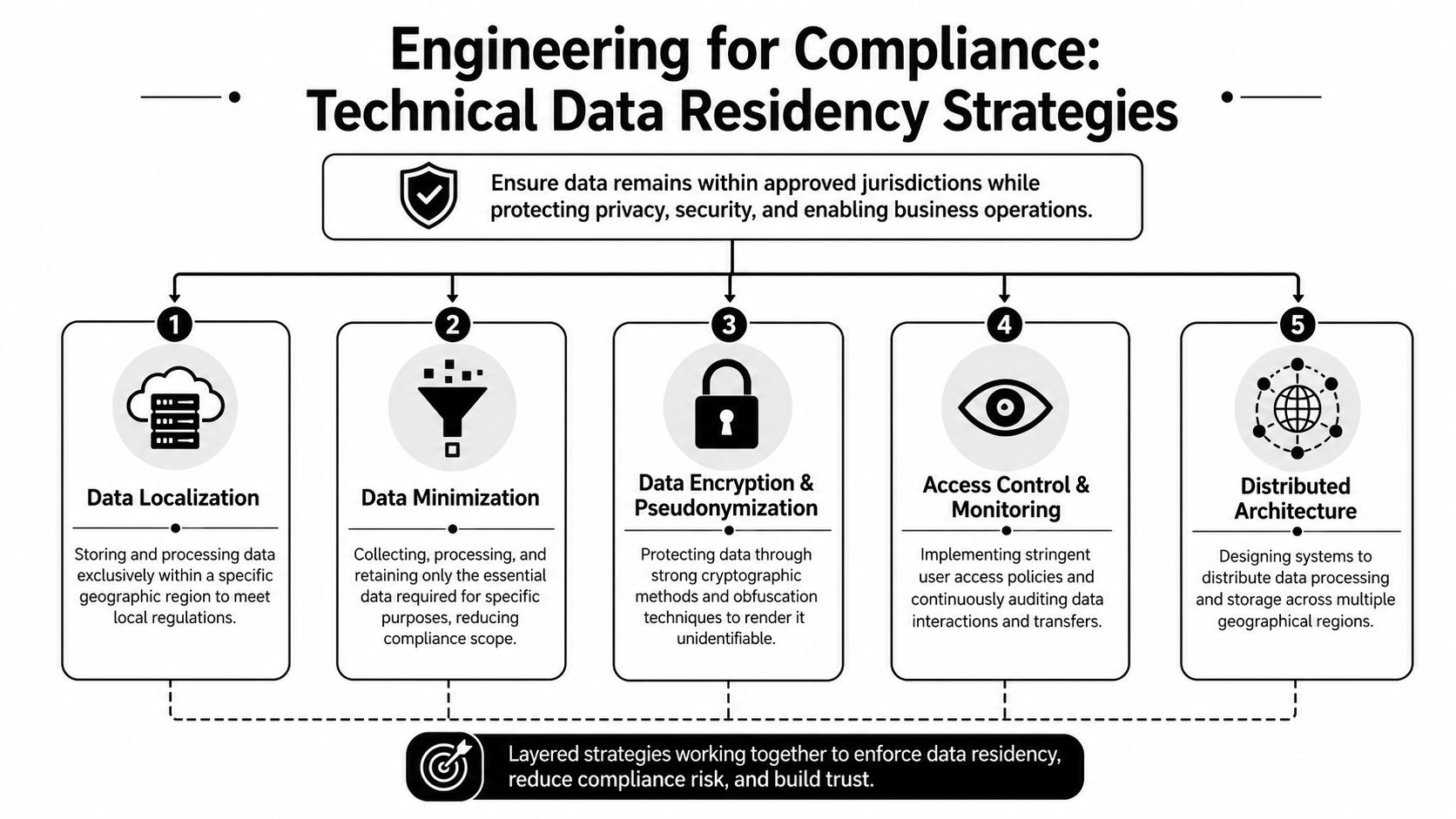
Early in a program, a visual reference helps align engineering, security, and compliance teams around the control stack.
Architecture patterns that work in practice
The most reliable pattern for regulated workloads is the regional pod model. Each jurisdiction, or tightly defined region, gets its own application stack, storage layer, observability plane, and recovery design. This costs more than a globally shared deployment, but it sharply reduces accidental cross-border movement.
A second pattern is central control with regional data planes. Identity, orchestration, and policy management remain centralized, while customer data, transcripts, and regulated records stay in-region. This can work well for CX and EX platforms that need governance consistency without moving sensitive content internationally.
A third option is tokenized global processing. Sensitive data is held in-region, while downstream systems consume tokens, summaries, or de-identified references. This isn't a universal answer because some laws regulate more than obvious identifiers, but it often reduces compliance scope and limits exposure across analytics and AI pipelines.
For teams reviewing highly regulated identity and border use cases, the architectural principles discussed in this piece on biometrics and transnational border safety are useful because they highlight the same tension enterprise platforms face: fast decisions, distributed systems, and strict control over where sensitive records are handled.
Controls that hold up under audit
Good patterns still need hard controls. The controls that tend to survive scrutiny are the ones that are difficult to bypass undetected.
- Region-locked storage: Configure primary databases, object stores, caches, and search indexes so covered data can't be created outside approved regions.
- Geo-fenced processing: Restrict job execution, queue consumers, and workflow runners to approved geographies.
- Local key management: Use encryption at rest and in transit with keys managed in the required jurisdiction.
- Segregated logging: Keep application logs, audit trails, and support telemetry region-specific when they contain regulated fields.
- Fine-grained access control: Limit remote access by role, geography, and approval workflow.
- Immutable audit evidence: Preserve logs that prove where data was stored, processed, and restored during incidents.
A practical benchmark for enterprise buyers is whether the platform exposes clear control surfaces for deployment regions, access restrictions, logging, and encryption. That's the kind of posture described in vendor materials focused on enterprise-grade security capabilities.
This walkthrough is also useful for teams translating policy into implementation detail:
Trade-offs leaders should expect
There is no perfect architecture. There are only trade-offs you understand and govern.
Cost increases when you replicate infrastructure across regions. Shared services become harder to maintain, and local support models may be required.
Operational complexity rises because release management, observability, and incident response now operate across multiple isolated environments.
Latency may improve or worsen depending on design. Regional processing helps end users, but cross-region administration and analytics can become slower if teams insist on centralization.
AI workflows get harder because model evaluation, prompt analysis, and debugging often depend on data access patterns that compliance teams won't allow globally.
The architectures that fail are usually the ones trying to preserve a single global operating model at all costs. The ones that work accept that regulated data needs a jurisdiction-aware design from the start.
Your Enterprise Data Residency Compliance Roadmap
Most enterprises don't need another abstract maturity model. They need a sequence of decisions that legal, security, architecture, procurement, and operations can execute together.
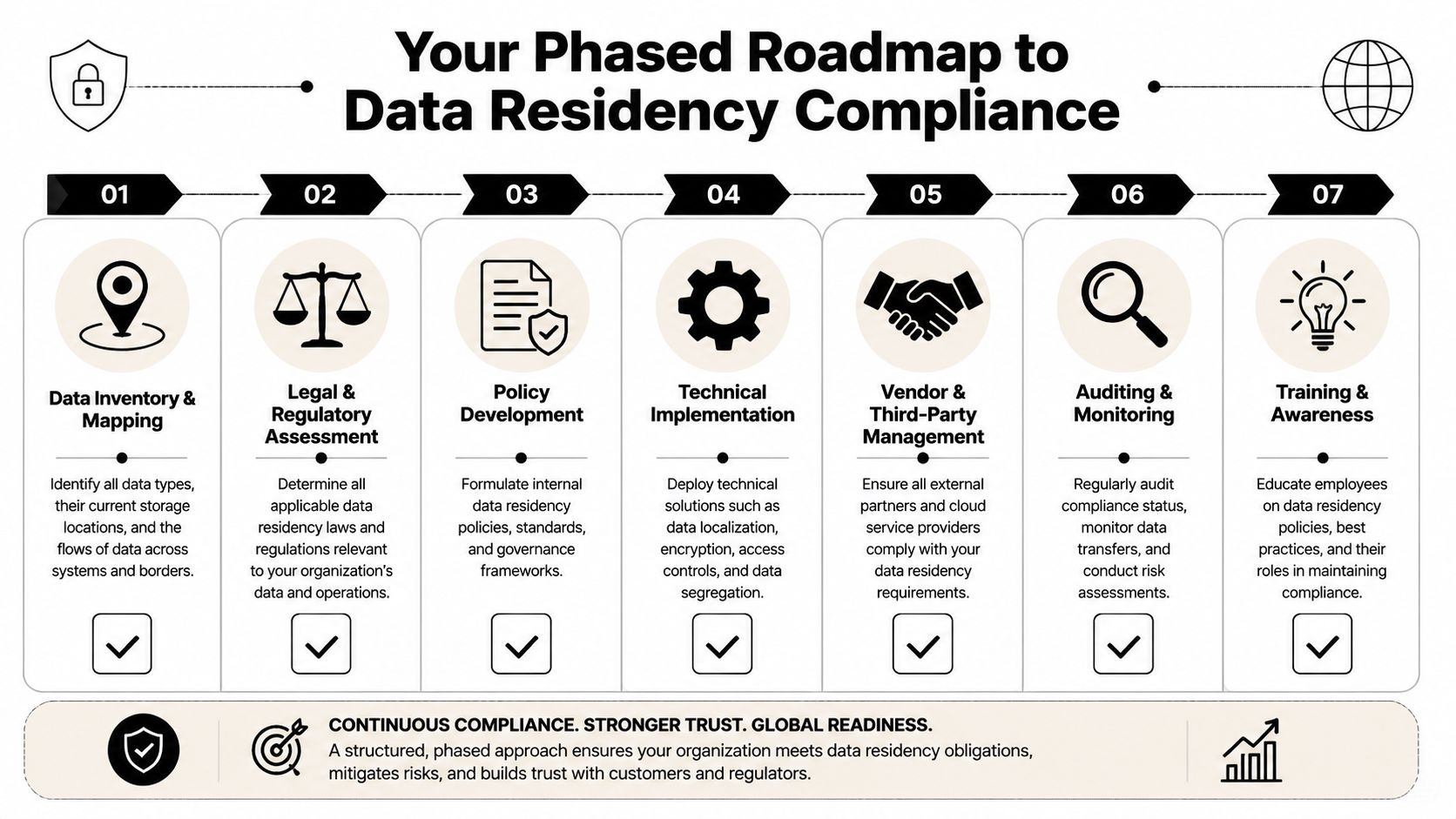
Phase one assess
Start with data discovery, not vendor selection. Many programs get this backward.
Map the data types your CX and EX systems handle. That usually includes conversation content, attachments, payment-related fields, identity attributes, authentication metadata, employee records, and analytics exports. Then map where each category is collected, processed, stored, backed up, and viewed.
A useful assessment asks:
- What data do we hold: Not just labels like “customer data,” but concrete categories such as transcripts, voice files, or HR tickets.
- Which jurisdictions matter: Based on user location, entity structure, sector obligations, contracts, and operating markets.
- Where does data drift: Through logs, support tooling, integration middleware, exports, and recovery systems.
- Who touches it: Internal admins, managed service teams, cloud providers, subprocessors, and support engineers.
Phase two design
Once the map is clear, choose the operating model market by market. Don't assume one pattern fits everything.
Some jurisdictions justify a full regional pod. Others can use regional storage plus lawful transfer mechanisms. Some low-risk workflows may tolerate tokenization or de-identification before cross-border processing. The right answer depends on the law, the data category, and the service expectation.
Vendor selection belongs here, and the questions should be precise:
| Ask the vendor | Why it matters |
|---|---|
| Can we pin storage, processing, logs, and backups to specific regions? | Primary storage alone doesn't prove compliance |
| How is disaster recovery handled by region? | Recovery design is a common source of violations |
| Which subprocessors can access regulated data, and from where? | Support and operations access often create hidden transfers |
| Can we segregate tenants and workloads by jurisdiction? | Shared services can undermine local controls |
| What audit evidence is available for region alignment? | You need proof, not just claims |
A structured buying process helps. Teams reviewing conversational AI vendors can use a framework like this buyer's guide to evaluating conversational AI solutions to pressure-test architecture, security, governance, and deployment fit.
The best vendor question is not “Do you support data residency?” It's “Show us how your backups, logs, support access, and failover stay compliant for our jurisdictions.”
Phase three implement
Implementation should follow the legal model, not the other way around.
Provision region-specific infrastructure. Turn on encryption with local control where required. Separate environments by jurisdiction. Restrict admin access. Review every integration that writes records outside the core platform. Make sure analytics, QA tooling, and exports follow the same rules as production storage.
Run implementation reviews with legal and security present. Engineering teams often close tickets that say “region configured” while log aggregation, archived files, and support workflows still violate the intended boundary.
Phase four govern
Governance is what keeps the design from decaying.
Set policy for approved regions, approved transfer paths, and escalation requirements for exceptions. Train product, platform, and support teams on what they can and can't do. Update procurement language so new vendors don't bypass established controls. Review contract clauses regularly when markets, data categories, or recovery strategies change.
A strong governance model also assigns ownership. Legal interprets obligations. Security defines control standards. Architecture designs the pattern. Operations proves it keeps working. If that chain breaks, data residency becomes everyone's concern and no one's job.
Continuous Monitoring and Future-Proofing Your Strategy
A residency design often looks clean in an architecture diagram and fails the first time operations has to use it under pressure.
The failure point is rarely the primary production region. It shows up in the systems around it: backup snapshots copied by default policies, log streams sent to a central SIEM in another jurisdiction, vendor support sessions that expose records offshore, or a disaster recovery restore that starts in the wrong region because the runbook prioritized recovery time over legal boundaries. For AI, CX, and EX platforms, that risk is continuous because data flows change with every integration, model update, routing rule, and resilience test.
Why static controls fail
Disaster recovery is where many programs discover that residency was configured, but not operationalized. A 2025 report by the Cloud Security Alliance found that 57% of DR testing exercises in 2024 resulted in temporary data residency violations because backup snapshots were automatically routed to non-compliant regions by default cloud settings, according to Teradata's summary of data residency and resilience.
The same Teradata summary of data residency and resilience notes that the EU's 2025 guidance on “resilient data sovereignty” mandates annual failover testing and documentation with immutable logs proving regional alignment.
That is the operational reality. Production controls are only one layer. If failover targets, backup retention, observability tooling, and support access paths are not held to the same jurisdictional rules, the platform can become non-compliant during the exact event when audit discipline is weakest.
Real-time customer and employee systems make this harder. During a service interruption, teams are measured on restoration speed, queue recovery, and user impact. If the architecture gives responders a compliant path and a faster non-compliant path, incident pressure will expose the gap.
What continuous compliance looks like
Continuous compliance treats residency as a live control objective, not a deployment choice. It needs the same operational discipline that enterprises already apply to uptime, security baselines, and change management.
In practice, that means:
- Automated region validation: Continuous checks confirm where data is stored, processed, replicated, and restored across production and recovery environments.
- Region-locked failover policies: Recovery automation, infrastructure templates, and cloud defaults are configured so covered data cannot be restored into disallowed regions.
- Immutable evidence collection: Audit logs capture data location, transfer activity, and failover outcomes in a form legal, security, and internal audit can rely on.
- Change-aware alerting: New integrations, model providers, admin tools, and support workflows trigger review when they introduce a cross-border path.
- Residency-aware DR exercises: Recovery tests verify not only that systems come back online, but that they do so lawfully and with evidence to prove it.
Upon maturing, many enterprise programs stop asking whether the right region was selected at launch and start asking whether the platform can prove compliance after a vendor update, an emergency restore, a routing change, or a regulator request six months later.
For CX and EX leaders, the business impact is direct. A residency breach during failover is not just a legal issue. It can delay incident closure, trigger customer notification duties, disrupt employee service channels, and force teams to choose between availability and compliance in full view of regulators and enterprise buyers.
If the platform can recover only by sending covered data somewhere it should not go, the architecture is unfinished.



