










The CIO has two weeks before the contract goes to signature. The CX vice president wants autonomous agents handling customer conversations; the security team wants proof they can stop those agents from acting outside their permissions. Then the board asks why this proposal deserves approval when a similar platform was rejected last quarter.
The answer can't be another feature matrix. Enterprise AI platforms should be judged on two operational tests: can the organization govern them when something goes wrong, and can it prove measurable ROI for each workflow after launch? A polished demo establishes neither.
Use those tests to evaluate architecture, retrieval, controls, and measurement. The right platform isn't the one with the longest feature list. It's the one your teams can operate safely and whose contribution they can verify.
Table of Contents
- The Selection Moment Every Enterprise Faces
- What an Enterprise AI Platform Is in 2026
- Core Capabilities Compared Across Enterprise AI Platforms
- RAG, Retrieval, and the Cost Quality Latency Frontier
- Governance Under Failure as the Real Readiness Standard
- Adoption Is Not ROI
- Situational Recommendations by CX, EX, and Industry
- A Vendor Evaluation Checklist You Can Take Into the Demo
The Selection Moment Every Enterprise Faces
Picture a procurement committee weighing two agentic platforms. Both can connect to the customer service stack, retrieve internal information, and hand work between AI agents and people. Both promise faster service and lower operating costs. On the demo screen, the difference looks small.
The difference appears when a customer asks for something the agent shouldn't do, a knowledge source contains stale guidance, or a workflow crosses into a system with stricter permissions. One vendor may show how to pause an action, escalate the case, and preserve evidence. The other may show another successful conversation.
That distinction should drive the decision. First, test governability under failure. Ask who owns each agent action, what permissions the agent inherits, when a human must approve the next step, and how the team can reverse an action or investigate an incident. Don't accept “human in the loop” as an answer without seeing how the override works in the actual workflow.
Second, test whether the platform can prove ROI per workflow. A broad automation rate can mask repeated contacts, poor resolutions, or expensive exception handling. Ask how the vendor measures resolution quality, transfers, employee effort, and fully loaded cost for a defined use case. If the platform can't connect its activity to a business outcome, the business case is still a hypothesis.
The comparison table below is a screening tool, not a substitute for testing. Use it to identify which capabilities matter for your environment, then make finalists demonstrate them against representative customer and employee workflows. A vendor that scores well on features but can't show safe recovery or credible measurement shouldn't make it through procurement.
What an Enterprise AI Platform Is in 2026
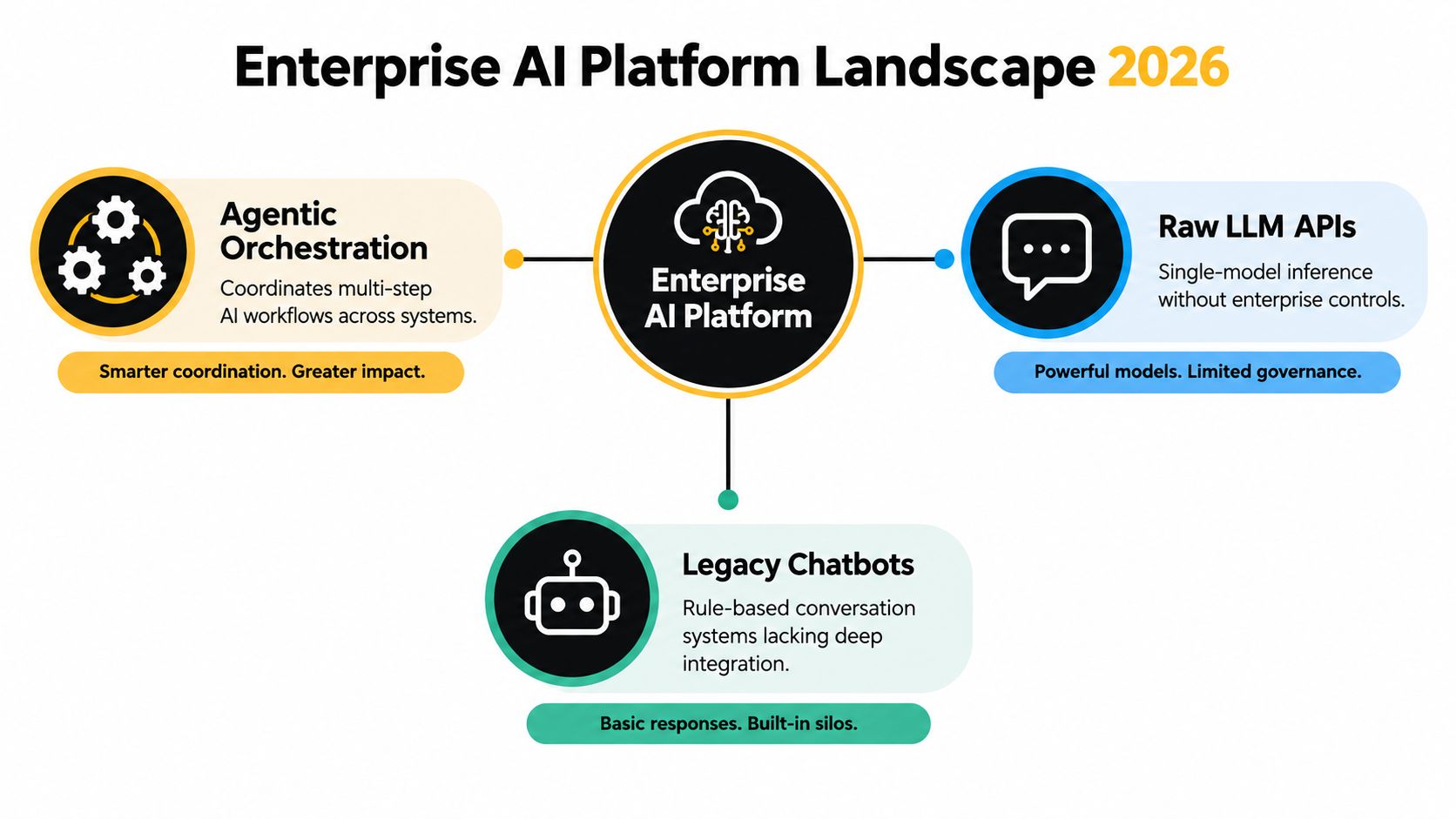
An enterprise AI platform is the operational layer that lets an organization build, connect, govern, deploy, and measure AI-powered workflows. It may include agent design, model access, retrieval from enterprise knowledge, integrations with business systems, controls over actions, and analytics. The essential point is that it coordinates work across models, data, applications, and people.
That makes it different from a raw large language model API. An API provides model inference; the enterprise must still supply the workflow logic, data access controls, monitoring, evaluation, and recovery mechanisms. A legacy chatbot typically follows predefined conversational paths. A single-channel copilot may help a user inside one application but isn't necessarily equipped to orchestrate a process across systems.
Agentic orchestration is the part that coordinates multi-step work: selecting tools, retrieving information, acting within permissions, and escalating when a workflow needs human judgment. It can create value, but it also creates operational obligations. A platform that adds autonomy without visibility into actions and exceptions makes risk harder to track.
Why the platform layer matters
The deployment context has changed. Stanford's 2025 AI Index reported that 78% of surveyed organizations used AI in at least one business function in 2024, up from 55% in 2023, while generative AI use in at least one function rose from 33% to 71%; among organizations using AI in service operations, 49% reported cost savings and 57% reported revenue gains (Stanford's 2025 AI Index). Adoption doesn't prove that any one platform will deliver value, but it does mean the buying decision increasingly concerns operational deployment, not a stand-alone experiment.
A useful platform must make the connections between capability and control explicit: which model answered, which sources it used, which action it took, and what happened next. Buyers who want a broader orientation to agent architecture can find agentic AI referral guides, then use their own workflows to test whether a vendor's design fits the organization's controls.
Core Capabilities Compared Across Enterprise AI Platforms
Don't score a platform by counting features. Score it by the evidence the vendor can produce for your environment. The matrix below turns common RFP categories into demo requirements. Ask every finalist to use the same workflow and evaluation conditions so the committee can compare behavior, not presentation quality.
| Capability | What to Evaluate | Evidence to Request |
|---|---|---|
| Multi-LLM architecture and routing | Whether teams can select or route among models, set workflow-specific policies, and avoid building critical processes around a single provider. | A live configuration showing model choice, routing conditions, fallback behavior, and logs that identify the model used for each interaction. |
| Voice and low-latency inference | Whether the system can handle interruptions, transfers, and natural turn-taking in real contact center conditions. | A voice demonstration using representative network and workload conditions, including handoff behavior and latency measurement. |
| Omnichannel orchestration | Whether the same workflow can operate across voice, chat, and email without losing context or applying inconsistent policies. | A conversation or task moving across channels, with shared history, permissions, and escalation records visible. |
| Agent builder maturity | Whether business owners can shape workflows while technical teams retain control of testing, deployment, and changes. | A build-to-test walkthrough showing versioning, debugging, approval gates, and rollback. |
| Integration breadth | Whether the platform can read and act in the systems your teams actually use, rather than relying on a slide of connector logos. | A working connection to a representative CRM, contact center, service desk, and knowledge source, including error handling. |
| Security and compliance posture | Whether identity, data access, audit records, and retention fit your policies and obligations. | Architecture and control documentation, plus evidence of permission enforcement and action-level auditability. |
| Deployment options | Whether the hosting and network model supports your data boundaries, residency needs, and operating model. | A deployment diagram, data-flow walkthrough, and confirmation of where prompts, outputs, logs, and retrieved content are processed and stored. |
| Enterprise scalability | Whether monitoring, evaluation, and operational support remain usable as workflows and business units expand. | A production operations walkthrough covering monitoring, incident escalation, service reliability, and per-workflow reporting. |
Make the demo prove the architecture
For voice, don't accept a pre-recorded clip. Test interruptions, ambiguous requests, and a transfer to a human who can see the conversation context. For integrations, ask the agent to perform a permitted action, then deliberately test an access boundary. A successful happy path doesn't tell you what the platform does when a dependency fails.
Treat browser-based automation as a distinct integration pattern, not a substitute for a supported API. It can help with systems that lack practical interfaces, but the buyer needs to understand how the agent handles changing pages, authentication, and failed actions. A practical primer on how AI browser agents work can help the team frame those questions before the demo.
No vendor should receive a high score for a claim it can't demonstrate. Record what the platform did, what evidence it exposed, and what required manual intervention. That record is more useful than a feature checklist filled in from sales materials.
RAG, Retrieval, and the Cost Quality Latency Frontier
A platform's retrieval-augmented generation feature isn't a yes-or-no capability. Retrieval determines what information reaches the model, how much work the system performs before answering, and how reliably the answer reflects the organization's documents. The right design depends on the workflow, the size and structure of the corpus, and the consequences of a wrong answer.
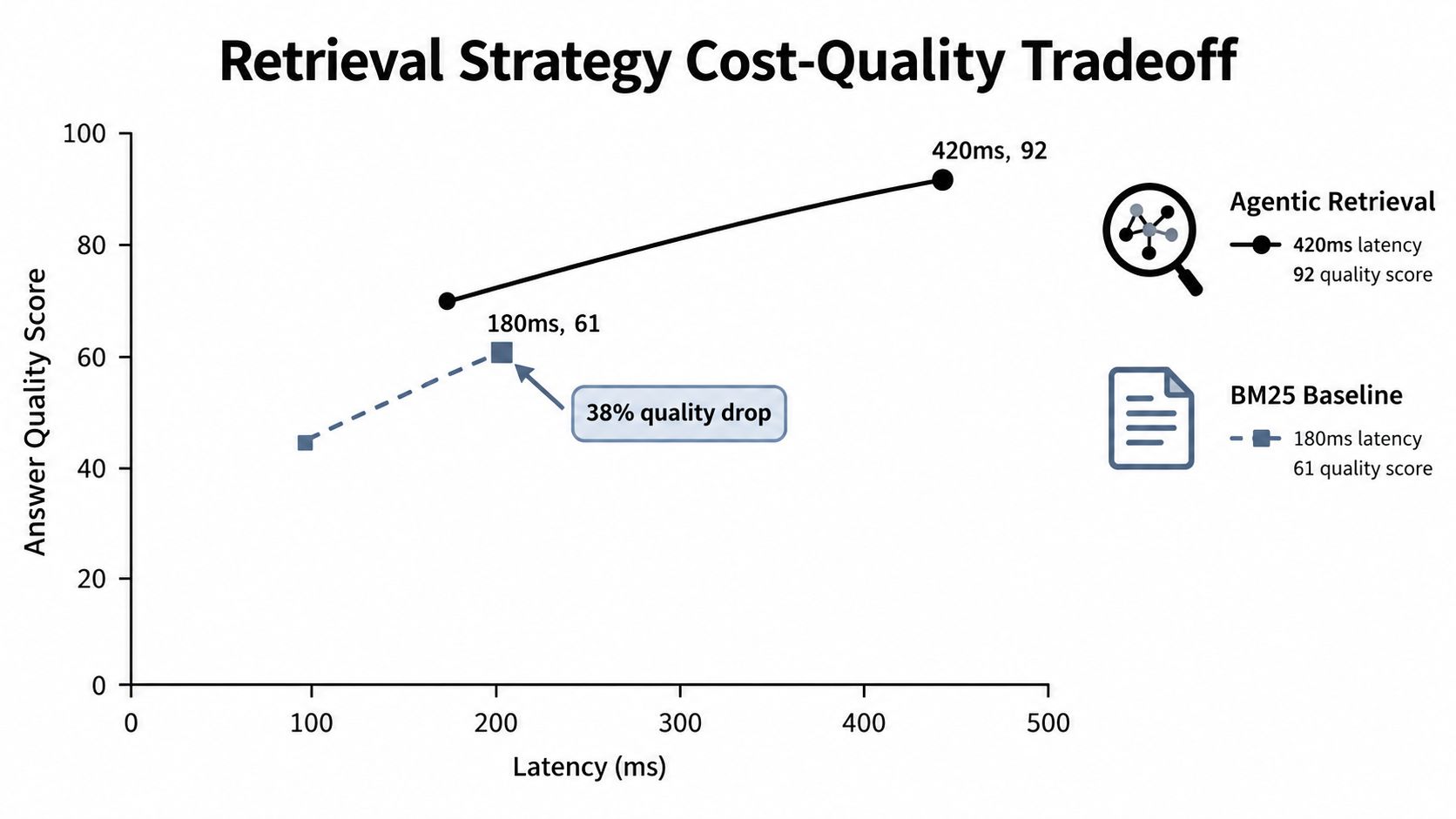
A 2026 controlled enterprise scaling study found that replacing an agentic retrieval strategy with BM25 reduced model calls per question from 36.12 to 5.79 and token usage from 895,000 to 101,000. In the same study, document recall rose from 36.8% to 72.4%, while the combined benchmark score increased from 36.9 to 69.4 (the enterprise scaling study). The result is a useful warning against assuming that more autonomous retrieval is automatically more accurate or more efficient.
Evaluate retrieval as an operating cost
The study's operational lesson isn't that BM25 should replace every agentic design. It's that retrieval needs to be evaluated across quality, cost, and latency together. A fixed retrieval method may be a better fit for a straightforward knowledge lookup; a bounded agent loop may be justified when the task requires choosing among distinct repositories or interpreting complex evidence.
Require vendors to report retrieval recall, answer faithfulness, model calls, prompt and output tokens, and p50/p95 latency for each workflow. Test large corpora and realistic distractors, not just clean benchmark questions. Ask for configurable retrieval policies and cost attribution at the interaction level, so the team can identify which retrieval path consumes resources and whether it improves outcomes.
If the vendor says its RAG layer is proprietary, ask how the team can inspect retrieved passages, evaluate missed documents, and compare retrieval configurations. A grounding approach such as retrieval-augmented generation for enterprise knowledge is only useful when the buyer can test it against the organization's own content, access rules, and failure cases.
Governance Under Failure as the Real Readiness Standard
Enterprise readiness isn't a badge or a compliance page. It's the ability to control an agent when its answer is wrong, its source is stale, a connected system fails, or a user asks it to cross a permission boundary. Buyers should evaluate how the platform behaves under those conditions before they accept claims about autonomy.
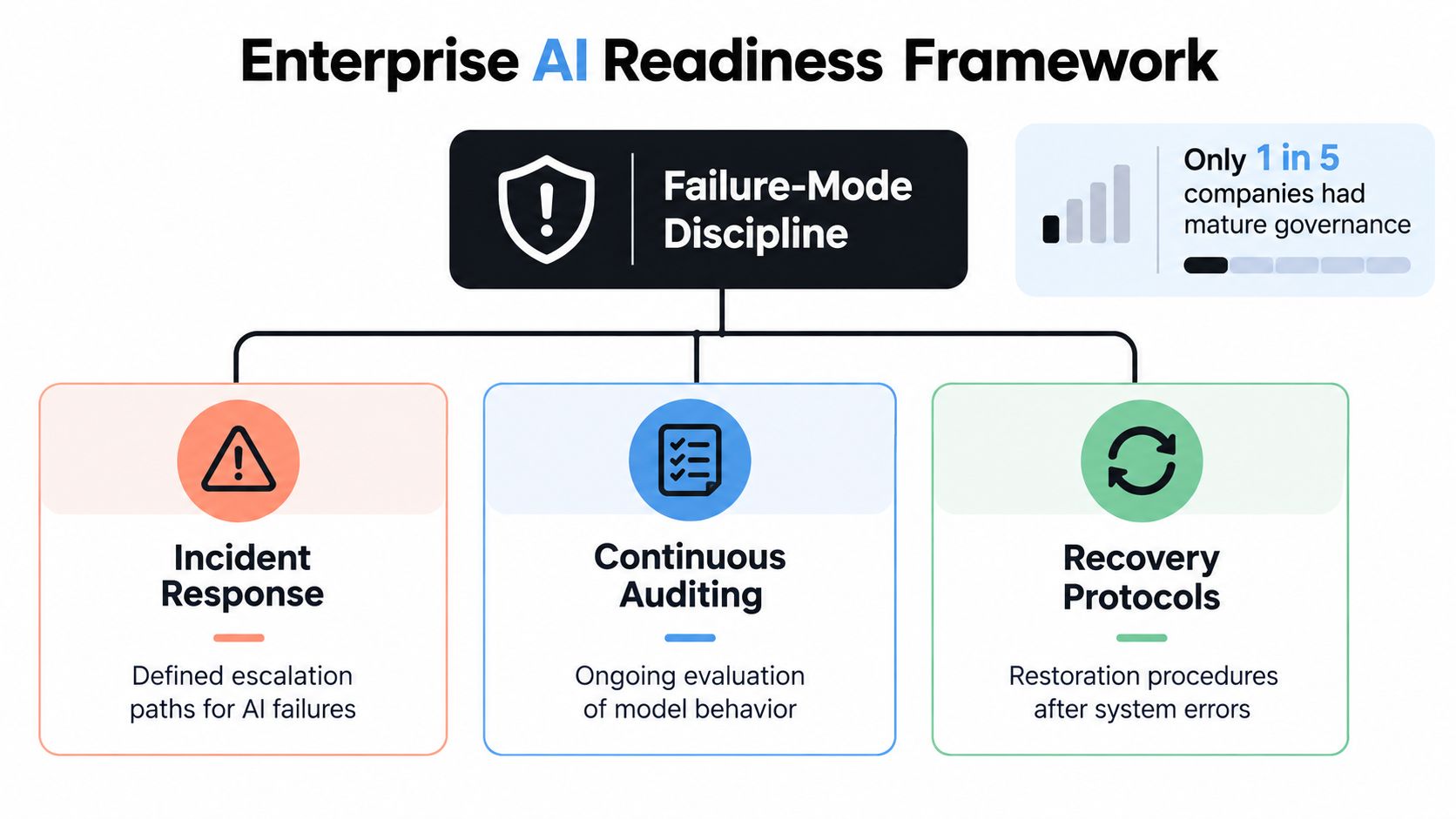
Deloitte's survey of 3,235 leaders found that only one in five companies had a mature governance model for autonomous AI agents. Grant Thornton reported that 78% of business executives lacked strong confidence that their organization could pass an independent AI-governance audit within 90 days; confidence was 7% among organizations still piloting AI and 74% among organizations with fully integrated AI. These figures point to an operational gap: organizations may deploy agents faster than they establish the controls needed to defend their use.
Map actions to owners and recovery
For each workflow, document the action, accountable owner, permission boundary, approval threshold, and recovery path. A customer-facing agent might be allowed to explain a policy but require approval before changing an account. An employee-service agent might answer a question from an internal knowledge base but need to escalate a sensitive case rather than infer an answer.
The same discipline should cover voice, chat, email, and employee-service workflows. Ask what evidence the platform retains: the agent's inputs, retrieved content, tool calls, approvals, output, and subsequent changes. Confirm how the team can pause an agent, revoke access, roll back a change, and notify the right owner when a failure occurs.
Practical rule: If you can't name who owns an autonomous action and how they can stop or reverse it, the workflow isn't ready for production.
Compliance teams that need a practical way to organize risk discussions can consult this compliance and risk management resource. For AI-specific platform controls, evaluate enterprise AI governance capabilities against your own approval paths, evidence-retention needs, and incident procedures. The point isn't to collect more policy documents. It's to make governance executable when a workflow fails.
Adoption Is Not ROI
A live agent is not proof of financial return. Deployment tells you that a system is running. It doesn't establish whether the system improves resolution, reduces workload, protects revenue, or creates costs elsewhere through poor answers and repeat contacts.
Deloitte's 2025 survey of 1,854 executives found that only 15% of organizations using generative AI reported significant, measurable ROI, while 38% expected to achieve it within a year. Capgemini's 2025 research found that 14% had implemented AI agents at partial or full scale and 23% were running pilots; although 46% had governance policies, adherence remained low (Deloitte's analysis of the AI ROI gap). A platform evaluation should therefore test the measurement system as closely as the agent itself.

Measure outcomes, not activity
For customer service, report containment alongside repeat contacts and resolution quality. Track transfers and handling time, but don't treat fewer transfers as an automatic win. If an agent gives a poor answer that prompts another call, the workflow may look automated while increasing total work.
For employee service, measure whether employees get accurate answers or complete the intended task, and whether specialists spend less time on routine requests without inheriting a larger backlog of exceptions. Then calculate fully loaded cost, including models, telephony, integrations, supervision, testing, and exception handling. Separate the baseline from the post-launch result and keep the definition of success consistent.
A useful business case starts with one workflow, named owners, and agreed measures. The vendor should show how the platform records those measures and how operations leaders can investigate a change in performance. If the platform can report conversations handled but can't connect them to resolution, cost, and downstream rework, the organization won't have a reliable basis for expansion.
The clip below can support a team discussion about what to measure, but it shouldn't substitute for a workflow-level business case built from your own operating data.
Situational Recommendations by CX, EX, and Industry
Don't look for one platform to win every use case. Shortlist by workflow, control requirements, and the systems the agent must operate. A vendor that fits a global contact center may be a poor fit for a regulated employee-service deployment, even if the product is marketed as horizontal.
For contact center modernization, prioritize voice behavior, transfer context, channel continuity, and integrations with the existing CRM and contact center. The demo should test interruptions, unclear requests, and escalation. Yellow.ai is one option for teams evaluating agentic CX and EX workflows; its platform supports voice, chat, email, and other modalities, connects to enterprise systems, and includes multi-LLM architecture and a conversational knowledge base. Validate those capabilities with your own call patterns, permissions, and service measures rather than relying on a general platform demonstration.
In BFSI, make audit evidence, permission boundaries, approval thresholds, and rollback essential. Ask the vendor to demonstrate a workflow that stops safely when a policy or identity condition isn't satisfied. In healthcare, test how the platform handles sensitive information across voice and chat, where content is processed, and how access and retention controls map to the organization's requirements. Don't infer compliance from a logo; request documentation and validate the actual deployment configuration.
Match the platform to the operating model
For HR and IT helpdesks, focus on employee identity, knowledge freshness, case creation, routing, and handoff to specialists. A capable employee service experience should reduce friction without exposing information across roles or turning uncertain answers into confident guidance. Teams comparing approaches to internal service delivery can review an employee experience platform for AI-enabled service.
Across all these scenarios, check the integration footprint. Salesforce, Zendesk, Genesys, Freshdesk, HubSpot, NICE, and similar systems may be central to the workflow, but a connector listing doesn't prove the agent can use the right data and take the right action under your access model. Require a live, permission-aware demonstration for the systems in scope. Where the vendor can't meet a deployment or audit requirement, remove it from the shortlist rather than treating the gap as a post-contract configuration detail.
A Vendor Evaluation Checklist You Can Take Into the Demo
Bring this checklist to every finalist demo. Use the same workflow and evidence standard for each vendor.
| Category | Question to Ask the Vendor | Evidence to Request |
|---|---|---|
| Retrieval | How do you measure recall and answer faithfulness? | Evaluation results using our corpus and realistic distractors. |
| Cost | How do you attribute cost to an interaction and workflow? | A sample report showing model calls, token use, and other attributable costs. |
| Governance | How can an authorized person pause, override, or reverse an agent action? | A live failure and recovery demonstration, with retained audit evidence. |
| Permissions | How does the agent respect access boundaries across sources and systems? | A test showing permitted and blocked actions. |
| ROI | How will we measure outcomes after launch? | A workflow-level measurement plan covering resolution, rework, and fully loaded cost. |
A vendor that can't produce this evidence is asking you to buy a promise. Keep the shortlist tied to demonstrated controls, representative workflow results, and a measurement plan agreed before commercial terms.
If you're evaluating agentic workflows for CX or EX, Yellow.ai offers a platform for building, testing, deploying, and optimizing agents across customer and employee service channels. Put it through the same failure-mode and workflow-ROI tests as every finalist, then decide from evidence rather than the demo.