










61% of consumers preferred completing customer-service tasks through human channels in 2025, according to Qualtrics' survey of more than 23,000 consumers and 3,072 contact-center employees. That's a useful corrective to buying call center solutions primarily on automation rate. Customers want their task completed, and removing a human interaction isn't proof that the task was resolved.
For enterprise buyers, the better comparison starts with verified resolution and governance readiness. Architecture matters because it determines who maintains the integrations, who controls the customer record, and who pays to investigate failures. The right choice depends on your volume, channel mix, existing infrastructure, and ability to supervise automated decisions.
Table of Contents
- Call Center Solutions at a Glance Across Architectures
- What a Modern Call Center Solution Includes
- Security and Compliance Requirements to Verify
- Metrics That Separate Solutions on Real Outcomes
- Governing AI Agents Before You Scale Them
- Use Cases Where Automation Stops and People Start
- Total Cost of Ownership and ROI Expectations
- Choose Your Call Center Solution in Three Steps
Call Center Solutions at a Glance Across Architectures
A cloud contact center as a service, or CCaaS, suite is a sensible starting point when you want one operating platform. But replacing the entire contact center isn't always the right decision. You may need an orchestration layer, a communications add-on, programmable infrastructure, or local telephony control instead.
Call center solution architectures compared
| Architecture | Best fit | Deployment | Main trade-off |
|---|---|---|---|
| Cloud CCaaS suite | Mid-size to enterprise teams wanting one platform | Subscription, vendor-hosted | Less control over core telephony |
| Omnichannel AI orchestration layer | Brands unifying voice, chat and email | Layered over an existing CCaaS or CRM | Integration effort and data mapping |
| UCaaS contact center add-on | Small teams already on a unified communications suite | Add-on license | Limited advanced routing |
| Build on CPaaS APIs | Engineering-led firms needing custom flows | Developer-built and hosted | Highest ongoing maintenance load |
| On-premises ACD and PBX | Regulated sites needing local control | Hardware plus software | High capital and upkeep costs |
Treat these as ownership choices, not mutually exclusive feature categories. A cloud suite can include AI and omnichannel capabilities; an orchestration layer can run alongside on-premises telephony.
A CCaaS platform typically brings routing, queues, workforce tools, and reporting under one commercial relationship, although package boundaries need checking. An orchestration layer preserves the underlying platform but introduces another integration and accountability boundary.
Match the architecture to your operating constraints
Use these tests to narrow the field:
- Consolidation: If supervisors need one environment for queues, scheduling, and reporting, start with cloud CCaaS.
- Customer continuity: If voice, chat, and email must share an existing customer record, assess an orchestration layer before replacing functioning infrastructure.
- Simple requirements: If a small team already uses a unified communications suite, test its contact center add-on against your hardest routing scenario.
- Engineering ownership: Choose CPaaS only when named engineers can maintain flows, observability, and incident response.
- Local control: If an approved requirement mandates local telephony, retain an on-premises candidate. Don't assume that every regulated operation requires one.
For a separate assessment of the hosted calling foundation, GoSafe Dark Web monitoring's VoIP comparison provides a resource to consult alongside your contact-center requirements. Keep that decision distinct: business calling capability alone doesn't establish customer-service workflow coverage.
What a Modern Call Center Solution Includes
Call centers developed from centralized telephone routing into broader customer-service operations. L.E.K. Consulting's history of call centers traces the foundations to private automatic branch exchanges and automatic call distributors, followed by wider telecommunications and internet-enabled customer contact. The buying implication is straightforward: assess the complete service workflow, not just the switch that answers the phone.
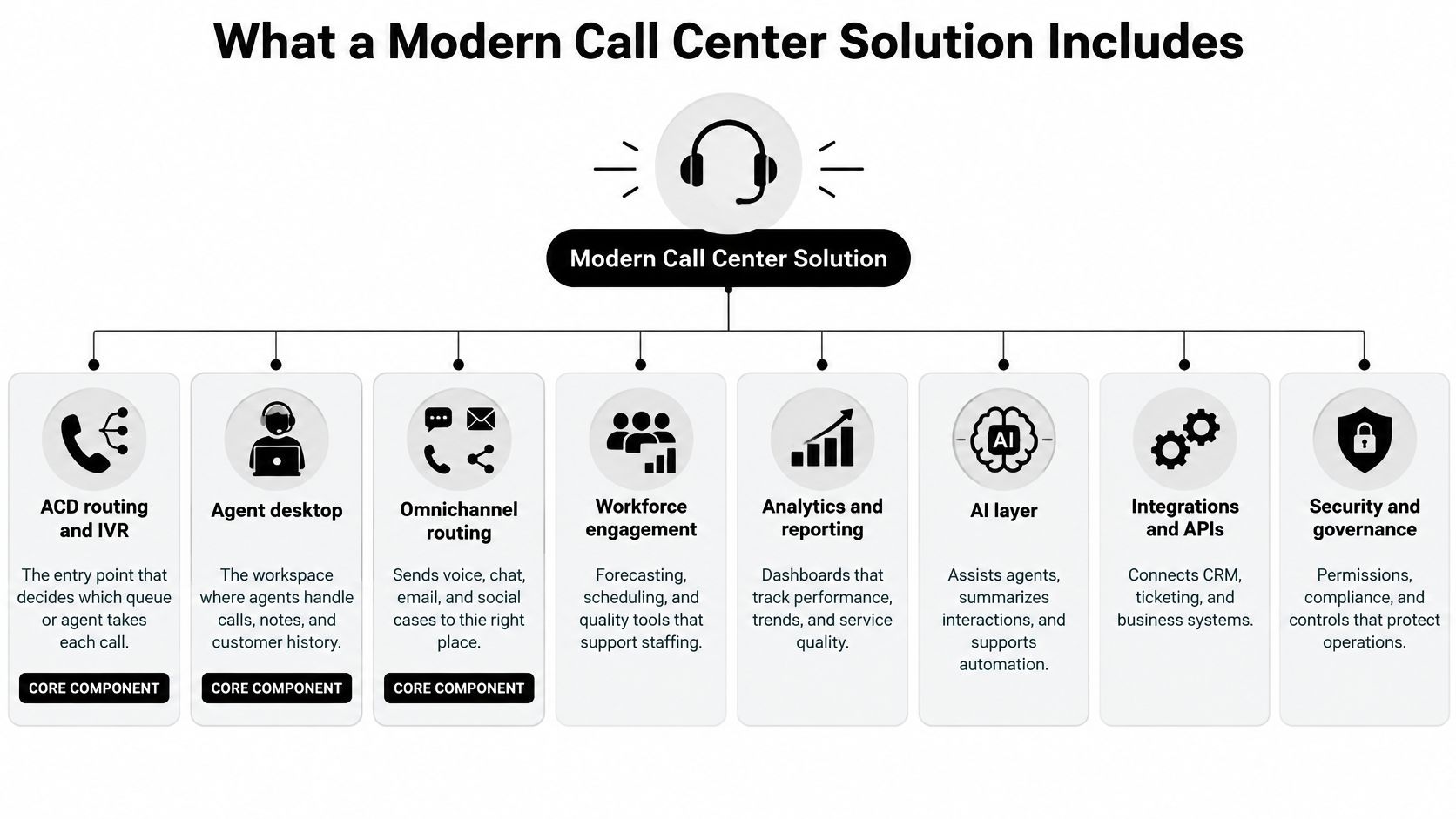
Use the component map to distinguish foundational capabilities from optional automation.
Define the minimum viable solution
- ACD routing and IVR, core. The entry point identifies the request and selects a queue or agent. Test overflow, unavailable agents, and failed authentication, not just the normal path.
- Agent desktop, core. Agents need customer history, notes, and current case status in a usable workspace. A unified record matters more than placing disconnected panels on one screen.
- CRM and ticketing integration, core. Require customer matching and outcome writeback. A connector that only retrieves a name won't establish whether the underlying issue was resolved.
- Digital channels, core where customers already use them. Include chat, email, and SMS according to actual demand. Don't purchase channel breadth without assigning ownership and response expectations.
- Analytics and quality monitoring, core. Retain interaction identifiers, timestamps, outcomes, and evaluation evidence so analysts can investigate performance rather than accept dashboard totals.
- Automation and voice AI, optional until the intent mix is understood. Identify eligible tasks before selecting autonomous handling. Some workflows need knowledge retrieval; others require authenticated business-system actions.
- Workforce management, core when staffing requires coordinated forecasting. Match schedules to arrival patterns, skills, and escalation demand rather than average daily volume alone.
- Agent-assist and handoff workflows, core whenever automation transfers to people. Pass the reason for escalation, authentication status, attempted actions, and relevant conversation context.
Apply security and governance across every component. They aren't a separate finishing layer that can be added after customer information starts moving between systems.
Practical rule: If a product covers only routing and scheduling, evaluate it as a telephone system with scheduling, not as a complete customer-service solution.
Ask vendors to demonstrate one request from entry through business-system update and final reporting. Missing steps reveal the services, connectors, or internal work your team must supply.
Security and Compliance Requirements to Verify
Security review should precede feature scoring. Give each vendor the same evidence request and classify every response as documented, partial, or missing. A sales assurance isn't equivalent to a configuration guide, audit report, or contractual commitment.
Your security and legal teams should decide which obligations apply to the proposed workflow and jurisdictions. Don't treat a certification logo as proof that your deployment, recording policy, or payment process is covered.
Request evidence for the complete data path
- Data residency: Identify where recordings, transcripts, customer records, backups, and diagnostic logs are processed and stored. Include disaster recovery and support access, not just the primary hosting region.
- Encryption: Require documentation for encryption in transit and at rest, key ownership, key rotation, and privileged access to decrypted information.
- Role-based access: Test agent, supervisor, developer, and administrator permissions. Verify that sensitive-field access and permission changes produce reviewable logs.
- Consent and retention: Review recording disclosures and automated-handling notices with counsel. Test configurable retention, deletion workflows, and how deletion propagates to connected systems.
- Payment handling: If the workflow accepts card details, establish how those details stay out of transcripts and recordings. Check that the relevant PCI DSS attestation covers the actual service and payment flow.
- Independent assurance: Request current SOC 2 reports or ISO/IEC 27001 certification documentation, as appropriate, along with scope, exceptions, and the subprocessor list.
Architecture changes who performs the work
With cloud CCaaS, inspect the vendor's service boundaries and shared-responsibility documentation. With an AI orchestration layer, extend the review to speech processing, model providers, observability services, and every connector that receives customer information.
On-premises deployment gives your team local infrastructure control, but it also assigns your team patching, key management, backup protection, and recovery testing. Local hosting doesn't remove operational security work.
For regulated journeys, treat any missing required control as a pilot blocker. Partial evidence should have a named owner, a remediation requirement, and an acceptance decision before production access.
Use synthetic or appropriately sanitized records during early demonstrations. A vendor shouldn't need unrestricted production recordings to prove basic routing, permissions, or deletion behavior.
Metrics That Separate Solutions on Real Outcomes
Metrics and benchmark reference points
| Metric | What it measures | Reference point | Watch-out |
|---|---|---|---|
| First-contact resolution | Issues fully resolved on the first contact | Cross-industry comparison plus a matched internal baseline | Bot containment can overstate it |
| Service level | Share of offered calls answered within a target time | Traditional and tighter queue targets detailed below | Can conflict with resolution when staffing is weak |
| Abandonment rate | Callers who hang up while queued | Compare matched queues, with the same short-abandon rule | Measure automated and human queues separately |
| Transfer rate | Share of automated contacts passed to a person | Set by intent eligibility and escalation policy | A lower rate isn't always better |
| Repeat-contact rate | Customers returning about the same issue | Use a defined issue-matching and follow-up window | Shows whether resolution held after initial contact |
First-contact resolution, or FCR, measures whether an issue was fully resolved without a callback or follow-up. BenchmarkPortal's sample industry report reports an all-industries FCR average of 76.62% for agent-handled contacts. Use it as context, not as a guaranteed target for a different intent mix or automated population.
WFM Labs' call center metrics guide identifies 70–79% as generally good FCR and 80% or higher as world-class, and describes the traditional service-level target as 80% of offered calls answered within 20 seconds, with leading centers sometimes targeting 80% or 90% within 15 seconds. These are reference points, not interchangeable promises of customer experience.
Separate access from completion
Service level measures access to assistance. FCR measures the outcome. A supervisor can improve answer speed by shortening conversations prematurely, only to generate callbacks; equally, longer handling may be justified if it prevents another contact.
Containment isn't resolution. A bot interaction that ends without a transfer may still lead to a reopened case, refund request, complaint, or contact through another channel. Join interaction records to subsequent case activity before accepting the vendor's completion label.
Buy the ability to verify an outcome, not just the ability to label an interaction complete.
Make comparisons reproducible
Define the denominator, eligible contact types, exclusions, and follow-up window before testing. For repeat contacts, specify how analysts will match the customer and issue across channels without counting unrelated requests as failures.
Report service level alongside abandonment, average speed of answer, occupancy, transfer rate, FCR, and satisfaction. This contact center metrics framework can help organize the scorecard, but your acceptance criteria must reflect your own queues.
Request results by channel, intent, language, customer tier, and automation path. Compare automated, human-assisted, and human-only cohorts with comparable work, and capture handoff latency and context completeness separately. Otherwise, routing easy requests to AI and difficult requests to people can make the automation look better without improving the operation.
Governing AI Agents Before You Scale Them
Containment and cost are easier to demonstrate than accountability. Yet in CallMiner's 2025 survey of 700 senior CX decision-makers, 96% viewed AI as a key strategy, while 67% said they were implementing AI without adequate governance structures. That gap makes organizational readiness a buying criterion, not an implementation afterthought.
The finding doesn't prove that model capability is irrelevant. It does show why a more capable agent won't resolve an unclear approval policy, missing owner, or unreviewable decision.
Governance requires people with authority to document and enforce operating boundaries.

Assign authority before autonomy
Name a business owner for each automated journey and establish a review group spanning operations, security, legal, and relevant domain specialists. Give that group authority to restrict actions, pause a workflow, and approve material changes.
Classify interactions by risk. An agent retrieving delivery information shouldn't automatically receive the authority to issue compensation, modify financial terms, or make decisions affecting access to essential services.
For banking, healthcare, utilities, and insurance, write approval boundaries around the consequences of a mistaken action. Speed isn't sufficient justification for allowing an agent to make a decision that customers can't understand or challenge.
Bring a readiness checklist to the demo
Use an enterprise AI governance framework to turn policy into demonstrable controls:
- Ownership: A named person accepts responsibility for the journey and its exceptions.
- Authority: Allowed actions, prohibited actions, and human-approval requirements are explicit.
- Auditability: Logs capture decisions, tool calls, exceptions, and configuration versions without unnecessarily exposing sensitive data.
- Data lineage: Reviewers can identify the approved knowledge or business record supporting an answer or action.
- Customer recourse: Customers have a documented route to challenge an automated outcome.
- Change testing: A standing regression suite runs after model, prompt, knowledge, or workflow changes.
- Fairness review: Performance is assessed by language and relevant customer groups, with appropriate privacy safeguards.
- Operational intervention: Authorized staff can stop unsafe actions and restore an approved configuration.
Ask the demonstrator to reconstruct a failed interaction, not merely complete a successful one. If nobody can explain what happened, which information the agent used, and who can correct it, the deployment isn't ready to scale.
Use Cases Where Automation Stops and People Start
Set automation boundaries around the consequence of being wrong, not just the frequency of a request. A repetitive interaction can still involve vulnerability, financial loss, or clinical risk.
Routine information with an exception path
Retail order status: Say a shopper asks where a parcel is. Automate the lookup and response when the customer is appropriately authenticated and the order system provides a reliable status. A damaged item, missing delivery, contradictory tracking record, or repeated unsuccessful enquiry should trigger a person with authority to investigate.
Bank balances and disputes: An authenticated balance or card-status request can follow a constrained retrieval workflow. A fraud allegation or disputed transaction needs a different path, with stronger safeguards and human review under the bank's procedures. Don't let a successful identity check become permission for every subsequent action.
Essential services with protective boundaries
Utility outages: Automate approved status updates and notifications, while keeping a fast human route for customers identified as vulnerable or reporting a safety concern. When restoration information is unavailable, say so rather than generating an unsupported estimate. Route urgent safety reports according to the utility's approved emergency procedures.
Healthcare access: Use AI for scheduling, reminders, and administrative questions within approved rules. Keep symptom assessment with clinicians in this proposed design, and configure clinical language or distress signals to trigger the appropriate clinical or emergency pathway. A chatbot shouldn't improvise medical triage because an administrative conversation changed direction.
Across these scenarios, handoff triggers should consider complexity, vulnerability, language comprehension, authentication risk, emotional distress, and failure cost.
Published customer examples illustrate different service contexts: our case studies include InteleTravel, which scaled travel support using AI agents, and The City of Cape Coral, which uses voice and chat AI agents for citizen service. Those examples establish deployment contexts, not proof that another enterprise should copy their automation boundaries.
A higher escalation rate can be the right result when the system recognizes situations it shouldn't resolve autonomously.
Inspect what happens after escalation. A customer who reaches the correct specialist with a usable case summary may receive better service than one who remains contained in an unsuccessful automated exchange. Judge each scenario by the completed customer task, not the absence of human involvement.
Total Cost of Ownership and ROI Expectations
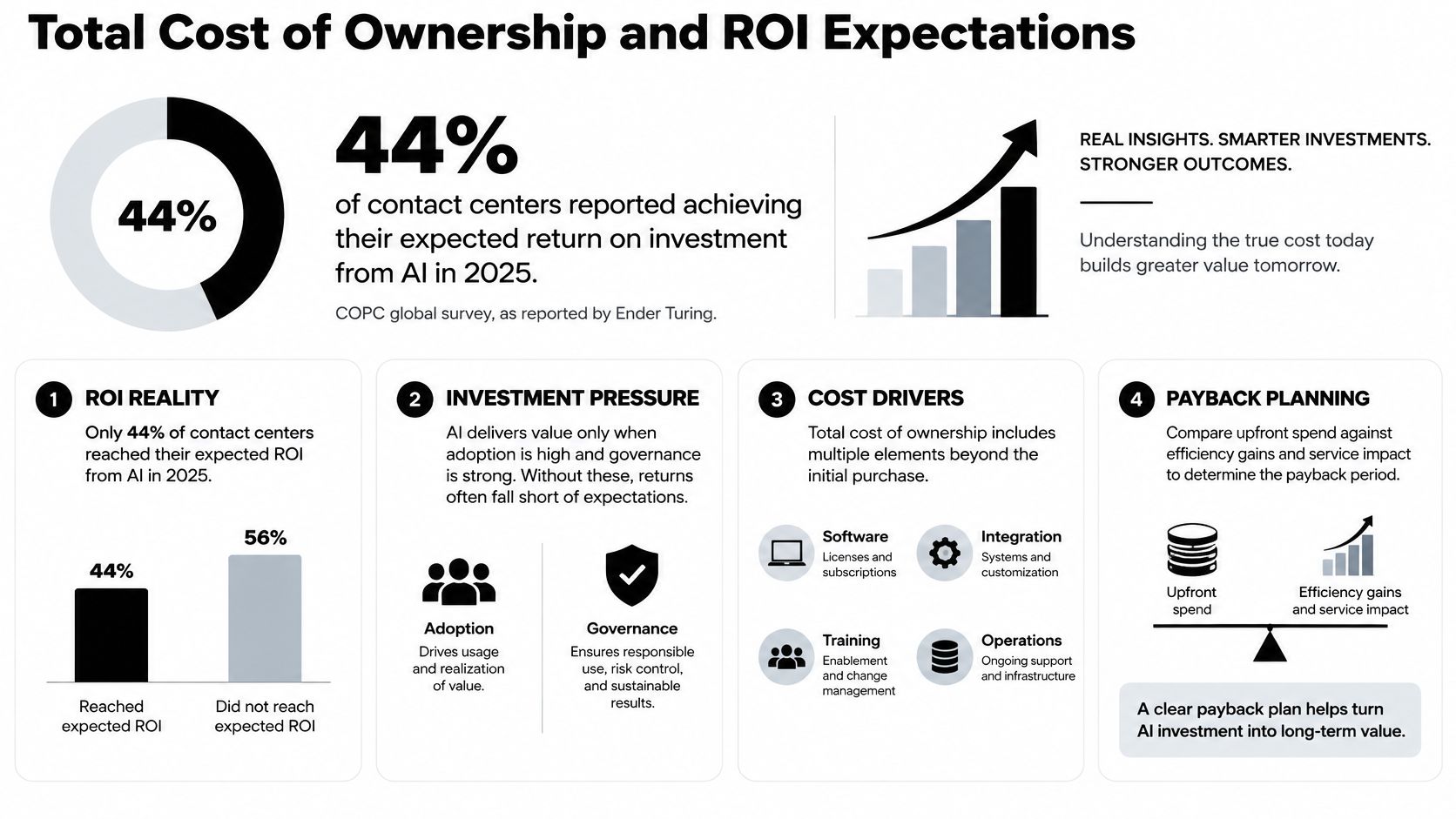
Only 44% of contact centers reported achieving their expected return on investment from AI in 2025, according to COPC's global survey as reported by Ender Turing. That finding doesn't establish why individual projects fell short, but it argues against treating quoted usage prices as a business case.
The headline result provides context for evaluating the full investment.
Cost components and what buyers often miss
| Cost component | What drives it | Often missed |
|---|---|---|
| Platform licensing | Seats or concurrent agents | Overage during peak volume |
| Telephony minutes | Inbound and outbound minutes and number routing | Regional voice rates and separate messaging charges |
| AI usage | Conversations, voice minutes and model calls | Spikes during launches and seasonal peaks |
| Integration and data mapping | CRM and helpdesk connectors | Upkeep after each platform update |
| Governance and testing | Review boards, audit logs and regression tests | Staff time outside the vendor quote |
Price the operating model
Model each proposal using its actual billing units. Seat charges can respond differently to peaks than consumption charges, and a voice workflow may incur telephony, speech processing, and model usage in the same interaction.
Architecture changes where you incur costs. A suite bundles some operational capabilities but may require migration and retraining. An orchestration layer preserves existing investment while adding connector work; a CPaaS build assigns more maintenance to engineers, while on-premises infrastructure requires capital and upkeep planning.
Cost per verified resolution = total operating cost ÷ verified resolutions.
Use the same accounting period for both parts. Include integration, telephony, governance, training, and the human effort required to complete escalated cases. Otherwise, a proposal can appear inexpensive because it excludes the expensive unfinished work.
Separate launch costs from recurring costs
Build an annual forecast with distinct launch and operating lines. Put initial mapping, configuration, acceptance testing, and training in the launch budget; model recurring usage against normal demand and peak scenarios.
Explicitly assign staff time for governance review, regression testing, and connector maintenance when CRM or helpdesk versions change. Then test the business case against lower-than-expected eligible volume or greater-than-expected escalation demand.
Compare proposals only when they use the same resolution definition, peak volume, and integration scope. A lower unit price isn't a saving if your team must supply missing operational work.
Choose Your Call Center Solution in Three Steps
Choose a solution through a controlled decision process, not a sequence of unrelated vendor demonstrations. Write the evidence requirements before the first meeting so each provider has to prove the same things.
The interface is one part of that evaluation, not the acceptance test itself.
Follow a bounded decision path
Map the operation and select an architecture. Document arrival patterns, channel mix, existing contracts, data constraints, and governance ownership. If your challenge is maintaining continuity across voice, chat, and email, prioritize a shared-record design rather than assuming a telephony add-on will solve it. Retain more than one architecture only when a genuine constraint remains unresolved.
Score evidence rather than demonstrations. Require segmented outcome reporting, security documentation, governance artifacts, and a clear responsibility matrix. Record whether each capability is available, requires configuration, or needs custom development. Weight unresolved mandatory requirements above optional features.
Pilot a bounded journey. Choose a high-volume task with a clear completion event and a safe fallback. Test production-like connector behavior, including expired credentials, unavailable systems, duplicate requests, and failed writeback. Set the duration to include representative demand and enough follow-up to detect repeat contacts, rather than assuming a fixed calendar period proves success.
At Yellow.ai, our AI Agent Builder 2.0 creates enterprise-ready agents for any channel in minutes, and we integrate with Zendesk, Freshdesk, HubSpot, and Genesys. Evaluate that starting point against your own deployment criteria; agent creation speed doesn't establish production readiness.
Use the platform walkthrough as preparation for a requirements-led demonstration.
Require clear answers in every demo
- Outcome evidence: Does the vendor show verified resolution rather than containment alone?
- Segmentation: Can it report the required metrics by channel and language?
- Handoff: Does the receiving agent get usable context?
- Integration: Are the required connectors live and demonstrable, rather than on a roadmap?
- Commercial scope: Will the proposal commit to your resolution definition, peak volume, and integration requirements?
This week, write and approve the pilot criteria before scheduling scoping conversations. Include the journey owner, completion event, stop conditions, required integrations, and evidence needed for expansion. That document gives procurement, operations, and IT a common basis for choosing.
Yellow.ai offers voice and digital AI agents, workflow integrations, testing, and analytics for enterprise customer service. Visit Yellow.ai to scope a pilot around a defined customer journey, with verified resolution, governance controls, and human handoff quality as the acceptance criteria.