













A conversational AI rollout can look healthy right up until customers start avoiding it. The dashboard shows completed integrations and a successful launch, yet containment falls, escalations circulate between teams, and agents route conversations around the bot. In BFSI, healthcare, and retail, that failure rarely comes from one bad model response. It comes from treating deployment as the finish line instead of establishing an operating system for performance, risk, and change.
Best practice implementation means translating principles into ownership, measurable outcomes, release controls, and daily operating behavior. The model matters, but organizational readiness usually determines whether autonomy produces value or creates another layer of work.
Table of Contents
- Why Most Conversational AI Programs Stall After Launch
- Planning the Program Before You Pick a Model
- Architecture, Knowledge, and Integrations as One Decision
- Governance as an Operational Control System
- The Test Measure Monitor Loop in Production
- Proving Value Without Hiding Operating Costs
- Continuous Improvement as an Ownership Problem
Why Most Conversational AI Programs Stall After Launch
A retail organization can launch a returns agent across chat and messaging, connect it to order data, and report strong early adoption. Then the exceptions arrive. A split shipment needs human judgment, a policy changes in one market, and an integration returns incomplete data. The agent keeps answering, supervisors begin correcting transcripts manually, and customers learn that typing “agent” is faster than explaining the issue again.
That pattern reflects an operating gap, not a prompt problem. The platform was installed, but the process wasn't embedded. No one owned the knowledge source, the escalation threshold, or the decision to pause a capability when a policy changed.

Installation is not usage
A 2005 study of 1,150 quality managers across 924 organizations found that installing a standard such as ISO 9000 was necessary, but organizations gained a distinct operating advantage only when the standard became part of everyday work and continuous improvement. The distinction applies directly to conversational AI. A deployed agent, documented workflow, or completed integration is an input. Sustained behavior and measurable improvement determine whether the program creates value. The study's discussion of installation and usage provides a useful foundation for this distinction.
The language change is simple: stop saying “we shipped the agent” and start saying “we operate the agent.” Operating means someone reviews unresolved intents, validates knowledge changes, owns permissions, investigates anomalous behavior, and decides when a human must take over.
Practical rule: If a team can't name the person who can pause an agent, the agent isn't production-ready.
The same principle applies to employee service. An HR assistant may answer routine policy questions well, but payroll corrections, leave disputes, and sensitive employee records need explicit authority boundaries. Teams can even use a mock interview practice tool to rehearse stakeholder questions before a governance review, especially when leaders need to defend why some decisions remain human-owned.
The rest of the program should therefore optimize for a continuous test, measure, and monitor loop. That loop turns deployment from a milestone into a management discipline.
Planning the Program Before You Pick a Model
Model selection is rarely the first decision that matters. Before comparing vendors, define the business outcome, the people affected, and the decisions the agent may make.
Start with a one-page agent intake brief. Keep it specific enough that a steering committee can reject an unsuitable use case without debating technology.
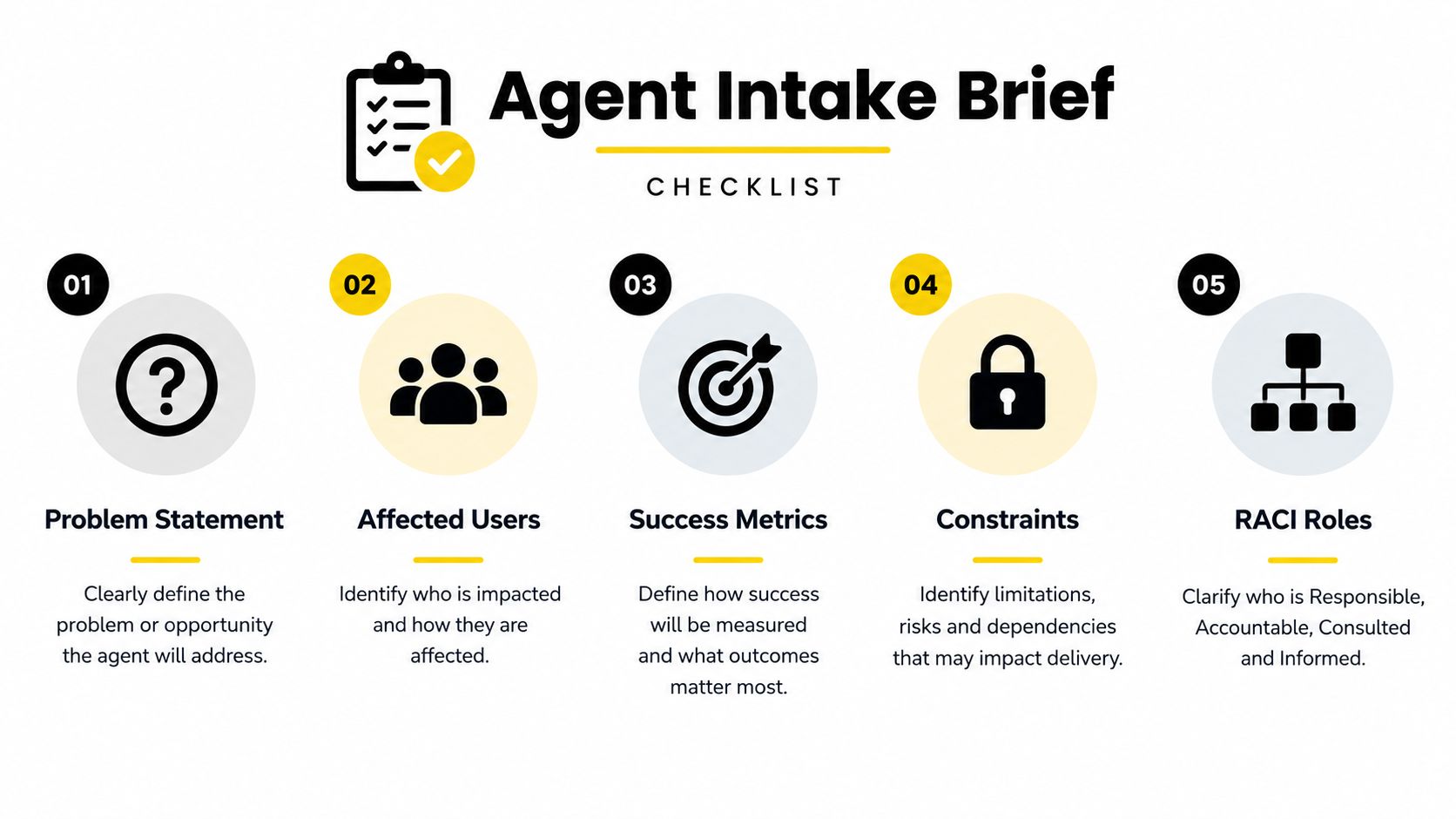
The intake brief
Include these fields:
- Problem statement: Describe the customer or employee friction in operational terms, such as repeated status requests or slow policy discovery.
- Affected users: Identify customer segments, employees, contact-center teams, supervisors, and people whose data the agent may access.
- Success metrics: Define the outcome before choosing the measurement tool. Resolution rate, service-level attainment, quality, adoption, and satisfaction may all matter, but not every use case needs the same mix.
- Constraints: Record jurisdictions, sensitive data, channel limits, accessibility needs, business hours, integration dependencies, and mandatory human approvals.
- RACI roles: Name the business owner, technical owner, risk owner, and incident authority. Add a knowledge owner where policy content changes frequently.
The business case development guidance from Yellow.ai can help structure the financial and operational discussion, but the steering committee still needs to own the assumptions.
Baselines before procurement
Capture the current state before an agent changes the workflow. Record contact reasons, handling patterns, escalation behavior, quality results, customer or employee effort, and the cost of human supervision. Where data is incomplete, mark the gap rather than filling it with an optimistic estimate.
Fund the program against resolved outcomes, not licenses or conversation volume. Finance should understand what happens if automation lowers initial contacts but increases repeat contacts, review effort, or compliance exposure. A sound intake brief makes those trade-offs visible before procurement narrows the discussion to model price and feature lists.
The RACI also changes decision speed. A business owner can decide whether the experience is acceptable, a technical owner can approve integration changes, a risk owner can set control requirements, and an incident authority can stop the system without negotiating during an outage.
Architecture, Knowledge, and Integrations as One Decision
Architecture, knowledge, and integrations should be designed together. Separating them often produces a capable language layer that can't access authoritative context, a knowledge base nobody versions, and connectors with permissions broader than the use case requires.
Begin with the system of record. Ask where the answer lives, who may access it, which action the agent can perform, and what evidence must appear in the audit trail. A knowledge layer should version source documents, identify effective dates, record retrieval context, and expose grounded-answer performance by intent or workflow.

Match access to the decision
| System | Primary Data Class | Minimum Permission Scope |
|---|---|---|
| Salesforce | Customer profile, account, and case context | Read only for scoped records, with write access limited to approved case actions |
| Zendesk | Tickets, conversation history, and support metadata | Read assigned or relevant tickets, write notes or status changes through controlled actions |
| Genesys | Contact history, routing, and interaction context | Read interaction context, invoke approved routing or escalation functions |
| HubSpot | Contact, company, and lifecycle data | Read scoped records, write only defined activity or service fields |
| HR systems | Employee identity, policy, and sensitive employment data | Least-privilege access, explicit field restrictions, and human approval for sensitive actions |
A multi-LLM architecture can reduce dependence on one model and let teams choose different models for latency, reasoning, or data-handling requirements. A single-vendor stack can simplify support, observability, and procurement. Neither choice removes the need for evaluation. The right question is whether the architecture lets you version prompts and knowledge, isolate failures, control permissions, and roll back changes.
Use retrieval for changing policy and factual enterprise content, but don't treat retrieval as a substitute for authorization. An agent may retrieve a correct document and still lack permission to disclose the underlying information. Tools should validate identity, scope records, enforce action limits, and return structured errors that the agent can explain safely.
The integration boundary also determines the human handoff. Pass the conversation summary, customer or employee context, attempted actions, and failure reason to the receiving team. A handoff that loses context shifts work to a person and makes the automation appear more successful than it is.
A short visual walkthrough can help architecture reviewers align on those boundaries before implementation decisions harden.
Governance as an Operational Control System
Governance fails when it lives in a policy binder that nobody consults during a release. It works when teams can answer operational questions quickly: who owns this agent, what data can it access, which actions can it take, when must it escalate, and who can retire it?
The readiness gap is visible in the available evidence. Gartner research found that 75% of surveyed IT application leaders were testing, implementing, or had implemented some form of AI agent, while only 13% strongly agreed that their organizations had appropriate governance structures. 74% viewed agents as a new attack vector. The reported Gartner findings point to a practical conclusion: model capability is advancing faster than control maturity.
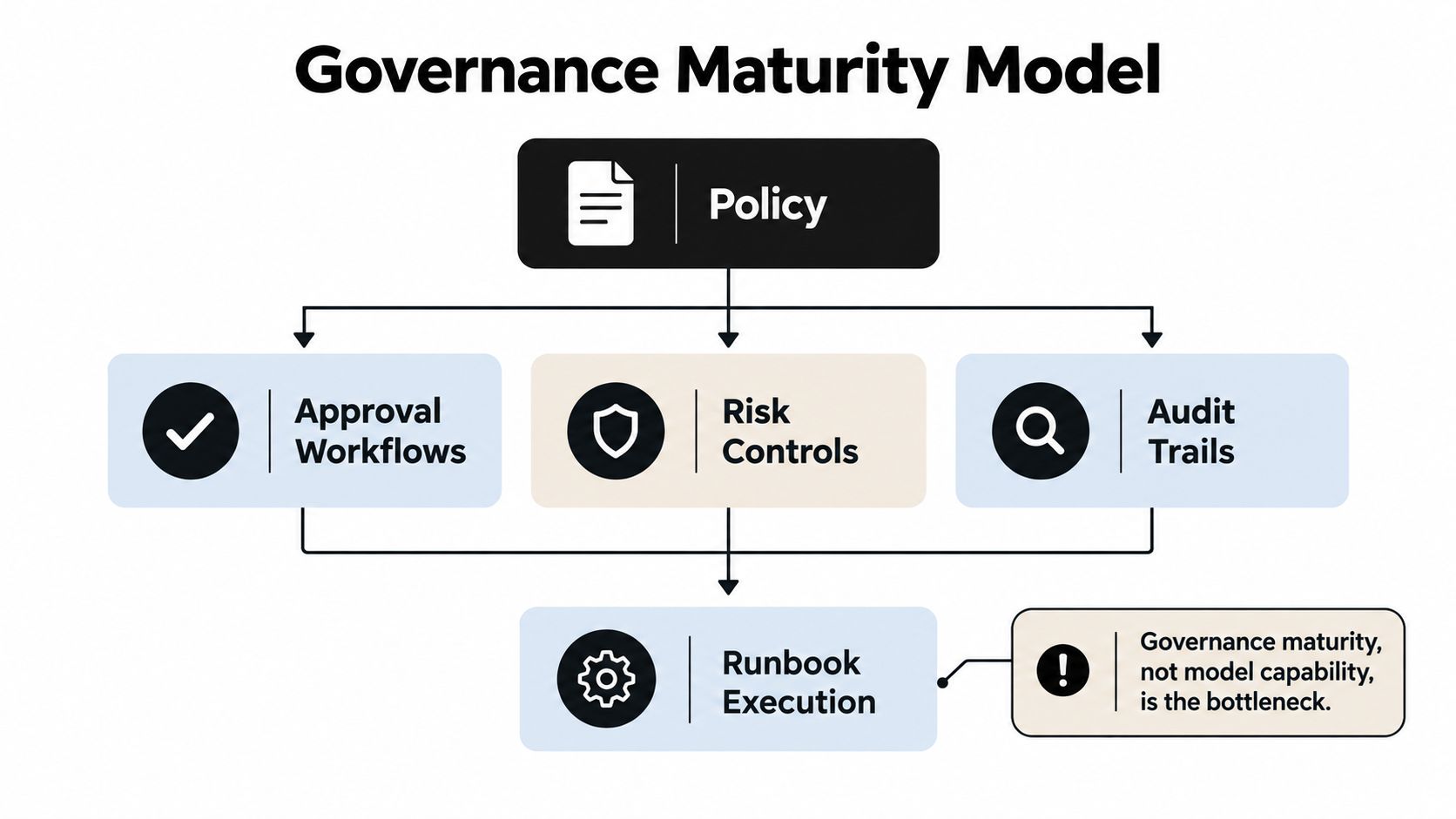
Build the agent register
Create one register for every deployed or experimental agent. At minimum, record:
- Identity and ownership: Agent name, business owner, technical owner, risk owner, and incident authority.
- Permission scope: Systems, data classes, jurisdictions, allowed tools, and prohibited actions.
- Escalation rules: Conditions that require a person, including uncertainty, sensitive requests, failed authentication, and high-consequence decisions.
- Change history: Model, prompt, knowledge, connector, and policy versions, with approval records.
- Evidence and retirement: Audit logs, incidents, overrides, decommissioning criteria, and the person authorized to retire the capability.
Map controls to risk rather than applying identical restrictions everywhere. NIST-style measures include accuracy, reliability, privacy, safety, bias, explainability, and security. Software-quality indicators such as defect severity, response time, and repair time belong beside those AI-specific measures.
The enterprise AI governance guidance from Yellow.ai is relevant when teams are turning policy requirements into platform controls, but the operating model must remain clear even when multiple vendors are involved.
Connect every metric to an action
A dashboard without thresholds is a reporting surface, not governance. Define the response before launch:
- Rising anomalous events trigger investigation and possible containment.
- Declining groundedness triggers knowledge review and regression testing.
- Increased escalation latency triggers workflow or staffing remediation.
- A privacy or data-leakage event triggers incident response, access review, and a release decision.
Autonomy should be earned by control evidence. The agent may draft, retrieve, classify, or recommend before it is allowed to execute sensitive actions. Human ownership should remain explicit for exceptions, irreversible transactions, access decisions, clinical or financial judgments, and policy disputes.
The Test Measure Monitor Loop in Production
A one-time UAT pass can't represent production. Channels differ, languages differ, integrations fail differently, and rare requests often carry the highest consequence. Each channel, language, integration, and escalation path needs a baseline and a release gate.
Test realistic behavior
Build documented evaluation sets from production scenarios and edge cases. Include multilingual inputs, sensitive-data handling, escalation requests, adversarial prompts, tool failures, and incomplete records. Test normal, stressed, and adversarial conditions, then preserve the datasets so later prompt or knowledge changes can run against the same cases.
Acceptance criteria should include task completion, grounded-answer rate, escalation precision, latency, unsafe-response rate, and data-leakage incidents. Add workflow-specific measures where needed, such as successful authentication or correct appointment routing. Average accuracy alone hides the failures that matter most.
NIST recommends documenting test sets, metrics, and testing tools, measuring performance in conditions similar to deployment, and comparing production indicators with pre-deployment results to detect degradation and error propagation across the lifecycle. NIST's AI Risk Management Framework profile supports this test-and-monitor discipline.
Release gates that survive change
A practical gate asks four questions:
- Does the candidate release meet the required thresholds for this channel and language?
- Did any high-consequence scenario regress, even if the aggregate score improved?
- Are prompts, models, knowledge sources, and connectors versioned?
- Is rollback tested and is an owner available to respond?
The common failures are predictable. Teams evaluate only average accuracy, omit low-frequency high-impact cases, change the knowledge base without regression testing, or allow production changes without approval. Use guidance on testing AI agents to structure the test inventory, then connect every failed case to an owner and release decision.
Proving Value Without Hiding Operating Costs
Automation rate is not value. A lower contact rate can reflect successful resolution, customer abandonment, repeat contacts moving to another channel, or agents spending more time repairing poor handoffs. The scorecard must distinguish those outcomes.
Track operational performance across the customer or employee journey:
- Resolution quality: Resolution rate, first-contact resolution, repeat-contact rate, escalation frequency, and quality scores.
- Service performance: Handling time, service-level attainment, latency, and outage recovery.
- Adoption and experience: Employee adoption, customer satisfaction, user effort, accessibility, and override behavior.
- Economic reality: Cost per resolved outcome, integration and monitoring effort, human-supervision hours, and exception-handling workload.
- Risk exposure: Error severity, unsafe responses, privacy incidents, and unresolved control failures.
McKinsey found that 51% of respondents in organizations monitoring KPIs during implementation reported successful change, compared with 13% where KPIs weren't monitored, a nearly four times higher reported success rate. The McKinsey implementation research supports making measurement part of implementation rather than an afterthought.
Use a value-and-risk scorecard
Give each use case a baseline, target, owner, review frequency, and action threshold. Don't combine a low-risk order-status agent with a sensitive HR workflow into one global automation score. Their acceptable error severity, approval requirements, and supervision costs are different.
Data quality and oversight also belong in the business case. KPMG's research identifies data quality and cybersecurity as major GenAI hurdles and reports that 63% of organizations wouldn't allow agents access to sensitive data without human oversight. The KPMG Q3 2025 survey reinforces why a defensible program may choose lower autonomy while data and controls mature.
The strongest business case is not “automate more.” It's “resolve the right outcomes at an acceptable cost and risk.”
Continuous Improvement as an Ownership Problem
Teams often buy better analytics when the actual problem is that nobody owns the response. A dashboard can show falling groundedness for weeks if no knowledge owner has authority to correct the source, approve a change, and trigger regression testing.
Continuous improvement needs a clear cadence. Run a weekly value-and-risk review for active workflows, a monthly governance review for incidents and control changes, and a quarterly agent-register audit covering permissions, owners, dependencies, and retirement criteria.
A 90-day operating cadence
Days 1 to 30: Confirm baselines, validate alert thresholds, review the highest-consequence failures, and assign every open issue to a named owner. Remove metrics that don't lead to an action.
Days 31 to 60: Run regression tests against prompt, model, knowledge, and connector changes. Review escalation quality with frontline teams and compare automation results with repeat contacts, supervision hours, and customer or employee effort.
Days 61 to 90: Audit the agent register, test rollback and incident procedures, reassess permissions, and decide whether each capability should expand, remain constrained, or be retired.
A metric without an owner is a number. A metric with an owner and a response threshold is a control.
The operating team must also decide which requests remain human-owned, what evidence permits wider autonomy, when a knowledge source is too unreliable to use, and when the cost of supervision exceeds the value of automation. Those decisions keep the program honest when a new model or vendor promises faster progress.
Best practice implementation succeeds when people treat the agent as a managed service with a lifecycle, not as a feature that has already shipped. The ISO evidence on embedded usage and the McKinsey evidence on KPI monitoring point in the same direction: sustained value depends on everyday behavior, measurement, and corrective action.
Yellow.ai provides agent building, automated testing, knowledge orchestration, analytics, omnichannel deployment, and enterprise integrations that can support this test, measure, and monitor operating model. Visit Yellow.ai to evaluate how its platform fits your governance requirements, integration needs, and target CX or EX workflow.



