








You're being asked to ship a voice that sounds human, handles real calls, and doesn't create a legal or trust problem in week one. That's the build. The demo voice is the easy part. AI voice characters succeed when you treat consent, familiar-voice trust, and accent equity as launch blockers, not cleanup tasks.
Table of Contents
- What an AI Voice Character Is and Its Three Parts
- Match Your Character to a Use Case and Voice Source
- Consent, Disclosure and Legal Limits for Cloned Voices
- How to Design and Clone Your Voice Character Step by Step
- Recognition, Language Model, Voice and Telephony
- Set Turn-Taking and Latency Targets That Feel Human
- Testing Voice Characters for Accuracy, Identity and Accent Equity
- Pick One Use Case and Launch With Guardrails
What an AI Voice Character Is and Its Three Parts
A utility customer calls at 9 p.m. about a flickering street light. A calm, named agent answers, recalls the outage she reported earlier that week, confirms the address, and books the crew. She doesn't repeat herself, and she isn't listening to a recording.
That's an AI voice character, a synthetic voice with a fixed name, personality, speaking style, and job that holds a multi-turn conversation rather than reading text aloud.
The Three Parts Working Together
- Automatic speech recognition hears the caller and turns speech into text.
- A language model decides what to say next, which tool to call, and when to stop.
- Neural speech synthesis speaks the reply in the character's locked voice.
The lineage is long. The Canva history of AI voice trends notes Christian Kratzenstein's 1779 apparatus produced five artificial vowel sounds, and Wolfgang von Kempelen followed in 1791 with a speech machine for individual sounds and combinations. Bell Labs later demonstrated the Voder and built the vocoder, Dragon Dictate reached buyers in the 1990s, and Apple introduced Siri on the iPhone in 2011.
The shift that matters now isn't better reading. It's the move from command recognition to characters that sustain conversations across customer service, employee service, and consumer products.
Write one sentence that names your character, its role, and the single job it must do. Every later decision depends on that sentence.
Match Your Character to a Use Case and Voice Source
Don't record anything until you've picked a row. The wrong voice source creates work you can't undo with a better prompt, especially when the voice belongs to a real person.
| Use case | Voice source | Disclosure needed | Handoff rule |
|---|---|---|---|
| Customer support | Stock or brand-designed voice | Say it is an AI at call start | Hand off after repeated misunderstanding or a request for a person |
| Employee HR service | Stock or brand-designed voice | AI notice plus a clear data-use statement | Hand off for pay, leave or conduct questions |
| Healthcare or financial intake | Designed voice, no clone of a familiar voice | AI notice and purpose before any sensitive question | Hand off for any clinical, credit or fraud decision |
| Brand spokesperson | Custom-designed voice backed by a signed release | Disclosure on owned channels | Hand off for complaints and disputes |
| Outbound reminders | Stock voice | AI notice and an opt-out option | Hand off on any dispute about the call |
Why the Rows Differ
A clone of a real staff member raises consent and identity questions a designed voice doesn't. If that employee leaves, objects to a new script, or appears in a complaint, you're managing a person's likeness, not just a brand asset. I'd reserve cloning for spokesperson work with a signed release, a defined term, and approved uses.
Keep designed voices for anything touching money, health, or employment. A designed voice can still sound warm and specific. It just doesn't borrow trust from a real individual, and you can revise scripts without renegotiating someone's identity every time operations change.
Support and reminders sit lower on that risk scale, but they aren't risk free. A support character that sounds confident while giving a wrong refund date creates the same harm as a human agent doing it, only faster and at scale. That's why every row needs a handoff rule written before launch, not improvised by the model.
Three Questions for Any Row
- Who is the character speaking for? Name the accountable team, not just the brand.
- What decision might a caller make because of it? Paying, disclosing, waiting, and accepting advice all count.
- What happens when the AI is wrong? Define the correction, the human owner, and the record you'll keep.
If you can't answer the third question in one sentence, you're not ready to choose a voice. Narrow the job first. A character that only confirms appointments and routes everything else will outperform a broader character that guesses through billing, eligibility, and complaints.
Pick the row closest to your first deployment and write its handoff rule into your character spec today. Treat exceptions as new use cases, not prompt tweaks.
Consent, Disclosure and Legal Limits for Cloned Voices
Two 2024 signals should shape your launch checklist. The 2025 Cambridge analysis of audio deepfakes reports the U.S. Federal Communications Commission ruled in February 2024 that AI-generated voices in robocalls fall under the Telephone Consumer Protection Act, while Tennessee's 2024 ELVIS Act explicitly added voice likeness to protected personal rights.
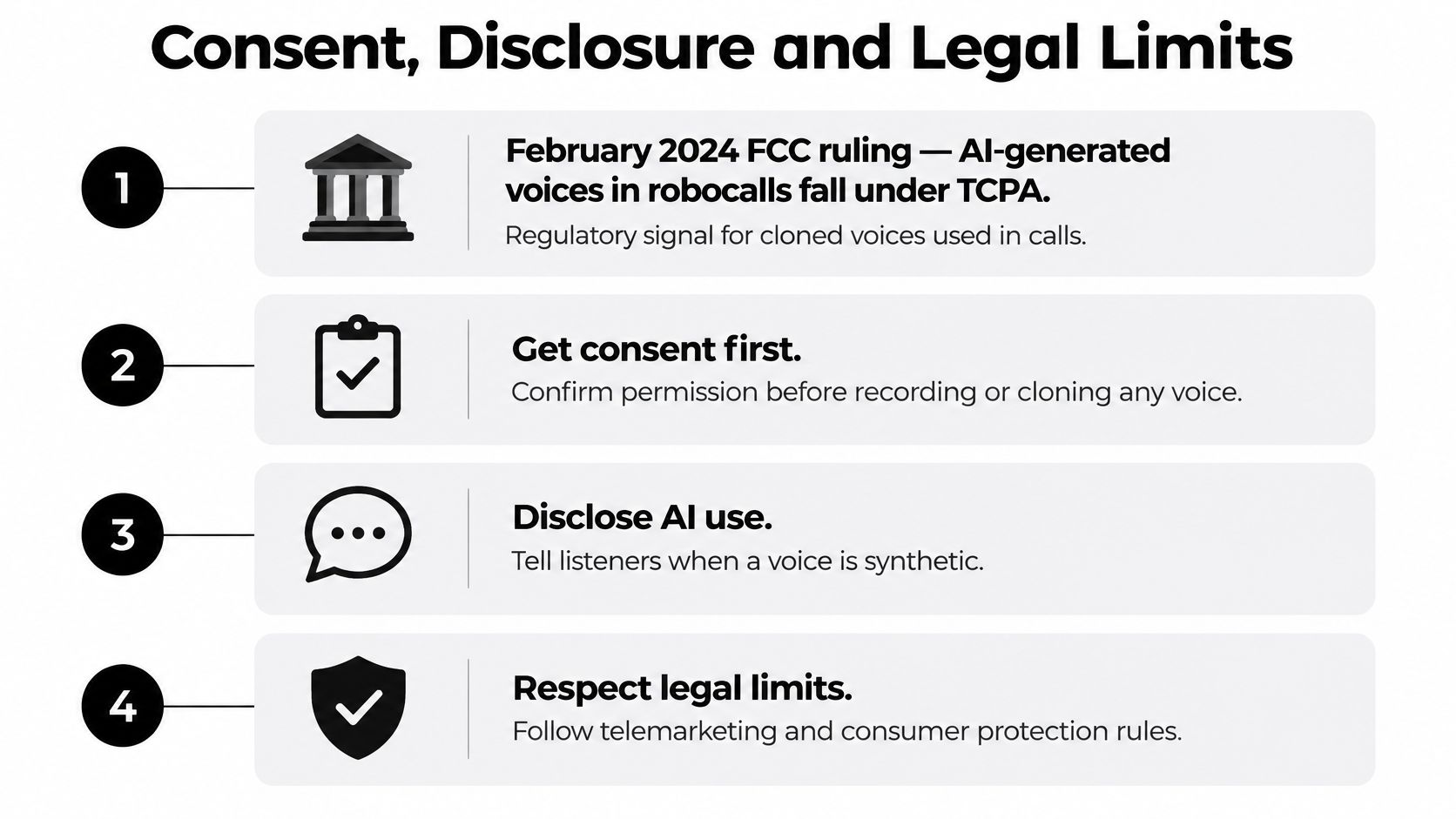
In practice, a clone needs written consent naming scope, languages, duration, and revocation. Our terms reflect that allocation. Customers guarantee they'll obtain all necessary permissions and releases from actors for instant or professional cloning, customers must indemnify Yellow.ai against claims for harm from generated voice content, and our Voice and Text Services aren't a compliance tool or warranted fit for your compliance purposes. Read your own enterprise AI governance obligations the same way before signing.
Your Pre-Recording Checklist
- Signed release on file before any session
- Purpose statement and approved disclosure script
- Opt-out path tested on a real call
- Retention period set for recordings
- Named complaints owner with authority to pause the voice
Hold the release before the first recording, and get counsel to review the checklist.
How to Design and Clone Your Voice Character Step by Step
Good characters don't drift because the model is weak. They drift because nobody locked the brief, the voice, and the forbidden lines in one place.
The visual below compresses the build into its core design loop.
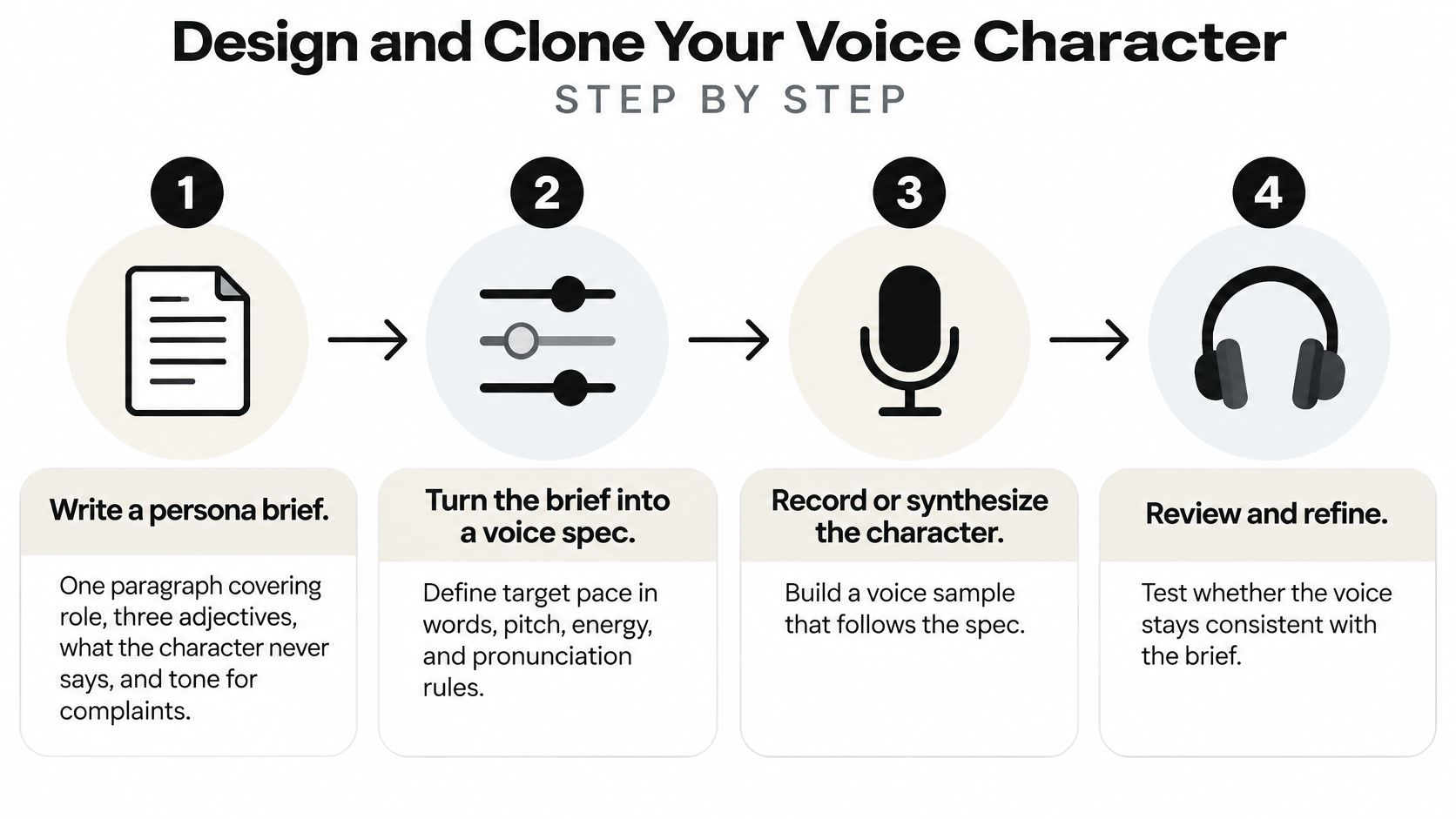
Six Steps to a Locked Character
- Write the persona brief. One paragraph covering role, three adjectives, what the character never says, and its tone for complaints. The common slip is writing adjectives like friendly and professional without defining behavior when a caller is angry.
- Turn the brief into a voice spec. Set target pace in words per minute, pitch range, pause habits, and accent, with one sample line from a reference speaker. prosody in speech becomes practical here, because rhythm and stress carry as much character as timbre. Don't approve a voice from a single cheerful greeting.
- Choose the source and record. Use your use-case row. For a clone, record only with signed consent, using a script that covers numbers, names, confirmations, apologies, and emotional range. Recording first and papering consent later is the expensive slip.
- Write the response library. Draft greeting, disclosure, confirmation, escalation, and closing lines. Keep each greeting under about 20 seconds of speech in your design target, because callers interrupt long openings and then blame the system for not listening.
- Generate sample calls. Build ten typical and five difficult scenarios, then listen for drift in pace, warmth, and certainty between them. A character that sounds patient on a password reset but clipped on a billing dispute isn't consistent yet.
- Lock a versioned voice profile. Bundle the brief, spec, scripts, consent reference, and test results under one version number. Changing the voice mid-project without a new version makes every later complaint impossible to trace.
Watch how those choices sound when they're applied to a complete sample, then compare the delivery with your written spec rather than your memory of the session.
You're finished when the team can replay a short sample set, open a one-page spec, and identify the exact locked version in production. If any of those three artifacts is missing, you have a demo, not a deployable character.
Version rule. Any change to voice, persona, disclosure, or escalation wording creates a new version. No silent swaps.
Recognition, Language Model, Voice and Telephony
Build the stack as five connected parts, each with one check you can run before a pilot. This is basic voice system engineering, and skipping a check usually moves the failure to a live caller.
Five Parts and Their Checks
- Speech recognition. Choose a streaming engine that returns partial transcripts, then test it on narrowband telephone audio, speakerphone noise, and callers who spell names.
- Language model. Build the system prompt from the persona brief, grant only the tools the job needs, and cap spoken answer length so replies don't become lectures.
- Voice output. Connect the locked profile to a text-to-speech engine that streams audio in chunks instead of waiting for the full text.
- Telephony. Connect through SIP or a cloud telephony provider that passes barge-in signals, caller ID, and recording controls into the stack.
- Logging. Stamp every call with stage timestamps, the consent ID, prompts used, tool calls, and voice version.
Add a fallback path. When recognition confidence drops or a service times out, play a short holding line, preserve context, and route to a human queue. Don't let the character improvise through an outage.
Recognition and endpointing usually drive your latency budget more than generation does, so instrument them first.
Set Turn-Taking and Latency Targets That Feel Human
Silence is a bad endpoint detector. The arXiv turn-taking study describes human turn transitions clustering around 0 to 200 ms, with roughly half of conversational turns including slight overlap. Wait for a clean pause and you'll create gaps, talk over corrections, and miss callers who say no mid-sentence.
A Streaming Pipeline
- Stream audio into speech recognition continuously.
- Classify the turn as complete, incomplete, or interrupted while the caller speaks.
- Start response planning before end-of-turn confirmation.
- Support barge-in by cancelling generation and speech immediately when new caller speech appears.
- Log timing for every stage and every premature cutoff.
That same source reports a 39-person human-robot interaction study where explicit cues and a shorter threshold reduced median response time from 2.7 seconds to 1.5 seconds and interruption rate from 16.6% to 6.9%.
| Timing metric | What it shows | Reference from the study |
|---|---|---|
| Time to first audio | Delay before the caller hears anything | Set from your pilot baseline by language and network |
| Full response latency | Time until the complete answer finishes | Median fell from 2.7 s to 1.5 s |
| Interruption rate | Share of turns where the caller is cut off or talks over the character | Fell from 16.6% to 6.9% |
| False endpoint rate | Times the system ends a turn before the caller has finished | Set from your pilot baseline by speaking rate and channel |
Don't tune model inference while recognition delivery and endpoint detection eat the budget. Set separate service targets for time to first audio and full completion, then test by language, acoustic environment, speaking rate, and network condition.
Testing Voice Characters for Accuracy, Identity and Accent Equity
A single quality score hides the failures that hurt callers. A voice can sound beautiful, mispronounce a drug name, cut off slower speakers, and still earn a strong average from listeners who only heard clean prompts. Score semantic accuracy, vocal identity, and interaction timing separately, then gate release on each one. The evaluation approach in the NeurIPS 2025 benchmark paper supports that separation, using word error rate and speaker similarity alongside human ratings rather than replacing them.
The review work below is where those separate scores become release decisions, not dashboard decoration.
Score Three Axes Independently
For semantic accuracy, transcribe generated speech with an independent recognizer and calculate word error rate against the intended text. For vocal identity, compare speaker embeddings between reference and generated audio. For naturalness and character consistency, run blinded human ratings for emotional appropriateness and whether the reply still sounds like the same character under pressure.
Report confidence intervals by language and scenario instead of one average. Human scores are useful, but they're costly and noisy because evaluator pools change. If you're building a call-testing practice from scratch, this guide on how to test AI call answering from Lighthouse Legal is a useful companion for structuring repeatable call checks.
| Axis | Metric | Method | Release gate |
|---|---|---|---|
| Semantic accuracy | Word error rate | Transcribe output with a separate ASR system | Set per language and accent before pilot |
| Vocal identity | Speaker similarity | Compare speaker embeddings with the reference | Set per voice version |
| Naturalness and character | Blinded human rating | Rate by listeners, report confidence intervals per language | Set per language and scenario |
| Interaction timing | Latency and barge-in success | Measure per language and network condition | Targets from the timing table |
Build a Test Set That Can Fail You
Include ordinary dialogue plus names, numbers, code-switching, interruptions, sarcasm, emotional shifts, long answers, and noisy telephony audio. Add mishearings you expect in production, such as similar street names, account numbers read in chunks, and callers correcting themselves halfway through a sentence.
Three pitfalls recur. Teams use the same speech model to generate and judge output, which inflates apparent quality. They test only read prompts, which misses recovery after interruptions. They also accept high speaker similarity while pronunciation or prosody is wrong, even though the caller hears the mistake, not the embedding score.
Treat Accent Equity as a Release Gate
Language count isn't inclusion. The 2025 ACM study of synthetic voice services examined five regional English accents and found technical performance disparities that can reinforce linguistic privilege and digital exclusion. Break word error and task-completion rates down by accent and channel, identify which intents fail disproportionately, and test with local speakers instead of one aggregate benchmark.
Check output intelligibility with older callers and people with hearing or cognitive differences. Offer fallback modalities and human escalation when a group can't complete the task reliably by voice.
Block release if any accent, language, or channel group falls below its threshold. A passing average doesn't excuse a failing group.
Gate every release on regression thresholds for accuracy, identity, latency, and unsafe or off-character replies. Require human review for emotionally sensitive, regulated, or high-impact interactions, and keep the failing audio. You'll need it when someone asks why launch slipped.
Pick One Use Case and Launch With Guardrails
Disclosure doesn't neutralize a familiar voice. The Management Science voice-clone trust research reports controlled experiments where voice agents using a clone of a participant's own voice generated significantly higher trust, AI disclosure didn't eliminate that effect, and clearer, higher-quality audio strengthened it. Treat that as a design input, not a copywriting problem.
Guardrails Before Scale
- No familiar-voice clone for intake that collects sensitive data
- Confirmation step before personal information is collected or changed
- Data minimization limited to what the single job needs
- Audit logs for voice version, prompts, tools, and handoffs on every call
- Human handoff for high-impact decisions, distress, or repeated confusion
Then launch narrowly. Pick one use-case row, confirm the signed release and disclosure script are on file, and run a 50-call pilot against your test set and gates. Check timing targets on real telephony, review every barge-in and false endpoint, and expand only when every gate passes for every accent and channel group.
Nexus VOX voice AI agents can answer, act and resolve calls in 500+ languages, but language coverage doesn't waive a single gate. I'd rather launch one language cleanly than ten with unknown failure groups.
Book the pilot now, name the complaints owner, and schedule a review of the first 30 days of call logs before you announce scale.
Build your first voice character with locked consent, measurable timing, and accent-level release gates, then deploy it on an enterprise platform built for voice, chat, and email. Visit Yellow.ai to design, test, and launch a guarded pilot your CX, EX, and compliance teams can all inspect.