













If you're responsible for voice AI right now, you've probably heard the same complaint in different forms. The bot is accurate enough, but customers still find it tiring. They interrupt it, talk over it, mistrust it, or ask for a human faster than your team expected. The issue often isn't just language understanding. It's delivery.
That gap is where prosody matters. In enterprise voice systems, prosody is the layer that makes speech sound structured, intentional, and responsive instead of flat and mechanical. It affects how people interpret meaning, how quickly they trust an agent, and whether a conversation moves toward resolution or friction.
For a CTO, this isn't a soft linguistic detail. It's an engineering and design variable that sits directly on the path between model output and customer experience.
Table of Contents
- The Music Beyond the Words What Is Prosody
- The Core Components of Prosody and Their Acoustic Cues
- Why Prosody Is Essential for Communication and CX
- Prosodys Critical Role in Modern Voice AI Systems
- Designing and Evaluating Prosody in Conversational Agents
- The Future Is Dynamic Prosody with Agentic AI
- From Feature to Foundation Why Prosody Defines Great Voice Experiences
The Music Beyond the Words What Is Prosody
A common first encounter with prosody happens when comparing two voice experiences that say nearly the same thing.
One system says, “Your payment is due today.” The words are correct, but the tone is flat, pacing is off, and the pause lands in the wrong place. Another system delivers the same line with measured timing, clear emphasis, and a calm downward finish. The second one sounds more competent before it has done anything more intelligent.
That difference is what is prosody in speech in practical terms. Prosody is the layer beyond literal words. It includes intonation, stress, rhythm, loudness, and timing, and it helps listeners interpret meaning, emphasis, and emotion. Academic work also treats prosody as more than a single feature set. It spans pitch, loudness, timing, pauses, voice quality, and phrasing, while serving functions like signaling focus, marking a question versus a statement, and conveying emotion or social identity, as outlined by Northwestern Prosody Lab's overview of prosody.
Prosody is not decoration
A lot of product teams treat prosody as polish added late in the build. That's usually a mistake.
In voice systems, prosody determines whether speech sounds usable under real conditions. It tells the listener what matters, where one thought ends and the next begins, and whether the system understands the interactional moment. If your voice bot platform can generate the right words but not the right delivery, users still experience the conversation as low quality.
Practical rule: If users describe a voice agent as robotic, confusing, cold, rushed, or oddly dramatic, they're often reacting to prosody before they're reacting to language.
Why CTOs should care
Prosody sits at the intersection of speech science, model behavior, and experience design. It affects text-to-speech quality, recognition performance, interruption handling, brand consistency, and customer trust.
That makes it a strategic concern. Enterprises that engineer prosody well don't just make voice AI sound nicer. They make it easier to understand, easier to engage with, and easier to deploy in high-stakes journeys where tone and timing influence outcomes.
The Core Components of Prosody and Their Acoustic Cues
Prosody becomes easier to work with when you stop treating it as a vague idea and start treating it as a measurable acoustic system. At a technical level, prosody is defined through three suprasegmental dimensions: fundamental frequency for pitch, acoustic intensity for loudness, and temporal duration for rhythm and timing. These dimensions act as a parallel communicative channel that carries both linguistic and paralinguistic information, as described in Columbia's explainer on prosodic dimensions.
Prosody as an acoustic layer
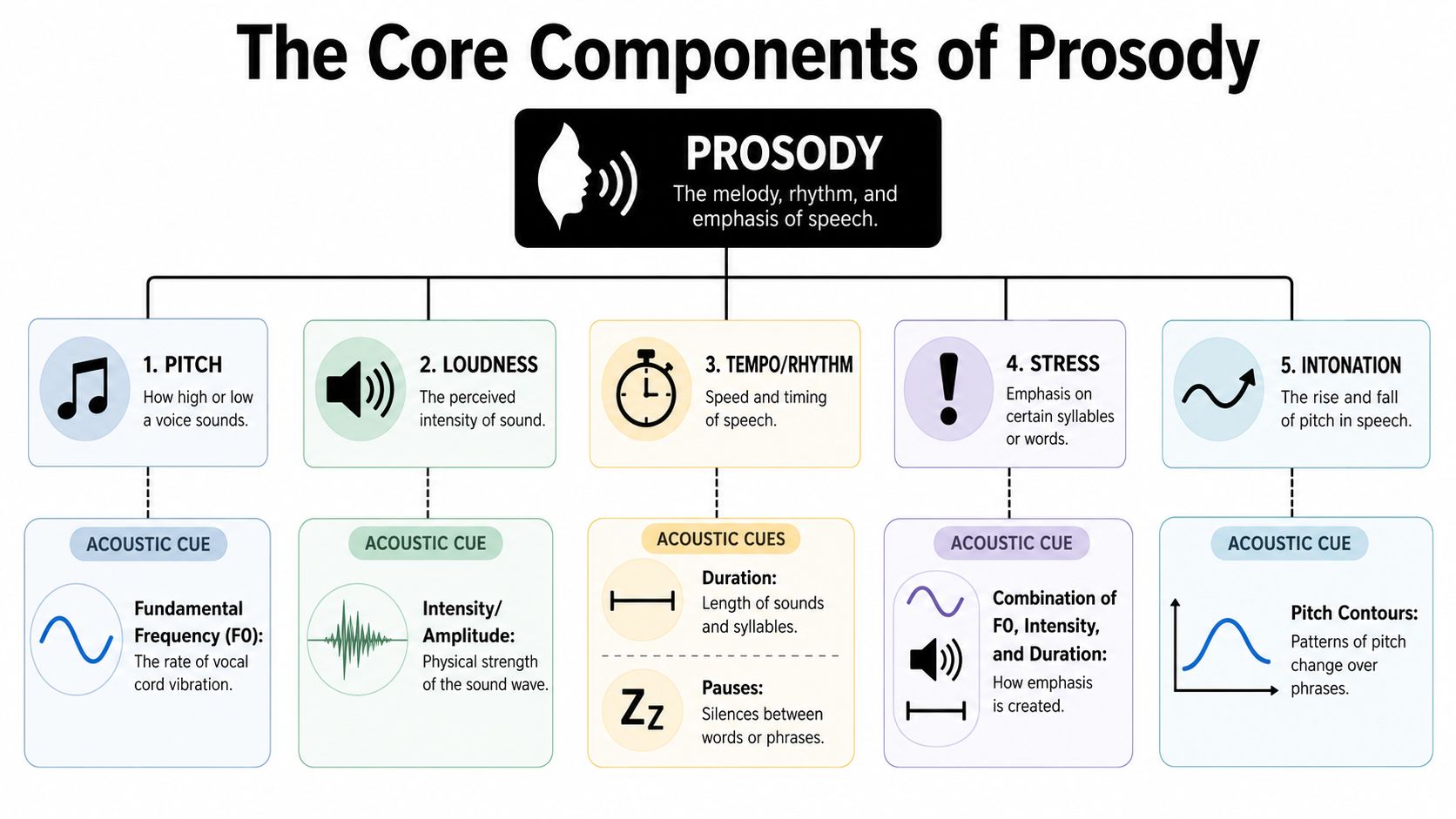
Here's the cleanest way to think about the core cues.
| Component | Acoustic cue | What it does in conversation |
|---|---|---|
| Pitch | Fundamental frequency, measured in Hz | Signals rise and fall, marks questions, emphasis, and phrase shape |
| Loudness | Intensity, measured in dB | Highlights stress, urgency, confidence, or restraint |
| Duration | Timing, measured in milliseconds | Controls rhythm, speech rate, phrase lengthening, and pausing |
Pitch is often what is noticed first. A rising contour can make an utterance sound open or uncertain. A falling contour often signals completion or certainty. In customer conversations, wrong pitch movement can make a statement sound like a question, or a reassurance sound oddly detached.
Loudness matters because emphasis isn't random. People expect certain words to carry prominence. If the voice stresses the wrong word, meaning shifts. If it never varies intensity, everything sounds equally important, which means nothing stands out.
Duration is where many systems fail. Timing controls rhythm, pause placement, and the lengthening that helps listeners parse boundaries. In practice, this is the difference between speech that flows and speech that feels like sentence fragments glued together.
How the components work together
Prosody is rarely produced through one cue alone. Stress often emerges from a combination of pitch, intensity, and duration. That's why simplistic tuning can backfire. Raising pitch without adjusting timing may sound artificial. Adding pauses without rebalancing emphasis can make an agent sound hesitant.
For multilingual teams, this gets more important. Languages and dialects don't use the same prosodic patterns in the same way. Teams building for regional voice experiences need phonology and prosody to work together. If your team wants a concrete example of how speech structure differs across languages, this guide to understanding Irish sounds is useful because it shows why voice design can't assume one universal speech pattern.
Treat prosody like interface behavior, not audio cosmetics. Users hear hierarchy, intent, and structure in milliseconds.
For engineering teams, that means you need controls for pauses, emphasis, phrase grouping, and contour shaping, not just a voice model with a pleasant timbre.
Why Prosody Is Essential for Communication and CX
Speech doesn't carry meaning through words alone. Prosody helps listeners interpret meaning, emphasis, and emotion, and it's shaped not only by linguistic structure but also by factors like length, complexity, and predictability of the material, according to this review of prosodic structure in speech.
That matters because customers don't experience your voice AI as a transcription engine. They experience it as a conversational actor.
Meaning changes before the words change
Take a simple service phrase such as, “I can help with that today.” Depending on stress and timing, it can sound reassuring, impatient, uncertain, or scripted. The text stays fixed. The user's interpretation doesn't.
Prosody also helps people disambiguate structure. A short pause can separate options. A longer phrase-final lengthening can signal completion. A change in emphasis can identify what the system thinks is important. Without those cues, users do extra cognitive work just to follow basic prompts.
In customer support, that friction shows up quickly:
- Clarification loops increase: Users ask the agent to repeat, restate, or slow down.
- Trust erodes early: Flat or misaligned delivery makes the system sound less competent.
- Emotion gets mishandled: An apology with poor timing can sound performative instead of helpful.
- Turn-taking breaks down: Customers interrupt because the agent doesn't signal conversational boundaries well.
What this means for customer operations
CX leaders often focus on intent accuracy, containment, and routing logic. Those matter. But prosody influences whether users stay calm enough to complete the journey.
A billing reminder, claims update, password reset, or care navigation flow all involve moments where timing and tone shape behavior. A voice that sounds rushed can escalate already tense calls. A voice that sounds too cheerful in a sensitive context can damage brand trust. A voice that places emphasis well can reduce confusion without changing the script.
When teams improve wording but ignore prosody, they often optimize the transcript and leave the experience broken.
This is why voice design belongs in CX strategy, not just speech engineering. If your organization is building stronger service interactions through AI, the ideas in this voice AI for interpersonal customer service whitepaper are relevant because they connect conversational quality to relationship quality, not just automation coverage.
Prosody doesn't guarantee a great experience. But weak prosody can undermine a strong workflow very quickly.
Prosodys Critical Role in Modern Voice AI Systems
Prosody affects three parts of the voice AI stack more than most buyers realize: speech recognition, speech generation, and voice identity.
Where prosody enters the stack
In automated speech recognition, prosody helps the system infer structure and interpret spoken input more accurately. The most concrete evidence comes from speech recognition research at the University of Illinois. That work reports that prosodic tagging reduced word error rate by 13% relative in one result, and about 12% relative in another when prosody was included in the model, as detailed on the University of Illinois page on prosody-dependent speech recognition.
That kind of improvement matters because recognition is upstream of everything else. If the system hears wrong, downstream intent classification, retrieval, and action execution all inherit the error.
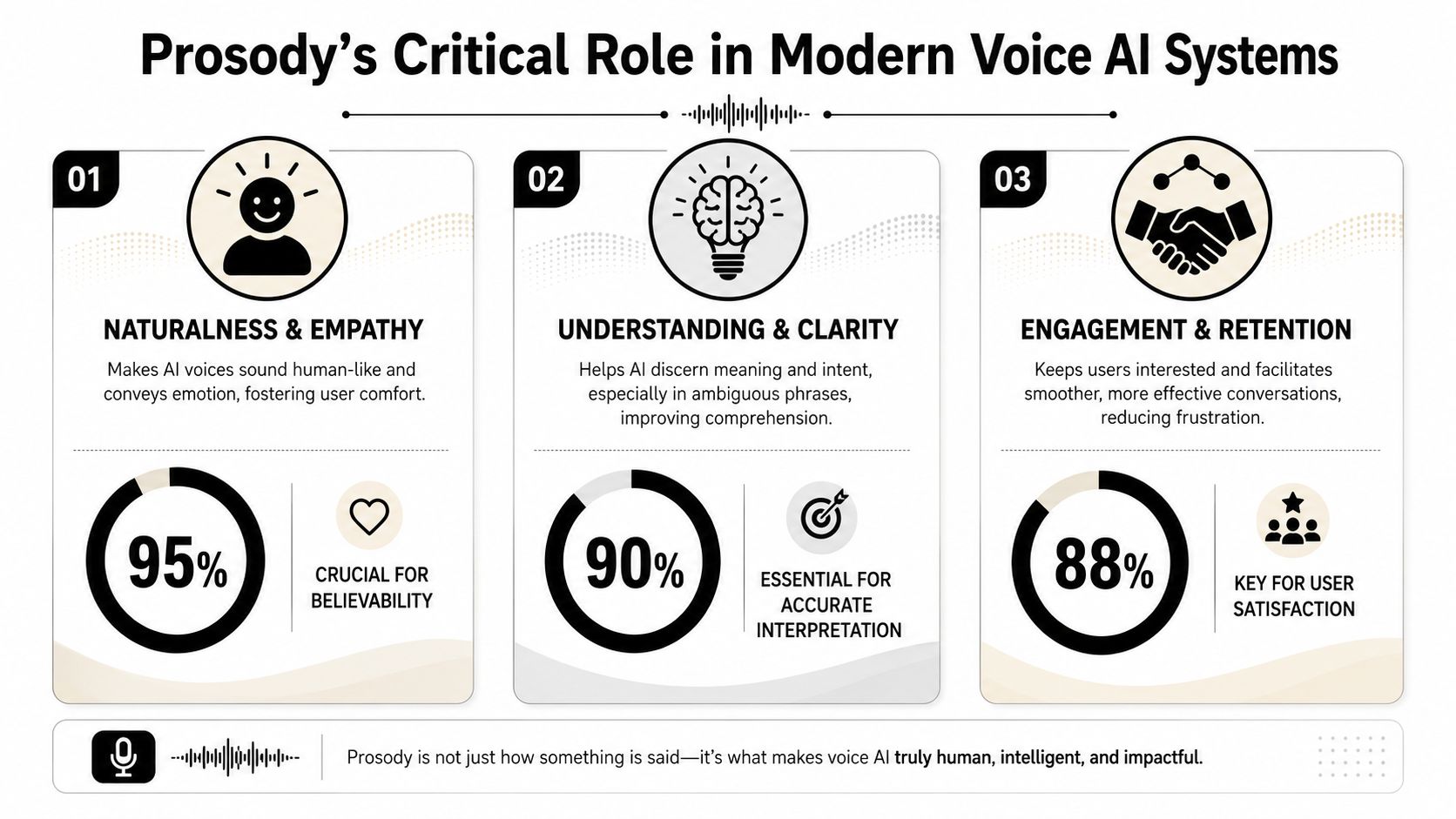
In text-to-speech, prosody determines whether generated speech sounds like fluent communication or synthetic output. While many demos appear successful, production systems often fall short. A polished sample sentence can sound natural. A long, branching service conversation with confirmations, corrections, and escalations exposes whether the model can maintain appropriate phrase grouping, emphasis, and timing.
Voice cloning adds another layer. Teams often focus on matching timbre, accent, or surface resemblance. But a cloned voice without the speaker's prosodic patterns still feels off. People recognize identity partly through rhythm, stress habits, pause behavior, and melodic shape.
Why this matters operationally
A practical way to assess a voice stack is to ask where prosody is controlled and where it is measured.
If your platform only lets you pick a voice and set a speaking rate, you're working with a narrow layer of control. If it supports markup and structured speech design, you can shape pauses, emphasis, and delivery more intentionally. Some teams use SSML-driven workflows for this. Others rely on end-to-end neural systems with more embedded prosodic modeling. Both approaches can work, but neither works well if design ownership is unclear.
For enterprises evaluating tooling, voice automation platforms that support orchestration across recognition, prompting, and synthesis are easier to operationalize than point solutions stitched together late.
A strong stack uses prosody for more than aesthetics. It uses it to improve machine understanding, reduce brittle interactions, and keep the spoken layer aligned with the business goal of the conversation.
Designing and Evaluating Prosody in Conversational Agents
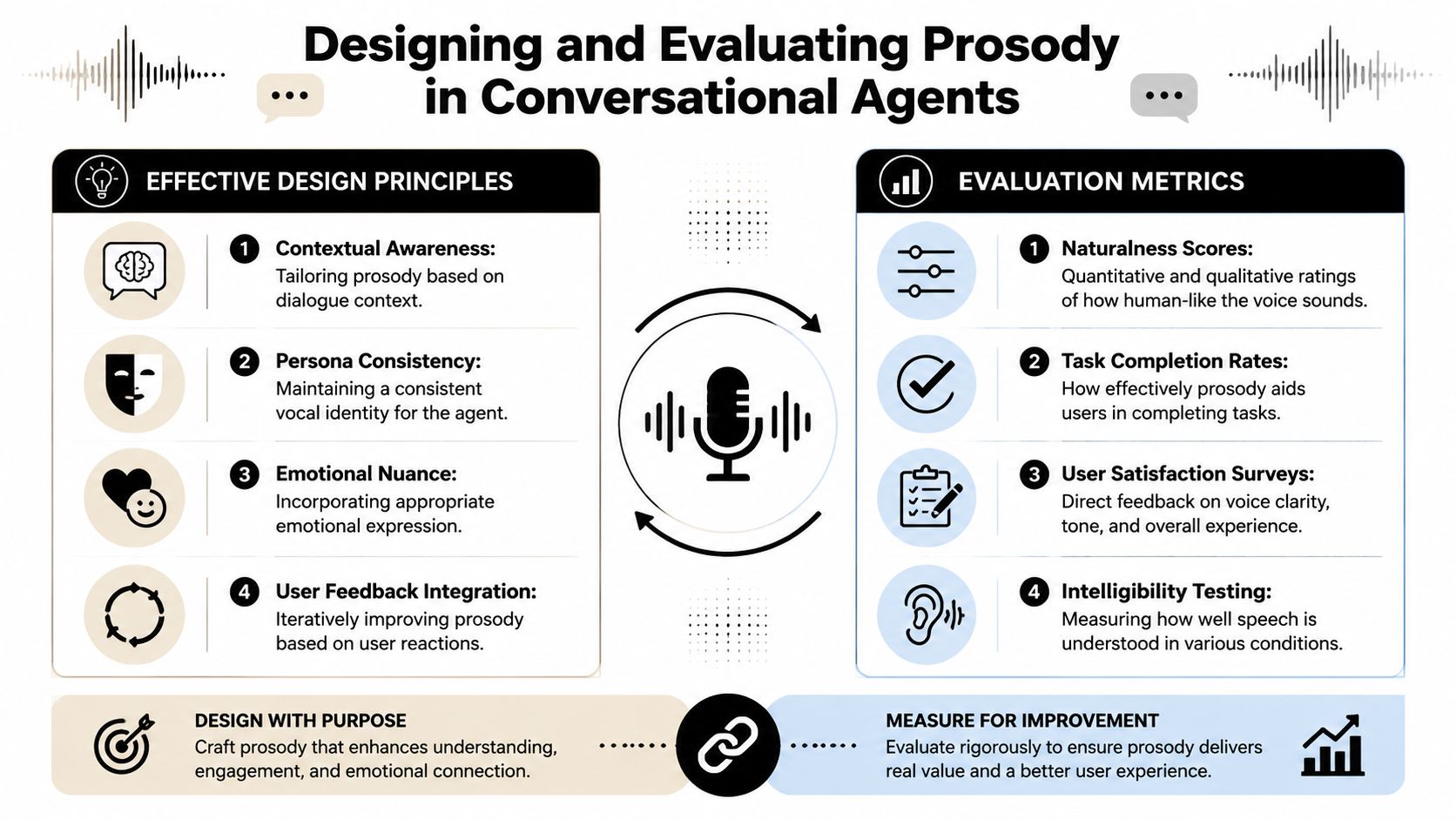
Teams often don't fail because they ignore prosody entirely. They fail because they treat it as taste. One stakeholder wants a warmer voice. Another wants a more premium tone. Someone else says the current version sounds fine.
That approach doesn't hold up in production. Prosody has to be designed against context and evaluated against task performance.
Design for context, not for generic pleasantness
A good voice agent shouldn't sound the same across every moment in a journey. Payment reminders, appointment confirmations, fraud checks, onboarding steps, and sympathy statements require different pacing and emphasis patterns.
Here is a simple contrast.
| Scenario | Weak prosody | Strong prosody |
|---|---|---|
| Verification step | Flat reading of every field, no boundary cues | Clear chunking, short pauses between fields, emphasis on required items |
| Apology after an issue | Bright tone, uniform speed, no softening | Slightly slower pace, lower energy, measured phrasing |
| Urgent action prompt | Hesitant rhythm, misplaced stress | Direct phrasing, crisp emphasis, faster but controlled delivery |
The usual design mistakes are consistent:
- Over-smoothing the voice: Teams remove variation to avoid sounding dramatic, then end up with monotony.
- Using one prosodic profile everywhere: The same cadence for collections, support, and care scenarios creates tonal mismatch.
- Pausing by punctuation only: Written punctuation doesn't always map cleanly to spoken phrasing.
- Ignoring interruption points: The agent keeps speaking with no audible cues that a turn is ending.
A few practical rules work better than broad style guidance.
- Write for breath groups: Draft prompts in chunks that can be spoken naturally.
- Mark emphasis intentionally: Decide which word carries the business-critical meaning.
- Tune for scenario severity: Calm doesn't mean cheerful. Efficient doesn't mean rushed.
- Review with real dialogues: Single-sentence audition tests miss most failure modes.
Later in the review cycle, it helps to watch and listen to examples with teams across design, QA, and operations.
What to measure in production
You don't need a perfect scientific lab to evaluate prosody, but you do need more than opinion.
Use a mix of perceptual, behavioral, and operational metrics:
- Naturalness scores: Ask evaluators whether speech sounds smooth, appropriately expressive, and easy to follow.
- Intelligibility testing: Check whether users correctly understand key details in noisy or fast-paced contexts.
- Task completion rates: Watch whether voice delivery helps or hinders successful completion.
- Semantic error review: Identify moments where users understood the wrong meaning despite correct words.
- User satisfaction feedback: Listen for comments about clarity, warmth, pacing, and professionalism.
A voice agent can be grammatically correct and still fail because users misread its intent, urgency, or confidence.
A simple review framework for teams
For enterprise programs, I recommend reviewing prosody in three passes.
- Script pass: Does the wording create natural spoken units?
- Playback pass: Does the delivery match the service moment?
- Conversation pass: Does the voice still work when users interrupt, hesitate, or switch goals?
This is also the point where tools matter. If your team uses a platform such as Yellow.ai, its Speak node supports SSML, which gives designers a practical way to shape pauses, emphasis, and intonation inside voice flows instead of leaving delivery entirely to default synthesis behavior.
Prosody becomes manageable once ownership is clear. Conversation designers shape intent and phrasing. Speech engineers tune synthesis behavior. QA reviews real-world calls, not just scripted samples. Operations teams feed back where customer friction appears.
The Future Is Dynamic Prosody with Agentic AI
Most legacy voice systems use static prosody. They have a default voice, a default pacing pattern, and a limited set of predictable contours. That was acceptable when automation handled narrow IVR-style tasks. It isn't enough for multi-turn, enterprise-grade conversations.
Static delivery is the old model
A static voice can read content. It struggles to adapt.
If a customer is anxious, confused, or in a hurry, a fixed delivery profile won't respond appropriately. It may continue with the same cadence whether it's confirming an appointment, de-escalating frustration, or asking for a sensitive identifier. That creates the exact mismatch customers notice immediately, even if they can't name it.
Dynamic prosody changes that design model. Instead of treating speech output as a final render step, the system treats delivery as part of conversation policy. Timing, emphasis, and phrasing can shift based on context, user state, and task urgency.
Why dynamic prosody changes enterprise design
At this point, agentic voice architecture becomes more interesting than traditional TTS pipelines.
An agent that can reason over context can also vary how it speaks. It can slow down for a compliance disclosure, tighten delivery for a transactional confirmation, soften phrasing during recovery, or use clearer prominence when a user has already misunderstood a key detail. That doesn't make the voice emotional in a theatrical sense. It makes the voice operationally adaptive.
For enterprise teams, the strategic shift is straightforward:
- Prosody becomes policy-aware: Delivery aligns with workflow state, not just script text.
- Brand voice becomes executable: Tone guidelines turn into controllable speech behaviors.
- Localization gets more realistic: Voice behavior adapts to language and region, not just translated text.
- QA expands beyond pronunciation: Teams evaluate whether the system chose the right delivery for the moment.
This is also why buyers should separate impressive voice demos from deployable voice systems. A compelling sample isn't enough. You need a system that can adapt prosodic behavior under live conversational conditions, across different intents, channels, and service environments.
The future of enterprise voice AI won't be defined only by better models. It will be defined by systems that know how to speak as well as what to say.
From Feature to Foundation Why Prosody Defines Great Voice Experiences
Prosody starts as a speech concept and ends as a business capability.
It shapes how users interpret meaning, how clearly they hear structure, and how much confidence they place in a voice agent. It also affects the AI stack at a deeper level than many teams expect. Recognition improves when systems use prosodic cues. Speech output improves when delivery matches context. Brand experience improves when tone, timing, and emphasis feel intentional rather than generic.
For enterprise leaders, that's the answer to what is prosody in speech. It isn't just the melody of language. It's part of the operating system for spoken interaction.
Teams that treat prosody as a late-stage voice polish step usually end up with serviceable demos and weak production outcomes. Teams that treat it as a design and engineering foundation build voice experiences that are easier to understand, more credible under pressure, and more capable of handling real customer conversations.
As voice AI moves deeper into support, sales, care, and employee service, the winners won't be the teams that just automate speech. They'll be the teams that engineer speech well enough for people to trust it.
If you're evaluating how voice AI should perform in production, not just in demos, explore Yellow.ai to see how an enterprise agentic AI platform approaches autonomous voice, multimodal orchestration, and conversational design at scale.



