














The popular advice is to start with the most human-sounding voice you can find. That's backwards. The first buying decision for AI voice agent services for businesses should be whether the agent can complete a defined job safely inside your existing systems. A beautiful demo that can't authenticate a caller, update a case, respect consent, or transfer context is an expensive IVR with better pronunciation.
The practical opportunity is still substantial. A 2024 global contact-center survey found that 42% of organizations were using generative AI to support human agents, while 29% were applying it directly to customer-facing scenarios. The same survey reported improved overall customer satisfaction at 51% of organizations and reduced cost per interaction at 69% after AI-powered solutions were deployed (2024 State of the Technology in the Contact Center report). Those figures support a measured conclusion, not a replacement fantasy: voice agents can create operating gains when leaders pair automation with integration, measurement, and human escalation.
Table of Contents
- The Shift From Interactive Response to Intelligent Action
- How Modern AI Voice Agents Work Under the Hood
- Transforming Customer and Employee Experiences
- Deployment Models and Integration Realities
- Measuring ROI and Navigating Costs
- Building Trust Through Compliance and Governance
- Evaluating Vendors and Executing Implementation
The Shift From Interactive Response to Intelligent Action
A voice agent earns its place by completing work, not by sounding human. Consider a utility customer calling about an unexpected bill. A conventional IVR asks for a language, account type, and reason for calling. One wrong key can send the caller back to the first menu, while repeated requests for “agent” expose a system built around routing rather than resolution.
A modern voice agent can interpret the request in natural language, retrieve the relevant account details, explain approved billing options, and open a case when investigation is required. If the caller becomes confused or raises a sensitive concern, it can pass the interaction to an employee with the gathered context intact. That handoff depends on more than speech quality. It requires permissions, reliable system connections, clear escalation rules, and an operating team prepared to review failures.
That distinction separates interactive response from intelligent action. Traditional Interactive Voice Response, or IVR, routes callers through fixed branches. A contemporary agent combines speech recognition, language understanding, workflow logic, knowledge retrieval, and backend actions. It is designed to complete a defined job, while staying within the authority granted by the business.
Start with narrow work, then widen the scope
Early deployments are easier to control when they target repetitive, high-volume workflows:
- Appointment scheduling: The agent checks approved availability, books or changes a slot, and confirms the details.
- Order and case status: It retrieves current information instead of sending callers through a menu.
- Authentication: It collects the required signals before revealing account information or taking action.
- Basic troubleshooting: It follows a controlled diagnostic path and escalates when the issue exceeds its authority.
- Employee services: It answers routine HR or IT questions and opens a ticket when a specialist must intervene.
The workflow does not remove the need for human support. Complex complaints, exceptions, vulnerable customers, disputes, and judgment-heavy situations still require a reliable handoff. The 2024 contact-center survey reports organizations adopting agent assistance alongside customer-facing automation, rather than shifting immediately to fully autonomous service (survey findings).
Practical rule: Automate the transaction before you automate the relationship.
Agentic AI for customer service works best as a digital operations layer. It handles predictable work at scale, gives employees better context, and reserves human attention for empathy, discretion, and complex reasoning. The business still owns the integration, monitoring, policy updates, and exception handling that keep that layer dependable.
How Modern AI Voice Agents Work Under the Hood
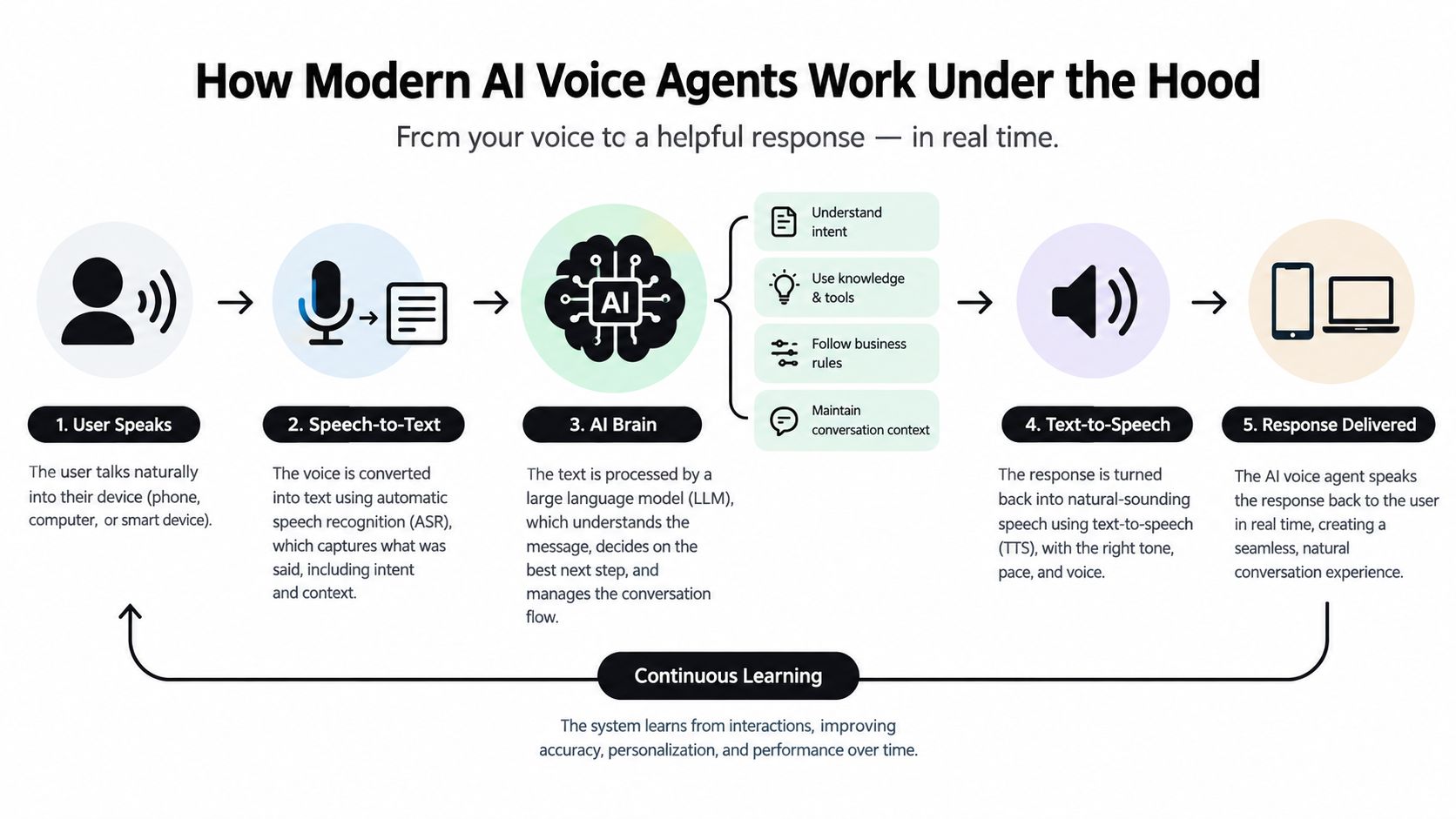
A production voice agent is not a single model listening and speaking in isolation. It's a real-time pipeline with several points of failure. Audio enters through telephony, voice activity detection identifies when the caller has finished speaking, speech recognition converts sound into text, orchestration determines what the request means, retrieval or a business tool supplies information, and text-to-speech streams the response back to the caller.
Three layers deserve particular attention.
Natural language understanding replaces keypad logic and simple keyword matching with intent, context, and entity recognition. The agent must distinguish “I want to change my appointment” from “I want to know whether my appointment changed,” then extract names, dates, account references, or product terms accurately.
Conversational orchestration decides what the agent may do. This layer connects prompts and policies to CRM lookups, knowledge bases, authentication services, calendars, payment systems, and case management. It also controls retries, confirmation requests, interruption handling, and escalation.
Speech synthesis turns the approved response into audio. Natural delivery helps, but realism isn't enough. The voice must pause appropriately, support barge-in, pronounce brand vocabulary correctly, and remain understandable across accents, noise conditions, and telephony compression.
The voice pipeline creates the real user experience
Latency accumulates across every component. Telephony ingress, voice activity detection, speech-to-text, retrieval, model inference, text-to-speech, and audio streaming all contribute to the pause a caller hears. A technically capable model can still produce an awkward interaction if orchestration adds unnecessary calls to external services.
NIST identifies word error rate, or WER, as a standard speech-recognition metric based on substitutions, deletions, and insertions divided by the number of spoken words (NIST publication on automatic speech recognition evaluation). In practice, a single aggregate WER figure is insufficient. Segment results by language, accent, background noise, channel, and task. Misrecognizing a casual sentence may be harmless. Mishearing an account number, address, medicine name, or product code can create a serious operational failure.
For teams turning calls into structured CRM activity, a practical resource is this guide to transcript automation for GTM teams. The same principle applies to service operations: transcripts are useful only when extraction is accurate, reviewable, and connected to the workflow that follows.
| Component | Legacy IVR | Modern Agentic AI |
|---|---|---|
| Input | Keypad selections and fixed phrases | Natural speech, interruptions, and contextual requests |
| Decision logic | Linear menu trees | Orchestration, policies, tools, and retrieval |
| System action | Route to a queue | Look up information, update records, schedule, or escalate |
| Response | Recorded prompts | Dynamically synthesized speech |
| Quality control | Menu completion and transfer data | WER, latency percentiles, resolution, repeat prompts, and escalation quality |
Engineering leaders should monitor latency with P50, P90, and P99 measures, then connect those results to repeat prompts, transfers, containment, and abandonment. The architecture described in voice system engineering is valuable only if those measurements remain visible after launch, when real traffic exposes conditions a polished demo never will.
Transforming Customer and Employee Experiences
The strongest business case isn't “replace the call center.” It's move human effort toward the interactions that need judgment. A voice agent can handle a routine request consistently, while an employee receives the complex case with the caller's history, intent, authentication status, and previous steps already available.
For customer experience, useful starting points include appointment changes, delivery status, warranty questions, account updates, basic troubleshooting, and after-hours intake. These workflows have clear boundaries and measurable outcomes. The agent either completed the booking, retrieved the status, gathered the required information, or transferred the caller with the correct context.

Customer experience requires more than availability
Twenty-four-hour coverage helps only when the experience remains dependable. An agent that answers every call but repeats a failed prompt, invents a policy, or blocks access to a human can increase customer effort rather than reduce it.
Design each customer workflow around four decisions:
- What can the agent verify? Define the identity signals and data sources it may use.
- What can it change? Limit actions to approved operations, with confirmation before irreversible steps.
- What should trigger escalation? Include explicit rules for uncertainty, frustration, sensitive topics, and repeated failure.
- What context reaches the employee? Send the transcript, collected fields, intent, and actions taken with the transfer.
Multilingual support adds another testing dimension. Teams should evaluate pronunciation, intent recognition, terminology, and escalation behavior by language and accent, not assume that a translated prompt creates an equivalent experience. The same applies to callers with speech differences, hearing-related needs, or limited comfort with automated systems. A customer should be able to request a human and correct a recognition error without fighting the workflow.
Employee experience is a separate operating opportunity
Internal voice agents can support HR onboarding, IT requests, facilities issues, payroll questions, and policy navigation. An employee might ask how to replace a device, check an onboarding requirement, or report a workplace issue while away from a desk. The agent can retrieve approved guidance, collect structured information, and open a service request in the correct queue.
The design standard changes inside the enterprise. Employee systems contain sensitive records, and an apparently simple question can expose payroll, health, identity, or access information. Role-based permissions, audit logs, retention controls, and human review matter as much as conversational fluency.
A useful CX operating model is described in customer experience strategies, but the implementation test is concrete: measure whether people resolve the intended task with less effort, not merely whether the agent keeps them from reaching a human.
Deployment Models and Integration Realities
The fastest proof of concept rarely becomes the most reliable enterprise deployment without additional work. Cloud services can put a narrow agent into operation quickly, while regulated organizations may require defined data residency, network controls, private connectivity, or strict processing boundaries. On-premise and hybrid models can meet those requirements, but they shift more infrastructure, release management, and incident response onto internal teams.
| Factor | Cloud/SaaS | On-Premise/Hybrid |
|---|---|---|
| Initial deployment | Faster setup with vendor-managed infrastructure | Longer preparation across security, networking, and operations |
| Scaling | Vendor manages much of the capacity planning | The enterprise owns more capacity and resilience decisions |
| Integration | APIs and pre-built connectors can accelerate access | Greater control, but more components may require internal engineering |
| Data controls | Depends on vendor regions, retention, and contractual terms | Stronger control over selected systems and processing boundaries |
| Maintenance | Vendor handles platform updates | Internal teams manage more upgrades, testing, and dependencies |
| Best fit | Pilots, standard workflows, and organizations comfortable with managed services | Strict regulatory, residency, or architectural requirements |
The deployment choice is only the first cost decision. A voice agent must connect to telephony or SIP, CRM records, knowledge systems, identity services, scheduling, payments, workforce management, case queues, analytics, and a human transfer destination. Each integration adds authentication, permissions, data mapping, timeout handling, monitoring, and regression testing. Those hours often sit outside the vendor quote, yet they shape total cost of ownership and production reliability.
A 2025 survey of business leaders identified integration as a major adoption challenge for 60% of respondents, compatibility with existing AI systems for 65%, and performance quality, including voice quality and conversational flow, for 72% (2025 State of Voice AI Report). A short demonstration therefore says little about the effort required for a dependable launch.
Before selecting a vendor, trace one call from entry to resolution:
- Telephony: Does it support your carrier, numbers, routing, recording, and transfer model?
- Data access: Which systems hold current information, and what happens during a timeout?
- Action permissions: Can the agent update records, or only retrieve data?
- Fallback behavior: Does an API failure produce a clear explanation and a human route?
- Observability: Can operators inspect prompts, tool calls, transcripts, and errors?
- Ownership: Who maintains the knowledge base, integrations, policies, and test suite?
A voice agent becomes an enterprise system the moment it can change a customer record.
Plan for partial failure from the start. If the CRM is unavailable, the agent should not guess or claim that an action succeeded. It should explain the limitation, collect only the necessary information, preserve the interaction for review, and route the case through a documented fallback path. That operating design may slow the initial rollout, but it reduces recovery work when dependent systems fail.
Measuring ROI and Navigating Costs
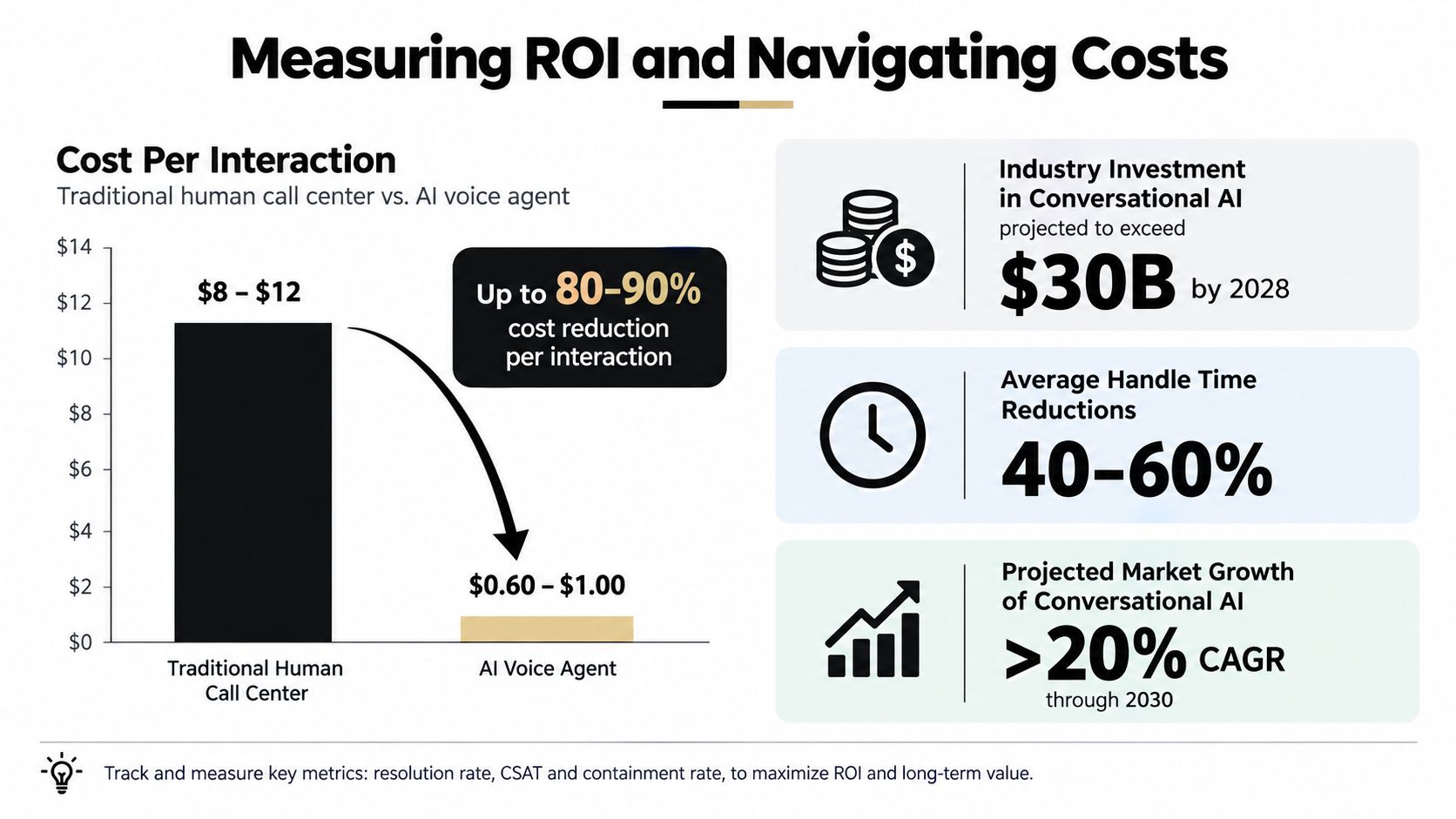
The financial case for conversational AI rests on unit economics, not adoption headlines. A 2024 industry compilation placed global spending on conversational-AI technology at $16.077 billion in 2022 and projected $23.17 billion in 2024, representing approximately 44% growth across that period. It also reported chatbot use at 74% of businesses, conversational-AI use at 29%, adoption at 23%, and planned adoption at 44% (AI in customer service statistics). These figures cover conversational AI broadly, rather than voice agents alone, but they show that companies are funding the category at scale.
The commercial question is whether a particular workflow produces a better fully loaded cost per resolved interaction without damaging resolution quality.
Calculate the cost of resolution, not just the cost of minutes
A credible business case counts every operating input. Include telephony, model and voice charges, integration work, testing, monitoring, security review, compliance operations, human transfers, knowledge maintenance, and incident response. Divide that total by interactions that reached the intended outcome, rather than calls that ended without an employee.
Review the measures together:
- Containment: How many calls finish without transfer?
- Resolution: How many callers achieve the intended outcome?
- Transfer quality: Does the employee receive enough context to avoid repetition?
- Customer effort: Does the caller repeat information or complete unnecessary steps?
- Cost per resolved interaction: What does the full workflow cost?
- Satisfaction and complaints: Does automation improve the relationship or hide failure?
A lower transfer rate can still indicate poor performance if callers abandon the interaction, repeat the request later, or escalate through another channel. Compare automated resolution with human resolution, repeat contact, and complaint outcomes by cohort. Include the ongoing work required to maintain accurate knowledge, test changes, review failures, and manage exceptions.
The best pilot has a narrow scope, a baseline, a fixed review cadence, and a stop condition. Its financial model should include integration upkeep and governance work, not just usage fees. If the agent cannot meet the required resolution quality without frequent human rescue, expansion will multiply operational problems rather than savings. Speed to deployment matters, but reliability determines whether the projected TCO survives production.
Building Trust Through Compliance and Governance
Compliance is part of the call flow, not a document reviewed after launch. Customers and employees should know when they are speaking with an AI system, what information it uses, how to reach a person, and how to correct an error. Each promise needs a corresponding control, owner, and audit trail.
For outbound calls in the United States, the FCC has confirmed that AI-generated and cloned voices qualify as an “artificial or prerecorded voice” under the Telephone Consumer Protection Act. Covered calls generally require prior express consent, subject to limited exceptions. AI-generated messages must also meet applicable identification and disclosure requirements (FCC declaratory ruling).
Consent therefore belongs inside the dialer workflow. Before initiating a call, the system should check the relevant consent record, apply jurisdiction and purpose rules, preserve opt-out events, and suppress future calls when consent is withdrawn. A review after the campaign has contacted people cannot repair a control that was missing at initiation.
Governance should cover the complete interaction lifecycle. Check whether the system can disclose its identity, capture authorization, and honor opt-outs. Confirm that it collects only the information the workflow needs and that teams can set retention, deletion, redaction, and access rules for recordings, transcripts, and sensitive fields. Regulated workflows may require controls for payment data, health information, or financial records.
Auditability matters when an incident reaches legal, security, or operations teams. Investigators should be able to reconstruct the prompt, tool call, data access, and handoff. Callers also need a reliable path to a person, along with support for repetition, alternate formats, transcripts, corrections, and accessibility needs. Test performance across languages, accents, disabilities, and noisy environments rather than treating the default test call as representative.
Privacy and cost can constrain adoption at the same time. Recent enterprise research identified data privacy and security as a challenge for 38% of surveyed organizations, cost as a challenge for 37%, and reported that about two-thirds of executives said privacy limits AI personalization. The same research found that 46% identified data quality as a major customer-experience pain point (generative AI adoption research).
The operating target is safe resolution, supported by clear consent, controlled data use, reviewable decisions, and accessible human assistance. A compliant handoff is preferable to an automated completion that misleads the caller. These controls also belong in the TCO model, because audits, retention management, testing, and exception handling continue after deployment.
Evaluating Vendors and Executing Implementation
Vendor selection should begin with the workflow, not a feature checklist. Ask each provider to demonstrate the same caller journey with an interruption, an ambiguous answer, a failed backend lookup, a sensitive request, and a human transfer. Then inspect the transcript, tool activity, latency, and handoff context.
A practical evaluation sequence is:
- Select one bounded workflow. Choose a high-volume task with a clear owner and an observable outcome.
- Map the dependencies. Document telephony, CRM, identity, knowledge, scheduling, case management, and escalation paths.
- Run real-audio tests. Include background noise, accents, interruptions, silence, corrections, and off-script questions.
- Define stop conditions. Set quality thresholds for recognition, resolution, transfers, complaints, and safety failures.
- Assign ongoing ownership. Name the people responsible for knowledge updates, monitoring, compliance, and release approval.
Compare vendors on integration depth, model flexibility, multilingual quality, testing tools, data controls, observability, support, and the cost of changing the system later. Yellow.ai, for example, offers enterprise voice and omnichannel orchestration, integrations with business systems, agent testing, analytics, and multilingual conversational automation. Treat those capabilities as evaluation criteria to verify against your own architecture, rather than as substitutes for a production pilot.

If internal teams lack the capacity to build integrations, test calls, or maintain backend workflows, an external engineering partner can help. Services such as Hire Developers may be relevant when the bottleneck is implementation capacity rather than vendor discovery.
The right platform is the one your team can operate after the launch team leaves. Choose the service that makes failures visible, changes testable, handoffs safe, and total cost explainable.
Yellow.ai provides enterprise AI voice agents that connect customer and employee conversations to workflows, knowledge, integrations, analytics, and human escalation. If you're evaluating AI voice agent services for businesses, visit Yellow.ai to assess how its platform could support a controlled pilot and a governed path to scale.



