














The weakest customer experience programs often spend the most time talking about customer centricity. The strongest ones build operating systems for it. That gap shows up in retention: businesses with effective omnichannel customer experience strategies retain an average of 89% of their customers, compared with 33% for companies running weaker or fragmented approaches, according to VWO's roundup of customer experience statistics.
That's the uncomfortable truth for enterprise teams heading into 2026. A CX strategy is no longer a service playbook, a journey map workshop, or a dashboard of lagging survey scores. It's a coordinated execution layer across data, channels, automation, and human teams. If that layer is fragmented, customers feel it immediately.
Table of Contents
- Why Your Customer Experience Strategy Needs a Reboot
- Redefining Customer Experience for the AI Era
- The Three Pillars of a Winning CX Strategy
- Your Enterprise Roadmap to CX Transformation
- How to Measure Customer Experience Success
- Scaling CX with AI Orchestration Platforms
- Your CX Strategy Questions Answered
Why Your Customer Experience Strategy Needs a Reboot
Legacy CX strategies are now a cost center in disguise. They look functional on paper, but in practice they create the exact friction customers remember. Repeated questions, channel switching, inconsistent answers, and slow resolutions are not isolated service issues. They are signs that the operating model is broken.
The root problem is structural. Many enterprises still manage customer experience as a set of channel programs instead of a coordinated system. Web teams improve conversion. Contact centers reduce handle time. App teams push self-service. Each team can hit its target while the customer still experiences a fragmented journey.
That gap shows up fast in high-volume environments, especially where timing matters. A missed support call can turn into a canceled order. A disconnected handoff can push a renewal into risk. In sectors where phone interactions still drive revenue, companies now use AI voice automation to prevent missed restaurant calls because manual coverage alone no longer holds up during peak demand.
What old CX gets wrong
Legacy programs usually break in three predictable ways:
- They measure touchpoints, not customer progress. Teams report channel-level success while customers still repeat context and restart tasks.
- They respond after the failure. Surveys, escalations, and churn analysis often surface problems only after trust and revenue have already taken a hit.
- They add AI without changing the system. A single chatbot or copiloted agent desktop does not fix fragmented data, poor routing logic, or disconnected voice and digital experiences.
Practical rule: If service, sales, and support teams cannot act on the same customer context in real time, the business is not running a modern CX strategy. It is running disconnected workflows.
A reboot starts with a harder admission than is readily accepted. The old model cannot support the speed, volume, and channel complexity that enterprise customers now expect. It was built for queue management and case handling, not for continuous orchestration across chat, email, app, and voice.
That is why CX leaders are shifting budget and attention toward orchestration platforms and agentic AI. The goal is not to add another layer of automation. The goal is to create a decision system that can interpret intent, carry context forward, and trigger the next best action across every interaction. For teams building that operating model, this framework for improving enterprise CX execution with AI is a useful reference point.
This matters even more for voice-first journeys. Phone support remains the channel customers turn to when the issue is urgent, emotional, or high value. If voice sits outside the rest of your CX stack, the strategy is incomplete before it launches.
Redefining Customer Experience for the AI Era
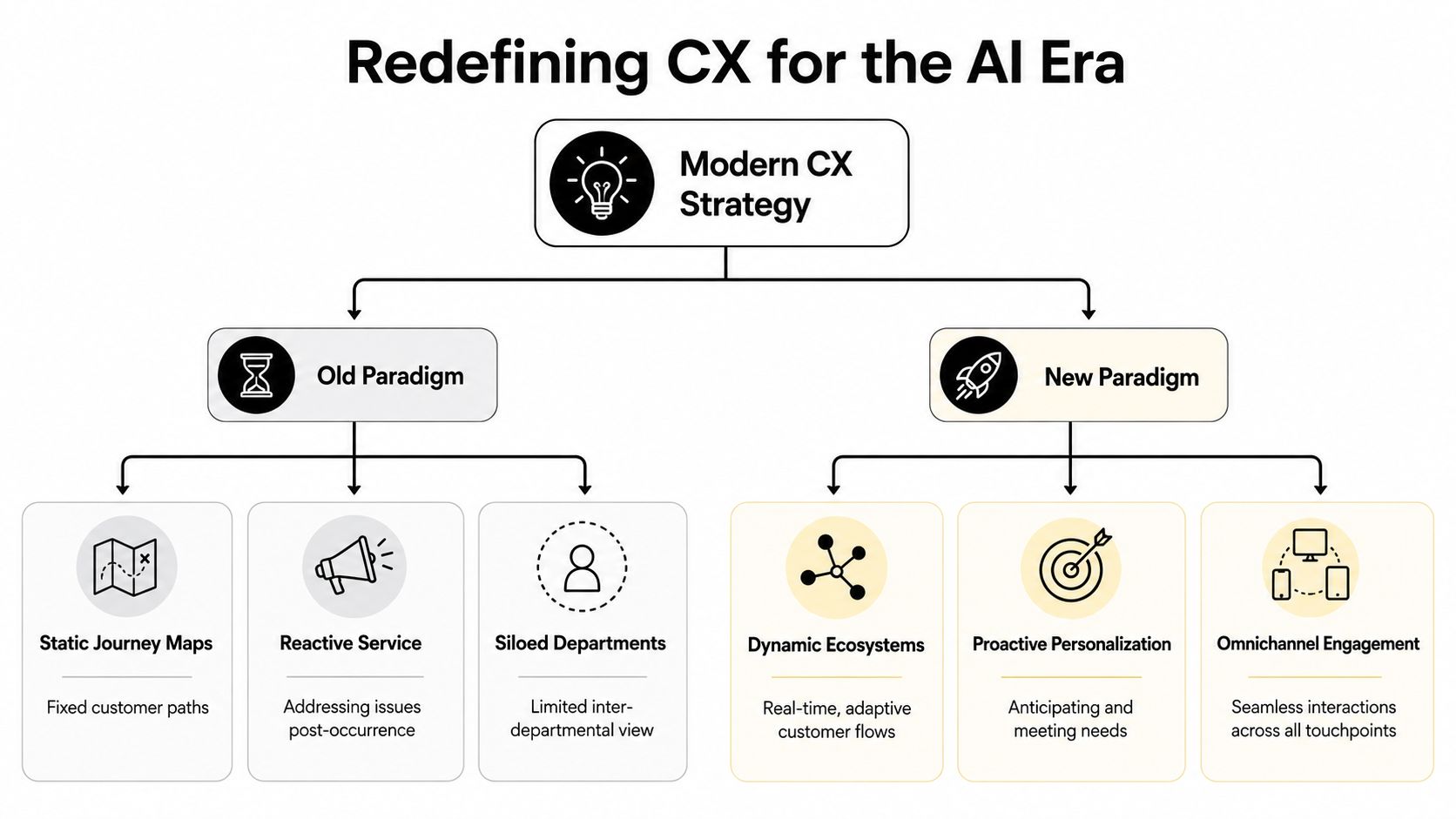
A modern CX strategy looks less like a map and more like a traffic control system. The old model is a printed road atlas. It shows possible routes, but it can't adapt when a lane closes, a customer changes intent, or demand spikes on one channel. The new model works more like live GPS. It reroutes in real time, uses current signals, and keeps the destination in view.
From static maps to live orchestration
Traditional customer experience strategies leaned on static journey maps, quarterly feedback reviews, and departmental ownership. Those tools still have value, but they don't operate fast enough for complex digital journeys. A customer can start in chat, move to voice, abandon a cart, open a support case, and re-engage after seeing an email. A static map can describe that. It can't manage it.
Modern CX requires a living system that can do four things well:
- Ingest signals continuously. Behavior, support history, sentiment, transaction context, and knowledge content need to flow into one decision layer.
- Preserve context across channels. A customer shouldn't have to restate the issue because they moved from app to phone.
- Take action in real time. The system should route, respond, escalate, summarize, and personalize while the interaction is happening.
- Learn from outcomes. Each resolution, drop-off, transfer, and deflection should sharpen the next interaction.
That's where agentic AI starts to matter. Not as a novelty, but as a practical way to coordinate decisions, content retrieval, and next-best actions. If you want a useful primer on the model, this overview of agentic AI and how it differs from AI agents is worth reviewing.
Why voice changes the design
Many enterprises still design CX as if voice is the exception. In practice, voice is often the channel customers choose when stakes are high, emotions are high, or the issue is messy. That makes voice the stress test for your entire operating model.
A simple example is restaurant operations. If a business wants to prevent missed restaurant calls, the problem isn't just answering the phone. It's preserving intent, handling peaks, routing accurately, and connecting the call outcome to the broader customer record. The same logic applies in healthcare, banking, utilities, and logistics.
Good customer experience strategies don't just add channels. They coordinate memory, intent, and action across them.
That's the AI-era shift. Presence used to be enough. Now orchestration is the standard.
The Three Pillars of a Winning CX Strategy
Winning CX strategies are built on operating principles, not a pile of disconnected initiatives. Enterprises that improve service at scale usually make three decisions early. They prevent avoidable issues, personalize with discipline, and keep context intact across every channel.

Proactive service beats reactive recovery
Reactive support still has a place. High-stakes disputes, sensitive exceptions, and complex technical failures often need a human team. But if reactive service is still your default model, costs rise faster than quality.
Analysts expect more service organizations to shift in this direction. Gartner predicts that 40% of customer service organizations will adopt proactive strategies by 2026, as cited in Onramp's customer experience statistics roundup. The business case is simple. Preventing friction is cheaper than recovering from it after a customer has already lost time or trust.
In practice, proactive CX shows up in a few concrete ways:
- Trigger-based outreach: alert customers when billing issues, delivery delays, or service disruptions are likely to affect them.
- Guided onboarding: deliver timely education and task completion prompts right after purchase or signup.
- Risk-based intervention: detect repeat failure, abandonment, or negative sentiment early and intervene before the issue becomes a complaint.
This pillar depends on orchestration. AI has to detect the signal, choose the action, and route the outreach through the right channel, including voice when urgency or complexity is high. Without that coordination, proactive service turns into fragmented alerts that create more noise than value.
Personalization has to work operationally
Personalization is not a copywriting exercise. It is the ability to make the right decision for the right customer at the right moment, using live context and rules your teams can govern.
That creates real trade-offs. More personalization can improve relevance, but it also raises the risk of bad timing, inconsistent offers, and brittle logic spread across teams. I have seen enterprises pour money into customized messaging while agents still lack order history, bots still miss intent, and voice systems still start from zero. Customers do not experience that as personalization. They experience it as disconnected service with better subject lines.
Strong programs personalize across three layers:
- Intent: what the customer is trying to get done right now
- History: what prior purchases, cases, conversations, and outcomes say about the next best action
- Delivery: which channel, language, and format fit the urgency and complexity of the moment
AI orchestration makes those layers usable. Agentic systems can pull context from CRM, knowledge bases, ticketing tools, and telephony, then decide whether to answer, ask a clarifying question, escalate, or hand off to voice with a full summary. That is how personalization becomes operational instead of aspirational.
Consistency is the multiplier
Consistency is what customers remember when journeys cross channels, teams, and time. A polished chat flow means little if the voice agent cannot see it, the live agent asks the customer to repeat everything, and the follow-up email contradicts what support promised.
The goal is not identical experiences everywhere. Voice should behave like voice. Messaging should behave like messaging. What must stay consistent is the memory, policy logic, and resolution path behind the interaction.
Many legacy CX programs break down when they optimize touchpoints one by one, while the customer experiences a single journey. AI orchestration platforms such as Yellow.ai address that gap by connecting automation, agent assist, channel routing, and voice-first workflows to the same context layer. That shared layer is what keeps the experience coherent when volume spikes, channels switch, or an issue needs human judgment.
The multiplier effect is straightforward. Proactive service reduces avoidable demand. Personalization improves relevance. Consistency protects trust across the full journey. Together, these three pillars turn CX from a service function into a coordinated system for retention, efficiency, and growth.
Your Enterprise Roadmap to CX Transformation
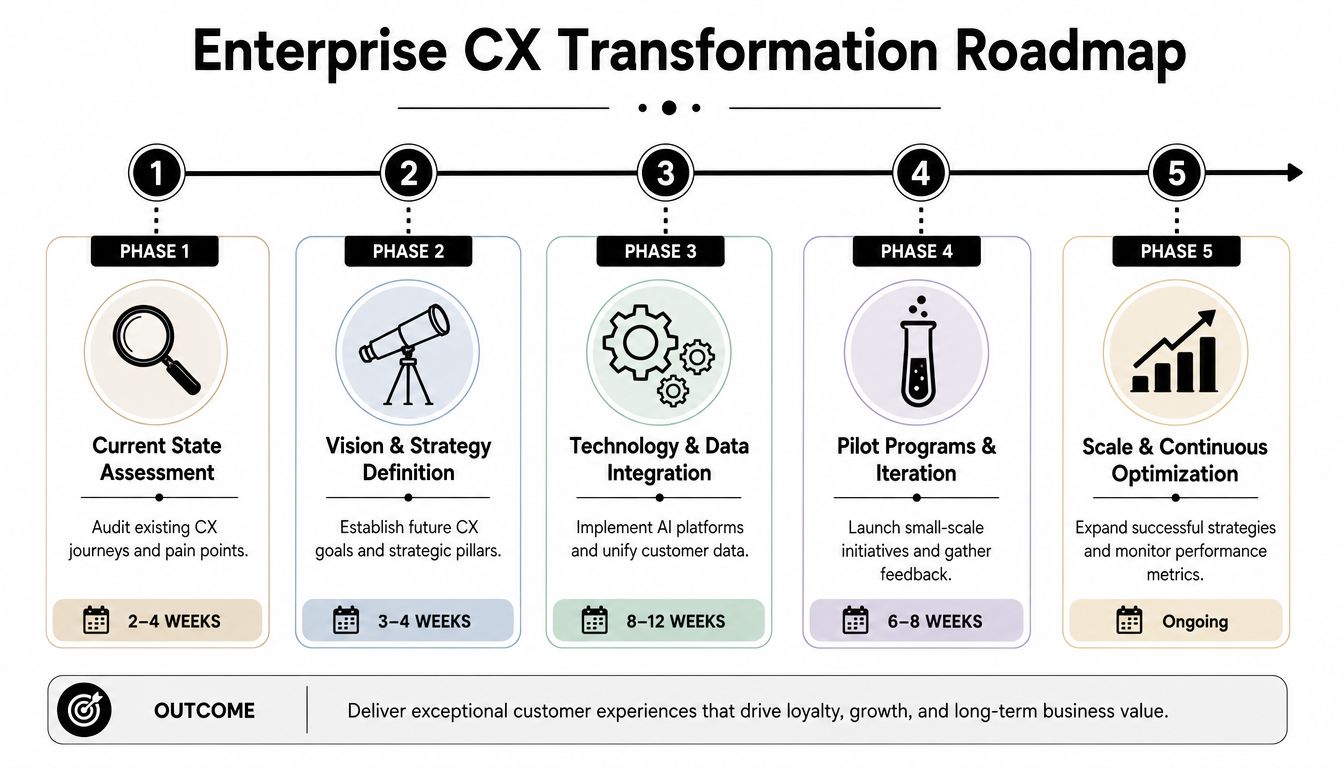
Big CX transformations fail when leaders treat them as a technology rollout. They work when leaders treat them as an operating model change with a clear sequence. The sequence matters because every later phase depends on earlier discipline.
Phase one and two
Start with an audit, but don't stop at channel inventory. Review where customers enter, where they switch channels, where agents lose context, where policies conflict, and where systems slow the response. Most organizations already know their loudest pain points. They usually haven't mapped the root causes across teams and tools.
Then define the future state. Choose one primary business-outcome metric to anchor the transformation. Retention, customer satisfaction, and lifecycle value are common choices. The mistake is choosing too many north stars and allowing each function to interpret CX success differently.
A practical first block of work looks like this:
- Audit journeys end to end: Include support, onboarding, billing, renewals, and digital self-service.
- Document system dependencies: CRM, telephony, knowledge systems, analytics, and case management all affect experience design.
- Set decision rights early: Clarify who owns journey changes, escalation policy, content updates, and AI governance.
TTEC's guidance is useful here: developing a cross-enterprise Customer Experience Management team that shares roles, business intelligence, and customer feedback is critical for cross-channel analysis and integrated service alignment, supported by end-to-end data engines that link disparate sources in real time, as described in TTEC's customer experience management strategy article.
That operating model is what keeps transformation from stalling in committee.
Here's a useful explainer to align teams on the broader shift before implementation starts:
Phase three and four
Once the ownership model is clear, centralize the data and begin orchestration. Many enterprises then discover that their channel tools can transact, but can't share memory well. A customer profile has to include behavioral signals, support history, and relevant business context in a form that automation and agents can both use.
Then automate with restraint. Don't start by trying to automate every interaction. Start where intent is common, answers are clear, and handoff logic can be tightly controlled. Good early candidates include order status, appointment flows, onboarding guidance, balance inquiries, FAQs, and repetitive internal employee requests.
The scale phase should include these controls:
- Pilot narrow use cases first. Prove that containment, resolution quality, and handoffs are reliable.
- Instrument everything. Measure friction points, dropout points, escalation reasons, and knowledge gaps.
- Expand by journey, not by bot count. One well-orchestrated journey beats several disconnected automations.
- Keep human fallback strong. Automation should lower effort, not trap customers in loops.
Enterprises usually don't need more channels. They need fewer disconnects between the channels they already have.
The organizations that move fastest aren't reckless. They sequence work carefully, centralize accountability, and scale only after the orchestration layer starts producing cleaner interactions.
How to Measure Customer Experience Success
Many teams still measure CX as if surveys alone can explain the whole relationship. Surveys matter, but they only capture what customers choose to report. A stronger measurement model combines sentiment, behavior, and business impact in one view.
Formbricks describes this well: implementing an integrated Customer Experience Analytics program that unifies feedback such as NPS, CSAT, and CES with behavioral and financial metrics helps organizations move from reactive to proactive management by identifying root causes of friction and increasing customer lifetime value, as outlined in Formbricks' guide to customer experience analytics.
Three metric groups that matter
Use three categories together rather than treating them as separate reporting streams.
| Metric Category | KPI | What It Measures | Why It Matters in an AI-Powered CX |
|---|---|---|---|
| Experience | NPS | Loyalty and advocacy intent | Shows whether the overall relationship is improving as journeys become more automated |
| Experience | CSAT | Satisfaction with a specific interaction or touchpoint | Helps teams compare human-led and AI-supported experiences at the moment level |
| Experience | CES | Customer effort | Reveals whether orchestration is actually removing friction or simply shifting it |
| Operational | First Contact Resolution | Whether the issue was resolved in the first interaction | Tests whether routing, knowledge access, and automation are working together |
| Operational | Containment Rate | Whether automation handled the interaction without human transfer | Useful only when paired with quality signals, because high containment alone can hide poor outcomes |
| Operational | Escalation Reasons | Why interactions move to human agents | Identifies weak intents, policy gaps, and knowledge failures in the automated flow |
| Business | Customer Lifetime Value | Long-term value of the customer relationship | Connects CX improvements to durable commercial impact |
| Business | Churn Rate | Loss of customers over time | Shows whether experience improvements are reducing relationship erosion |
| Business | Revenue per Customer | Commercial depth of the relationship | Helps test whether better service and personalization are supporting growth, not just efficiency |
How to read the signals together
A common mistake is celebrating an operational win that hurts the experience. For example, a higher containment rate looks good until CSAT drops or repeat contacts increase. Another mistake is focusing only on sentiment and missing process failure. Customers may rate an interaction positively because an agent rescued a bad journey that should never have required rescue.
Build a review rhythm that asks a tougher set of questions:
- Where does effort rise? Look for steps where customers repeat themselves, switch channels, or abandon the flow.
- Which intents underperform? Separate simple, high-volume requests from emotionally complex issues.
- What is automation doing to outcomes? Compare resolution quality, not just speed or deflection.
- Which friction points are root causes? A weak knowledge article, bad routing rule, or broken integration often drives multiple visible symptoms.
The goal of measurement isn't to prove that AI handled more interactions. It's to prove that customers got to resolution with less friction and better continuity.
That's the standard worth using.
Scaling CX with AI Orchestration Platforms
A modern CX strategy can't run at enterprise scale through point solutions alone. Chat on one platform, voice on another, knowledge somewhere else, analytics in a separate dashboard, and agent context buried in the CRM creates lag everywhere. Teams spend their time stitching systems together instead of improving outcomes.
Why orchestration is the missing layer
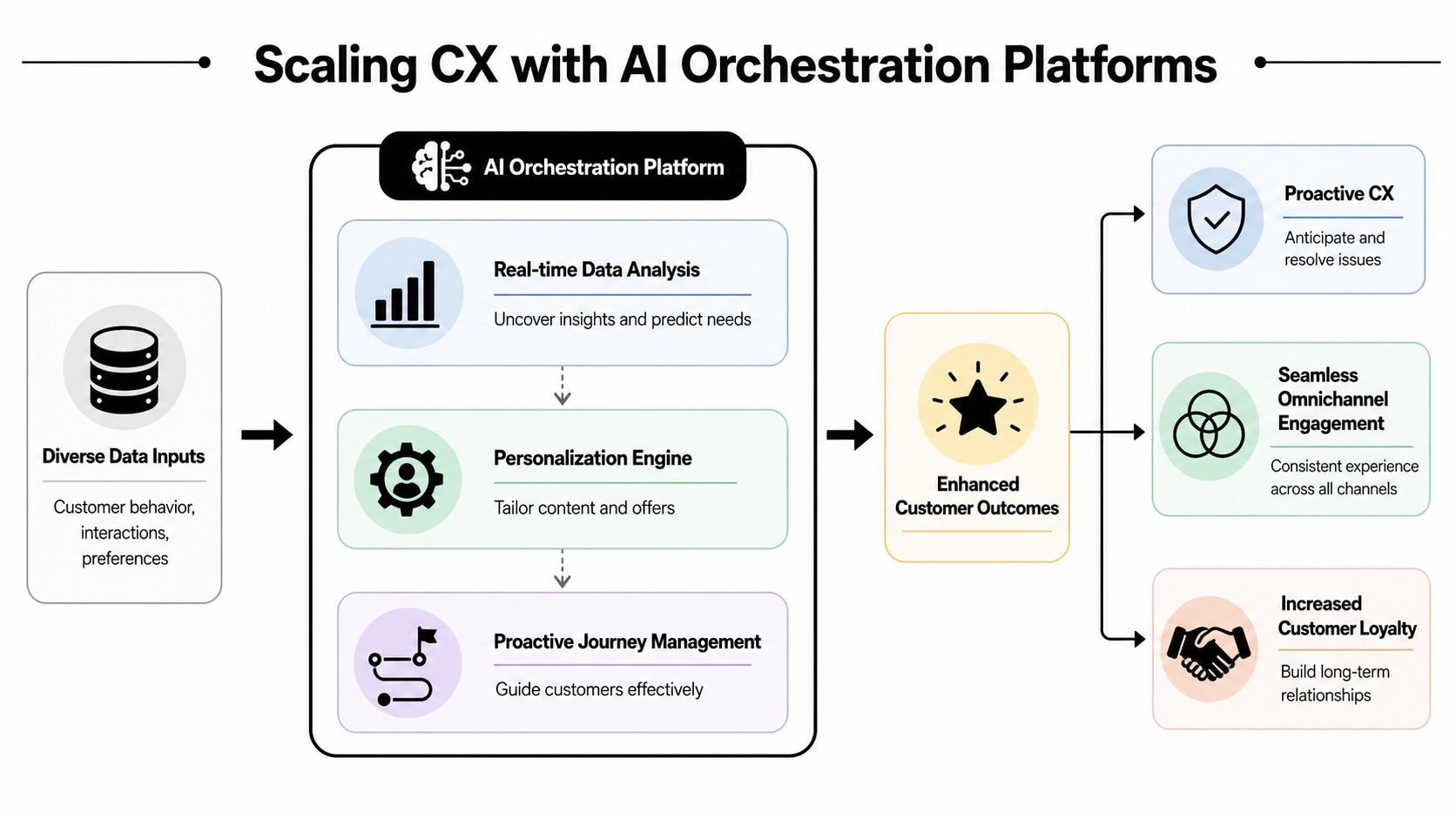
The missing layer is orchestration. Not just automation. Orchestration decides what should happen next, based on customer context, business rules, knowledge access, channel state, and confidence thresholds.
In practical terms, an enterprise orchestration platform should support:
- Omnichannel continuity: voice, chat, email, and other touchpoints share context rather than operating as separate conversations
- Knowledge-grounded responses: agentic retrieval and reasoning can pull from enterprise content without forcing teams to hardcode every flow
- Testing and hardening: automated testing, previewing, and debugging help teams find weak intents and risky edge cases before broad rollout
- Integration depth: CRM, contact center, ticketing, and workflow systems must exchange state in real time
- Model flexibility: multi-LLM design reduces lock-in and lets teams choose the right model for the task
One platform in this category is Yellow.ai's agentic AI platform, which combines omnichannel orchestration, conversational knowledge access, automated testing, and multi-LLM support. That kind of stack matters because customer experience strategies now depend on operational coordination, not isolated bots.
Why voice-first CX deserves board-level attention
The voice channel exposes every weakness in your system. If knowledge retrieval is weak, the caller notices. If handoff logic is poor, the caller notices. If latency is high or context is missing, the caller notices immediately.
That's why the underserved angle in many CX programs is voice-first agentic design. According to the MIT Executive Education article referenced in the verified data, 70% of enterprises plan to adopt AI for CX by 2027, yet most still treat voice as a legacy channel, even though 45% of consumers prefer voice for complex issues, as noted in the MIT Executive Education discussion on customer experience strategy.
That gap has consequences. Enterprises often automate low-stakes chat flows while leaving the most consequential interactions in brittle voice systems with weak memory and limited autonomy. The result is a modern-looking CX surface with an outdated service core.
A stronger design treats voice as a primary orchestration surface. That means natural language handling, low-latency turn-taking, reliable authentication and routing, knowledge-grounded answers, multilingual support, and clean transitions to human agents when autonomy should stop.
If your most complex customer moments still rely on disconnected voice infrastructure, your CX strategy isn't modern yet.
Your CX Strategy Questions Answered
How do I get executive buy-in
Executive support usually hinges on whether CX is framed as an operating model issue, not a channel project. A polished chatbot demo rarely gets budget approval on its own. A clear case that ties fragmented journeys to higher service cost, slower resolution, weaker retention, and inconsistent compliance usually does.
Use the language your leadership team already uses to make decisions:
- Connect CX to revenue and retention. Show how broken journeys affect renewal, expansion, and customer lifetime value.
- Quantify the operational drag. Repeated contacts, disconnected systems, and manual handoffs consume agent time and inflate support costs.
- Present a staged investment plan. A roadmap with one or two high-value journeys, defined controls, and measurable milestones is easier to fund than a broad platform pitch.
It also helps to position AI orchestration correctly. The point is not to add one more automation layer. The point is to give the business a control plane for routing, resolving, and measuring customer interactions across voice and digital channels.
What Is the Difference Between Multichannel and Omnichannel?
Multichannel means customers can contact your business through several touchpoints. Omnichannel means those touchpoints share context, memory, and next-best action so the journey continues instead of restarting.
That difference shows up fast in production. A company may offer chat, email, voice, and messaging, yet still force the customer to repeat the issue, reverify identity, and wait while each team checks a different system. That is multichannel coverage without omnichannel continuity.
A practical test is simple. If your AI agent or human agent cannot see what happened in the previous channel and act on it in the current one, you do not have omnichannel CX.
For enterprise teams, that usually points to an orchestration problem, not a channel problem. The work is less about adding endpoints and more about unifying identity, session history, knowledge, routing logic, and handoff rules, including voice.
How do I measure autonomous AI agents accurately
Autonomous agents should be measured the same way any enterprise service capability is measured. Start with outcome quality, then examine cost, containment, escalation patterns, and governance.
Gainsight's customer experience guide argues for continuous listening beyond surveys, including AI-based analysis of unstructured interactions such as chat and social conversations, in Gainsight's customer experience guide. That approach fits autonomous agents well because surveys alone miss where resolution failed, where confidence was low, and where customers had to re-engage later.
A useful measurement stack includes:
- Unstructured interaction analysis: review chat transcripts, social comments, and other free-text signals to identify friction and sentiment shifts
- Resolution quality: confirm whether the customer's issue was solved, not just contained or deflected
- Escalation diagnostics: track why the agent handed off, whether the handoff had full context, and whether the final outcome improved
- Automated testing and monitoring: test high-risk flows continuously so agent behavior stays grounded in policy, knowledge, and approved actions
One caution matters here. Enterprises often overvalue containment and undervalue recovery quality. If an agent deflects contacts but creates repeat interactions, poor transfers, or failed voice resolutions, the reported savings will not hold.
If your team is redesigning customer experience strategies around orchestration, autonomy, and voice, Yellow.ai is one platform to evaluate. It supports enterprise teams that need to unify channels, deploy agentic AI across voice and chat, connect to existing systems, and measure outcomes with the level of control large organizations require.



