













Most customer service automation still fails at the moment that matters most. It can answer a question, summarize a policy, or point a customer to the right page. It often can't fix the issue.
That gap is why agentic AI for customer service matters. The shift isn't from one chatbot interface to a better one. It's from passive conversation to supervised action across real systems. A major 2025 Cisco global survey found that 68% of customer service and support interactions with technology vendors are expected to be handled by agentic AI by 2028, and 56% are expected to be handled by agentic AI within the next 12 months, according to Cisco's 2025 survey on agentic AI in customer service.
Enterprise leaders should read that signal carefully. Adoption is accelerating, but success won't come from dropping an LLM into a chat window. It comes from deciding where an AI agent can act, what systems it can touch, what approvals it needs, and how you'll measure whether it resolved the problem without creating downstream risk.
Table of Contents
- The Shift from Answering Questions to Solving Problems
- Understanding Agentic AI vs Traditional Chatbots
- Key Business Benefits and Measurable KPIs
- Strategic Use Cases for Agentic AI
- Your Enterprise Implementation Roadmap
- Choosing the Right Enterprise Platform
- FAQs About Agentic AI in Customer Service
The Shift from Answering Questions to Solving Problems
Most chatbots are still built around retrieval and response. They identify intent, surface an answer, and hope the customer can finish the job alone. That model works for store hours, password rules, or policy lookups. It breaks when the customer needs a refund reviewed, a shipment rebooked, a billing profile corrected, or a service appointment changed.
Agentic AI for customer service changes the unit of value from conversation to resolution. Instead of stopping at telling customers what to do, the system can reason through the task, call tools, verify constraints, and complete the action inside connected platforms. The practical difference is simple. Customers don't judge automation by how fluent it sounds. They judge it by whether the problem is gone.
Why traditional automation stalls
Most service stacks still separate knowledge from execution. The bot reads content from a help center. The customer then moves into another queue, another form, or another department to complete the transaction.
That separation creates familiar failure patterns:
- Answer without action: The customer gets instructions but still has to log in, find the right screen, and perform the task manually.
- Escalation after false confidence: The bot sounds competent, but the issue still lands with a human team after time has already been lost.
- Fragmented journeys: One system handles chat, another handles CRM data, and a third handles fulfillment or billing changes.
Practical rule: If the automation can't complete the workflow, it isn't end-to-end self-service. It's triage.
Why this shift is strategic
This isn't just a better FAQ experience. It changes staffing models, service design, and platform architecture. Once an AI agent can take approved actions across CRM, commerce, ticketing, and back-office systems, the service organization can redesign how work enters queues in the first place.
That requires discipline. Leaders need to stop asking whether the bot can talk naturally and start asking whether the agent can execute safely under policy. The strongest programs define a narrow set of high-volume journeys, wire the necessary systems together, and put approval logic around sensitive actions before they expand scope.
Understanding Agentic AI vs Traditional Chatbots
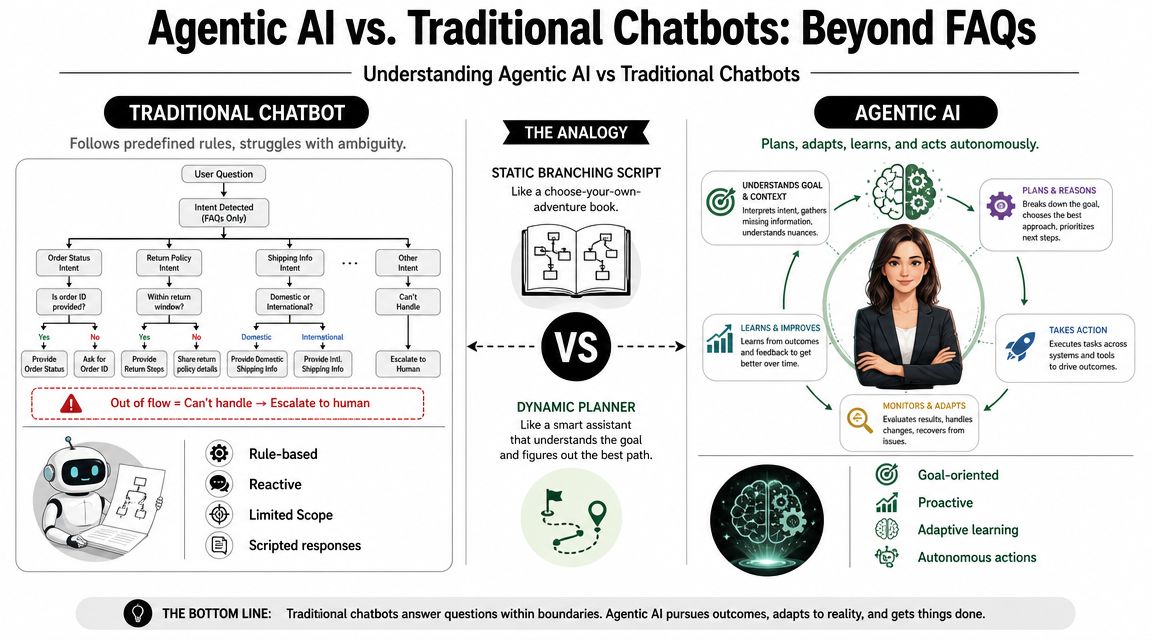
A traditional chatbot is like a talking encyclopedia. It can search, summarize, and respond in polished language. An agentic system is closer to a junior operator with access to approved tools. Give it a goal, the relevant context, and clear boundaries, and it can work through the steps needed to complete the task.
The real capability gap
The cleanest distinction is execution. Coveo notes that chatbots and LLMs can provide answers, but they stop before completing the action, while agentic AI becomes valuable when it can cancel a subscription, update billing, or rebook a shipment in connected systems, as described in Coveo's overview of agentic AI in customer service.
That difference comes from three capabilities working together:
| Capability | Traditional chatbot | Agentic AI |
|---|---|---|
| Reasoning | Matches patterns and responds | Interprets the goal and evaluates steps |
| Planning | Follows predefined flows | Chooses a sequence of actions dynamically |
| Tool use | Usually limited to content retrieval | Calls APIs, updates systems, and triggers workflows |
A copilot sits somewhere in the middle. It can assist a human agent, draft a response, or recommend the next step. It doesn't necessarily own the transaction. An agent does.
Teams that are still sorting out the difference between instruction quality and grounding quality should review this piece on comparing prompt and context engineering. It's useful because many failed pilots aren't model failures. They're context failures, permission failures, or workflow-design failures.
Why this matters in enterprise operations
Once a system can act, architecture matters more than interface polish. The hard questions become operational:
- Which systems can it access
- What data can it see for a given user
- When should it act automatically
- When must it pause for human approval
- How are actions logged for audit and review
That's why enterprise buyers should look past marketing labels. Plenty of tools now call themselves agents. The relevant test is whether the system can pursue a goal through multiple steps, recover from partial failure, and operate within policy boundaries.
If you need a practical baseline on the terminology, this guide to what agentic AI is and how it differs from AI agents is a helpful reference point.
A fluent chatbot can improve containment. An agentic system can improve completion.
Key Business Benefits and Measurable KPIs
Agentic AI gets funded when it moves business metrics that leadership already cares about. The strongest programs don't sell it as a moonshot. They position it as a service operating model that can reduce avoidable work, improve customer outcomes, and shorten the gap between request and resolution.
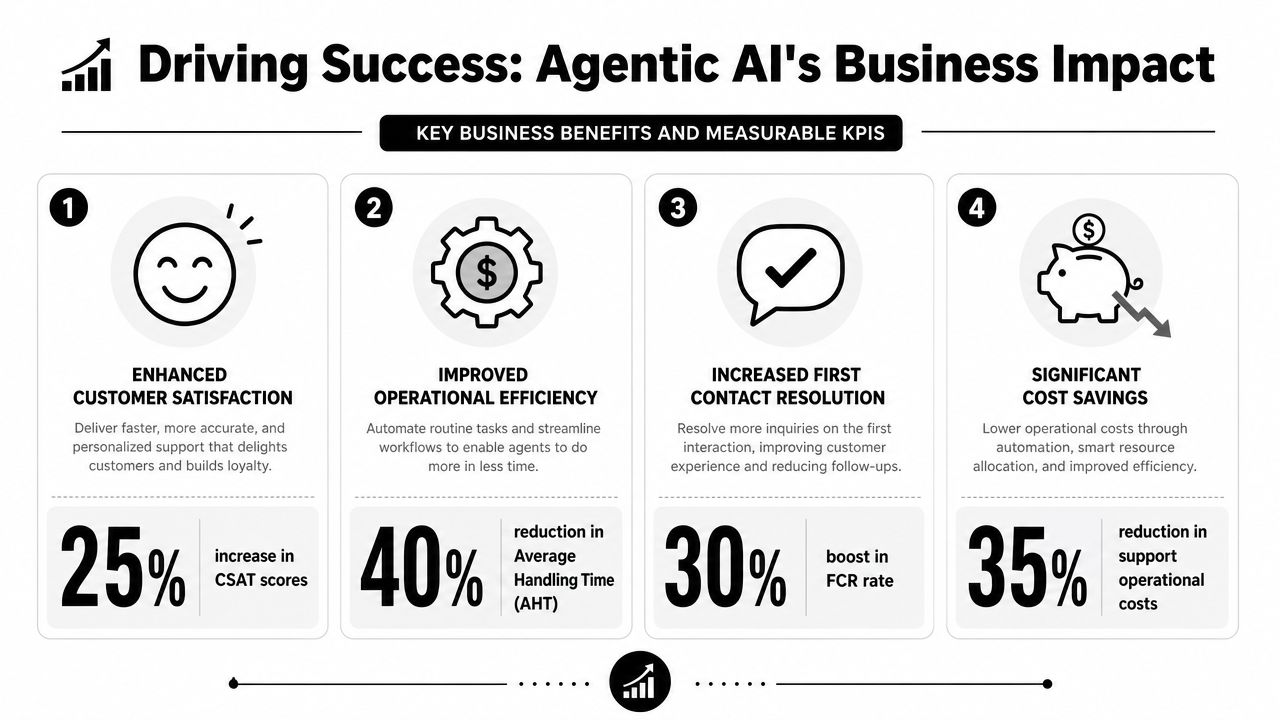
A useful signal is speed to value. A 2026 summary of Salesforce's State of Service research reported that 70% of organizations using AI agents saw measurable value within 60 days, and customer satisfaction ranked as the #1 improved KPI ahead of traditional metrics like rep productivity and average handle time, according to Futurum's summary of State of Service findings.
What leaders should measure first
Most executive teams start with efficiency. That's reasonable, but it shouldn't be the only lens.
Track a balanced set of indicators:
- Resolution quality: First-contact resolution, reopened cases, and transfer frequency tell you whether the agent solved the issue.
- Customer experience: CSAT, customer effort, and complaint themes show whether the automation is reducing friction or hiding it.
- Operational impact: Queue pressure, human handoff volume, and cost per resolved contact reveal whether the model is changing work distribution.
- Control metrics: Approval rates, exception rates, and policy-triggered escalations show whether governance is doing its job.
For teams formalizing that measurement stack, this framework on measuring AI agent performance in an AI-first environment is worth reviewing.
Here is a practical walkthrough of what modern AI-driven service operations can look like:
Why customer metrics matter as much as efficiency
The common mistake is to deploy autonomous service only where it saves labor. That often produces brittle experiences. The better approach is to prioritize journeys where customers benefit from speed, reduced repetition, and fewer handoffs.
A well-designed agent can improve service quality because it doesn't forget a step, skip a policy check, or ask the customer to repeat information that already exists in the CRM. But those benefits only hold if the workflow is grounded in current knowledge and integrated with the systems of record.
Focus on whether the customer got a clean outcome, not whether the bot handled more conversations.
Strategic Use Cases for Agentic AI
The best use cases for agentic AI for customer service aren't the broadest ones. They're the ones with a clear outcome, stable policy boundaries, and systems that are accessible through reliable integrations. That's where autonomous action beats traditional self-service.
Gartner projects that by 2029 agentic AI will autonomously resolve 80% of common customer service issues without human intervention, producing a 30% reduction in operational costs, according to the OneReach summary of Gartner's forecast on agentic AI in customer service. The practical implication is straightforward. Start with common, repeatable service journeys where decisioning rules are knowable and exception paths can be managed.
Transactional journeys with clear rules
These are usually the first wins because the desired outcome is concrete.
A retailer can let an agent verify order eligibility, issue a return authorization, update the commerce system, and send the customer next steps in one flow. A subscription business can handle plan changes, billing updates, or cancellations without forcing the customer through multiple screens. A logistics provider can rebook a delivery window after checking service constraints and account status.
Common high-fit patterns include:
- Account maintenance: Profile updates, communication preferences, payment method changes, and contact detail corrections.
- Order and subscription changes: Exchanges, cancellations, plan modifications, and shipment rescheduling.
- Case management tasks: Status updates, document collection, appointment changes, and confirmation workflows.
If your team is comparing copilots with fuller workflow automation, this overview of understanding Microsoft Copilot features helps clarify where assistive tools end and action-oriented systems begin.
Diagnostic and proactive service scenarios
The next layer involves reasoning over multiple signals. In telecom, an agent can validate device status, account entitlements, and outage conditions before deciding whether to troubleshoot, dispatch, or escalate. In financial services, it can gather missing details, verify account context, and route the case with a structured summary when policy requires human approval. In healthcare administration, it can coordinate scheduling changes, reminder flows, and required follow-up communication while staying inside approved process boundaries.
Proactive service is where many teams underestimate the value. Instead of waiting for the complaint, the agent can detect a delivery exception, notify the customer, present the available options, and complete the selected update. That turns service from reactive handling into issue prevention.
A practical example set of end-to-end workflows across channels appears in this overview of agentic AI workflows for customer service.
Your Enterprise Implementation Roadmap
Agentic AI succeeds or fails in the operating model, not in the demo. Enterprise teams get results when they treat it as a service redesign program with clear decision rights, system controls, and measurable rollout stages.
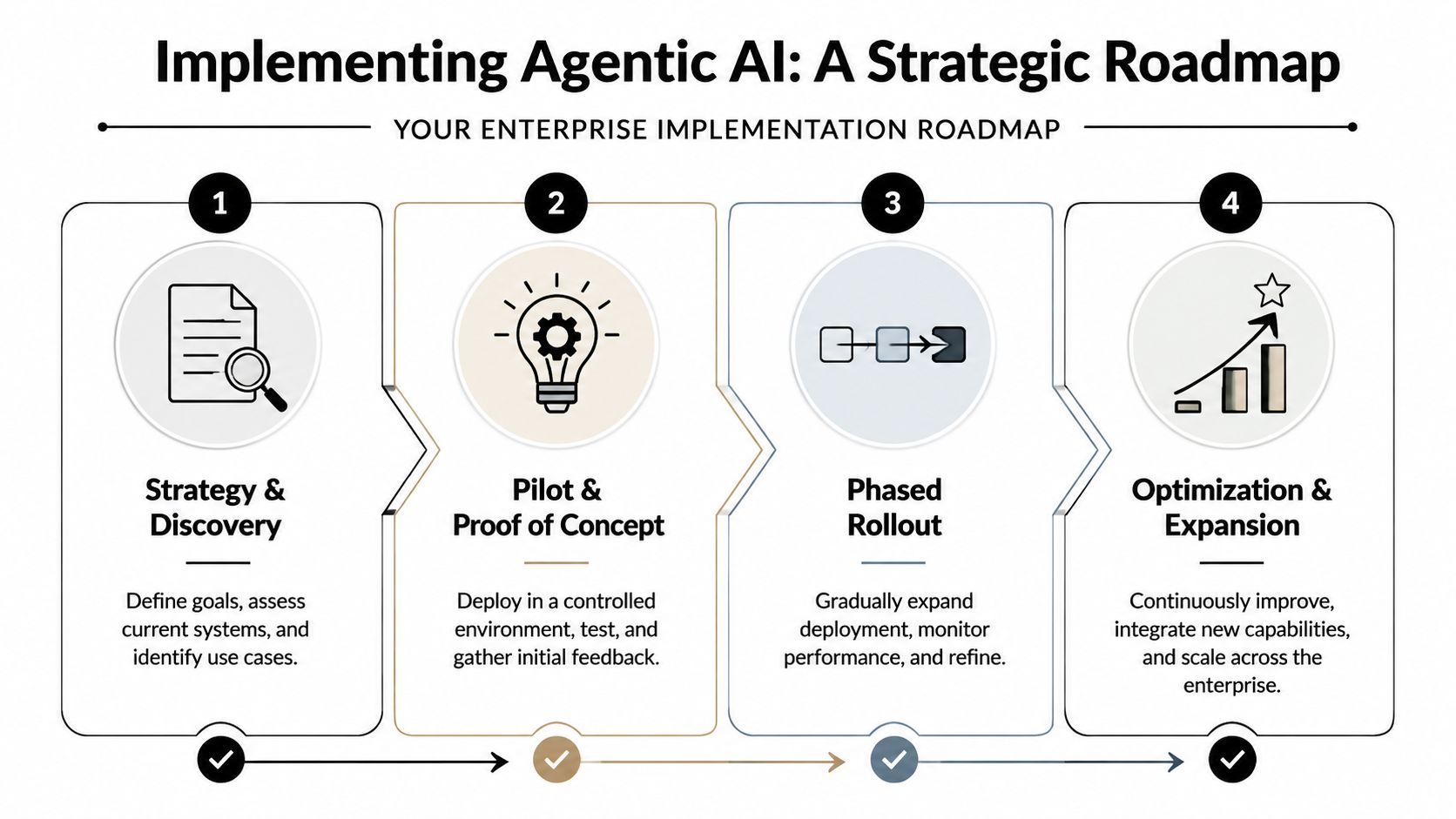
Analysts at BCG make the same point in their research on the new frontier of customer service transformation. The difficult work sits behind the interface. Teams have to redesign service processes, define where an agent can act independently, and document where human approval stays mandatory. The first serious design question is simple: which decisions can the business delegate, under what policy, and with what audit trail?
Start with decisions, not demos
Map journeys at the decision level. "Billing issue" is a queue label. "Reverse a duplicate charge when identity is verified, the amount falls inside policy threshold, and the payment system confirms settlement status" is an automatable workflow.
For each candidate journey, define four things before any build starts:
- Resolved outcome: The exact end state that counts as complete.
- Systems touched: CRM, ticketing, payments, ERP, identity, scheduling, or commerce.
- Risk tier: Low-risk updates, policy-bound actions, or sensitive financial and regulatory tasks.
- Exception route: What happens when confidence is low, records conflict, or a rule blocks execution.
This changes the quality of the program. Teams stop prioritizing use cases that sound good in a workshop but collapse under real operational complexity.
Build the foundation for governed action
Enterprise deployment usually comes down to five components working together.
The first is the reasoning layer. It interprets requests, selects steps, and decides which tools to call. In practice, many large organizations use more than one model because summarization, policy reasoning, and real-time orchestration have different cost and latency profiles.
The second is tool orchestration. Agents need secure access to systems of record through APIs, workflow services, or approved connectors. Read access and write access should be designed separately from day one. A system that can retrieve an order does not automatically earn the right to modify it.
The third is grounded knowledge. Service policies, product rules, exception handling guidance, and regulatory content must stay current. If the knowledge base is fragmented across departments, the agent will apply inconsistent logic at scale.
The fourth is state management. The agent needs enough memory to finish the job across a session and, where policy allows, across channels. That requires disciplined retention rules, not indiscriminate storage.
The fifth is governance. Approval gates, confidence thresholds, policy checks, access controls, action logging, and rollback design should be specified before broad rollout, not after the first production incident.
A simple autonomy model keeps teams honest during design:
| Decision type | Autonomy level | Human role |
|---|---|---|
| Low-risk information update | High | Review by exception |
| Policy-bound transactional change | Medium | Approve edge cases |
| Financial adjustment or sensitive exception | Low to medium | Explicit approval before action |
I use one test with executive teams: if no one can explain why an agent is allowed to take an action, the action boundary is not ready for production.
Test failure paths before you scale
Pilot teams often spend too much time on happy-path conversations. Production pressure shows up somewhere else. Duplicate customer records, partial API outages, conflicting entitlements, stale policy content, and unclear identity are the cases that determine whether the program earns trust.
A useful test plan includes:
- Permission failures: The agent attempts an action the customer is not authorized to request.
- Data conflicts: CRM, billing, and policy systems do not agree on the current state.
- Ambiguous requests: One customer message could trigger multiple workflows with different risk levels.
- Interrupted execution: A downstream system fails after earlier steps have already completed.
- Escalation quality: The human agent receives context, evidence, and the exact step where automation stopped.
This is also the stage where vendor fit becomes visible. Some enterprises build orchestration internally. Others standardize on platforms from Salesforce, ServiceNow, Microsoft, or Yellow.ai based on channel requirements, integration maturity, and governance needs. The better decision is the one your architecture, security, and service operations teams can run at scale.
Choosing the Right Enterprise Platform
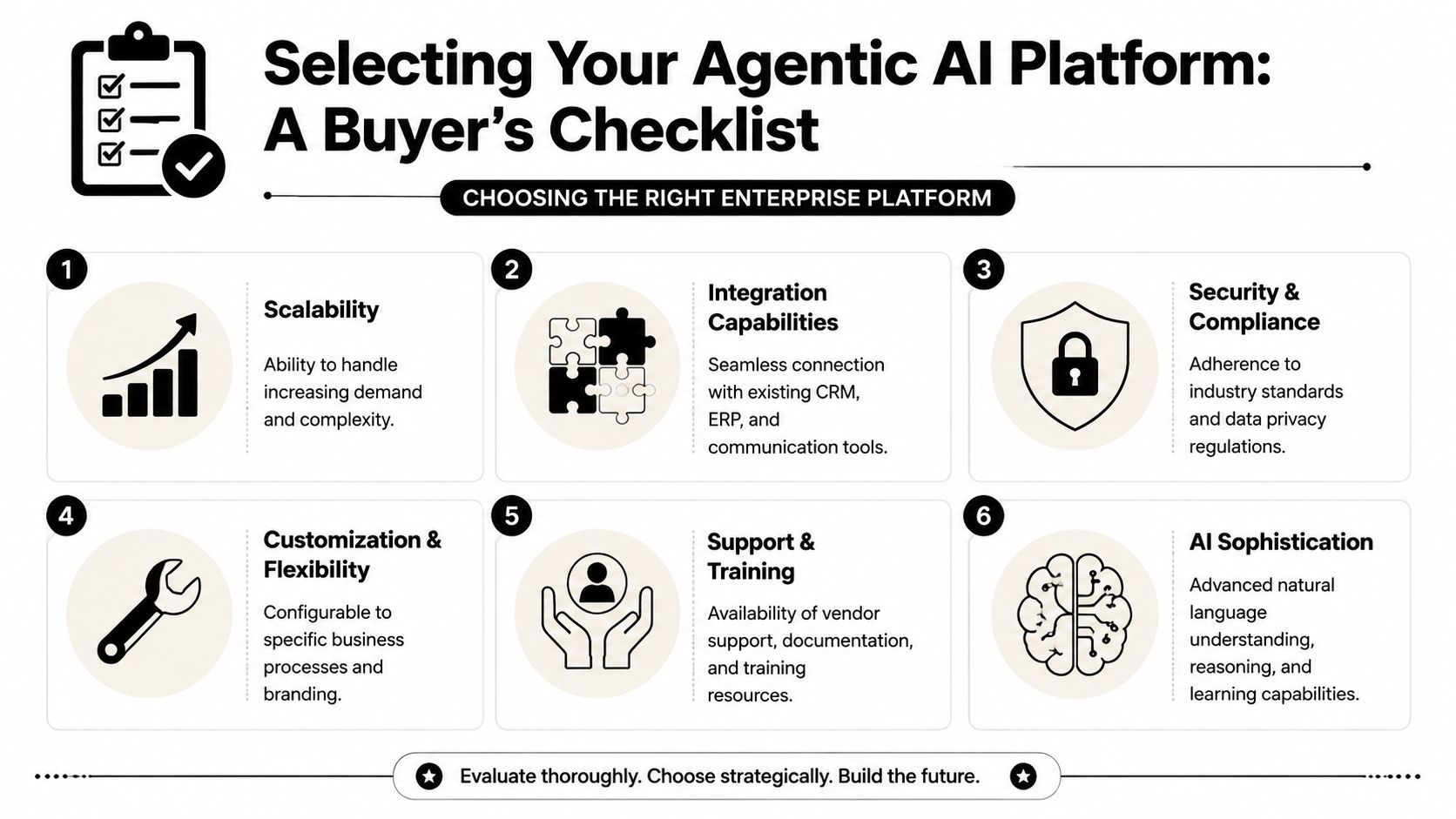
Platform selection gets muddled when buyers focus on demos instead of operating fit. Most vendors can show a smooth conversation and a well-designed dashboard. Fewer can support governed action across enterprise systems at scale.
What to evaluate before procurement
Use a practical scorecard instead of a feature wishlist.
| Evaluation area | What to ask |
|---|---|
| Integration depth | Can the platform both read and write across CRM, ticketing, commerce, ERP, and identity systems |
| Governance model | Can you define approval steps, action boundaries, audit logs, and role-based permissions |
| Knowledge architecture | How does it ground responses and actions in approved enterprise content |
| Model strategy | Are you locked into one model, or can you route by task and policy |
| Testing and observability | Can teams simulate journeys, inspect failures, and monitor action quality over time |
| Channel orchestration | Does it support the service channels you actually run, not just web chat |
Good platforms make it easy to separate policy from prompt logic. That matters because service teams will change policies more often than they change model architecture.
Signals that a platform won't scale cleanly
Some warning signs show up early.
- Black-box orchestration: If you can't inspect why an action was taken, governance will become painful.
- Weak approval controls: Sensitive workflows need more than a generic fallback to a human.
- Thin connector strategy: If every integration turns into a custom project, scale will stall.
- Knowledge without permissions: Grounding is not enough if the platform can't enforce who can see what.
- Pretty demos with no operational telemetry: If the vendor can't show logs, action histories, and failure analysis, you'll struggle in production.
Buy for controlled execution, not conversational theater.
FAQs About Agentic AI in Customer Service
Will agentic AI replace human agents
Not entirely, and it shouldn't. It removes repetitive transactional work and handles the common paths that don't need judgment-heavy intervention. Human agents still own sensitive exceptions, emotionally charged situations, negotiated outcomes, and cases where policy, context, and empathy must be balanced carefully.
How do you keep autonomous actions safe
Use layered controls. Limit system permissions by role, classify workflows by risk, require approvals for sensitive actions, and log every meaningful decision and system update. Safe deployment isn't about making the agent passive. It's about making its authority explicit.
How quickly can teams see value
Some organizations move quickly when they start with narrow, high-volume workflows and clean integration boundaries. The fastest path usually isn't a broad "virtual service rep" launch. It's a tightly scoped production use case with clear rules, measurable outcomes, and a fallback path that operations teams trust.
What's a bad first use case
Anything with unclear resolution criteria, unstable policy rules, or fragmented ownership across too many systems. If nobody can explain the handoff logic today, the agent won't magically solve that ambiguity tomorrow.
Where should enterprises start
Start where three conditions hold: the workflow is common, the outcome is specific, and the risk can be governed. Then expand one journey at a time. That's how agentic AI for customer service becomes an operating capability rather than another stalled pilot.
If you're evaluating how to operationalize agentic AI across chat, voice, and back-office workflows, Yellow.ai is one option to assess alongside your existing platform stack. Focus on whether the platform can support governed actions, enterprise integrations, testing, and the service channels your teams already run.



