









Your retrieval stack is probably not why your knowledge base will fail. Your content governance is. Teams ship a polished demo over clean PDFs, then discover in production that policies conflict, owners have left, and the answers agents need were never documented. An AI powered knowledge base only moves containment and resolution when you treat it as an operating system for trusted content, not a smarter search box.
Table of Contents
- What an AI Powered Knowledge Base Actually Does
- Traditional Knowledge Base vs AI Powered Knowledge Base
- The Five Stages Inside an AI Powered Knowledge Base
- Use Cases for CX, EX, and Agent Automation
- How to Implement an AI Powered Knowledge Base
- Why Content Governance Is the Real Differentiator
- Evaluation Metrics That Actually Matter
- Buyer Checklist and Integration With Conversational Agents
What an AI Powered Knowledge Base Actually Does
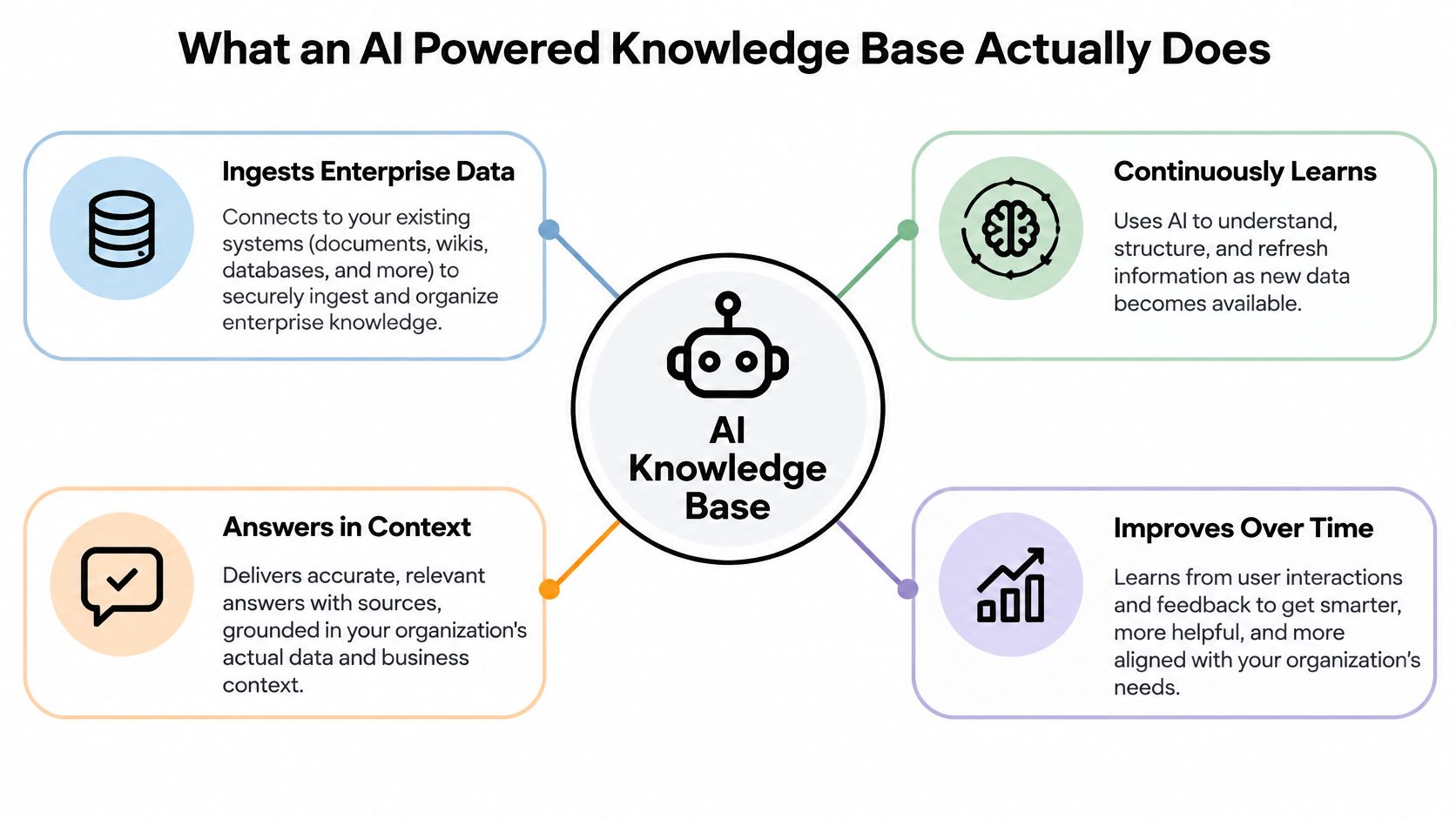
Think of an AI powered knowledge base as a living service, not a repository. It ingests enterprise content, indexes it for semantic retrieval, grounds answers in approved sources, and learns from every question it couldn't answer. Humans and AI agents query the same layer, so a customer, an agent, and a voice bot stop giving three versions of the same policy.
That shift arrived fast. In McKinsey's 2023 Global Survey on AI of 1,684 respondents, 79% reported exposure to generative AI and one-third of organizations reported regular use in at least one business function. By early 2024, McKinsey's 2024 Global Survey of 1,363 participants found 65% of organizations regularly using generative AI and overall AI adoption at 72%.
The Four Jobs It Has to Do Well
- Ingest enterprise data: Pull from help centers, policy docs, ticketing systems, CRM notes, and product manuals, then normalize versions and permissions.
- Answer in context: Interpret a natural-language question, retrieve relevant passages, and synthesize a cited answer instead of returning ten blue links.
- Learn continuously: Log unanswered questions, failed searches, and agent corrections as signals, not noise.
- Improve over time: Turn those signals into a prioritized backlog so owners fix gaps in order of business impact.
What It Will Not Do
It won't invent missing procedures, resolve two contradictory policies on its own, or make stale content safe. If your source of truth is ambiguous, generation just delivers that ambiguity faster and with more confidence. That's why the decisions ahead matter in sequence. You need to choose the right model, understand the internal stages, apply it to CX and EX, implement without creating content debt, and measure outcomes in business terms. Get those five jobs right and the system compounds. Skip one and you'll debug bad answers forever.
Traditional Knowledge Base vs AI Powered Knowledge Base
A traditional knowledge base is a publishing system with search bolted on. Someone writes an article, tags it manually, and hopes the customer's wording matches the title. An AI powered knowledge base changes the contract. The user asks a question in their own words, the system retrieves semantically relevant evidence across many documents, and it generates a grounded answer with provenance.
Take a fee reversal asked about in a different currency. A customer writes, "You charged me in euros, can I get that maintenance fee back?" Keyword search looks for "maintenance fee" and "euros" and often returns a generic fee schedule or nothing useful. The customer rephrases, fails again, and contacts support.
Where the Traditional Model Breaks
The AI system handles that same ticket differently. It maps "get that fee back" to reversal eligibility, retrieves the fee policy and the currency conversion rule, checks the effective dates, and answers with conditions and next steps. If eligibility depends on account type, it asks a clarifying question instead of guessing.
The difference isn't a better search bar. It's whether the system returns documents for a human to interpret or evidence a model can reason over safely.
| Dimension | Traditional KB | AI Powered KB |
|---|---|---|
| Search | Keyword matching, manual tags | Semantic retrieval over meaning |
| Answer format | List of articles | Synthesized, cited answer |
| Maintenance | Manual reviews, brittle decision trees | Gap signals from real queries |
| Failure mode | No results, wrong article | Ungrounded or stale answer if governance is weak |
| Consumers | Humans browsing | Humans plus chat and voice agents |
Neither model removes the need for good content. The traditional model fails visibly with zero results. The AI model can fail persuasively, which is why retrieval quality alone doesn't make it production ready.
The Five Stages Inside an AI Powered Knowledge Base
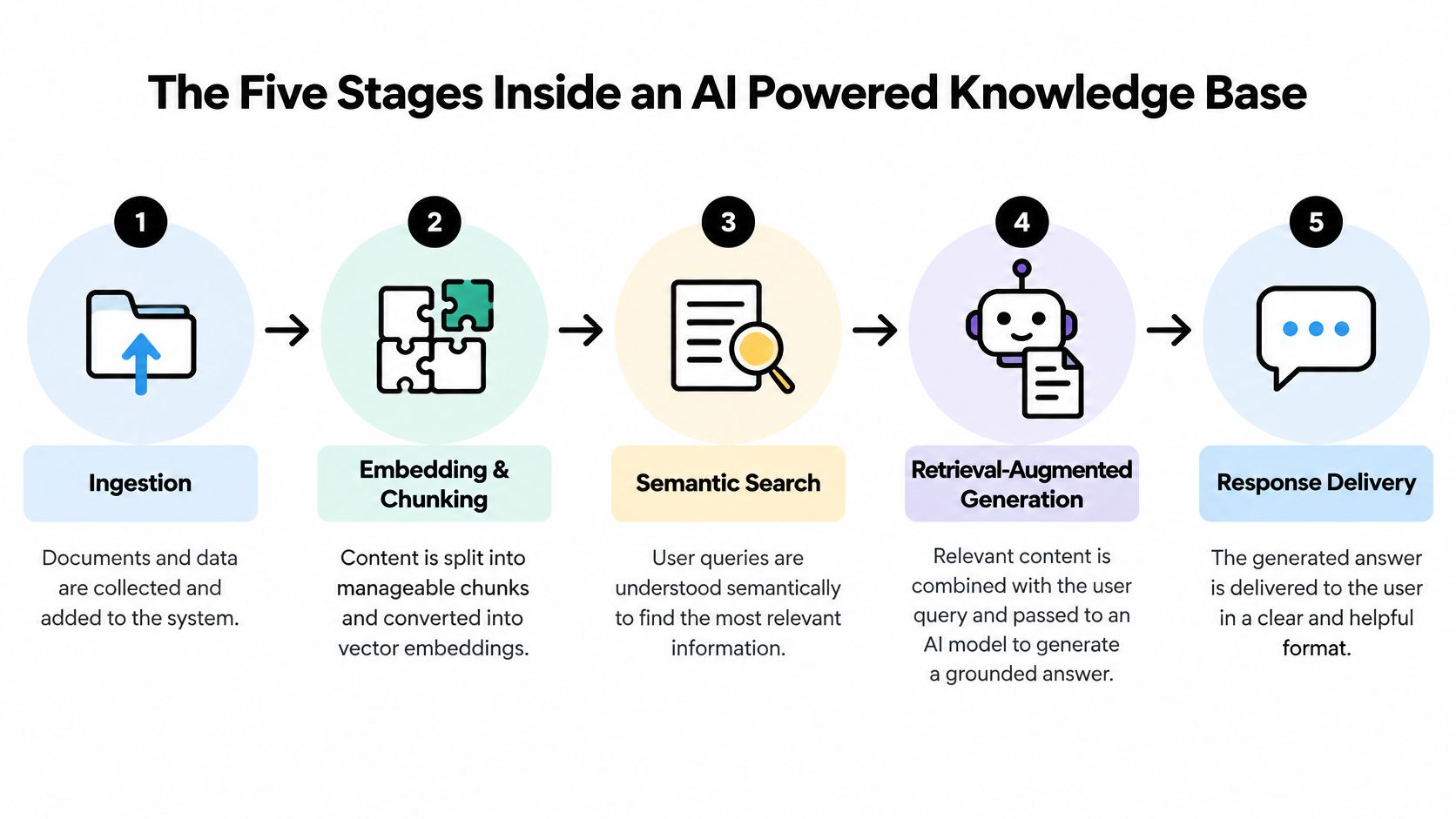
Bad answers at the surface usually start as a weak link deep in the pipeline. Debug by stage, not by blaming the model. Each stage has a clear job, a clear failure mode, and a test you can run before users ever see it.
Ingestion and Chunking Decide What Retrieval Can Find
Ingestion extracts text from PDFs, web pages, tickets, and internal systems while preserving headings, tables, effective dates, and access controls. Lose structure here and you'll retrieve fragments without context. Tables flattened into garbled text are a classic production failure.
Embedding and chunking split content into indexed units and convert them into vectors. This is a first-order design decision, not tuning. A 2025 benchmark of 90 chunker and embedding combinations across 2,520 retrieval runs found sentence-based splitting with a 512-token window and 200-token overlap produced the strongest token-level Intersection-over-Union score at approximately 0.099. Start there, then tune on your own support and HR queries. Don't copy a universal chunk size from a blog post.
Search, Generation and Learning
Semantic search matches intent, not exact words, and ranks passages by relevance. If ranking ignores freshness or permissions, you'll surface superseded policies to the wrong audience. Retrieval-augmented generation then constrains the model to retrieved evidence. For a deeper treatment of that pattern, see this overview of retrieval-augmented generation for conversational systems. Good RAG cites sources and abstains when evidence is thin.
- What good looks like: The answer traces to approved passages, with dates and owners intact.
- What failure looks like: Fluent text stitched from unrelated chunks, with no citation a reviewer can check.
Continuous learning closes the loop. Every no-answer event, escalation, and agent edit becomes a labeled gap. Teams that skip this stage don't have a learning system. They have a static index with a generative front end, and it decays from launch day.
Use Cases for CX, EX, and Agent Automation
The same AI powered knowledge base can serve a banking customer and an HR manager in the same hour. What changes is the content, the permissions, and the cost of being wrong.
The image below captures the human side of that work, where an advisor still needs trusted source material at hand during a live conversation.

Two Scenarios, Different Guardrails
A BFSI customer asks whether a disputed charge qualifies for a provisional credit. The system retrieves the dispute policy, checks the transaction category, and explains timelines without promising an outcome it can't guarantee. Because the answer touches regulated commitments, it shows citations and routes edge cases to a human.
An HR manager asks whether an employee in a specific region qualifies for parental leave. Now the system must respect regional policy variants and employee-level permissions. A global article that overrides a local rule is a compliance incident, not a helpful shortcut.
Where the Value Concentrates
- Customer experience: Deflect tier-one tickets with self-service answers grounded in approved help content.
- Employee experience: Give staff one place to ask about benefits, IT procedures, and internal policies.
- Agent augmentation: Surface evidence during live chats and calls so agents verify instead of hunting across tabs.
- Agent automation: Ground voice and chat agents in the same sources humans use, including specialized front doors such as an AI receptionist for clinics that still needs approved answers behind the conversation.
The short video below shows how conversational access changes the experience compared with forcing users to browse a static help center.
Map your top three knowledge problems to these patterns before you buy anything. If a use case doesn't name its audience, its source owners, and its escalation path, it's not ready.
How to Implement an AI Powered Knowledge Base
Sequence matters more than speed. The most common failure I see is shipping retrieval before the content lifecycle can support it. Work through six gates, and don't advance until each one passes a concrete validation check.
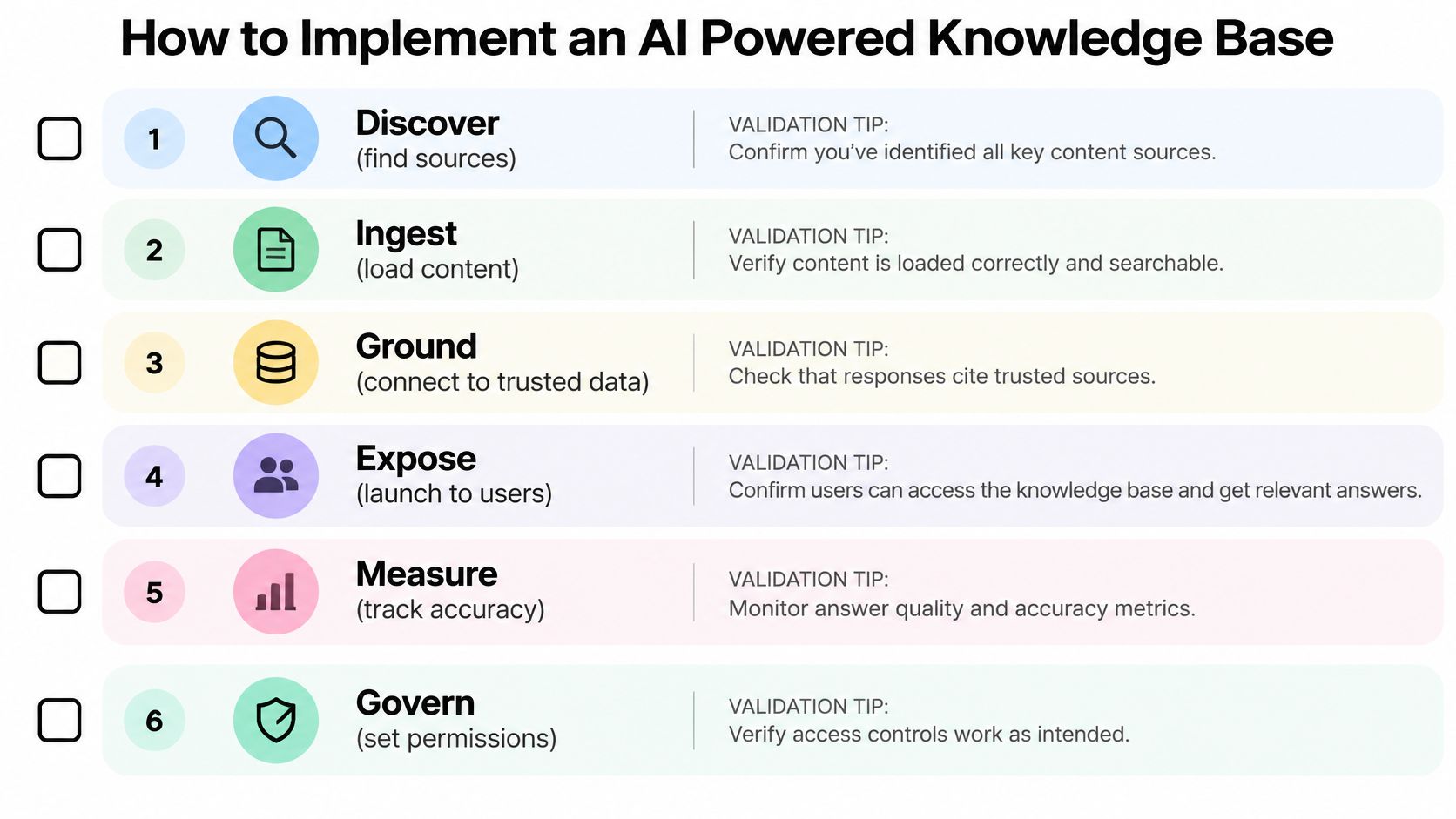
Discover Before You Ingest Anything
Inventory what exists, who owns it, and what's missing. In a 2025 survey of roughly 2,200 knowledge workers, only 16% considered their workflows extremely well documented, and only 4% said none of their team workflows relied on person-dependent knowledge. Assume your hardest knowledge lives in people's heads. Interview agents, supervisors, and field operators, and mine unresolved tickets and repeated searches for undocumented procedures.
Capture tacit knowledge through reviewed drafts, not by dumping raw transcripts into the index. An expert validates, an owner approves, then it becomes retrievable. Unreviewed interaction data as source material is how you automate one agent's workaround into company policy.
Ingest, Ground and Expose in That Order
Ingest with structure and permissions intact, applying the sentence-aware chunking approach covered earlier. Strong unstructured data management practices matter here because messy source files produce messy retrieval. Validate with a fixed query set drawn from real tickets, not invented demo questions.
Ground every answer in approved evidence with citations, abstention thresholds, and conflict handling. If two sources disagree, the system should flag the conflict instead of picking one in secret. Expose it first in shadow traffic, where agents see suggested answers but customers don't. Compare suggestions against what agents really sent.
- Gate check for grounding: Reviewers can trace sampled answers to current, approved passages.
- Gate check for exposure: Latency and recall hold up under realistic concurrency, not just in a single-user test.
Measure and Govern From Day One
Measure containment, transfer rate, and repeat contacts alongside retrieval quality. Govern with named owners, review cadences, and expiry dates on every source. Treat unanswered questions as a prioritized backlog, ranked by volume and risk. That's your gap-discovery loop, and it's the engine that keeps the system improving after launch instead of decaying.
Why Content Governance Is the Real Differentiator
Here's my contrarian position after shipping these systems. Retrieval quality is table stakes. Every serious vendor can embed documents and run vector search. The implementations that survive in BFSI, healthcare, utilities, and HR are the ones with a measurable content operating model behind the model.
The demand is real. APQC's 2025 survey on knowledge management priorities found incorporating AI or generative AI was the top priority for 41% of respondents, while measuring KM impact remained difficult. Priority without measurement produces demos, not outcomes.
What a Real Operating Model Includes
- Named ownership: Every domain has a person accountable for answer accuracy, not a shared inbox.
- Freshness scoring: Sources carry review dates and expiry rules, so stale content gets flagged before users hit it.
- Contradiction handling: Conflicting policies trigger a resolution workflow with a clear winner and an audit trail.
- Access control: Permissions follow the content into retrieval, a discipline well covered in HolyJot's guide to role-based access for teams formalizing who can see what.
A better embedding model won't fix an expired refund policy. It'll retrieve the wrong answer more precisely. Governance work connects directly to knowledge management for customer service operations because frontline teams feel every stale article as a transfer, a repeat contact, or a compliance exception.
Operating rule: If nobody owns a source, it doesn't go into the index. Unowned content is future misinformation with good formatting.
Ask hard questions early. What share of answers must be grounded in approved sources? Who approves a customer-facing answer that conflicts with a regulated policy? How fast must a corrected policy propagate to every agent surface? If your next knowledge base conversation is about model selection instead of ownership, you're having the wrong conversation.
Evaluation Metrics That Actually Matter
You need two scorecards, not one. Technical metrics tell engineers whether retrieval works. Business metrics tell leadership whether anyone should care. Report both, and never let a strong benchmark score hide a flat containment rate.
The Technical Layer
Recall@k measures whether the right evidence appears in the top retrieved passages. nDCG rewards ranking that evidence highly. Answer faithfulness checks whether the generated response follows from the retrieved sources. Add time-to-first-token and time-to-final-answer, because users experience the whole pipeline, not just vector search.
Latency is a design variable you can engineer. A production-oriented study of PipeRAG reported in the Mendeley catalogue entry for PipeRAG found overlapping retrieval with model prefill cut response latency by 25% to 71% while preserving extremely low recall loss. Optimize recall first, then hide delay with streaming, prefetching, and pipeline overlap. Never trade grounding for speed.
The Business Layer
- Containment: Conversations resolved without a human, verified against repeat contacts.
- Transfer rate: How often the system hands off, and whether the handoff includes useful context.
- Time-to-update: Elapsed time from a policy change to corrected answers in production.
- Compliance exceptions: Answers that violated an approved source or permission boundary.
Re-evaluate on a fixed query set whenever content, models, or chunking change. When a metric moves the wrong way, check content freshness and chunk boundaries before you touch the model. Most regressions are content regressions wearing a technical costume.
Buyer Checklist and Integration With Conversational Agents
Put five questions to any vendor or internal team. Demand evidence, not roadmap promises.
- Proof of grounding: Can sampled answers trace to approved, dated sources, and does the system abstain when evidence is weak?
- Latency under concurrency: What happens to recall and response time at your peak volume?
- Governance and auditability: Who owns freshness, and can you audit why an answer was given?
- Multilingual and regional coverage: How do local policy variants override global content safely?
- Agent integration: Can your production voice and chat agents call the knowledge base as a tool today?
As you formalize evaluation criteria, the AgentReady compliance checklist for websites is a useful companion for checking whether agent-facing surfaces meet integration and compliance expectations. Platforms such as Yellow.ai offer a conversational knowledge base with agentic RAG that connects to voice and chat agents, which is one option to evaluate against these criteria. A knowledge base your agents can't reach is shelfware, whatever its benchmark scores say.
Yellow.ai gives enterprise teams an agentic AI platform where a governed knowledge base with agentic RAG grounds autonomous voice and chat agents in your approved content, across customer and employee experience. If you're ready to turn unanswered questions into a managed knowledge backlog instead of repeat contacts, visit Yellow.ai to explore the platform and start your evaluation.