














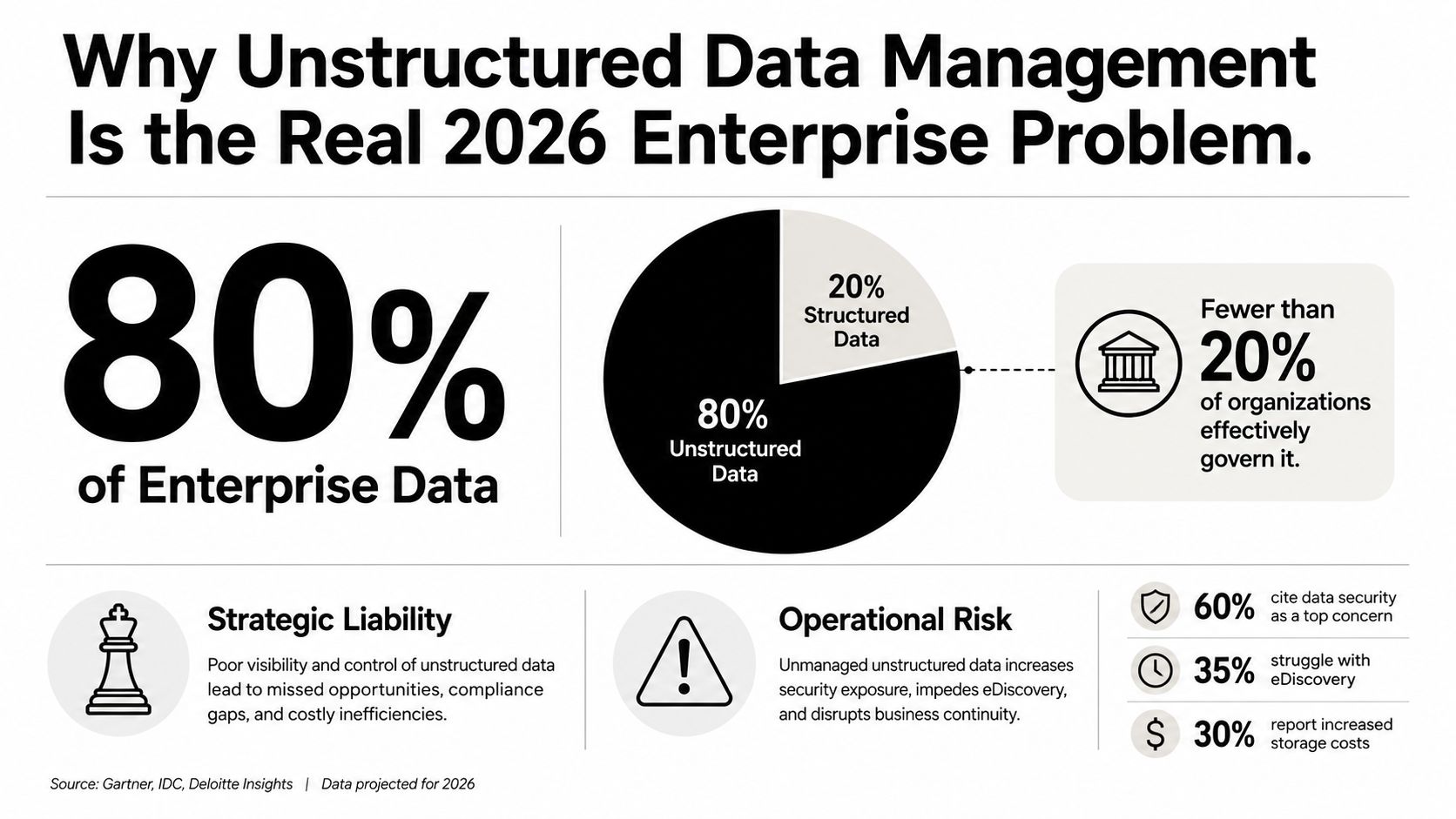
Unstructured data is no longer the messy side of the house. Around 80% of enterprise data is unstructured, and it's expanding 55% to 65% annually, roughly 3 to 4 times faster than structured data, which is why the old warehouse-first mindset is now a liability rather than a strategy. If your team still treats emails, calls, PDFs, images, and video as secondary storage, you're building AI on top of a blind spot, not a foundation. Industry coverage of unstructured data growth
Table of Contents
- Why Unstructured Data Management Is the Core Enterprise Problem for 2026
- Defining Modern Unstructured Data Management
- The Technical Architecture Behind Modern Unstructured Data Management
- Governance as a Lifecycle, Not a One-Time Cleanup
- CX and EX Use Cases That Make Unstructured Data Pay Off
- How Agentic AI Platforms Operationalize Unstructured Data Management
- Implementation Roadmap and Success Metrics
Why Unstructured Data Management Is the Core Enterprise Problem for 2026
The growth curve is the warning sign. It means the enterprise knowledge base is drifting faster than the controls built to manage it, and most governance teams are still reacting as if content were static. That assumption breaks first in customer operations, then in employee support, then in AI workflows that depend on current context instead of stale archives. Unstructured data growth and scale overview
The architecture problem is no longer about holding files in one place. It is about controlling content that moves across tools, teams, and permissions while its meaning changes with every interaction. Traditional relational systems were built for known fields and predictable joins, which makes them a poor fit for emails, contracts, call transcripts, images, videos, and sensor streams that need to be classified, governed, and retrieved fast enough to support real work.
Why the old model fails
Enterprises did not run out of storage discipline. They built years of process around structured reporting and left the majority of their knowledge scattered across disconnected repositories. Projected unstructured information scale by 2025 is not a curiosity. It is the signal that content has become an operating issue, not a back-office archive problem.
The old model assumes retention equals control. It does not. Keeping content is the easy part. Making it searchable, policy-aware, and usable by agentic AI without creating security or compliance debt is the work that matters. Most governance playbooks fail because they stop at inventory. They label files, then walk away before addressing lineage, access, context, and lifecycle state.
A CIO should treat unstructured content as decision infrastructure. If customer calls, support notes, contracts, and internal documents cannot be found and trusted quickly, they do not support service, compliance, or automation. They slow all three down. A conversational knowledge layer like Yellow.ai's conversational knowledge base only works when the underlying content has been governed as an active system, not a passive archive.
Practical rule: if content cannot be found, governed, and traced, it is latent risk.
That is the problem. Not volume alone, and not storage alone. The enterprise issue is whether unstructured data can be kept current, controlled, and useful as it moves through CX, EX, and AI-driven workflows.
Defining Modern Unstructured Data Management
Unstructured data management is the discipline of turning content that does not fit a table into something the enterprise can govern, search, trust, and use. Structured data works like a library card catalog, cleanly indexed and easy to query. Unstructured content works like the special collections room, where photos, recordings, PDFs, and scans carry value, but only if they are cataloged, protected, and made available in context. That is the mental shift executives need, from database administration to content operationalization. IBM's summary of unstructured data management challenges
What this discipline owns
It owns the work of discovering sources, attaching metadata, setting policy, improving searchability, and keeping content usable as systems change. It does not stop at storage, and it does not get solved by naming a data lake and walking away. The hard part is correlating unstructured content with structured records so the business can connect a customer call, a ticket, and a transaction without manual stitching.
That is where too many governance programs fail. They treat unstructured data as a cataloging exercise, when the job is lifecycle control. You need to know where content lives, who can access it, what it means, how long it stays valid, and how it supports downstream workflows without creating security or compliance debt. The operating model is closer to a controlled special collections system than a folder tree with labels.
How it differs from nearby disciplines
Data governance sets policy across all data, but unstructured data management handles the content-specific mechanics of discovery, tagging, retrieval, and control. Master data management focuses on authoritative entities like customer, product, or vendor records, while unstructured content often explains the context around those entities. Content services handles storage and workflow, but it does not automatically solve semantic retrieval or AI-readiness.
Unstructured data management is the bridge between raw content and operational decisions.
For enterprise architects, the practical view is simple. Content clouds handle access, content platforms handle storage and workflow, governance sets the rules, and retrieval layers make the material useful for CX, EX, and agentic AI. A conversational layer like Yellow.ai's conversational knowledge base only works when the underlying content has been governed as an active system, not a passive archive.
The Technical Architecture Behind Modern Unstructured Data Management
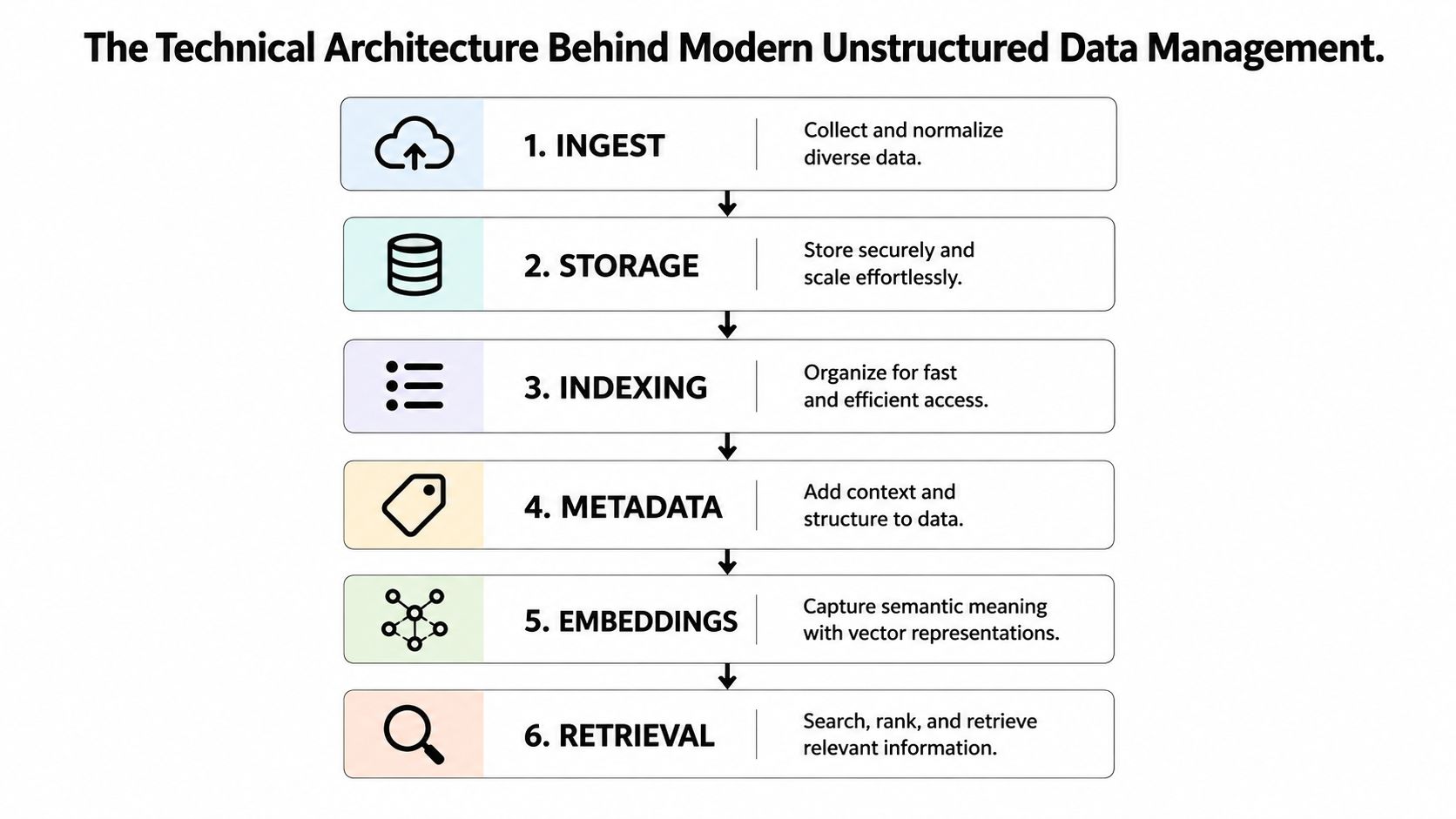
The architecture works only when the pipeline is treated as one system, not six disconnected tools. If ingest, storage, indexing, metadata, embeddings, and retrieval sit in separate political territories, users wait, agents return weak answers, and governance teams get blamed for failures created upstream. The first bottleneck is movement, not capacity. Komprise reports that moving data without disrupting users or applications is the top challenge at 54%, and classifying data for AI is the leading challenge at 58%. Komprise on unstructured-data management challenges
Ingest and storage
Ingest is where source chaos enters the system. Calls, documents, chat logs, and image-based files arrive with different formats, different owners, and different sensitivity levels, so the pipeline has to normalize arrival without forcing every source into the same shape. Storage then has to preserve the original content while keeping it governable at scale.
The infrastructure lesson is simple. Scale-out limits appear fast when unstructured workloads rely on fixed, physically bounded storage patterns. That is why the storage layer cannot act like a passive vault. It has to support policy-aware movement and retrieval paths from day one.
Indexing, metadata, and embeddings
Indexing makes content searchable, but search alone does not create meaning. Metadata adds context, ownership, classification, source, freshness, and access rules, while embeddings capture semantic relationships that keyword search misses. AI readiness starts here, because agents need more than file names and folder paths.
The common mistake is treating embeddings as a model project instead of a content infrastructure layer. Weak metadata produces weak embeddings. Inconsistent classification produces inconsistent retrieval, and then the AI program gets blamed for a governance problem. The sequence matters. First make the content traceable, then make it semantically useful.
Retrieval as an operational service
Retrieval is where the architecture proves whether it is business-grade. A good retrieval layer returns the right chunk, not just the right document, and it has to respect permissions, relevance, and freshness at the same time. If the system cannot do that, the agent will answer confidently and incorrectly, which is worse than a simple search miss.
Architecture rule: if retrieval cannot honor policy, it does not belong in production.
That is why the pipeline has to be built for controlled movement, classification, semantic enrichment, and retrieval in one flow. The enterprise value does not come from any single component. It comes from making the whole chain reliable enough that customer-facing and employee-facing agents can trust it. That is also where a secure enterprise control layer for Yellow.ai matters, because agentic systems inherit the quality of the content and permissions behind them.
Governance as a Lifecycle, Not a One-Time Cleanup
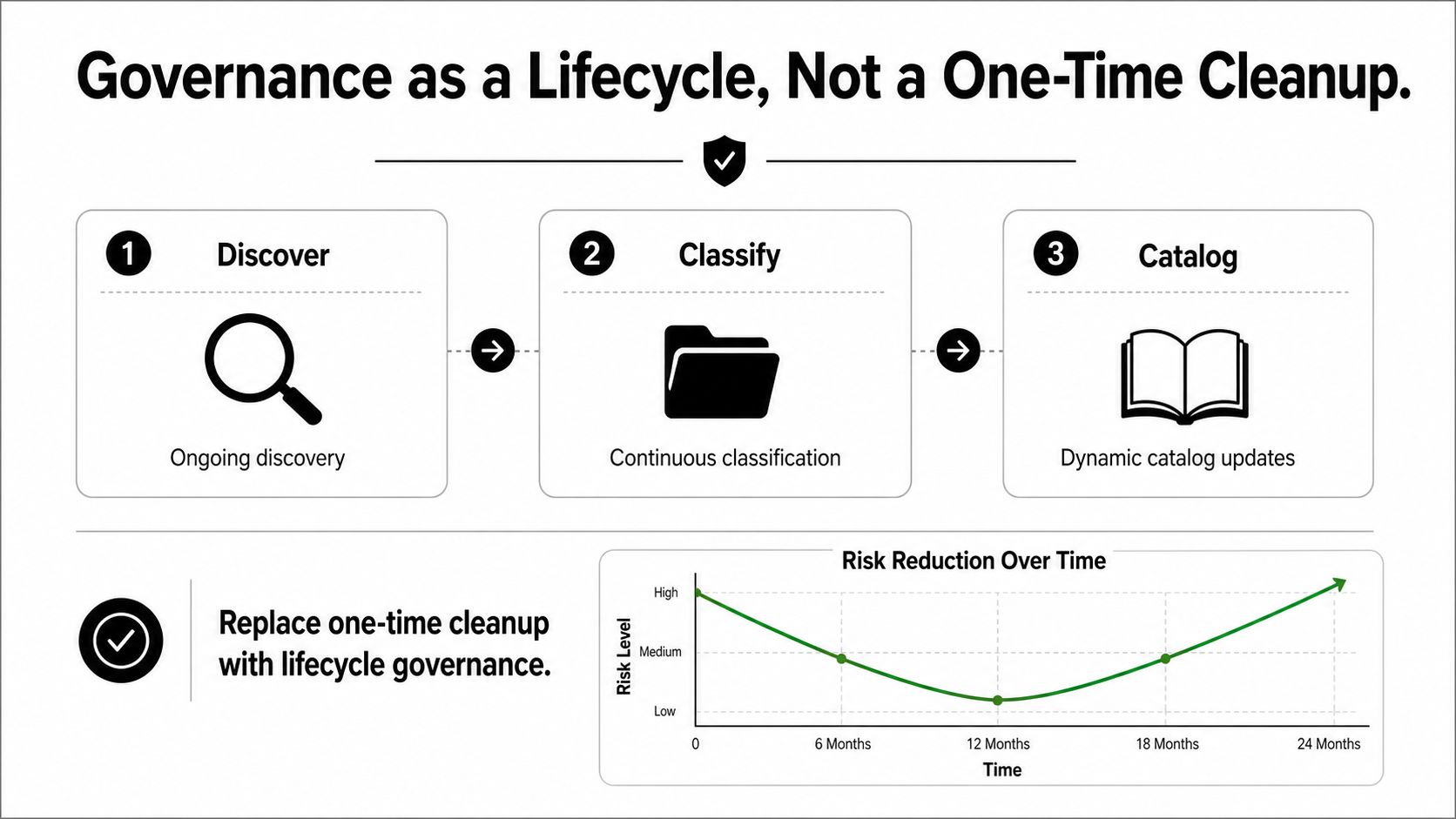
The biggest lie in unstructured governance is that discovery plus classification equals control. It doesn't. A repository that was clean six months ago can become risky today because roles changed, permissions drifted, owners left, and regulations evolved. EWSolutions explicitly pushes scheduled permission audits, remediation SLAs, elimination of stale shares and orphaned accounts, and executive ownership because governance is a recurring operation, not a box to tick once. EWSolutions on unstructured data governance
The lifecycle loop that actually works
Start with discovery, then classify content by sensitivity, owner, business function, and retention needs. After that, catalog it with enough metadata to make the content usable by both humans and machines. Then keep auditing permissions, reviewing stale content, and remediating policy drift on a schedule instead of waiting for the next compliance fire drill.
PMC's review of digital unstructured data reinforces the same point, because without sufficient metadata and documentation, stewardship breaks down. If no one can tell who owns the content or why it still exists, the repository becomes a liability as soon as the business changes around it. PMC review of digital unstructured data stewardship
What to operationalize
Use a real operating model, not a project plan. That means one team owns policy, another owns technical enforcement, and business owners are accountable for the content they create and approve. Executive sponsorship matters here, because no engineering team can clean up stale access patterns across the enterprise without authority.
- Schedule audits: review permissions, ownership, and policy mappings on a fixed cadence instead of waiting for exceptions.
- Set remediation SLAs: force action on stale shares, orphaned accounts, and misclassified content before they spread.
- Assign business ownership: make content owners visible so governance doesn't die in IT.
- Track metadata health: rich metadata is not decoration, it's the control surface for retrieval and policy.
- Retire dead content: if content no longer supports a process, it shouldn't stay in circulation just because storage is cheap.
Use governance as a continuous control loop, and the architecture stays honest. Treat it as a one-time cleanup, and your AI layer will eventually ingest stale permissions, stale policies, and stale knowledge. Enterprise security reference
CX and EX Use Cases That Make Unstructured Data Pay Off
Customer and employee experience only improve when the right content is available at the moment of need. That means the value of unstructured data management shows up in call recordings, knowledge articles, internal policies, ticket histories, manuals, and onboarding content, not in a dashboard someone checks once a quarter. The highest-value use cases are the ones that reduce friction in live service moments.
CX patterns that use managed content
Agent assist works when the platform can surface the right policy, prior case, or product answer while the customer is still on the line. Conversation intelligence works when call recordings and chat logs are searchable enough to reveal recurring issues, intent patterns, and service failures. Policy-aware self-service works when customers get answers that reflect the approved version of the truth, not whatever PDF happened to be uploaded first.
The common thread is controlled retrieval. If the content is stale, fragmented, or poorly classified, the experience degrades fast. That's why CX leaders should stop funding more content collection and start funding content control.
EX patterns that reduce internal drag
HR knowledge agents should be able to answer policy and benefits questions from current documents, not from six versions of an onboarding deck. IT helpdesk automation needs access to ticket history, standard fixes, and approved troubleshooting steps. Onboarding copilots do real work when they can pull from role-specific manuals, team process docs, and system guidance without exposing irrelevant or sensitive material.
| Use case | Content it depends on | Business effect |
|---|---|---|
| Agent assist | Call transcripts, case notes, knowledge articles | Faster resolution and fewer handoffs |
| Policy-aware self-service | Approved policies, product docs, FAQs | Fewer incorrect answers |
| HR knowledge agents | Benefits guides, HR policies, onboarding material | Less back-and-forth with HR |
| IT helpdesk automation | Ticket histories, runbooks, fix articles | Less repetitive support work |
The useful distinction is simple. CX content supports external trust, while EX content supports internal productivity. Both depend on the same discipline, because unmanaged content creates inconsistent answers, longer handling time, and more escalations. Unstructured data management pays off when it stops being a repository problem and starts becoming a service-design input.
How Agentic AI Platforms Operationalize Unstructured Data Management
A serious platform turns governed content into actions, not just search results. In practice, that means a conversational knowledge base, agentic RAG, AI Agent Builder tooling, automated testing, and omnichannel orchestration sitting on top of the managed corpus. One concrete example is Yellow.ai's Conversational Knowledge Base, which is built to search enterprise content across multiple sources, including unstructured material such as scanned or non-searchable text and invoices, and its DocCog capability includes native OCR for image search. Yellow.ai agentic AI platform
Why multi-LLM orchestration matters
A multi-LLM architecture matters because different models perform differently on retrieval, summarization, reasoning, and interaction style. If every unstructured workload is forced through one model, you get brittle performance and a real lock-in problem, especially when the corpus is tied to a single embedding approach. Enterprises should expect model diversity, not pretend one foundation model will fit every use case equally well.
That's the right response to a messy content estate. Retrieval from customer policies is not the same as summarizing a call transcript or classifying an HR document. The platform has to route work to the best-fit model while keeping governance, access control, and testability consistent across channels.
What production rollout looks like
The rollout usually starts with a limited corpus, such as support articles, policy documents, and ticket history. Then teams wire that corpus into a knowledge layer, test answer quality, and use automated evaluation to catch retrieval failures before users do. After that, they expand into voice, chat, email, and internal workflows, with analytics watching where the agent gets stuck or the answer quality drops.
The platform should adapt to the content estate, not force the content estate to fit the platform.
That's why the buying decision can't be reduced to chatbot features. The core question is whether the platform can consume governed unstructured data, keep answers policy-aware, and support both CX and EX workflows without fragmenting the stack. If it can't, it's just another interface on top of an unfinished data problem.
Implementation Roadmap and Success Metrics
The right rollout is phased, because enterprises don't go from content chaos to autonomous agents in one jump. Start with foundation, move to activation, then earn autonomy. Each phase should have a different operating goal, and each goal needs a metric the CIO can hold the team to.
Foundation
Inventory the content sources, classify the high-risk repositories, and establish metadata standards that people maintain. At this stage, success is not flashy. It looks like better coverage, cleaner ownership, and fewer unknown repositories.
Activation
Turn the managed corpus into search, retrieval, and copilots that solve real CX and EX tasks. Retrieval precision, deflection rate, average handle time, and time-to-knowledge start to matter, because the platform should be doing work, not just indexing content. The question is whether employees and agents can find the right answer faster than they could before.
Autonomy
Move into agentic workflows where content triggers actions, approvals, or next-best steps under policy constraints. This is also where continuous optimization becomes mandatory, because retrieval quality, policy drift, and prompt behavior will all change as the corpus changes. A good operating team watches compliance audit findings alongside service metrics so the AI layer doesn't drift away from governance.
| Phase | What to measure | Why it matters |
|---|---|---|
| Foundation | Coverage, ownership, metadata completeness | Proves the corpus is governable |
| Activation | Retrieval precision, deflection rate, average handle time, time-to-knowledge | Proves the content is usable |
| Autonomy | Audit findings, workflow completion, escalation quality | Proves the agent can operate safely |
The three mistakes to avoid are predictable. Don't over-invest in cataloging before governance, because a perfect inventory with broken access control is still broken. Don't treat embeddings as a one-time project, because the corpus and the business will keep changing. Don't under-fund change management, because the people who maintain content are the ones who decide whether the system stays accurate.
If you want unstructured data management to produce real CX and EX outcomes, Yellow.ai gives you the platform layer to operationalize governed content into agents, copilots, and omnichannel workflows. Explore Yellow.ai if you want to connect content governance, retrieval, and agentic AI without turning your enterprise stack into another slide deck.



