









The most popular advice about customer-service knowledge management is also the least useful: build a knowledge base, connect a search bar, and let customers or agents find answers. That approach treats knowledge as a library. In a large contact center, knowledge behaves more like a supply chain. Someone must capture it from interactions, validate it against policy, deliver it in the right context, and remove it when it becomes unsafe or irrelevant.
That distinction matters even more when AI generates customer-service answers. A retrieval system can find information quickly, but speed doesn't decide which policy is authoritative, whether a regional exception applies, or when a human must take over. This guide focuses on the operating model behind reliable knowledge management for customer service, including governance, integration, measurement, and the hidden work required to keep answers trustworthy after automation shifts labor from answering questions to curating knowledge.
Table of Contents
- Why Your Knowledge Base Is Not the Real Problem
- What Knowledge Management for Customer Service Really Means
- The Five Core Components of a Modern Knowledge System
- Knowledge Governance for AI-Generated Answers
- Implementation Roadmap and Platform Integration
- Measuring KPIs and Real ROI
- Real-World Examples and Your First 90 Days
Why Your Knowledge Base Is Not the Real Problem
Most contact centers already have plenty of information. They have help-center articles, product documentation, internal wikis, macros, ticket notes, policy documents, training decks, and messages exchanged by experienced agents. The problem is that these sources rarely form a managed system.
An agent may find three answers to the same billing question, each written by a different team. An AI assistant may retrieve a current product page alongside an obsolete procedure. A policy update may reach the public help center but not the internal escalation guide. The organization has content, but it lacks clear ownership, source precedence, review controls, and feedback loops.
Practical rule: Treat every answer as a product with an owner, a version, an audience, and a retirement decision.
Knowledge management is therefore a supply chain rather than a repository. The flow starts with customer interactions and operational signals. Teams identify recurring questions, exceptions, failed searches, escalations, and resolution patterns. Subject-matter experts then convert those signals into approved guidance, and technology delivers that guidance to agents, AI assistants, customers, and downstream systems.
This guide is written for CX leaders, contact-center operations teams, knowledge owners, and IT leaders responsible for conversational AI. The emphasis is practical: how to structure the knowledge system, govern AI-generated answers, connect the system to enterprise platforms, and measure whether it improves resolution rather than merely increasing article activity.
A knowledge initiative also needs a business case. In a 2017 Golha Company case study, knowledge about customers had a 0.592 Pearson correlation with customer satisfaction, and it explained approximately 35.1% of the variation in satisfaction within the study model. The result doesn't prove that knowledge management alone caused satisfaction to rise, but it shows why customer understanding belongs in service-performance management, not only in documentation projects. See the Golha Company case study on customer knowledge and satisfaction for the reported analysis.
What Knowledge Management for Customer Service Really Means
Think of the system as the contact center's operating memory. The CRM records what happened to a customer, such as the case opened, the purchase made, or the complaint resolved. Knowledge management determines what the organization has learned from those events and how the next agent or AI system should act.
That operating memory has three jobs:
- Acquire knowledge from customer conversations, agent observations, complaints, product changes, escalations, and resolved cases.
- Share knowledge across agents, shifts, channels, regions, and support tiers.
- Apply knowledge during the interaction, when someone must diagnose a problem, explain an eligibility rule, or choose the next action.
A customer-service knowledge system should combine internal and external knowledge, but it shouldn't expose them in the same way. Internal guidance may contain diagnostic logic, account-handling procedures, escalation instructions, or restricted policy interpretation. External content should explain what customers can do in clear language without revealing internal controls or sensitive operational details.
The two layers still need common governance. If an internal procedure says one thing and a customer-facing article says another, agents will spend time reconciling the contradiction. An AI assistant can amplify the problem by selecting a plausible answer without understanding which audience or policy context applies.
The practical definition is broader than “a searchable knowledge base.” It includes the content lifecycle, retrieval quality, channel delivery, governance, analytics, and the workflows that turn customer feedback into approved changes. A good article that nobody can find is operationally weak. A highly discoverable article with outdated policy language is dangerous.
Customer knowledge also creates value indirectly. It can help teams identify unmet needs, improve processes, and change service design. That means leaders should evaluate knowledge alongside outcomes such as satisfaction, first-contact resolution, repeat contacts, handling time, and escalations. Article views can help diagnose usage, but they aren't the result the contact center is funded to deliver.
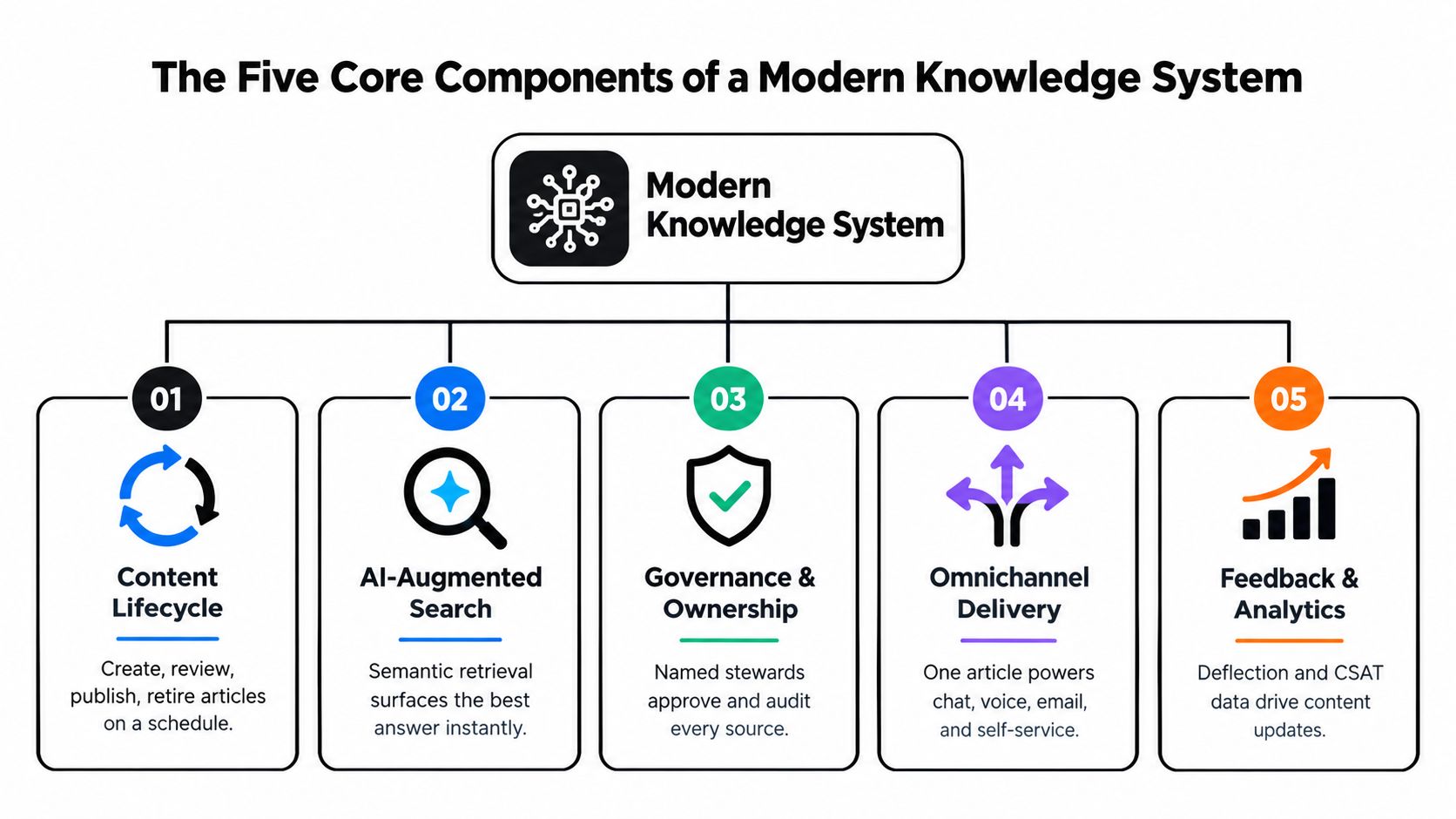
The Five Core Components of a Modern Knowledge System
A mature system has several connected parts. Each one solves a different failure mode, and improving search alone won't compensate for missing ownership or weak workflows.
Content lifecycle
Every article, procedure, snippet, and policy reference needs a lifecycle: create, review, approve, publish, monitor, update, and retire. Assign an owner by domain, record the audience and effective date, and require a review trigger when the related product or policy changes.
Without lifecycle control, the knowledge base becomes an archive. Agents may continue using a familiar article because it ranks well, even after the underlying process has changed.
Search and retrieval
Keyword search remains useful, but customer language rarely matches internal terminology. Semantic retrieval, metadata, intent classification, and filters for product, region, customer type, and channel can help the system surface relevant material.
Retrieval-augmented generation, or RAG, adds another layer. It retrieves supporting content before an AI system drafts an answer. That can reduce unsupported responses, but RAG isn't a guarantee of correctness. If the indexed sources conflict, retrieval can make the contradiction easier to deliver at speed.
Conversational knowledge
A conversational knowledge base should support both agents and AI assistants. Agents need concise procedures, decision logic, exceptions, and next actions inside the desktop where they work. Customers need clear explanations and a path to a person when self-service isn't appropriate.
The content structure matters. A short article organized around intent, prerequisites, steps, exceptions, and escalation conditions is more useful than a long product document that expects the reader to infer the procedure. A conversational knowledge base can serve as the delivery layer, but the operating team still owns the accuracy of the content behind it.
Workflow delivery
Knowledge creates value when it reaches the right interaction. Connect relevant guidance to the CRM record, ticketing context, customer segment, product, and channel. An agent handling a failed payment shouldn't have to search a general library for the procedure that applies to that customer's region and account state.
The failure mode here is isolation. A well-written article that requires agents to leave the desktop, sign into another tool, and search manually will be bypassed under pressure.
Governance and feedback
Governance decides which sources are allowed, who approves changes, how conflicts are resolved, and when an answer must be escalated. Feedback then shows where the system failed: unanswered questions, low acceptance, repeated contacts, unsafe suggestions, and articles associated with escalations.
A documented customer-service deployment reported that better frontline access to relevant knowledge increased FCR from 40% to above 65%, reduced agent research time by 55%, and raised first-search resolution accuracy above 85%. The documented customer-service deployment illustrates the operational chain: better access can reduce research effort, but only when the content is relevant and usable.
Knowledge Governance for AI-Generated Answers
The most serious knowledge failure is not an AI assistant missing an answer. It is finding several plausible answers, then confidently selecting the wrong one.
Enterprise sources conflict for legitimate reasons. Product documentation may describe the standard workflow, a regional policy may add an exception, and CRM data may show a customer-specific entitlement. Governance must decide which source takes precedence before the AI can generate a response.
Recent evidence found that only 2% of surveyed CX leaders said their data was fully unified, while 45% cited disconnected systems and 50% cited compliance as barriers to CX automation. Those figures appear in Customer Experience Dive's coverage of the knowledge problem in customer-service AI. Retrieval cannot compensate for fragmented authority.
Establish source precedence
Create a ranked source hierarchy for each domain. A current, approved policy may outrank a general help article. A customer-specific entitlement may outrank a generic product rule, but only when the system can verify the relevant field. Regional controls may override global content when the interaction concerns a regulated market.
Store those rules in machine-readable metadata where possible. “Newest document wins” fails when an older regulation or contract-specific term remains authoritative. Governance also needs an owner for each source class, because unresolved ownership eventually becomes inconsistent AI behavior.
Create approval and audit controls
Every material change should record the author, reviewer, approver, effective date, audience, and reason for the change. AI can draft an article or suggest an update, but a named steward must approve it before the content becomes an answer source.
An agent-assist panel that surfaces retrieved sources and confidence signals can support the human reviewer before an answer reaches the customer. Store the evidence behind each generated response as well. The audit trail should show retrieved sources, versions, policy context, model action, confidence or eligibility signal, and whether a person reviewed the interaction.
This work changes the economics of service automation. Labor moves from answering every question to curating sources, resolving conflicts, reviewing risky outputs, and maintaining the metadata that controls retrieval. Budget for that knowledge supply chain instead of treating automation as a one-time content project.
Define escalation thresholds
The AI should hand cases to a person when sources conflict, the customer requests an exception, the answer could create financial or regulatory exposure, identity or eligibility cannot be verified, or the system lacks sufficient evidence.
Preserve context during escalation. The agent needs the customer's question, attempted answer, retrieved sources, and reason for referral. Without that information, automation transfers the research burden to a human rather than reducing it.
Measure more than answer accuracy. Track citation traceability, policy currency, unsafe-answer rate, unresolved source conflicts, and the share of responses requiring human review. These measures expose risks that a simple thumbs-up score can hide, particularly in BFSI, healthcare, utilities, and other regulated environments.
Implementation Roadmap and Platform Integration
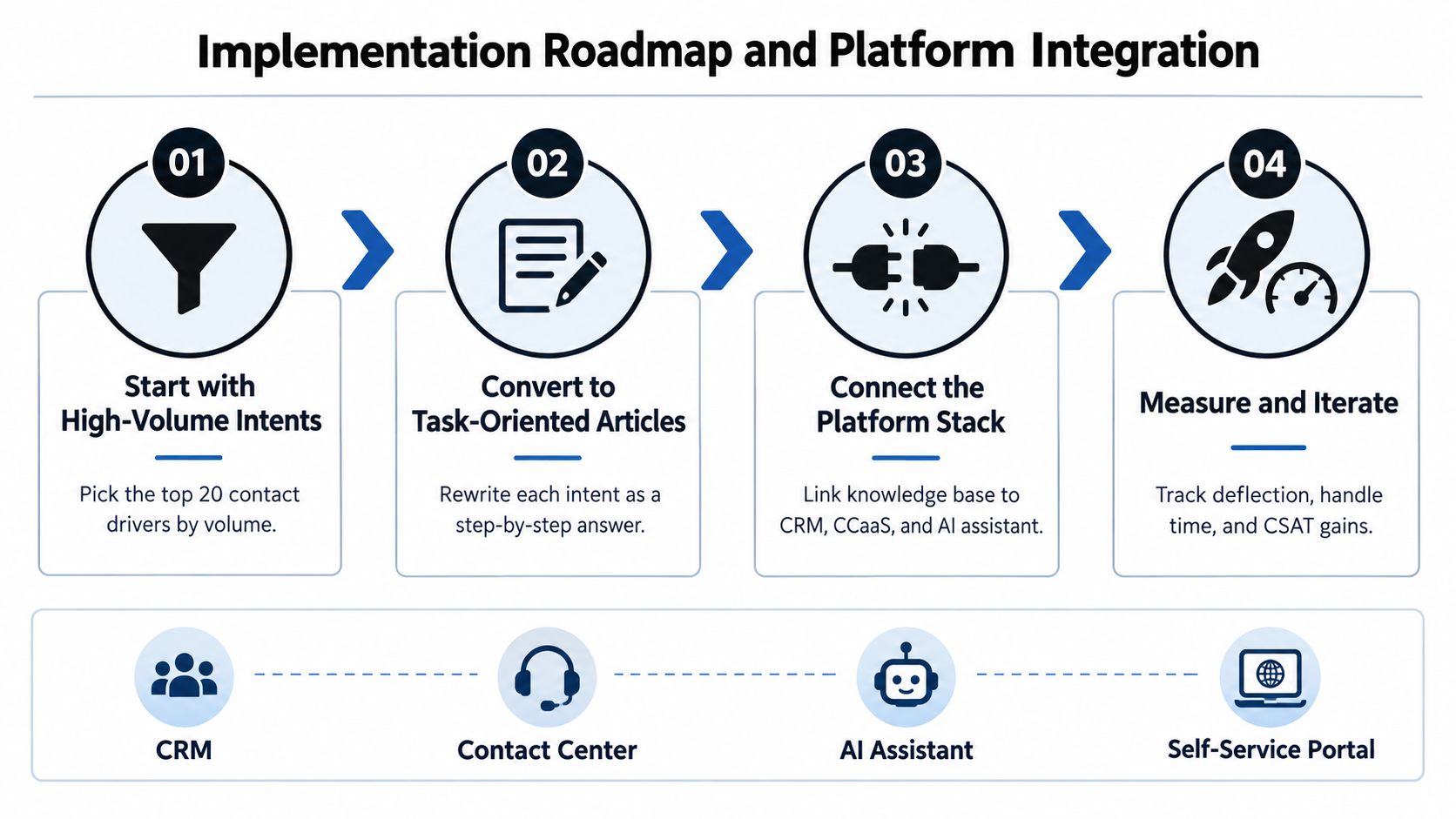
Implementation works best when the team starts with a narrow operational problem rather than attempting to clean every document in the enterprise. The sequence below keeps the project connected to service outcomes.
Start with the intents that create operational pressure
Use contact reasons, transfer patterns, escalations, failed searches, and repeat contacts to identify the intents where better knowledge could change the queue. Prioritize tasks with clear resolution logic, not questions that require discretionary judgment or unavailable system data.
For each intent, document the baseline. Capture FCR, repeat-contact rate, handling time, transfers, escalation frequency, and the current search path. Without a baseline, the team won't know whether improved content changed service performance.
Convert source material into task-oriented articles
Rewrite documents around the work an agent or customer must complete. A useful article states the intent, prerequisites, diagnostic questions, decision branches, approved wording, system action, exception, and escalation condition.
Avoid copying entire policy documents into the retrieval index. Long, mixed-purpose documents increase ambiguity. Keep the authoritative source available for audit, but create a controlled service version that makes the operational instruction explicit.
Connect the knowledge layer to the service stack
The knowledge experience should appear inside the tools agents already use. Depending on the environment, that may include Salesforce, Zendesk, Genesys, Freshdesk, or another CRM and contact-center platform. Connect customer context and case state to retrieval, while keeping access controls and source permissions intact.
A conversational AI channel, an agent-assist panel, and a self-service portal may use the same approved content but require different presentation rules. Customers need plain-language answers. Agents need internal procedures. AI systems need structured source boundaries and escalation instructions.
Pilot one queue and test failure modes
Run the pilot with a defined group of agents or a contained interaction type. Test ordinary questions, ambiguous wording, regional variations, missing data, contradictory sources, and deliberate attempts to trigger an unsafe response.
Don't move forward because the assistant sounds natural. Move forward when the evidence shows that retrieval is relevant, answers are accepted, escalations preserve context, and the selected service outcomes are stable against the baseline.
Instrument the feedback loop
Every failed search, rejected suggestion, repeat contact, and escalation should create a possible knowledge task. Route those signals to an owner who can decide whether the fix belongs in content, retrieval, workflow, product design, or policy.
A peer-reviewed inbound contact-center study found a statistically significant positive effect of knowledge management on FCR, with a standardized coefficient of 0.37, p < 0.01. Knowledge management and technology-based CRM together explained 20.2% of the variance in FCR in that study. The peer-reviewed contact-center research supports connecting the knowledge initiative to CRM and resolution measurement rather than treating it as a publishing project.
Measuring KPIs and Real ROI
Article views and search volume are useful diagnostic signals, but they don't prove that customers received better service. A page can attract views because it's confusing, because agents are forced to open it repeatedly, or because the content is easy to find but difficult to apply.
Use a controlled comparison wherever the operation allows it. Compare equivalent queues, intents, channels, products, or agent groups before and after improved knowledge coverage. Track the operational outcome and the retrieval mechanism together.
| Surface Metric | Outcome Metric to Track Instead | Why It Matters |
|---|---|---|
| Article views | FCR and repeat-contact rate | Shows whether knowledge helped resolve the issue rather than merely attract attention |
| Search volume | Retrieval precision and answer acceptance | Distinguishes active use from useful retrieval |
| Deflection | Resolution quality and escalation appropriateness | Prevents the operation from rewarding avoidance of difficult cases |
| Articles published | Time-to-publish approved updates and stale-content exposure | Measures the health of the knowledge supply chain |
| AI response rate | Unsafe-answer rate and human-review share | Shows whether automation is operating within risk boundaries |
| Agent clicks | Research time and handling time | Connects interface activity to productivity |
| Customer feedback on articles | CSAT, FCR, and repeat contact by intent | Links content experience to service results |
A 2025 benchmark covering more than 32,000 companies and 1.2 billion tickets reported that 53% of customer-service practitioners viewed rising ticket volumes without proportional headcount growth as their top challenge. The same verified data notes that separate knowledge-management research found 23% of organizations had no formal KM structure. These findings are summarized in the 2025 customer-service benchmark report.
That workforce pressure exposes the economics most self-service advice skips. Automation may reduce routine answering while increasing the need for content validation, exception review, localization, policy monitoring, testing, and retirement. Someone must fund that work, reserve time for it, and decide whether it belongs to operations, product, compliance, or a shared knowledge team.
Track maintenance measures such as cost per validated article, time to publish a policy update, stale-content exposure, reuse across channels, and knowledge work per resolved case. Use AI analytics for customer-service performance monitoring to connect those measures to interaction outcomes, not to celebrate a growing content inventory.
Real-World Examples and Your First 90 Days
The documented deployment cited earlier offers a useful operational pattern. Frontline access to relevant knowledge was associated with FCR rising from 40% to above 65%, research time falling by 55%, and first-search resolution accuracy moving above 85%. The lesson isn't to promise the same result everywhere. It's to isolate the mechanism: prioritize high-volume work, write task-oriented guidance, make it easy to retrieve, and measure what happens during the interaction.
A regulated operation needs a different proof point. It should test whether the system can refuse or escalate when evidence is incomplete, distinguish a global rule from a regional exception, and show the source behind an answer. A lower automation rate may be the correct result if it keeps high-risk interactions with trained agents.
The first 30 days
Audit the intents that generate the most operational friction. Sample resolved and unresolved conversations, identify contradictory guidance, and document the current path an agent follows to answer each question.
Assign a business owner and a technical owner for every priority domain. Define who can author, review, approve, publish, and retire content. Start a source-precedence register before connecting more documents to retrieval.
The next 30 days
Convert the priority intents into concise, task-oriented content. Label each source by audience, region, product, effective date, and risk. Pilot retrieval in one queue, with human escalation enabled from the first interaction.
Capture FCR, repeat contacts, handling time, transfers, retrieval precision, answer acceptance, and escalation reasons. Review failed answers with operations, product, compliance, and the agents who handled the conversations.
The final 30 days
Retire or correct conflicting material, formalize the approval workflow, and connect the knowledge experience to the CRM or agent desktop. Test the system against edge cases rather than only common questions.
A 2024 quantitative study of IT companies found that customer knowledge management had a 0.64 path coefficient to open innovation, while open innovation had a 0.45 path coefficient to service quality, producing an indirect effect of 0.288. The 2024 study of customer knowledge management, open innovation, and service quality supports a broader view of value: knowledge isn't only a way to answer today's questions. It can help the organization learn and change how it serves customers.
The durable outcome is a governed learning loop. Customer interactions reveal gaps, stewards validate the correction, retrieval delivers the approved guidance, and performance data shows whether the change worked. That loop is the foundation for agentic customer service, and it remains necessary after the AI system goes live.
Yellow.ai provides an enterprise agentic AI platform with a conversational knowledge base, agent assist, omnichannel orchestration, integrations with CRM and contact-center systems, and analytics for improving customer-service interactions. Use Yellow.ai to explore how governed knowledge and human escalation can support AI-assisted service operations.