








The most popular advice about AI copilot chat is to get it into employees' hands quickly and drive adoption. That's the wrong starting point for a service operation. An activated seat doesn't tell you whether an agent checked the refund policy, whether HR approved an exception, or whether anyone can reconstruct a wrong answer after a complaint.
Start with who owns the outcome. A useful copilot reduces the effort of finding, understanding, and drafting information without making responsibility disappear into a chat window. For CX leaders, rollout criteria are traceability, approval gates, and whether employees become more effective without losing the knowledge they need to handle exceptions.
Table of Contents
- What AI Copilot Chat Does in the Workday
- Core Capabilities CX and EX Teams Use
- Enterprise Benefits and the Limits of the Evidence
- Architectures and the Systems Behind the Chat
- Accountability When an Answer Is Wrong
- Copilot Chat in Support and Employee Service
- Roll Out Only Where a Human Owns the Outcome
What AI Copilot Chat Does in the Workday
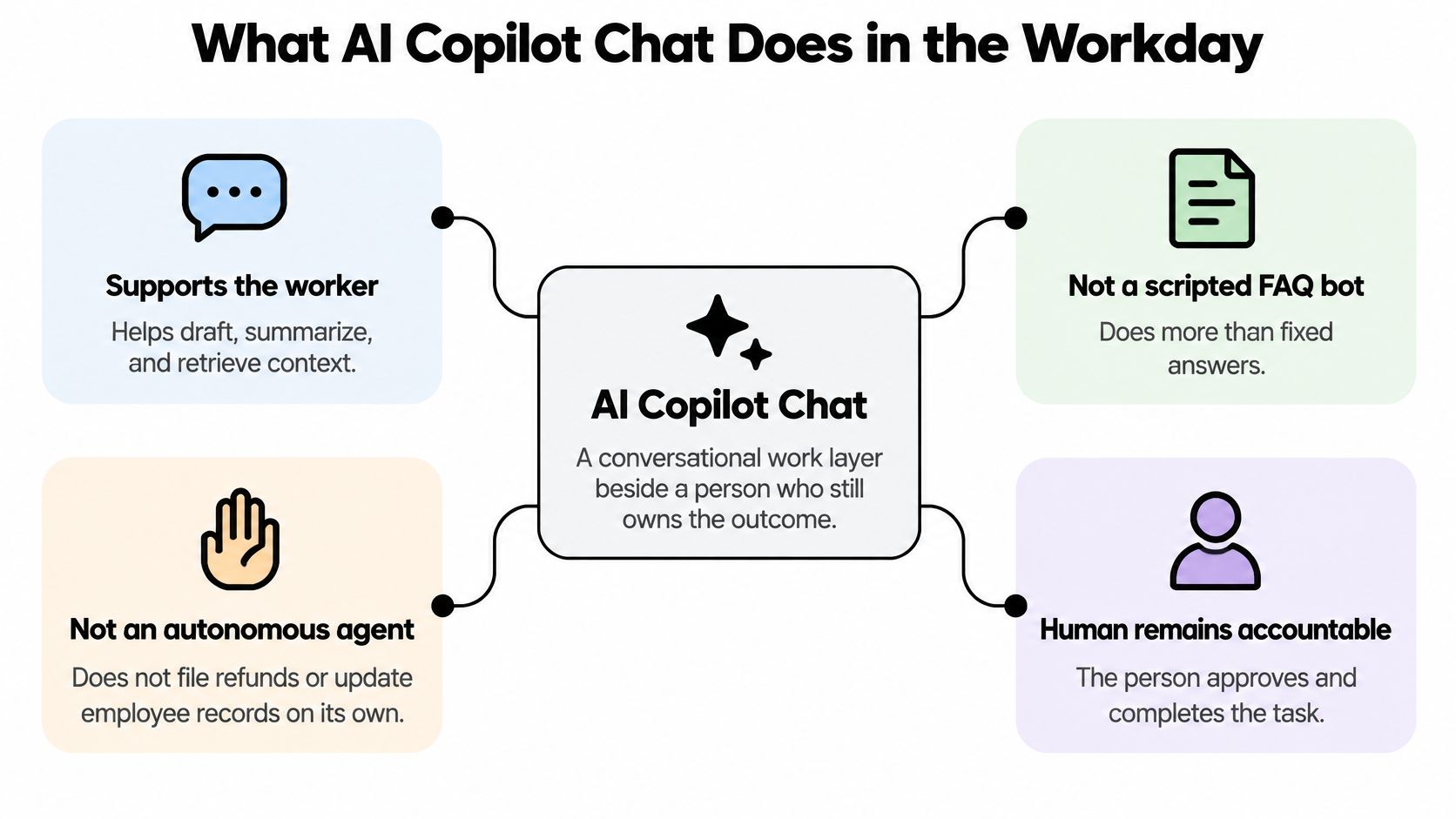
Think of AI copilot chat as a sharp colleague who prepares the brief but doesn't sign the decision. You describe a goal in ordinary language. The assistant retrieves relevant context, summarizes it, or prepares a draft, and you accept, edit, or reject the result.
That definition matters because enterprises often put different operating models under the same conversational interface. Use the action boundary, not the appearance of the chat window, to tell them apart.
Chatbot, copilot chat, and autonomous agent
| Pattern | What it does | Human role | Typical CX or EX use | If it is wrong |
|---|---|---|---|---|
| Scripted chatbot | Follows fixed intents and menus | User walks the tree | FAQ deflection on known questions | Dead end or wrong branch |
| AI copilot chat | Retrieves, summarizes, and drafts inside a workflow | Person accepts, edits, or rejects | Agent assist, policy answers, case summaries | Unverified policy or stale source reaches the customer |
| Autonomous agent | Completes multi-step actions in business systems | Person sets the outcome and handles exceptions | Refunds, ticket updates, employee requests | Unapproved write to a customer or employee record |
These are operating patterns, not permanent product categories. A platform can support all of them. If a conversational assistant can issue a refund without a person reviewing that transaction, treat that capability as delegated execution, even if the interface still says copilot.
For a frontline worker, the useful distinction is simpler: Does this prepare my work, or commit the business to an action? Preparing a response and sending it are different permissions. Finding an employee record and changing it are different permissions, too.
The workday boundary should be visible to the person using the assistant.
Context matters more than an empty prompt box
Microsoft's 2024 Work Trend Index reported that 75% of global knowledge workers were using generative AI, and its workplace study found that Copilot users read 11% fewer individual emails. That supports looking beyond standalone question answering toward assistance embedded in information-heavy work.
For service teams, the opportunity is the preparation between decisions: reading a conversation, locating a policy, identifying what's unresolved, and drafting a response. A generic assistant may produce fluent language, but fluency doesn't establish which contract applies or whether a policy has expired.
Put the assistant beside the case, not in a separate destination that requires employees to paste sensitive context. Give it access appropriate to the signed-in user, and distinguish customer statements from verified account facts.
Practical rule: Define the copilot's boundary with verbs. Retrieve, summarize, and draft are assistance. Approve, send, refund, and update require an explicit execution policy.
For CX, EX, and IT leaders, that boundary is the starting specification. The chat interface comes afterward.
Core Capabilities CX and EX Teams Use
Buy capabilities as jobs with acceptance tests, not as feature names. A polished demonstration can hide the work an employee must do to make the output usable.
Test the work product
- Find an authoritative answer. Grounded retrieval should return the relevant passage, document title, and policy context. It passes when the employee can verify the answer without starting another search. If nothing relevant exists, the assistant should say so rather than fill the gap.
- Prepare an editable reply. Ask for a customer response, an internal case note, or a rewrite in the approved service voice. The draft fails if it invents an eligibility condition, promises an unauthorized outcome, or changes the meaning while improving the tone.
- Compress a conversation accurately. A useful summary separates the issue, completed troubleshooting, commitments already made, and the unresolved question. Leaving out a prior promise is more serious than producing an inelegant sentence.
Next-step suggestions need a different test. A recommendation to use a macro, request a document, or escalate a case should match the current case state. Don't accept a plausible escalation path if the employee must discover that the receiving team no longer handles that issue.
Language support also needs policy-level review, not just fluent translation. Ask a qualified reviewer whether the translated response preserves exclusions, conditions, and uncertainty. The source should remain available alongside the translated wording.
Teach employees to challenge the draft
Training should rehearse a conversation, not just demonstrate prompt syntax. The conversational training tips from VideoLearningAI offer a useful starting point for designing interactive practice; adapt that approach to exercises where staff ask follow-up questions and identify unsupported statements.
Knowledge-gap detection belongs in the same operating loop. When employees repeatedly ask an unanswered question, send the unresolved intent and relevant examples to a named content owner. Don't let the assistant turn its own improvised answer into unofficial policy.
Use a small, deliberately selected transcript set for acceptance testing:
- Hide the approved reply. Give the copilot the conversation and the knowledge available at that moment.
- Score evidence separately from writing. A readable response with the wrong policy is a failure.
- Record the remaining work. Track what the employee had to verify, remove, or rewrite before sending.
A capability that can't substantiate a policy claim hasn't passed, however confident its prose sounds.
Enterprise Benefits and the Limits of the Evidence
The defensible benefits are specific: faster first drafts, less effort assembling context, and less friction finding information. Those are worthwhile improvements. They aren't evidence that an entire contact center can achieve the same percentage gain as a bounded laboratory task.
Copilot-style results and their limits
| Evidence | Task measured | Reported effect | Do not treat it as |
|---|---|---|---|
| GitHub Copilot experiment, 2023 | Implementing a JavaScript HTTP server | 71.17 versus 160.89 minutes, a 55.8% reduction in completion time | A contact-center handle-time guarantee |
| Writing experiment involving 453 professionals | Bounded occupation-specific writing | 40% less completion time, 18% higher output quality | End-to-end casework with CRM and policy checks |
| AI-assisted learning trial | Learning a Python library | Approximately two minutes faster, not statistically significant; conceptual-knowledge scores of 50% versus 67% for manual coding | Proof that faster employees understand the underlying process |
The programming experiment supports testing assistance on a clearly defined production task. It doesn't establish first-contact resolution, customer satisfaction, or safe exception handling. Those outcomes require their own operational measurements.
The writing experiment supports using assistance for composition and revision. A support reply, however, sits inside a larger case: the employee may still need to authenticate the customer, inspect account history, validate eligibility, and document the disposition. Faster prose doesn't remove those obligations.
The learning trial introduces a more difficult trade-off. Employees can finish an assisted task without developing the understanding they would gain by doing it manually. In a service operation, that matters when an unusual case requires someone to recognize that the suggested answer is incomplete.
Measure the work left after generation, not just the time saved before it.
Translate benefits into service measures
Use a scorecard that distinguishes speed from successful resolution:
- Time to resolution. Include reading, verification, correction, and follow-up, not just drafting.
- First-contact resolution. Check whether the customer returns because the original answer omitted a condition.
- Escalation accuracy. Assess whether employees send the right cases to the right specialists.
- Rework and review quality. Record reopened cases, corrected replies, and policy defects.
- Independent capability. Test whether employees can explain the decision without copying the assistant.
Usage belongs on an adoption dashboard, not in the benefits calculation. Microsoft's 2025 Copilot usage report analyzed approximately 37.5 million conversations. That demonstrates the scale of interaction, not whether a particular enterprise resolved work more accurately.
I would approve a business case built on measured task improvements. I wouldn't approve one that multiplies an experimental writing gain across every paid hour in the operation.
Architectures and the Systems Behind the Chat
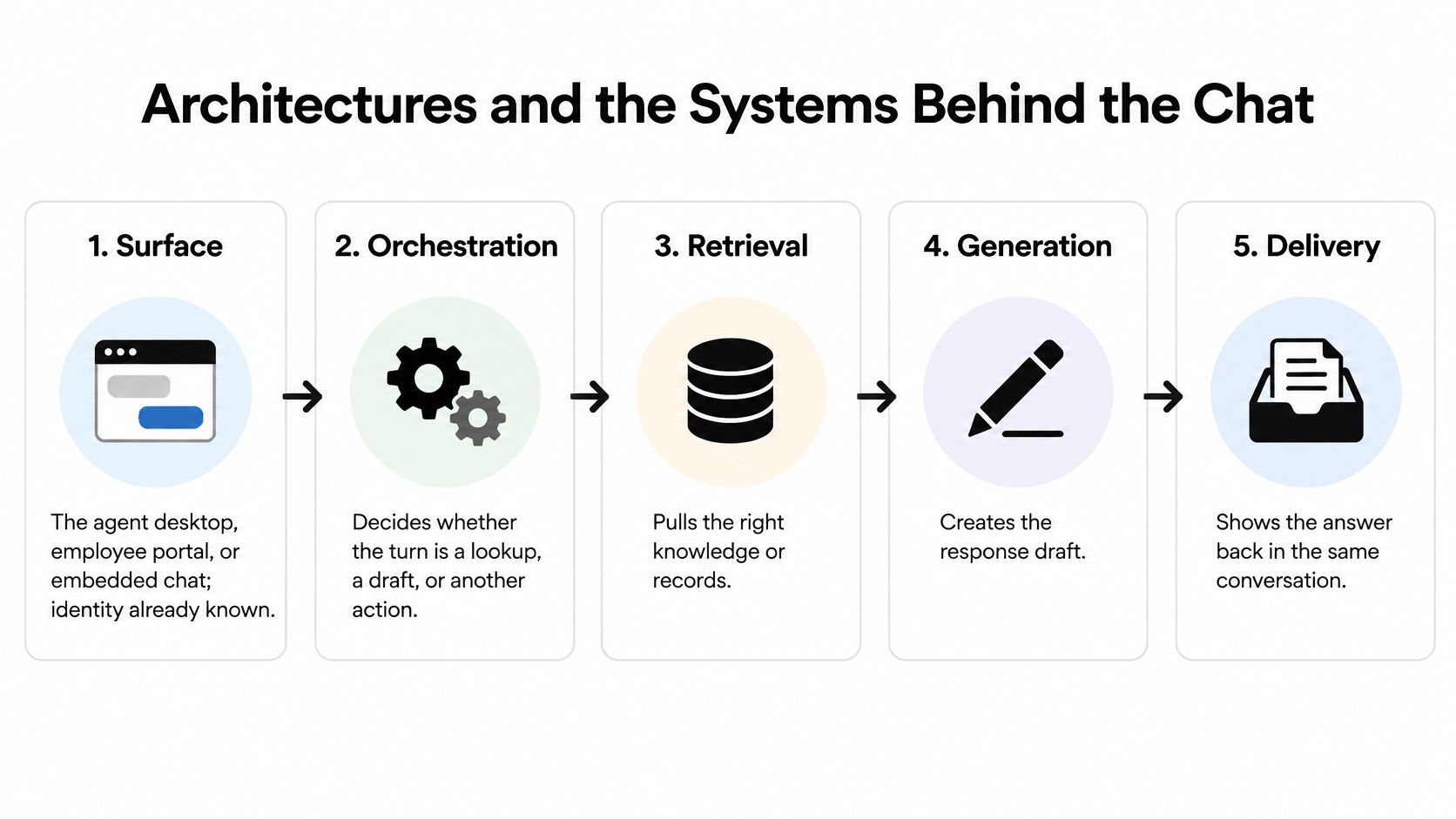
Follow a billing-policy question from the agent desktop to the proposed response. The architecture must preserve identity, select usable evidence, and return a draft without obtaining permission to act without notification.
The message flow should be inspectable at each stage.
From the desktop to the evidence
Surface. The agent opens assistance inside the case view. Pass the authenticated identity and authorized case context through the application, rather than asking the agent to paste account details into an unrestricted prompt.
Orchestration. The application identifies whether the request is a lookup, a summary, a draft, or a requested action. It should distinguish a customer's demand for a refund from the agent's instruction to explain refund eligibility. Customer text is case content, not authority to call a tool.
Retrieval. Search the approved knowledge and permitted business records. Apply access rules before material reaches the model, including customer boundaries, confidential HR restrictions, and document permissions. A frontline agent shouldn't retrieve another customer's record merely because it resembles the current case.
For document-heavy processes, document workflow design with Matil is a useful companion when mapping how material moves between intake, extraction, review, and downstream action. Keep those process boundaries explicit when the conversation crosses into document handling.
From evidence to a controlled response
Generation. The model constructs the answer from the retrieved material. Model routing can be designed to balance latency, cost, and task accuracy, but any alternative model must pass the same evaluation set. Switching models isn't a substitute for fixing incomplete knowledge.
Delivery. Return the draft with its supporting context and a clear distinction between suggested and completed actions. Read tools can fetch CRM, ITSM, or HRIS information; write tools should remain separately permissioned and gated.
For an enterprise stack, evaluate:
- System access. Map the necessary records in Salesforce, Zendesk, Genesys, Freshdesk, HubSpot, or NICE without granting broad access by default.
- Knowledge handling. A platform's retrieval-augmented generation approach should be assessed for evidence visibility, permissions, and content freshness, not just answer fluency.
- Testing support. Builder-side copilot tools can help preview and debug agents. That role is distinct from a frontline assistant and doesn't replace operational review.
Keep policy rules consistent when a conversation moves between chat, email, and voice. The delivery channel may change how evidence is presented, but it shouldn't change who can access it or authorize an action.
If engineers can't trace a wrong response to the user, retrieved material, and processing path, the architecture isn't ready for service delivery.
Accountability When an Answer Is Wrong
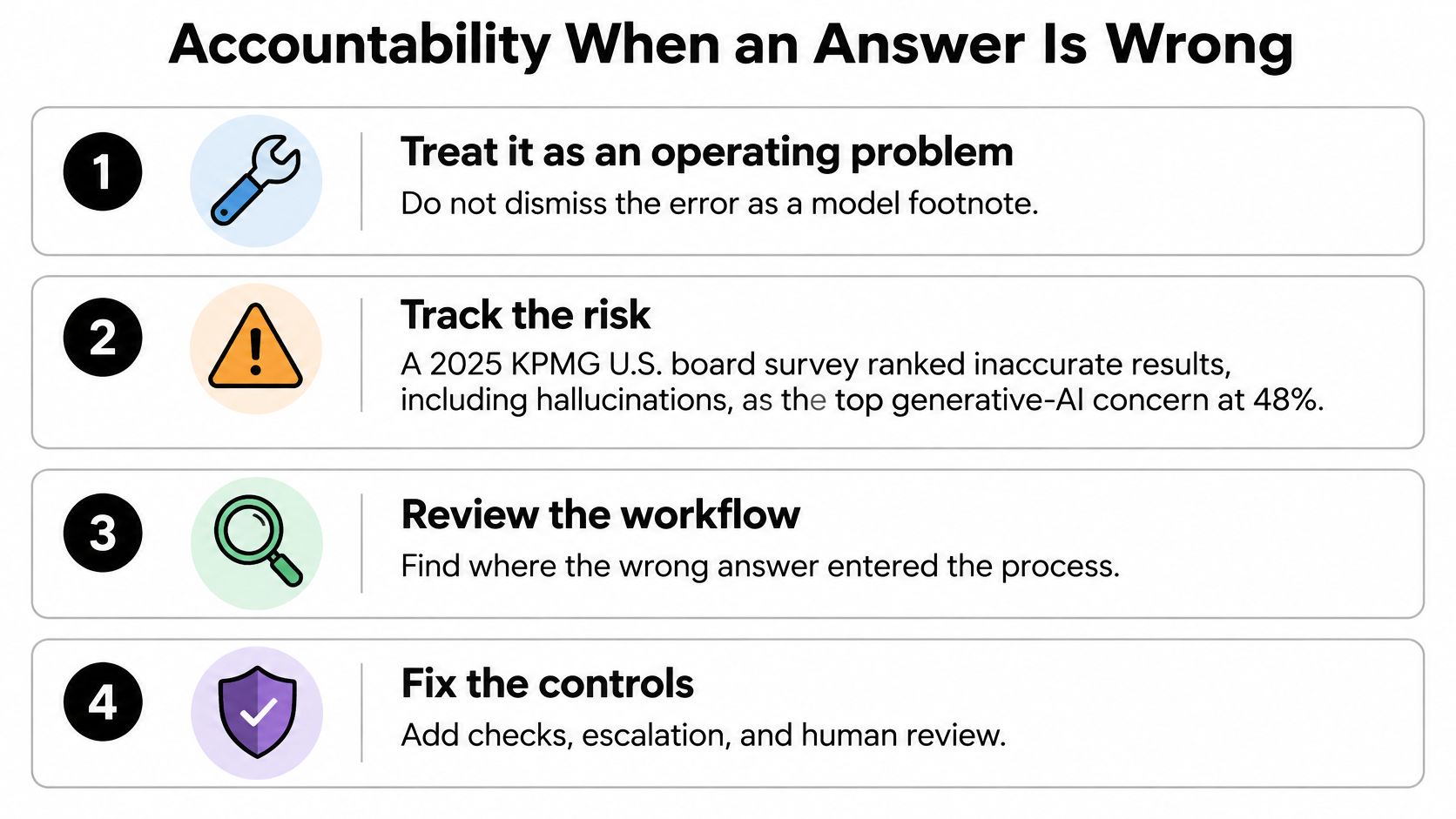
Inaccurate results, including hallucinations, were the top generative-AI concern at 48% in the 2025 KPMG U.S. board survey. Treat that as an operating concern, not an invitation to add a disclaimer beneath the input box.
An employee can technically remain responsible while having no practical way to verify the answer. That's not meaningful control. Responsibility needs evidence, time to review, and authority to stop the workflow.
Assign ownership before enabling delivery
The controls need named owners with different duties:
- Knowledge owner. Maintains the approved policy, effective dates, applicable populations, and replacement process for obsolete material.
- Service owner. Defines which outputs need routine review and which require specialist approval.
- Platform owner. Maintains access enforcement, interaction records, and the ability to investigate incidents.
- Quality owner. Classifies defects and checks whether corrective changes prevent recurrence.
For policy answers, display the supporting passage and enough document context to judge applicability. A citation to a general policy page isn't sufficient when the answer relies on a particular exclusion.
Set approval requirements by consequence. A wording adjustment can receive ordinary agent review. Refund authorization, employment exceptions, or consequential medical and financial guidance need a designated qualified approver and a defined escalation path.
Use enterprise AI governance as an operating design exercise: specify who may approve, what they must inspect, and what happens when they decline.
The incident process should lead to a control change, not just a corrected sentence.
Reconstruct the failure and preserve judgment
Administrators need a protected record of the conversation, user identity, channel, retrieved document versions, proposed output, edits, and approvals. Apply retention and access policies to that record because the audit trail itself may contain sensitive information.
Classify mistakes by intent, channel, geography, and risk tier. A global accuracy average can conceal a recurring failure in a local leave policy or a high-consequence billing exception.
Accountability test: Name the person who can halt delivery, the owner who corrects the source, and the reviewer who confirms the fix.
Protect employee capability, too. Use unfamiliar cases in periodic unaided exercises and ask staff to explain why an exception requires escalation. Evaluate their reasoning, not whether they remember the assistant's wording.
Frequent use isn't proof of stronger judgment. A Microsoft Research study of 125 interns found that 86% used Copilot daily for at least one use case, but its observational findings don't establish that use caused better performance.
Investigate heavy reliance rather than automatically celebrating it. Employees may find the assistant useful, or they may have no workable way to find authoritative information themselves.
Copilot Chat in Support and Employee Service
A Microsoft Research analysis published in 2026 examined approximately 5.5 million anonymized M365 Copilot Chat sessions, finding writing was the dominant use, with retrieval, analysis, and decision-making also common. For service leaders, those activities become useful only when attached to a concrete case and a clear human decision.
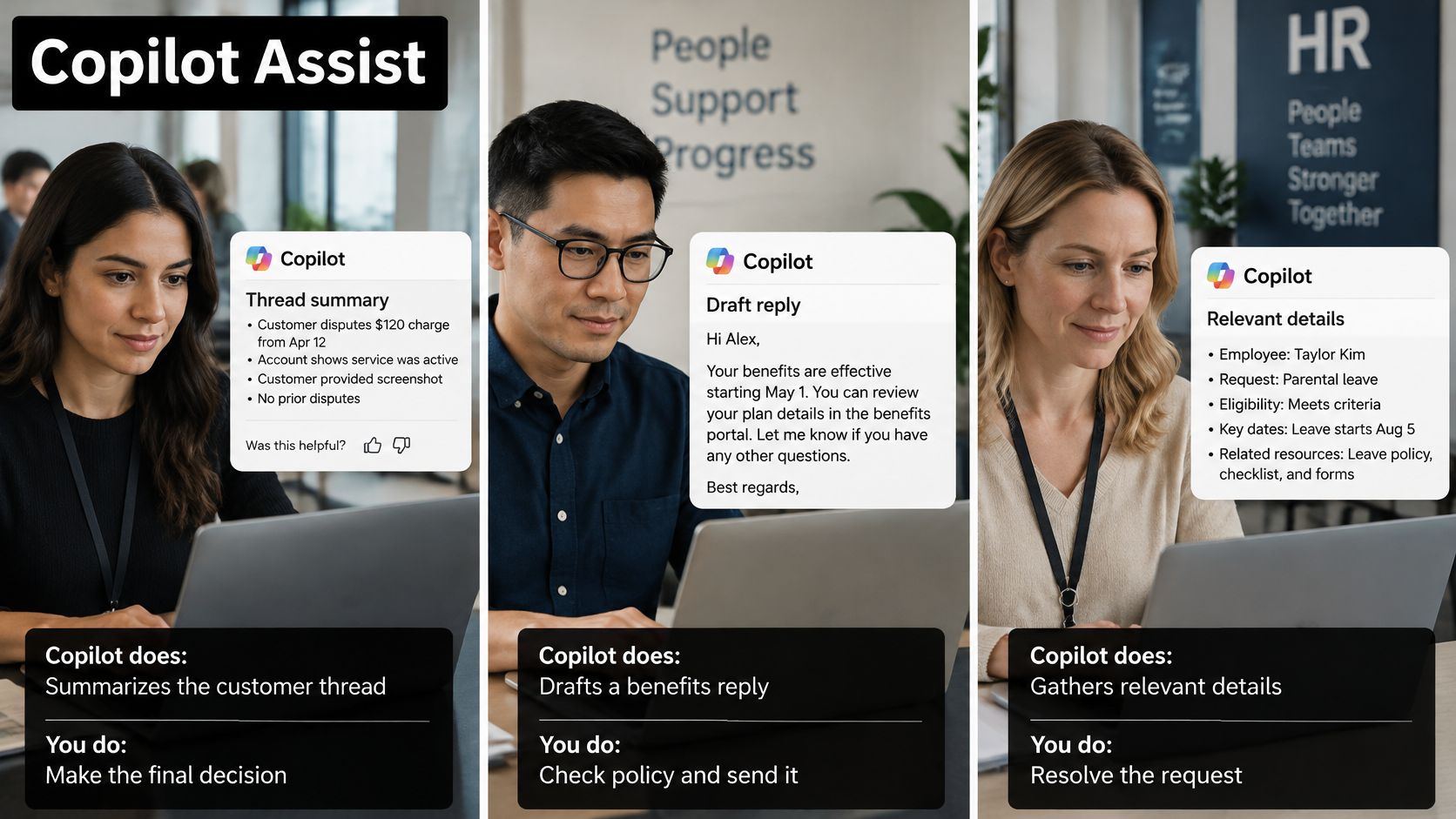
The working pattern is preparation beside the employee.
A billing dispute with a prior promise
Say a customer disputes a charge after an earlier agent promised an adjustment. The copilot summarizes the thread and drafts a reply using the refund policy. The agent checks both the clause and the earlier commitment before deciding what to send.
The failure to test is omitted context: a summary that drops the promise can produce a technically accurate policy reply that mishandles the case. The employee still decides whether the prior commitment requires an exception.
Agents who prefer speaking their first draft can use guidance to turn spoken drafts into polished support replies from AIDictation. Review the resulting text for promises and eligibility language before delivery, just as you would a generated draft.
A parental-leave question with missing eligibility
A new hire asks how much parental leave they have. The assistant finds the current policy and points to the HRIS request form, but the available context doesn't establish the employee's applicable entitlement.
The right output identifies the missing eligibility detail and routes the question to HR. Finding the policy isn't the same as determining entitlement. The HR reviewer still decides how the rules apply to that employee.
When evaluating help desk automation, include these incomplete-context cases rather than testing only questions with clean answers.
A conversational demonstration can help reviewers examine how turns unfold, but it shouldn't substitute for case-based acceptance testing.
A supervisor's knowledge review
A supervisor asks for recurring unanswered questions across service conversations. The copilot groups candidate gaps; the supervisor checks examples before assigning work to content owners.
- What can fail. A summary may combine unrelated issues or mistake inaccessible content for missing content.
- What the person decides. Whether to revise an article, repair access, or change training.
Don't turn that review into a ranking of employees by prompt activity. Its useful output is a prioritized knowledge-maintenance queue.
Roll Out Only Where a Human Owns the Outcome
Choose a queue with maintained knowledge, manageable consequences from a wrong sentence, and an established service baseline. Don't begin with the most politically visible use case or the workflow with the largest theoretical savings.
Make the launch decision on demonstrated readiness. Reviewers should be able to inspect policy evidence, exercise the approval path, and replay a test interaction before any customer or employee depends on the output.
Set the pilot gate in writing
Use a controlled comparison between assisted and unassisted work in the same queue. Keep case mix and employee experience comparable, and record differences that could distort the result.
- Count all effort. Include verification and correction inside handle time, along with downstream follow-up.
- Protect service quality. Compare assisted-resolution quality, rework, and whether escalations reached the right team.
- Check retained knowledge. Sample unaided decisions on unfamiliar cases, including situations where the source is incomplete.
- Define stop conditions. Pause expansion when harmful errors appear, rework increases, or escalation accuracy deteriorates.
Give the pilot owner authority to reject expansion even when usage is strong. Otherwise, adoption targets can pressure managers to keep a system running while agents absorb the checking work.
Expand on evidence, not enthusiasm
If the queue improves after verification effort is counted and quality remains acceptable, consider the next workflow. Revalidate its knowledge, permissions, and risk rather than assuming the first result transfers.
If performance disappoints, diagnose the cause before buying a more capable model. The problem may be contradictory articles, missing record access, an unusable review interface, or a workflow that needs redesign rather than generated text.
The final gate is simple: a named service owner must be able to stand behind the delivered answer. If that person can't inspect the basis, enforce approval, and investigate a failure, keep the deployment in testing.
Yellow.ai offers enterprise conversational AI tools for building and testing agents, connecting business knowledge, and inspecting interactions. Visit Yellow.ai with a specific pilot queue, representative failure cases, and your approval requirements to evaluate how its tools fit a human-owned service workflow.