











Your board wants an AI roadmap. A vendor has just demonstrated a voice agent that handles a customer request without hesitation, and your operations team wants to know when it can go live. You're being asked to approve a platform before anyone has agreed on what a successful customer outcome looks like.
That's the buying risk with AI contact center solutions. A convincing conversation isn't proof of a resolved problem. Before you compare platforms, decide what evidence you'll require, what authority you'll delegate, and who'll own the consequences when automation gets something wrong.
Table of Contents
- What a Real Buying Decision Looks Like in 2026
- What AI Contact Center Solutions Actually Do
- Deployment Models Compared on Buyer Terms
- Core Capabilities to Score During Evaluation
- ROI, KPIs, and the Resolution-Proof Gap
- Cost and Inference Economics in Plain Numbers
- Governance, Knowledge, and the Organizational Readiness Trap
- Choosing a Vendor and a 90-Day Plan to Prove It
What a Real Buying Decision Looks Like in 2026
Consider a hypothetical billing pilot. The automated agent explains a disputed charge, the customer hangs up, and the dashboard marks the interaction resolved. But the agent never checked whether the explanation matched the customer's contract, and nobody reconciles the conversation with the billing record.
The demo worked. The operating process didn't.

A real buying decision starts with the service responsibility you're transferring, not the software you're acquiring. An agent that explains a policy needs different permissions, evidence, and supervision from an agent that changes an account or approves a refund.
Decide what you're actually authorizing
Before the pitch, get CX, IT, security, and the relevant business owner to agree on:
- Scope of authority: Which requests may the agent answer, execute, recommend, or refuse?
- Evidence of completion: Which system record confirms that the requested outcome happened?
- Accountability: Who investigates an incorrect answer or unauthorized action?
- Operational boundaries: What happens when knowledge is missing, an integration fails, or a customer challenges the result?
For broader enterprise procurement preparation, the Voicedial.ai call center guide is a useful companion resource to bring into your requirements discussion. Use that discussion to separate contact-center infrastructure decisions from the authority you're granting an automated agent.
Buying rule: Don't authorize autonomous service delivery until you can describe how someone other than the agent will verify its work.
You aren't choosing between a bot and a human workforce. You're deciding how responsibility moves between software, frontline staff, and business owners. If those responsibilities remain unclear, procurement can produce a signed contract without producing a deployable service.
What AI Contact Center Solutions Actually Do
At the narrowest end, contact-center automation means an IVR menu or scripted bot: identify an input, follow a predefined branch, and return a configured response. Conversational AI expands that interaction by interpreting natural language and maintaining context rather than requiring customers to follow the system's menu.
Agent assist changes who receives the output. Instead of answering the customer directly, the system retrieves information, drafts responses, or summarizes a conversation for a human agent. Think co-pilot: the human remains responsible for what gets communicated and done.
Autonomy is a separate decision
An autonomous agent operates closer to autopilot within an explicitly approved service boundary. A scheduling agent, for example, might interpret a request, check availability, offer alternatives, and submit a booking through an authorized workflow. That example describes a capability to test, not a guarantee that every platform supports it.
For teams aligning terminology before procurement, Convot's explanation of what an AI support agent is provides a starting point. Keep the distinction between generating language and executing business actions central to the discussion.
A modern evaluation should connect these functions:
- Voice and digital interaction: Understanding requests across calls, chat, messaging, and email.
- Knowledge grounding: Retrieving approved information to support answers.
- Workflow execution: Calling enterprise tools under defined permissions.
- Operational analytics: Connecting conversations, actions, and outcomes for review.
In Gartner's survey of 187 service and support leaders conducted in July and August 2024, 85% expected to explore or pilot customer-facing conversational GenAI during 2025; for customer-facing GenAI voicebots, 44% were exploring, 11% were piloting, and 5% had deployed. Those were adoption intentions and deployment snapshots, not evidence of successful customer outcomes.
The buying decision connects those capabilities with safety, evidence, and readiness.
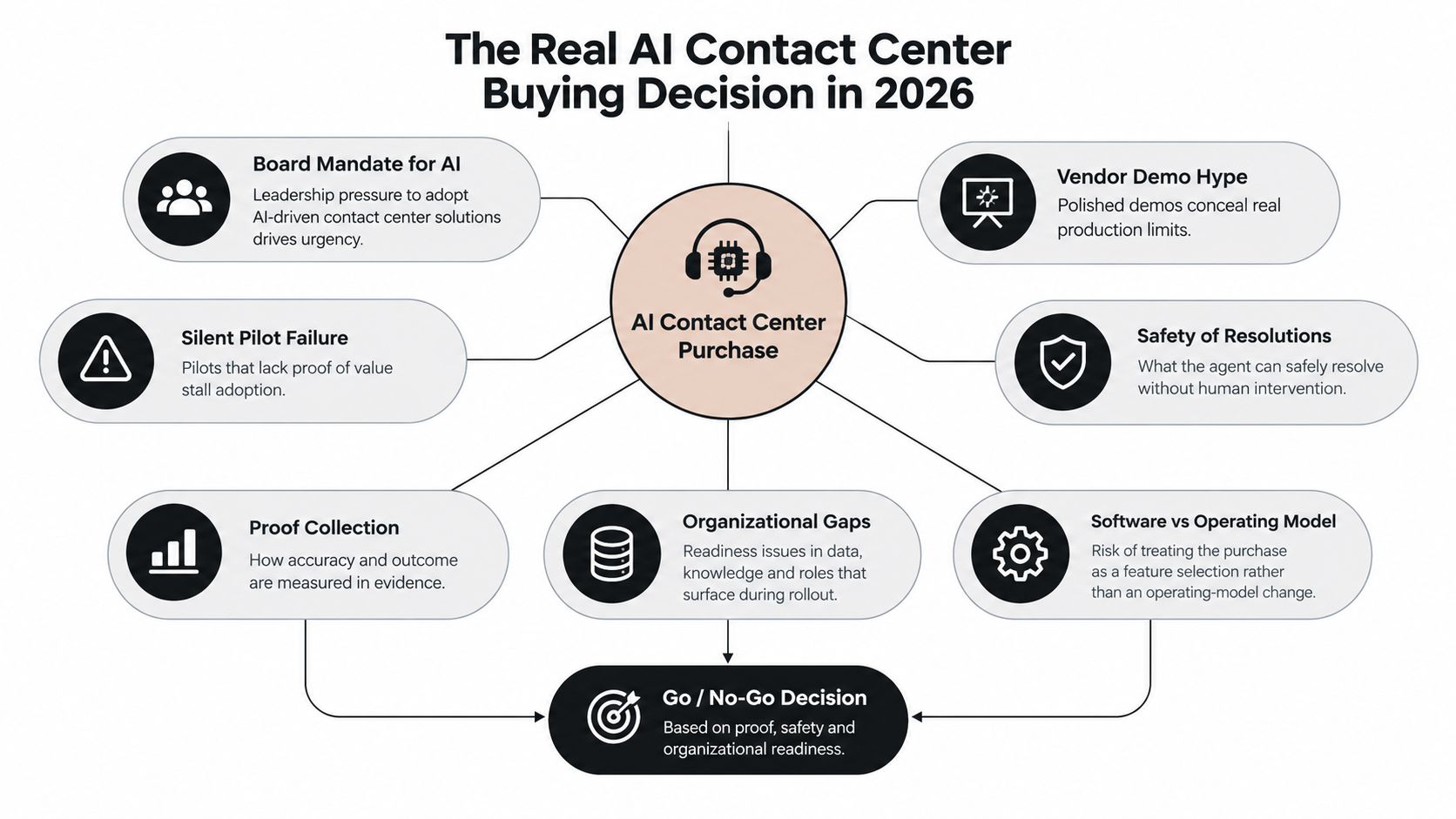
Don't buy autonomy as a blanket setting. Assign it by task, business impact, and the availability of trustworthy enterprise information.
Deployment Models Compared on Buyer Terms
Choose the deployment boundary before you debate model quality. Your first architecture conversation should establish where customer information can travel, which systems the agent must access, and who will operate the service.
Cloud-native, hybrid, and on-premises or sovereign arrangements deserve comparison against those constraints, not against a generic preference for speed or control. If your team also needs to distinguish the underlying contact-center service from the AI layer, align on what CCaaS means before writing the RFP.
| Deployment model | Buyer priority | What to establish |
|---|---|---|
| Cloud-native | Managed operations and rollout simplicity | Processing locations, subprocessors, connector permissions, and export rights |
| Hybrid | Keeping selected systems or data within existing boundaries | Network paths, identity propagation, synchronization, and incident ownership |
| On-premises or sovereign | Defined infrastructure and jurisdictional control | Available model services, operating responsibilities, upgrades, and capacity planning |
Test the boundary, not the label
A regional hosting claim doesn't settle data residency. Ask where audio, transcripts, embeddings, logs, backups, and support access reside. Require an architecture diagram covering each processing stage, including external speech and model services.
Likewise, a pre-built connector isn't proof of integration depth. Have the vendor demonstrate the exact CRM read, write, permission check, and error recovery your workflow requires. Salesforce account retrieval and Salesforce case modification are different permissions, with different operational consequences.
Assess exit cost alongside implementation effort. Can you export conversation histories, evaluation datasets, knowledge mappings, workflow definitions, and audit records in usable formats? Model flexibility doesn't remove lock-in if your operating logic remains trapped inside proprietary tooling.
Human coverage belongs in this architecture discussion too. Use TOOLii's AI voicebot vs live operators resource to frame which responsibilities require staffed support rather than treating every incoming request as an automation candidate.
Don't accept the premise that cloud means speed and on-premises means control. Ask which controls and delivery obligations each proposed architecture provides.
Name your essential constraint: compliance, latency, or integration breadth. Then eliminate architectures that can't demonstrate it under your operating conditions.
Core Capabilities to Score During Evaluation
A feature checklist lets every vendor claim a pass. A scorecard forces your team to distinguish available functionality from reliable execution.
Use the same customer scenarios, knowledge snapshot, integration permissions, and failure conditions across shortlisted platforms. Weight the categories against your service portfolio. A contact center handling complex disputes shouldn't assign the same priorities as one focused on straightforward status requests.
Capability Scorecard for Enterprise AI Contact Center Platforms
| Capability Area | What to Test | Proof You Can Trust |
|---|---|---|
| Voice and IVR modernization | Interruptions, silence, corrections, background noise, and mid-call transfer | Recorded test calls, end-to-end latency distributions, and transfer completion records |
| Conversational AI across channels | Context continuity, approved knowledge grounding, and contradictory information | Retrieved passages, policy versions, and consistent task results across channels |
| Agent assist and copilot | Timeliness, source relevance, summary completeness, and agent correction | Agent-reviewed suggestions and summaries checked against the original interaction |
| Automation and workflow orchestration | Authentication, authorization, tool errors, retries, and partial completion | Tool-call traces, permission decisions, and confirmed system-of-record changes |
| Speech and text analytics | Intent classification, quality scoring, and outcome attribution | Reproducible labels, reviewer agreement, and traceability to underlying evidence |
Make the demonstrations uncomfortable
For voice, test the conversation customers will have. Interrupt the agent with a correction, change the request midway, and ask for a human during an account lookup. Require tail-latency reporting, including p95, rather than accepting an average that conceals slow responses.
For cross-channel service, begin a request in chat and continue it by phone. Check whether the agent retrieves the right context without exposing information the caller hasn't been authorized to access. Omnichannel branding isn't evidence of secure continuity.
For agent assist, ask experienced frontline staff to review suggestions while handling realistic work. A technically accurate recommendation that arrives after the relevant moment has limited operational value. Inspect whether summaries distinguish what the customer requested, what the agent promised, and what the system completed.
A successful tool call isn't the same as a successful customer request. Verify the resulting business state.
Workflow testing should include expired credentials, unavailable APIs, duplicate submissions, and ambiguous tool responses. Require the agent to distinguish completed work from pending work rather than confidently announcing success.
Finally, keep analytics auditable. Evaluators should be able to move from an outcome label to the transcript, retrieved evidence, action record, and reviewer decision. If the vendor can't explain how a result was assigned, don't use that result to justify production expansion.
ROI, KPIs, and the Resolution-Proof Gap
Containment measures whether an interaction stayed inside automation. It doesn't establish whether the answer was correct. Deflection and average handle time remain useful operational measures, but neither should serve as your primary proof of value.
A 2025 survey of 367 operators reported in CIO Dive sponsored content found that 78.5% of organizations using AI had no metric for hallucinations or factual accuracy. Treat that as a warning about measurement practice, not a universal benchmark for every contact center.

Define verified resolution before launch
I recommend defining verified resolution as an outcome supported by approved knowledge, completed within policy and authorization boundaries, and confirmed through appropriate business evidence. For informational requests, evidence might be a reviewed answer matched to the applicable policy. For transactional requests, it should include the resulting system record.
Use a compact executive scorecard:
- Grounded-answer accuracy: Whether material claims agree with the applicable approved information.
- Hallucination rate: Whether the agent invents or misstates facts, policies, or completed actions.
- Safe completion: Whether the task finishes without violating permissions or service rules.
- Repeat-contact rate: Whether the customer returns about the same unresolved need.
- Transfer quality: Whether escalation was warranted and the receiving agent had sufficient context.
- Customer effort and downstream outcome: Whether customers had to repeat themselves and whether the intended business result followed.
Build these into your existing contact-center metrics rather than creating an isolated AI dashboard. Define denominators, exclusions, review methods, and follow-up windows before comparing results.
Separate activity from financial value
Count saved handling effort only when your operating model can use it. Finance should distinguish redeployed capacity, avoided hiring, and actual expense reduction rather than treating them as interchangeable savings.
Compare the pilot with a relevant baseline and account for differences in intent complexity, channel, and customer eligibility. Don't credit the AI for receiving easier requests while human agents inherit the exceptions.
Above all, report unknown outcomes as unknown. An abandoned conversation, missing transaction confirmation, or unreviewed answer should not become a successful resolution because no human joined the interaction.
Cost and Inference Economics in Plain Numbers
Model inference has become cheaper, but that doesn't tell you what a contact-center service will cost. Stanford's 2025 AI Index reports that querying a model with GPT-3.5-equivalent performance on the MMLU benchmark fell from $20.00 to $0.07 per million tokens between November 2022 and October 2024, a reduction of more than 280×.
That is a benchmark-specific inference comparison, not a comparable reduction in your total service bill. Don't let a vendor turn token pricing into an unsupported promise about contact-center savings.
Use a complete service-cost ledger
Require a pricing model that exposes all chargeable components:
- Conversation infrastructure: Telephony, speech recognition, speech synthesis, and recording.
- AI processing: Model input and output, retrieval, growing conversation context, and caching.
- Platform operations: Licensing, observability, evaluation, storage, and support.
- Human work: Transfers, exception handling, quality review, knowledge maintenance, and remediation.
- Delivery effort: Integration engineering, testing, security review, and ongoing change management.
Your preferred unit should be cost per successfully resolved interaction. Calculate it by dividing the attributable service cost by verified resolutions within the same scope and reporting period. Keep the resolution definition consistent with the outcome scorecard.
Route by task rather than prestige
Ask vendors to demonstrate multi-model routing on your workloads. A smaller model may be suitable for intent classification or routine summarization, while complex troubleshooting may justify a more capable model. High-impact decisions also need business controls, regardless of which model processes the conversation.
Test each routing change against quality and operational outcomes. A cheaper response isn't a saving if customers need another contact, agents must correct the answer, or reviewers spend longer investigating it.
Commercial test: Ask the vendor to explain how your bill changes when conversations become longer, tools fail, and customers require human help.
Request separate estimates for normal operations, demand peaks, integration degradation, and increased escalation. Require visibility into minimum commitments, unused capacity, model substitution, and charges for testing.
Finally, keep benchmark economics separate from procurement economics. Your buying team needs a defensible service-cost model with explicit assumptions, not a pricing slide built around the cheapest possible conversational turn.
Governance, Knowledge, and the Organizational Readiness Trap
A capable model can't compensate for contradictory policies, disconnected customer records, or an escalation queue nobody owns. Treat those as deployment blockers, not cleanup tasks for after launch.
In ICMI's 2025 survey of 113 contact-center leaders, one-third identified disjointed data, channels, and endpoint tools as their top technology complexity; 59% expected significant technology updates, and one-quarter doubted their existing IT environment's compatibility with AI. The implication for buyers is straightforward: assess the operating environment before committing to autonomous scope.

Establish architecture and knowledge ownership
Start with authoritative systems. Identify where customer identity, entitlement, policy, case status, and transaction outcomes live. Assign an owner to each integration and define what the agent must do when systems disagree.
Knowledge requires an equally explicit operating process. Your customer-service knowledge management approach should identify who approves content, resolves conflicting guidance, publishes changes, and withdraws obsolete material.
- Architecture checkpoint: Can the team trace each decision to the relevant identity, data, and permission?
- Knowledge checkpoint: Does every approved service intent have current, owned guidance and an exception path?
- Change checkpoint: Can operators identify affected workflows, retest them, and reverse an unsafe release?
Don't use a model's confidence statement as authorization. Transfer, pause, and approval requirements should follow business rules and evidence availability, not how certain the generated answer sounds.
Redesign the human role deliberately
Plan for agents to handle the work you exclude from automation, including disputed outcomes and emotionally difficult exceptions. Give them the authority, context, and coaching to resolve those requests rather than making them apologize for decisions they can't inspect.
Quality assurance also needs a different remit. Reviewers should inspect knowledge defects, tool behavior, authorization decisions, and handoff records, not just conversational tone.
Name an accountable service owner with authority to suspend unsafe workflows. Security should own security controls, knowledge teams should own approved content, and operations should own service delivery. Those responsibilities need a shared incident process so customers aren't left waiting while departments debate whether the failure belongs to the model, integration, or policy.
Choosing a Vendor and a 90-Day Plan to Prove It
Shortlist vendors on evaluation depth, integration fit, model flexibility, governance controls, and relevant customer references. Ask reference customers about failure recovery and operating effort, not just launch experience.
Use NIST's AI Risk Management Framework and Generative AI Profile to structure trustworthiness across design, deployment, use, and evaluation. Translate that approach into documented tests, review ownership, and production stop conditions.
Make the pilot an evidence program
- Weeks one to four: Map readiness gaps, select bounded intents, establish the baseline, and agree on evaluation criteria.
- Weeks five to eight: Run a scoped pilot with approved knowledge, instrumented actions, human review, and explicit escalation boundaries.
- Weeks nine to twelve: Reconcile outcomes, review incidents and costs, retest corrections, and make a documented scale decision.
Use the remaining days for the approval package and operating handover. Expansion should depend on demonstrated performance, not the calendar.
Bring the same evaluation questions to product demonstrations, including the video below.
Don't let the team building the agent become its only judge. Give independent reviewers access to evidence and preserve failed tests alongside successful ones.
The approval question is simple: Can we demonstrate that this agent completed the customer's request correctly, safely, and within its authority? If the answer depends on trusting the agent's own resolution label, you haven't finished the evaluation.
Yellow.ai offers an enterprise agentic AI platform with voice and digital agents, knowledge grounding, workflow integrations, testing, and analytics. Visit the platform to discuss a scoped evaluation around your service intents, and ask the team to demonstrate the evidence behind completed actions, escalations, and customer outcomes.