










The global call-center AI market is projected to grow from approximately USD 1.6 billion in 2022 to USD 4.1 billion by 2027, according to estimates cited by Sci-Tech Today. That investment raises a practical question for CX leaders: are you buying software that talks, or building an operation that finishes customer requests?
AI call center automation means connecting speech understanding, approved knowledge, business systems, and human support into a controlled service workflow. The strongest design isn't the one that keeps every caller inside automation. It's the one that completes appropriate work and recognizes when a person should take over, without making the customer start again.
Table of Contents
- Why Most Call Centers Still Are Not Automated
- What AI Can Finish From Greeting to Resolution
- When Voice Automation Should Stop and Ask
- Where Agent Assist Raises Output First
- Why a Clean Handoff Beats Raw Containment
- How to Govern Automation Across Laws and Jobs
- Choose the First Calls Worth Automating
Why Most Call Centers Still Are Not Automated
In a 2025 survey of more than 400 global contact-center leaders reported by CloudTalk, 98% were using AI in some form, but only about one-quarter had fully integrated it into daily workflows. That contrast is the difference between installing a tool and changing how service gets delivered.
On the floor, partial adoption can look useful but limited. An agent gets a suggested reply, searches a knowledge base through an assistant, or receives an after-call summary. The same person still authenticates the caller, updates the account, and decides which exception needs a supervisor.
A center can therefore report AI adoption while leaving its underlying workload largely unchanged. If agents still copy information between disconnected systems, automation hasn't removed the operational bottleneck.
Adoption isn't completion
An older phone menu collects digits and sends the call somewhere. A connected AI system can interpret an ordinary sentence, retrieve a permitted record, complete a bounded task, or stop when the request exceeds its authority.
The preparation isn't exclusive to enterprise contact centers. GolfRep's automation insights for volunteer-run committees offer a useful adjacent resource for teams thinking about routine administration and ownership, although enterprise deployments need more extensive security and operational controls.
Practical rule: Don't count the presence of AI as proof that a customer task has been automated.
Leaders need clear answers to three questions: which work can finish without a person, which measurements establish a real improvement, and what the human receives when automation stops. Those answers should shape the operating model before anyone expands traffic.
What AI Can Finish From Greeting to Resolution
What AI finishes and what stays with a person
| Call job | AI role | Human role | Proof metric |
|---|---|---|---|
| Authentication and identity | Check known data within policy | Take failed or high-risk identity checks | Verification success and false-accept rate |
| Intent and routing | Classify the reason and route a clear request | Handle ambiguous or multi-issue calls | Intent accuracy and misroute rate |
| Routine answers | Answer from approved policy and status knowledge | Correct outdated or conflicting answers | Containment read with satisfaction |
| Transactions | Book, pay, cancel, or update a connected record | Own exceptions and goodwill | Completion rate and undo rate |
| Live agent assist | Draft the reply, next action, and thread summary | Own the conversation and the decision | Resolutions per hour and handle time |
| After-call work | Write the summary, tags, and quality notes | Review scores used in coaching | Summary accuracy and wrap time |
| Escalation | Pass intent, auth state, and steps already taken | Finish the unresolved issue | Repeat-explanation rate and transfer quality |
The table separates speaking about a task from finishing it. A voice agent that says a booking can be moved hasn't completed the transaction until the booking system confirms the change. Likewise, generating a summary isn't enough if the summary misstates what the caller agreed to.
Follow an order-status call through the system
Greet and set expectations. Use the brand's normal vocabulary, explain that the caller is speaking with automation, and make human help available. Keep the greeting short enough that the caller can state the problem without listening to a product introduction.
Authenticate within policy. Request only the information needed for the permitted lookup. A weak match or high-risk account condition should stop access, not trigger increasingly revealing hints. Verification success matters, but so does the false-accept rate: a completed lookup isn't a success if the wrong person received the information.
Identify and confirm the request. Say the caller asks when an order will arrive. The system can confirm that it will check the delivery status, rather than reciting a long interpretation of the conversation. If the caller combines a missing parcel, a disputed charge, and an address problem, route the case to someone who can manage the combined issue.
Retrieve the relevant record. Read the order status from the connected order-management system using the authenticated customer context. Retrieve the fields needed for the answer, not the entire customer history. If the carrier feed is unavailable, report that limitation instead of inventing a delivery estimate.
Act inside the approved boundary. Read the recorded delivery window and explain any approved next step. If policy allows a delivery-note update, make that change only through the authorized workflow and verify the result. A refund exception or goodwill credit stays with the person authorized to approve it.
Handle a changed request safely. The caller now says an item from the same order arrived damaged. Finish the safe status answer if it's still useful, but don't force the complaint into an order-tracking flow. Transfer the unresolved issue with the verified identity state, lookup result, completed steps, and any promise already made.
Document the outcome. Record the resolved status question separately from the unresolved damage complaint. The summary should distinguish a confirmed system action from a suggested next step. If automated quality notes become coaching scores, a person should review their basis.
Make completion auditable
For a transaction, keep evidence of the requested action, authorization, system response, and final customer confirmation. A timeout needs special handling: before retrying a write, check whether the first attempt succeeded so the system doesn't create a duplicate booking or payment.
For an answer, retain the approved knowledge version or record used. That lets a reviewer distinguish a reasoning error from a stale policy or incorrect upstream record.
Undo rate is especially useful for apparently successful transactions. Frequent reversals can reveal that the system completed the wrong request even when its completion dashboard looks healthy.
Start by marking the table rows where your team already has a reliable record, an owned knowledge source, and a measurable outcome. Don't enable every job because the software can demonstrate it. Enable the jobs your operation can verify and recover.
When Voice Automation Should Stop and Ask
In the NIST/IARPA OpenASR20 challenge, the best systems under severely constrained training conditions produced word-error rates ranging from 0.40 to 0.65, depending on the language. This was a difficult, low-resource telephone-speech benchmark, not a universal accuracy estimate for commercial voice agents.
The operating lesson is still important: a transcript is a recognition hypothesis, not a guaranteed record of what someone said. On a noisy line, the system may confuse a negation, a name, or an account detail while producing a sentence that looks perfectly readable.
Match confidence to the consequence
A confidence-aware pipeline carries uncertainty forward. Streaming speech recognition should provide confidence signals and alternative interpretations; the dialogue manager should ask a focused clarification question when the uncertainty affects the next action.
Don't assume that a high recognition score proves identity or authorizes a transaction. Speech confidence, identity verification, and permission to act are separate controls.
When the voice agent may act
| Action risk | Confidence rule | Example |
|---|---|---|
| Low-risk information | Answer at a lower score and offer a correction | Store hours or shipment status after required verification |
| Reversible change | Repeat the understood request before writing | Callback time or delivery note |
| Irreversible or regulated action | Require explicit confirmation or a person | Payment change, identity, or medication |
For a callback change, repeat the proposed time and timezone before saving. For a misunderstood payment instruction, don't keep guessing until the caller says something that fits the workflow. Stop the action and use the approved verification or human-review path.
Test the conditions callers actually use
A single aggregate accuracy score can conceal failures for accents, code-switching, mobile noise, and languages with limited training coverage. Build evaluation sets around those conditions rather than testing only clean recordings from employees reading scripts.
Track word error rate, intent accuracy, false completions, containment, transfer quality, and latency by language, region, and acoustic condition. Review the errors that change outcomes, especially missed negations and incorrectly captured identifiers.
Expand autonomy only where the monitoring stays within the agreed threshold for that intent.
Set a named owner for each threshold and define what happens when it fails. The response might be clarification, a read-only fallback, or transfer, rather than allowing the same action with a less confident answer.
Where Agent Assist Raises Output First
A field study of 5,172 customer-support agents published in the Quarterly Journal of Economics found that generative-AI assistance increased issues resolved per hour by 15% on average, while average chat duration fell by 3.7 minutes. These were assisted chat interactions, so the findings shouldn't be treated as a promised voice-automation result.
The study provides a useful starting point for evaluating augmentation.
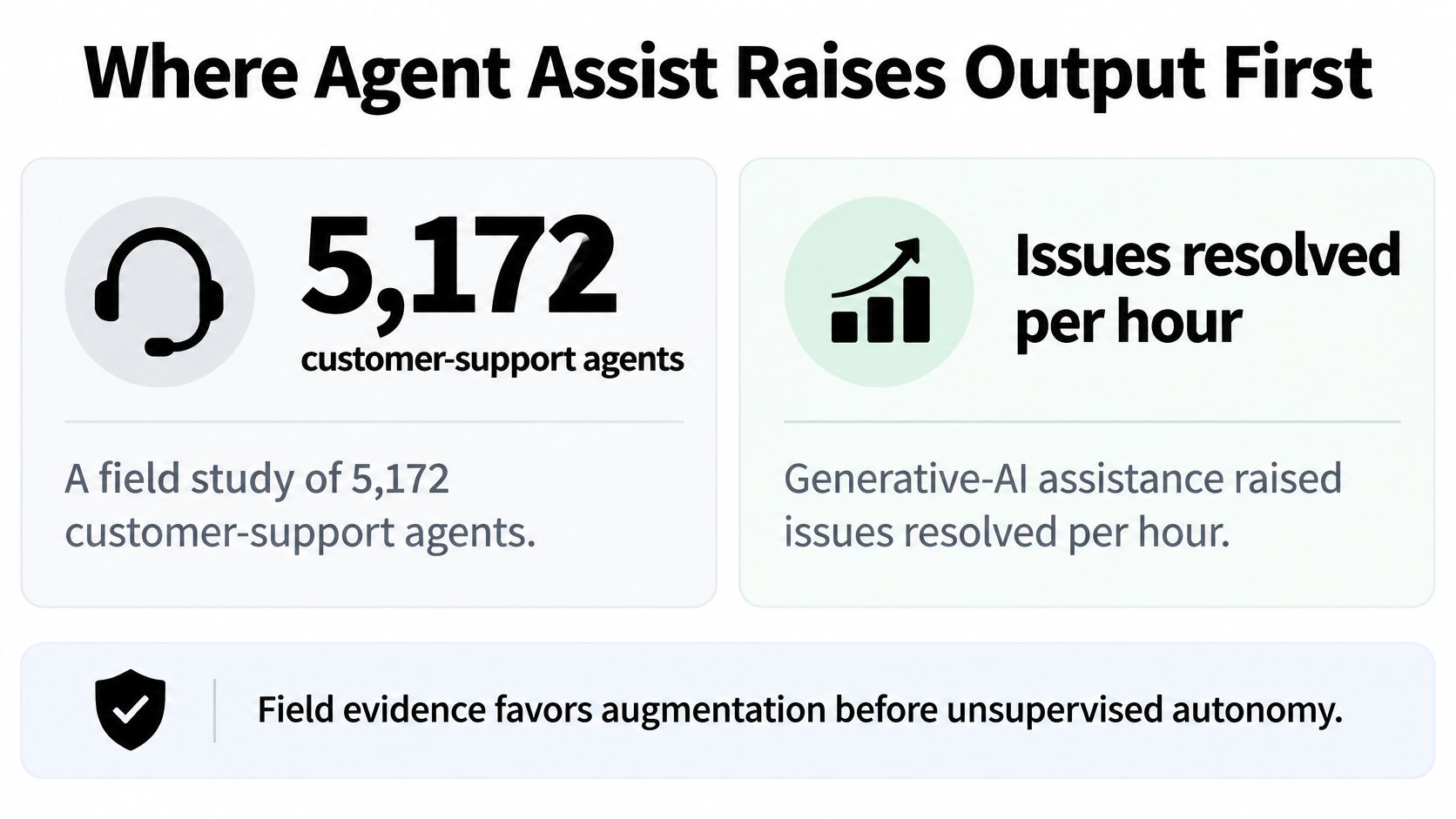
The gains were concentrated among less-skilled and less-experienced workers, while highly experienced workers saw little or no improvement. That distribution changes the rollout decision: assistance can help newer agents apply established procedures without necessarily improving an expert's already efficient workflow.
Pilot the work agents already perform
Begin with retrieval, response drafting, next-action suggestions, and summarization. The agent should see the supporting policy or customer record and remain responsible for deciding whether the suggestion fits.
Our real-time agent assist supports human-plus-AI service through auto-response, ticket summarization, and coaching insights across chat, email, and voice. Treat those capabilities as workflow components to test, not reasons to accept every generated suggestion.
A practical pilot should distinguish helpful assistance from extra reading:
- Retrieval usefulness. Did the assistant surface the policy the agent needed, or merely return something related?
- Draft suitability. Could the agent use the answer after checking it, or did rewriting take longer than composing it?
- Action accuracy. Did the suggested next step respect account state and policy exceptions?
- Summary fidelity. Did the notes preserve the customer's request and the actual outcome?
Pair speed with resolution quality
Measure resolutions per hour alongside average handle time, first-contact resolution, quality scores, transfer rate, and escalation accuracy. Segment the results by experience level and case type so easier work doesn't create a misleading improvement.
A shorter interaction that causes another call isn't a productivity gain. Review recontacts and corrections before concluding that an assistant has increased useful capacity.
The study also observed persistent faster handling during AI outages, suggesting that agents may learn procedures through repeated exposure. Test that possibility separately in voice, regulated workflows, and each pilot language rather than assuming the effect transfers unchanged.
Expand assistance where newer agents improve and quality holds. Don't force experienced agents through suggestions that add friction without improving their decisions.
Why a Clean Handoff Beats Raw Containment
Containment shouldn't be the headline measure of customer service. It tells you whether a caller stayed inside automation, not whether the caller received the right outcome.
The following findings come from the Liveops 2026 Resolution Gap Report, based on a survey of nearly 6,000 customers.
What customers experience after automation fails
| Failure | Customer evidence | Design response |
|---|---|---|
| Hard to reach a person | 93% considered easy human access very or extremely important when automation couldn't solve an issue | Keep a visible, low-effort path to a person |
| Rough transfer | Only 10% said automated-to-human handoffs were always smooth | Make transfer quality a primary KPI |
| Repeated story | 59% said handoffs were difficult because they had to repeat their problem | Pass intent, authentication, steps taken, and promises |
Customers can accept an automated answer and still find the overall journey exhausting. A bot that answers the easy part, hides the transfer option, and drops the conversation history hasn't delivered good service.
Design the transfer before the failure
Trigger escalation when confidence falls below the action threshold, the caller introduces an unrelated issue, the request requires a policy exception, or the caller asks for a person. Distress should also prompt a human path rather than a longer sequence of automated questions.
Before the agent says hello, the workspace should contain:
- Customer intent and unresolved need. Separate what the automation answered from what remains open.
- Authentication state. Show what was verified, how, and whether further checks are required.
- Completed and attempted steps. Include the systems checked and any failed action.
- Promises and commitments. Preserve callback expectations, stated timelines, and other commitments.
The operational difference between a warm transfer and a cold transfer is especially relevant here. Routing a call to the correct queue isn't enough if the receiving agent lacks the context needed to continue.
Audit the customer's effort
Review a sample of transfers each week. Ask whether the agent received the context before speaking, whether it was accurate, and whether the customer had to repeat information that was already available.
Track repeat explanations, additional transfers, recontacts, unresolved outcomes, and customer effort. Also distinguish necessary security re-verification from repetition caused by a missing handoff record.
If the customer has to tell the story twice because the context was lost, the automation failed even when its initial answer was correct.
A lower containment rate can represent better service when early, context-rich transfers reduce repeated work and customer effort. Accept that dip when the full journey improves, rather than teaching the system to avoid a useful escalation.
How to Govern Automation Across Laws and Jobs
An automated flow isn't ready to scale merely because it gives accurate answers. The operation must also establish what data it may collect, where that data goes, and who is accountable for decisions affecting customers and employees.
Capacity's contact-center AI governance analysis highlights differences among GDPR-related disclosure and human-intervention considerations, India's DPDP consent framework, and US state call-recording requirements, including all-party consent in some states. Use those differences to commission jurisdiction-specific legal review, not to create a universal compliance script.
Turn legal requirements into launch evidence
Maintain a control matrix for each use case, jurisdiction, channel, and affected group. Assign an owner and require evidence rather than accepting a compliant label.
- Disclosure and intervention. Document how callers learn that automation is involved and how they reach a person. Have counsel confirm the applicable disclosure and intervention obligations.
- Purpose and consent. Where India's DPDP framework applies, define the explicit, purpose-specific consent needed. Don't assume permission to provide support also authorizes reuse of audio for model training.
- Recording rules. Map notice and consent requirements to the countries and US states served. Set retention separately rather than treating permission to record as permission to retain indefinitely.
- Voice and biometric handling. Determine how each applicable law classifies recordings and voiceprints. Approve processing locations, access, deletion, and vendor boundaries before audio moves between systems.
A practical enterprise AI governance review should follow the entire data path, including transcription, model processing, logs, recordings, and exported quality reports.
Keep decisions reconstructable and reviewable
For an automated answer or action, retain enough evidence to reconstruct the decision without collecting unnecessary personal information. Useful records include the policy version, permitted action, system response, reason for refusal or transfer, and responsible owner.
Employee-facing uses deserve their own review. A generated summary may become evidence in coaching; a quality score may influence performance evaluation or pay. Managers shouldn't treat either as an unquestionable account of the interaction.
Give employees a way to inspect the basis of consequential scores, challenge errors, and obtain human review. Calibrate automated assessments against expert evaluation and keep a named person accountable for the employment decision.
The launch gate is concrete: the team can demonstrate lawful handling, approved retention, controlled access, and human accountability. If it can't, keep autonomous actions disabled while the gaps are resolved.
Choose the First Calls Worth Automating
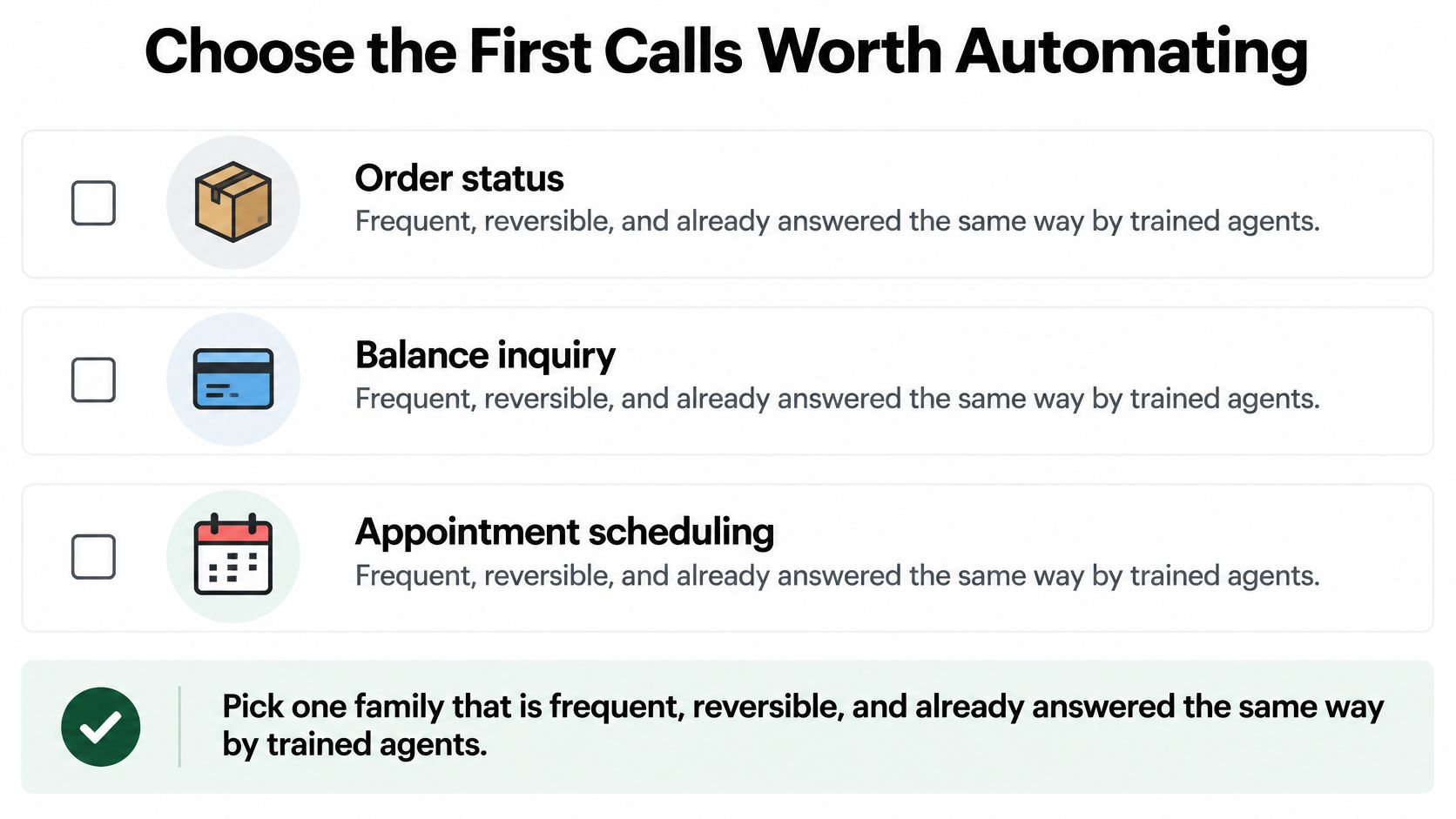
Choose a first intent that trained agents already answer consistently. Order status, a balance inquiry, an appointment move, or a read-only account lookup can be suitable when access controls are clear and any permitted change is reversible.
Don't begin with billing disputes, hardship requests, clinical advice, or fraud claims. Those calls introduce judgment, emotion, or high-impact consequences that make them poor tests of a new operating workflow.
Use this checklist to narrow the candidate call family.
Apply a readiness gate to actual conversations
Review candidate transcripts against these conditions:
- Owned knowledge. The answer comes from a current source with a named owner who can correct it.
- Connected records. The CRM or order system supports the required read, and any write has a tested reversal or recovery path.
- Defined permissions. Identity checks, disclosure, recording consent, and human access are approved for every jurisdiction in scope.
- Risk-matched confidence. The intent has tested thresholds for the languages and calling conditions the service will encounter.
- Usable transfers. The agent desktop receives intent, authentication state, completed steps, and promises before the conversation resumes.
- Outcome measurement. The scorecard includes resolution quality, effort, and repeat contacts, with human accountability for summaries used in coaching.
A failed gate is a preparation task, not a reason to relax the requirement. Fix the missing integration or unclear policy before exposing callers to it.
Use examples without borrowing their targets
A Fortune 500 consumer health company automated its support with voice AI in 60 days. That is a specific implementation outcome, not a deadline every enterprise should adopt regardless of readiness.
Use the video as a discussion prompt while mapping your proposed call flow.
Bring operations, quality, IT, and compliance owners into the same review. Ask each owner to identify the evidence that would permit launch and the failure that would require stopping traffic.
Start with ten real transcripts, mark each against all six gates, and automate only the set that passes. Keep a record of the rejected calls too: those examples define where the first release must stop.
Yellow.ai offers voice AI agents, connected workflow automation, and human-agent assistance for customer service. Visit Yellow.ai to discuss a bounded first call flow, including the systems it must access, the actions it may complete, and the context your agents need when it transfers.