










Your team is on a live escalation. The caller is frustrated, the first agent has the facts, and the specialist is five clicks away. You've got two choices, bridge the call with context or dump it into the queue and hope the next person can pick it up cleanly. That choice looks tactical, but it's really a workflow decision that affects customer effort, compliance, resolution quality, and routing speed.
| Transfer type | What it does | Best use case | Main trade-off |
|---|---|---|---|
| Warm transfer | Passes context before connection | Escalations, sensitive cases, complex issues | Takes longer up front |
| Cold transfer | Routes without briefing the receiver | Routine lookups, simple routing, fast containment | Caller may repeat themselves |
| Hybrid transfer | Bot or system briefs first, human finishes the handoff | AI-assisted and omnichannel flows | Requires good context design |
Table of Contents
- The Moment Every Contact Center Leader Recognizes
- What Warm and Cold Transfers Mean
- Comparing Warm and Cold Transfers Across Four Dimensions
- The Hidden Cost of Speed
- A Decision Matrix for Choosing the Right Transfer
- Implementing Transfers in Enterprise and Voice AI Workflows
- KPIs to Measure After You Ship the Change
- Best Practices When You Automate the Decision
The Moment Every Contact Center Leader Recognizes

The agent already knows this call isn't ending on the first line. The customer has repeated the problem twice, the policy is unclear, and the next best owner sits in another queue. What happens next tells you almost everything about the operation, because a transfer is never just a transfer, it's a choice about whether the customer gets continuity or gets dumped.
A lot of teams still treat that choice like a telephony setting. I don't. I treat it like a design decision that reaches into CX, cost, compliance, and automation. If you get it wrong, the customer feels the break immediately, and your agents pay for it later in rework and repeat explanation.
Practical rule: if the next person needs to know what already happened, don't send them a blind handoff.
That's the lens I use when I look at warm transfer vs cold transfer. The wrong default is expensive, and the right default changes by channel, risk, and how much the first system already learned. In modern operations, especially when voice bots and chat bots touch the issue before a human does, the central question isn't “Can we transfer?” It's “What context must survive the handoff?”
The rest comes down to reading the moment correctly. If the request is simple, speed may win. If the issue is emotional, regulated, or already half-diagnosed, continuity wins. In either case, the handoff should be intentional, not accidental.
What Warm and Cold Transfers Mean

A warm transfer is a contextual handoff. The receiver gets the caller's identity, intent, and what has already been tried before the connection completes. That context can come from a live intro, a CRM note, a system message, or an AI summary. A cold transfer is a blind handoff. The caller is routed without a briefing, and the next agent or bot starts from scratch.
The difference looks minor on paper. In the receiving chair, it changes the whole call. With a cold transfer, the first sentence is usually some version of “How can I help you?” With a warm transfer, the first sentence can be the right one because the receiver already knows the shape of the problem. That cuts repetition, keeps the customer from rehashing the story, and shortens the path to resolution.
For operations teams, the distinction is contextual versus blind routing. That applies to voice, chat, and AI agent handoffs, not just phone calls. A warm transfer can move an issue from a bot to a human, from one chat queue to another, or from one voice specialist to the next. A cold transfer can happen in those same places too. The channel changes, but the workflow rule stays the same.
The reason leaders should care is simple. Transfer design moves real KPIs. A widely cited SQM Group benchmark, summarized by Bland AI's warm transfer benchmark summary, says 19% of contact-center callers are transferred to another agent, and those transferred calls have 12% lower CSAT and 14% lower First Call Resolution than calls handled without a transfer. That points to a direct operational cost. If you want better CSAT and FCR, stop treating handoff style as a routing detail and treat it as a workflow decision.
If you are wiring this into broader voice automation, Yellow.ai's voice automation overview shows where the handoff logic sits. The system has to capture context before it passes the interaction along, or the next agent inherits a blank slate.
Comparing Warm and Cold Transfers Across Four Dimensions
Customer experience
Warm transfers keep the conversation intact. The customer does not have to repeat the story, restate the issue, or rebuild trust with a new person or bot. That matters most when the customer is upset, confused, or already deep into a problem, because repetition only adds friction and makes the interaction harder to recover.
Cold transfers are simpler at the point of routing. If the request is straightforward and the next agent can handle it without any prior context, a blind handoff keeps the front end moving. That works best when customer effort is already low and the priority is getting the interaction out of the current queue quickly.
Operational efficiency
Warm transfers cut down the cleanup after handoff. Parloa's comparison says the receiving agent gets a full summary, intent, identity, and attempted resolution steps, which reduces repeat contacts and re-escalations while improving first-contact resolution relative to cold transfer Parloa's warm transfer comparison. That is where the efficiency gain shows up. The next agent spends less time reconstructing the case and more time resolving it.
Cold transfers make the first leg lighter. They are easier to execute, and they keep the routing path short. In a queue that is already overloaded, that speed can help. But if the same issue comes back later, the apparent gain disappears into more work for the operation.
Technical feasibility
Cold transfer is the easier build. In many environments it behaves like a single routing action or a direct telephony step. Warm transfer needs a briefing window and a payload the next system can use. Bitbytes' cold transfer vs warm transfer comparison says warm transfer typically adds a 10–30 second briefing step, while cold transfer is the fastest handoff mechanism.
That trade-off is real, but raw transfer speed is the wrong KPI to worship on its own. If those extra seconds prevent a second contact or a re-escalation, the workflow comes out ahead. Operations teams should measure what happens after the handoff, not just how fast the bridge opens.
Compliance
Cold transfer creates a cleaner break. The next party hears less context, which can help when you want tighter scoping and simpler audit boundaries. Warm transfer exposes more case detail to the receiver, which matters when the process touches regulated data and you need controlled disclosure. If your team handles PCI-DSS or HIPAA-sensitive workflows, the transfer policy has to be deliberate.
A transfer policy should match the data already in play. If the issue involves sensitive context, the handoff needs a script, a payload, and a receiver who is entitled to hear it.
The Hidden Cost of Speed
A fast transfer looks efficient right up until the customer has to repeat themselves. That is the trap. The bridge closes quickly, but the work does not end there. The true cost shows up in the next agent's time, the customer's frustration, and the extra contact that follows when the issue was never fully carried over.
Warm transfer adds a controlled pause up front. The context moves with the customer, so the receiver does not have to rediscover identity, restate the problem, or restart troubleshooting from zero. The claim from Bitbytes' cold transfer vs warm transfer comparison is simple enough, warm transfer usually adds a briefing step, while cold transfer gets the caller through the handoff fastest. That trade-off is easy to dismiss if you only watch transfer time. It matters when the next agent already has the facts and can start solving instead of re-asking.
The operational math is straightforward. If the customer already told the bot or first agent what went wrong, forcing a specialist to ask again is wasted effort. If the first touch captured useful signals, the transfer should carry them forward. Cold transfer only looks cheaper at the routing moment. Warm transfer usually reduces the work after the handoff, which is where contact center cost lives.
That is why Sift AI skill based routing fits this decision so well. Routing should follow issue type and agent skill, then decide how much context must travel with the case. The handoff is not just a connection event, it is a workflow choice that should match the customer's problem, whether the interaction happens in voice, chat, or an AI-assisted channel.
The right way to judge the trade-off is by lifecycle impact. If you only care about the transfer event, cold transfer wins. If you care about handle time after the handoff, first-contact resolution, and re-escalation pressure, warm transfer is the better operational choice. That is the difference between a fast transition and a fast resolution.
A Decision Matrix for Choosing the Right Transfer
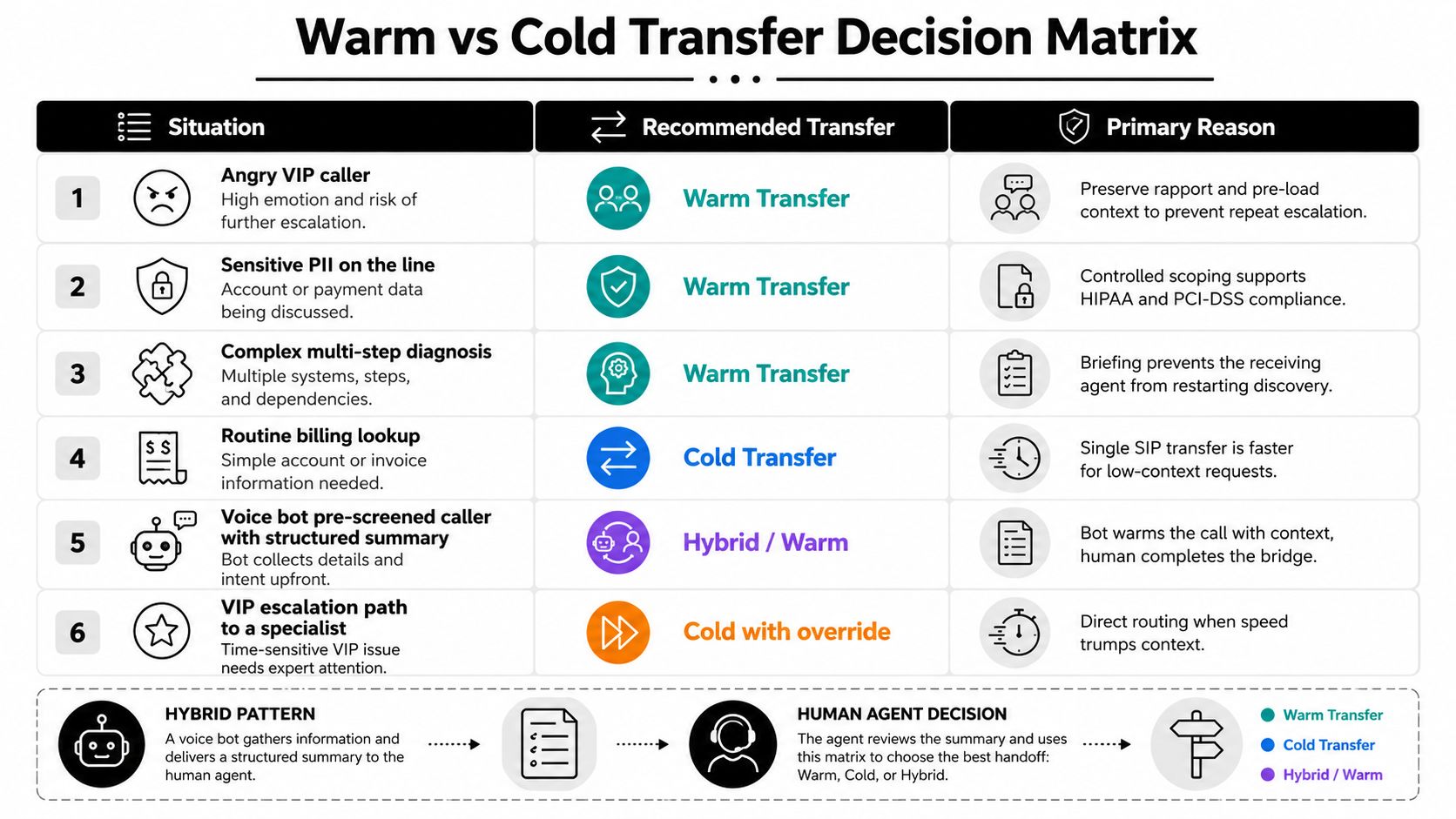
The right handoff depends on what kind of problem is in front of you. A billing check and a complaint about a denied claim are not the same routing problem. Neither are a chatbot that collected clean details and a bot that only identified the customer's name.
| Situation | Recommended Transfer | Primary Reason |
|---|---|---|
| Angry VIP caller | Warm transfer | Preserve rapport and brief the receiver before the caller repeats the story |
| Sensitive PII on the line | Warm transfer | Controlled scoping supports tighter compliance handling |
| Complex multi-step diagnosis | Warm transfer | The next agent shouldn't restart discovery |
| Routine billing lookup | Cold transfer | Fast routing is enough when context is thin |
| Voice bot pre-screened caller with structured summary | Hybrid / Warm | The bot should pass its summary so the human starts informed |
| VIP escalation path to a specialist | Cold with override | Direct routing can beat context when speed is the business rule |
What flips the choice
The first signal is urgency. If the issue is time-sensitive and simple, cold transfer is fine. If the issue is urgent and emotionally loaded, warm transfer protects the interaction better.
The second signal is sensitivity. If the call carries personally identifiable information or regulated details, treat the handoff as a disclosure event, not just a routing event. The receiver should only get the context they need, but they should get enough of it to avoid asking the customer to repeat sensitive material.
The third signal is what automation already learned. If a voice bot or chat bot has collected identity, intent, and steps attempted, throwing that away is bad design. In that case, the handoff should be hybrid, meaning the bot warms the call and the human chooses whether the final connection is warm or cold based on the issue and risk level.
If you're configuring this inside a platform, Yellow.ai's integration layer is relevant because the transfer policy has to work across systems, not just inside one queue. The mechanics matter less than whether the context survives the trip.
Implementing Transfers in Enterprise and Voice AI Workflows
A transfer policy has to be built into the workflow before a human agent ever takes the handoff. In IVR, chat, and voice AI flows, route by issue type first, then decide whether the next hop should be blind, contextual, or a mix of both. If the bot already owns the conversation, it should pass a summary, not drop the customer into silence.
A warm handoff needs a specific payload. I want identity, intent, sentiment, steps attempted, and the last touchpoint. If the customer moved from chat to voice, the receiving agent also needs the channel history, because cross-channel escalation creates more repetition than same-channel escalation. That is why warm transfer is workflow design, not just call control.
Build the handoff script around the receiver.
The receiving agent should get what happened and what still needs to happen. Leave out the full conversation and keep the facts that move resolution forward. That stops the first minute from getting wasted on reconstruction.
If the next agent can solve the issue without asking the customer to restate context, the transfer is warm enough. If not, you are still routing blind. In chat, that usually means putting the summary in the agent console before the live connect. In voice, the bridge or pre-connect summary has to exist before the customer hears the next greeting.
Treat AI handoffs differently by channel.
Voice-to-voice transfers can work with a compact summary because tone and timing still carry part of the context. Chat-to-voice transfers need richer context because the receiving agent loses the written trail once the call starts. Cross-channel moves are where teams usually under-design the handoff and overestimate what the agent can infer.
Yellow.ai is one platform that supports AI-to-human handoff patterns and omnichannel orchestration, so the transfer policy can be enforced across voice and chat instead of one channel at a time. Yellow.ai's agent assist workflow matters here because the agent has to see the right context at the right moment. The point is the architecture. If the platform cannot pass structured context cleanly, your warm transfer policy turns into manual note-taking.
KPIs to Measure After You Ship the Change
Start with the transferred-call slice, not the overall queue. Enterprise-wide averages hide what changed at the handoff point, and that is where warm transfer either earns its keep or fails.
- CSAT for transferred calls. Warm transfer should raise it compared with blind routing because the caller repeats less and the next agent starts with context.
- FCR for transferred calls. Warm transfer should improve it, since the specialist is not rebuilding the case from zero.
- Average handle time split into pre-handoff and post-handoff. Cold transfer should shrink the front end, while warm transfer should reduce the cleanup after the connect.
- Transfer rate. If this climbs without a policy change, routing is too loose.
- Repeat contact rate within 7 days. Warm transfer should push this down when the issue can be resolved in one pass.
- Compliance flags per transfer. Any spike means the handoff is exposing too much context, or not enough.
Use the benchmark as a warning sign, not a trophy. The benchmark summary from Bland AI's warm transfer benchmark summary points to lower satisfaction and resolution on transferred calls, with 12% lower CSAT and 14% lower FCR than non-transferred calls in the SQM benchmark it summarizes. Your job is to see whether warm transfer narrows that gap in your own queue, and whether the same pattern holds in voice, chat, and AI-assisted handoffs.
If the transfer policy does not move FCR and repeat contact in the first month, fix the policy or fix the context payload. Do not keep a weak routing rule just because it sounds customer-friendly. The KPI slice will tell you quickly whether the handoff design is helping resolution or just moving work around.
Best Practices When You Automate the Decision
Automation should make the transfer rule stricter, not looser. Define the minimum context payload before the system chooses warm or cold, otherwise the bot will hand off useless summaries and you'll think you've solved the problem.
Use cold transfers for routine lookups and warm transfers for any interaction that already had several turns of discovery. Keep a cold escape hatch for VIP escalation paths when speed matters more than continuity. Instrument the pre-handoff and post-handoff legs separately so you can see where the time is going.
Revisit the matrix quarterly with the KPI slice from transferred calls. If CSAT is flat, FCR is weak, or repeat contacts stay high, the routing rule is failing. Don't defend the policy out of habit, change it based on the evidence.
Yellow.ai gives teams a way to design AI-to-human handoffs across voice and chat, so the transfer policy can follow the workflow instead of living as a manual exception. If you're trying to decide where warm transfer, cold transfer, and hybrid routing belong in your operation, visit Yellow.ai and evaluate how your current handoff rules would work inside an omnichannel AI flow.