














The biggest mistake executives make with real-time agent assist is treating it as a productivity widget for frontline teams. The evidence points to something far more strategic. When the system can deliver guidance in under 200 milliseconds, it becomes fast enough to influence the live conversation itself, not just analyze it afterward, and that same operating model can support scoring 100% of interactions across voice and digital channels according to Crescendo.
That changes the discussion. This isn't just about helping agents answer faster. It's about turning every service interaction into a real-time stream of operational intelligence that the enterprise can use to improve compliance, coaching, knowledge management, workflow design, and customer outcomes continuously.
Most contact centers still run on fragmented systems, static scripts, and retrospective QA. Real-time agent assist replaces that with a live decision layer. Once that layer is in place, the contact center starts acting less like a queue management function and more like an autonomic system that can sense, guide, learn, and optimize.
Table of Contents
- The End of the Swivel Chair
- What Is Real-Time Agent Assist
- The Core Architecture of an Agent Assist Platform
- Business Impact and Enterprise Use Cases
- Your Enterprise Implementation Roadmap
- How to Choose the Right Vendor
- The Future Is an Autonomic Contact Center
The End of the Swivel Chair
A legacy contact center agent spends much of the day in a mechanical routine. Listen to the customer. Open the CRM. Search the knowledge base. Ask a supervisor. Toggle to billing. Toggle back to case history. Put the customer on hold. Return with partial information and hope it's the right answer.
That workflow creates two kinds of waste. The customer hears delay and uncertainty. The agent absorbs cognitive strain from stitching together a process that the enterprise never unified.
In high-volume operations, leaders often try to solve this with more training, more scripting, or more dashboards. Those moves help at the margin, but they don't remove the core problem. The agent still has to act as the integration layer between disconnected systems.
The better state looks very different. A customer asks about a disputed charge, an address change, and whether a fee can be waived. Instead of searching across multiple screens, the agent sees the relevant policy, the next-best action, and the required compliance prompt appear while the conversation is still unfolding. The interaction keeps moving. The customer doesn't feel the machinery behind the service experience.
The swivel chair problem isn't really about too many tabs. It's about asking human beings to compensate for broken system design in real time.
This is why real-time agent assist matters beyond speed. It retires the idea that agents should manually assemble answers from fragmented enterprise knowledge. In practice, that shift reduces friction for customers and pressure for agents, but it also does something larger. It starts converting service from a labor-heavy execution layer into a guided, data-rich operating environment.
When leaders frame the technology only as “agent efficiency,” they undersell it. The more important outcome is that the enterprise finally gets a live intelligence layer sitting inside the conversation itself.
What Is Real-Time Agent Assist
Real-time agent assist is an AI-powered co-pilot for service teams. It listens to live conversations, understands what's happening, and surfaces the right guidance while the interaction is still in progress. That guidance might include knowledge articles, compliance reminders, workflow prompts, sentiment cues, or suggested responses.

A useful analogy is the co-pilot system in a commercial cockpit. The pilot is still responsible for judgment and control, but the system monitors conditions continuously, highlights risks, and provides decision support fast enough to matter. That's what agent assist should do for a frontline agent.
What it is not
A static knowledge base is a library. It can be valuable, but the agent still has to know what to search for, how to phrase the query, and which answer is current.
Post-call analytics is an autopsy. It can explain what happened after the interaction ends, but it can't rescue the moment that already went wrong.
Real-time agent assist is different because it works inside the live service moment. That timing is the whole point. If the system only becomes useful after the call, it may improve reporting, but it doesn't improve the conversation the customer experienced.
For a practical look at how AI is changing frontline service delivery outside the contact center context, this piece from Premier Broadband on frontline AI in ISP operations is a useful companion read.
Why enterprises are adopting it now
Large enterprises aren't just trying to make agents faster. They're trying to make service execution more consistent across channels, regions, and experience levels. That's where real-time guidance changes the economics of the operation.
Instead of relying on memory, tribal knowledge, and manual process recall, teams can standardize how work gets done during the interaction itself. New agents get support that narrows the gap with experienced agents. Supervisors get a clearer view of where guidance is helping and where workflows are still broken.
Practical rule: If the agent still has to stop the conversation to hunt for answers, you don't have real-time assist. You have a nicer search tool.
The strongest implementations feel almost invisible. Agents don't “use the AI” as a separate task. They work inside their normal interface, and the platform quietly orchestrates retrieval, prompting, summarization, and policy guidance around them. That's when the technology stops being a feature and starts becoming infrastructure.
The Core Architecture of an Agent Assist Platform
Real-time agent assist becomes strategic infrastructure the moment it stops acting like a sidebar feature and starts acting like the decision layer behind every service interaction. The interface gets attention in demos. The architecture determines whether the enterprise can standardize judgment, capture operational signals, and turn every conversation into usable intelligence.
Why latency is the product
An assist platform has to keep pace with human conversation. If guidance shows up after the agent has already responded, the system trains the wrong behavior. Agents stop trusting it, supervisors see inconsistent usage, and the organization ends up funding a recommendation engine that sits beside the workflow instead of shaping it.
AssemblyAI makes the technical requirement clear in this overview of real-time agent assist. Low-latency performance across audio capture, transcription, intent detection, sentiment monitoring, and delivery to the desktop is what makes in-the-moment guidance usable. In enterprise settings, that speed is not a cosmetic metric. It is the boundary between an operational system and a reporting artifact.
This matters for a bigger reason. Fast inference and delivery are what allow the platform to become a foundational layer for an autonomic service operation. Once the system can interpret conversations as they happen, route the right knowledge into the interaction, and record what guidance was accepted or ignored, the enterprise starts building a feedback engine, not just an agent tool.
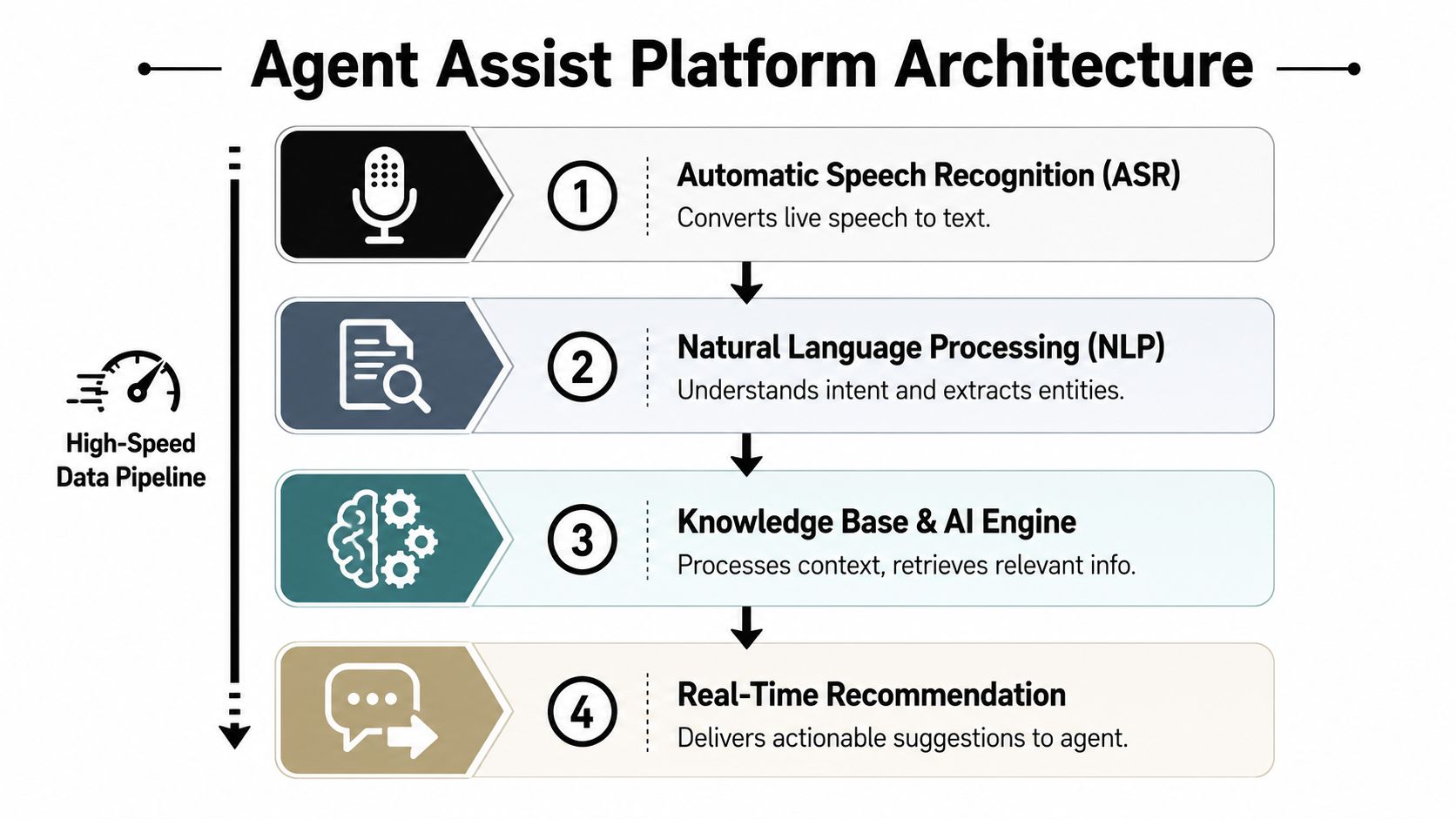
The four layers that have to work as one
The first layer is automatic speech recognition. Voice has to convert to text fast enough and accurately enough for every downstream component to rely on it. Domain vocabulary, background noise, speaker overlap, and accent variation all show up here first. If this layer struggles, every other layer inherits bad context.
The second layer is natural language understanding. Here, the platform identifies intent, entities, stage of resolution, and signals such as hesitation, urgency, or frustration. Basic keyword matching creates brittle prompts. Enterprise systems need enough context awareness to distinguish a billing dispute from a cancellation threat, or a routine identity check from a potential fraud event.
The third layer is retrieval and reasoning. In practice, this usually means retrieval-augmented generation tied to governed enterprise sources. The system pulls policy, process, product, and compliance content based on live conversational context, then assembles guidance the agent can act on. A well-structured conversational knowledge base for enterprise support workflows matters because the model cannot produce dependable guidance if the underlying knowledge is fragmented, outdated, or impossible to rank correctly in real time.
The fourth layer is the agent-facing interface. Many deployments lose adoption here. Good output still fails if it arrives at the wrong moment, interrupts screen flow, or forces the agent to read paragraphs during a sensitive interaction. The best designs make guidance glanceable, situational, and tied to the step the agent is already in.
The same architectural principle appears in adjacent operational systems. For example, artificial intelligence in dispatch depends on continuous context sensing, priority resolution, and next-best-action delivery inside the operator's working flow. Agent assist follows the same rule. The model matters, but orchestration matters more.
A quick visual makes the stack easier to assess before you buy or build:
Why architecture decisions show up in agent behavior
Architecture flaws rarely stay hidden in the backend. Agents expose them quickly.
If agents keep opening separate knowledge tools, retrieval precision is weak or confidence scoring is poorly tuned. If they ignore prompts, latency, timing, or interface placement is off. If supervisors keep correcting outputs, the platform is probably grounded in incomplete policy content or missing workflow context. Those are not adoption problems. They are design problems.
The platforms that perform well at enterprise scale usually share a few common traits:
- Streaming-first design: They process partial utterances continuously instead of waiting for full turns to end.
- Grounded retrieval: They use approved enterprise sources rather than generating unsupported answers.
- Workflow awareness: They account for the task stage, not just the words spoken.
- Closed-loop learning: They capture what agents accepted, edited, skipped, or escalated so the system can improve over time.
That final point is where the enterprise-intelligence value starts to compound. Every accepted suggestion validates useful knowledge. Every ignored prompt exposes friction in content, timing, or process design. Every correction becomes training data for a better operating model.
That is why architecture deserves executive attention. Real-time agent assist is the control layer for a service organization that can observe itself, tune itself, and steadily reduce variation in how work gets done.
Business Impact and Enterprise Use Cases
The business case for real-time agent assist gets stronger when you stop treating every call type as the same problem. Different industries need different kinds of guidance. The common thread is that the platform reduces cognitive load while improving the consistency of what the enterprise says and does.
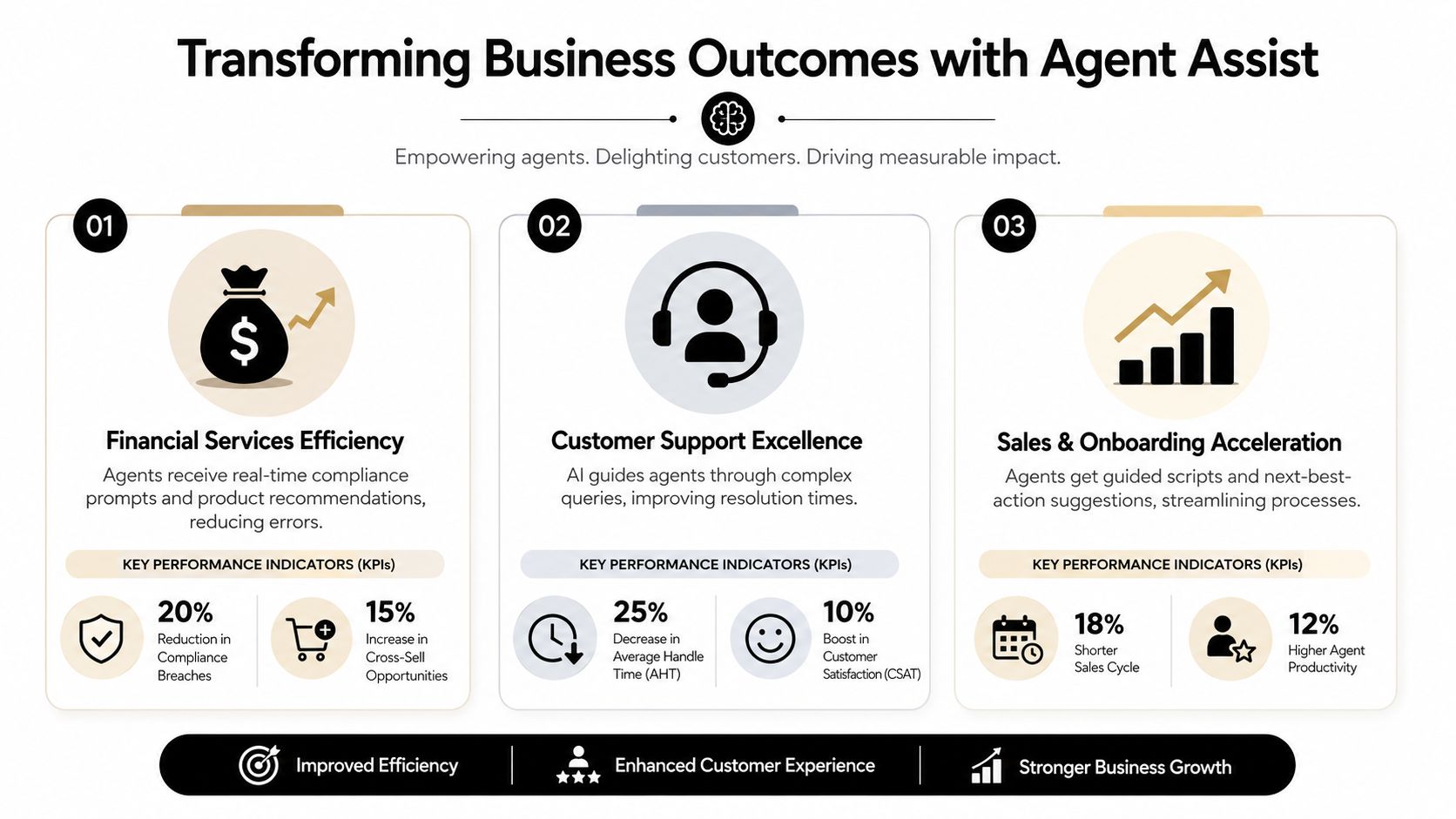
Capacity reports that implementations of real-time agent assist consistently reduce Average Handle Time by more than 60 seconds per interaction and cut manual typing by over 50% in digital channels, while organizations also report stronger First Contact Resolution and lower agent attrition in its contact center guide.
Financial services
In financial services, the headline value is usually compliance, but that's only half the story. Yes, live prompts help agents deliver required disclosures and follow the right sequence during account servicing, lending, or collections conversations. Beyond these functions, they reduce the variance between how different agents handle the same regulated moment.
That consistency affects more than audit posture. It changes escalation rates, rework, and customer confidence. When the platform surfaces the right script, policy interpretation, and next step inside the flow of the call, the agent can stay present instead of mentally juggling rules.
Healthcare
Healthcare teams often deal with emotionally charged interactions, fragmented payer logic, and highly sensitive information. In that setting, real-time agent assist can support both procedural accuracy and communication quality.
An agent discussing insurance verification or appointment scheduling may need policy guidance, workflow reminders, and soft-skill cues at the same time. The strongest systems balance those needs without turning the interaction into script reading. That matters because empathy in healthcare isn't a nice add-on. It's part of the service outcome.
When guidance is timely and context-aware, the agent sounds more prepared, not more robotic.
There's also a workforce benefit. Healthcare support work is demanding, especially for newer hires. Tools that reduce uncertainty during difficult conversations can help teams retain people longer and shorten the path to confidence.
Retail and commerce
Retail support has a different pressure profile. The volume is high, the intent shifts quickly, and the value of speed is immediate. Customers call or chat about order status, exchanges, discounts, compatibility, stock levels, and loyalty questions, often within the same interaction.
Here, real-time agent assist earns its keep by compressing lookup time and minimizing manual wrap-up work. If the platform can surface product policy, purchase context, and the right response path without forcing the agent to jump between commerce systems, service becomes faster and more coherent.
Three operational effects show up repeatedly:
- Resolution quality improves: Agents have fewer blind spots in the moment, so they can close more issues without back-and-forth.
- Digital throughput rises: Suggested responses and summarization reduce repetitive typing in chat and email workflows.
- Frontline stress drops: Agents don't have to improvise as often when product, policy, and workflow context is available immediately.
For executives, the key point is this. The impact isn't limited to one KPI. Real-time agent assist changes how the enterprise executes service, which is why the outcomes show up across efficiency, quality, consistency, and retention at the same time.
Your Enterprise Implementation Roadmap
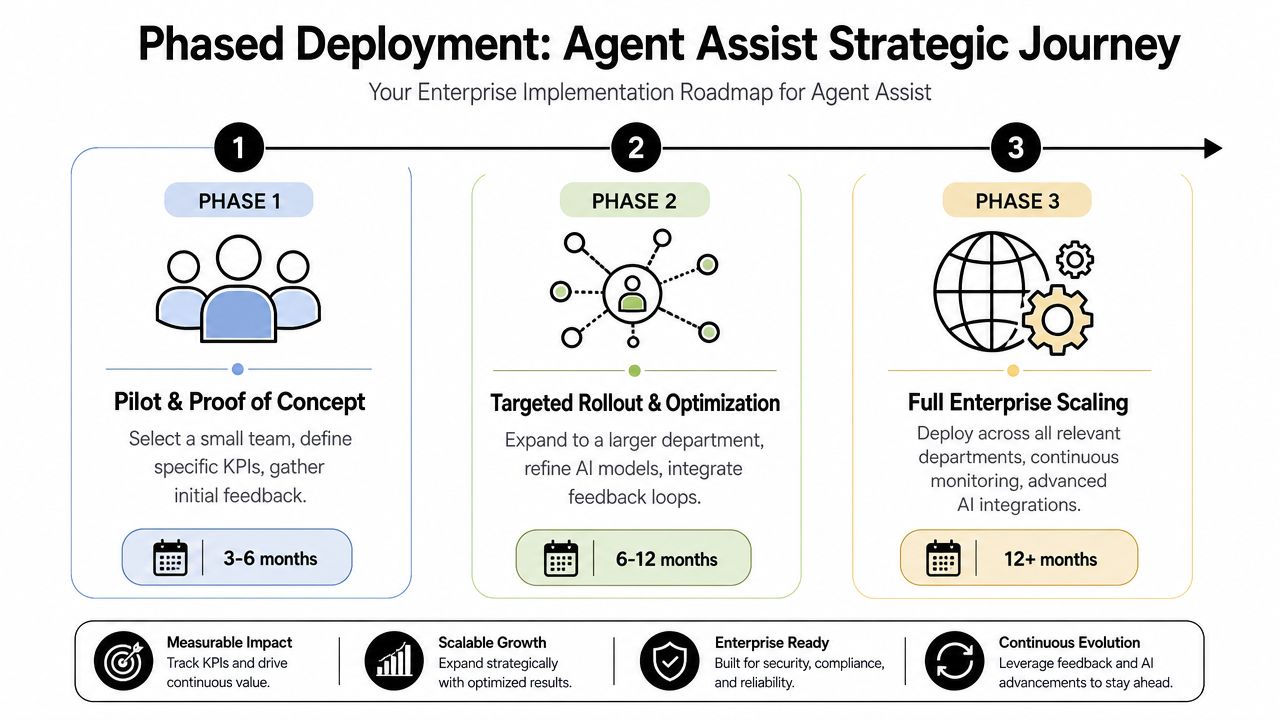
Most real-time agent assist programs don't fail because the model is weak. They fail because the rollout is treated like a software installation rather than an operating model change. The implementation has to be phased, measurable, and designed around real work.
Phase one pilot with operational discipline
Start narrow. Pick a use case with clear friction, repeatable workflows, and enough volume to generate learning quickly. Good pilot candidates usually involve policy-heavy calls, complex authentication steps, or support motions where agents spend too much time searching across systems.
The pilot needs a baseline before anyone turns on the technology. Capture current handle time patterns, transfer behavior, QA issues, agent effort, and the kinds of questions that create delay. Without that baseline, teams end up debating anecdotes instead of performance.
A strong pilot also needs guardrails:
- Use approved content only: Don't let the model pull from stale or lightly governed documentation.
- Design for agent trust: Show why a prompt appeared and where the answer came from.
- Measure adoption behavior: Track what agents accept, edit, dismiss, or ignore.
Field note: If agents say the tool is “interesting” but keep working around it, pause the rollout. Curiosity is not adoption.
Phase two expansion through systems integration
Once the pilot proves that the guidance is useful, the next bottleneck is integration, at which point many promising proofs of concept stall. Enterprises need the assist layer connected to CRM, ticketing, telephony, knowledge systems, and workflow tools so the AI has the context required to be relevant.
That's also the point where platform fit matters more than feature lists. Teams should evaluate how the vendor handles orchestration across existing systems and channels, not just what the demo sidebar can display. A broad enterprise integration layer for CX workflows is often the difference between isolated success and operational scale.
Change management becomes more important in this stage. Supervisors need coaching playbooks. Agents need clarity that the system is there to reduce effort and improve execution, not to micromanage every word they say. Operations leaders need a shared process for tuning guidance based on frontline feedback.
Phase three optimization and operating model design
At scale, the value shifts from individual prompts to organizational learning. Leaders can start asking better questions. Which policies trigger confusion most often? Which call reasons generate the most prompt dismissals? Where are agents still switching systems despite having assist in place?
This is the point to formalize a cross-functional review rhythm involving operations, QA, knowledge management, compliance, and IT. Some organizations create a center of excellence. Others build a lighter governance model. The exact structure matters less than the discipline of continuous tuning.
The most mature programs focus on three loops:
- Knowledge loop: Improve source content based on failed retrievals and repeated clarifications.
- Workflow loop: Simplify process steps that the AI repeatedly has to compensate for.
- Coaching loop: Use interaction patterns to support targeted agent development.
That's how real-time agent assist evolves from a frontline support layer into a self-optimizing service capability. The implementation roadmap isn't just about deployment. It's about teaching the organization how to learn from its own conversations.
How to Choose the Right Vendor
Vendor selection gets distorted when buyers focus on what the agent sees and ignore what the enterprise has to operate. A polished interface matters, but it's rarely the reason a deployment succeeds. The hard questions are about latency, governance, integration depth, security, and how the system behaves under production pressure.
The questions that separate a tool from a platform
Start with the basics. Can the vendor support the compliance and security posture your industry requires? In regulated environments, that usually means looking closely at capabilities aligned to frameworks such as HIPAA, SOC 2, and PCI-DSS, along with data handling controls, auditability, and role-based access.
Then ask about model strategy. A single-model dependency may look simple, but it can create lock-in and operational rigidity later. A multi-LLM architecture gives enterprises more room to balance accuracy, cost, speed, and governance over time. That matters when use cases expand beyond one narrow support motion.
You also need proof of real-world low-latency performance, not just a claim that the product is “real-time.” Ask how the platform handles streaming inference, peak concurrency, knowledge grounding, and fallback behavior when confidence is low.
One enterprise option in this category is Yellow.ai, which combines agent assist with omnichannel orchestration, agentic RAG, and multi-LLM support. That may fit organizations that want one platform spanning customer and employee conversations. Other buyers may prefer narrower specialist stacks. The right answer depends on whether you're buying a point solution or an AI operating layer.
Buy for the operating model you want in two years, not the demo you saw in forty minutes.
Enterprise vendor selection criteria
| Criterion | What to Look For | Why It Matters |
|---|---|---|
| Security and compliance | Support for enterprise controls, audit trails, encryption, access governance, and alignment with the regulatory requirements your teams operate under | Sensitive conversations and workflow data can't sit in a loosely governed AI layer |
| Low-latency performance | Clear evidence that the platform can deliver guidance fast enough for live use, with stable performance under production load | If prompts arrive late, agents won't rely on them |
| Knowledge grounding | Retrieval from approved enterprise sources, source transparency, and controls over what content the model can use | Accurate guidance depends on governed, current information |
| Integration depth | Pre-built and API-based connections to CRM, CCaaS, ticketing, telephony, and knowledge systems | Agent assist only works well when it understands the full service context |
| Workflow awareness | Ability to trigger prompts based on process stage, not just spoken keywords | Good assistance is procedural, not merely conversational |
| Model flexibility | Support for multiple models or adaptable model strategy over time | Enterprises need room to optimize for performance and avoid lock-in |
| Analytics and feedback loops | Visibility into prompt acceptance, edits, overrides, and performance by use case | You need evidence to tune the system and justify expansion |
| Change management support | Enablement for supervisors, rollout controls, and configuration practices that support agent trust | Adoption is operational. It won't come from technology alone |
The best vendors answer these questions precisely. The weaker ones redirect the conversation toward generic AI language, broad claims, or roadmap promises.
The Future Is an Autonomic Contact Center
Real-time agent assist starts as support for the frontline, but it doesn't stay there. Once the enterprise can listen to interactions live, retrieve grounded knowledge instantly, guide workflows in the moment, and learn from every accepted or rejected recommendation, the service operation begins to optimize itself.
That's the path toward an autonomic contact center. Not a fully human-free operation. A system where human judgment remains central, but the surrounding environment continuously senses, adapts, and improves. Quality assurance becomes thorough rather than sampled. Knowledge gaps become visible in production instead of hidden in postmortems. Workflow friction stops being anecdotal and starts becoming measurable.
This is also why the strategic value extends beyond customer support. The same patterns apply to employee help desks, claims intake, care coordination, field service, collections, and internal operations. The contact center becomes one of the enterprise's richest live intelligence environments.
For leaders tracking where this is heading, Yellow.ai's perspective on the universal agentic interface and the autonomic enterprise is worth reading because it frames the broader shift clearly. Real-time assist is not the destination. It's the foundational layer.
The organizations that invest well today won't just give agents better prompts. They'll build service operations that can learn faster, execute more consistently, and adapt with less friction than the teams still relying on static scripts and after-the-fact analysis.
If you're evaluating how to operationalize real-time agent assist across customer and employee service, Yellow.ai is one platform to review. It supports agent assist, conversational knowledge, omnichannel orchestration, and enterprise integrations, which makes it relevant for teams looking beyond a point tool and toward a broader AI operating layer.



