









Your regression suite runs for hours, breaks after another UI change, and still misses a broken discount rule. Someone suggests an AI agent for testing, and the demo looks convincing: the agent opens a browser, completes checkout, and reports a pass.
The useful question isn't whether it can finish the flow once. It's whether it can detect the wrong total, repeat the result, stay inside its permissions, and stop before an expensive retry loop. Treat the agent as another test tool with its own failure modes, not as a replacement for your QA function.
Table of Contents
- Where AI Agents Fit in Your Test Stack
- How an AI Testing Agent Is Built
- How to Build Your First Agent Test Suite
- Which Self-Healing Changes to Trust
- KPIs That Show Whether the Agent Tester Works
- How to Run Agent Tests in CI/CD and Rollout
- Confirm Human Checkpoints Before Your Pilot
Where AI Agents Fit in Your Test Stack
An AI testing agent chooses actions, calls tools, and adapts to what it observes. That flexibility helps when a test requires interpretation, and it introduces failure modes a fixed script doesn't have. A planner can loop on a flaky step, misread a state, or burn through retries before anyone notices the bill.
Keep business truth outside that uncertainty. The agent can work through checkout; deterministic code should verify the charge. It can simulate an employee asking about benefits; an approved policy should define the expected answer.
Evaluate it the way you'd evaluate any new tool in the pipeline: repeated runs against labeled outcomes, enough trials to put a confidence bound around the pass rate, and a hard cap on cost per run. A single green execution tells you almost nothing.
Agent roles across common test types
These are practical deployment categories, not a universal maturity ranking. "Mature" describes the underlying deterministic testing approach, not proof that autonomous execution is dependable.
| Test type | Agent role | Keep deterministic | Maturity |
|---|---|---|---|
| Functional UI flows | Turns requirements into flows and runs them in a browser | Final balance, order and status checks | Pilot-ready |
| API and tool contracts | Generates cases from OpenAPI or tool schemas | Schema, auth and permission checks | Mature foundation |
| Regression suites | Selects tests by changed code and runs repeated trials | Pass thresholds and baselines | Established testing pattern |
| Self-healing locators | Proposes replacement selectors after UI changes | Assertions and expected values | Pilot with review |
| Conversational agent evaluation | Simulates customer personas over multi-turn chats | Policy, PII and refusal rules | Early, needs repeated runs |
| Security probing | Chains attack tasks inside a defined scope | Scope, rules of engagement and a kill switch | Early, restrict autonomy |
Functional UI flows and regression selection are sensible pilot candidates because teams can compare them with existing scripts and labeled outcomes. Security probing needs tighter supervision because an incorrect action can cross a boundary, not just produce a bad verdict.
Interest shouldn't be confused with deployment. A 2025 literature review covering 17 industry-context studies found that more than 75% of surveyed teams considered AI-driven testing central to their strategy, while only 16% had adopted it (review of AI adoption in software testing).
Practical rule: Start with repeated, labeled manual work where a wrong verdict is cheap to catch.
That could be the refund eligibility check your team performs before every release. Don't begin with an ambiguous workflow whose expected behavior nobody has written down.
How an AI Testing Agent Is Built
Build the agent around a test harness, not around a chat window. The harness should own permissions, expected outcomes, environment resets, and termination.
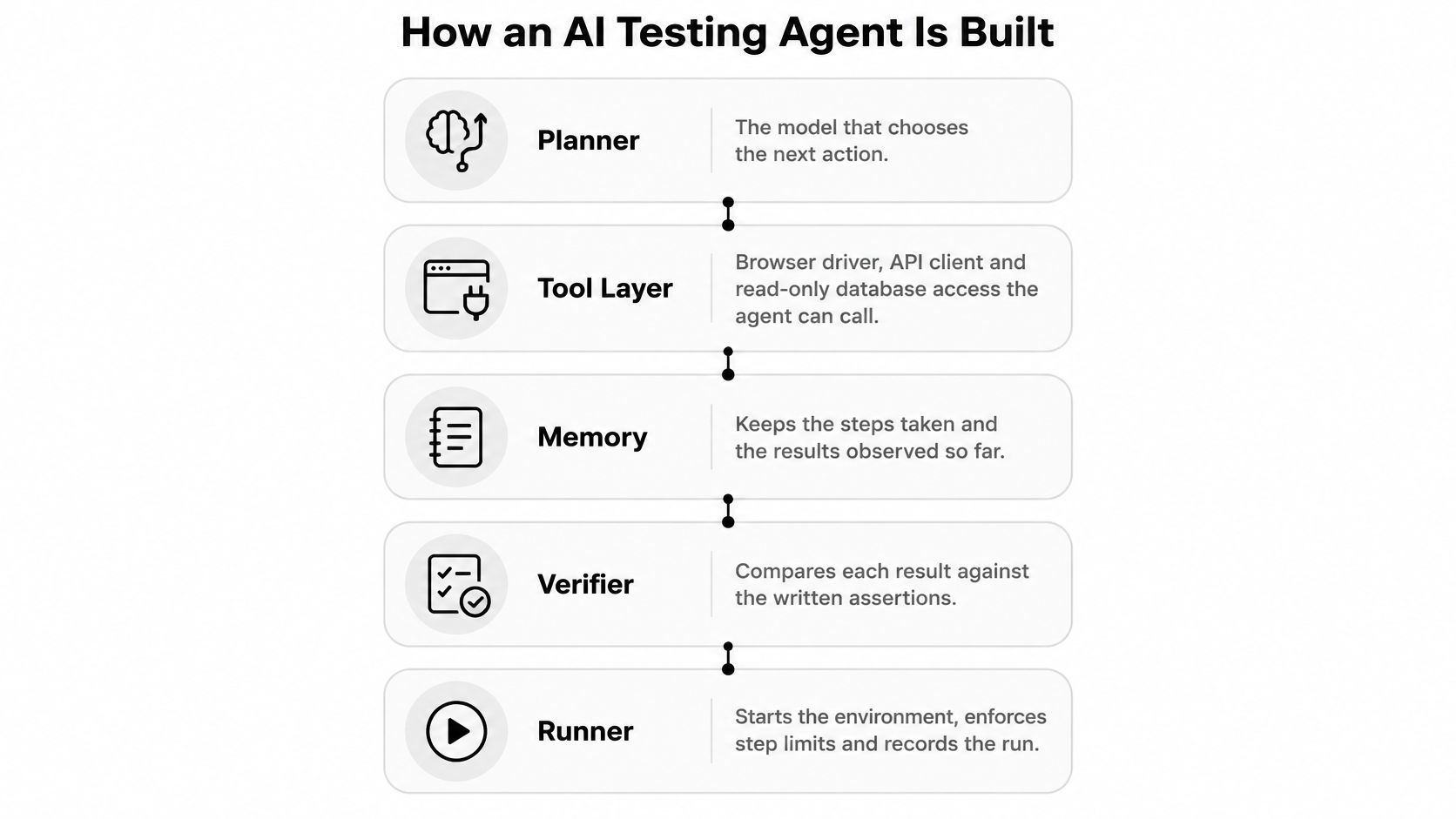
The architecture separates action selection from evidence collection and grading.
Separate decisions from verification
- Planner: The model chooses the next action from the task, current state, and available tools. It should receive a bounded task, not open-ended authority.
- Tool layer: A browser driver, API client, and read-only database interface expose approved operations. Validate arguments before executing them.
- State store: Per-run memory holds observed results and completed steps. Reset it between independent trials so previous attempts don't influence later ones.
- Verifier: Independent checks compare the resulting application state with approved assertions. The planner mustn't be able to rewrite those checks.
- Runner and trace logger: The runner starts environments and enforces limits; its logger records tool inputs, outputs, timestamps, and latency.
The separation matters because strong tool coverage can conceal weak planner coverage. In a study of 39 frameworks and 439 agentic applications, more than 70% of testing effort targeted deterministic tools and workflows, while fewer than 5% targeted planning (study of testing practices in agentic applications).
Build the tool layer and its contract tests first. Then test how the planner handles unavailable tools, rejected arguments, and incomplete results.
Contain access and execution
Use scoped credentials and synthetic fixtures. Mask personally identifiable information before a transcript reaches the model, and keep secrets in the execution environment rather than prompts.
A trace should let a reviewer reconstruct observable actions without exposing credentials or requiring private model reasoning. Store the application response, verifier result, and relevant state changes together.
For UI flows, choose a browser driver such as Playwright; for API checks, use your existing client and assertion library. Run isolated jobs through a container scheduler, and place the agent framework behind an adapter so framework changes don't force you to replace the verifier.
Set cost, elapsed-time, and action limits before the first scheduled run. Parallel containers need separate accounts or fixtures where shared state could cause collisions. More concurrency is useful only while the results remain interpretable.
How to Build Your First Agent Test Suite
Choose a narrow business outcome, then make the evidence explicit. For customer support, refund eligibility is easier to judge than whether an entire conversation was helpful.
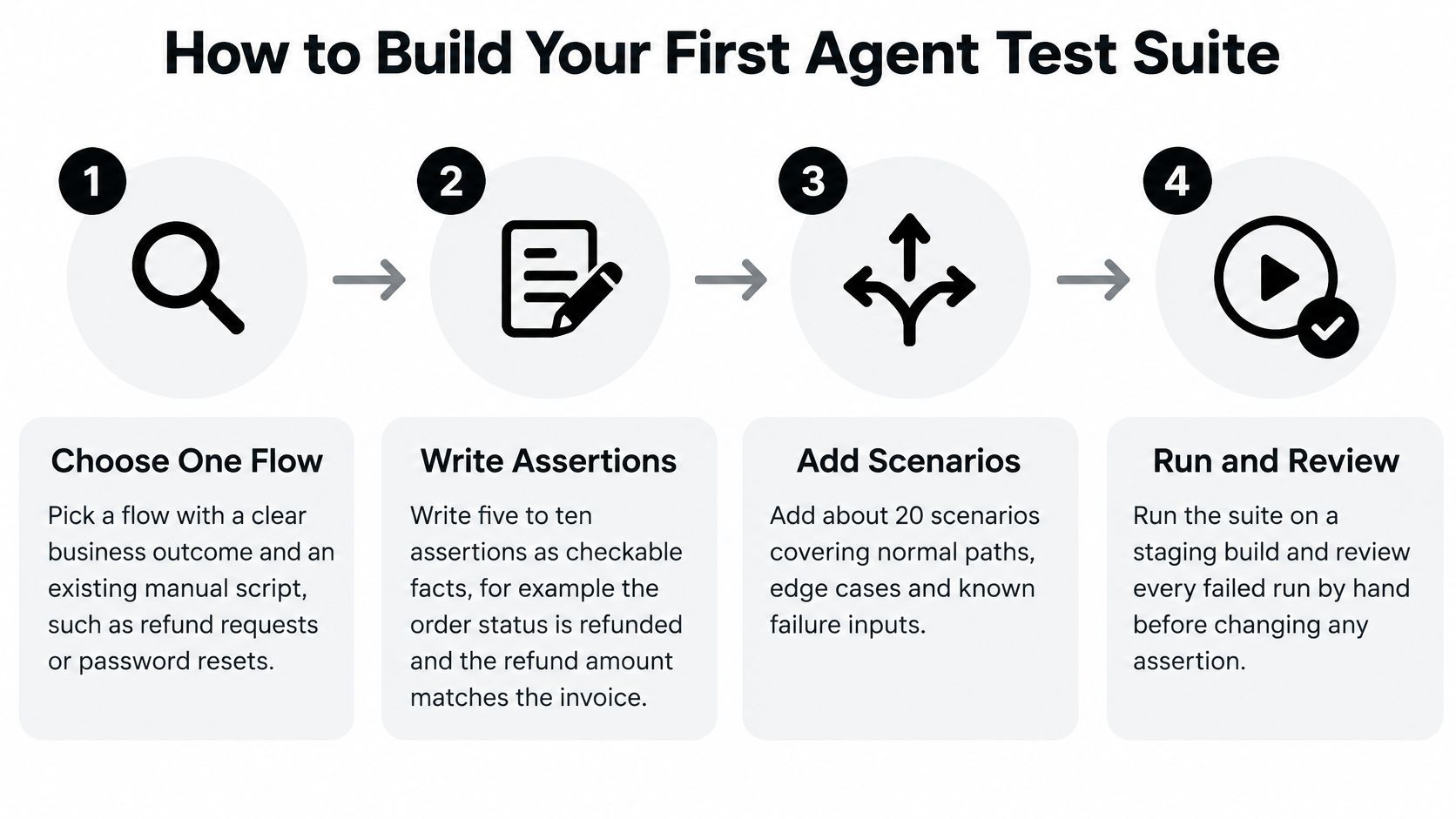
The visual summarizes the workflow. The implementation needs additional controls around tools, scoring, and replay.
Turn the manual script into executable evidence
Choose a flow with a clear business outcome and an existing manual script.
Use refund requests, password resets, or another bounded task your QA team already understands. The manual script provides a reference outcome and exposes missing prerequisites before you automate interpretation.Write assertions as checkable facts.
As a starter design, write five to ten assertions, not a paragraph saying the workflow should work correctly. For a refund, check that the amount matches the eligible invoice amount, the status changes appropriately, and the audit record isn't duplicated. These are proposed suite-design choices, not research-derived targets.Wrap each callable tool with a deterministic contract test.
Check argument schemas, authentication, permissions, and error responses before allowing agent execution. Otherwise, a malformed API response can look like a planning failure, and you'll debug the wrong component.Give the agent a sandbox account with scoped permissions and synthetic data.
Include fixtures for approved and rejected outcomes, not just the happy path. A password-reset test should also cover a request the account isn't authorized to complete.Run each scenario repeatedly and record every outcome.
Use eight trials per scenario as an initial diagnostic batch, not as proof of release readiness. Reset fixtures between trials, retain failures, and distinguish first-attempt success from eventual success after retries.Score task completion, policy compliance, tool-call validity, and latency separately.
A completed task can still violate policy or use an invalid tool call. Don't average those failures into a reassuring composite score; retain the underlying counts and failure labels.Store the trace and configuration together.
Save the prompt version, model identifier, application build, tool definitions, fixture version, and verifier version with the run. Replay requires the execution context, not just the final response.
Classify failures before changing prompts
Use explicit failure categories: product defect, agent mistake, tool-contract failure, environment failure, and uncertain verdict. Assign an owner to uncertain cases rather than treating them as passes without review.
A failed run is useful only if the team can tell what failed.
An unstable environment is a predictable first-week trap. An expired sandbox session, delayed fixture setup, or shared account can produce false failures that have nothing to do with agent reasoning.
Check environment health before evaluating the agent. Report excluded infrastructure failures separately, preserve their traces, and explain any exclusions. Deleting inconvenient failures without a trace makes the first dashboard look cleaner and every later result harder to trust.
Which Self-Healing Changes to Trust
When a selector breaks, the agent can search by role, visible text, and nearby structure, then propose a replacement locator. The verifier should still check the original business outcome.
The dangerous failure isn't an obvious crash. It's a wrong-element false pass, such as clicking a similarly named control and accepting a success banner from the wrong workflow.
Keep healing inside a narrow boundary
| Healing type | Auto-apply? | Guardrail |
|---|---|---|
| Locator swap with same role and visible text | Yes, with log | Weekly diff review and independent state check |
| Label or copy change | Propose only | Reviewer confirms the new text is intended |
| Assertion or expected value change | Never | Expected values come from requirements |
| Test data or fixture change | Propose only | Check against the source of record |
| New step added to a flow | Never | Needs a full test review |
Adopt these rules before enabling healing:
- Heal locators, never assertions. A changed expected value is a requirement change, not maintenance.
- Log every replacement. Preserve the old locator, proposed locator, matching evidence, and verification result.
- Cap automatic changes. As an example local policy, allow five auto-applied heals per suite per week, then require batch approval. This is a suggested control, not an established industry threshold.
A matching label alone isn't enough. Confirm the element belongs to the intended form, dialog, or record, and verify the backend outcome where possible.
Review the verdict as well as the patch
An agent that proposes a repair and declares its own repaired test successful has conflicting responsibilities. A separate reviewer or verifier should determine whether the test still detects the original defect.
During pilot setup, deliberately break the business rule while leaving the UI usable. The healed test must reject that build; otherwise, the repair has preserved navigation while losing coverage.
Track the heal rate over time. A sudden increase is a reason to inspect product changes, locator strategy, and agent behavior, not evidence that the agent is doing more useful work. Keep a rollback path for locator patches so reviewers can restore the last approved suite without reconstructing it manually.
KPIs That Show Whether the Agent Tester Works
A successful demo says little about consistency or economics. Evaluation research reports cost differences of up to 50 times between comparable agents, performance falling from 60% on a single run to 25% across eight runs, and a 37% laboratory-to-production gap (research on agent evaluation and deployment gaps).
Score reliability and operating limits separately
The numerical thresholds below are example local policies, not validated universal benchmarks. Set them before the pilot, then revise them using observed risk and workload requirements.
| Metric | How to measure | Example threshold |
|---|---|---|
| Pass rate across repeats | Start with 8 trials per scenario; report rate and 95% confidence interval | Lower bound above 90% before release, with additional evidence as needed |
| Cost per completed test | Model usage plus tool time, divided by independently verified completions | Suite budget approved before the pilot |
| p95 latency | End-to-end elapsed time per scenario | Under 2 minutes per UI flow |
| Policy compliance | Rule checks on transcripts and traces | 100% observed compliance on high-risk intents |
| Unauthorized action rate | Compare audit events with the allowed-action list | Zero observed unauthorized actions |
| Verdict accuracy | Compare agent verdicts with a human-labeled set | Review per intent, not only overall |
| Flake rate over time | Compare outcomes on unchanged builds and fixtures | Investigate weekly swings over 10 percentage points |
Eight successful trials cannot establish a lower confidence bound above the example release target. Treat the initial batch as a diagnostic starting point and collect more independent evidence before claiming that level of reliability.
Specify the interval method in the report. For binary outcomes, use an appropriate binomial interval, and account for dependence when trials share scenarios or infrastructure. Don't pool unrelated low-risk cases to make a high-risk intent appear well supported.
Release discipline: Insufficient evidence is a reason to continue testing, not permission to report confidence you haven't earned.
Measure useful findings, not generated volume
Track cost per confirmed defect found alongside execution cost. Include review effort and unsuccessful runs; a low-cost generator isn't useful if reviewers spend their time rejecting invalid tests.
For conversational workflows, automated quality assurance should connect transcript checks with verified outcomes. Keep ambiguous requirements, denied permissions, and unavailable tools in the evaluation set rather than testing only a clean sandbox.
Before granting customer-facing access or autonomous suite edits, require reproducible results, replayable traces, tested rollback, and working escalation. A dashboard average isn't a substitute for that evidence.
How to Run Agent Tests in CI/CD and Rollout
Give each pipeline stage a different job. Pull requests need fast feedback; release gates need stronger evidence; production exposure needs containment.
Make contract failures visible before investigating probabilistic results.

Assign gates by pipeline stage
These are proposed starting settings, not research-established limits. Tune the workload and alert sensitivity after the first month of operating data without relaxing safety boundaries.
| Stage | Trigger | Agent scope | Gate rule |
|---|---|---|---|
| Pull request | Every commit | Contract tests plus a 20-scenario smoke set | Block merge on any contract failure |
| Nightly regression | Scheduled run | Full flow suite, 5 repeats each | Alert if pass rate drops 5 percentage points |
| Pre-release | Release branch | Conversational suite, 8 initial repeats each | Ship only when the lower 95% bound clears the approved threshold |
| Shadow mode | Replay of labeled live conversations | No customer impact; compare with human outcomes | Review hallucination and wrong-action counts |
| Canary rollout | Proposed 1% to 5% of eligible live traffic | Monitor every tool call | Automatically roll back on any unauthorized action |
At pull request, keep the agent smoke set bounded and separate infrastructure errors from product regressions. Nightly jobs can explore broader scenarios, but an alert should retain the changed cases and traces, not merely announce a lower average.
Pre-release evaluation must collect additional trials when the initial batch can't support the confidence gate. For every stage, stratify results by intent, channel, language, and risk level.
The staged approach matters because benchmark success and production readiness aren't interchangeable. A review of coding-agent deployment evidence recommends historical replay, realistic tool-contract testing, shadow evaluation, and controlled rollout rather than relying on aggregate benchmark performance (review of agent deployment readiness).
Use the following video as additional implementation context.
Test the stop path before exposure
Shadow evaluation should use approved, de-identified replays, with writes disabled. Canary execution belongs to the released application agent, not an exploratory test agent operating freely against customer accounts.
Treat AI agent integration as a permissions and rollback problem as much as a connectivity problem. Verify that disabling the deployment revokes pending work, stops queued actions, and returns control to the designated service path.
Confirm Human Checkpoints Before Your Pilot
In a 2025 study of 19 developers resolving 33 repository issues, participants who actively iterated on agent outputs were more successful, yet developers still struggled with trust and collaborative debugging (study of developer collaboration with agents). Human involvement should therefore be designed into the workflow, not added only after a failure.
Security testing offers another boundary signal: AutoPenBench reported 21% success for its fully autonomous agent versus 64% with human assistance (AutoPenBench evaluation). Those results concern penetration testing, not general QA, but they challenge the assumption that removing supervision automatically improves testing.
Use explicit ownership checkpoints before granting execution access.
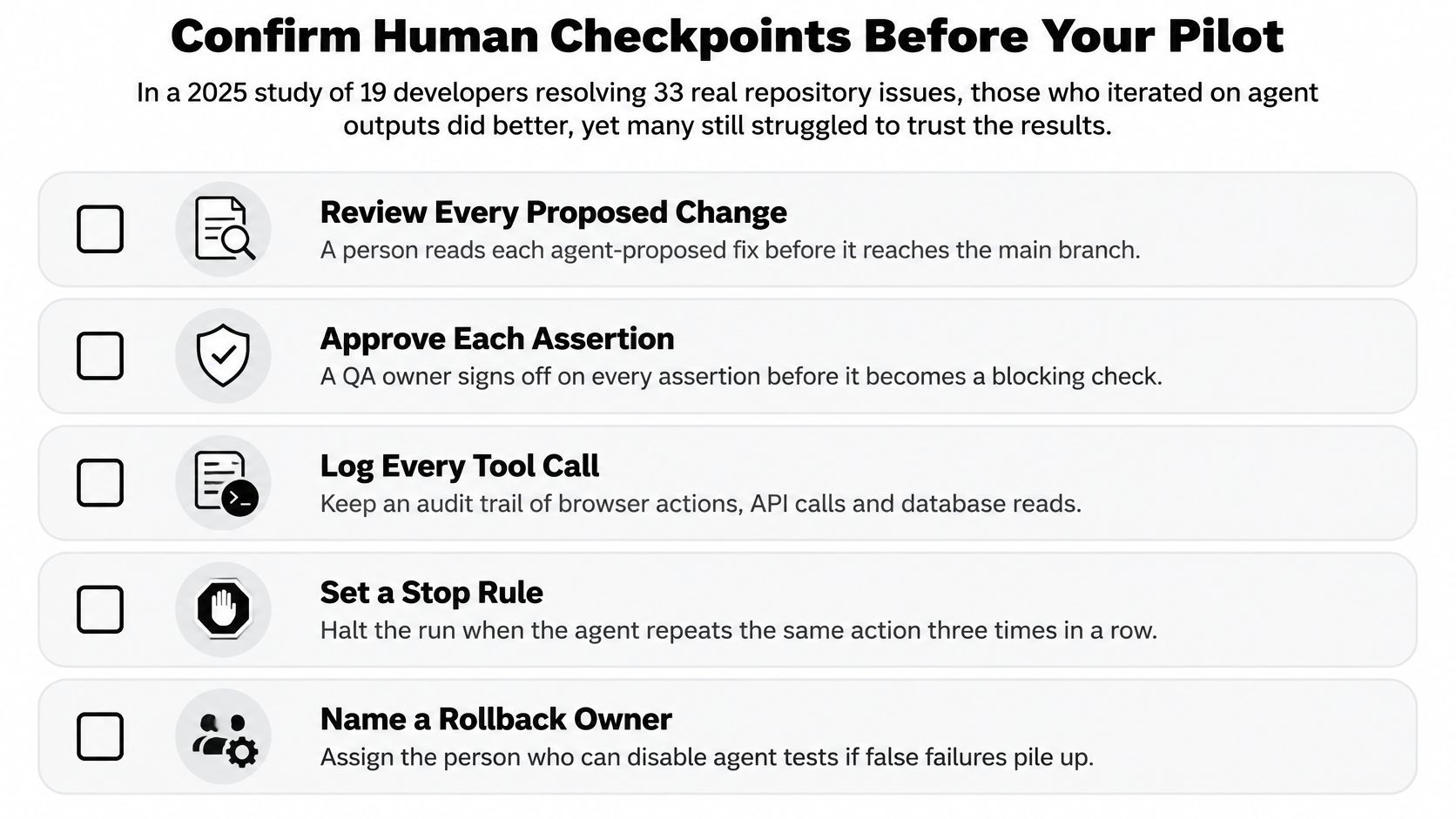
Name the accountable decision-makers
- Ambiguous requirements: A named domain owner writes the expected behavior before the test becomes blocking.
- Destructive actions: A person approves the operation; the agent can't approve its own request.
- Production data: Keep it outside the pilot. Use synthetic fixtures and approved de-identified material.
- Policy exceptions: Require documented human sign-off rather than allowing an agent-generated justification.
- Release approval: Assign an owner who can reject the evidence, delay deployment, and initiate rollback.
Good human-in-the-loop automation concentrates review where judgment changes the outcome. Reviewers shouldn't spend all their time confirming harmless browser clicks while policy exceptions pass without scrutiny.
Measure supervision effort as part of operating cost. Record whether review catches false passes, clarifies requirements, or merely repeats a deterministic check that should have been automated.
Keep the pilot small enough to inspect
As a proposed pilot, spend four weeks on a single sandbox flow and manually compare verdicts across about 50 runs. That's an inspection workload, not statistical certification or permission to bypass the confidence gate.
Expand only when verdict accuracy meets the approved per-intent target, cost stays within budget, and the unauthorized-action count remains within the safety limit. If those conditions don't hold, narrow the task or improve the harness before adding autonomy.
Yellow.ai offers an AI Copilot and automated testing capabilities for previewing, debugging, and evaluating conversational agents. Visit Yellow.ai to discuss a bounded CX or employee-service pilot, and bring your labeled scenarios, verification rules, and release scorecard to the conversation.