













The most popular advice about automated quality assurance is also the least useful: automate more tests. More scripts can produce more execution without producing more confidence. In enterprise contact centers, quality plateaus when teams automate the expected path but leave the operational conditions that break agent reliability untouched, including changing knowledge, ambiguous customer language, unstable environments, weak test data, and unclear ownership of failures.
Conversational AI makes the problem harder. A customer can change intent mid-sentence, provide incomplete information, switch languages, challenge an answer, or ask the agent to recover from an earlier mistake. Traditional automation can validate known inputs and expected outputs. It struggles to evaluate the thousands of plausible conversations that emerge when context, tools, policies, personas, and channels interact.
The practical answer isn't maximum automation. It's an operating model that combines agentic test generation, continuous observation, defect prioritization, regression control, and informed human review. That model helps CX and IT leaders improve agent reliability without mistaking test volume for quality.
Table of Contents
- Why More Automation Does Not Mean Better Quality
- The Market Shift from Niche Tool to Enterprise Standard
- Traditional Testing Versus Agentic QA for Conversational AI
- Building an Automated QA System for AI Agents
- Defect Prediction and Early Detection Strategies
- The Case for Human-in-the-Loop Quality Assurance
- Implementation Framework and Success Metrics
Why More Automation Does Not Mean Better Quality
More automated tests don't automatically create better customer experiences. A test can pass while the agent gives an incomplete answer, follows the wrong policy, loses context after a handoff, or reaches the correct outcome through an unacceptable conversation. The execution result looks healthy because the test checks whether a fixed condition occurred, not whether the interaction was useful, safe, and operationally sound.
Enterprise teams often discover the same ceiling after investing in tools, frameworks, and script libraries. Tests break when interfaces change. Test data becomes stale. Environments behave differently from production. Skilled people spend time repairing brittle suites instead of investigating customer-impacting behavior. A discussion of the CX paradox captures why adding AI capacity doesn't guarantee better satisfaction. The operating model still determines whether customers receive dependable help.
Where automation plateaus
One major industry report found that teams currently automate about 40% of testing on average, while aiming for 63% by the following year, and 47% identify understaffing as a barrier. Those figures point to an operational constraint, not a missing automation feature. TestRail's Software Testing and Quality Report shows why ambitious targets can stall when teams haven't solved maintenance, staffing, and process ownership.
The plateau usually comes from four connected problems:
- Breakage: UI, APIs, prompts, tools, and policies change faster than test scripts.
- Unstable data: Test accounts, customer records, permissions, and knowledge sources don't remain consistent.
- Environment drift: A green result in a controlled environment doesn't prove that production integrations will behave the same way.
- Skill gaps: Teams may know how to write assertions but lack the expertise to judge tone, policy interpretation, escalation quality, or recovery behavior.
Practical rule: Treat every failed automated test as an operational signal. First determine whether the failure belongs to the product, the test, the environment, the data, or the evaluation criteria.
Quality needs an operating system
Automated quality assurance works when someone owns the full loop. That includes deciding what good looks like, generating relevant scenarios, running tests against controlled versions, classifying failures, repairing tests, and feeding valid defects back into development.
For contact center leaders, the most important shift is from coverage as a count to coverage as risk exposure. A suite that touches every intent but never tests authentication failure, policy exceptions, emotional escalation, or handoff behavior can create false confidence. A smaller suite with reliable data, meaningful assertions, and production-informed scenarios may protect the customer journey more effectively.
This is why agentic QA is emerging for conversational systems. It doesn't discard deterministic checks. It extends them with dynamic scenario creation and contextual evaluation, so teams can test behavior that wasn't fully anticipated during design.
The Market Shift from Niche Tool to Enterprise Standard
Automated quality assurance has become part of the enterprise delivery model, rather than a specialist productivity tool. Industry reporting places the automation testing market at roughly USD 24.7 billion in 2022 and USD 28.1 billion in 2023, with an estimated USD 55.2 billion by 2028 at a 14.5% CAGR, as reported in market tracking from Metastat Insight. More recent tracking values the global software testing automation market at USD 54.44 billion in 2026 and projects USD 99.94 billion by 2031, according to Data Insights Market's software testing automation report.
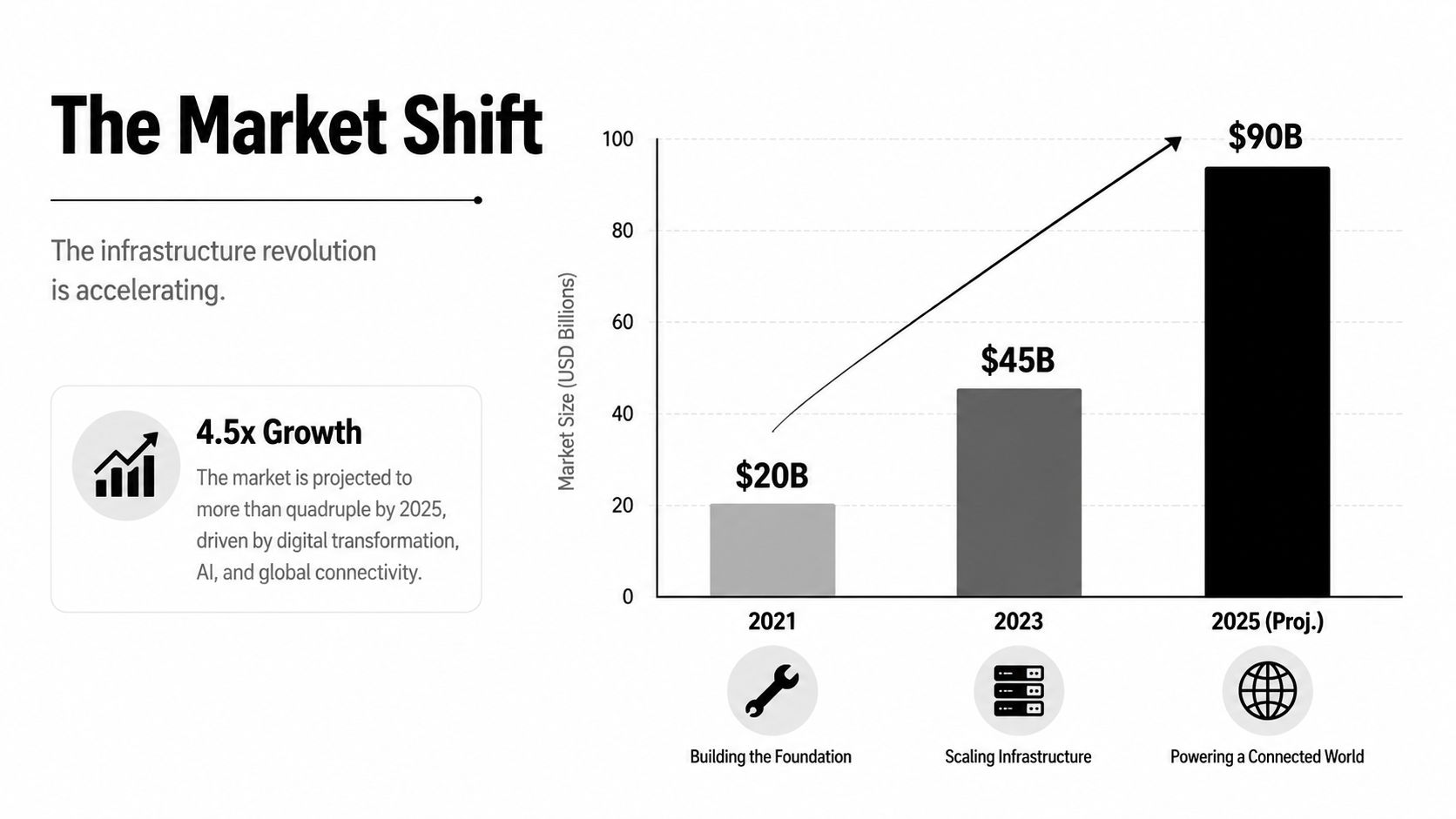
Analysts differ on the exact market values and methodology. The direction is consistent. Automated testing supports agile delivery, DevOps, and continuous delivery, where teams need feedback throughout release cycles instead of waiting for a large manual testing phase. For contact centers, that speed matters because agent prompts, policies, integrations, and customer experiences can change together.
AI-assisted testing changes the economics
AI-assisted testing marks another adoption milestone. Industry reporting summarized that 55% of organizations were using AI or machine learning in QA globally in 2023 to 2024, with projected adoption reaching 80% by 2027. The same report attributes gains of 20% to 40% in test coverage, 40% to 70% reductions in test creation time, and 50% lower test maintenance time in mature programs to AI-assisted testing, as detailed in compiled AI testing statistics.
Those figures describe potential, not a guaranteed result. Programs with clean data, clear evaluation criteria, strong observability, and capable owners are better positioned to reduce scenario creation and maintenance costs. Adding a tool to an unstable QA process does not solve unclear standards or poor test selection.
That limitation explains why automated QA can plateau despite continued investment. Traditional automation repeats known paths efficiently, while conversational AI creates new combinations of intent, context, policy, sentiment, and tool behavior. Agentic testing addresses that scenario explosion by generating varied interactions and evaluating whether the agent handled the situation appropriately, not merely whether it returned an expected string.
Why CX leaders should care
The investment question has changed. Automated QA is becoming a baseline capability for CX, EX, and operations teams that must validate customer-facing agents across channels, policies, integrations, and release versions.
One 2026 report put automation testing at 42.53% of software testing market share in 2025, reinforcing automation as a default operating model. For an enterprise contact center, the larger risk is releasing an agent whose behavior has not been tested against the unpredictable combinations customers create every day.
Traditional Testing Versus Agentic QA for Conversational AI
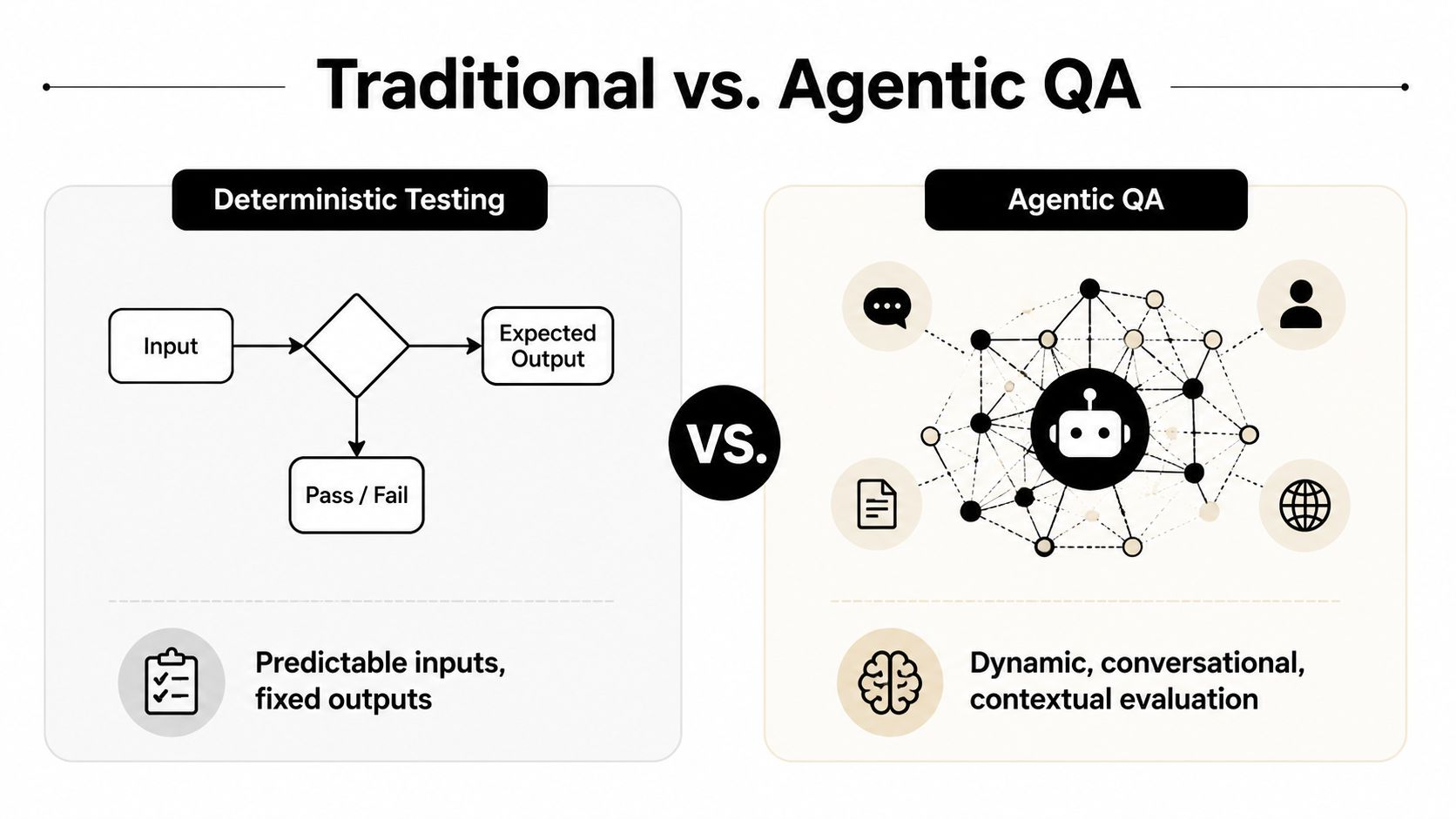
Traditional testing assumes that a known input should produce a known output. That model works well for deterministic functions, such as checking whether a button triggers an API call, a required field rejects invalid data, or a calculation returns the expected result. The evaluator can compare the actual result with a fixed assertion.
Conversational AI doesn't behave like a calculator. A customer may express the same request in many ways, introduce new information halfway through the exchange, or ask a follow-up that changes the correct action. The agent's response must be evaluated against intent, context, policy, tone, tool use, and resolution quality at the same time.
The scenario explosion problem
A single enterprise agent can serve multiple customer personas across voice, chat, email, and other channels. Each interaction can branch based on authentication status, account history, language, sentiment, product eligibility, previous turns, and the availability of downstream systems. Traditional teams usually write cases for the paths they expect. Customers generate the paths teams didn't think to document.
| Traditional deterministic testing | Agentic QA |
|---|---|
| Starts with predefined inputs | Generates varied inputs from intents, policies, and conversation context |
| Checks fixed outputs or assertions | Evaluates meaning, task completion, safety, and contextual behavior |
| Focuses on isolated flows | Exercises multi-turn paths and branching conversations |
| Requires manual expansion as scenarios change | Uses observed failures and new requirements to expand coverage |
| Produces pass or fail results | Produces results that support triage and improvement |
Manual testing can't economically explore every combination, while conventional automation often repeats a narrow set of scripted paths. Agentic QA uses simulated users, varied language, contextual turns, and evaluation criteria to explore a broader behavioral surface. It can challenge an agent with interruptions, incomplete answers, contradictory details, and recovery requests rather than replaying a happy path.
What a useful agentic test evaluates
A good test doesn't ask only whether the agent recognized an intent. It asks whether the agent completed the customer's goal without violating policy or creating unnecessary effort. That evaluation may include:
- Intent handling: Did the agent identify the customer's actual need, including a mid-conversation change?
- Context retention: Did it preserve relevant details across turns and handoffs?
- Action correctness: Did it call the right system, use the right parameters, and report the result accurately?
- Policy adherence: Did it avoid promises, disclosures, or actions outside its authority?
- Recovery quality: Did it ask a useful clarification question or escalate when automation couldn't safely continue?
- Conversation quality: Was the response clear, appropriately concise, and suitable for the channel?
Yellow.ai's overview of agentic AI testing describes the need to move beyond fixed scripts when validating AI agents. The key distinction is not that traditional tests become useless. It's that conversational deployments need a second layer capable of evaluating dynamic, contextual behavior at scale.
Building an Automated QA System for AI Agents
An effective system starts with the behavior the business needs, not with the testing product. Define the customer's goal, the agent's authority, the required evidence of completion, and the conditions that require transfer to a human. Without those criteria, an automated evaluator may reward fluent language even when the agent fails the underlying task.
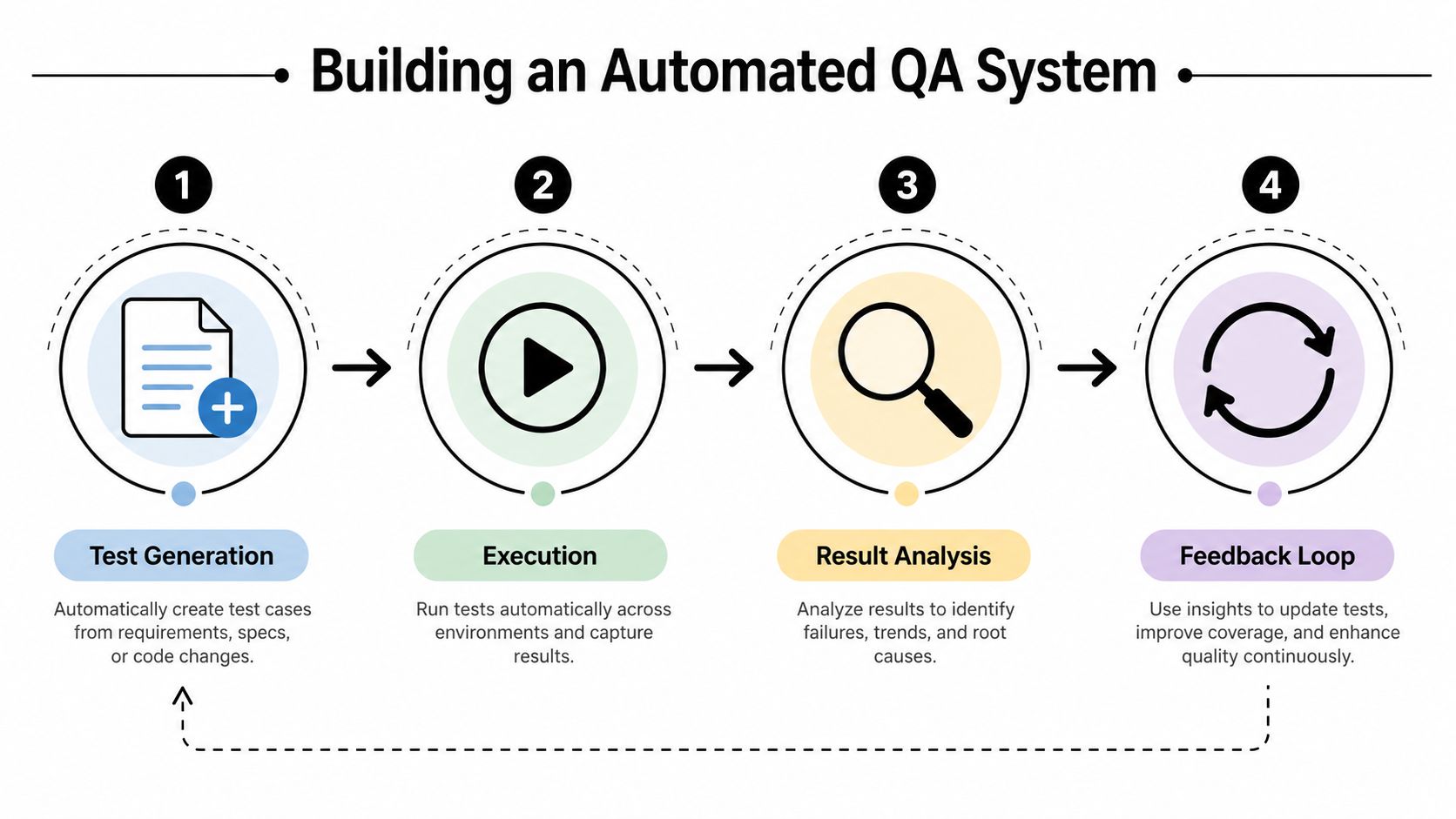
Start with scenario generation
Build scenarios from several sources rather than relying only on product requirements:
- Business intents: Include common requests, adjacent intents, ambiguous wording, and intent changes.
- Operational policies: Test eligibility rules, authentication requirements, disclosure language, and escalation boundaries.
- Production evidence: Convert real failure patterns, supervisor findings, and contact drivers into reusable scenarios.
- Adversarial variation: Add incomplete information, interruptions, emotional language, conflicting instructions, and attempts to bypass controls.
- Channel conditions: Account for the differences between voice, chat, email, and multimodal interactions.
The purpose isn't to create a giant static library. It's to create a scenario engine that can produce meaningful variations while preserving the business objective behind each test.
Separate execution from evaluation
Run each scenario in a controlled environment with known agent versions, integrations, permissions, and test data. Capture the full trace, including user turns, agent responses, tool calls, retrieved knowledge, latency signals, transfers, and final outcomes.
Then evaluate the trace against explicit criteria. A response can be factually correct but operationally poor if it fails to explain the next step. Conversely, a response can sound natural while using an unauthorized tool action. Separate evaluators for task success, factuality, policy, tool behavior, and customer effort make failures easier to diagnose.
Turn failures into a feedback loop
A failed test should lead to a decision, not merely a ticket. Classify it as an agent defect, knowledge issue, integration failure, test defect, data problem, or evaluation error. Assign ownership and retain the scenario so a future release can prove that the regression has been fixed.
Yellow.ai's Automated Testing capability is one example of tooling designed to generate test cases, run scalable scenarios, validate agent behavior, and use failures to support improvement. Regardless of the platform, the operating principle stays the same: every meaningful failure should make the next test cycle more informative.
Defect Prediction and Early Detection Strategies
Defect prediction is most valuable when it changes what the team tests first. In a large codebase or a complex agent deployment, execution capacity is limited. A prediction layer can prioritize components, intents, integrations, or conversation paths that are more likely to fail, allowing engineers and QA specialists to investigate risk before a release reaches customers.
Search-based software testing research provides a precise lesson about predictor quality. A study found that every 5% drop in defect-predictor recall reduced bug detection by an average of 7.5 bugs out of 420, while precision had only a very small practical effect. The study on defect predictors and search-based testing recommends prioritizing recall, even at the expense of precision, provided precision remains at least 75%, because the predictor steers automated test generation toward likely-buggy code.
Recall matters for QA prioritization
For enterprise AI agents, recall means finding as many risky areas as possible. A high-recall system may send some false positives to triage, but it reduces the chance that important defects remain invisible because the predictor was too selective.
Apply that principle to customer operations by prioritizing:
- New or heavily changed intents
- Integrations that execute account or transaction actions
- Knowledge articles with recent policy changes
- Flows with high escalation or abandonment signals
- Conversation branches that combine authentication, eligibility, and handoff rules
The predictor shouldn't make the final release decision. It should direct scarce human and automated testing effort toward the places where missed defects could cause the most harm.
Detect before full execution
An AI-based software defect predictor case study reported that the model identified, on average, 88% of defective files and automatically surfaced 75% of defects found through unit testing, code reviews, and inspections in a few seconds. The AAAI case study on AI-based defect prediction illustrates a practical pattern: use prediction before or alongside execution to compress detection time.
For conversational deployments, that can mean generating targeted scenarios as soon as a prompt, knowledge source, tool, or policy changes. The system can then route high-risk failures for review while running broader regression checks in parallel. Teams get earlier signals without pretending that prediction replaces execution or expert judgment.
The Case for Human-in-the-Loop Quality Assurance
Automation should remove repetitive checking, not remove accountability. In customer-facing AI, the most damaging failures often involve judgment: an unsafe interpretation, an inappropriate refusal, a misleading explanation, or a failure to recognize that a customer needs a person. A pass result can't carry responsibility for those outcomes.

Recent reporting on automated AI vulnerability scanning found that 78% of respondents said fully automated tools missed critical vulnerabilities, according to Infosecurity Magazine's coverage of AI vulnerability scanning. That finding is about vulnerability scanning, not conversational QA, but the operational warning applies: broad automation can create a dangerous sense of completeness when people don't validate the results.
Decide where people must intervene
Human review belongs where the cost of a miss is high or the evaluation is contextual. In a contact center, that commonly includes financial actions, sensitive personal information, health-related guidance, regulated disclosures, vulnerable customers, complaints, and escalations involving reputational risk.
Automation can still perform the first pass. It can generate scenarios, detect policy deviations, flag unsupported claims, compare behavior against known requirements, and group similar failures. A qualified reviewer should then confirm whether the flagged behavior is unsafe, determine severity, and decide whether the solution requires a prompt change, knowledge correction, workflow change, guardrail, or human transfer.
Quality boundary: Let automation widen the search. Let accountable people decide whether the resulting behavior is acceptable.
A human-in-the-loop model also improves the test system itself. Reviewers can identify false positives, refine evaluation criteria, add missing scenarios, and distinguish a harmless variation from a meaningful regression. Over time, that feedback makes automated QA more useful because the system learns what the operation considers risky and valuable.
A mature program therefore measures more than execution volume. It tracks whether reviewers can understand failures, whether engineers can reproduce them, whether fixes remain fixed, and whether production observations generate better tests. That is how teams avoid replacing manual effort with an opaque queue of automated alerts.
Implementation Framework and Success Metrics
Start with a baseline that reflects agent reliability, not just test quantity. Record task completion, correct escalation, policy adherence, factual accuracy, context retention, tool-call correctness, regression recurrence, and reviewer agreement. Add operational signals such as unresolved failure age and the share of production incidents that already had a corresponding test.
A practical rollout
- Choose a narrow risk domain: Begin with a customer journey where the business outcome and escalation rules are clear.
- Create a trusted evaluation set: Include successful conversations, known failures, edge cases, and policy-sensitive situations.
- Connect tests to delivery: Run targeted checks when prompts, knowledge, tools, integrations, or model configurations change.
- Instrument every trace: Preserve the turns, actions, retrieved content, handoffs, and outcome needed for diagnosis.
- Review and tune: Have CX, QA, product, compliance, and engineering agree on severity and ownership.
- Expand by risk: Add channels, languages, personas, and journeys as the team proves that failures are being resolved rather than merely reported.
Avoid setting automation targets that reward script accumulation. A growing suite with low signal, frequent breakage, and unclear ownership will slow releases instead of protecting them. The right target is dependable coverage of meaningful risk, supported by a feedback loop that keeps pace with agent change.
Measure the loop, not the vanity metric: A healthy program finds important failures early, explains them clearly, assigns them quickly, and verifies the fix in realistic conversations.
For enterprise teams, the final decision criterion is operational fit. The platform must support the channels, integrations, evaluation methods, access controls, and reporting that your agents use. It should also make it easy for QA specialists and contact center leaders to contribute without turning every test change into an engineering project.
Yellow.ai offers automated testing for AI agents, including test-case generation, scalable scenario execution, regression checks, and behavior validation across enterprise agent workflows. Visit Yellow.ai to evaluate how its agentic platform can help your team address scenario explosion while keeping observability and human review in the quality loop.



