













Most advice on human in the loop automation starts in the wrong place. It treats a review step like a seatbelt, as if adding a person somewhere in the workflow automatically makes the system safer. In live contact center and employee experience operations, that usually leads to something worse, a queue full of rubber-stamped decisions, slower handling, and the same mistakes still slipping through.
The design problem is narrower and harder. You have to decide which cases deserve human attention, what context reviewers need to make a meaningful decision, and how the workflow learns from those interventions without turning into a permanent manual checkpoint. That's the difference between selective oversight and review theater.
Table of Contents
- Why Human in the Loop Automation Is Harder Than It Looks
- What Human in the Loop Automation Actually Means
- The Selective Escalation Pipeline
- High-Value Use Cases in CX, EX, and Contact Center Operations
- An Implementation Roadmap With Graduated Autonomy
- Governance, Safety, and the Operating Model Question Most Guides Skip
- Tuning Thresholds and Measuring Whether the Loop Is Working
Why Human in the Loop Automation Is Harder Than It Looks
The easiest mistake is assuming that human review equals safety. It doesn't. If reviewers are staring at a long queue of machine suggestions with no context, they tend to accept the default, which creates automation bias instead of better judgment. The system looks controlled on paper, but in practice it's just adding latency to the same decision path.
That's why the strongest enterprise deployments don't route everything to humans. They use selective escalation, where routine, high-confidence work stays automated and only low-confidence, high-risk, ambiguous, or policy-sensitive cases get reviewed. That pattern aligns with the way risk-sensitive automation is described in practice, where workflows pause for approval before final execution on consequential actions such as loan approvals, medical diagnoses, or legal recommendations as described in HITL guidance.
The failure mode most pilots miss
A lot of pilots begin with broad review rules because teams are trying to be conservative. Then the queue balloons, reviewer fatigue sets in, and the business starts asking why the “AI project” slowed operations without a visible quality lift. The hidden cost is not just speed, it's trust. Once agents or back-office staff notice that every flagged item is getting rubber-stamped, the review function loses credibility.
Practical rule: if humans don't have enough context to challenge the machine, the loop is decorative, not protective.
The other trap is assuming the review step will compensate for a weak model. It won't. On structured documents such as invoices and order forms, modern IDP systems can exceed 99% accuracy, but performance falls to the 92%–97% range on semi-structured documents like handwritten forms or mixed-format PDFs, which is exactly where edge cases become expensive and human review still matters AIIM benchmark cited in industry reporting. The takeaway is not “review everything.” It's “review the right things.”
Good HITL programs are calibrated systems, not moral statements. If the escalation logic is too broad, you create slow service and reviewer burnout. If it's too narrow, you get blind trust and expensive misses. The architecture has to absorb both risks at once.
What Human in the Loop Automation Actually Means
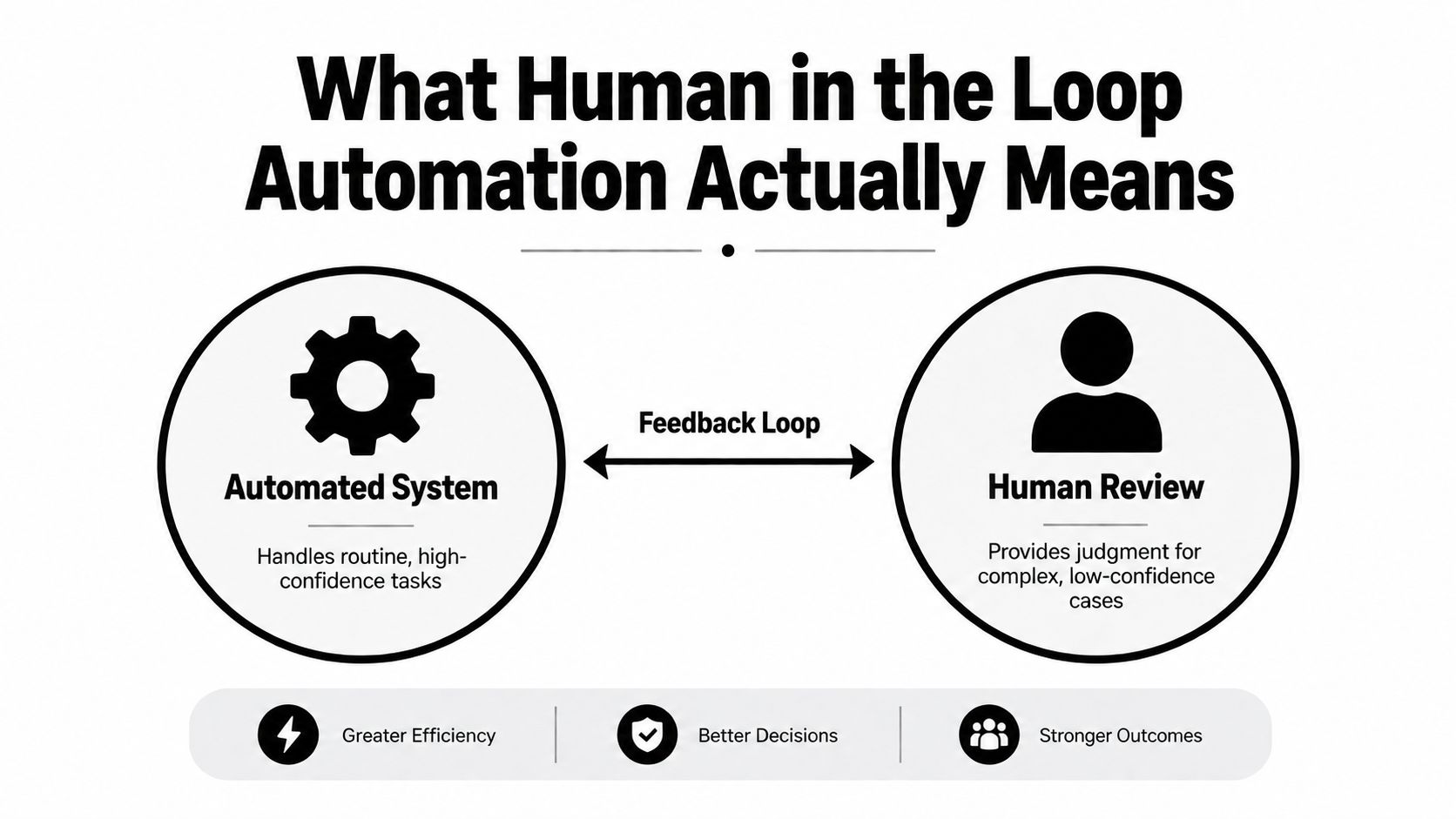
At its simplest, human in the loop automation means an automated system handles routine work, then pauses for human judgment when a case is risky, ambiguous, or compliance-sensitive. In enterprise terms, the machine handles the first pass, and a person decides whether the output can move forward. That is an operating model with review rights, audit trails, and policy controls built in as framed in enterprise HITL design guidance.
The three patterns that matter in practice
The first pattern is review-before-execution. A claims workflow is a clear example. The model drafts a recommendation, but any case with fraud signals, unusual documentation, or policy exceptions stops for human approval before payout. That is the safest pattern when the action is hard to reverse.
The second pattern is review-after-execution. This is more common in customer service QA or knowledge article moderation. The system acts first, then humans inspect the decision later for drift, policy issues, or tone problems. It does not prevent every bad action in real time, but it gives you an audit layer and a correction loop.
The third pattern is the most valuable over time, the closed feedback loop. A reviewer confirms, edits, or rejects the AI output, and that correction is captured for retraining or rule updates. IBM describes this feedback dynamic as making systems more reliable and aligned with real-world needs, while Databricks and Appen both frame human correction as a way to improve interpretability and decision boundaries IBM human-in-the-loop overview. That is the difference between a checkpoint and a learning system.
If you want a practical external reference point for another enterprise context, the human-in-the-loop for digital product passports resource shows how the same pattern extends beyond CX into governed product data.
What belongs in the reviewer view
The reviewer should not have to hunt across tabs. The interface should show the model output, the rationale or evidence, prior history, and the actions the reviewer is allowed to take in one place. When that context is scattered, reviewers default to approval because it is faster than investigation. Structured capture of approvals, edits, rejections, and reasons is equally important because it creates retraining data and an audit trail for future policy changes.
The main mental model is simple. Automation handles routine work. Humans handle exception quality. The loop learns from every meaningful intervention.
The Selective Escalation Pipeline
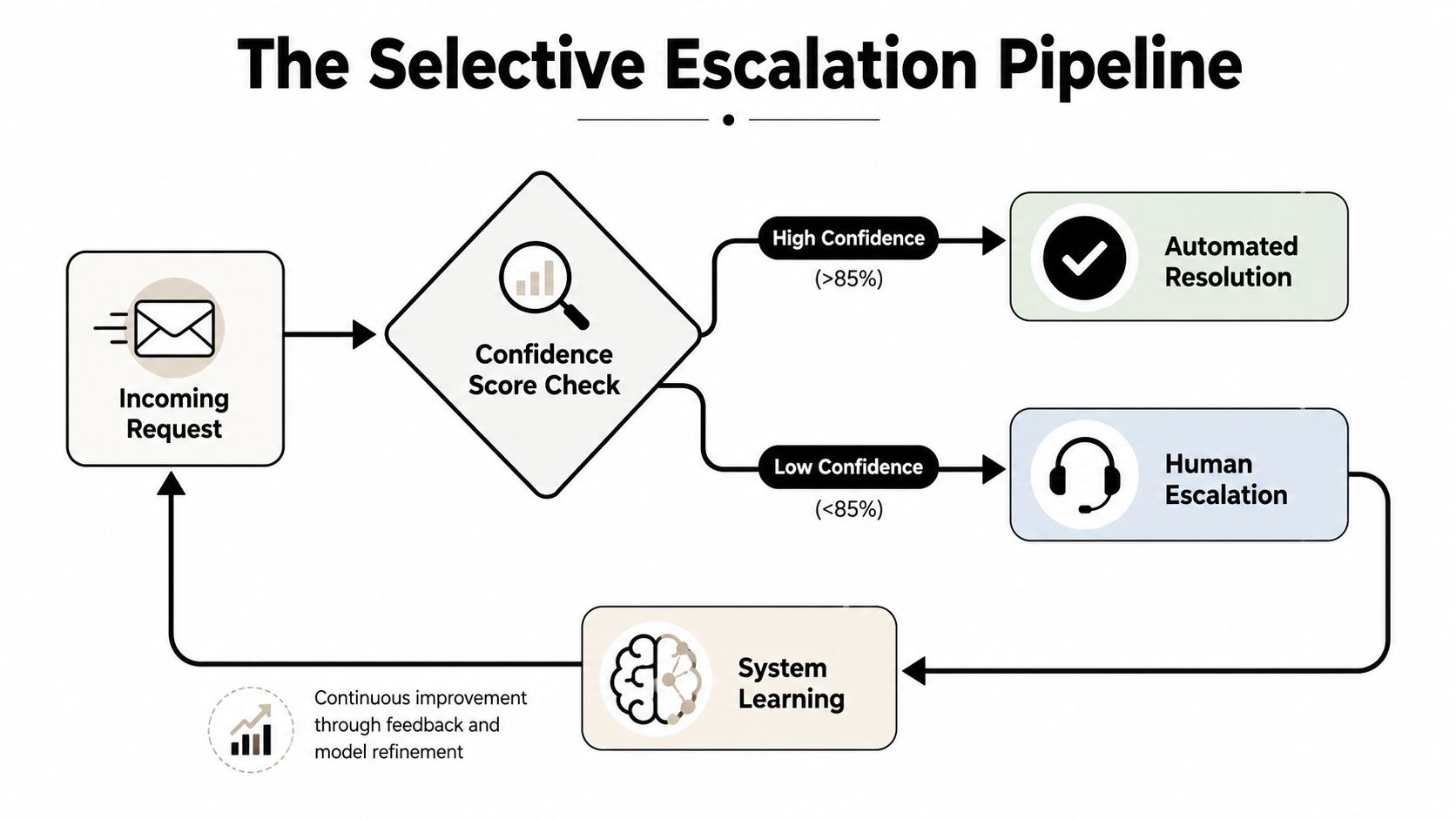
A good HITL system does not ask humans to review uncertainty in bulk. It routes uncertainty intelligently, so the reviewer sees only the cases where human judgment can improve the outcome. That's what makes selective escalation the technical heart of the design. Confidence scores, anomaly signals, risk tiers, and policy flags become the routing logic, not a blanket “send to a person” rule as outlined in practitioner guidance.
How to think about routing logic
The routing rule should combine several signals, not just a raw model score. A low-confidence prediction is a candidate for review, but so is a case with contradictory data, a high-impact customer segment, or a policy-sensitive action like a refund exception or account change. Underbuilding this layer by relying on one threshold and calling it governance is a common pitfall. That's not enough.
A better queue separates cases into categories:
- Routine and stable: keep these fully automated when the model is confident and the action is low risk.
- Ambiguous but reversible: route these to human review when context matters more than throughput.
- High-risk or policy-bound: require mandatory review before execution.
- Outlier or anomaly-driven: escalate even when confidence looks high, because the input itself is unusual.
High-confidence automation is useful only if the system can recognize when confidence is misplaced.
The reviewer experience matters just as much as the queue logic. If the interface hides the model's evidence or history, reviewers spend time reconstructing context, and that increases both decision fatigue and blind acceptance. The interface should expose the prediction, the supporting signals, any prior interaction history, and the exact override actions available. That design keeps the human focused on judgment instead of navigation.
Why capture matters as much as review
Every approval, correction, rejection, and reason code should be stored in a structured way. That data becomes retraining material, but it also helps policy owners see why cases keep escalating. If the same edge case keeps triggering review, the workflow probably needs a new rule or a revised threshold. If reviewers keep rejecting the same category, the model may be overconfident or the instruction set may be too vague.
This is also where a conversational platform can matter. For example, Yellow.ai's agent assist capabilities fit naturally in workflows where the machine suggests responses or actions and a human agent remains in control of what gets sent. It's a useful fit when the goal is to accelerate decisions without removing accountability.
The practical blueprint is simple. Route only the cases where human attention changes the outcome, present enough context to make review real, and capture the result in a form the system can learn from later.
High-Value Use Cases in CX, EX, and Contact Center Operations
The same HITL pattern behaves differently depending on the work. In a credit workflow, the point is to stop a bad decision before it reaches the customer. In an HR service desk, the point is to keep employee support fast without letting policy exceptions leak through. In a customer contact center, the point is often empathy plus compliance, which means the human moment matters as much as the final answer.

Where the pattern pays off fastest
A loan or credit decisioning workflow is a natural fit when the model can pre-screen obvious approvals, but borderline or policy-sensitive applications get routed to a human analyst. The trigger is usually a mix of confidence, exception flags, and risk tier. The human moment is the final judgment on cases where a rules-only path would overreach.
In healthcare claims adjudication, HITL is strongest when the system handles routine claims and escalates unusual documentation, suspected fraud, or inconsistent coding. That's a good example of review-before-execution, because the cost of a bad auto-decision can be hard to unwind. The measurable outcome is usually not just speed, but fewer avoidable reversals and cleaner auditability.
IT and HR service desks are different. There, human review is often most useful for employee requests that combine policy, identity, and sensitivity, such as access approvals, onboarding exceptions, or benefits edge cases. The best design is a triage layer that routes straightforward requests automatically and sends unusual cases to the right resolver with context attached.
Operational rule: if a human has to ask three follow-up questions before deciding, the workflow didn't escalate soon enough.
Complex customer disputes are another strong use case because tone and empathy matter. The system can classify the issue, draft a response, or propose a resolution path, but a human should handle complaints that involve emotion, cross-system confusion, or business exceptions. That's where the machine can shorten the path, but it shouldn't own the conversation.
Compliance-sensitive communications are often the highest-friction category. A bot can draft customer-facing language, but the final send should pass through human review when wording must be exact. In those flows, review is not a productivity tax, it's a control point.
If you're mapping candidate workflows, start with the ones where errors are costly, exceptions are common, and human context is additive. That shortlist usually beats broad “automation opportunities” decks that never survive contact with operations. For teams evaluating platform approaches, it also helps to compare how the orchestration layer and the reviewer workflow fit into a broader stack, especially where an AI Copilot can support agents without taking away the final decision.
An Implementation Roadmap With Graduated Autonomy
A rollout plan that never changes usually fails. Good HITL programs move from tight oversight to graduated autonomy, where each step earns more trust because the system proves it can handle the next layer of complexity. The point is to shrink unnecessary review over time, not institutionalize it forever.
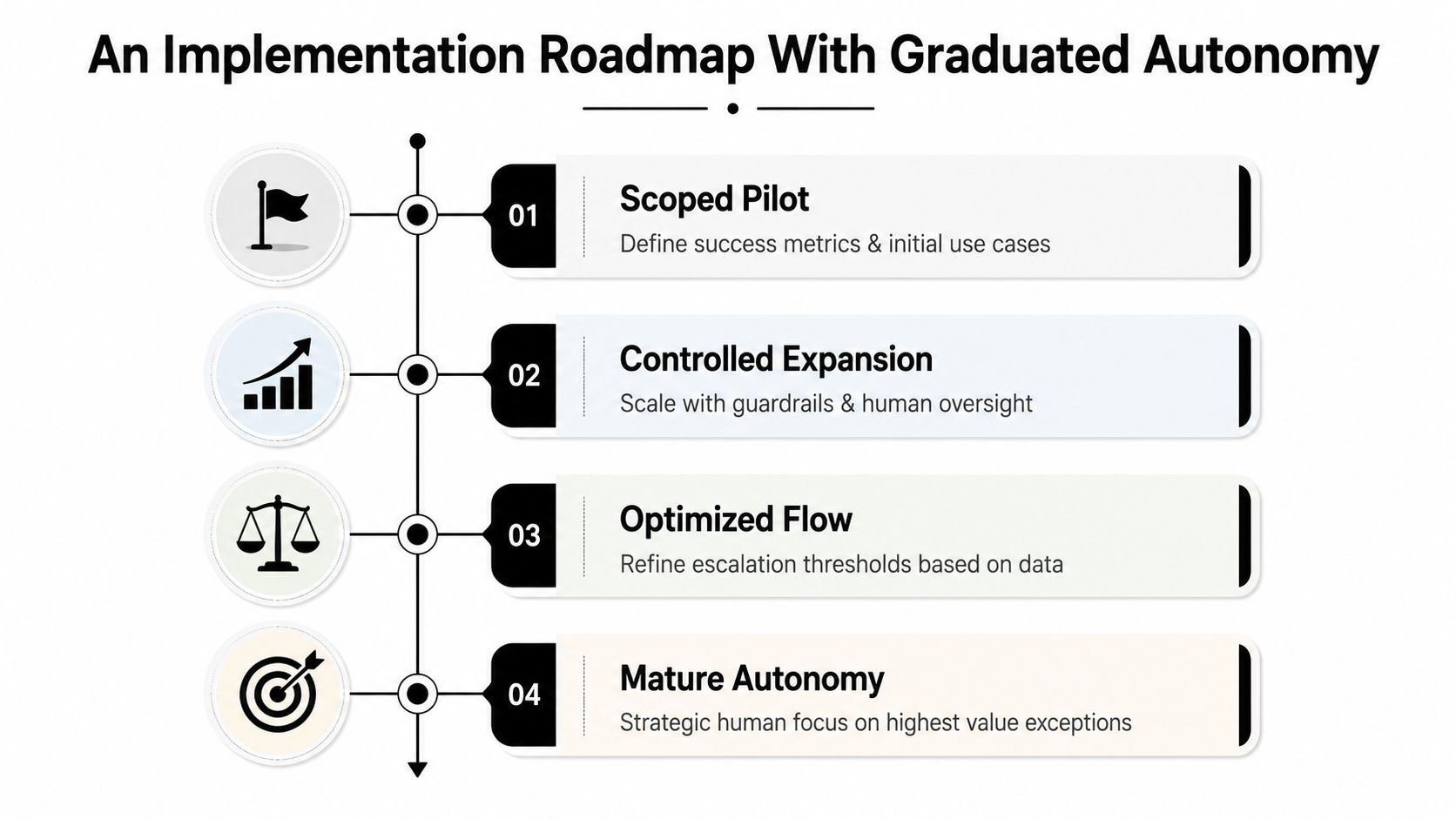
Stage one scoped pilot
Start with a narrow workflow, strict escalation criteria, and a small reviewer group. Pick cases where the model can safely automate the easy volume while humans inspect the exceptions. The main goal is not scale, it's learning where the thresholds fail and where reviewers disagree.
Stage two controlled expansion
Once the pilot is stable, broaden coverage while keeping the human gate intact for sensitive cases. At this stage, the useful metrics are escalation rate, override rate, resolution time, and reviewer satisfaction. If the team can't explain why cases are being escalated, the expansion is too fast.
Stage three optimized flow
The system starts to earn trust at this point. Thresholds should be revised based on actual review patterns, not intuition. If a particular anomaly type always results in the same correction, you can often update the rule or model instruction instead of leaving the case in the queue forever.
Stage four mature autonomy
Mature autonomy does not mean no humans. It means humans focus only on the most consequential exceptions, policy escalations, and novel cases. That's the stage where the operating model gets lighter, the review queue gets sharper, and the system becomes easier to defend in audits and service reviews.
The integration layer matters at every stage. Contact centers usually need clean handoffs into tools like Salesforce, Zendesk, or Genesys, and the quickest deployments use pre-built connectors rather than bespoke glue. A platform like Yellow.ai also exposes an advanced analytics layer that helps teams monitor escalation behavior and track whether the workflow is learning.
Keep the rollout disciplined. If a stage doesn't reduce errors, sharpen review quality, or improve resolution time, don't advance just because the pilot is “live.” Gradual autonomy is earned with evidence, not enthusiasm.
Governance, Safety, and the Operating Model Question Most Guides Skip
The hardest part of HITL isn't the queue. It's the operating model around the queue. If reviewers don't have clear authority, documented audit trails, and training on failure modes, the process becomes ceremonial. Independent responsible-AI guidance is explicit that human oversight only adds value when people can meaningfully challenge the machine, not just confirm it as discussed in governance analysis.
Three risks that quietly degrade the model
The first is automation bias, which shows up when reviewers trust the suggestion too quickly. That risk rises when the interface buries the evidence or when the same reviewer sees too many cases that look similar. The fix is not more reminders, it's better context and stronger review design.
The second is deskilling. If a team only reviews narrow exceptions for too long, people stop practicing the judgment the process depends on. That matters in contact centers and employee services, where reviewers may eventually be asked to handle a novel issue without enough live experience.
The third is unclear accountability. When an AI-suggested action goes wrong, someone still owns the outcome. If that ownership is fuzzy, operations teams start to treat the tool as the decision-maker and the reviewer as a formality. That's where HITL turns into blame diffusion.
Governance rule: if a reviewer can't override the system, they're not in the loop.
There's also a labor question that most vendors skip. HITL can improve outcomes, but it can also shift work from front-line teams to a new review layer without reducing total effort. That's why it's important to define savings, error reduction, and handoff quality up front. For teams trying to understand the policy and cost side of this, resources like find compliance cost insights can help frame the governance burden more concretely.
The best programs use version-controlled rules, captured feedback, and reviewer training as standard operating procedure. That turns HITL from a static control into a managed capability. Without that scaffolding, the system may look safer while becoming slower, flatter, and harder to audit.
Tuning Thresholds and Measuring Whether the Loop Is Working
If you cannot measure the loop, you do not have a loop, you have a queue. The practical work is to tune confidence scores, anomaly signals, and risk tiers so the workflow keeps hard cases for humans and lets easy ones move on. Then watch what reviewers do with those cases, because that is where threshold quality shows up.
The clearest operating metrics are straightforward, escalation rate, override rate, resolution time, and the reasons reviewers give when they intervene. If escalation is too high, the system is probably over-reviewing and creating fatigue. If override rate is too low, you may have blind trust or a reviewer experience problem. If resolution time keeps climbing, the human layer is no longer acting like a control, it is acting like a bottleneck.
A useful cadence is to review disagreement patterns between the model and the human team, then update instructions, thresholds, or routing rules based on those patterns. That is how a permanent manual checkpoint becomes a stepping stone to autonomy. The loop should get narrower as evidence improves, not wider because nobody wants to touch the settings.
Yellow.ai's AI analytics is one example of the kind of instrumentation teams need when they want to see whether escalation is helping or just creating work. Whatever platform you use, the rule is the same, measure the reasons humans step in, then adjust the system so fewer low-value reviews recur.



