









In 2025, 79% of surveyed U.S. companies reported that AI agents were already being adopted, according to PwC's survey of 308 senior executives. That adoption figure sounds settled. It isn't. The harder question for Agentic AI in enterprise programs is which workflows an agent may complete alone, which actions need approval, and how much control each decision costs in latency, review time and rework. Treat governance as a deployment-speed setting for each workflow, not a generic safety label, and the architecture, metrics and rollout plan start to align.
Table of Contents
- What Agentic AI Means and How It Differs From Chatbots and Copilots
- How an Agentic System Is Built, Layer by Layer
- Where Agentic AI Pays Off in Customer and Employee Experience
- Integration Patterns for RAG, Multi-Model Routing and Voice
- Governance, Safety and Reliability Controls That Keep Pace
- Measuring ROI and Migrating Without Breaking Live Service
- Confirm One Workflow and Pilot It This Quarter
What Agentic AI Means and How It Differs From Chatbots and Copilots
A customer's flight is cancelled at 7 a.m. A rule-based chatbot offers menu options and waits for a tap. A copilot drafts an apology and a possible rebooking for a human agent to approve. An agentic system checks the booking, finds an allowed seat, rebooks it within policy, notifies the traveller and logs each change, then escalates if no seat meets the rules.
Agentic AI is software that pursues a goal, plans the steps, calls tools in business systems, changes records and decides when to hand off to a person. That state change is the dividing line. Talk alone doesn't make a system agentic, and fluent language doesn't prove it can finish work.
Chatbots, copilots and agentic systems compared
| Approach | How it decides | What it changes | Human role |
|---|---|---|---|
| Rule-based chatbot | Follows scripted decision trees | Nothing beyond the conversation | Customer chooses menu options |
| Copilot | Suggests answers and drafts for the user | Nothing until the user acts | Human reviews and executes each step |
| Agentic AI | Plans steps toward a goal and adapts to results | Records, bookings, tickets and payments through tools | Sets goals and limits, handles escalations |
Three Properties That Matter
Goal orientation means the system receives an outcome, such as resolving a failed delivery, rather than a fixed script for every turn. It can reorder lookup, verification and notification steps when tool results change. The plan still stays inside a defined boundary.
Tool access gives that plan effect. The agent calls a CRM lookup, creates a ticket, checks inventory or starts an approved payment action through named interfaces. Each tool should expose only the parameters and operations the workflow needs.
State change makes success testable. A completed rebooking exists in the booking system, a password reset changes an identity record, and a refund creates a payment transaction. If nothing changes outside the chat window, you're looking at an assistant, whatever the vendor calls it.
Agentic doesn't mean unlimited autonomy. A well-scoped agent has a named goal, an allowlist of tools, financial and policy limits, a stopping condition and an escalation path. Broader discretion belongs only where actions are reversible, evidence is complete and repeated testing shows stable behaviour.
Vendor test: Ask the system to complete one real transaction, then break a middle step. A credible agent detects the failure, retries safely or escalates with context, and doesn't claim success from a plausible final message.
Apply that test to every demo. Does it take an action in a real system of record? Can it recover when a lookup returns conflicting records or an API times out? Can an operator reconstruct why it acted? Those answers separate Agentic AI in enterprise deployments from conversational interfaces placed in front of manual work.
How an Agentic System Is Built, Layer by Layer
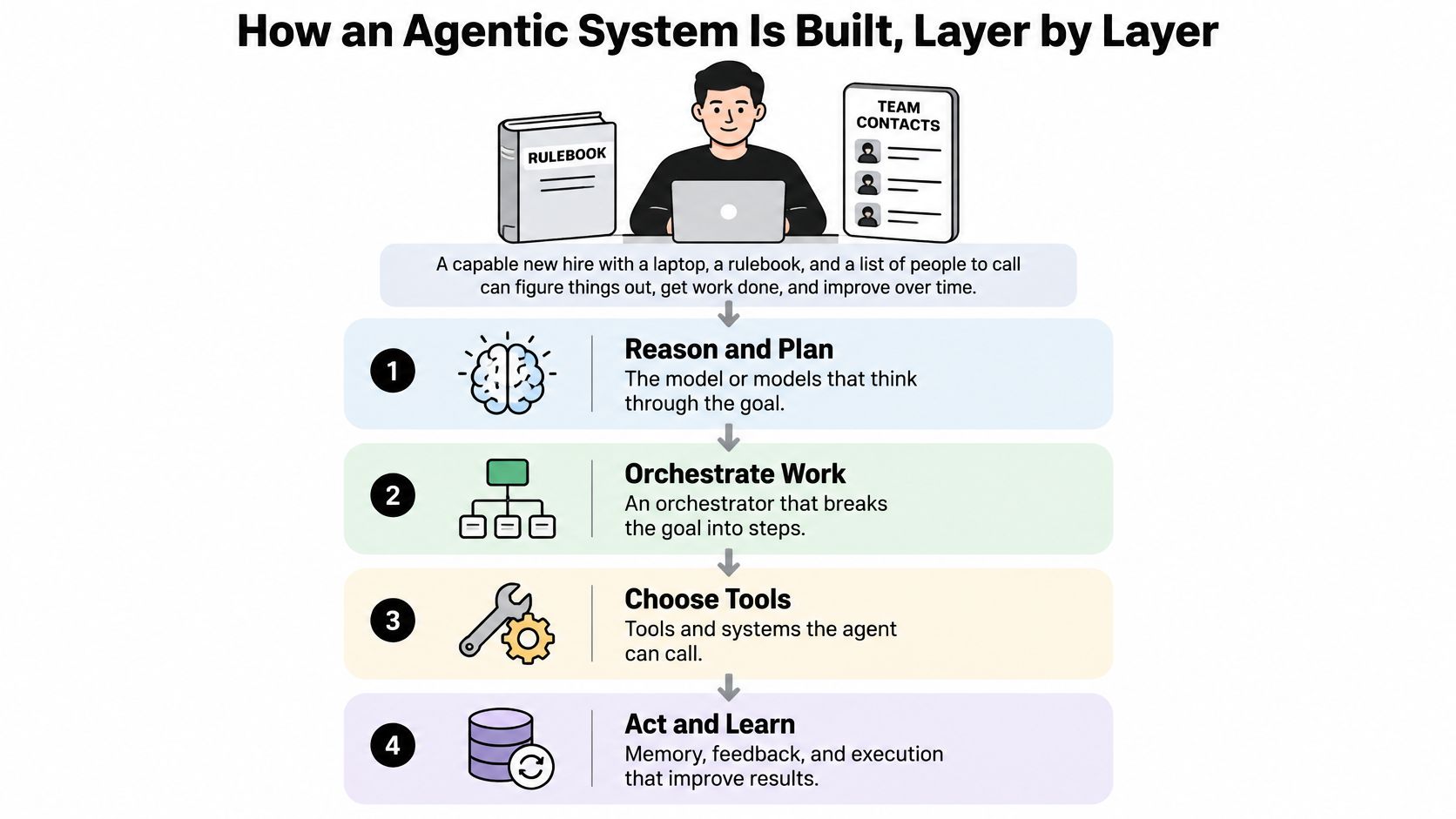
Think of a capable new hire with a laptop, a rulebook and a phone list. The hire can reason, but safe output depends on which applications are open, which approvals are required, what notes persist, and who reviews unusual cases. An agent needs the same separation of concerns, implemented in software rather than supervision alone.
The layered view below shows how reasoning, orchestration, tools and feedback fit together.
The Six Working Layers
- Models: One or more language models interpret intent, reason over evidence and propose the next step.
- Orchestrator: This component breaks the goal into steps, tracks progress, handles retries and chooses whether to continue, ask, or escalate.
- Tools and connectors: CRM lookups, ticket creation, payment actions and identity checks sit behind explicit schemas that define inputs, outputs and errors.
- Memory and knowledge: Session context holds the current case, while retrieval supplies policies, product data and prior-resolution patterns.
- Policy and guardrails: Permissions, spending limits, data rules and approval gates constrain actions before tools execute them.
- Observability: Logs capture prompts, retrieved evidence, tool calls, decisions, costs, handoffs and final system state for review.
A useful AI agent architecture diagram helps teams assign ownership to each layer instead of treating the model as the whole product. Platform, domain and operations teams can then change one layer without weakening another. That boundary matters during incidents, audits and model upgrades.
One Refund Through the Loop
The working loop is observe, plan, call a tool, read the result, check policy, then continue or escalate. Say a customer requests a refund for a duplicate charge. The agent verifies identity, retrieves the order and payment record, and checks whether the charge and refund window match policy.
If the amount sits below the approved threshold, the orchestrator calls the payment tool with an idempotency key, reads the transaction result, updates the ticket and tells the customer the confirmed reference. If the payment record conflicts with the order, policy blocks the refund and routes the case with both records attached. The customer doesn't restart the conversation.
Avoid giving the agent broad system credentials because a prompt might need them someday. Narrow tools reduce blast radius and make tests meaningful. A refund tool shouldn't also delete accounts, alter prices or export customer data.
Start architecture work with a mapping exercise. List every system the workflow touches, assign each interaction to a scoped tool, mark who owns its schema and errors, and identify the missing layer. Most weak designs reveal themselves there, usually as unowned policy checks, invisible retries or logs that record conversation text but not the final business state.
Where Agentic AI Pays Off in Customer and Employee Experience
Focused scope is the current adoption pattern. McKinsey's Global Survey on the State of AI gathered responses from 1,993 participants and found that 62% of respondents said their organizations were at least experimenting with AI agents, while 23% reported that their organizations were already scaling an agentic AI system somewhere in the enterprise. Among organizations scaling agents, most were doing so in only one or two business functions.
That concentration isn't a failure signal. It points leaders toward workflows with frequent triggers, verifiable outcomes and contained consequences. The strongest early candidates span customer support, employee service, finance operations and frontline work.
The workplace image below reflects where these pilots usually begin, with service and operations teams jointly defining triggers, limits and handoffs.

Priority CX and EX workflows to pilot first
| Workflow | Trigger | Actions taken | System touched | Human fallback |
|---|---|---|---|---|
| Customer support | Customer asks about order status, rebooking or a refund | Checks status, rebooks or refunds within set limits | Order and payment systems | Human agent takes over above the refund limit |
| Employee service | Employee submits a leave request or access reset | Approves leave within policy, resets passwords after identity check | Identity and HR systems | IT or HR agent takes over when identity check fails |
| Finance operations | Invoice arrives needing a match | Matches invoice to purchase order, routes exceptions for approval | ERP and invoice approval systems | Approver signs off unmatched invoices |
| Field and frontline staff | Technician requests job or asset information | Looks up records across systems and returns the answer | Multiple back-office systems | Supervisor on call when lookup fails |
How to Rank the Candidates
Score each workflow on volume, clarity of success state, reversibility and measurable outcome. Order status scores well because the agent can verify the answer against a shipment record. Leave approval also works when balances, blackout dates and manager rules are machine-readable. Invoice matching can produce value, but unmatched amounts should stop for approval rather then being forced into a match.
Employee service deserves equal attention because internal users can authenticate cleanly and feedback loops are shorter. When you budget that pilot, the DataLunix guide to Freshservice pricing is a useful reference for separating service-desk platform costs from agent build and operating costs. That split prevents a workflow saving from being credited to the wrong investment.
At enterprise volume, our AI agents can swiftly address most daily inquiries that arrive in the hundreds or thousands, provided the selected intents have authoritative data and a clear fallback. The qualification matters. Frontline lookups are a good expansion case once identity, asset and job records agree, but they're a poor first pilot if technicians already dispute which system is correct.
The video below gives a practical view of agent behaviour in service interactions, including where human backup remains part of the design.
Choose the workflow your team can score from system records, not from whether the final response sounds helpful. Resolution means the booking changed, access works, leave is recorded or the invoice reached the right approval state. That definition protects Agentic AI in enterprise programs from optimizing conversation quality while operational queues stay unchanged.
Integration Patterns for RAG, Multi-Model Routing and Voice
Integration choices determine whether an agent is accurate, fast and economical under real workload variation. Start with the pattern that matches the decision risk and channel, then add complexity only when a measured failure requires it.
Integration patterns, use cases and trade-offs
| Pattern | Use when | Main trade-off |
|---|---|---|
| Agentic RAG | Answers must reflect current policy or product data | Stale or conflicting documents reach the answer |
| Multi-model routing | Mixed workloads with simple and high-risk intents | Routing logic must be regression-tested |
| Voice agents | Phone service and high-volume calls | Latency and interruption handling define the experience |
| Single-model agent | Small, stable workflow with few tools | Limited fallback when the model degrades |
Agentic RAG lets the agent decide when retrieval is needed, which source to query and whether the returned evidence is sufficient. A returns agent might search policy first, then the product catalogue, then prior tickets for exception handling. It should cite the governing passage internally, compare effective dates and stop when sources conflict.
Document hygiene becomes an operational control. Remove superseded policies, expose owners and publication dates, and test questions where two documents appear to disagree. Retrieval can't repair a knowledge estate that gives the agent two authoritative answers.
Route Models by Workload, Not Reputation
The KAMI enterprise benchmark processed 170,000 test items and more than 5.5 billion tokens across 35 model configurations, finding that conventional benchmark rankings poorly predicted practical agentic performance. Newer models didn't consistently outperform older variants on enterprise-relevant tasks.
That result changes procurement. Don't route by a public leaderboard or assume the newest model belongs everywhere. Build an evaluation set from actual support, HR, finance and operations cases. Score tool-call accuracy, policy adherence, recovery behaviour, latency, token consumption and cost per successful outcome, and count success only when the final business state is correct.
Say order-status requests dominate chat volume. A smaller model can classify the intent, collect an order number and call one read-only tool. An ambiguous billing dispute can escalate before action to a stronger model that compares invoices, payments and contract terms. The router saves money only if regression tests prove the smaller model still hands off borderline cases instead of guessing.
Routing rules therefore need versioning just like prompts and tools. Log which model handled each step, why escalation occurred and whether the fallback preserved task success. A cheaper route that creates repeat contacts is more expensive than the premium model it replaced.
The contact-centre image below points to the operating reality behind routing decisions, where speed and escalation quality affect every live queue.

Voice Adds a Timing Constraint
Voice agents must listen, reason, retrieve, call tools and speak within a tight conversational rhythm. Callers interrupt, correct digits and change goals mid-sentence. Speech recognition errors can turn account numbers and names into bad tool parameters, so confirmation rules should tighten around identity, payment and address changes.
Design the handoff as part of the call, not as an error page. The human should receive the transcript, a concise summary, authenticated status, tools already called and any pending action. Callers judge the system by whether they must repeat themselves, while operations leaders should judge it by completed outcomes and safe recoveries.
Governance, Safety and Reliability Controls That Keep Pace
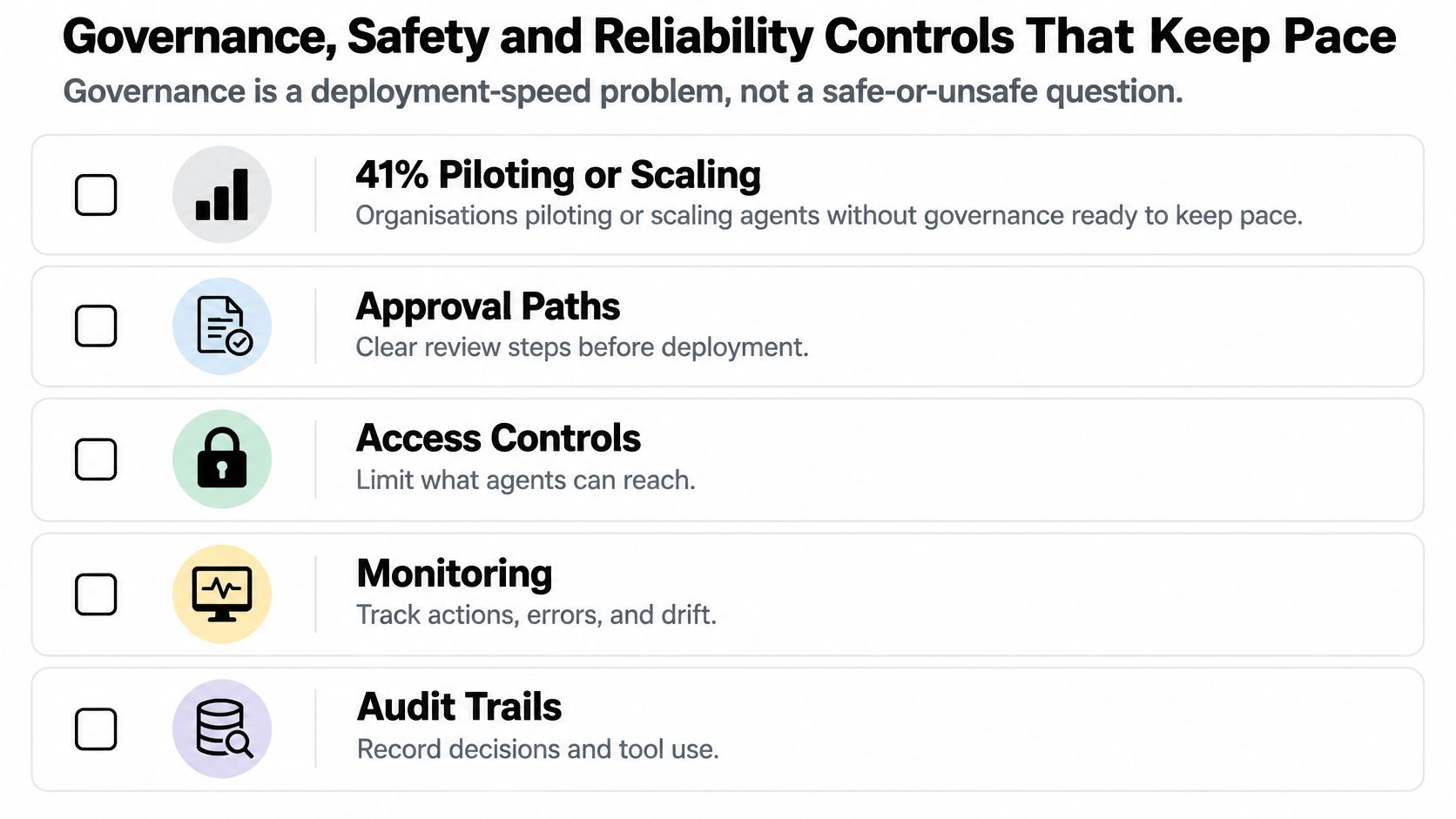
Governance isn't a safe-or-unsafe verdict. It's the mechanism that sets how fast each workflow may move, which actions run unattended, and where a person slows the process because the cost of error justifies delay. Too little control creates rework and exposure. Too much uniform control sends trivial lookups through approval queues and destroys the business case.
Domino's fifth annual enterprise AI report found that 41% of organizations are piloting or scaling agents without governance capable of managing them, while organizations whose governance keeps pace are substantially more likely to have agents in governed production at 67.5%. Separate findings in that source say nearly 60% of AI leaders identify legacy-system integration and risk and compliance as their main adoption challenges.
Faster deployment isn't better when every exception returns to an unprepared queue. Governance maturity can be a prerequisite for repeatable scale because it reduces investigation time, defines authority in advance and lets low-risk actions move without bespoke review. The checklist image below summarizes the minimum operating controls.
Reliability evidence reinforces the need for tiering. The AgentArch benchmark tested 18 agent configurations, and its strongest configuration achieved only a 6.34% probability of completing all eight repeated trials successfully, measured as pass^k. Errors compound across multi-step plans through tool selection, parameter formatting, retrieval and policy decisions, so one polished demonstration says little about production consistency.
Set Controls by Impact and Reversibility
- Classify every action: Rate customer impact, financial exposure, data sensitivity and whether the action can be undone.
- Make high-impact controls mandatory: Customer-facing voice, payments, account changes and regulated advice require scoped permissions, approval gates, audit logs and tested escalation.
- Risk-tier internal lookups: Read-only HR or asset queries can use lighter review if identity checks, source logging and exception monitoring remain active.
- Measure repeated success: Track pass@1 and pass^k through scenario replay for each workflow architecture, not just each foundation model.
- Bound failure: Use explicit tool schemas, limited retries and idempotent actions so a repeated call can't create duplicate refunds or tickets.
- Escalate on thresholds: Route to a person when confidence, source agreement or policy compliance falls below the workflow limit.
- Track exception rates: Review failures by action and system, then tighten or loosen controls based on observed risk and handling cost.
A practical enterprise AI governance model embeds these choices in runtime permissions, testing and monitoring instead of leaving them in a policy document. Operators need to prove why an action happened, which evidence supported it, who approved exceptions and how quickly the agent stopped.
Service providers face the same tiering problem across many client environments. Vight's guide to AI for MSPs is relevant context for teams translating governance and service operations into repeatable managed offerings. The principle transfers directly. Standardize the control plane, then vary approval depth by client and workflow risk.
Every unnecessary approval has a cycle-time cost, and every missing approval has a possible recovery cost. Price both before you set the agent's authority.
In BFSI and healthcare, one journey may cross CRM, ticketing, payments, identity and knowledge systems. Classify each tool call separately because a harmless balance lookup and an irreversible payment can occur in the same conversation. That's the operating discipline that lets Agentic AI in enterprise scale without giving every workflow either a free pass or a committee.
Measuring ROI and Migrating Without Breaking Live Service
Investment is moving faster than financial evidence. Deloitte's State of Generative AI in the Enterprise survey covered more than 2,800 AI-savvy business and technology leaders, and 67% said their organizations were increasing generative-AI investment because of perceived value. Efficiency and productivity was the most commonly achieved benefit at 34%.
The accountability gap sits beside that optimism. In the same survey, 68% said their organizations had moved 30% or fewer generative-AI experiments fully into production, 41% struggled to define and measure impact precisely, and only 16% produced regular reports for the CFO on value created. Define the value metric before the pilot, or the team will select a flattering metric after launch.
Value measures to track before and after launch
| Measure | What to track | Warning sign |
|---|---|---|
| Containment rate | Share of conversations resolved without a human | Containment rises while repeat contacts rise too |
| Cost per resolved outcome | Total model, platform and handling cost divided by successful completions | Cost falls only because failures are not counted |
| Time to value | Weeks from pilot start to the first measured saving | The pilot never reaches a budget owner |
| Escalation quality | Share of handoffs that arrive with full context | Humans receive cases with no summary |
Use a disciplined automation ROI calculation that includes model usage, platform charges, integration support, human exception handling and evaluation work. Compare it with the fully loaded baseline for the same completed outcome. Handle time saved on failed cases isn't a saving if customers return through a more expensive channel.
Migrate in Five Controlled Phases
- Choose one workflow: Record baseline volume, completion rate, repeat contacts, handle time and cost per resolved outcome.
- Run in shadow mode: Let the agent plan and call read-only tools beside staff, then compare its intended actions with human decisions.
- Release a small traffic share: Enable bounded actions with escalation, rollback and daily exception review.
- Expand by function: Increase scope only after repeated-trial reliability, exception rates and handoff quality hold under live variation.
- Retire the old flow: Remove the scripted path after the agent owns the outcome and support staff no longer maintain duplicate logic.
Migration usually breaks at unglamorous boundaries. Legacy systems may lack idempotent endpoints, customer records may be duplicated, and knowledge articles may contradict policy data. Test timeouts, partial writes and duplicate submissions before launch, because users will encounter them during retries and channel switches.
Don't let the legacy script and the agent write to the same record without an ownership rule. One component should create the case, one should update status, and every action should carry a correlation identifier. That prevents duplicate tickets, competing notifications and reports that credit both systems for one resolution.
Report to finance monthly with cost per resolved outcome, successful completions, repeat-contact rate, escalation quality and exception cost. Include workflow volume and any control changes that altered speed or authority. This cadence turns Agentic AI in enterprise from an innovation narrative into an operating asset with an owner, a unit cost and a clear decision on whether to expand, revise or stop.
Confirm One Workflow and Pilot It This Quarter
Pick one high-volume workflow with reversible actions and a success state your systems can verify. Leave irreversible payments and account closures for a later phase, after approvals, replay tests and exception handling have proved themselves on lower-risk work.
Before building, write down the final business outcome, baseline cost per resolved outcome, escalation rule and named owner who signs off the result. Then choose the knowledge sources, model tier for each step and channels required. Sort every action by impact and reversibility, and place approval gates before anything the team can't undo cleanly.
Run a 30 to 60 day shadow pilot beside staff. Score intended actions against human decisions weekly, report repeated-trial reliability and exception rates, and promote the workflow only when completed outcomes improve without pushing cost into repeat contacts. A short pilot with a hard baseline tells you more than a broad demo across ten loosely defined use cases.
When comparing platforms, verify four things. Our Enterprise-Grade Agentic AI Platform uses 15+ LLMs, so routing can change without rebuilding every agent. We offer 150+ pre-built enterprise integrations, including Salesforce, Zendesk, Genesys and Nice. You should also confirm built-in audit logs and permission scopes, plus reporting that finance can reconcile to resolved outcomes.
"In just six weeks, we launched a fully functioning AI-powered chat that now automates more than 70% of customer interactions." Treat that customer result as a prompt for your own test, not a substitute for one. Ask each vendor to replay the same scenarios on your workflow data, then book a scoped review with the baseline, success state and escalation rule in hand.
Yellow.ai gives enterprise teams a governed platform for building, testing and running autonomous agents across customer and employee journeys, with multi-model routing, enterprise integrations and controls suited to production service. Bring one workflow, its baseline cost per resolved outcome and its escalation rule, and we'll help you scope a pilot that can prove value without disrupting live operations. Start that conversation at Yellow.ai.