













A compliance review can fail even when the security team has a polished penetration-test report. The usual cause isn't a lack of technical activity. It's a weak boundary around the test: an application was assessed, but its APIs weren't; external infrastructure was tested, but privileged integrations weren't; findings were listed, but no evidence showed that fixes worked.
That gap matters more in enterprise CX and EX environments. A conversational platform can connect voice, chat, email, identity, CRM, HR, ticketing, payment, and analytics systems. An assessment that treats it as a conventional web application may miss the paths that create the greatest business impact.

Table of Contents
- Introduction to Penetration Testing Requirements
- Legal and Contractual Obligations
- Scoping and Rules of Engagement
- Technical Prerequisites and Test Types
- Compliance Standards and Mapping
- The Agentic AI Gap
- Reporting and Remediation Workflows
- Practical Implementation Checklist
Introduction to Penetration Testing Requirements
A defensible program treats penetration testing requirements as governance controls, not as a yearly appointment with a security vendor. NIST Special Publication 800-115 describes penetration testing as a validation technique. Scanning can identify potential weaknesses, while penetration testing attempts to determine whether an adversary can exploit them. The guide also requires an organization to define who owns assessments, which methods apply, how often assessments occur, and what evidence must be retained. NIST SP 800-115 therefore supports a repeatable, authorized, risk-based process rather than one universal schedule.
An auditor reviewing a failed program will usually ask practical questions. What was approved for testing? Which production interfaces were included? Did the tester validate tenant isolation, authorization, and integration privileges? Were the findings remediated and independently retested? A report that answers only “which vulnerabilities did the scanner identify?” leaves the organization exposed to uncomfortable follow-up.
Practical rule: A test is valuable when it produces evidence that a realistic attack path was attempted, controlled, documented, and either blocked or remediated.
The distinction between scanning and exploitation is central. Automated tools are efficient at identifying exposed services, outdated components, and common configuration weaknesses. They don't reliably establish whether a business-logic flaw permits cross-tenant access, whether a workflow can be abused through a trusted integration, or whether a token remains valid across channels.
For enterprise AI platforms, the assessment boundary must include exposed applications, APIs, identity paths, integrations, cloud services, containers, administrative functions, and the data flows connecting them. The strongest programs define the boundary before testing begins, obtain written authorization, preserve evidence, and use retesting to confirm that controls work after remediation. That approach withstands audit scrutiny because it connects business approval to technical validation.
Legal and Contractual Obligations
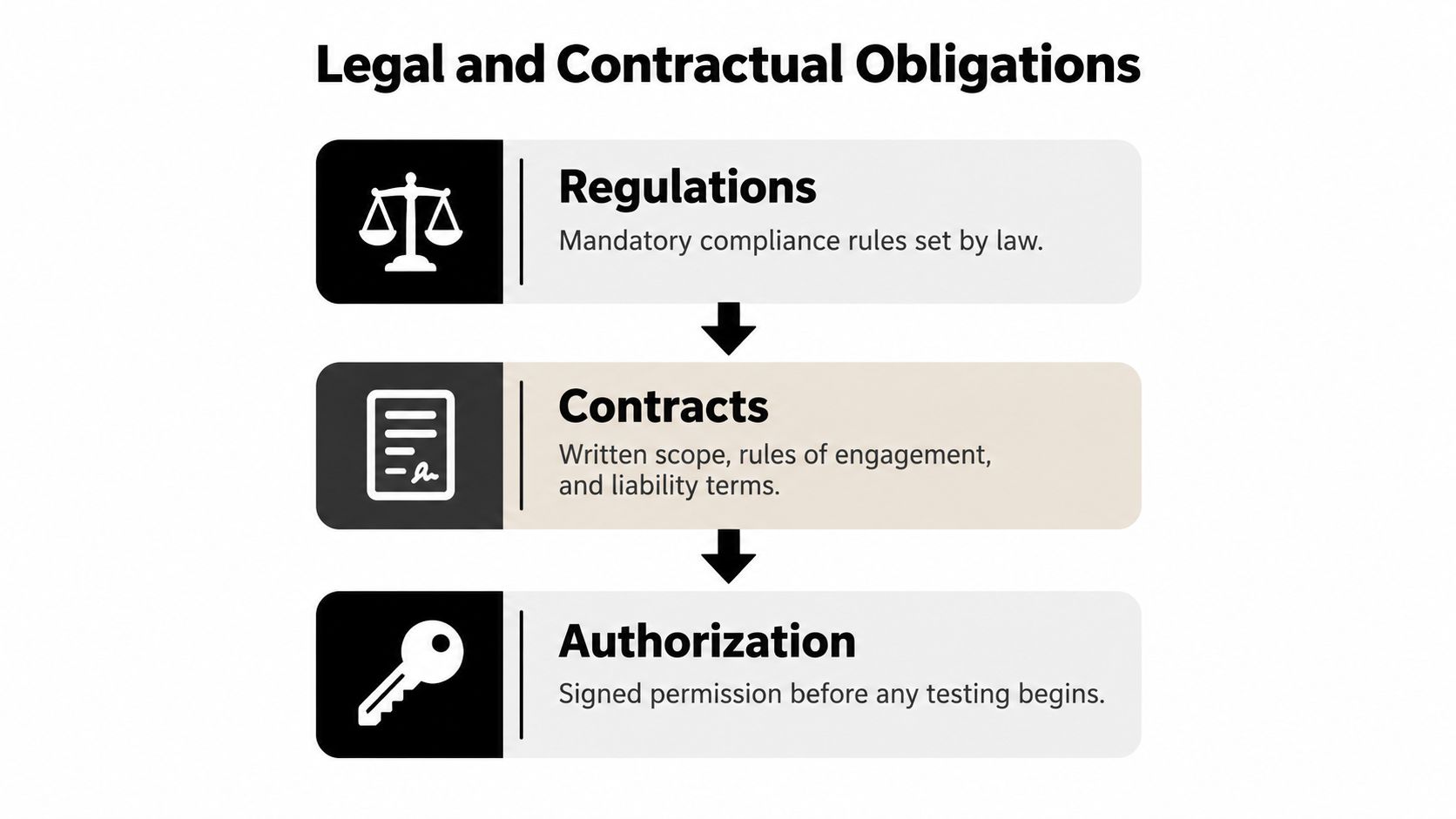
Penetration testing can create operational, privacy, and legal exposure if the tester lacks clear permission. A signed authorization should exist before any active activity begins, especially when the scope includes production systems, third-party infrastructure, customer data, employee records, or connected services.
Establish authority before access
Start by identifying the obligation that requires the test. It may come from a regulation, a customer contract, an insurance condition, an internal policy, or a board-approved risk decision. Each source can impose different expectations for independence, frequency, evidence, notification, and remediation.
Next, define the parties. The agreement should identify the organization commissioning the work, the testing provider, system owners, cloud or software suppliers, and any other party whose assets could receive test traffic. If a provider's terms prohibit certain testing activity, obtain explicit written permission rather than assuming that your contract with the provider covers it.
The contract should also address confidentiality, liability, data handling, evidence retention, subcontractors, incident escalation, and ownership of deliverables. Organizations evaluating broader cyber-risk responsibilities may find ABS Insurance Brokers advice useful when aligning testing evidence with insurance discussions. For distributed CX deployments, document data-location expectations alongside security scope. Teams assessing those questions can also consult Yellow.ai's data residency requirements as a practical reference point.
Make the authorization operational
A useful authorization names the targets, excludes prohibited systems, identifies the testing window, and provides emergency contacts. It should state whether testers may create accounts, submit test data, execute controlled exploit chains, or access sensitive records. If a test could trigger an outbound call, modify a workflow, lock an account, or expose a transcript, the rules must define how that risk is controlled.
The evidence package should include the signed authorization, final scope, rules of engagement, tester qualifications, methodology, test dates, findings, remediation records, and retest results. A verbal approval may help a team move quickly, but it won't provide the same audit trail as an approved document with named responsibilities.
Scoping and Rules of Engagement
A scope document should make it possible for a tester, system owner, incident responder, and auditor to understand exactly what the engagement permits. Broad language such as “test the platform” is not a scope. It creates uncertainty for the tester and makes the final report difficult to defend.
Build the boundary from business flows
Start with the services that matter, not only the hosts that are easiest to list. For a customer or employee-service platform, enumerate voice, chat, email, APIs, identity providers, administrative consoles, webhooks, cloud resources, containers, knowledge stores, CRM connections, ticketing systems, payment paths, and analytics exports. Identify the data each surface can read, write, or transmit.
Then map trust relationships. A low-privilege user may reach an API that invokes a privileged connector. A support agent may access a transcript containing sensitive information. An automated workflow may update a record without a human approval step. These relationships should become explicit test objectives.
Write rules that control impact
A strong Rules of Engagement document answers operational questions before the first request is sent:
- Approved targets: List domains, applications, APIs, environments, accounts, integrations, and excluded assets.
- Testing windows: Specify permitted periods, change freezes, maintenance coordination, and monitoring coverage.
- Tester identity: Record source locations, provider contacts, and the process for distinguishing authorized activity from an incident.
- Prohibited actions: Ban destructive payloads, uncontrolled denial-of-service activity, irreversible workflow changes, and unnecessary access to live sensitive data.
- Emergency response: Name technical and executive contacts, escalation channels, stop conditions, and the authority to suspend testing.
- Evidence controls: Define how screenshots, tokens, transcripts, payloads, and extracted records will be minimized, encrypted, retained, and destroyed.
NIST's assessment approach emphasizes planning, target identification, vulnerability validation, execution, and post-testing activities. That sequence is more than administrative formality. It creates traceability from authorization to exploit evidence and remediation verification.
The scope should also state the success criteria. “No critical findings” is too narrow. Better criteria include demonstrated tenant isolation, enforced role boundaries, protected administrative actions, validated rate limits, safe integration behavior, and documented handling of sensitive test data. The most useful scope connects each technical test to a business consequence.
Technical Prerequisites and Test Types
Test design should match the access an attacker could realistically obtain. A black-box assessment can reveal what an unauthenticated external party sees, but it may not expose weaknesses that require a valid customer, employee, administrator, or service identity. White-box testing gives the tester deeper visibility into code and architecture. Gray-box testing often provides a practical middle ground by supplying selected credentials and system knowledge.
Prepare realistic access
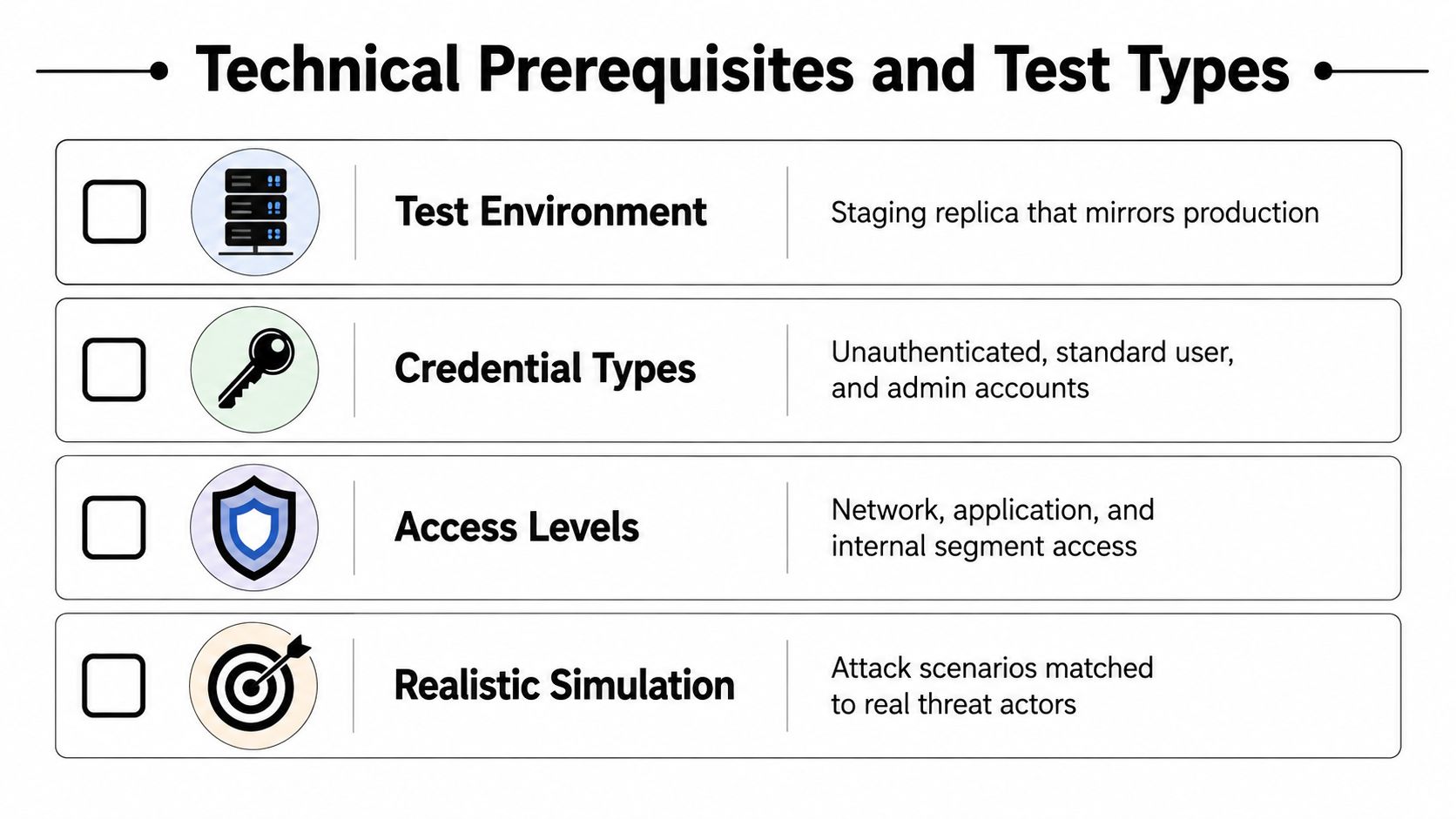
Provide separate accounts for unauthenticated, standard-user, support, supervisor, administrator, and service roles where those roles exist. Testers need enough access to evaluate privilege boundaries without receiving unnecessary production privileges. Use synthetic records where possible, and mark any approved test data so monitoring teams can recognize it.
The environment must support safe validation. A staging replica can reduce operational risk, but it may not reproduce production identity, integration, rate-limit, logging, or tenant behavior. If production testing is required, define safeguards and use controlled records. A test environment that omits the actual authorization model can create false confidence.
Combine tools with manual validation
Automated vulnerability scanners, SAST, DAST, and software-composition analysis each find different classes of weakness. They help establish coverage and identify repeatable technical issues, but they don't replace manual testing of business logic, race conditions, cryptographic misuse, authorization, or chained attacks. OWASP's Web Security Testing Guide organizes coverage across configuration, identity, authentication, authorization, sessions, input validation, error handling, cryptography, business logic, client-side behavior, and APIs.
For an AI-enabled environment, add tenant-isolation tests, prompt and tool-abuse paths, webhook authorization, replay and rate-limit tests, sensitive-data exposure in transcripts and logs, and denial-of-service resilience. Include malformed media and API payloads, normal and adversarial conversations, and tests from both unauthenticated and authenticated roles.
The useful question isn't whether the vendor used a particular tool. It's whether the methodology can reproduce an attack path, show prerequisites and impact, and support a retest after remediation.
A short visual summary of the execution model is available below.
Compliance Standards and Mapping
Compliance frameworks overlap, but they don't create one universal penetration-testing schedule. The organization must map each obligation to the systems, methods, evidence, and change events that apply.
| Framework or obligation | What to map | Evidence that usually matters |
|---|---|---|
| PCI DSS Requirement 11.4 | Internal and external testing of relevant network and application layers, plus segmentation where applicable | Methodology, scope, findings, remediation, formal retest, and change-triggered assessments |
| HIPAA | Risk analysis, safeguards, exposed applications, access paths, and systems handling protected health information | Risk-based rationale, authorization, test report, corrective actions, and retained evidence |
| ISO 27001 | The organization's information-security assessment policy, risk treatment, applicable controls, and review cycle | Approved policy, risk assessment, test scope, results, corrective actions, and management review |
| SOC 2 Type II | Security control operation across the review period, including change management, access, monitoring, and remediation | Test report, tickets, retest evidence, control owners, and operating records |
PCI DSS supplies the clearest recurring numerical requirement in the available standards. Requirement 11.4 calls for internal and external penetration testing at least once every 12 months and after any significant change to infrastructure or applications. Where segmentation is used to reduce the cardholder-data environment, segmentation controls must be tested at least every six months for service providers, and after changes. Findings must be remediated and formally retested. PCI DSS penetration-testing requirements provides a practical explanation of those obligations.
That schedule should not become an excuse to ignore material changes. A new identity provider, connector, model, agent tool, payment workflow, or tenant architecture may alter the attack surface before the annual date arrives. Record the change, evaluate its risk, and determine whether a focused assessment is required.
For SOC 2 programs, the important distinction is between having a report and demonstrating that controls operated through the review period. Teams working through that evidence model can reference SOC 2 Type II certification while mapping control ownership and retained records.
ISO 27001 and HIPAA generally require risk-based security management rather than a single universal penetration-test interval. The defensible approach is to document why the scope, method, and cadence fit the organization's risks, then preserve evidence that the policy was followed.
The Agentic AI Gap
Traditional penetration tests assume relatively stable applications, endpoints, and user roles. Autonomous agents disrupt that assumption. They can interpret untrusted instructions, call APIs, access enterprise data, retain memory, and influence downstream workflows. Testing only the model endpoint can miss the more consequential weaknesses in the surrounding system.
Test the complete agent system
OWASP's agentic-AI threat taxonomy identifies attack classes such as goal hijacking, tool misuse, identity and privilege abuse, agentic supply-chain vulnerabilities, memory poisoning, insecure inter-agent communication, cascading failures, and rogue-agent behavior. These categories are not captured by a basic annual web-application test. The taxonomy is available through OWASP's agentic applications security resource.
A better assessment layers established application testing with AI-specific scenarios:
- Instruction attacks: Test direct and indirect prompt injection through documents, messages, webpages, transcripts, and retrieved knowledge.
- Tool boundaries: Verify that an agent cannot invoke privileged actions outside its role or bypass approval requirements.
- Memory integrity: Attempt to poison stored context, retrieval sources, summaries, and inter-agent messages.
- Identity behavior: Check whether delegated tokens, sessions, and service identities retain least privilege across channels.
- Irreversible workflows: Test whether an agent can issue a payment, alter an employee record, close a case, or change access without the required control.
The right requirement isn't “test the model.” It is “test the agent, tools, identities, data, memory, and downstream actions as one system.” Enterprise CX and EX deployments need scenario-based testing that reflects real permissions and failure conditions, including what happens when an integration is unavailable or returns malicious content.
OWASP's release of a GenAI Red Teaming Guide in January 2025, as described in the cited resource, indicates that AI-focused testing is becoming a distinct discipline. Security leaders should treat prompt, connector, model, policy, and retrieval changes as potential assessment triggers rather than waiting for a calendar date.
Reporting and Remediation Workflows
A report should help three audiences act: executives deciding on risk, engineers reproducing the issue, and auditors verifying that the control operated. A severity label without evidence or ownership doesn't close a finding.
Make every finding reproducible
Record the affected asset, entry point, prerequisites, role used, reproducible steps, evidence, business impact, severity rationale, recommended fix, owner, status, and retest result. For a cross-tenant authorization issue, the report should show the boundary that failed and the minimum permissions needed to cross it. For an agent issue, preserve the relevant prompt or retrieved content without retaining unnecessary sensitive data.
Use a workflow that keeps technical detail connected to accountability:
- Log the finding: Create a unique record with evidence and affected assets.
- Rate the risk: Consider exploitability, privilege required, data exposure, workflow impact, and detection difficulty.
- Assign remediation: Name a responsible owner and record the change or control intended to address the cause.
- Verify the fix: Repeat the exploit path, test adjacent paths, and confirm that the remediation didn't create a new weakness.
- Close with evidence: Preserve the original result, corrective action, retest outcome, and approval for residual risk where applicable.
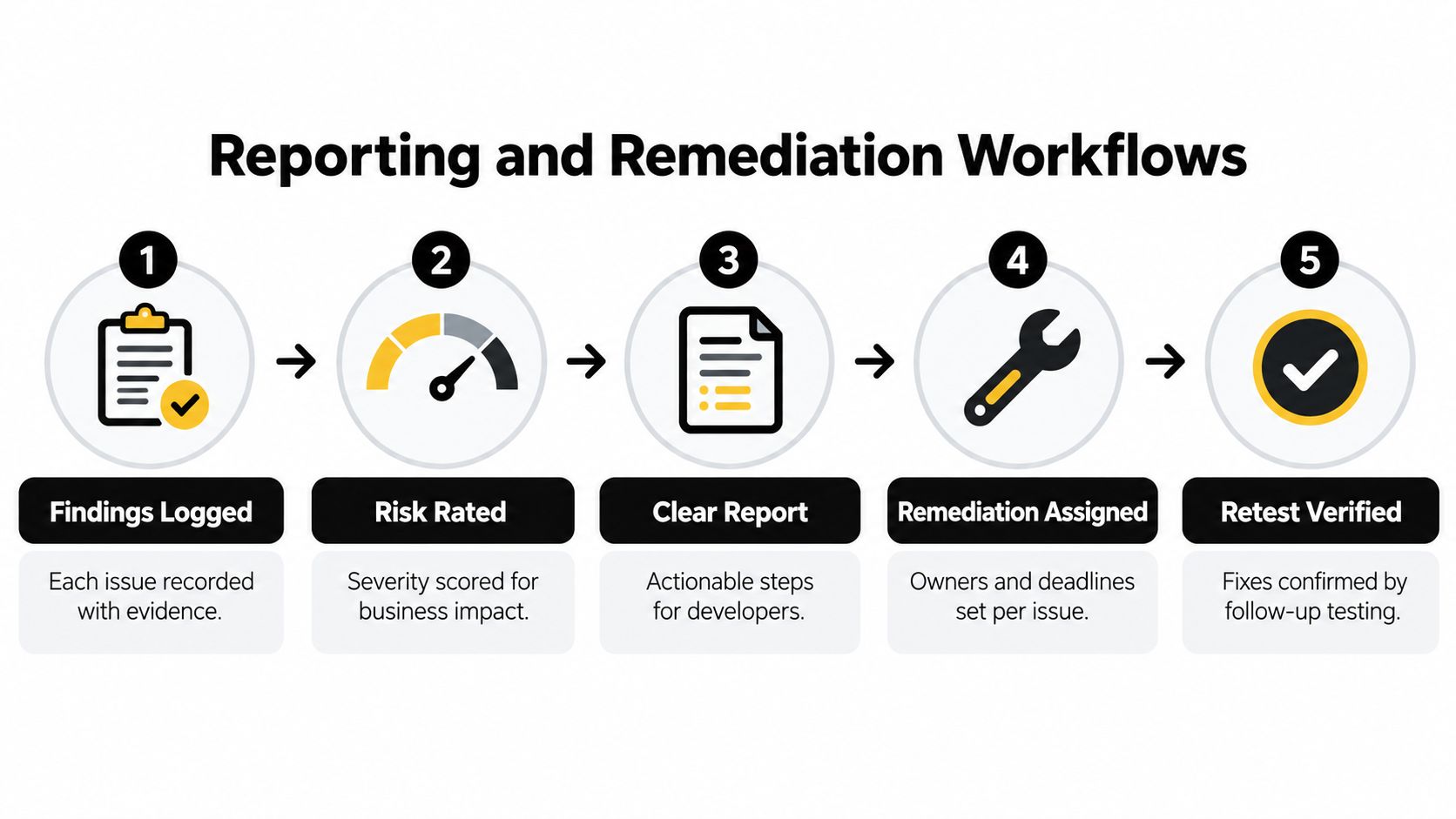
Retesting should be more than a screenshot of a patched error message. The tester should confirm that the original exploit no longer works, check related endpoints and roles, and record any residual behavior. High-risk controls should become regression tests in the release pipeline where practical.
Organizations that want a public intake path can use a documented vulnerability disclosure program alongside formal penetration testing. Disclosure handling doesn't replace an authorized assessment, but it can provide another route for receiving and triaging reports from external researchers.
Practical Implementation Checklist
Use this checklist before approving the next engagement:
- Identify obligations: Map regulatory, contractual, insurance, policy, and customer requirements.
- Authorize testing: Obtain signed permission, named owners, provider approvals, and escalation contacts.
- Define assets: Include applications, APIs, identity, cloud, containers, integrations, administrative surfaces, and data flows.
- Set boundaries: Record windows, source identities, prohibited actions, stop conditions, and sensitive-data rules.
- Prepare access: Provide representative roles, safe test records, monitored accounts, and the access needed for realistic validation.
- Select methods: Combine automated testing with manual authorization, business-logic, API, integration, and AI-agent scenarios.
- Map compliance: Connect each test objective to the applicable framework and retain the methodology and scope.
- Track change triggers: Reassess after material infrastructure, application, connector, model, prompt, policy, or segmentation changes.
- Manage findings: Assign owners, document impact, preserve evidence, and set risk-based remediation decisions.
- Retest: Confirm fixes through reproducible follow-up testing and record residual risk approvals.
- Review the program: Evaluate coverage, recurring weaknesses, evidence quality, and whether the cadence still matches the threat.
Security leaders who need structured professional development can compare options through this guide to SEC course options. Training helps, but it shouldn't substitute for a documented operating model with accountable owners and retained evidence.
Yellow.ai offers an enterprise agentic AI platform for CX and EX workflows across voice, chat, email, and other channels, with integrations that can become part of the assessment boundary. Review how those agents, tools, identities, and data flows fit your penetration-testing requirements, then visit Yellow.ai to evaluate the platform and its security approach.



