













The most common advice about SOC 2 Type II certification is also the least useful: write the policies, organize the evidence, and prepare for the auditor. That approach treats compliance as a documentation project. In enterprise SaaS and AI environments, the true test is whether people, systems, and vendors followed those policies consistently across the audit window.
A polished binder can't repair skipped access reviews, undocumented production changes, or an incident response plan that was never tested. Evidence continuity is the currency of a Type II engagement. Your team must connect each control to a real system, an accountable owner, and dated operational evidence that spans the period under review.
For AI platforms, that challenge is sharper. Model versions change, data pipelines evolve, engineers rotate, and third-party providers become part of the service boundary. The teams that pass cleanly do not describe what they intend to do. They build workflows that make the right evidence appear as work happens.
Table of Contents
- Why Policies Alone Fail SOC 2 Type II Audits
- Type I vs Type II and What the Difference Means
- Trust Services Criteria and Common Controls for AI Platforms
- The Audit Lifecycle and Realistic Timeline
- Readiness Checklist and Remediation Playbook
- Selecting an Auditor and Managing Cost and Scope
- Continuous Compliance and Monitoring Beyond the Report
Why Policies Alone Fail SOC 2 Type II Audits
A policy can say that quarterly access reviews are required. It can't prove that the reviews happened, that the reviewer had the right authority, or that excessive permissions were removed afterward. Auditors test operating effectiveness through evidence, not confidence in the policy language.
Type II engagements evaluate whether controls operated over a sustained period, commonly six to twelve months, rather than at one point in time, as explained in this SOC 2 criteria overview. That changes the question from “Does the company have an access review procedure?” to “Can the company demonstrate that the procedure ran, was approved, and produced an appropriate result throughout the observation window?”
The gap between design and execution
Several failure patterns appear repeatedly:
- Access reviews run late: The control owner signs a quarterly review once a year, then tries to reconstruct the missing cycles.
- Offboarding lacks a complete trail: Human resources records the departure, but identity-provider logs don't show when accounts, tokens, and privileged roles were disabled.
- Incident plans stay theoretical: The response document exists, yet the team can't produce drill records, decision logs, or evidence that lessons were tracked.
- Vendor oversight stops after approval: A supplier is assessed during onboarding, but there's no continuing review of service changes, incidents, or subservice providers.
- Change approvals become informal: Engineers discuss a deployment in chat, while the change-management system contains no linked approval or test result.
The problem isn't always weak intent. Operational teams are busy, tools change, and control ownership becomes unclear during reorganizations or infrastructure migrations. A control that works in January can drift by the middle of the review period.
Practical rule: Treat every recurring control as a production process with an owner, a schedule, an evidence source, and an escalation path.
The strongest programs design evidence collection into normal workflows. Identity systems retain access-review results, ticketing tools preserve approvals, CI/CD pipelines link deployments to reviewed changes, and incident platforms retain response records. This is more durable than asking employees to assemble screenshots shortly before fieldwork.
A Type II report therefore measures operational discipline as much as policy quality. If your team can't prove continuity, a policy binder becomes an explanation of what should have happened, not evidence of what did happen.
Type I vs Type II and What the Difference Means
Type I and Type II answer different questions. A Type I report examines whether controls are suitably designed at a specified point in time. A Type II report goes further by testing whether those controls operated effectively throughout a defined observation period, commonly six to twelve months, according to this AICPA-focused explanation of SOC 2 Type II.
For an AI platform, Type I might establish that the company has a documented code-review policy, defined production roles, and an approval workflow. Type II requires evidence that deployments during the audit period followed those controls. The distinction is operational, not cosmetic.
Comparison at a glance
| Dimension | Type I | Type II |
|---|---|---|
| Primary question | Are controls suitably designed? | Did controls operate effectively? |
| Evidence perspective | Point-in-time snapshot | Evidence sampled across a defined period |
| Typical use | Early assurance or initial buyer review | Ongoing enterprise assurance |
| Engineering impact | Document workflows and control design | Run workflows consistently and preserve records |
| Main risk | Poorly designed controls | Control drift, missed cycles, and exceptions |
A Type I report can be appropriate when a service is establishing its control environment or when a buyer needs an initial view of control design. It shouldn't be presented as proof that the organization maintained those controls over time.
What Type II adds to the workload
Type II requires recurring operational evidence. An auditor may examine access approvals, vulnerability-management records, incident tickets, change approvals, backup results, or monitoring outputs from across the observation window. The exact procedures depend on scope and the selected Trust Services Criteria, but the underlying expectation remains consistent: the organization must show that control execution was repeatable.
That creates a coordination burden across security, engineering, human resources, procurement, and platform operations. A single missed handoff can affect several controls. For example, an employee offboarding process may involve an HR trigger, an identity-provider action, privileged-cloud access removal, API-key revocation, and an evidence record that connects the steps.
Enterprise buyers often prefer Type II because it provides more evidence about sustained performance. It also gives procurement and security reviewers a more useful basis for vendor assessment than a single-date design review. The report still isn't a guarantee that no incident will occur. It is independent assurance about the design and operation of in-scope controls during the stated period.
Type I tells a buyer what your control environment looked like. Type II shows how reliably your organization ran it.
Trust Services Criteria and Common Controls for AI Platforms
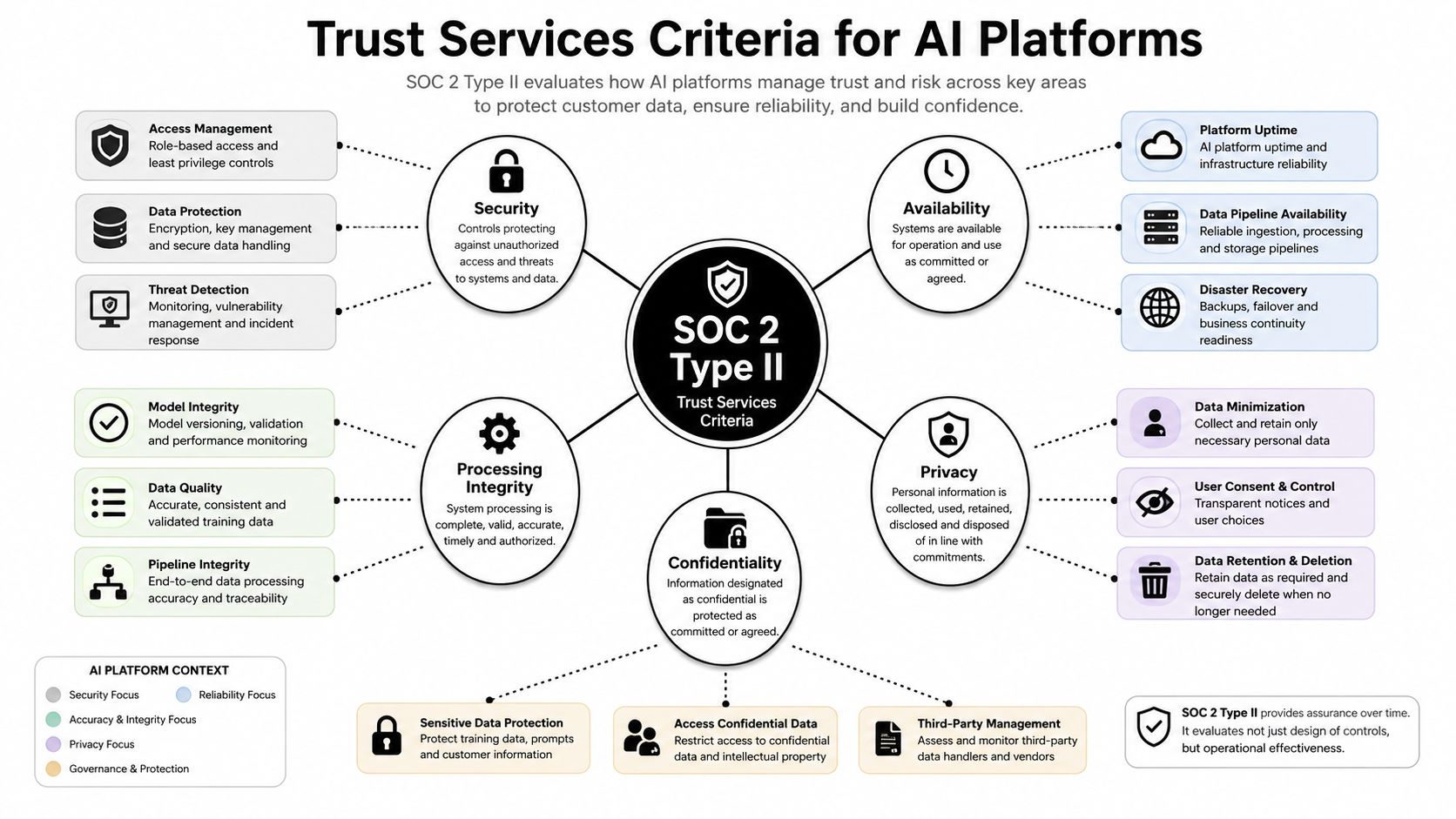
SOC 2 Type II is built around the AICPA's five Trust Services Criteria: Security, Availability, Processing Integrity, Confidentiality, and Privacy. Security is mandatory in every SOC 2 report. The other criteria are selected according to the service being evaluated, while the AICPA's governing framework is the 2017 Trust Services Criteria, with revised points of focus published in 2022, as described in this SOC 2 controls reference.
The right scope depends on what the platform does, what data it processes, and what enterprise buyers expect to review. Selecting every criterion can expand the evidence surface without improving assurance for the actual service.
Security
Security covers controls that protect systems and information against unauthorized access and inappropriate changes. Common evidence includes identity-provider configuration, MFA enforcement, privileged-access approvals, vulnerability scans, encryption settings, secure development records, and incident handling.
For AI platforms, security also extends to model repositories, training environments, inference endpoints, API keys, and tenant boundaries. Model versioning can support change control, while access logs help show who accessed sensitive datasets or production model artifacts.
Availability
Availability matters when customers depend on an inference API, orchestration layer, or employee-service platform being accessible according to a defined commitment. Relevant controls can include monitoring, incident escalation, capacity planning, backup procedures, recovery testing, and service-status communications.
A real-time CX platform may need stronger availability evidence than an internal experimentation environment. Scope should follow customer dependency, not the fact that an availability control appears in a standard checklist.
Processing Integrity
Processing Integrity addresses whether processing is complete, valid, accurate, timely, and authorized for its intended purpose. For AI workflows, teams may need to connect model versions to release approvals, test results, input validation, output monitoring, and rollback decisions.
This criterion becomes more significant when automated decisions affect customer outcomes or employee workflows. A useful evidence chain connects the deployed model, the approved change, the test execution, and the monitoring record.
Confidentiality
Confidentiality focuses on protecting information designated as confidential. Enterprise AI teams often apply it to proprietary prompts, training data, customer knowledge bases, internal documents, and model evaluation sets.
Controls may include data classification, tenant isolation, encryption, restricted administrative access, retention rules, and secure deletion. Vendor contracts and subservice-provider reviews also matter when external infrastructure or model providers process confidential information.
Privacy
Privacy applies when the service collects, uses, retains, discloses, or disposes of personal information. CX and EX platforms may process transcripts, employee records, contact details, or other end-user data, so privacy controls should connect to actual data flows and product behavior.
A practical scope decision asks which criteria reflect the platform's customer commitments and risk profile. Teams can review the enterprise-grade security controls described by Yellow.ai as an example of how an enterprise AI platform presents its security and compliance posture, then map their own controls to the services they operate.
The Audit Lifecycle and Realistic Timeline
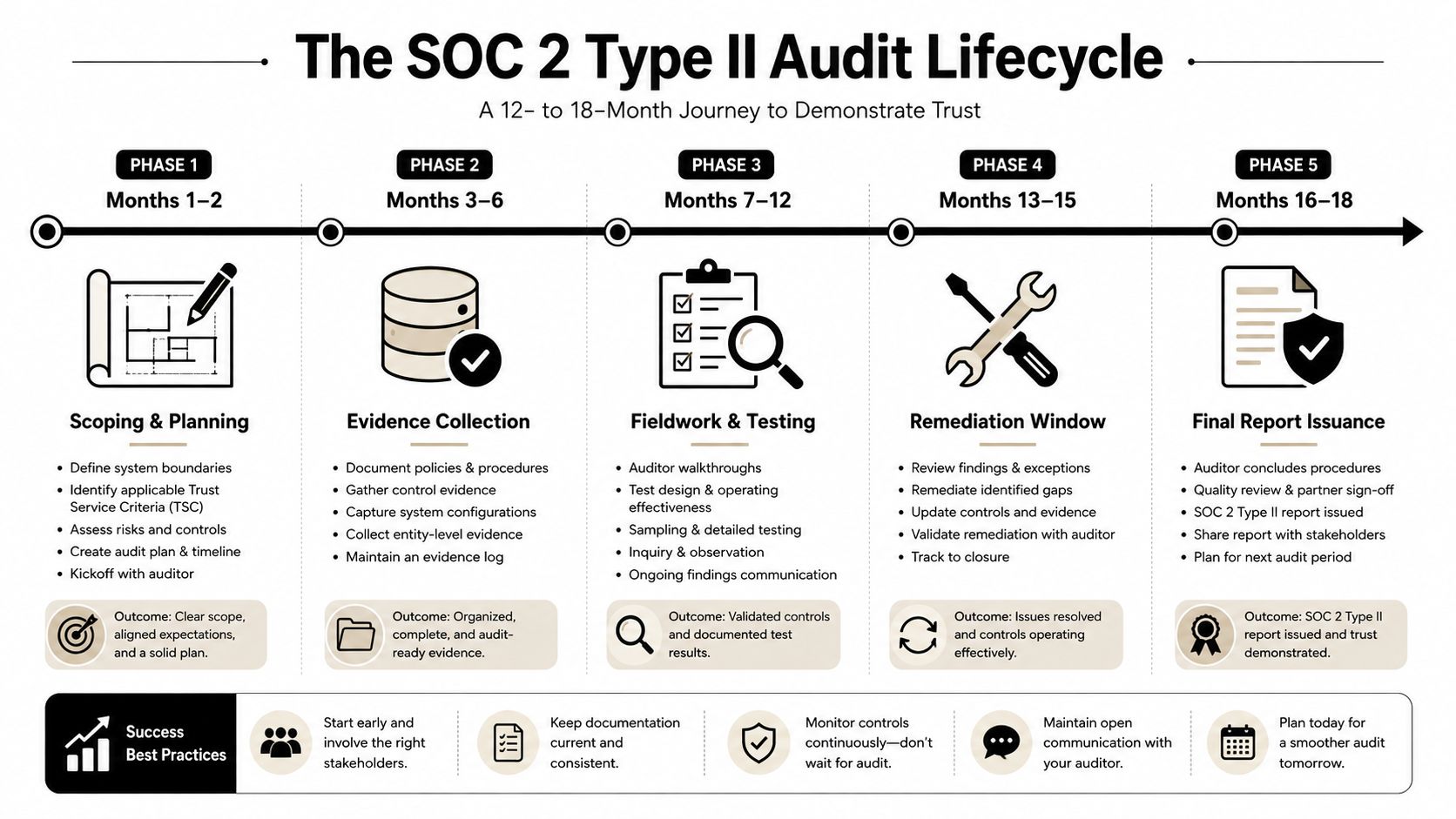
A Type II engagement is a long operational cycle, not an event that begins when the auditor sends a request list. Industry guidance describes total elapsed time from kickoff to report as roughly nine to eighteen months, depending on readiness and fieldwork, while the observation period commonly covers three to twelve months, as outlined by the Cloud Security Alliance's explanation of the Trust Services Criteria.
The practical sequence
- Scope and plan: Define the service, systems, locations, teams, vendors, criteria, and control owners. A vague boundary creates later disputes about which infrastructure and evidence belong in the report.
- Assess readiness: Test the controls before the observation period begins. Identify missing owners, weak integrations, incomplete policies, and evidence sources that can't produce reliable records.
- Implement and stabilize: Fix gaps, configure collection tools, train control owners, and run the workflows. Starting the window before the process is stable creates avoidable exceptions.
- Operate through the window: Preserve recurring evidence as events occur. Access reviews, vulnerability scans, incidents, deployments, and vendor reviews need dates and approvals that cover the required period.
- Support fieldwork and report issuance: Auditors select samples, request supporting artifacts, discuss exceptions, and assess whether remediation affects the report. The final report reflects the defined scope and period, not improvements made after the evidence window closes.
Auditors test samples from across the period. They aren't just checking the most recent successful review. Missing tickets, incomplete access logs, or changes that lack approvals can make a control difficult to defend even when later records look strong.
Fieldwork warning: Infrastructure migrations and tool replacements are evidence risks. Before changing systems, define how historical logs, approvals, and ownership records will remain accessible.
AI teams face additional friction because model deployments and data-pipeline changes can happen frequently. Engineering should link each release to a ticket, approval, test result, and deployment record. Security should verify that monitoring and access controls still apply after the change. Operations should retain incident and service records in systems the audit team can sample without manual reconstruction.
The report date is the end of the engagement, not the end of the control obligation. Buyers usually want current assurance, so the next observation period should begin with mature workflows already operating.
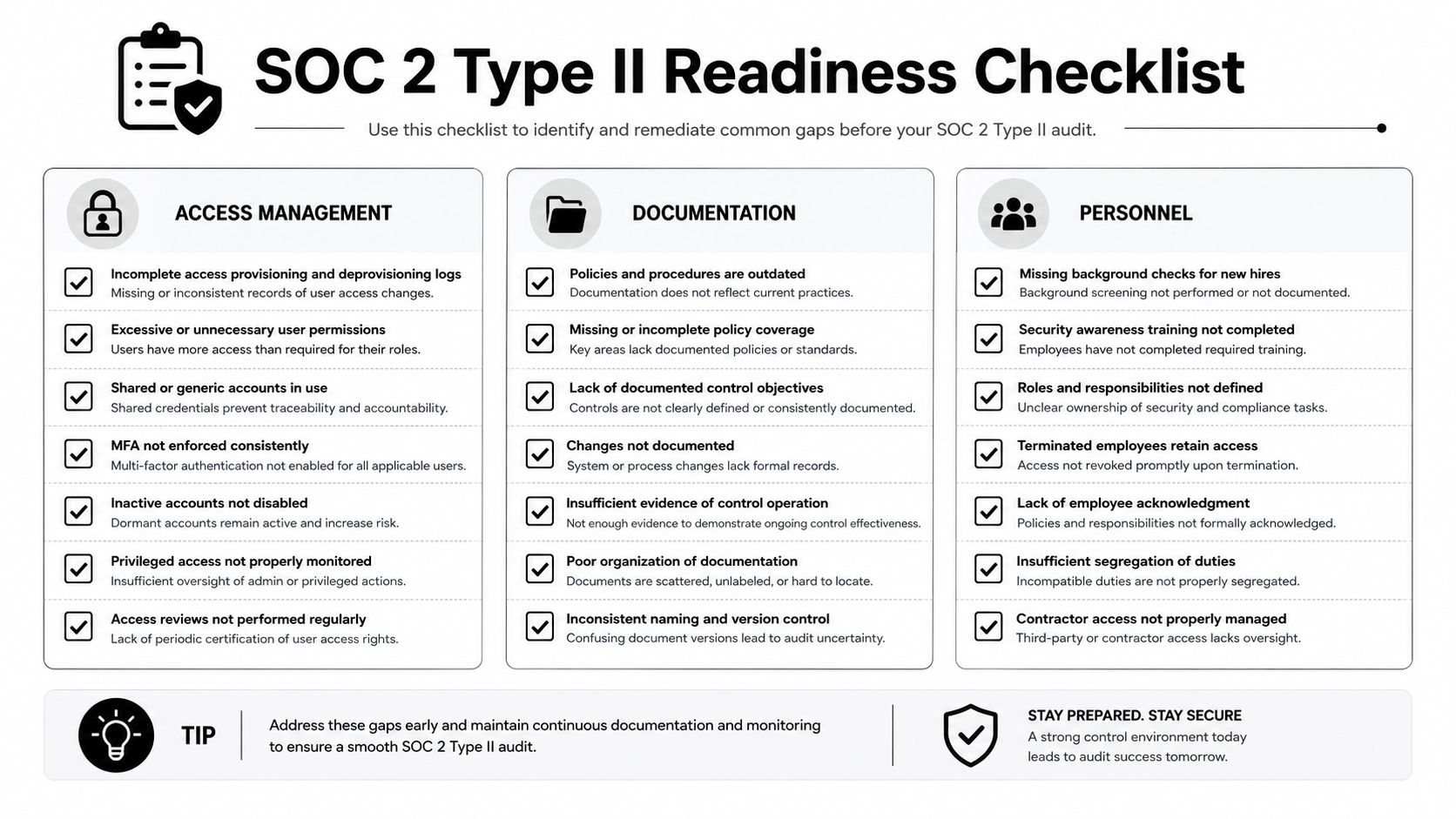
Readiness Checklist and Remediation Playbook
Readiness work should identify whether controls produce durable evidence, not merely whether a policy exists. Run a mock audit before the observation window opens, with control owners supplying artifacts exactly as they would during fieldwork. Score each control by risk to customer trust, frequency of execution, evidence availability, and remediation effort.
Access and infrastructure
- Provisioning and deprovisioning: Reconcile HR events with identity-provider actions, privileged roles, cloud accounts, service accounts, and API keys. Retain timestamps and approvals.
- MFA enforcement: Apply MFA through the identity provider and monitor exceptions. Shared credentials should be eliminated or formally controlled.
- Permission review: Automate recurring reviews, require accountable approvals, and record remediation for unnecessary access.
- Encryption enforcement: Validate encryption for databases, object stores, backups, and transmission paths. A configuration screenshot isn't enough if the setting can drift later.
- Model and data access: Restrict training data, model artifacts, evaluation sets, and inference administration by role and environment.
- Key rotation: Assign owners and recurring evidence for API-key issuance, rotation, revocation, and emergency replacement.
Operational controls
Incident response plans need exercise records, assigned participants, decisions, follow-up actions, and closure evidence. A tabletop or drill is useful only when the organization retains what happened and demonstrates that corrective actions reached completion.
Change management should connect a request to review, testing, approval, deployment, and rollback or post-release monitoring. Infrastructure-as-code gates can prevent unreviewed changes, but teams must preserve pipeline records and handle emergency changes through a documented process.
Vendor management needs more than an onboarding questionnaire. Track critical suppliers, contract commitments, security reviews, incidents, and changes in the services they provide. For AI platforms, include external model, cloud, data, and observability providers in the review logic.
A focused mock audit
Conduct the exercise 90 days before the observation window opens, using real systems rather than manually prepared folders. Ask reviewers to sample recurring controls, trace an employee lifecycle event, follow a production model change, and reconstruct an incident from the record.
A practical scoring model uses three levels:
- Ready: The control operates on schedule and produces complete, timestamped evidence.
- At risk: The control exists but has inconsistent ownership, late execution, or incomplete supporting records.
- Not ready: The process is manual, untested, missing, or unable to produce evidence from the relevant source system.
Fix high-impact “not ready” controls first, then address at-risk controls that recur frequently. Teams can also compare their evidence discipline with requirements discussed in this PCI DSS compliance guide, while remembering that each framework has its own scope and testing expectations.
Selecting an Auditor and Managing Cost and Scope
Auditor selection affects more than the report deadline. The firm needs to understand your service architecture, sampling approach, control owners, and the evidence generated by cloud and AI operations. A large firm may offer strong recognition with enterprise procurement teams. A mid-tier or boutique CPA firm may provide more direct access to experienced engagement staff, but you should assess whether it has relevant experience with your platform type and buyer expectations.
The cost figures often quoted for these engagements range from $30,000 to $150,000 or more, depending on scope complexity, selected criteria, and observation-window requirements. Those figures should be treated as planning guidance, not a universal price list. Ask each firm to explain what drives the estimate and which activities are excluded.
Selection trade-offs
| Auditor Tier | Typical Cost Range | Report Credibility | Turnaround Time | Best For |
|---|---|---|---|---|
| Big Four | $150,000+ | Strong recognition with large enterprises | Often structured and formal | Complex environments and demanding procurement teams |
| Mid-tier | $30,000 to $150,000 | Broad commercial credibility | May offer more flexibility | Growing SaaS providers with established controls |
| Boutique CPA firm | $30,000 to $150,000 | Depends heavily on buyer familiarity | Potentially more direct and focused | Narrow scopes and teams needing hands-on engagement |
A wider scope compounds quickly. Adding Availability can bring uptime monitoring, recovery, capacity, and incident evidence into the engagement. Adding Confidentiality can expand data classification, access restrictions, retention, and supplier oversight. Each criterion may improve assurance, but it also creates more owners, evidence streams, and opportunities for drift.
Choose criteria based on customer requirements and service risk. Don't select all five just because the framework names them. Conversely, don't exclude a criterion that enterprise buyers routinely expect for a platform handling personal or proprietary data.
Multi-framework audits can reduce duplicated work when controls are mapped carefully across SOC 2, ISO 27001, HIPAA, or other obligations. They can also create scope confusion if the engagement letter doesn't define which systems, controls, and evidence satisfy each framework.
Before signing, require a written sampling methodology, named deliverables, assumptions about system boundaries, treatment of subservice providers, remediation handling, and a process for scope changes. Red flags include promises of an unusually fast Type II report, vague language about sample selection, and pricing that excludes core fieldwork activities.
Continuous Compliance and Monitoring Beyond the Report
A look-back approach is brittle for AI platforms. Model updates, data-pipeline changes, infrastructure scaling, and identity changes can occur throughout the week. Waiting until fieldwork to discover that evidence is missing forces engineers and security teams into forensic reconstruction, which is slower and less reliable than collecting records during normal operations.
Continuous compliance means validating controls and retaining evidence as work happens. Platforms such as Vanta, Drata, and Secureframe can connect with cloud environments, identity providers, ticketing systems, and CI/CD tools to surface configuration drift and collect supporting records. Automation doesn't replace control owners or auditor judgment. It reduces the chance that a recurring control depends on someone's memory.
Where automation earns its place
Prioritize controls that are frequent, high-impact, and easy to validate automatically:
- Identity lifecycle: Detect accounts that remain active after departure or retain excessive privileges.
- Encryption and configuration: Flag resources that fall outside approved security baselines.
- Model change management: Connect model releases and pipeline changes to approvals, tests, and deployment records.
- Vulnerability management: Retain scan results, remediation decisions, exceptions, and closure evidence.
- Vendor oversight: Track required reviews and changes affecting critical service providers.
Automation has trade-offs. Poorly tuned rules create false positives and alert fatigue. Teams may start ignoring notifications, which defeats the purpose of monitoring. Build an escalation model, suppress known harmless conditions with documented reasoning, and review control exceptions rather than silently closing them.
The strongest operating rhythm includes quarterly internal reviews that mirror auditor expectations. Sample a few access events, deployments, incidents, vendor reviews, and configuration changes. Confirm that evidence links to the source system and period, then resolve gaps before they become part of the formal audit sample.
Security disclosures should also have an accountable workflow. An enterprise platform can document its external reporting path through a vulnerability disclosure program, while internal teams should connect reported issues to triage, ownership, remediation, and closure evidence.
For teams evaluating an enterprise AI platform, Yellow.ai provides agentic AI capabilities for CX and EX use cases alongside an enterprise compliance posture that includes SOC 2 Type II. Review the provider's current trust materials, scope, report period, and subservice-provider disclosures rather than relying on a certification label alone.
Visit Yellow.ai to review how its enterprise agentic AI platform supports CX and EX automation with security and compliance considerations built into the service. Use the Trust Center and security materials to evaluate the current SOC 2 Type II attestation, control scope, and evidence relevant to your vendor review.



