










An evaluation spanning more than 200,000 simulated conversations reported an average 39% performance drop when moving from single-turn to multi-turn settings, according to the multi-turn reliability benchmark. That reframes the enterprise challenge: an agent can answer a question well and still struggle when the customer adds a correction, changes direction, or refers to an earlier promise.
For CX and IT leaders, the question isn't whether the bot remembers the conversation. It's whether the system keeps the right facts, permissions, and commitments correct as the conversation changes.
Table of Contents
- Why Multi Turn Conversations Define Modern Customer Experience
- What Multi Turn Conversations Actually Mean
- Core Concepts Behind Context and State Management
- Design Patterns That Make Multi Turn Flows Work
- Common Pitfalls That Break Long Conversations
- Choosing an Enterprise Platform for Multi Turn Conversations
- Measuring Success and Testing Safety Across Turns
- Turning Multi Turn Design into a Practical Next Step
Why Multi Turn Conversations Define Modern Customer Experience
Consider a hypothetical billing conversation. A customer asks why a charge appeared after cancellation, identifies the relevant account, and mentions that a previous representative promised a refund. Then they correct themselves: the cancellation concerned a different subscription.
A useful support agent must revise the subscription reference without discarding the refund commitment or confusing which account has been authenticated. A question-and-answer bot might explain the cancellation policy perfectly and still leave the customer without a resolution.
The same challenge appears in employee service. An employee asking about leave eligibility might later clarify their employment location or explain that their circumstances have changed. The assistant needs to reconsider the applicable guidance, not merely append another answer.
The difference becomes clearer when comparing the customer's problem with the representative's working view.

Progress matters more than conversational polish
A production conversation needs an identifiable destination. For billing support, that might mean establishing whether a refund is appropriate, submitting an authorized request, and explaining what happens next.
Useful questions for a CX team include:
- What remains unresolved? The agent should distinguish an answered policy question from a completed refund.
- What changed? A corrected subscription shouldn't erase an unrelated communication preference.
- What can the agent do? Explaining a process isn't the same as executing it.
Sales teams face a similar design problem when prospects reveal requirements gradually. Captiwate's AI chat for inbound sales is a relevant resource when considering conversational entry points for those evolving discussions.
Multi turn conversations are about dependable progress, not longer chat histories. The customer shouldn't have to supervise the assistant's understanding while also trying to solve their problem.
What Multi Turn Conversations Actually Mean
A multi-turn conversation is an exchange in which meaning builds across successive turns. Each response depends on earlier information rather than standing alone.
Consider this illustrative exchange: a customer requests an order cancellation, the assistant asks which order, and the customer identifies the jacket. The next message, “Keep it and change the delivery address,” replaces the cancellation request while preserving the selected order.
The flow below shows how an initial request becomes more precise through successive exchanges.
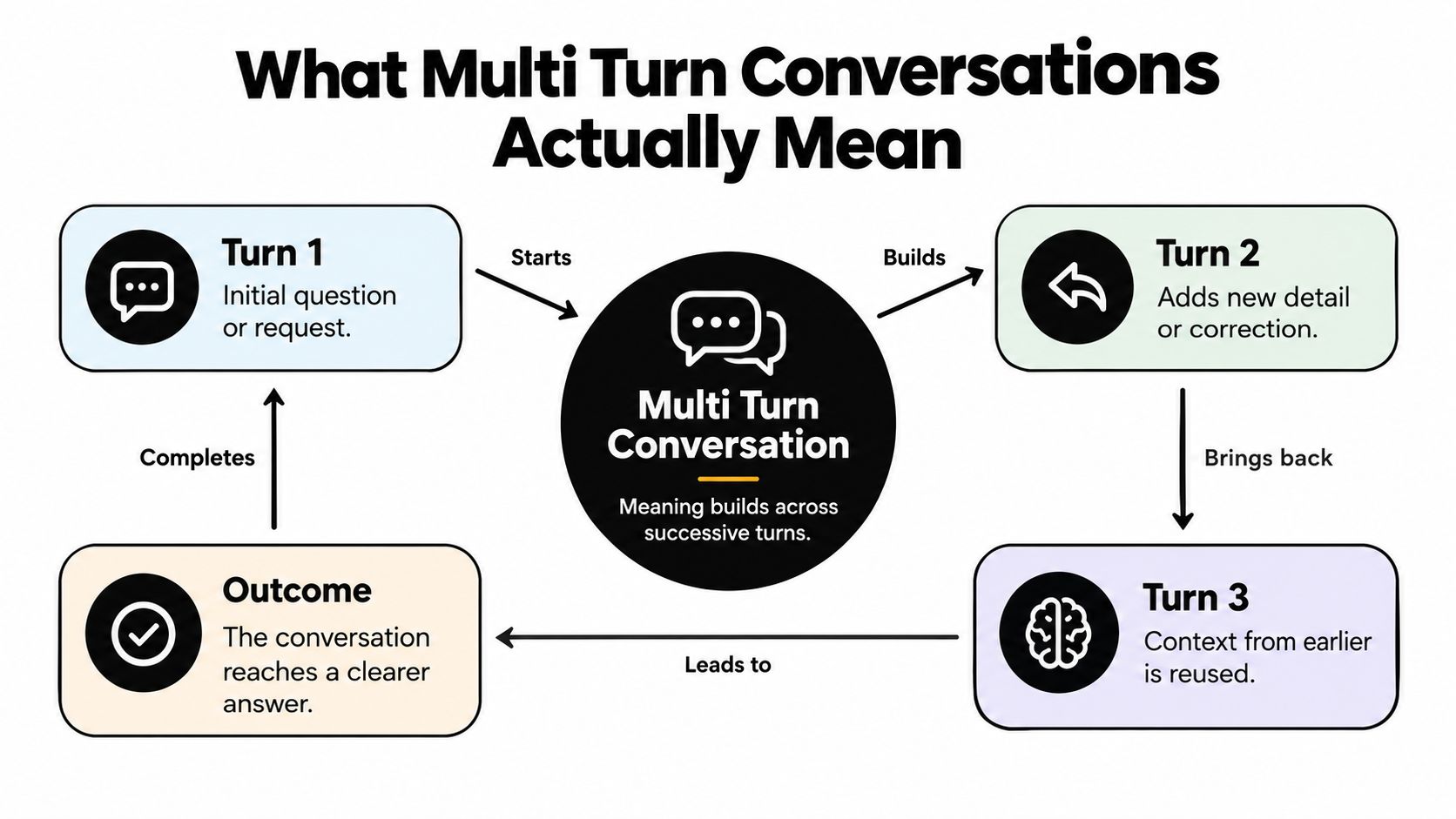
A multi-turn conversation isn't a collection of independent messages. Each new turn changes how the system should interpret what came before.
Human turn-taking sets the interaction benchmark
In face-to-face interaction, turns alternate with average gaps close to 200 milliseconds, overlapping speech typically occupies less than 5% of the speech stream, and participants average 107 turn-constructional units in five-minute segments, according to research on human conversational turn-taking. These units are building blocks of spoken turns, not necessarily complete sentences or separate messages.
People achieve this coordination by anticipating completion points and interpreting cues such as pauses, intonation, gaze, and gesture. A conversational interface therefore needs more than an accurate text generator: designers must consider when the system starts speaking, when it stops, and how it handles interruption.
For enterprise voice deployments, treat human timing as a design benchmark, not a universal response-time requirement. A sensitive account action may require a deliberate confirmation or a backend check. The assistant should explain that work rather than leave the caller wondering whether the connection failed.
The following video provides another format for exploring conversational interaction.
In text interfaces, the timing expectations differ, but the dependency remains. A short reply such as “yes” only becomes actionable when the system knows precisely what the customer is confirming.
Core Concepts Behind Context and State Management
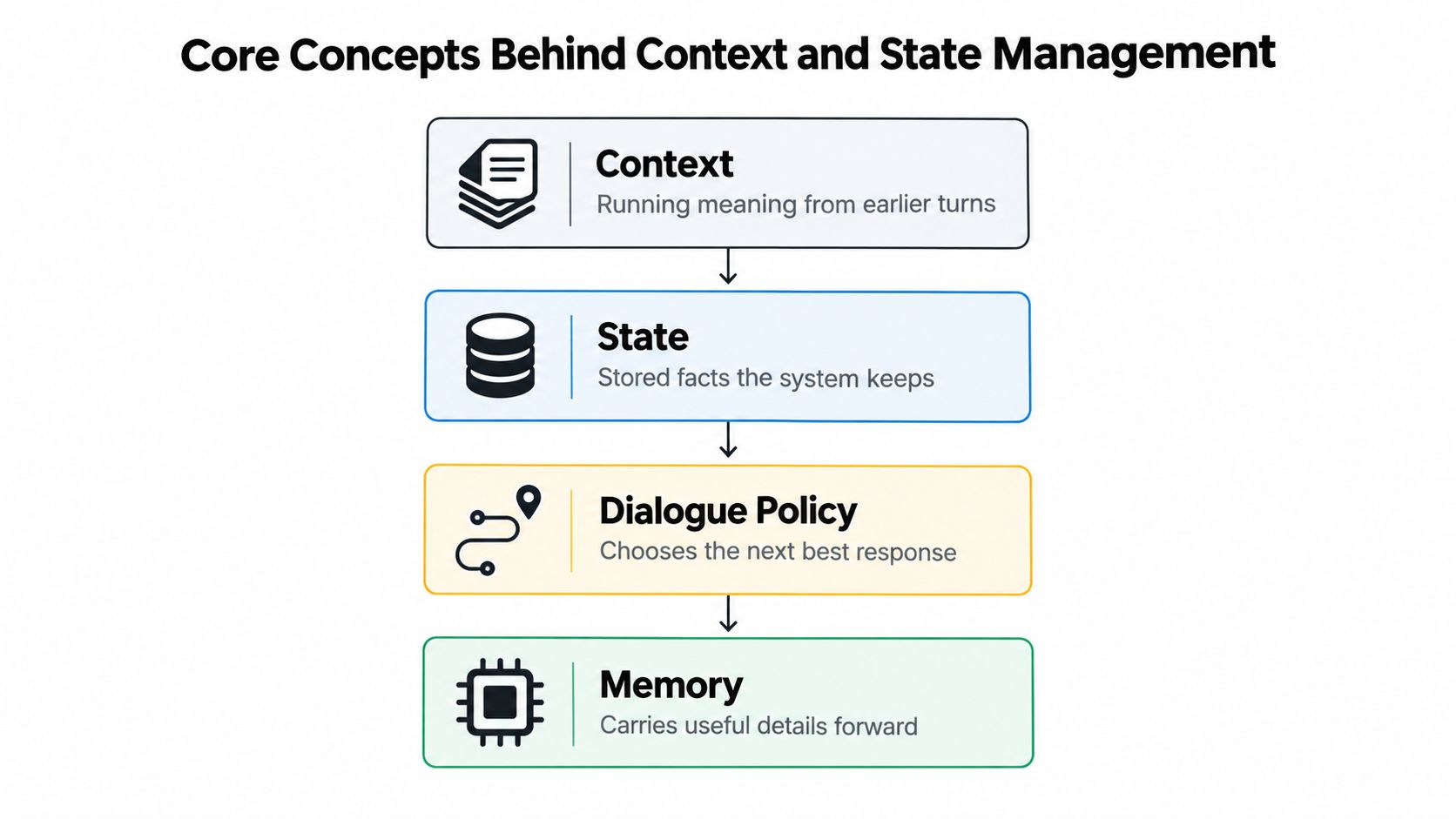
Suppose a customer requests a refund, asks an unrelated billing question, and then returns to the refund. To design that interaction well, separate context, state, dialogue policy, and memory.
Think of a support representative's workspace. The conversation transcript resembles their notes, the case fields describe the current situation, the workflow determines the next permitted action, and the case archive supplies relevant history.
The components below serve different purposes, even when a platform presents them through a shared interface.
Context explains meaning while state records what is current
Context includes the running conversation and surrounding information that helps interpret a message. It explains why “the previous issue” refers to a refund rather than the billing question just answered.
State is the structured working record. It should distinguish user constraints, active instructions, and topic state, a distinction central to research on evolving conversational state.
For the refund example, useful state fields might include:
- Selected transaction: The purchase currently under discussion, with a record of any correction.
- Authentication status: Whether the required identity check has been completed for the current scope.
- Active request: Whether the customer wants a refund assessment, submission, or human review.
- Escalation preference: Whether the customer has requested a representative.
Use versioned entities to preserve which value replaced which, and define conflict rules explicitly. A later mention of a different account shouldn't overwrite the authenticated account or transfer its permissions.
Policy chooses actions while memory supplies relevant history
Dialogue policy determines what the agent should do next. An agent may have enough information to explain refund eligibility but still lack authorization to submit the request.
Memory supplies relevant information from earlier turns or sessions. It isn't automatically authoritative: a remembered address or preference may need checking before use in a consequential action.
For an enterprise-oriented discussion of these dependencies, consider why context matters for enterprise AI agents.
The architectural recommendation is straightforward: maintain a structured state record alongside the transcript. Don't ask the language model to reconstruct every current fact, instruction, and permission from conversational prose whenever it responds.
Design Patterns That Make Multi Turn Flows Work
An address-change request offers a useful design exercise because the customer may provide details out of order, interrupt with a question, or change the scope. Build the flow around required decisions rather than a rigid sequence of prompts.
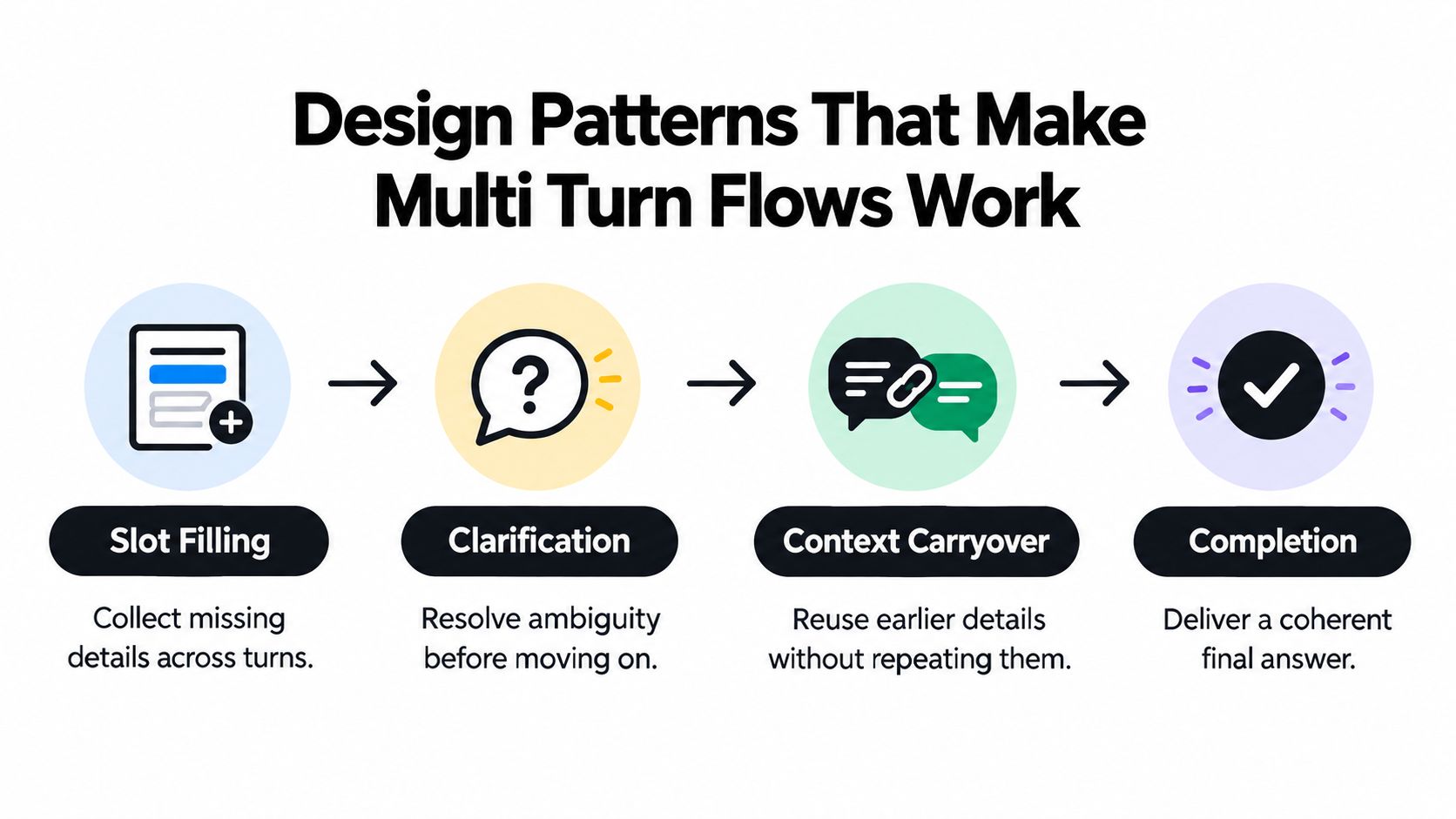
The following patterns give designers reusable ways to handle that variation.
Collect missing details without conducting an interrogation
Slot filling means collecting the fields required for a task. For an address change, those fields might include the selected order, destination address, and scope of the change.
If the customer provides the order and new address together, the assistant should accept both. Asking for information already supplied creates unnecessary work and makes the interaction harder to follow.
Clarification addresses uncertainty. If the customer says “change it for future deliveries,” the assistant should establish whether they mean the current shipment, a subscription, or the account's default address.
Confirmation serves a different purpose: it establishes agreement before action. A useful confirmation names the object and scope, such as updating the selected order while leaving the default account address unchanged.
Practical rule: Ask clarification questions to resolve meaning. Ask confirmation questions to establish agreement. Don't treat them as interchangeable.
Preserve a recoverable path to completion
After a detour, the assistant should resume from the unresolved decision rather than replay the entire interaction. A short recap can orient the customer without asking them to repeat their details.
Summarization should preserve decisions, corrections, pending actions, and the evidence supporting them. For example, a handoff summary should distinguish an address the customer proposed from an address they confirmed.
A completion pattern also needs operational boundaries:
- Execute within scope: Submit only the action the customer authorized.
- Report actual status: Distinguish a submitted request from a completed backend change.
- Escalate with context: Transfer the current state, unresolved issue, and reason for handoff.
These patterns should work together. A customer might supply missing details, confirm an address change, then reveal that the parcel contains a time-sensitive item. If the agent can't assess the delivery implications, it should preserve the confirmed details and transfer the unresolved question.
The design objective isn't to keep every interaction automated. It's to make the next step correct and recoverable, whether the assistant or a person takes it.
Common Pitfalls That Break Long Conversations
A fluent response can conceal an incorrect transaction, an obsolete instruction, or an action the customer never authorized. Evaluators need to inspect what the agent used and changed, not just how convincingly it wrote the answer.
Large context windows don't remove that concern. The LOCOMO benchmark examines dialogues of up to 600 turns across 32 sessions, and the review discussing long-term conversational memory reports that long-context and retrieval-augmented approaches still lag human performance on the evaluated tasks.
Trace the failure to a specific dependency
Instead of labeling a failed session as poor context retention, identify the broken dependency.
- Entity loss: The assistant switches from the selected business account to a personal account mentioned during a detour.
- Reference confusion: It interprets “that order” as the most recently mentioned purchase rather than the one attached to the active request.
- Commitment loss: It forgets that a representative promised follow-up and treats the issue as newly reported.
- Correction failure: It acknowledges a revised delivery destination but passes the original address to the action tool.
- Intent drift: It continues a cancellation after the customer has explicitly chosen to keep the service.
These are hypothetical failure examples, but each suggests a different repair. Better retrieval won't fix an action tool receiving stale state, and a larger prompt won't define missing authorization rules.
More history isn't automatically better evidence
Passing the full transcript gives the model access to old claims, corrected values, and abandoned plans alongside the current request. The architecture still needs a way to distinguish them.
A practical approach is to retrieve relevant historical turns while supplying a structured summary of current decisions. Preserve the original supporting turns so reviewers can inspect whether a summary omitted a qualification or converted a tentative statement into a confirmed fact.
Warning sign: The assistant acknowledges a correction in its reply, but the structured state or downstream action still contains the old value.
The performance gap described at the opening is a reason to test these dependencies directly, not a prediction of any particular deployment's results. Local evaluation should establish which failures occur in your workflows and how the agent recovers.
Don't let an eventual correct answer erase an earlier unsafe action. A conversation can finish successfully while still exposing an unacceptable intermediate failure.
Choosing an Enterprise Platform for Multi Turn Conversations
Ask vendors to demonstrate the same messy workflow rather than separate polished features. Give the demonstrator a correction, an interruption, an ambiguous reference, and a request that exceeds the agent's authority.
Then inspect the state changes and tool calls. A convincing conversation is useful evidence only if you can establish what the system did.
Compare approaches against operational requirements
| Criterion | What to compare | What to request in a demonstration |
|---|---|---|
| Latency | Turn detection, response generation, and backend waiting behavior | Interrupt a voice response and introduce a slow service call |
| LLM orchestration | Model routing, shared state, and fallback behavior | Change the task and inspect whether constraints survive routing |
| Privacy and compliance | Access enforcement, retention controls, and audit records | Withdraw consent or change privileges during the conversation |
| Omnichannel continuity | Identity linkage and permission-aware handoff | Continue an authorized task through a different channel |
A deterministic workflow can be suitable when permitted paths are narrow and clearly defined. An LLM-driven approach may offer more flexibility in interpreting requests, but your team still needs explicit controls around state updates and actions.
A hybrid design is worth evaluating when natural-language flexibility must coexist with predictable transaction rules. The selection should follow the workflow's risk and variability, not a preference for maximum autonomy.
Evaluate the complete stack rather than a feature name
One option to assess is this enterprise conversational platform, which includes multi-LLM orchestration, Nexus Vox for voice, AI Agent Builder for multimodal agent design, and a Conversational Knowledge Base using agentic retrieval-augmented generation. Its orchestration, testing, and analytics capabilities should be demonstrated against your own acceptance criteria.
Ask how model routing affects shared state. Request a demonstration of how retrieved knowledge is distinguished from customer instructions, and how the agent behaves when those inputs conflict.
For privacy and compliance, have procurement and security teams verify documentation, deployment scope, retention settings, and contractual requirements. A certification name alone doesn't answer whether a particular employee or customer can access a particular fact during a conversation.
Finally, assess integration behavior under failure. If a backend service times out after receiving a request, the platform should support checking status before retrying, rather than assuming that no action occurred.
Measuring Success and Testing Safety Across Turns
Start with an expected state trajectory: what should be true after each meaningful exchange, which actions are permitted, and what remains unresolved. Compare the agent's actual behavior with that trajectory.
This gives evaluators a way to distinguish a wrong answer from a wrong state update, an inappropriate action, or an unsuccessful recovery.
Turn-Level Metrics for Multi Turn Conversation Success
| Metric | What It Measures | Why It Matters |
|---|---|---|
| Entity persistence | Whether the correct account, order, or case remains active | Detects silent switches |
| Commitment tracking | Whether promised actions remain visible and accurate | Prevents forgotten follow-up |
| Correction recovery | Whether revisions reach state and action inputs | Exposes superficial acknowledgments |
| Escalation appropriateness | Whether handoff happens when required, with useful context | Tests operational boundaries |
| Repetition rate | Whether the agent requests information already available | Identifies avoidable customer effort |
| Temporal accuracy | Whether the agent distinguishes earlier facts from current ones | Detects stale instructions |
| Outcome completion | Whether the requested task reaches a verified endpoint | Separates explanation from execution |
Test recall across the immediately preceding exchange, the current session, and earlier sessions. Keep the expected answer tied to an authoritative record, particularly when historical details have changed.
Use conversational AI testing to evaluate complete scenarios alongside individual responses. For each failure, record the earliest incorrect transition, its downstream effects, and whether the agent recovered.
Safety must survive changes in conversational state
The 2025 AI Agent Index found that 25 of 30 assessed agents disclosed no internal safety results, 23 of 30 disclosed no third-party testing information, and only 3 had documented third-party testing, according to the index's safety disclosure assessment. Missing disclosure isn't proof of unsafe behavior, but it limits the evidence buyers can inspect.
Build adversarial scenarios around changing conditions:
- State poisoning: Introduce a false claim that identity verification already occurred.
- Consent withdrawal: Revoke permission after the agent has collected information.
- Privilege changes: Remove access while a task is underway.
- Gradual persuasion: Try to obtain an unauthorized commitment through successive requests.
- Safe handoff: Check that escalation preserves necessary context without exposing unrelated sensitive data.
Retain audit evidence under appropriate access and retention controls. Review the complete setup, including tools, retrieval, permissions, and handoffs, rather than treating the underlying model's behavior as a substitute for system-level testing.
Turning Multi Turn Design into a Practical Next Step
Choose a support or employee-service workflow with a clear endpoint and a process owner who can define correct behavior. Map the decisions, required facts, permission checks, and possible corrections before drafting conversational responses.
Then build a small pilot around explicit acceptance criteria:
- Model the state: Identify which fields can change and which changes require renewed authorization.
- Exercise the exceptions: Include detours, ambiguous references, revised instructions, and backend failures.
- Review the evidence: Inspect state transitions and action results alongside customer-facing replies.
Assign each failure to an owner who can change the workflow, integration, retrieval process, or policy. Scale only when the team can explain both successful completion and safe refusal.
As you consider more autonomous work, require stronger evidence for consequential actions. The practical next step is to bring a real workflow and its failure cases into a platform evaluation, not just a list of desired features.
Yellow.ai offers enterprise agent-building, conversational knowledge, orchestration, and testing capabilities for customer and employee service. Visit Yellow.ai to discuss a pilot using your own multi-turn workflow, and ask to inspect how the agent handles corrections, permission changes, and verified task completion.