









Enterprise chatbots have outgrown the label. In serious organizations, the platform is becoming operating infrastructure for service, support, and internal execution.
Adoption matters, but the bigger signal is architectural. Enterprises are no longer buying chat interfaces to deflect a few support tickets. They are standardizing on AI systems that can reason over knowledge, connect to business systems, and complete multi-step work across customer and employee journeys. Teams that also discover AI employee training benefits are usually seeing the same pattern on the employee side. Conversational AI is shifting from a front-end tool to a process layer.
The strategic mistake is treating an enterprise chatbot platform like a better FAQ layer. That model breaks the moment a customer needs an order changed, a claim escalated, or a billing issue resolved across multiple systems. It also breaks internally when employees need policy guidance, training support, access requests, or workflow help that spans HR, IT, and operations.
A modern enterprise chatbot platform sits at the intersection of customer experience, employee experience, orchestration, knowledge access, and workflow execution. In practice, it serves as the conversational control plane for the autonomic enterprise. It does not stop at intent recognition and answer retrieval. It routes decisions, triggers actions, maintains context across channels, and drives end-to-end outcomes.
Table of Contents
- Beyond Bots Defining the Modern Enterprise Platform
- The Architectural Blueprint of an Agentic AI Platform
- Core Capabilities Your Platform Must Have in 2026
- Enterprise Use Cases for Customer and Employee Experience
- Measuring Success with Business-Driven ROI and KPIs
- Strategic Procurement and Implementation Roadmap
- Frequently Asked Questions About Enterprise Chatbots
Beyond Bots Defining the Modern Enterprise Platform
The old chatbot model is obsolete
The old chatbot model broke because it was built to answer questions, not complete work.
Legacy bots classified a request, matched it to a scripted response, and pushed the user through a narrow flow. That model held up for store hours, password reset instructions, and simple policy lookups. It falls apart when the interaction crosses system boundaries, needs identity verification, or requires a real transaction such as changing an order, checking claim status, or restoring employee access.
An enterprise chatbot platform exists to solve a different class of problem. The enterprise issue is not conversation quality alone. It is execution. Teams need a platform that can coordinate channels, pull trusted data, trigger actions, preserve context, and route exceptions without creating another operational silo.
That shift matters because enterprises are no longer buying bots as point tools. They are standardizing on AI interaction infrastructure that sits close to CRM, ITSM, knowledge, identity, and workflow systems. In practice, the failure point was rarely the wording of the reply. The failure point was the gap between conversation and action.
Most chatbot failures were not language failures. They were operating model failures. The assistant could not access the right system, complete the task, or hand off with context intact.
What the platform is now
The modern platform is the execution layer for an autonomic enterprise.
It handles customer experience and employee experience through the same architectural model. A customer asks for a delivery update. An employee requests software access. Different journeys, same requirement. Understand intent, retrieve the right context, take governed action, and close the loop inside enterprise systems.
That is why the category has outgrown the “FAQ bot” label. A serious agentic AI platform for enterprise automation translates natural language into controlled business operations. It does not stop at answer generation.
Three shifts define the modern platform:
- It manages work, not just dialogue: The platform retrieves records, verifies identity, opens cases, updates systems, triggers downstream tasks, and escalates with context attached.
- It supports both CX and EX at scale: The same foundation can handle billing questions, HR policy guidance, IT triage, onboarding flows, and service recovery.
- It standardizes execution across the business: Resolution quality stops varying by queue, geography, or agent availability because the process logic is centralized.
This change also exposes a leadership issue that many teams miss. Once AI starts handling real service operations, the job design changes. Supervisors review exception patterns instead of only queue volumes. Service teams manage orchestration logic, knowledge quality, and escalation thresholds. L&D teams have to prepare employees for that shift, which is why it helps to discover AI employee training benefits in the context of operating model change, not just software adoption.
A real enterprise chatbot platform is no longer a thin layer on top of fragmented service operations. It becomes the control plane that coordinates requests, systems, and outcomes across the business.
The Architectural Blueprint of an Agentic AI Platform
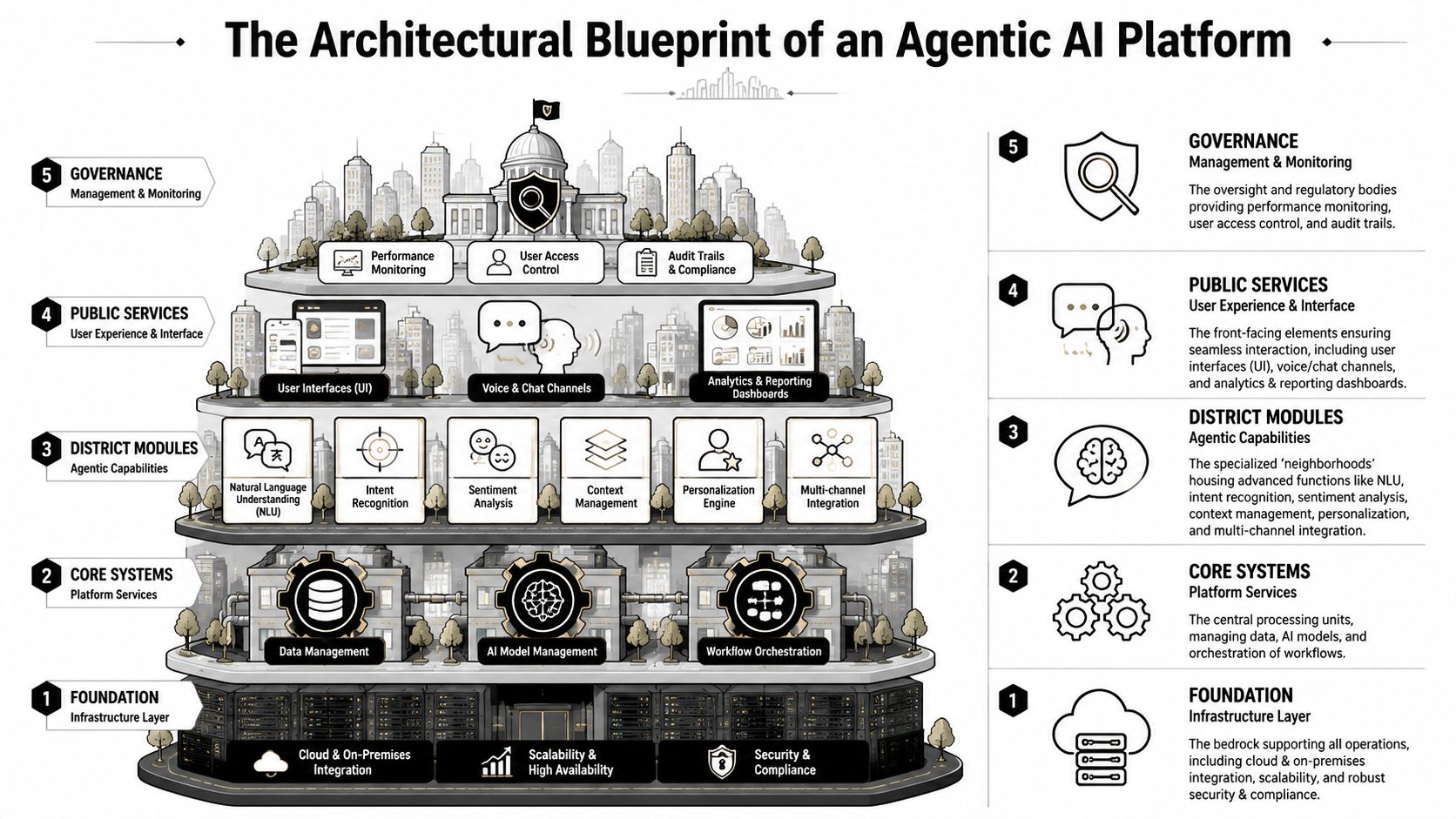
An enterprise chatbot platform becomes strategic when it is designed as an operating system for work. The old bot stack was built to classify intent and return text. That design breaks the moment the conversation has to trigger action across identity, policy, systems, and human approval.
Foundation and model layer
The foundation starts with deployment control and model choice. Large enterprises rarely operate under one security posture. Some workloads can run in public cloud. Others need hybrid deployment, regional isolation, private networking, or tighter control over data residency and retention. A platform that cannot support those patterns forces architecture workarounds before the first workflow goes live.
Model strategy matters just as much. Single-model dependence is a weak design decision. Model quality changes. Pricing changes. Provider policies change. Different tasks also benefit from different model behaviors, so the platform should route work at the task level for extraction, summarization, classification, and grounded response generation.
That separation is not academic. It is how teams keep control.
When orchestration lives inside prompts, operations become opaque. Teams cannot inspect why a decision was made, test workflow branches cleanly, or enforce policy with confidence. Strong platforms separate reasoning, retrieval, decision logic, and system actions into components that can be monitored and governed.
Orchestration and system action
The orchestration layer determines whether the platform can run end-to-end service operations or just hold a conversation. Legacy chatbot architectures often fail here; they lose state, mishandle interruptions, and break when a request spans multiple systems or approval steps.
An agentic platform has to maintain a live execution thread across the entire interaction. It needs to know what the user is trying to achieve, what has already happened, what systems have been queried, what policy checks are still pending, and when a human should step in. That is the difference between a customer hearing “I found an article for that” and a customer getting a refund processed, a card replaced, and a confirmation sent in one flow.
The orchestration layer should manage:
| Layer | What it must do |
|---|---|
| Conversation state | Track context across turns, channels, and unfinished tasks |
| Decision logic | Choose when to answer, ask, act, authenticate, or escalate |
| Workflow execution | Call APIs, trigger automation, and log outcomes |
| Handoff control | Transfer to an agent with summary, history, and next-best action |
This architecture also changes the role of the platform in the enterprise. It stops being a front-end assistant and becomes the control plane for service execution. That is the core design principle behind an agentic AI platform for enterprise automation. The platform coordinates language, policy, workflow, and system action in one governed runtime.
Governance is part of the architecture
Governance has to sit inside the stack, not outside it. If security review starts after the agent is built, the design is already wrong.
Production platforms need role-based access controls, audit logs, prompt and policy versioning, test environments, approval paths for high-risk actions, and clear boundaries on what the model can and cannot do. They also need observability at the workflow level. Teams have to see where automation succeeded, where it escalated, where it failed, and which dependencies caused the failure.
One practical rule has held up across deployments. If a vendor leads with a polished demo but cannot explain auditability, exception handling, and integration control, the product is built for pilots, not operations.
The autonomic enterprise depends on this architectural shift. Customer experience and employee experience automation both require the same core system. A governed platform that can sense, decide, act, and escalate with traceability. That is the blueprint that replaces FAQ bots with autonomous process execution.
Core Capabilities Your Platform Must Have in 2026
By 2026, an enterprise chatbot platform either runs work or it adds another layer of friction. Buyers who still evaluate platforms on intent matching, FAQ coverage, or demo fluency are solving for the wrong era.
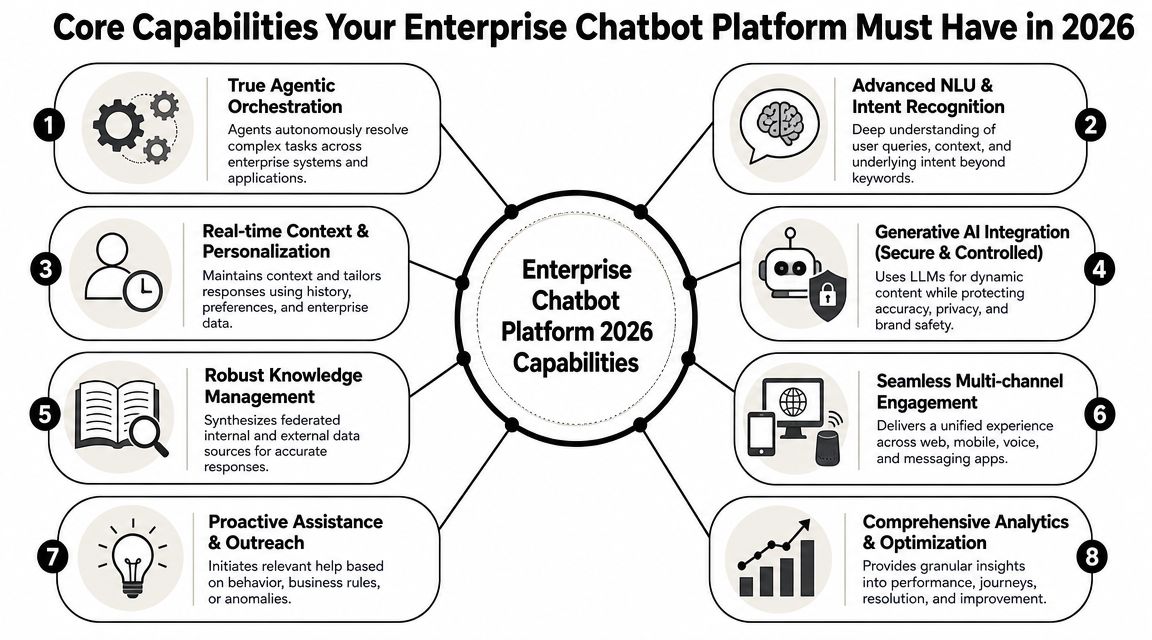
The autonomic enterprise needs a platform that can interpret requests, decide the next best action, execute across systems, and recover cleanly when automation hits a policy or process boundary. That standard applies equally to customer service and employee operations. If the stack cannot complete work from end to end, it remains a support tool, not an operating layer.
Capabilities that change outcomes
These capabilities determine whether the platform reduces operational load or shifts it to agents, IT teams, and process owners.
True agentic orchestration
Resolution depends on coordinated action. The platform has to manage multi-step tasks across CRM, ITSM, ERP, identity, payment, and case systems while keeping the user experience coherent. Single-turn routing is easy. Stateful execution with retries, exception paths, and policy checks is what matters in production.Real-time context management
Enterprise conversations rarely stay linear. Customers change channels. Employees reopen requests days later. A useful platform preserves identity, prior actions, preferences, and workflow state without exposing data the user should not see. Context quality directly affects containment, accuracy, and trust.Secure generative AI with grounding
Generative AI is only useful when the answer is anchored to approved knowledge, live enterprise data, and policy controls. Without source-aware retrieval, response constraints, and fallback logic, the model produces plausible language that creates expensive downstream work.
Before going deeper, it helps to see how these platform elements are assembled in production:
- Knowledge orchestration, not just a knowledge base
Enterprise knowledge lives in too many places to be managed as a static repository. Policies sit in SharePoint. Product rules live in documentation portals. Resolution history sits in ticketing systems. The platform has to retrieve, rank, synthesize, and cite the right source based on user role and task context.
What separates a serious platform from a polished demo is operational depth. Strong language generation helps, but enterprise value comes from execution quality, integration depth, and controlled handoffs when the agent should stop and a person should take over.
That is why buyers should inspect these capabilities closely:
- Omnichannel continuity: Web, mobile, messaging, email, and voice should share identity, memory, and workflow state. A channel switch should not reset the task.
- Low-latency voice infrastructure: Voice exposes weak architecture fast. The platform needs fast response times, interruption handling, turn management, and reliable speech components under load.
- Analytics tied to decisions: Teams need visibility into retrieval failures, workflow drop-offs, fallback causes, escalation points, and action completion rates. Transcript review alone is not enough.
- Governed human handoff: Escalation is part of the operating model. The transfer should include intent, conversation history, completed steps, retrieved knowledge, and pending actions so the human starts ahead.
- Enterprise security posture: Access controls, environment separation, test workflows, audit trails, data retention controls, and policy enforcement are baseline requirements.
- Builder productivity with control: Business teams need speed, but IT needs standards. Platforms that support design, orchestration, testing, and release management in one governed workspace shorten deployment cycles without losing control. Yellow.ai's AI bot studio for enterprise agent design and deployment reflects this shift toward a single operational workspace.
A simple maturity test helps expose the gap between pilot-ready tooling and enterprise-grade platforms:
| Capability | Weak implementation | Enterprise implementation |
|---|---|---|
| Knowledge | Static FAQ search | Federated retrieval with permissions and traceability |
| Automation | Form fills and routing | Multi-step workflow execution across systems |
| Channels | Separate bots per channel | Shared orchestration across all touchpoints |
| Escalation | Blind transfer | Context-rich handoff with action history |
| Optimization | Basic transcript review | Decision analytics and continuous tuning |
One rule holds up across enterprise evaluations. If a platform can answer correctly but cannot complete the transaction, enforce policy, or recover from failure, it has not automated service. It has automated conversation.
Enterprise Use Cases for Customer and Employee Experience
The value of an enterprise chatbot platform shows up when language becomes action. That is where the autonomic enterprise moves from concept to operating model.
Customer journeys that complete real work
A customer in banking opens chat to dispute a transaction. The platform authenticates, gathers the required details, checks transaction history, creates the dispute workflow, and explains next steps in plain language. If the case hits a policy boundary, it routes to a human reviewer with the full trail already attached.
That pattern matters in regulated industries because the platform isn't acting alone. In BFSI and healthcare, chatbot platforms increasingly sit inside broader BPO and workflow stacks that combine AI, RPA, analytics, and human oversight. The benchmark is secure integration into enterprise process layers for tasks such as claims processing and compliance reporting, as outlined in this BFSI BPO market analysis.
A healthcare provider uses the same architecture differently. A patient starts with an appointment question, shifts to benefits clarification, then needs intake instructions. The platform handles triage and information retrieval first, then triggers the right transactional steps through APIs or automation, while staff review the parts that need clinical or compliance-sensitive judgment.
A retailer sees another variant. A customer asks where an order is, changes the delivery address, requests a refund window, and later continues by voice. The enterprise chatbot platform should preserve that thread across channels and systems. The user shouldn't have to restate the problem because the stack was designed around channels instead of journeys.
In complex service operations, the highest-value automation usually starts where volume is high, policy is stable, and backend actions are clear.
Employee experience is the second front
Internal service is where many enterprises realize bigger long-term value. HR, IT, finance, procurement, and workplace operations all run on repetitive requests with predictable resolution paths.
An employee joins a new team and needs software access, policy clarification, equipment status, and training guidance. A weak internal bot returns links. A real platform sequences the request, checks entitlements, opens or updates tickets, answers policy questions from approved knowledge, and escalates exceptions only when needed.
CX and EX finally converge. The same orchestration patterns that improve customer service also reduce internal friction. Once that happens, the enterprise chatbot platform stops being a contact center tool and starts acting like an enterprise execution layer.
Measuring Success with Business-Driven ROI and KPIs
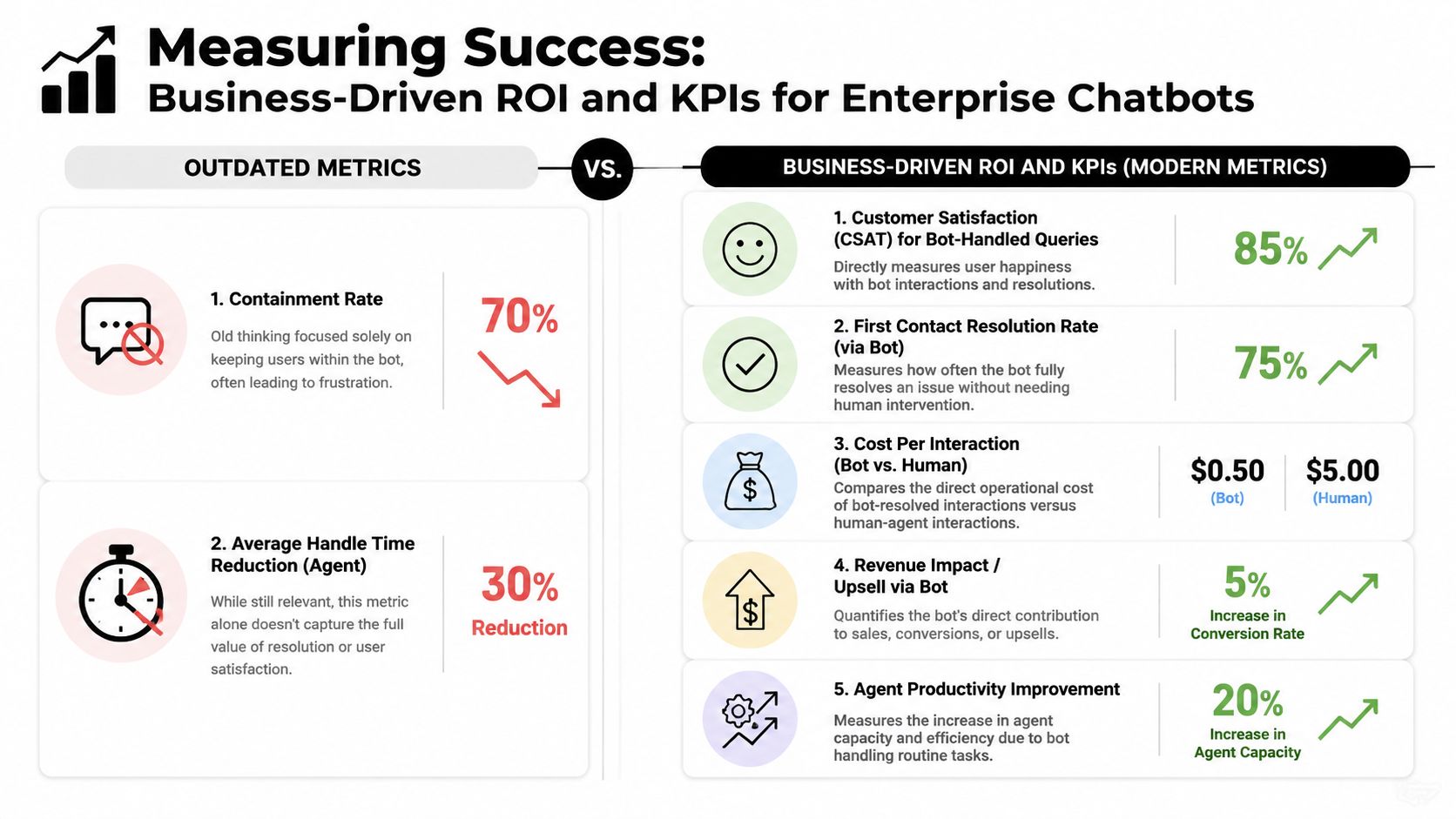
Most chatbot programs still use the wrong scorecard. They optimize for containment, then wonder why users are frustrated and agents inherit messy escalations.
Stop rewarding containment
Containment can hide failure. A user may stay in the bot because the exit is hard, not because the issue was resolved. That metric rewards trapping traffic, not finishing work.
A better lens is business completion quality. Did the platform resolve the issue, reduce manual effort, preserve experience quality, and hand off properly when it should?
The analytics layer should answer questions like these:
- Did the user get a completed outcome? Not just an answer.
- Was the handoff appropriate? Some transfers improve service quality.
- Did agent workload improve? Automation should remove repetitive effort, not create cleanup work.
- Did service consistency improve across channels? Fragmented performance is a platform problem, not a staffing problem.
Track unit economics and resolution quality
Leadership cares about operational efficiency, resolution performance, and risk reduction. The KPI set should reflect that.
A practical scorecard includes:
| KPI | Why it matters |
|---|---|
| First contact resolution | Measures whether the journey ended successfully without avoidable rework |
| Total cost of resolution | Captures bot, agent, and workflow effort together |
| Escalation quality | Shows whether transferred cases arrive with usable context |
| Time to meaningful resolution | Focuses on progress, not superficial response speed |
| Agent productivity | Reveals whether automation is removing low-value work |
| Bot CSAT for resolved journeys | Separates successful automation from frustrating deflection |
If you want a product example of where these measurement patterns are heading, platforms such as Yellow.ai's insights engine focus on surfacing journey analytics and optimization signals rather than only dashboard vanity metrics.
The right question isn't “How many conversations stayed with the bot?” It's “How many issues were resolved at lower effort without degrading trust?”
Strategic Procurement and Implementation Roadmap
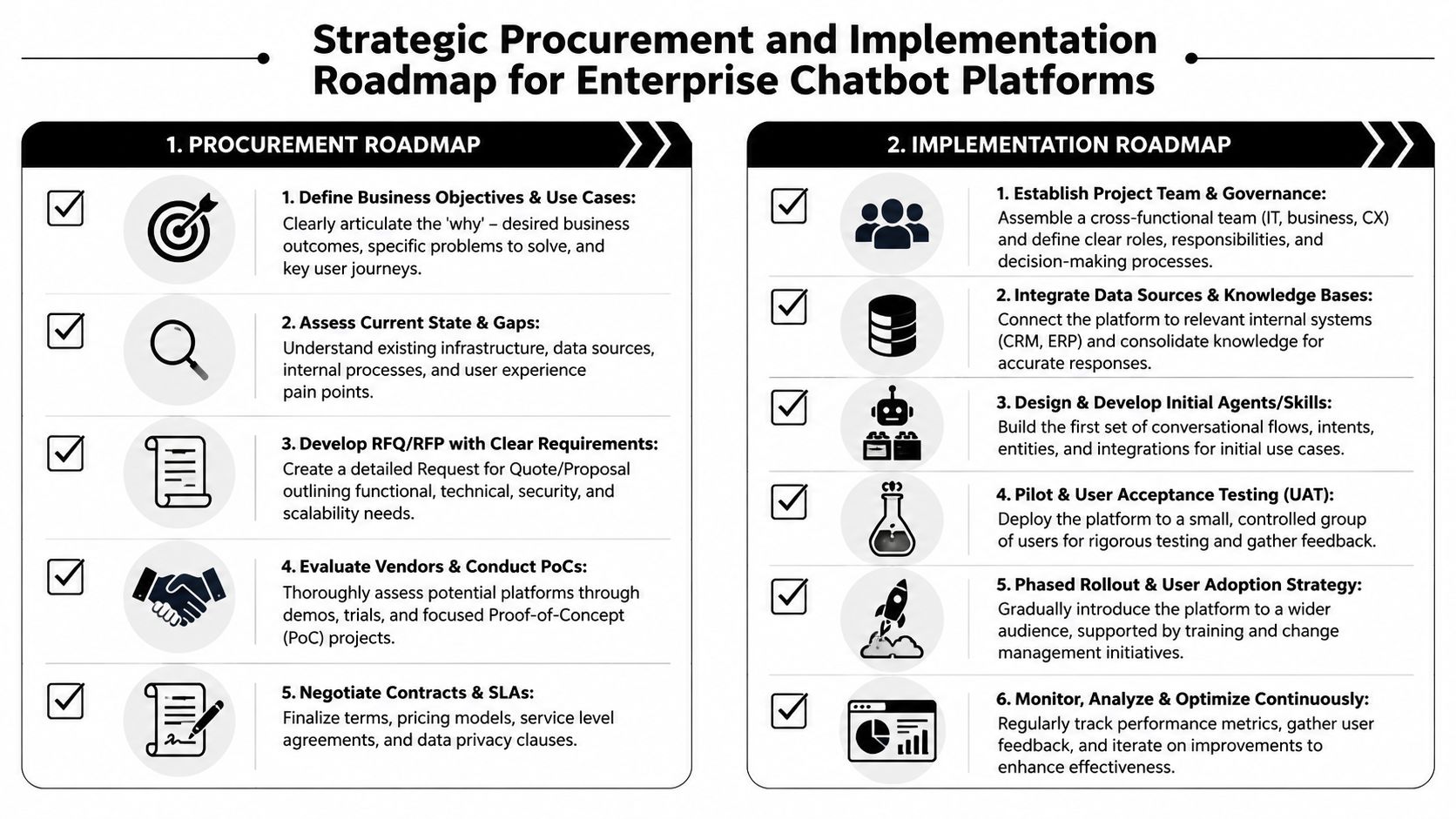
Buying the software is the easy part. Getting to enterprise-grade reliability is where most programs get exposed.
What to ask before you buy
Procurement should focus less on feature abundance and more on operating reality. Recent enterprise guidance stresses that conversation memory, guardrails, auditability, and human handoff are baseline requirements, not add-ons, when scaling reliably, as discussed in Rasa's enterprise chatbot guidance.
That immediately changes the vendor checklist.
- How does the platform maintain context? Ask what memory is stored, how it's scoped, and how it behaves across channels and sessions.
- What governs model behavior? Look for guardrails, policy controls, testing workflows, and approval patterns.
- How does handoff work? Demand specifics on transcript transfer, summary generation, queue routing, and agent desktop integration.
- What is required to integrate core systems? A prebuilt connector list is useful, but execution detail matters more.
- How is the platform audited? Teams need logs that explain what happened, not just transcripts that show what was said.
- What is the operating model after launch? Ask who tunes retrieval, reviews failed journeys, updates policies, and manages release quality.
A polished demo can hide brittle architecture. Procurement teams should insist on a proof of concept that includes one high-value workflow, one human handoff pattern, one authenticated journey, and one analytics review.
How to deploy without creating a governance mess
Implementation should follow a phased operating model, not a big-bang rollout.
Start with one workflow that is repetitive, high-volume, and operationally painful. Choose a process with stable business rules and clear backend actions. Define success in business terms before you build.
Then scale in layers:
Pilot one journey thoroughly
Don't launch ten shallow use cases. Launch one that proves orchestration, retrieval, action, and handoff.Create a cross-functional control group
CX, IT, operations, compliance, and knowledge owners should all be involved. This is not a chatbot side project.Instrument before expansion
Track failure reasons, retrieval gaps, broken flows, latency issues, and transfer quality before adding more volume.Standardize patterns
Reuse identity checks, escalation logic, policy prompts, and analytics definitions across departments.Build a governance rhythm
Review changes regularly. AI operations needs release discipline just like application operations.
The hidden cost in an enterprise chatbot platform isn't usually the first deployment. It's the absence of a system for keeping the platform trustworthy after deployment.
Frequently Asked Questions About Enterprise Chatbots
Should you build or buy
Most enterprises should buy a platform and build differentiated workflows on top of it. Building the full stack in-house sounds attractive until teams account for orchestration, channel management, testing, analytics, compliance controls, handoff logic, and lifecycle governance. Custom development still matters, but it should focus on the workflows and integrations that create competitive advantage.
If your requirements include strict sovereignty, unusual backend systems, or highly specialized policy logic, the answer may be a hybrid model. Buy the core platform. Extend where the business is unique.
What changes operationally after launch
A production chatbot program creates a new operating discipline. Someone has to own knowledge quality, conversation review, escalation tuning, workflow changes, release controls, and exception handling. If no team owns that work, the platform degrades.
The strongest enterprises treat this as a product, not a project. They assign owners, define change management, and review performance continuously.
How are enterprise platforms usually priced
Pricing models vary. Some vendors charge by usage, some by seats, some by platform tiers, and some through enterprise agreements tied to channels, environments, or service scope. The important question isn't the list price. It's the total cost of reliability once integration, governance, monitoring, and optimization are included.
How should leaders think about organizational readiness
Readiness is less about AI enthusiasm and more about process discipline. If knowledge is fragmented, workflows are undocumented, and escalation ownership is unclear, the platform will expose those weaknesses quickly.
For leadership teams still sorting out broader transformation questions, it can help to get answers on AI strategy services before locking procurement decisions. The useful part is not vendor selection advice. It's clarifying whether the organization is prepared to operationalize AI, not just purchase it.
The enterprise chatbot platform is no longer a peripheral tool. It is becoming the interaction fabric for the autonomic enterprise, where CX and EX run on the same governed, action-oriented AI layer.
Yellow.ai offers an enterprise agentic AI platform for customer and employee conversations across voice, chat, email, and other channels, with orchestration, analytics, and enterprise integrations designed for large-scale CX and EX deployments. If you're evaluating how to move from isolated bots to an operating platform, it's one of the vendors worth including in a serious shortlist.